 By
ByRathi Cow Milk Per Day, Price & Origin | Complete Rathi Breed Guide
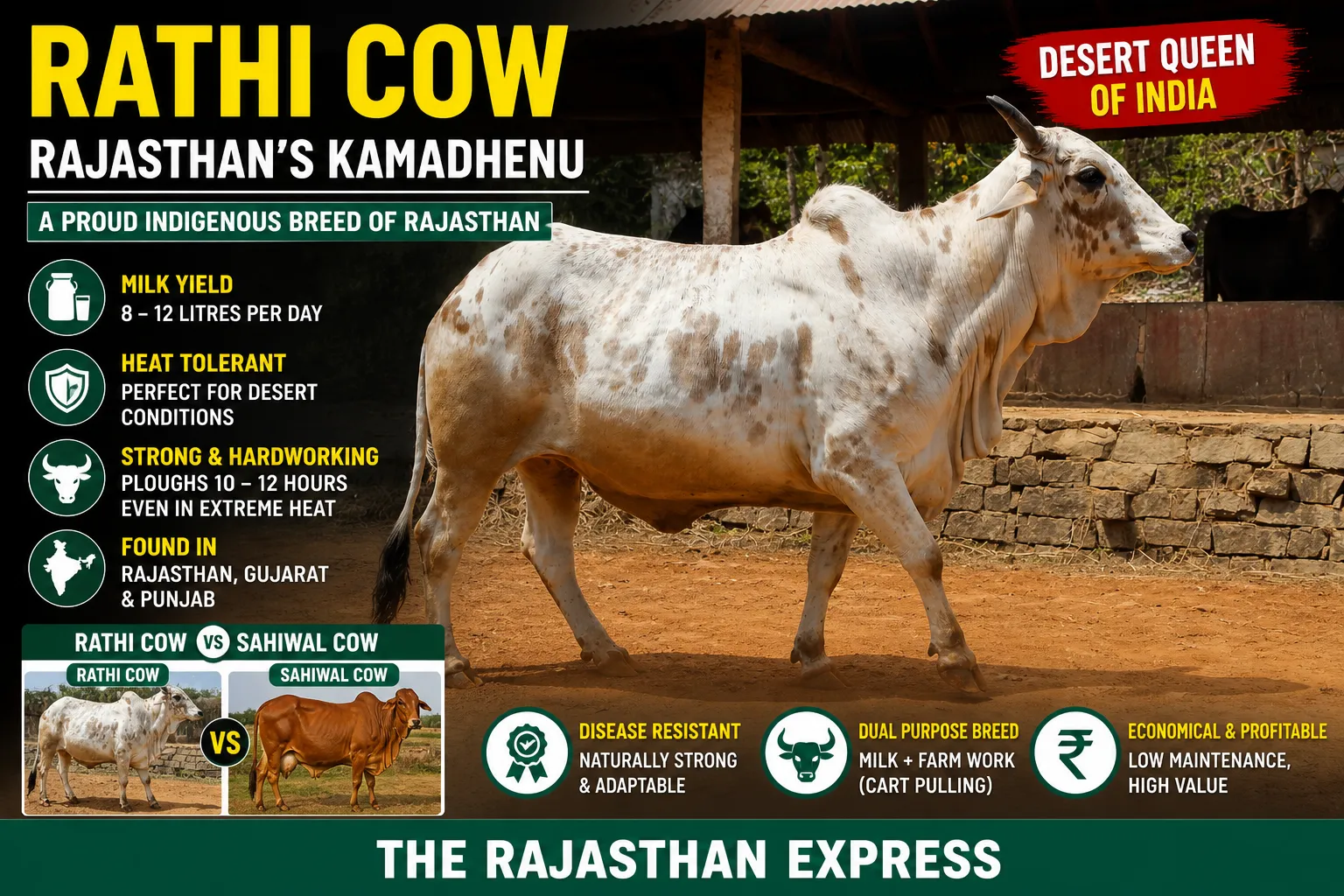
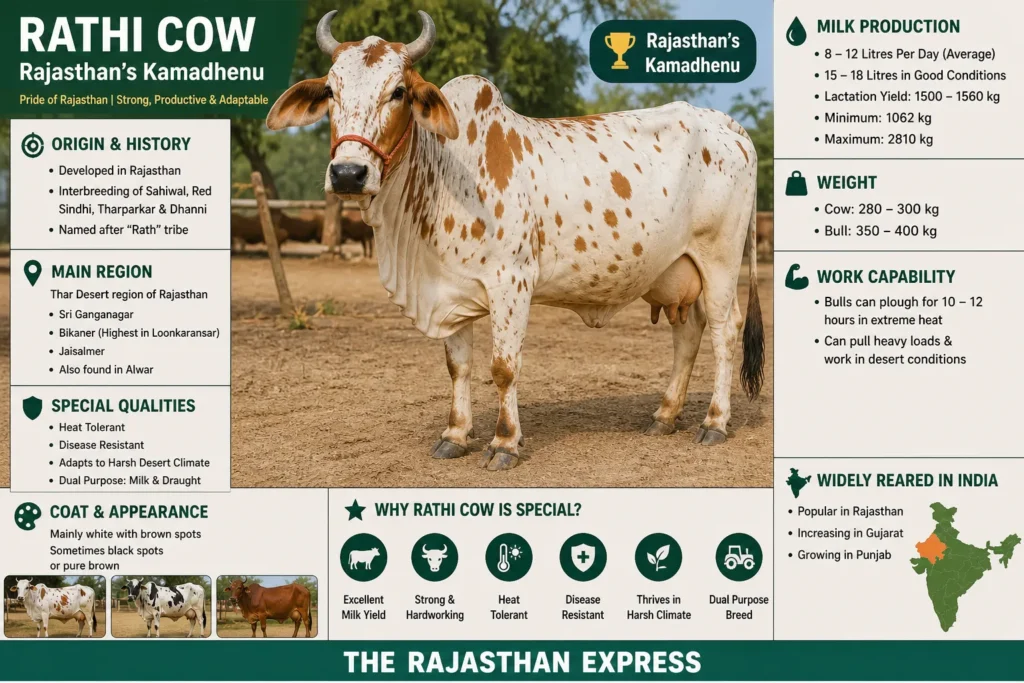
When we talk about Rajasthan, it is impossible not to mention its most special cow. The Rathi cow is an extremely important, prominent, and advanced indigenous milch breed of the state of Rajasthan, which is also worshipped and known as “Rajasthan’s Kamadhenu” . It is found mainly in the Thar Desert region of Rajasthan, in the Sri Ganganagar, Bikaner, and Jaisalmer districts. Apart from these three districts, the Rathi cow can also be seen in Alwar district. The density of Rathi cows is highest in the Loonkaransar tehsil of Bikaner district, which is why this area is also known as the “Rathi tract” . This breed is named after a nomadic tribe called “Rath” , who were originally Rajputs and later converted to Islam. This tribe used to wander from place to place with their herds. Regarding the origin of the Rathi cow, it is believed that it developed from the interbreeding of four famous breeds – Sahiwal, Red Sindhi, Tharparkar, and Dhanni – among which the blood of the Sahiwal breed is the highest. The colour of the Rathi cow is mainly white with brown spots, but sometimes cows with black spots or completely brown colour can also be seen. Their skin colour is brown and white, or sometimes black and white. It is a medium‑sized cow. An adult Rathi cow weighs approximately 280 to 300 kilograms and an adult bull weighs approximately between 350 to 400 kilograms. It is known for its excellent milk production and gives an average of 8 to 12 litres of milk per day, although on many occasions it has been seen giving 15 to 18 litres under special circumstances. During lactation, it gives on average about 1500 to 1560 kilograms of milk, which can range from a minimum of 1062 kg to a maximum of 2810 kg. The bulls of the Rathi breed are also very hardworking and powerful. These bulls can plough fields continuously for 10 to 12 hours even in severe heat and can pull heavy loads in the desert. This breed is also very famous for its dual purpose (milk and farm work or cart pulling). Additionally, it is one of the most disease‑resistant and adaptable breeds. The Rathi cow easily adapts to almost any weather and environment – from the harshest desert areas of India to other regions – which is why this breed has started being reared with great enthusiasm not only in Rajasthan but also in states like Gujarat and Punjab. Let us learn about this invaluable breed in detail. Because of all these characteristics, the Rathi cow is not only the lifeline and first choice of Rajasthan’s farmers, but also a valuable heritage of the entire country.
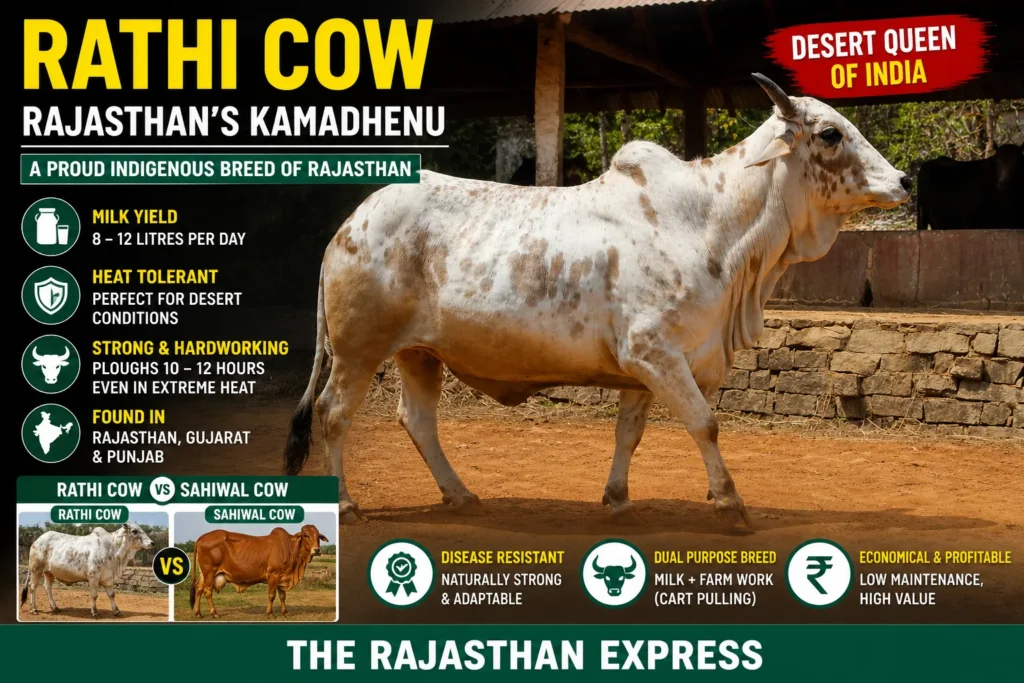
Rathi Cow Origin (Rathi Cow Origin & History)
The story of the Rathi cow, also called ‘Rajasthan’s Kamadhenu’ , is connected to the harsh land of the Thar Desert and the Rath tribe living there. The birthplace of this breed is Loonkaransar tehsil of Bikaner district, Rajasthan. In fact, the entire area where this cow is mainly found is spread across Bikaner, Sri Ganganagar and Jaisalmer districts, but the Loonkaransar region is called the ‘Rathi tract’ because the number of this breed is highest here.
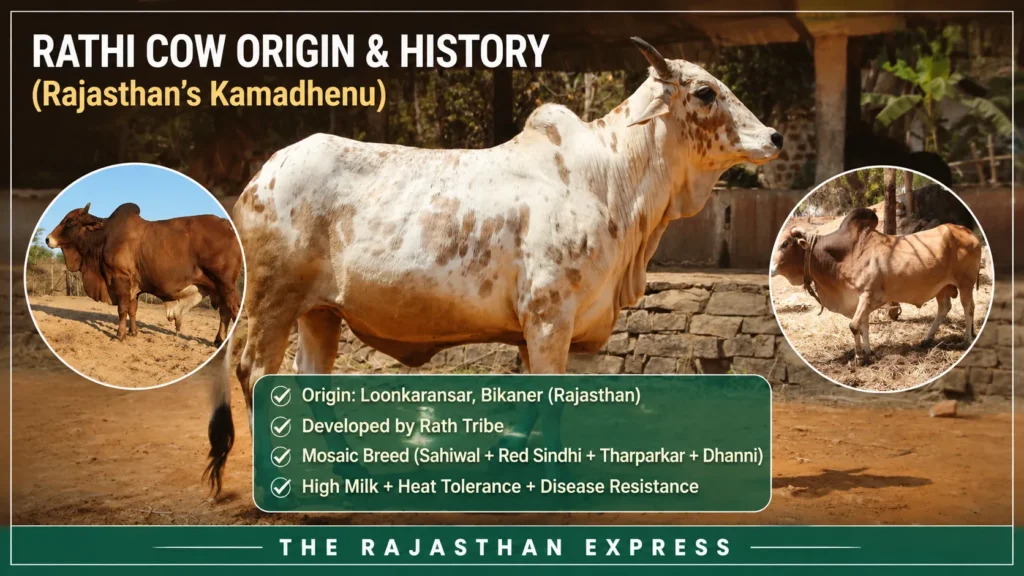
Now the question is, how did the name ‘Rathi’ come about?
- Behind this lies the history of an entire tribe. A nomadic tribe named ‘Rath’ used to live here. These Rath people were originally Rajputs, but later they adopted Islam. They did not stay in one place but wandered from place to place in the desert with their herds of animals. Since it was these people who reared this cow and played an important role in its development, the breed was named ‘Rathi’ after ‘Rath’ .
Genetic Origin (Rathi Cow Cross Breed Background)
But the Rathi cow is not just the gift of one tribe; it is the result of an excellent genetic mixture. Scientists and livestock keepers believe that this breed was formed from the natural mixing of four famous indigenous breeds. These four breeds are – Sahiwal (which gives the most milk), Red Sindhi (which is the most intelligent among all indigenous breeds of India), Tharparkar (which is the highest milk‑giving breed of Rajasthan), and Dhanni (which is found in the Punjab region of Pakistan). Among the mixture of these four, the influence of the Sahiwal breed is the highest – that is, in the Rathi cow, the qualities of Sahiwal – high milk, strong body, and disease resistance – are seen the most.
Rathi Cow Latitude & Distribution (Rathi Cow Origin Region)
Geographically, this breed is spread across an area between approximately 27° to 30° North latitude and 72° to 75° East longitude. This region covers the Bikaner, Ganganagar and Jaisalmer districts of Rajasthan. Its main use is for milk production, although its bullocks are considered equally hardworking and powerful for farming and cart pulling.
In simple words: The Rathi cow is native to the Loonkaransar area of Bikaner, Rajasthan, and was named after the Rath tribe living there. It was formed from the mixture of four breeds – Sahiwal, Red Sindhi, Tharparkar and Dhanni – in which Sahiwal blood is most dominant. That is why it is such a good milch and strong cow.
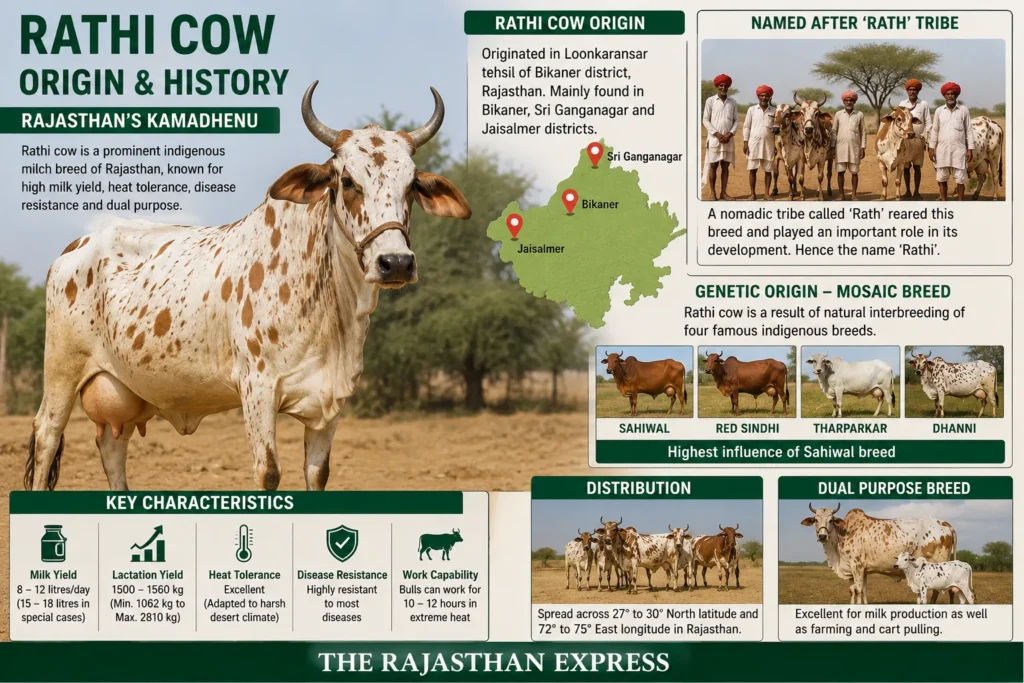
Rathi Cattle Characteristics (Genetic History & Mosaic Breed)
The genetic history of the Rathi cow is very special because it is an excellent result of natural crossbreeding. This breed is not just a local cow; it was formed from the natural mixing of four famous and excellent indigenous breeds – Sahiwal, Red Sindhi, Tharparkar and Dhanni. Scientifically, it is called a ‘Mosaic Breed’ . Among these four, the influence of the Sahiwal breed is the highest, which is why excellent milk production capacity is seen in Rathi.
What is a Mosaic Breed?
‘Mosaic Breed’ simply means – a breed formed from the mixing of several different breeds, just as a mosaic picture is made from many small pieces of different colours.
In simple words:
When the blood of four or five different cow breeds (such as Sahiwal, Red Sindhi, Tharparkar, Dhanni) keeps mixing over many generations, the new breed that forms is called a ‘Mosaic’ . The Rathi cow is the best example of this. It possesses the milk capacity of Sahiwal, the hardiness of Red Sindhi, the disease resistance of Tharparkar, and the agility of Dhanni – all in different proportions, like different coloured pieces in a mosaic.
Indigenous Development & Conservation (Rathi Cow Breed Improvement)
In the last decades of the 20th century, the Government of India took a big step to overcome the shortage of milk in the country. At that time, it was thought that if Indian indigenous cows (such as Rathi, Sahiwal, Gir, etc.) were crossbred with foreign breeds like Jersey and Holstein Friesian, milk production would increase very quickly. Under this thinking, the government implemented a large‑scale crossbreeding policy. Initially, the effect looked good – crossbred cows indeed started giving very high quantities of milk. But as time passed, serious disadvantages began to emerge. These crossbred cows proved to be very less resistant to India’s harsh heat, hot winds, drought, and local diseases. They needed expensive medicines, cool tin sheds, and special fodder to survive, which an ordinary farmer could not afford. An even bigger problem was that gradually the number of pure indigenous breeds (such as Rathi) started declining, because farmers, lured by money, started abandoning them and rearing only crossbred cows. Learning from this historical experience, the government had to change its policy. Then the government adopted “Selective Breeding” . The main objective of this policy is to select bulls and cows with the best qualities (such as high milk, strength, disease resistance) from within pure indigenous cows and breed them, without mixing any foreign blood. In this way, the government has now shifted its entire focus to protecting, conserving, and further improving Indian indigenous breeds, so that our invaluable indigenous breeds (such as Rathi) do not become extinct and future generations can also benefit from them.
🇮🇳 Government Efforts for Rathi Cow Conservation
In recent years, recognising the importance of indigenous breeds including Rathi, the government has taken several historic steps:
- NDDB Initiative (2002): The National Dairy Development Board (NDDB) recognised the wonderful potential of the Rathi breed. For this reason, in 2002, they started a major programme for the conservation and development of this breed in Bikaner and Ganganagar districts of Rajasthan.
- National Dairy Plan (2011‑2019): Taking this work forward, NDDB ran a special ‘Pedigree Project’ in the Loonkaransar area under the National Dairy Plan (NDP‑I). This project was so large that it spread over more than 120 villages. Its goal was to select well‑bred bulls and further improve the Rathi breed. For this work, 16 selected bulls were used and 31 high‑quality calves were produced.
- Maharashtra Expansion (2018): Seeing the success of the Rathi cow, in 2018, with the help of NDDB, three Rathi cows were taken from Bikaner to Amravati and Wardha (Vidarbha region) of Maharashtra. This was an experiment. When it succeeded, about 200 Rathi cows were taken and reared on private farms in Nagpur and Amravati.
- National Gokul Mission (RGM): This entire development programme of NDDB later became an important part of the Government of India’s much larger and ambitious “National Gokul Mission” . Launched in December 2014, this mission is the central platform to promote indigenous breeds across the country, and it gave even more strength to the improvement of the Rathi breed.
From 2002 till now, through NDDB and the National Gokul Mission, the government has continuously worked across the country to save and improve the Rathi cow.
🌍 International Export History (Rathi Cattle Global Demand)
The history of the Rathi cow is also connected beyond India’s borders:
- Export to Bahrain (1939‑1941): The name of the Rathi cow is known not only in India but also abroad. Its history goes back about 80‑85 years, when the Second World War was about to begin. Between 1939 and 1941, the Gulf country Bahrain was taking ‘Rath’ cows to their country because these cows were much cheaper compared to their local cows. However, later, in some old letters, an advisor suggested to the Bahrain government that they should focus more on the ‘Sindhi breed’ (i.e., Red Sindhi), because they were finding it difficult to arrange purebred Rathi cows. These old documents show how much demand Indian cows had abroad even in those days.
- Export of genetic material: Now let’s talk about recent times. Currently, the Government of India has banned the export of live animals (actual cows and bulls) to prevent our indigenous breeds from becoming extinct. But this does not mean that the qualities of the Rathi cow cannot go abroad. The policy is now changing. The government is now preparing to send semen and embryos of indigenous breeds abroad. This means that plans are being made to send the genetic seeds of excellent indigenous breeds like Rathi, Sahiwal and Gir across the world. In this way, without sending the cow itself, its genetic heritage can reach other countries, and farmers there can also incorporate the qualities of Indian breeds into their cows.
Main Use of Rathi Cow (Rathi Cow Milk Per Day & Utility)
The Rathi cow is primarily a milch breed, meaning it is reared in India mainly for higher milk production. The biggest speciality of this breed is that among all indigenous cows of Rajasthan, it produces the best quality milk. For this reason, Rathi is called Rajasthan’s Kamadhenu.
Why is it called Kamdhenu?
- Meaning of Kamadhenu: The Rathi cow is lovingly called “Kamadhenu” in Rajasthan. Kamadhenu means the cow that fulfils all wishes – according to mythological belief, it was the cow of the gods that could fulfil every need.
- Rathi was given this title because it gives abundant milk to its keeper and also provides powerful bullocks for farming. That is, this breed is primarily milch but also helpful in agricultural work. Even in the harsh desert climate, it remains the main source of livelihood for farmers.
| Rathi Cow Milk Production (Rathi Cow Milk Per Day & Lactation) : The Rajasthan Express | ||
| Production Level | In Kilograms | In Litres (≈) |
|---|---|---|
| Average production | 1560 kg | ≈ 1515 litres |
| Minimum production | 1062 kg | ≈ 1031 litres |
| Maximum production | 2810 kg | ≈ 2728 litres |
|
Calculation method: Litres = Kilograms ÷ 1.03 (milk density ≈ 1.03 kg/litre). 🎨 Color coding: 🟢 Average 🔴 Minimum 🔵 Maximum | ||
Calculation method: Litres = Kilograms ÷ 1.03 (density of milk is approx 1.03 kg/litre)
- Fat content in milk: On average found up to 4% , which makes the milk quite thick and nutritious.
- This breed is capable of giving 1062 to 2810 kg of high‑quality milk per lactation even on low fodder and normal care, making it an excellent choice for small and marginal farmers.
Key Point
1. Selective Breeding:
- A form of outcrossing where selected males are bred with unrelated females within the same herd. Selective breeding is currently the most widely used method.
2. Types of Cattle Based on Hump:
(A) Humped Cattle:
- Cattle with humps, scientifically known as Bos indicus, are referred to as Zebu cattle.

- Zebu cattle typically have lower milk production compared to exotic cattle but possess higher disease resistance.
- Examples include Gir Cow, Sahiwal Cow, Hariyana Cow, Tharparkar Cattle, Red Sindhi Cattle, and Punganur Cow.
(B) Humpless Cattle :
- Cattle without humps are scientifically known as Bos taurus and are called exotic cattle.
- Exotic cattle are used in cross-breeding, such as the Jersey × Red Sindhi cow.
- Examples of exotic cattle breeds include Jersey, Holstein Friesian, Brown Swiss, Red Dane, and Ayrshire.
3. Cattle-Related Terminology:
- Beef: The meat from cows is referred to as beef. The dressing percentage for beef is approximately 55%.
- Buffen / CaraBeef: The meat from buffaloes is known as Buffen or CaraBeef, with a dressing percentage of about 57%.
- Calving: The process of childbirth in cows and buffaloes is called calving. The offspring of a cow is called a calf.
- Gestation Period:
- For cows, the gestation period is approximately 9 months and 9 days, or 283 days.
- For buffaloes, the gestation period is around 10 months and 10 days, or 310 days.
- Serving: The act of mating in cows and buffaloes is referred to as serving.
4. Cross Breeding:
- Breeding between two different breeds of the same species is known as crossbreeding. The offspring resulting from crossbreeding is called a crossbreed.
- Breed Complementation: The desirable traits of different breeds are combined into one breed.
- Heterosis / Hybrid Vigor: The offspring outperform their parents, a phenomenon also known as Hybrid Vigor.
- Cross Breed Animals: Crossbreed animals can produce more with less feed.
Rathi Cow Identification (Rathi Cattle Characteristics)
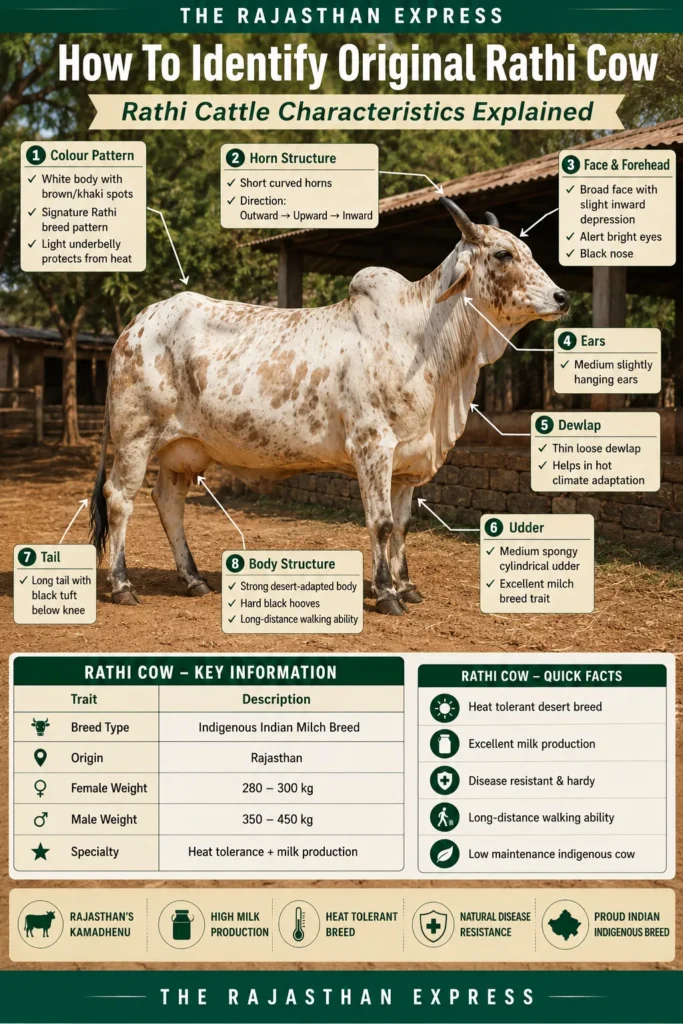
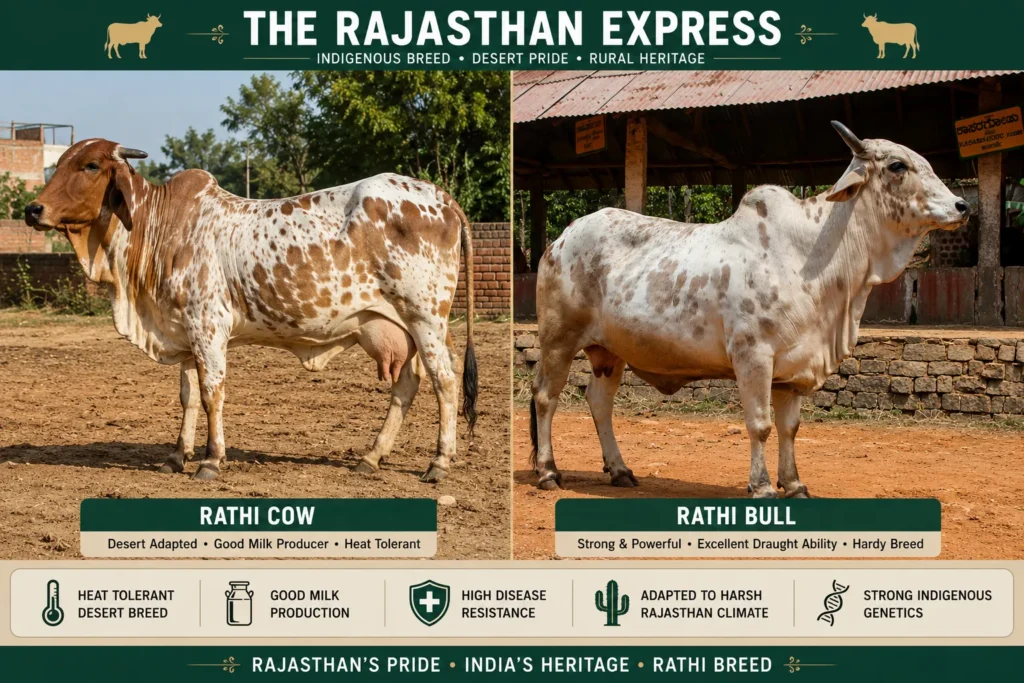
The Rathi cow is very easy to recognise at a glance, provided you know the details of its every body part. This breed has a medium‑sized and well‑built body, which can survive easily in Rajasthan’s harsh sunlight and desert winds.
1. Colour – White with brown spots
- First of all, if you look at its colour, the identification of the Rathi cow begins here. The base colour of the Rathi cow is white, but its colour is not uniform – it has spots. These spots can be large or small.
- You will find many cows with a white body and brown (almond or khaki) coloured spots scattered on it. Some cows are the opposite, i.e., their base colour is brown with white spots. However, sometimes some cows are found completely brown or black with white spots. Another special thing is that the belly area and the area around the udder of the Rathi cow are much lighter (almost whitish) than the rest of the body. This light colour helps protect it from intense heat.
| Quick Identification by Color: The Rajasthan Express | ||||
| Breed | Base Colour | Shades | White Markings | Special Feature |
|---|---|---|---|---|
| Sahiwal | Brownish‑red | Light reddish‑brown to dark mahogany red | No large white spots; very small marks possible | Bulls have darker shoulders and thighs |
| Red Sindhi | Clear, bright red | Deep blood red to light yellowish‑red | Only very small white marks on dewlap and forehead | Uniform, bright red colour without whitish tint |
| Rathi | White with brown spots | Most common: white with brown spots; sometimes completely brown or black with white spots | Large and small irregular brown spots all over body, rest white | Belly and udder area much lighter (almost white) than upper body |
|
🎨 Color coding for quick visual reference: 🟠 Sahiwal – light warm peach background 🔴 Red Sindhi – light soft red/pink background 🔵 Rathi – light soft blue/grey background | ||||
2. Horns – Short, curving outward‑upward‑inward
- Looking at its horns, the Rathi cow’s horns are short to medium in size. Their structure is very special, making it easy to identify. The horns first go outward, then turn upward, and finally bend slightly inward. This curve distinguishes it from other breeds.
3. Face and Head – Broad and slightly depressed
- The face of the Rathi cow appears quite broad and clean. The area between the eyes is slightly wide, and the forehead appears generally straight or slightly depressed inward, but not as deeply depressed as in the Gir breed.
- That is, the forehead is not completely convex but has a slight hollow in the middle. Its eyes are large, bright, and alert, allowing it to quickly understand the surrounding environment. The nose is usually black, and there is a slight shine on the face.
4. Ears – Medium and hanging
- The ears of the Rathi cow are medium‑sized and appear slightly hanging. They are not very large like in the Gir cow, but neither are they small. The ears remain slightly bent forward and look soft and thin.
5. Dewlap – Thin and loose
- The area under the neck (dewlap) is very thin and quite loose. This looseness helps it breathe comfortably and graze in hot weather.
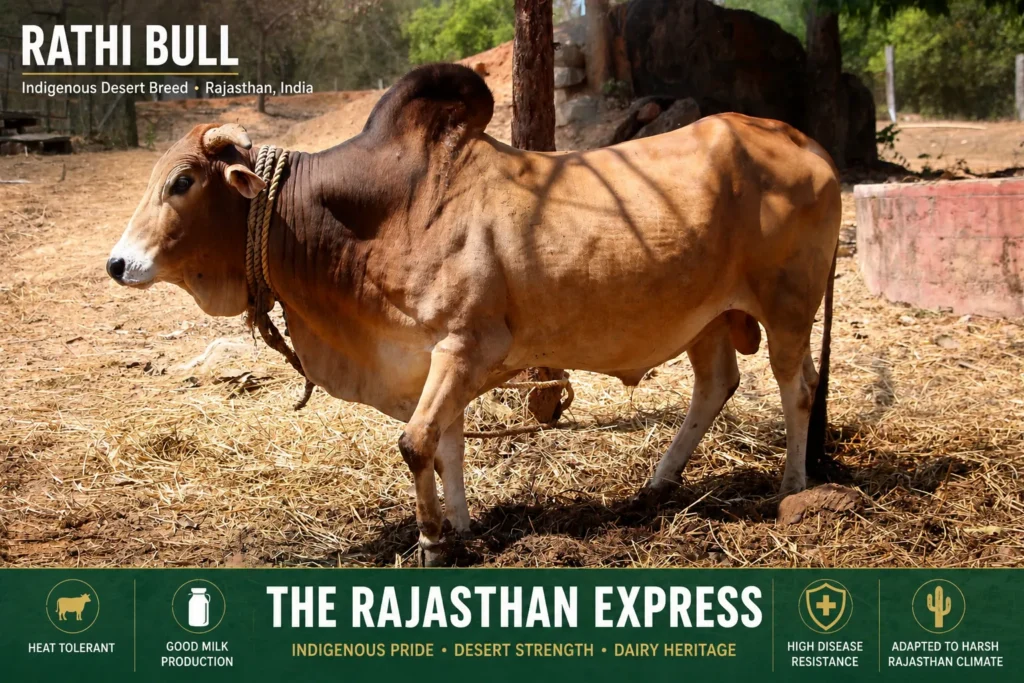
6. Hump – Large in males, small in females
- Rathi bulls (males) have a large, fleshy, and strong hump at the junction of neck and back above the shoulders, which shows their strength and masculinity. In contrast, Rathi cows (females) have a much smaller and less prominent hump. This hump gives them the strength for heavy work (in bulls) or milk production (in cows).
7. Tail – Long, thin, with tuft reaching below the knee
- The tail of the Rathi cow is very long and thin, hanging straight down. At the end of the tail is a beautiful tuft (switch) , which is usually black, although sometimes white is also seen. This tuft definitely hangs below the knee – a distinguishing feature of this breed.
8. Udder – Medium, cylindrical, spongy
- The most important organ of a milch cow is its udder. The Rathi cow’s udder is medium‑sized, cylindrical, and quite spongy (soft) . Its four teats hang straight down, causing no difficulty in milking. Light brown or white spots can often be seen on the udder of the Rathi cow.
9. Body structure – Strong, sturdy, suited for the desert
- The whole body is strong, sturdy, and muscular, but with low fat. The legs are strong and straight, capable of walking long distances and standing firmly in desert sand. The hooves are hard and black.
10. Size and weight – Medium
- Cow (female): When adult, its weight is approximately 280‑300 kg.
- Bull (male): When adult, its weight is approximately between 350‑450 kg.
- On average, it is slightly smaller than other large breeds (such as Sahiwal or Gir), but no less in agility and strength.
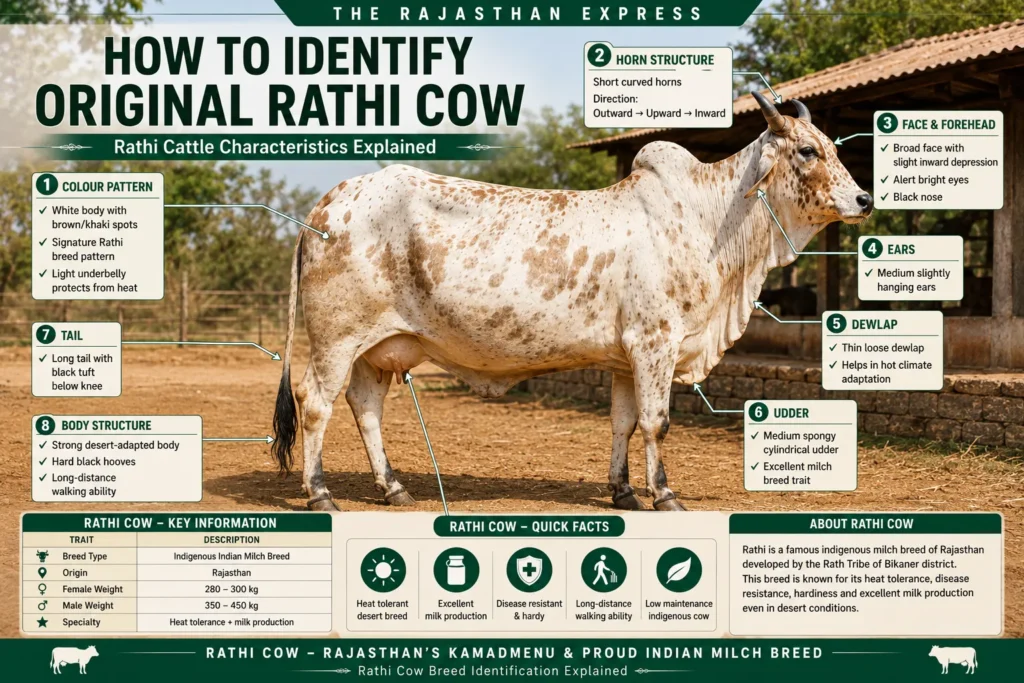
Main point: The Rathi cow is identified by its white‑brown spotted colour, medium‑sized curved horns, thin loose dewlap, and tail tuft hanging to the knee. Its strong body and spongy udder make it an excellent milch and hardworking breed.
| Rathi vs Sahiwal Traits Comparison : The Rajasthan Express | ||||
| Trait | Condition in Sahiwal | Condition in Rathi | ||
|---|---|---|---|---|
| Dewlap | Very large, heavy and quite loose. Most developed among all indigenous breeds. | Thin but quite loose and distinct (structure like Sahiwal, slightly lighter) | ||
| Navel Flap | Large and hanging. Most developed navel among all indigenous breeds. | Well‑developed, loose and distinct – proof of being a descendant of Sahiwal | ||
| 📌 Comparison: Rathi shows clear Sahiwal influence in both dewlap and navel flap, though slightly lighter in dewlap. | ||||
Sahiwal, Red Sindhi and Rathi – Main differences and identification
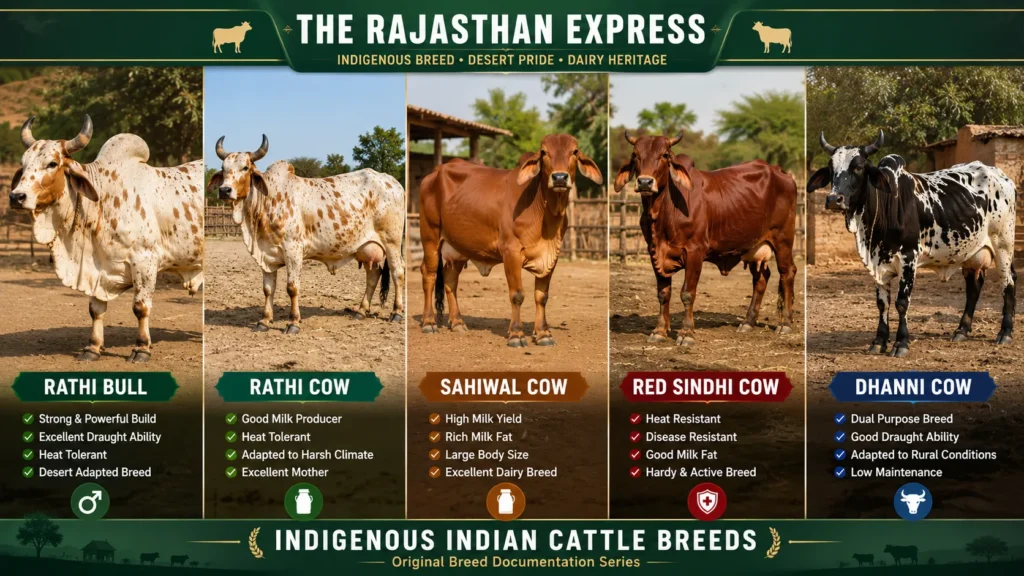
India’s three wonderful milch breeds – Sahiwal, Red Sindhi and Rathi – may look similar, but each has its own distinct identity. These three are genetically related to each other (Rathi has the highest amount of Sahiwal blood), yet their colour, horns, skin looseness and body structure distinguish them.
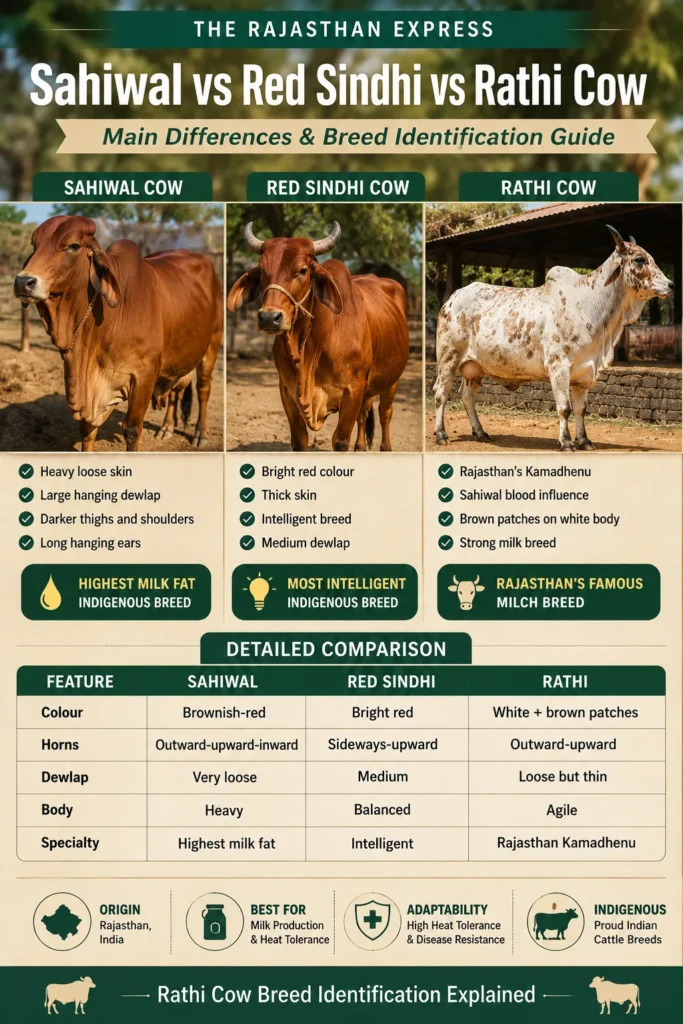
| Sahiwal vs Red Sindhi vs Rathi Cow (Breed Identification & Characteristics) : The Rajasthan Express | |||
| Trait | Sahiwal | Red Sindhi (Mahi) | Rathi (Kamadhenu) |
|---|---|---|---|
| Colour | Base colour: Brownish‑red Shades/variations: Mahogany reddish‑brown to greyish‑red White markings: Small white spots possible on body occasionally; no large permanent white patch Special feature: Bulls’ legs, shoulders and thighs are darker than the rest of the body | Base colour: Distinctly red Shades/variations: From dark red to dim yellow White markings: Small white marks possible on dewlap and forehead; no large white patch on body Special feature: Bulls’ shoulders and thighs are darker. Skin colour is uniform and bright red | Base colour: White with brown patches Shades/variations: Most of the body has brown (almond/khaki) spots scattered on a white background. Sometimes completely brown or completely black body with white spots is also found. White markings: Irregular distribution of white and brown spots all over the body. Special feature: The lower belly area and the area around the udder are relatively lighter (almost whitish) compared to the upper body. |
| Horn direction | Short, stumpy, curving outward → upward → inward | Thick at base, go sideways and then curve upward (outward‑upward; inward curve is less or absent) | Short to medium, curving outward → upward → inward |
| Dewlap | Very large, heavy and quite loose skin | Medium, thick‑skinned | Thin but quite loose (reminiscent of Sahiwal) |
| Navel flap | Very distinct, large and hanging | Small and less distinct | Distinct and hanging (most developed after Sahiwal) |
| Skin looseness | Entire skin very loose and soft | Skin tight and thick; less looseness | Looseness clearly visible on face and neck, but less than Sahiwal |
| Face/forehead | Broad forehead, slightly convex | Broad and slightly convex (dome‑like), eyes large and appear intelligent | Broad and slightly dished in the middle |
| Ears | Long and very hanging | Medium, slightly hanging | Medium, slightly pendulous |
| Tail tuft | Black, hanging to or below the knee | Black, to the knee | Black or white, hanging quite below the knee |
| Udder | Large, spread‑out, spongy | Medium, well‑shaped, spongy | Medium, cylindrical, spongy |
| Body shape | Heaviest, sturdy | Medium, well‑built and balanced | Medium, muscular and agile |
| Specialty | Sahiwal is the highest milk‑giving indigenous cow of India. Compared to all indigenous cows, Sahiwal milk has the highest fat percentage – about 4.5%‑5.0%. | Red Sindhi is considered the most intelligent cow breed. | Rathi cow was formed by mixing Red Sindhi, Sahiwal, Tharparkar and Dhani breeds. Rathi cow is also called Rajasthan’s Kamadhenu. |
|
🎨 Color coding for quick breed identification: 🟠 Sahiwal – light warm peach background 🔴 Red Sindhi – light soft red/pink background 🔵 Rathi – light soft blue/grey background | |||
Rathi Cow Origin & Breed Overview (Rathi Cow Origin, Rathi Cattle Characteristics)
Rathi cow is developed from a mix of Red Sindhi, Sahiwal, Tharparkar, and Dhanni breeds. It is also called the “Kamdhenu of Rajasthan.” It is one of the best indigenous cows for desert regions due to its high heat tolerance and disease resistance.
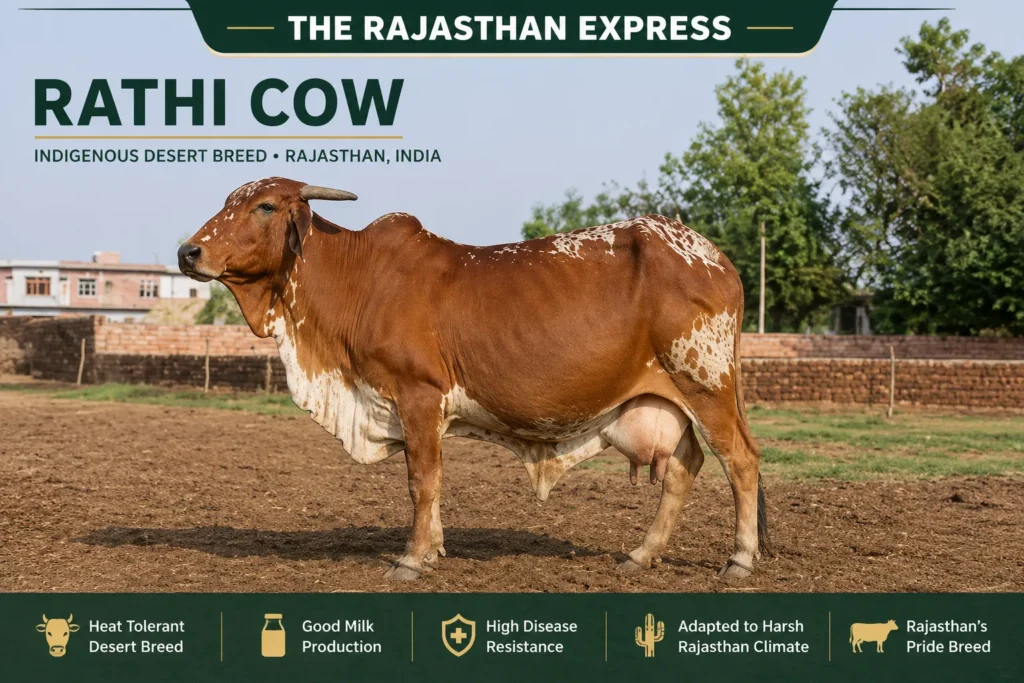
| Measurement | Male (Rathi Bull) | Female (Rathi Cow) |
|---|---|---|
| Height at shoulder (Avg cm) | — | 114.92 cm |
| Body length (Avg cm) | — | 131.33 cm |
| Heart girth (Avg cm) | — | 165.78 cm |
| Adult weight (Avg kg) | 350‑400 kg | 295 kg |
| Birth weight (Avg kg) | 19.1 kg | 18.9 kg |
| Note: Height at shoulder, body length, and heart girth data for Rathi bulls are currently unavailable. Female measurements are based on field records. | ||
Note: Official records of ICAR‑NBAGR do not have data for height, body length and heart girth of Rathi males (bulls). Only data for Rathi cows is available.
Rathi Cow Performance Record (Rathi Cow Milk Per Day & Lactation)
These figures are based on scientific studies and farm records. They show how advanced and balanced the Rathi breed is.
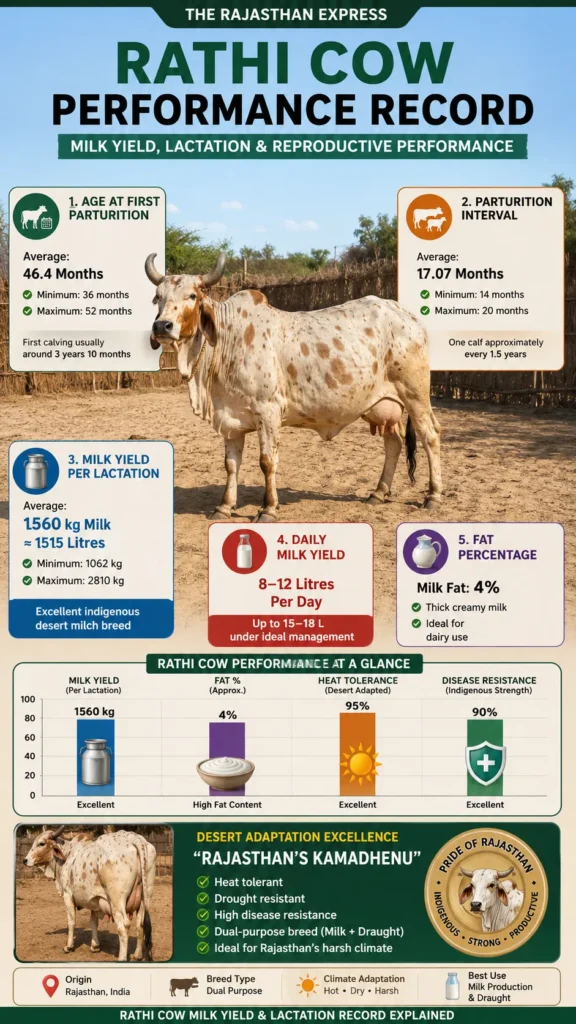
1. Age at first parturition
- Average: 46.4 months (approx 3 years 10 months)
- Minimum: 36 months (approx 3 years)
- Maximum: 52 months (approx 4 years 4 months)
In simple words: The Rathi cow gives her first calf at an average age of 3 years 10 months. With good care, she can give at 3 years, but sometimes it may take up to four and a half years. This is normal for milch breeds.
2. Parturition Interval – time between two calves
- Average: 17.07 months (approx 17 months)
- Minimum: 14 months
- Maximum: 20 months
In simple words: The Rathi cow gives one calf on average every 17 months. A normal cow’s ideal calving interval is 12 months. In a good farm, she can calve in 14 months. That is about one calf every one and a half years – a steady reproduction rate among indigenous breeds.
3. Rathi Cow Milk yield per lactation
The Rathi cow produces on average 1,560 kilograms (approximately 1,515 litres) of milk per lactation. According to ICAR‑NBAGR data, it gives from a minimum of 1,062 kg to a maximum of 2,810 kg.
Milk Yield Per Day
- The Rathi cow gives on average 8 to 12 litres of milk per day. Under special care and good fodder, it can sometimes give 15 to 18 litres.
Note: These figures are averages and can vary depending on the animal’s care, fodder quality, and weather.
Fat percentage in milk (%)
- The milk of the Rathi cow contains on average 4% fat. With fat ranging from minimum 3.7% to 4%, the milk is thick and creamy.
Main point: Rathi is primarily a milch breed, but its bullocks are also extremely powerful and hardworking, therefore it is also considered a dual‑purpose breed. It is counted among the best indigenous cows of desert areas and is called “Rajasthan’s Kamadhenu”. Its biggest speciality is its wonderful ability to tolerate heat and drought and its high disease resistance.
| Rathi Cow Performance Record (Rathi Cow Milk Per Day & Lactation): The Rajasthan Express | |||
| Parameter | Average | Minimum | Maximum |
|---|---|---|---|
| Age at first parturition (months) | 46.4 | 36 | 52 |
| Parturition interval (months) | 17.07 | 14 | 20 |
| Milk yield per lactation (kg) | 1560 kg | 1062 kg}._ | 2810 kg |
| (in litres approx) | 1515 L | 1031 L | 2728 L |
| Milk fat percentage | 4.0% | 3.7% | 4.0% |
| Daily milk yield | 8‑12 L | — | 15‑18 L (special) |
|
Color coding:
🟢 Reproductive parameters
🟠 Calving interval
🔵 Milk yield (kg & litres)
🟣 Fat %
🔴 Daily yield Conversion: Litres = Kilograms ÷ 1.03 (milk density ≈ 1.03 kg/L). Note: Rathi cows can produce up to 2810 kg (≈2728 L) per lactation under ideal management. | |||
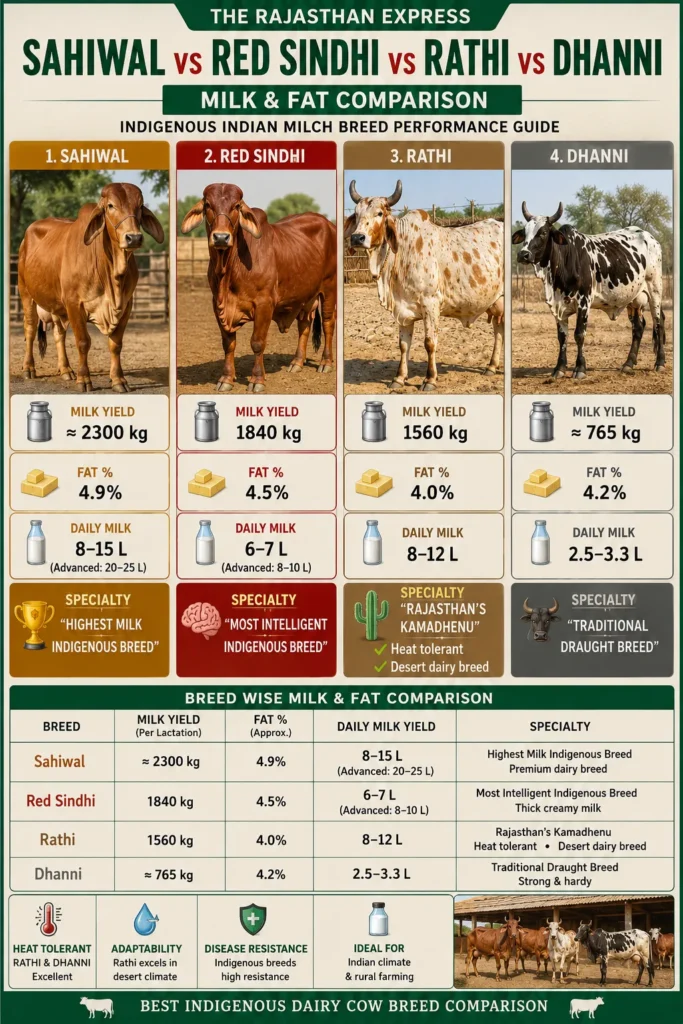
| Sahiwal vs Red Sindhi vs Rathi Milk & Fat Comparison: The Rajasthan Express | ||||
| Breed | Average milk per lactation (kg) | Average milk fat (%) | Daily milk (approx) | Main specialty |
|---|---|---|---|---|
| Sahiwal | ≈ 2300 kg | 4.9% (4.8‑5.1) | 8‑15 L (advanced: 20‑25)} | Highest milk‑giving indigenous breed and highest fat content} |
| Red Sindhi (Mahi)} | 1840 kg} | 4.5% (4.0‑5.2)} | 6‑7 L (advanced: 8‑10)} | Most intelligent indigenous breed, thick creamy milk} |
| Rathi (Kamadhenu)} | 1560 kg} | 4.0% (3.7‑4.0)} | 8‑12 L} | Milch utility, desert tolerance, Rajasthan’s Kamadhenu} |
| Dhanni} | ≈ 765 kg (1930s) / 708 kg (2000s)} | — (not available)} | ≈ 2.5‑3.3 L} | Mainly draught, traditional use, distinctive piebald colour} |
|
Color coding:
🟢 Highest milk & fat (Sahiwal)
🔵 High milk (Red Sindhi)
🟠 Medium milk (Rathi)
🔴 Draught focused (Dhanni) Note: Dhanni milk data is historical; recent records are scarce. Sahiwal remains the top indigenous dairy breed in both quantity and fat percentage. | ||||
What factors does the price of a Rathi cow depend on?
Rathi Cow Price in India (Rathi Cow Price in Rajasthan & Other States)
The Rathi cow is a prominent milch breed of Rajasthan, known for its excellent performance in heat and drought. There is no single fixed formula for the price of this breed. In the same market, you will find a cow for ₹25,000 and also for over ₹1.5 lakh. This entire difference depends on the quality of the cow. Let us understand all the factors that affect its price.
1. Milk production capacity – the biggest factor
The main purpose of buying a Rathi cow is milk, so this is the biggest determinant of price. According to ICAR‑NBAGR performance records:
- Milk yield per lactation: Average 1560 kg (≈1514 L), Minimum 1062 kg (≈1030 L), Maximum 2810 kg (≈2728 L)
- Daily average milk (on 270‑300 day lactation):
- Normal Rathi cow: 4‑5 litres
- Good Rathi cow: 6‑8 litres
- High‑producing Rathi cow: 9‑11 litres
- Milk fat (%): 3.7% to 4.0% – not as thick as Sahiwal or Gir, but still considered good quality milk.
Effect on price:
- A cow giving 4‑5 litres per day will cost between ₹30,000‑₹50,000.
- If a Rathi cow gives 9‑10 litres per day, its price can directly reach ₹80,000‑₹1,20,000. More milk = higher price – simple math.
2. Breed purity – Registered cow is more valuable
Breed purity of Rathi means that the cow’s parents, grandparents are all pure Rathi without any mixing of other breeds.
- Cow without documents: Cheap, but carries risk of crossbreeding.
- Registered / certified cow: Registered with a government body (such as NBAGR) or a recognised farm, with documents available. Such a cow can cost 20‑30% more than an unregistered cow because her purity is guaranteed.
3. Age of the cow – Young cow is most expensive
The remaining productive period of the cow determines its real price.
- Heifer (1‑2.5 years): Has not started giving milk yet. Price ₹25,000‑₹40,000, because future milk is uncertain.
- Young milch cow (3‑6 years): After first or second calving. Sells the most expensive because milk production is at its peak and she has many productive years ahead.
- Old cow (above 10 years): Price drops sharply and often sells only at meat price.
- Example: A 4‑year‑old Rathi giving 8 litres daily will sell for much more than an 8‑9 year old cow even if both give the same milk. Age is directly related to future earnings.
4. Is the cow pregnant? – Direct increase in price
Buying a pregnant Rathi cow is like getting “two for the price of one”. Within a few months you will get a calf (male or female). A female calf can expand your future milch herd, and a male calf can be sold for additional income. For this reason, a pregnant Rathi cow costs ₹15,000‑₹25,000 more than a non‑pregnant cow.
5. Pedigree record – Proof of the past, guarantee of the future
A pedigree record contains the complete history of the cow’s mother, grandmother and great‑grandmother – their milk production, breeding history, and diseases. It is scientific proof of how strong the cow’s “family line” is in terms of production.
- Cow without record: Cheap, but no guarantee of future performance.
- Cow with recorded pedigree: If the ancestors’ milk production history is very good, such a cow can cost 50% to double the price of an ordinary cow. If a normal Rathi is ₹60,000, with full records she can sell for ₹1,00,000.
6. Vaccination and health certificate – Freedom from disease risk
A certificate of full vaccination (Foot & Mouth Disease, Haemorrhagic Septicaemia, Brucellosis, Black Quarter, etc.) shows that the cow has been protected against major infectious diseases.
- Unvaccinated cow: Cheaper, but if disease breaks out later, treatment can cost thousands. Therefore her market price is relatively low.
- Fully vaccinated cow: Due to assurance of good health, her price can be 10‑15% higher.
7. Place of purchase – Prices vary by state
The native region of the Rathi breed is Rajasthan (especially Bikaner, Sri Ganganagar, Hanumangarh) . Therefore, it is cheapest and most easily available in these areas. As you go to distant states (Haryana, Punjab, Uttar Pradesh, Madhya Pradesh, South India), the price increases by 20‑40% due to transport costs, middlemen commission, and local demand‑supply. A cow costing ₹60,000 in Rajasthan can become ₹90,000 by the time it reaches South India.
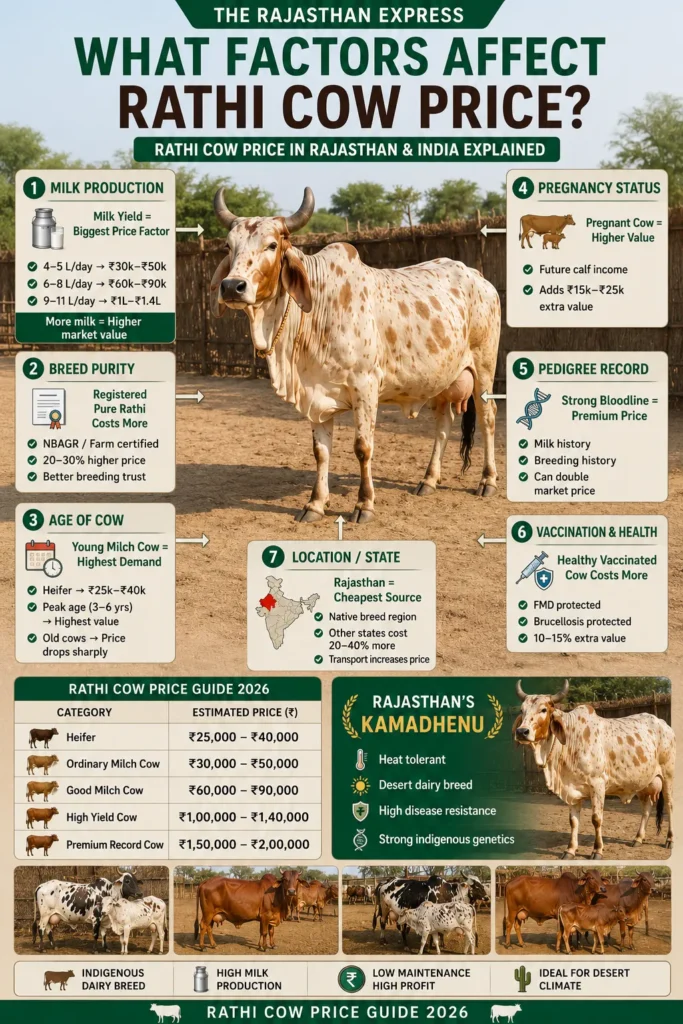
| Rathi Cow Price in India (Rathi Cow Price in Rajasthan & Other States): The Rajasthan Express | |
| Category | Estimated Price (₹) |
|---|---|
| Heifer / young unbred cow (1‑2.5 years, not yet milking) | 25,000 – 40,000 |
| Ordinary Rathi cow (4‑5 litres/day) | 30,000 – 50,000 |
| Good milch Rathi cow (6‑8 litres/day) | 60,000 – 90,000 |
| High‑yielding Rathi cow (9‑11 litres/day) | 1,00,000 – 1,40,000 |
| Complete record cow (pedigree, vaccination, milk records, breeding history) + high milk | 1,50,000 – 2,00,000 |
| 📌 Estimated prices for Rathi cows as of 2026. Actual prices may vary by region, health, lactation stage, and market conditions. | |
Note: All these figures can vary according to fodder quality, weather, local demand and the cow’s physical condition. The biggest speciality of the Rathi cow is that it gives reliable milk production even on low expenses and in harsh dry climates, which makes it an ideal milch breed for drought‑prone areas like Rajasthan.
Rathi Cow Price in India (Rathi Cow Price in Rajasthan & Other States)
Key Points About Indigenous Cows in India (Desi Cow Facts)
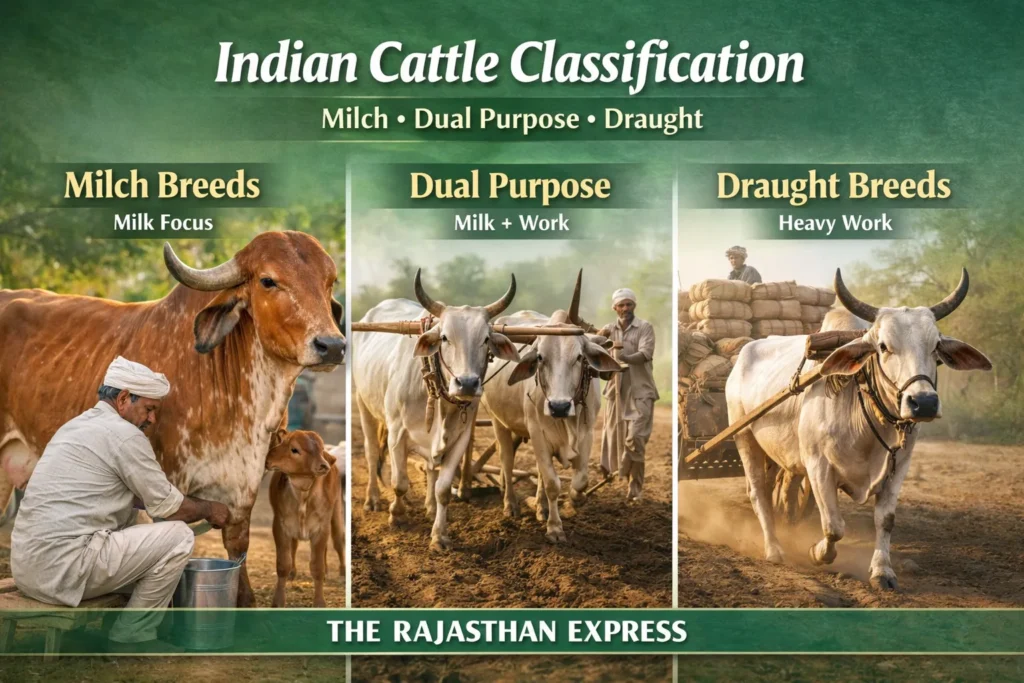
- India’s best draught (load‑carrying) breed is Amrit Mahal.
- Maharashtra’s best draught breed is Khillari.
- Rajasthan’s best load‑carrying breed is Nagori.
- India’s best dual‑purpose (milk + work) breed is Hariana.
- The world’s smallest cow breed is Vechur.
- India’s heaviest cow breed is Kankrej.
- The Kankrej breed exhibits a “Sawai Chal” (fast and special gait).
- Deoni cow was created by crossing Gir, Dangi, and local cows.
- Nimari cow was created by mixing Gir and Khillari breeds.
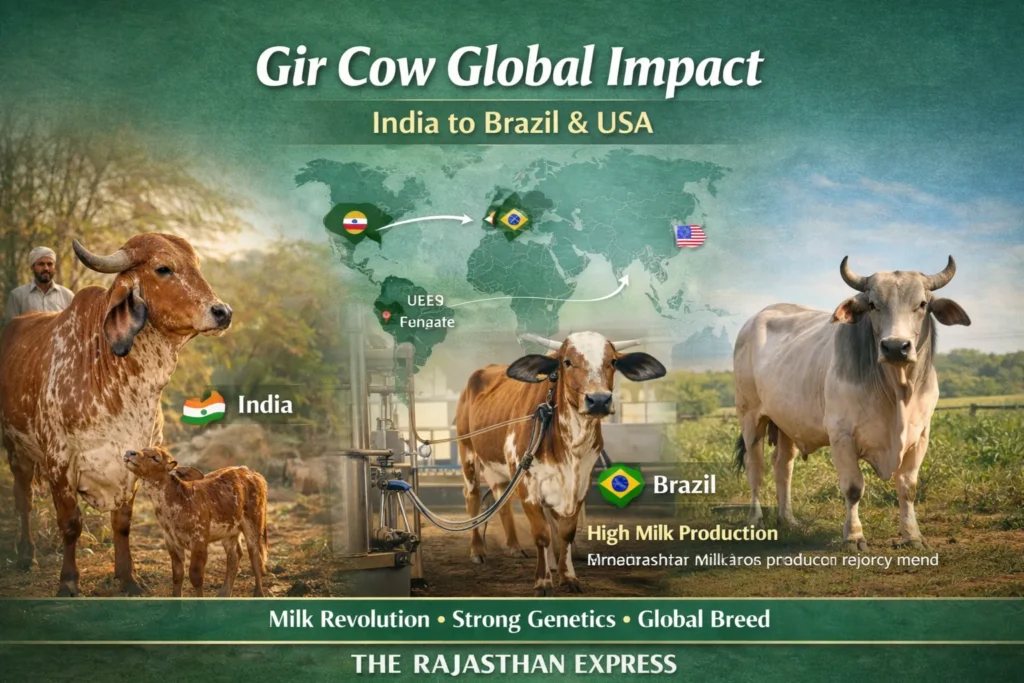
- India’s most expensive cow breed is considered to be Ongole. In Brazil, this same breed is called Nelore. At the beginning of the year 2025, a Nelore cow named “Viatina‑19” was sold for approximately ₹40‑41 crore. It also set a Guinness World Record. “Viatina‑19” weighed about 1100 kg, which is much more than a normal cow. The first Ongole cows were taken from India to Brazil in 1868. Later, by 1960, about 7000 cattle were sent there. In Brazil, this breed was named “Nelore”, after the Nellore district of Andhra Pradesh.
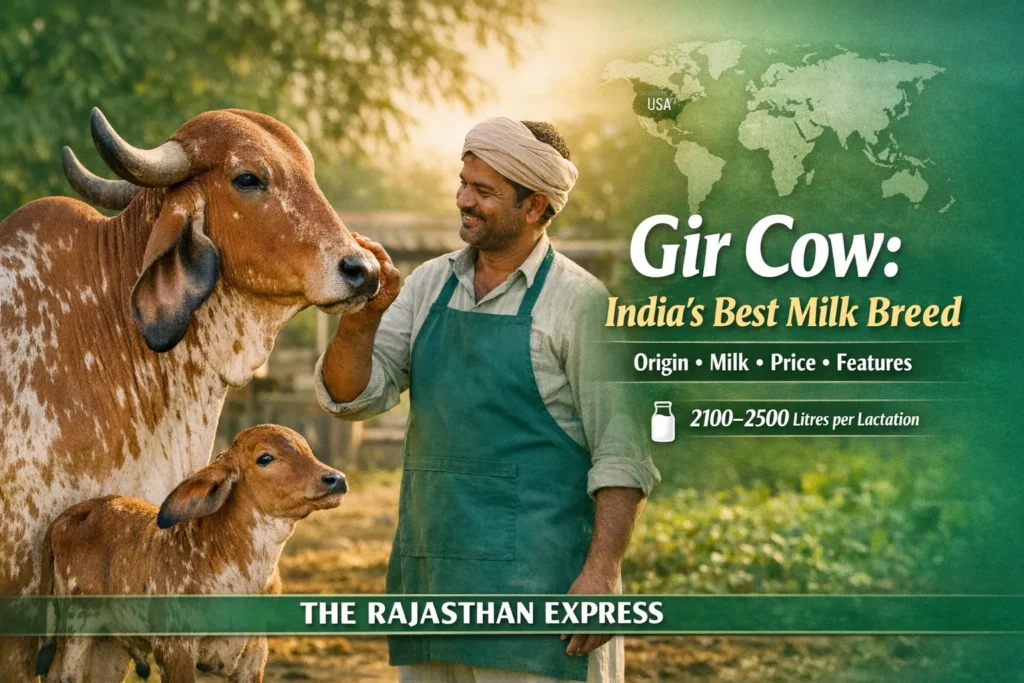
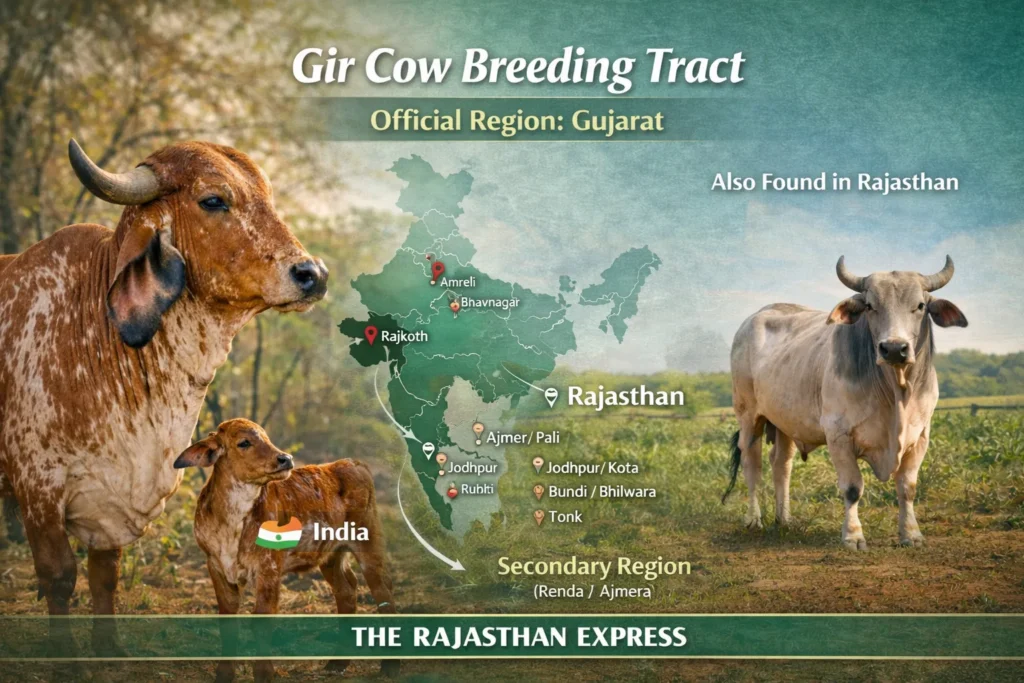
- Among indigenous cows, the longest lactation period is of the Gir cow (about 325 days). The Gir cow originated in the Gir forests of Kathiawar, Gujarat. The Gir cow is also called Kathiyawadi, Ajmera, Renda, Surti.
- Among buffaloes, the longest lactation period is of the Mehsana buffalo (about 352 ± 15 days).
- Identification of Gir cow:
- Red, brown, or spotted skin
- Prominence on forehead
- Long, hanging, leaf‑shaped ears
- Half‑moon shaped horns
- India’s highest milk‑producing indigenous cow is Sahiwal.
- In the Sahiwal cow, the dewlap (loose skin of the neck) and Nawelflap are more developed. This is the main identification of the Sahiwal cow. The Sahiwal cow originated in Montgomery (Pakistan), Punjab, Haryana. The Sahiwal cow is also called Lola breed, Multani, Montgomery, Lambi Bar.
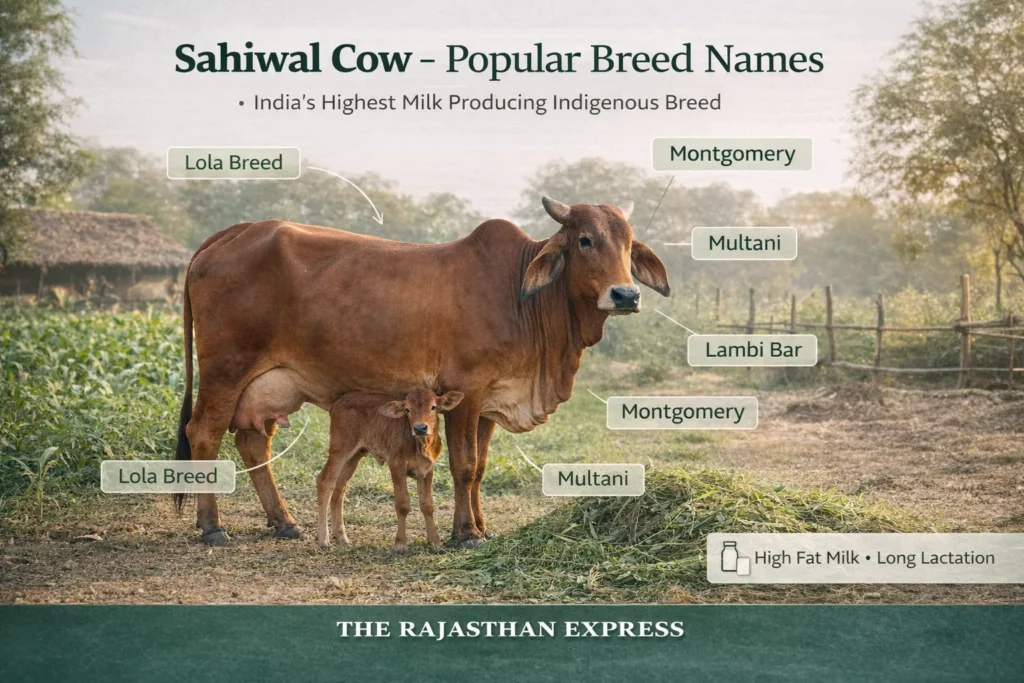
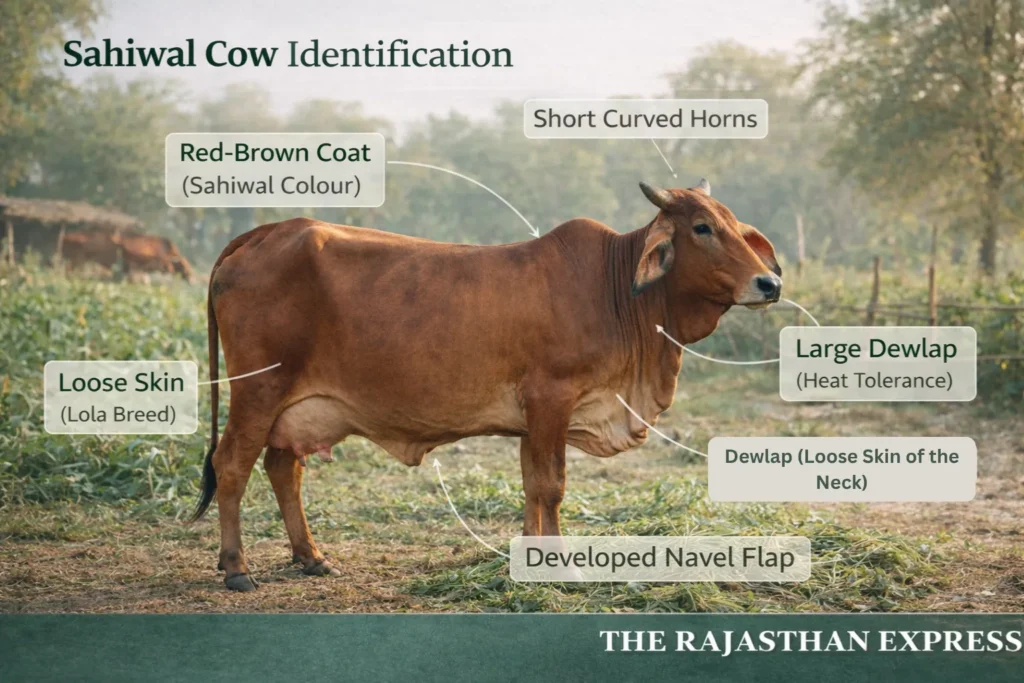
- Because the Sahiwal cow’s skin is loose, it is also called the Lola breed.
- The most intelligent cow breed is considered to be Red Sindhi. The Red Sindhi cow originated in Karachi, Hyderabad (Sindh), Pakistan. The Red Sindhi cow is also called Red Karachi.
- Among indigenous breeds, the highest disease resistance is found in the Tharparkar cow, which is found in the state of Rajasthan, India. The Tharparkar cow originated in the Tharparkar district of Sindh province in Pakistan and in Gudamalani, Barmer. It is also known as White Sindhi, Grey Sindhi, or Thari and Malani. This breed is named after the Thar Desert, which extends from Sindh to the Kutch district of Gujarat and to the Barmer, Jaisalmer, and Jodhpur districts of Rajasthan, India.
- The Tharparkar cow also has the ability to change colour.
- The highest milk‑producing cow in Rajasthan is Tharparkar.
- The Rathi cow was created by mixing Red Sindhi, Sahiwal, Tharparkar, and Dhani breeds. The Rathi cow is also called Rajasthan’s Kamadhenu.
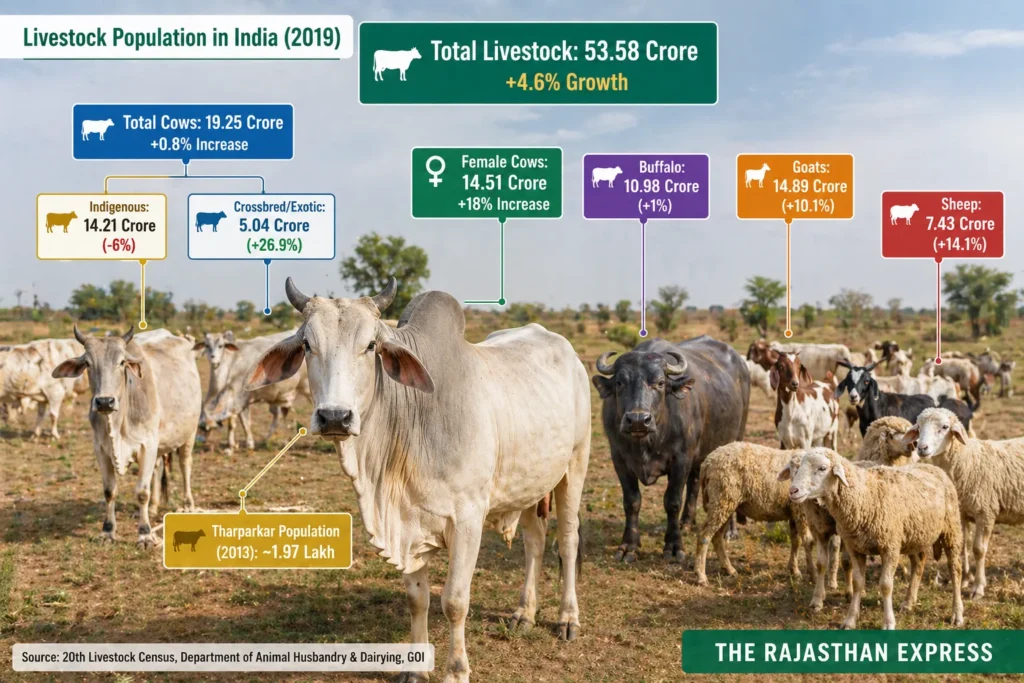
Livestock Population in India (20th Livestock Census 2019)
| Livestock Population in India (20th Livestock Census, 2019) | ||
| Particulars | 20th Livestock Census (2019) figure | Change from previous census (2012) |
|---|---|---|
| Total livestock | 53.58 crore (535.78 million) | +4.6% (increase) |
| Total cows (all types) | 19.25 crore (192.49 million) | +0.8% (increase) |
| Indigenous/unclassified cows | 14.21 crore (142.11 million) | -6% (decline) |
| Exotic/crossbred cows | 5.04 crore (50.42 million) | +26.9% (remarkable increase) |
| Female cows (Cows) | 14.51 crore (145.12 million) | +18.0% (much higher than previous census) |
| Buffaloes | 10.98 crore (109.85 million) | +1.0% |
| Goats | 14.89 crore (148.88 million) | +10.1% |
| Sheep | 7.43 crore (74.26 million) | +14.1% |
| The Rajasthan Express : Livestock Census 2019 | ||
Important point:
- While the total cow population has increased marginally by 0.8%, the population of female cows has seen a large increase of 18.0%. In contrast, the total population of indigenous cows (both male and female) has declined by 6%. These figures indicate that attention to milk production has increased, due to which the number of female animals has increased.
Rathi Cow Population in India (2013): Breed Status, Origin & Key Insights
Rathi Cow Population Data (Rathi Cow Breed Overview & Origin)
The Rathi breed is primarily a prominent milch cow of Rajasthan. The most recent and official breed‑wise survey of its total population was conducted in the year 2013, published by the Department of Animal Husbandry, Dairying and Fisheries, Government of India. According to this survey:
Total population of Rathi cow (2013): 8,65,921 (approximately 8.66 lakh)
This figure indicates that in the year 2013, there were approximately eight and a half lakh animals of the Rathi breed present in India. This number is considered quite good for any indigenous breed, and it shows that the Rathi breed was safe in terms of numbers at that time. This entire population is mainly concentrated in the dry regions of Bikaner, Sri Ganganagar, Hanumangarh and surrounding areas of Rajasthan. Some animals are also found in the border districts of neighbouring states Haryana and Punjab.
Source: Estimated Livestock Population Breed Wise Based on Breed Survey 2013. Department of Animal Husbandry, Dairying & Fisheries, Government of India, New Delhi.
Rathi cow milk per day: 8-12 liters. Price in Rajasthan ₹25k-₹2 lakh. Pure Desi breed, origin Bikaner, characteristics, disadvantages & FAQs. Click to learn!
The Rajasthan Express: Your Trusted Source for Animal Care and Veterinary Science.
People Also Ask
Is Rathi cow pure indigenous (Desi) or a crossbreed?
How much milk does a Rathi cow give per day?
What is the price of a Rathi cow in Rajasthan and India?
• Heifer (1‑2.5 yrs): ₹25,000 – ₹40,000
• Ordinary (4‑5 L/day): ₹30,000 – ₹50,000
• Good milch (6‑8 L/day): ₹60,000 – ₹90,000
• High‑yielding (9‑11 L/day): ₹1,00,000 – ₹1,40,000
• Complete record + high milk: up to ₹2,00,000.
Prices are lowest in Rajasthan (Bikaner, Ganganagar) and increase 20‑40% in distant states.
What are the main characteristics and identification of Rathi cow?
What is the origin of Rathi cow? Why is it called “Rajasthan’s Kamadhenu”?
What are the disadvantages of Rathi cattle?
• Lower milk yield compared to foreign breeds like Jersey/Holstein (which give 20‑25 L/day).
• Longer calving interval – average 17 months (ideal is 12‑14 months).
• Limited availability outside Rajasthan – mostly confined to Bikaner, Ganganagar, Hanumangarh.
• Purebred Rathi cows have become rare due to crossbreeding in open markets.
How to identify Rathi cow vs Sahiwal vs Red Sindhi?
• Sahiwal: Brownish‑red colour, very loose hanging skin (Lola breed), large dewlap, highest milk yield.
• Red Sindhi: Distinct bright red colour, normal skin, thick horns curving sideways then upward, most intelligent breed.
• Rathi: White base with brown spots, medium loose dewlap, tail tuft below knee, cylindrical spongy udder.