 By
ByGir Cow (Gir Gay): Origin, Breed, Milk Capacity, Price & Global Impact
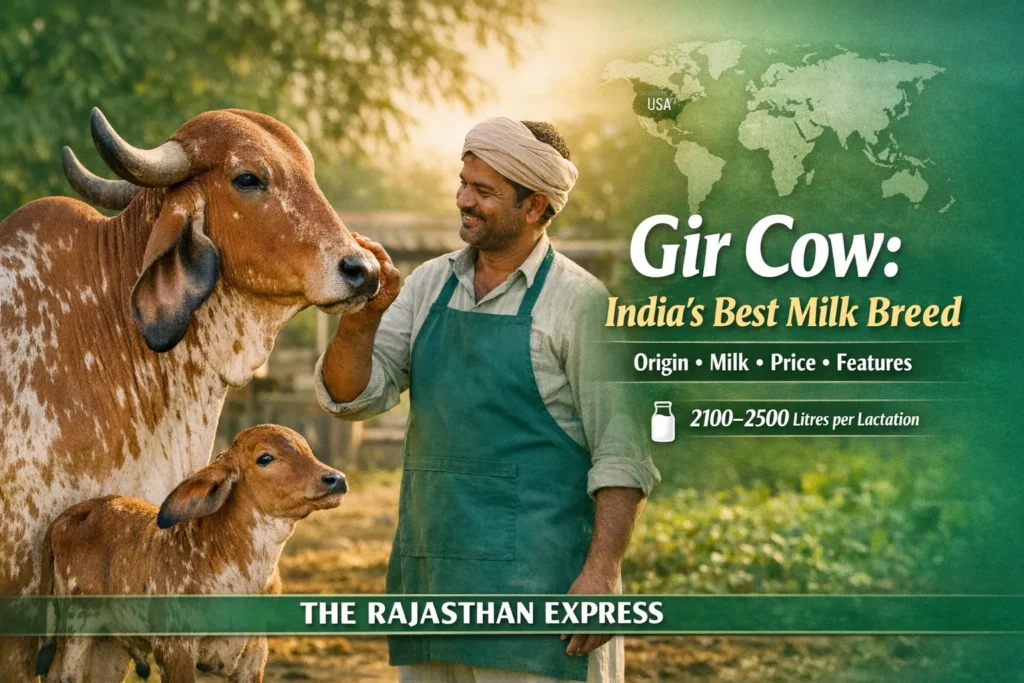
Gir cow is one of the most famous and registered indigenous breeds of India. It originated in the Kathiawar region of Gujarat and the Gir forests, which is why it is named “Gir.” People also call it Kathiawadi, Surti, or in Rajasthan, Ajmera Renda. Gir cow is mainly reared for milk, so it is called a “milch breed.”
It can produce an average of 2100 to 2500 liters of milk in one lactation (period after calving), and with good care, it can produce even more. The biggest specialty of the Gir breed is that it has the longest lactation period among all indigenous cows of India. Additionally, it has excellent tolerance to heat and diseases, which helps it adapt easily to different climates.
This is the reason why Gir cattle have been taken to countries like Brazil, America, and Venezuela to develop improved breeds. However, the highest milk-producing indigenous cow in India is Sahiwal.
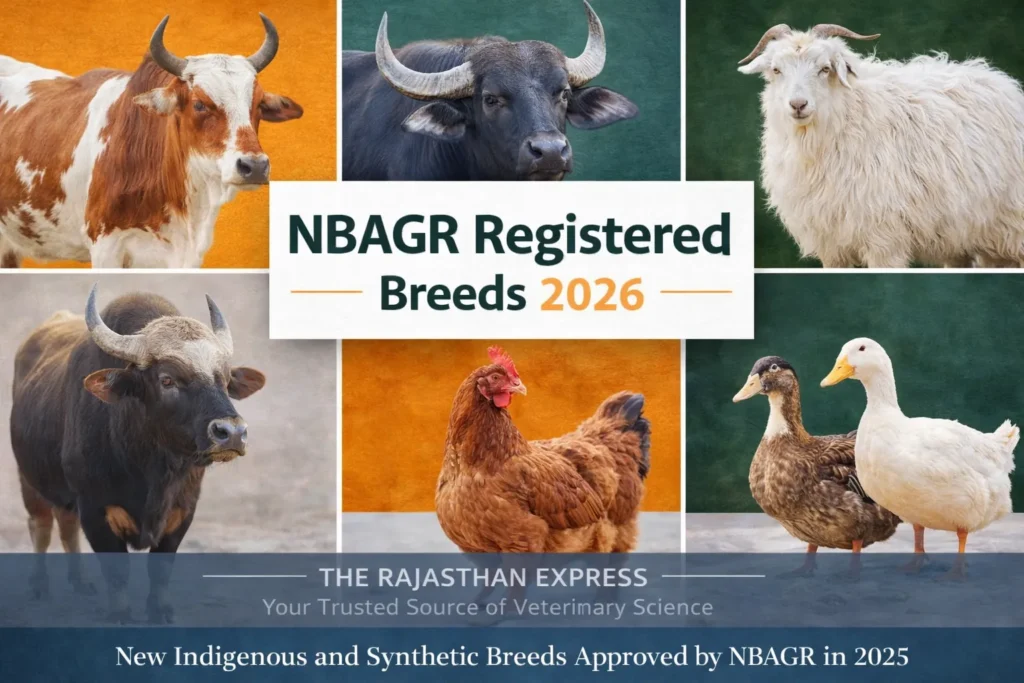
Now, regarding registration: Indigenous breeds are registered by NBAGR (National Bureau of Animal Genetic Resources) located in Karnal, Haryana. To register any breed, it is necessary that at least 1000 animals of that breed exist in the country.
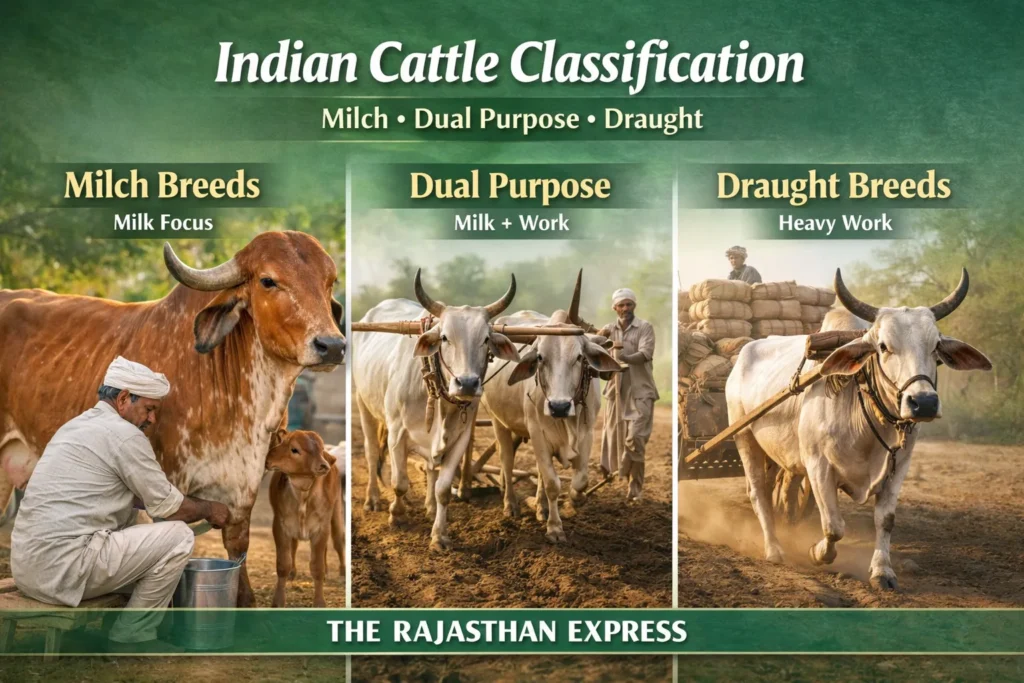
In India, indigenous cows are divided into three categories:
- Milch breeds (such as Gir and Sahiwal)
- Dual-purpose breeds (such as Hariana and Ongole, useful for both milk and ploughing)
- Draught breeds (such as Hallikar and Amritmahal, mainly used for pulling work)
Interestingly, India’s first synthetic (crossbred) cow is Frieswal, developed by combining Sahiwal (37.5%) and Holstein Friesian (62.5%). However, among pure indigenous breeds, Gir cow holds a unique and high position.
Gir Cow (Gir Gay)
| Other Names | Kathiawadi, Surti, Ajmera, Renda, Sorthi, Bhodali, Desi Gir, Gujarati Cow, Sorathi |
|---|---|
| Breed Type | Indigenous Zebu (Bos indicus) – Milch Breed (primary); bulls used for draught |
| Origin | Gir Forests, Kathiawar (Saurashtra), Gujarat, India Geographical coordinates: 20°5′ to 22°6′ N, 70° to 72° E |
| Official Breeding Tract | Amreli, Bhavnagar, Junagadh, Rajkot (Gujarat) |
| Distribution | Gujarat, Rajasthan (called Renda/Ajmera), Maharashtra; exported to Brazil, USA, Mexico, Venezuela |
| Primary Use | Milk production (milch breed); bulls used for ploughing & heavy load carrying (especially in Gujarat) |
| Milk Production |
|
| Lactation Period | ~325 days – Longest among all Indian indigenous cows (gives milk ~11 months/year) |
| Reproductive Traits |
|
| Physical Characteristics |
|
| Body Size & Weight |
|
| Adaptability | Highly tolerant to heat, drought, and diseases; thrives in arid, semi‑arid, and even hot‑humid climates (e.g., Konkan). Excellent disease resistance. |
| Special Traits |
|
| Global Impact |
|
| Brazil Success (Selective Breeding) |
|
| Scientific Importance |
|
| Population Status (India) |
|
| Economic Value (Gir Cow Price 2026) |
|
| Traditional Management Communities | Rabari, Bhanod, Maldhari, Ahir, Charan – generations of professional livestock keepers |
| Breed Classification | Milch breed (compared with Sahiwal, Tharparkar, Rathi, Sanchori). India’s indigenous cows divided into: Milch (Gir, Sahiwal), Dual‑purpose (Hariana, Ongole, Kankrej), Draught (Amritmahal, Nagori, Khillari, Vechur). |
| Additional Key Facts |
|
| Livestock Census Context (2019) |
|
| Summary: Gir Cow is India’s most globally influential indigenous dairy breed. Known for longest lactation (~325 days), 4.6% fat milk, excellent heat/disease tolerance, and unique physical traits (leaf‑shaped ears, half‑moon horns, domed forehead). It has transformed dairy industries in Brazil (Girolando) and USA (American Brahman). India’s first cloned cow “Ganga” belongs to this breed. Population increased from 9.17 lakh (2000) to 68.57 lakh (2019), making it the 3rd most numerous indigenous breed. Despite overall decline in desi cows, Gir remains a prized milch breed with prices ranging ₹40,000 to ₹2 lakh depending on pedigree and yield. | |
Classification of Indigenous Cattle Based on Utility
Indian Zebu breeds are divided into three main categories based on their primary utility:
1. Milch Breeds (Milk Breeds)
These breeds are mainly reared for high milk production. They are tolerant to different climatic conditions and produce high-quality milk.
Examples: Gir Cow, Sahiwal Cow, Tharparkar Cow, Rathi Cow, Sanchori Cow, etc.
- Gir: Origin is the Gir forest area of Gujarat. They have a reddish‑brown colour and long, drooping ears. Considered best for milk production.
- Sahiwal: This breed originally belongs to the Punjab region of Pakistan (Montgomery district), but it is also widely reared in India. It is a red‑coloured, calm‑temperament breed.
- Red Sindhi: This breed originates from the Sindh province of Pakistan. It is deep red in colour and has the ability to give good milk even in adverse conditions.
- Tharparkar: Originates from the Thar desert of Rajasthan. It is white or light grey and highly tolerant to drought and hot climates.
2. Dual‑Purpose Breeds
These breeds are equally suitable for both milk production and agricultural work (e.g., ploughing, carrying loads).
Examples: Ongole cow, Hariana, Kankrej, Mewati cow, Dangi, Deoni, Nimari, Nari, etc.
- Hariana: Found in Haryana and neighbouring states, this breed is known for its balanced performance in both tasks.
- Kankrej: This breed from Gujarat and Rajasthan is known for its large size and powerful build. Its special gait is famous as “Sawaichal”.
- Ongole: Originating in the Prakasam district of Andhra Pradesh, this breed is extremely powerful. Interestingly, Brazil imported this breed and crossbred it to develop a new breed called Nellore, which is very popular in Brazil today.
- Deoni: This breed developed in the Latur district of Maharashtra from crossing Gir, Dangi, and local breeds. It is a strong and reliable dual‑purpose breed.

3. Draught Indigenous Breeds
These breeds are mainly developed for carrying loads and agricultural work. Their muscles are extremely strong, and they are capable of performing hard physical labour.
Examples: Amritmahal, Nagori, Khillari, Hallikar, Malvi, Vechur, Bachaur, Panwar, Siri, Kangayam, Badri, Pullikulam, Punganur, etc.
- Amritmahal: This breed from Karnataka is considered one of India’s best draught breeds. It was developed by the rulers of Mysore for the “Milk Department” (Amritmahal) to provide strong bullocks for the army.
- Nagori: This breed from Rajasthan is famous for its extraordinary speed and stamina.
- Khillari: This is a major draught breed from Maharashtra, known for its strength and toughness.
- Vechur: This is a dwarf breed from Kerala, which, despite its small size, has good draught capacity. Its milk is also considered highly nutritious.
Gir Cow Origin (Gir Cow Origin / Gir Cow Breed Origin)
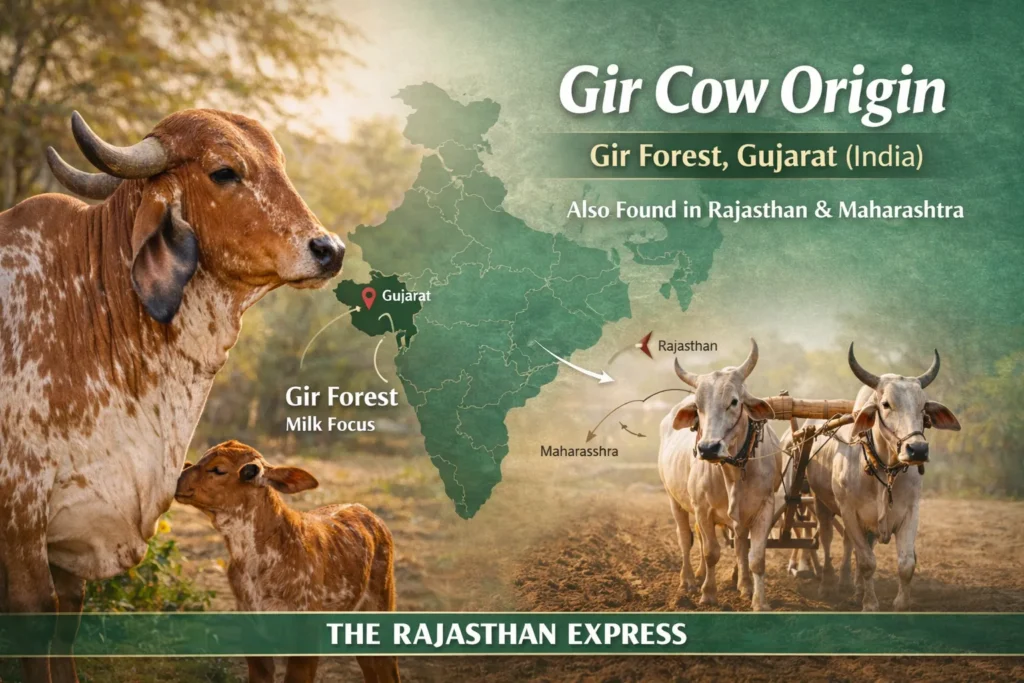
Gir Cow (also known as Kathiawadi, Renda, Ajmera, and Surti) originated in the Gir forests of the Saurashtra region of Gujarat. That is why this breed is named “Gir.”
Key Points About Gir Cow Origin:
- Original Region: Gir forests of Kathiawar, Gujarat
- Major Districts: Amreli, Bhavnagar, Junagadh, Rajkot, and Porbandar
- Geographical Range: Between 20°5′ to 22°6′ North latitude and 70° to 72° East longitude
- Spread to Other States: Maharashtra and Rajasthan
In Rajasthan, it is mainly found in Ajmer, Chittorgarh, Bundi, Kota, Bhilwara, and Tonk districts, where it is locally called “Renda.”
History and Global Impact of Gir Cattle (Gir Cattle / Gir Breed)
Now comes the most interesting part of the story. Our indigenous Gir Cow not only became famous in India but also established its dominance in distant countries like America and Brazil.
Gir Cow’s journey abroad is a very interesting and important story. At different times, this breed reached many countries and transformed their dairy industries.
Gir Cow in Brazil (Gir Cow Milk Production Success)
The history of Gir Cow in Brazil is very old and successful.
- Time and method of arrival: The Gir cow reached Brazil in several stages. Many people are credited with taking it there.
- Early arrival: According to some sources, the first Gir cows were taken to Brazil around 1850‑1870. Then between 1912 and 1921, they were sent in large numbers. Another account says that between 1918 and 1926, Gir cows were also brought to Brazil by ‘Angojas’ (possibly the English or another group).
- Contribution of Indian kings: According to a famous story, in the 1940s, the then Maharaja of Bhavnagar, Krishnakumarsinhji Bhavasinghji Gohil, gifted 18 Gir cows to Brazil. According to another event, in 1960, a Gir bull named ‘Krishna’ brought a dairy revolution to Brazil. Now let’s talk about an old Brazilian tale: after around 1870, many indigenous cows were taken from India to Brazil, among which the most special were – Gir and Kankrej.
- Success and advancement in Brazil:
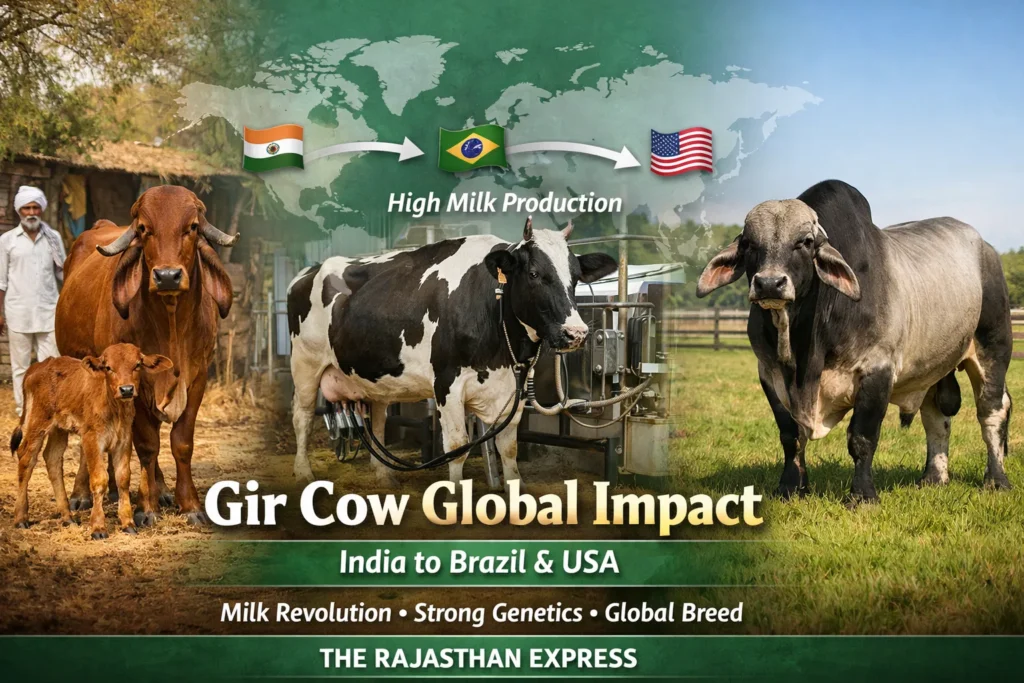
Brazil’s climate is very hot and humid, and Indian cows adapted so easily to the climate there, as if it were their own home. Brazilians also adopted the trick of crossbreeding. They mated their local cows with Indian Gir and Kankrej cows. The result was a new and excellent breed – Indu‑Brazil (also called Induberaba). This breed is entirely the gift of our Indian Zebu cows (especially Gir and Kankrej). Another interesting point is that in Brazil, the Kankrej breed is called Guzerá. After reaching Brazil, scientists there performed selective breeding on the Gir cow, greatly increasing its milk production. In India, the Gir cow gives an average of 5‑10 litres of milk per day, whereas in Brazil it began giving 50‑65 litres per day. It is important to note that the average production is taken in India, whereas in Brazil only those select animals that give very high milk are kept for breeding. - The Gir cow in Brazil was also used to create even newer breeds. The biggest success came in the form of the Girolando breed, which was created by crossing Gir with Holstein Friesian. Today this breed contributes 80% of Brazil’s total milk production. Thus, today Brazil has more than about 5 million (50 lakh) animals of the Gir breed (and breeds derived from it), making it one of the most important breeds there. This whole story is a living example of how an Indian breed went abroad, took its identity and potential to new heights, and is now returning to its native land in that improved form.
Reverse Import (Pizza Effect)
Today, an interesting situation exists. India, which originally gave Gir cows to the world, is now importing improved genetics from Brazil. This process is called reverse import or the pizza effect.
Reason:
- Brazil has significantly improved Gir cow genetics, especially for milk production. Indian farmers now import semen or embryos from Brazil to improve milk yield.
Gir Cow in America (American Brahman Story)
Gir Cow also has a long history in America. Although not as impactful as in Brazil, its contribution is very important.
Gir cattle were imported into America, Mexico, and Venezuela.
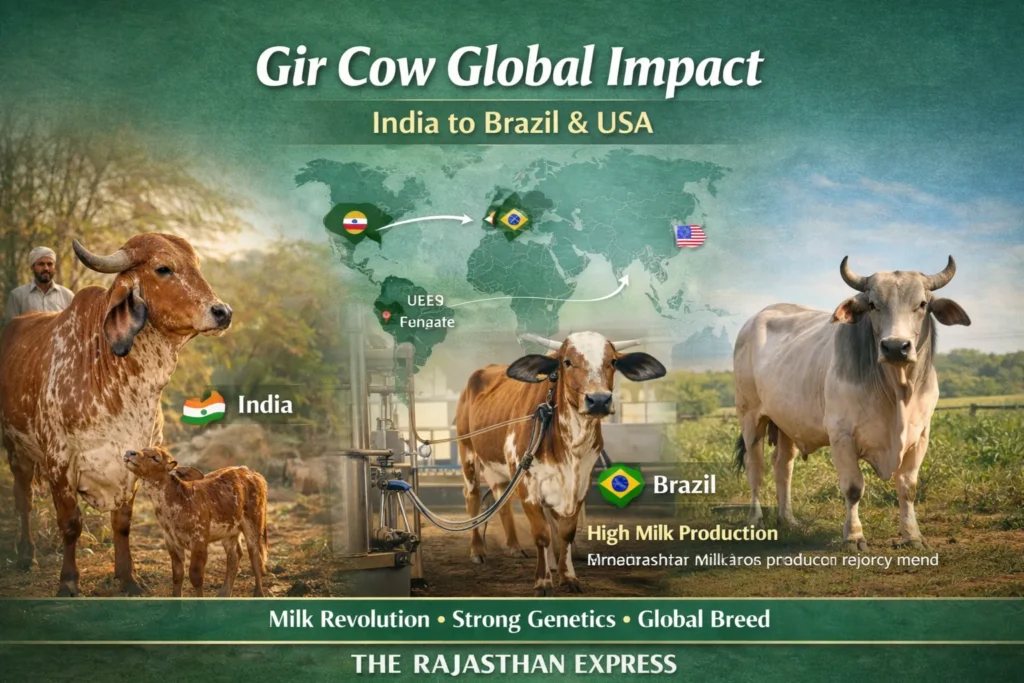
Birth of American Brahman:
The USA had hot and humid regions where European breeds could not survive well. So Americans imported Indian breeds:
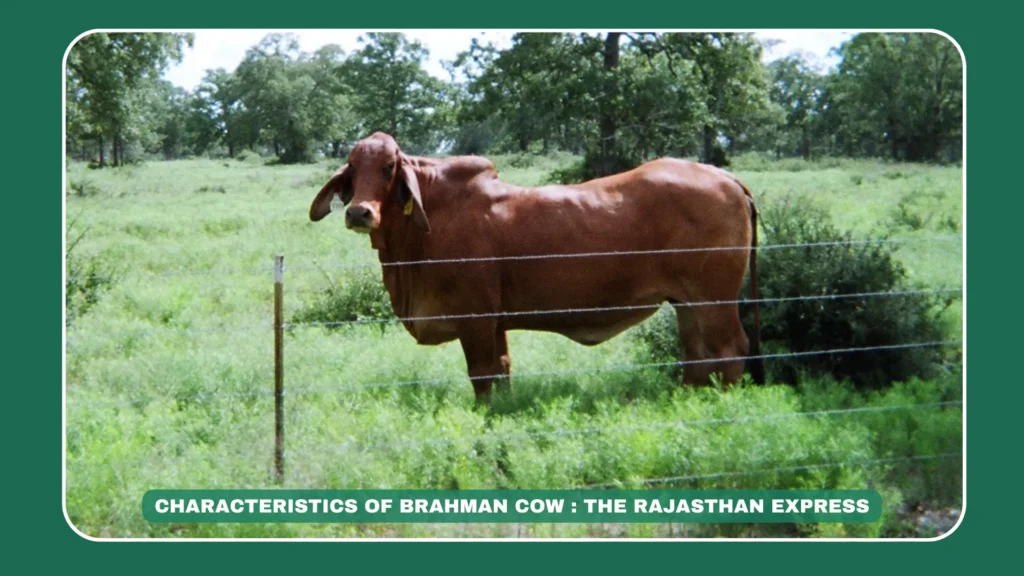
These were crossbred with local cattle, resulting in a new and powerful breed: American Brahman.
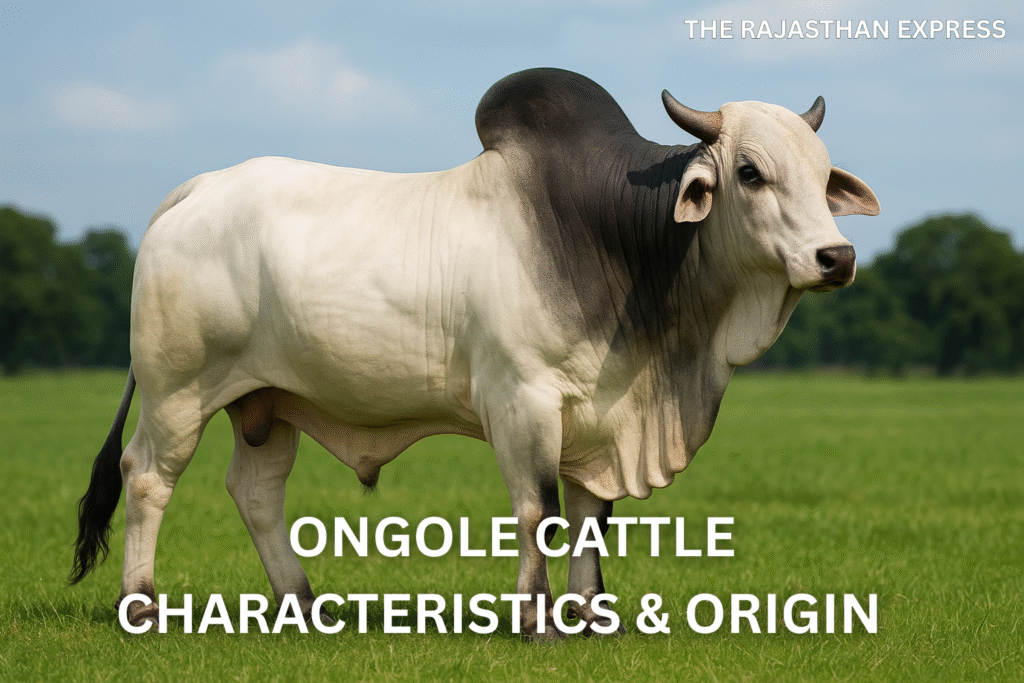
What are the qualities of the American Brahman?
It can tolerate great heat, diseases do not bother it (tremendous disease resistance), and it can survive even the harshest weather. Today this American Brahman is very popular in many hot countries around the world. Thus, our Gir cow contributed greatly to the livestock revolution in America.
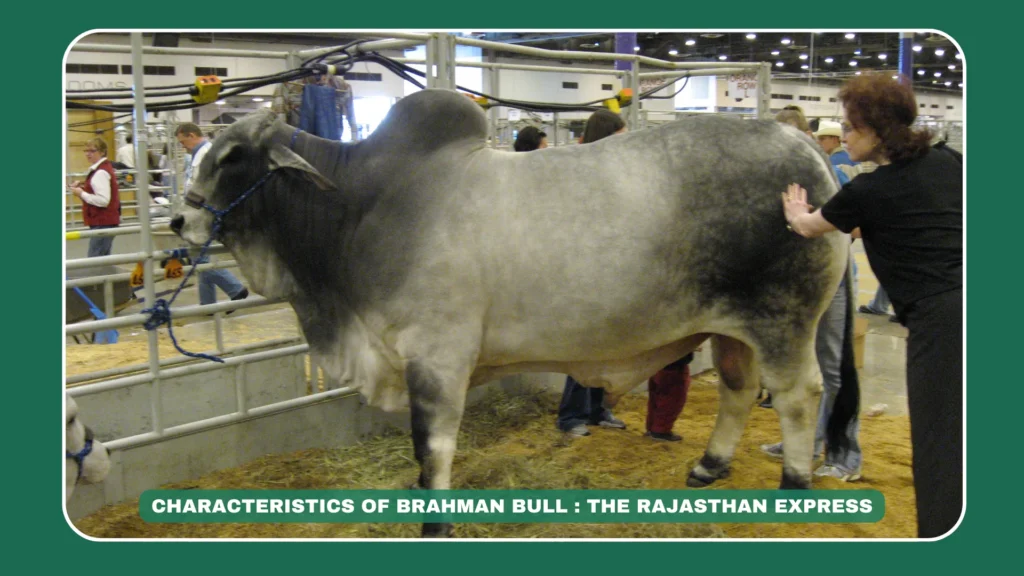
Kankrej Breed (Related to Gir Cattle Development)
Kankrej is an important indigenous breed of India, mainly found in the Kutch region of Gujarat. It is a dual-purpose breed used for both milk production and farming work.
Its main characteristics are: it easily survives in hot and dry weather, has a strong body and the ability to work fast, and also gives satisfactory milk. Because of these qualities, this breed was also very liked abroad, especially for creating the American Brahman in America. Thus, both Gir and Kankrej together brightened India’s name around the world.
Gir Cow Breeding Tract (Official Breed Area)
Gir Cow originated in the Gir forests of Gujarat, hence the name “Gir.”
The region where a breed originates and is mostly found is called its breeding tract.
Official Breeding Tract of Gir Cow:
- Amreli
- Bhavnagar
- Junagadh
- Rajkot
This is the original and main region where this breed started and is still found in large numbers.
Geographical Location:
- Longitude: 70° to 72°
- Latitude: 20°05′ to 22°06′
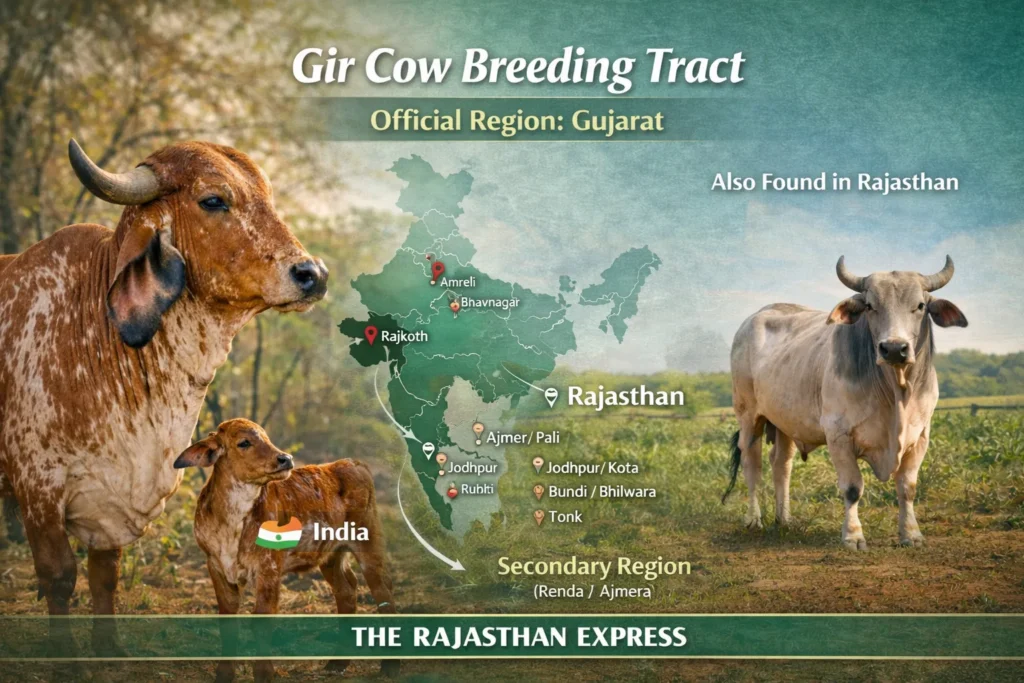
Gir Cow in Rajasthan (Gir Cow in Rajasthan / Gir Gay)
- Gir cows are also widely found in Rajasthan, especially in: Ajmer, Pali, Jodhpur, Chittorgarh, Bundi, Kota, Bhilwara, and Tonk districts.
- In Rajasthan, people call it Renda or Ajmera.
The official origin and breeding tract of Gir Cow is strictly limited to Gujarat (Amreli, Bhavnagar, Junagadh, Rajkot), even though it is widely found in Rajasthan and other states today.
Gir Cow Other Names (Gir Gay / Gir Cattle Names in India)
The origin place of the Gir cattle is considered to be Kathiawar, Gir forests, Gujarat. Because of this, it is also known as Kathiyawadi, Surti, Ajmera and Renda (in Rajasthan) cow.
The Gir cow is originally a native of the Kathiawar region of Gujarat and the Gir forests. That is why it got several names, which reflect the language and culture of different areas.
- Kathiyawadi – This name comes from ‘Kathiawar’ (a famous region of Gujarat). This cow is found most abundantly in this area, so people lovingly call it Kathiyawadi.
- Surti – This breed is also found a lot in and around the Surat district of Gujarat. People there call it ‘Surti’.
- Ajmera – This name is associated with the city of Ajmer in Rajasthan and its surrounding areas. When this breed spread to Rajasthan, it started being called ‘Ajmera‘ around Ajmer.
- Renda – In Rajasthan, especially in districts like Ajmer, Pali, Jodhpur, Tonk, Bhilwara, etc., the Gir cow is known by the name ‘Renda‘. This is a name prevalent in the local dialect.
- Bhodali – In some very local areas (perhaps in some parts of Gujarat or some villages of Madhya Pradesh), it is also called ‘Bhodali’. Although this name is less common, it can be heard among older livestock keepers.
- Desi Gir – Since this is a completely indigenous breed, and no foreign blood has been mixed in it, many times people also call it simply ‘Desi’ or ‘Desi Gir’. This name reflects its purity.
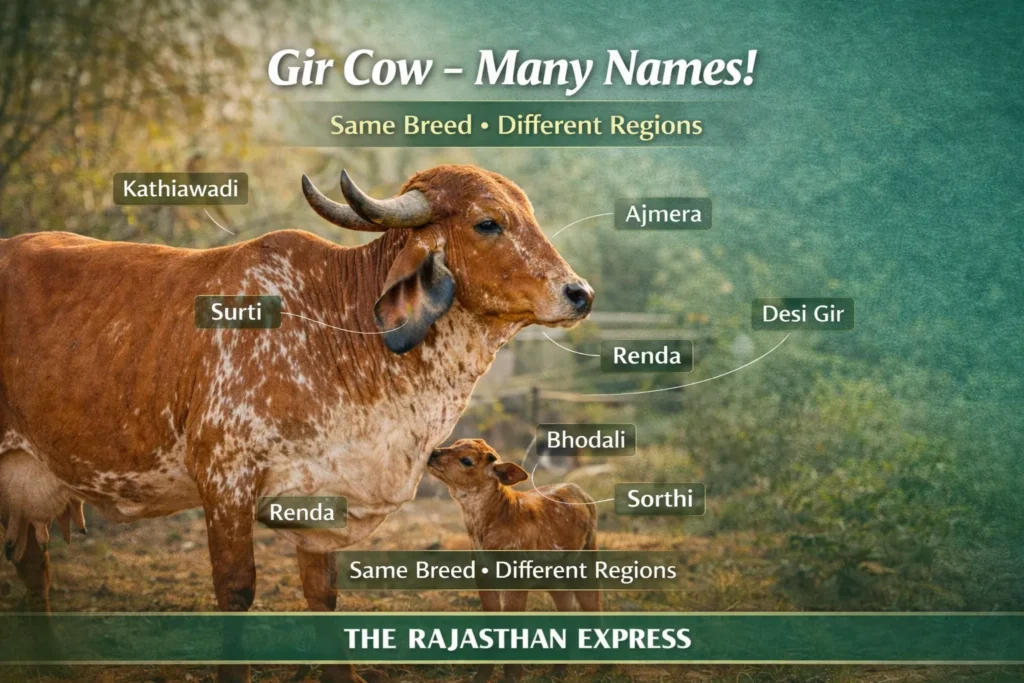
| Names and Their Regions | ||
| Name | Why is it called that? | Where is it prevalent? |
|---|---|---|
| Kathiyawadi | Because this cow is found in Kathiawar (Gujarat). | Amreli, Bhavnagar, Junagadh, Rajkot districts of Gujarat. |
| Surti | In the city of Surat and surrounding areas, this name was given. | Surat region of Gujarat. |
| Ajmera | This breed is also found abundantly in the Ajmer region of Rajasthan. | Rajasthan (Ajmer, Pali, etc.) |
| Renda | In many parts of Rajasthan, it is called Renda in the local language. | Rajasthan (especially Marwar region) |
| Bhodali | In some areas, especially parts of Gujarat, it is also called Bhodali (slightly less common). | Some villages of Gujarat |
| Desan / Gujarati | It is a pure indigenous breed, so sometimes people simply call it “Desi” or “Gujarati cow”. | In common conversation |
| Sorthi | Named after “Sorath”, a part of Kathiawar. | Sorath region of Gujarat |
| The Rajasthan Express : Regional Names of Indigenous Cattle | ||
All these names refer to the same breed (Gir). Gir Cow is known for its pink udder, bulging forehead (dome-shaped), and long drooping ears.
Gir, Kathiawadi, Surti, Ajmera, Renda, Bhodali, Sorthi – all are names of the same cow, just like one person can have different nicknames.
Gir Cow for Use in India (Gir Cow Uses)
Gir Cow for use in India (For what purpose is the Gir cow reared in India?)
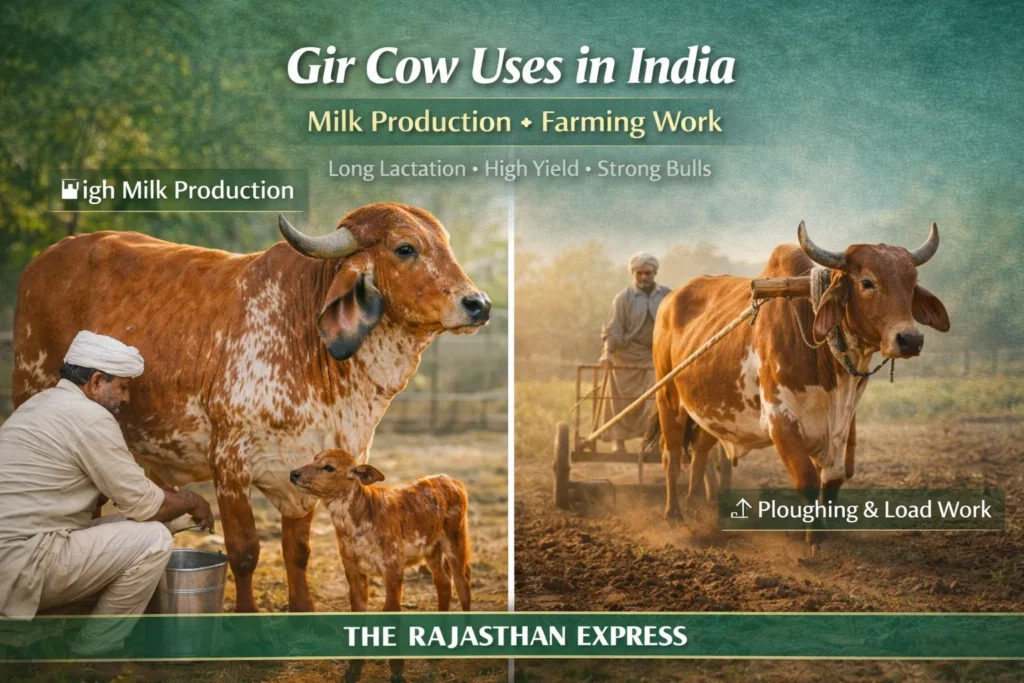
Gir Cow is mainly a milch breed, meaning it is mostly reared in India for milk production.
The biggest specialty of this breed is that among all indigenous cows of India, it has the longest lactation period. A Gir Cow produces milk for about 325 days after calving, which means it gives milk for almost 11 months in a year.
- In one lactation, it produces about 2110 kg (around 2100 liters) of milk on average.
Not only for milk, but in the Gujarat region, Gir bulls are also used for ploughing fields and carrying heavy loads. These bulls can easily walk on sand, black soil, or rocky land.
Rearing of Gir Cow Calf (Baby Gir Cow Care)
- Gir cows are usually reared by professional livestock keepers such as Rabari, Bhanod, Maldhari, Ahir, and Charan communities. These communities have been engaged in animal husbandry for generations and take very good care of Gir cattle.
Digestive System of Gir Cow (Ruminant Animal)
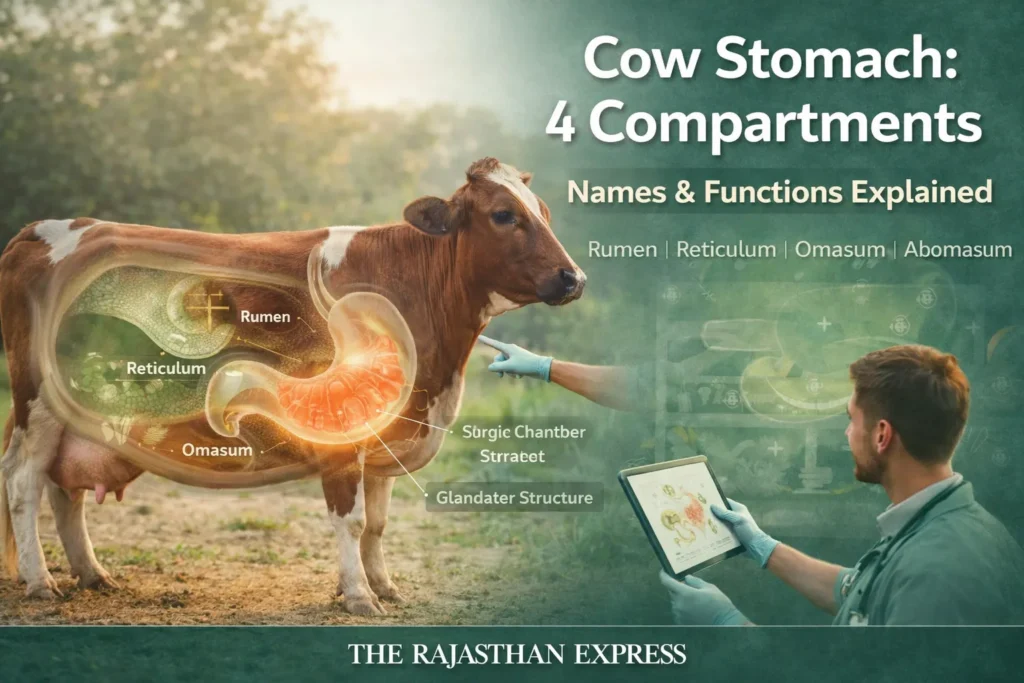
Gir Cow is a ruminant animal. Its stomach is divided into four parts:
When the cow grazes grass, microorganisms in the rumen help digest cellulose (fiber).
How the Calf’s Digestion Develops
A newborn calf is like humans – only the abomasum (true stomach) works initially.
Gradually, when the calf drinks milk for 8–12 months and starts eating dry fodder (grass, hay), beneficial bacteria develop in the rumen. Over time, the rumen becomes fully functional, and the calf learns to digest grass properly.
Why Tying Cow in Field at Night is Important
Keeping the cow tied in the field at night helps it perform rumination (chewing cud).
Rumination means the cow brings back partially digested food from the rumen to the mouth and chews it slowly again. This improves digestion and increases milk production.
Gir Cattle Characteristics (Physical Features of Gir Cow Breed)
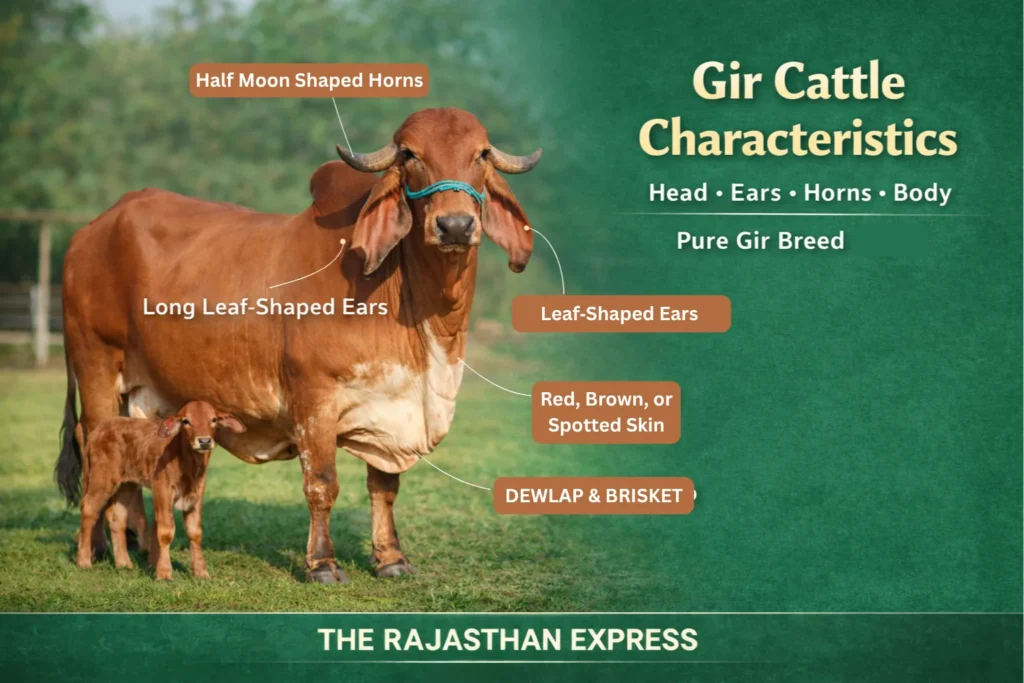
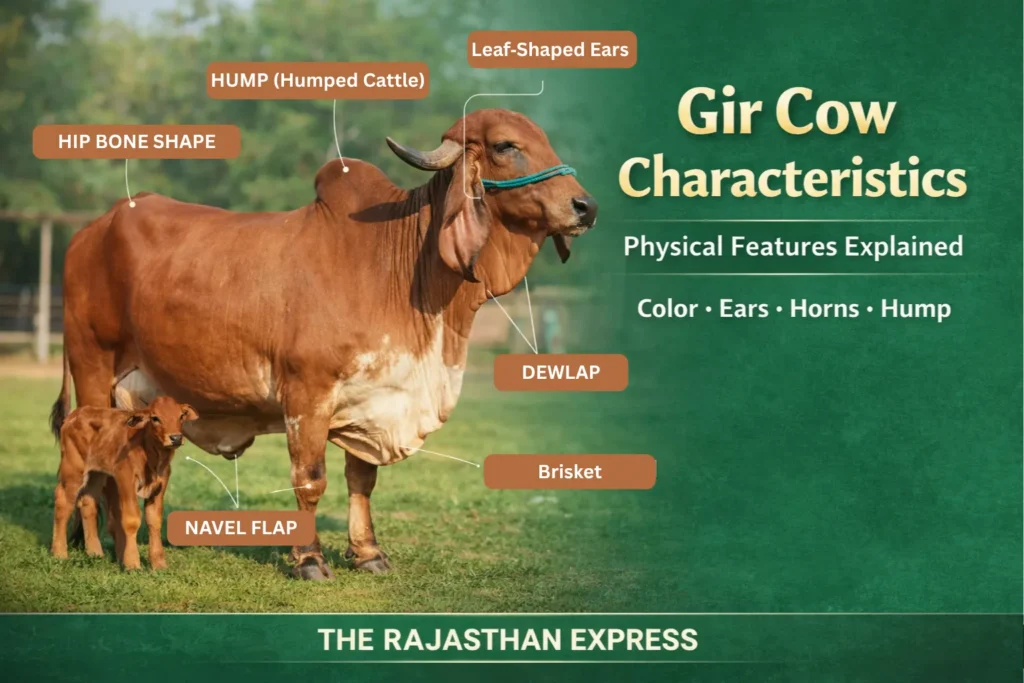
Gir Cow can be identified by its unique physical characteristics, which distinguish it from other breeds.
Colour of Gir cow
- First of all, talking about colour, the colour of the Gir cow is usually deep red to brown. But its most special feature is that black or white spots are scattered all over its body.
- On some cows, these spots are very clear, on others they are faint. Calves are often born light red in colour, and the colour darkens as they grow. This colour also helps protect it from heat.
Head
- Its head or forehead (frontal bone) is very wide and prominent, often called ‘Doli wala matha’ – this is a key identifier.
Ears
- The most unique identification is its ears – the Gir cow’s ears are very long, loose (hanging), and curved. These ears are leaf‑shaped, meaning they are wide at the bottom and not pointed at the tip, but rather round or flat. These ears are so long that they hang down to the neck and often curve downward. This leaf‑shaped ear is the second biggest identification of the Gir cow – anyone can easily tell by looking that this is the Gir breed.
- Here is an interesting fact: the ‘Nali sheep’ found in the Sri Ganganagar, Hanumangarh, Bikaner and Churu districts of Rajasthan also have leaf‑shaped ears. This is the only breed of sheep that gives yellow wool. But this is the only similarity between cow and sheep – everything else is different.
Horns
- Now talking about horns, the Gir cow’s horns are curved in a special way. They start from the lower part of the head, then turn under and behind the ears, and finally curve slightly upward and forward to form a spiral‑like twist. The shape thus formed is called a half‑moon like shape, which is another key identification of the Gir cow.
Hump
- This is a Zebu breed, so it has a large and fleshy hump above its neck and shoulder. The hump of bulls is much larger and more prominent than that of cows. This hump gives it energy even in heat and drought.
Body structure
- The Gir cow’s body is strong, deep, and heavy. It is neither very small nor very large. On average, its weight is 400‑500 kg (cow) and a bull’s weight up to 550‑650 kg. Its back is straight, but may also appear slightly sloped.
Special structure of the hip bone
- Finally, its hip bone is also prominent, which is an additional physical characteristic of this breed. A pure Gir cow is identified by seeing all these traits.

Gir Bull vs Gir Cow Weight (Male vs Female)
| Gir Bull vs Gir Cow Weight (Male vs Female) | ||
| Measurement | Male (Bull) | Female (Cow) |
|---|---|---|
| Height (shoulder) | ~160 cm | ~131 cm |
| Body length | 138 cm | 131 cm |
| Chest girth | 201 cm | 166 cm |
| Weight | 544 kg | 310 kg |
| Birth weight | ~20–21 kg | — |
| The Rajasthan Express : Gir Bull vs Cow Comparison | ||

Gir Cow Milk Production (Gir Cow Milk Per Day & Capacity)
Gir Cow produces an average of 2110 kg (approx. 2110 liters) of milk per lactation. According to ICAR-NBAGR, a Gir Cow can produce between 800 kg to 3300 kg of milk per lactation.
This means:
- Average: 2100–2200 liters
- High-yield cows: up to 3300 liters
Gir Cow Milk Per Day
- Normal Gir Cow: 6–12 liters per day
- High-yield Gir Cow: 15–20 liters per day
- Milk fat content: 4.6%
| Gir Cow Performance (Production Data) | |||
| Performance | Average | Minimum | Maximum |
|---|---|---|---|
| Age at first calving | 46.08 months (~3 years 10 months) | 39 months | 59 months |
| Calving interval | 13.4 months | — | — |
| Milk per lactation | 2110 kg | 800 kg | 3300 kg |
| Milk fat % | 4.6% | 3.9% | 5.1% |
| The Rajasthan Express : Gir Cow Performance | |||
Key Insights About Gir Cow Milk Production
- Gir Cow takes about 4 years to be ready for first calving.
- The gap between two calvings is about 13–14 months, which is considered good.
- Gir Cow milk is thick and nutritious. While normal cow milk contains 3–4% fat, Gir Cow milk contains up to 4.6% fat.
- After calving once, it produces an average of 2100–2200 liters, and good cows can produce up to 3300 liters.
Key Points About Indigenous Cows in India (Desi Cow Facts)
- India’s best draught (load‑carrying) breed is Amrit Mahal.
- Maharashtra’s best draught breed is Khillari.
- Rajasthan’s best load‑carrying breed is Nagori.
- India’s best dual‑purpose (milk + work) breed is Hariana.
- The world’s smallest cow breed is Vechur.
- India’s heaviest cow breed is Kankrej.
- The Kankrej breed exhibits a “Sawai Chal” (fast and special gait).
- Deoni cow was created by crossing Gir, Dangi, and local cows.
- Nimari cow was created by mixing Gir and Khillari breeds.
- India’s most expensive cow breed is considered to be Ongole. In Brazil, this same breed is called Nelore. At the beginning of the year 2025, a Nelore cow named “Viatina‑19” was sold for approximately ₹40‑41 crore. It also set a Guinness World Record. “Viatina‑19” weighed about 1100 kg, which is much more than a normal cow. The first Ongole cows were taken from India to Brazil in 1868. Later, by 1960, about 7000 cattle were sent there. In Brazil, this breed was named “Nelore”, after the Nellore district of Andhra Pradesh.
- Among indigenous cows, the longest lactation period is of the Gir cow (about 325 days). The Gir cow originated in the Gir forests of Kathiawar, Gujarat. The Gir cow is also called Kathiyawadi, Ajmera, Renda, Surti.
- Among buffaloes, the longest lactation period is of the Mehsana buffalo (about 352 ± 15 days).
- Identification of Gir cow:
- Red, brown, or spotted skin
- Prominence on forehead
- Long, hanging, leaf‑shaped ears
- Half‑moon shaped horns
- India’s highest milk‑producing indigenous cow is Sahiwal.
- In the Sahiwal cow, the dewlap (loose skin of the neck) and Nawelflap are more developed. This is the main identification of the Sahiwal cow. The Sahiwal cow originated in Montgomery (Pakistan), Punjab, Haryana. The Sahiwal cow is also called Lola breed, Multani, Montgomery, Lambi Bar.
- Because the Sahiwal cow’s skin is loose, it is also called the Lola breed.
- The most intelligent cow breed is considered to be Red Sindhi. The Red Sindhi cow originated in Karachi, Hyderabad (Sindh), Pakistan. The Red Sindhi cow is also called Red Karachi.
- Among indigenous breeds, the highest disease resistance is found in the Tharparkar cow, which is found in the state of Rajasthan, India. The Tharparkar cow originated in the Tharparkar district of Sindh province in Pakistan and in Gudamalani, Barmer. It is also known as White Sindhi, Grey Sindhi, or Thari and Malani. This breed is named after the Thar Desert, which extends from Sindh to the Kutch district of Gujarat and to the Barmer, Jaisalmer, and Jodhpur districts of Rajasthan, India.
- The Tharparkar cow also has the ability to change colour.
- The highest milk‑producing cow in Rajasthan is Tharparkar.
- The Rathi cow was created by mixing Red Sindhi, Sahiwal, Tharparkar, and Dhani breeds. The Rathi cow is also called Rajasthan’s Kamadhenu.
Gir Cow Price (Gir Gay Ki Kimat / Gir Cattle Price)
The price of a Gir Cow depends on several factors:
- How much milk does it give? (More milk = higher price)
- How pure is the breed? (Registered cow is more expensive)
- What is the age of the cow? (Young cow higher price)
- Is the cow pregnant? (If yes, price increases)
- Is the cow’s pedigree record (ancestry) available? If the record is available and there is living proof of the success of the cow’s ancestors (parents, grandparents) – such as how much milk they gave, how many calves they delivered, how seldom they fell ill – then the price of such a cow becomes several times higher than a normal cow.
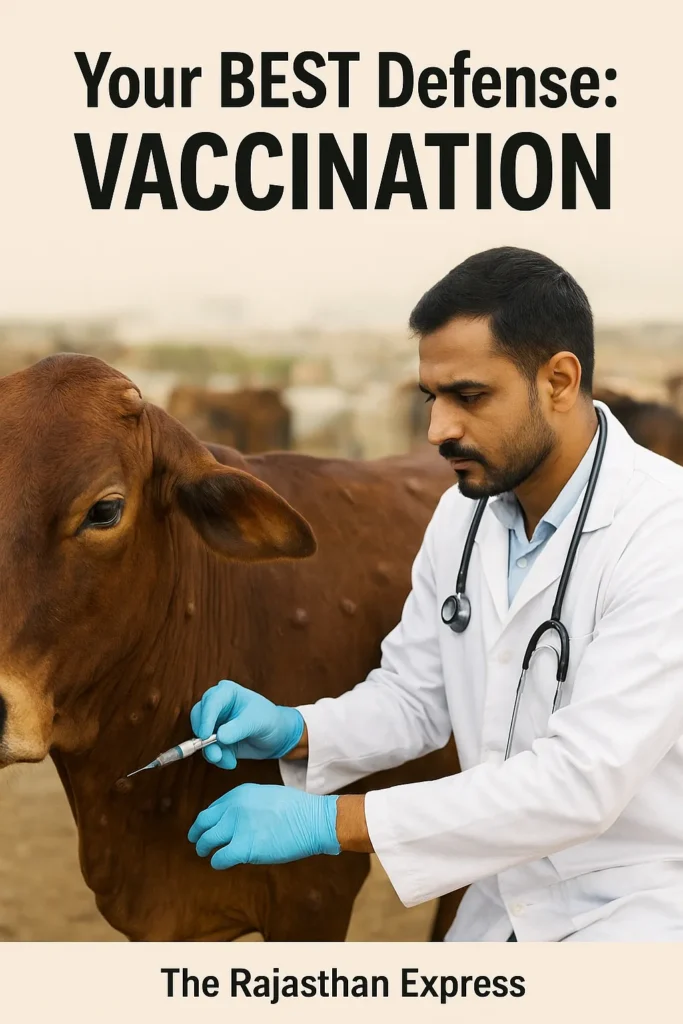
- Has the cow been vaccinated from time to time? If yes, and there is a vaccination certificate, then its price also increases several times over normal cows because protection against diseases has already been done.
- Where are you buying? (Cheaper in Gujarat, more expensive in other states)
📌 Estimated price (as of 2026):
- Ordinary Gir cow: ₹40,000 – ₹80,000
- Good milch Gir cow: ₹80,000 – ₹1,50,000
- Cow with complete records (milk record, calving birth, heat period, calving time, conception rate, pedigree, vaccination – everything with documents) + extremely high milk‑yielding: up to ₹2 lakh
Gir Cow Reproductive Performance Research
This research, which is based on 25 years of data from 1981 to 2005 and studied 226 Gir cows, clearly shows that the Gir cow can breed excellently in hot and humid areas like Konkan (e.g., Ratnagiri, Dapoli) without any special technology. Let us see what this research found about the cow’s reproductive health.
First of all, the puberty of the Gir cow occurs at about 2 years 8 months (979 days), which is slightly slow but considered normal for this breed. After that, when the cow gives birth for the first time, her age is about 3 years 5 months (1254 days). This figure is very good, because in many other indigenous breeds the age at first calving is 4 to 5 years. Not only that, at the time of first calving the cow’s weight is 352 kg, meaning she is fully developed. All this shows that the Gir cow is maturing well in the Konkan climate.
Now the most important thing – the time taken to become pregnant again after calving, called the ‘service period’. For the Gir cow, this period was found to be only 108 days (about 3.5 months), which is very good. If it exceeds 150 days, it causes loss in dairy farming, but here it is very low. Meanwhile, to get her pregnant once, an average of 1.83 matings (about 2 times) were required, which is completely normal. If this number had been more than 2, it would be considered a fertility problem.
An even bigger point is the ‘calving interval’, i.e., the time from one calving to the next. For the Gir cow, this interval was found to be 387 days, i.e., about 13 months. According to the dairy industry, this is absolutely ideal (12‑14 months). This means that even in the hot‑humid area of Konkan, the Gir cow can give one calf almost every year. The gestation period (time to produce a calf) was found to be 280 days i.e., 9 months, which is normal for cows. And the dry period (when the cow does not give milk) was 88 days i.e., about 3 months, which is also considered ideal because during this time the cow’s body prepares for the next calving.
Finally, reproductive efficiency was found to be 40.70% and breeding efficiency 89.29%. Efficiency above 89% is considered very good, proving that the Gir cow’s calving interval is quite close to the ideal (365 days).
So the direct answer is yes, the Gir cow gives calves very well even in hot and humid areas like Konkan, and her reproductive health is perfectly fine. Provided she receives proper care and nutrition. That is why the Gir cow is considered an excellent indigenous breed from both perspectives – milk and fertility.
India’s First Cloned Gir Cow (Ganga)
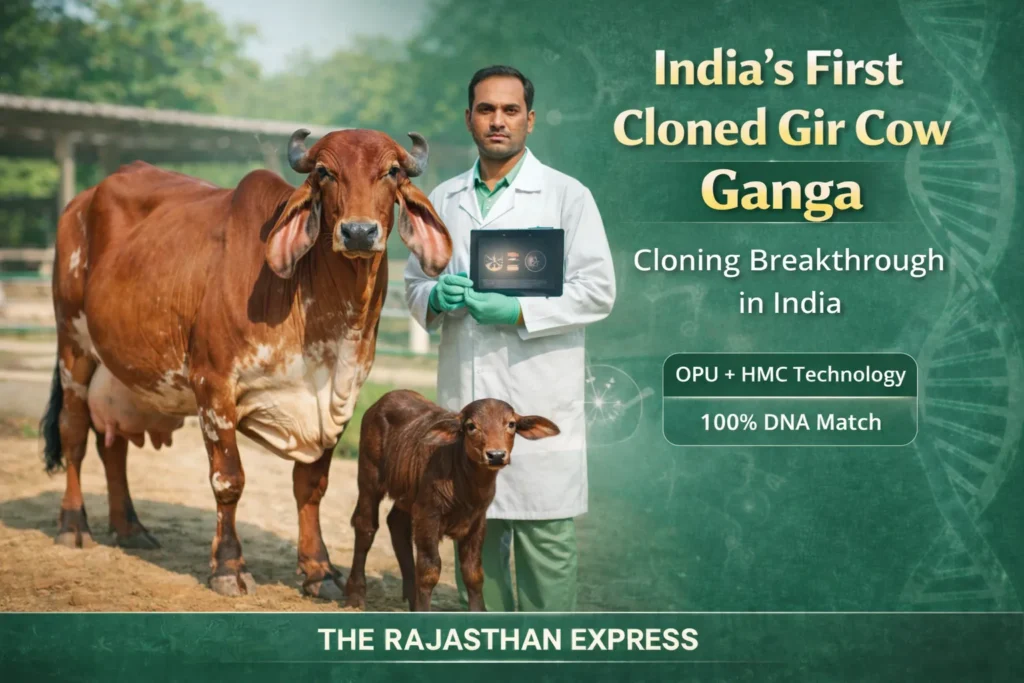
This is the scientific story of the birth of India’s first cloned cow. The breed of the cow is Gir, and she was named “Ganga”.
Why is cloning necessary?
- Cloning means – creating an exact genetic copy (identical replica) of an animal. For example, if a cow gives very high milk or has the strength to fight diseases, then making another cow that is exactly the same.
World’s first cloned sheep – The world’s first cloned sheep, Dolly, was created in 1996. After that, cloned cows, buffaloes, goats were created all over the world. But before 2025, no cloned cow had been created in India. The biggest reason for this was that for cloning, the cow usually had to be killed to extract eggs (oocytes), but cow slaughter is banned in India. This research proved that eggs can be extracted from a live cow without killing her using OPU (Ovum Pick‑Up) technology.
How was the cloning done?
Step 1: Cells taken from donor cow (Donor – Gir)
- First, a small piece of tissue was taken from the tail of a just 2‑month‑old Gir breed calf. Fibroblast cells were grown in the lab from this piece, which contained the complete DNA (genetic code) of that calf – this became the “donor” cow.
Step 2: Where were eggs (Oocytes) brought from? (Recipient – Sahiwal)
- On the other side, 98 eggs were extracted from living Sahiwal breed cows using OPU technology. These eggs were extracted without killing (transvaginal ovum pick‑up) – this is very important because cow slaughter is banned in India. Then scientists worked with Handmade Cloning (HMC) technology.
Step 3: Creating the cloned embryo – Handmade Cloning (HMC)
- They removed the nucleus (genetic material) from the Sahiwal cow’s eggs, emptying them. Then they placed the donor cell of the Gir breed (which contained the real Gir cow’s DNA) inside those empty eggs and fused them with a mild electric shock. In this way, 24 cloned embryos were created, of which 5 embryos could become blastocysts (healthy embryos about 8 days old). These 5 embryos were transferred into 5 crossbred surrogate mothers (into whose uterus the embryos were placed).
Step 4: Transfer into surrogate mother
- Among these, 2 cows became pregnant, but one miscarried. The remaining one surrogate mother completed the full pregnancy and gave birth to a healthy female calf weighing 32 kg, which was named “Ganga”. To ensure that Ganga was indeed an exact copy of that Gir cow, DNA fingerprinting (microsatellite analysis) was performed, which confirmed that Ganga’s DNA completely matched the donor Gir cow, while the surrogate mother’s DNA was different.
Step 5: Genetic confirmation (Microsatellite Analysis)
- To ensure that Ganga was indeed a copy of the donor Gir cow, DNA fingerprinting was done.
- Result: Ganga’s DNA completely matched the donor Gir cow. The surrogate mother’s DNA was different.
Can a cloned cow herself produce calves? (Reproduction Performance)
- The most important question was whether this cloned cow could herself produce calves. The answer is yes.
What happened:
- Ganga reached puberty normally, came into heat on time, and the number of follicles in her ovaries was normal like other cows. Scientists also extracted eggs from Ganga using OPU technology, performed IVF (in‑vitro fertilisation) on those eggs, and 35% of the eggs transformed into healthy embryos – which is equivalent to normal cows. When these embryos were transferred into surrogate mothers, one pregnancy succeeded, meaning Ganga gave birth to a calf.
- India has created a cloned cow of its indigenous breed (Gir). Now India’s name has been added to the list of countries that can clone.
- Cloning without killing cows: Eggs were extracted without slaughter using OPU – this is very important for a country like India where cow slaughter is banned.
India’s First Cloned Buffalo – Garima
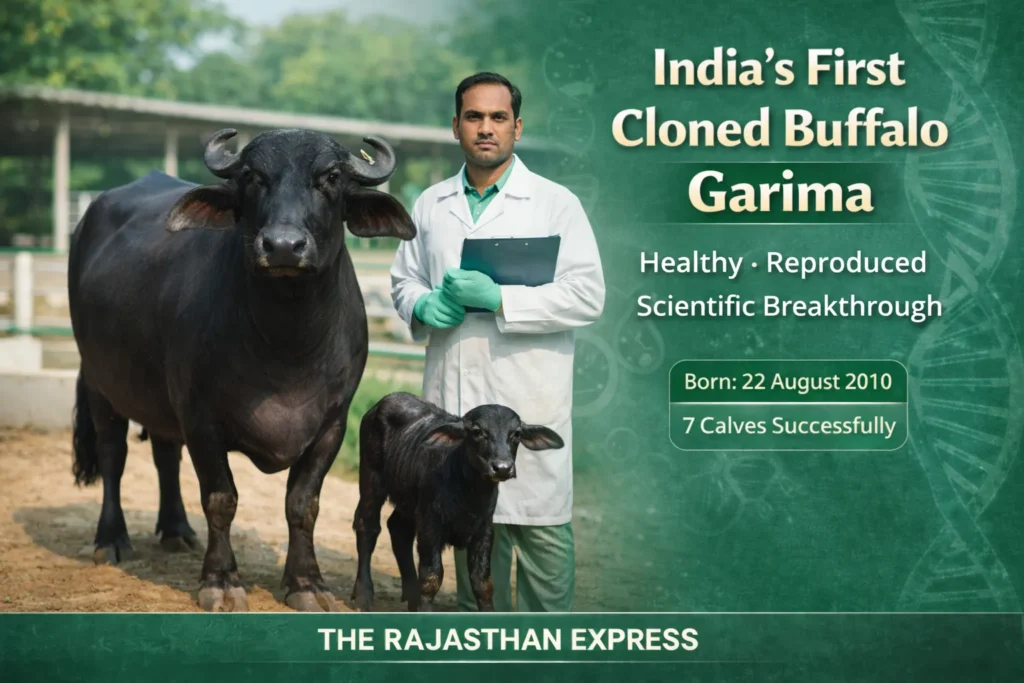
Garima is India’s first living cloned buffalo, created by scientists at the National Dairy Research Institute (NDRI), Karnal, Haryana.
Earlier, in 2009, a cloned buffalo named Samriddhi was born but survived only 7 days. Scientists continued their efforts and successfully produced Garima on 22 August 2010.
Garima was completely healthy and later gave birth to 7 calves (3 males and 4 females). Her first offspring, Mahima, was born in 2013.
This proved that cloned animals are healthy and capable of reproduction. The success was achieved using Handmade Cloning (HMC) technology, which is cost-effective and simple. The same technology was later used to create India’s first cloned cow, Ganga.
India’s First Horse via Embryo Transfer – Raj-Shital
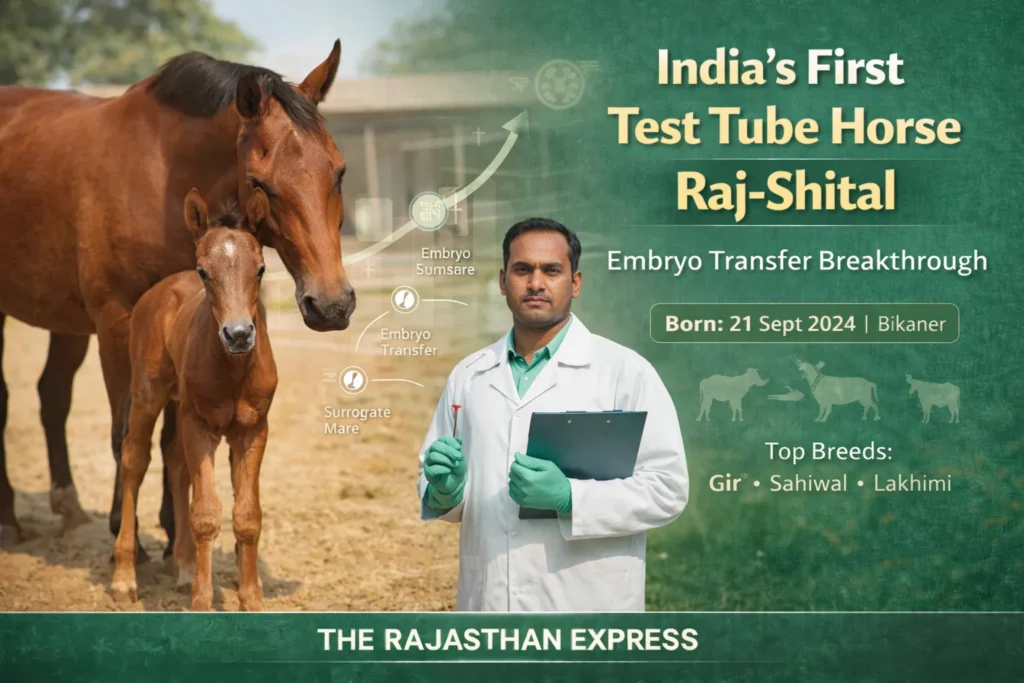
Raj-Shital is India’s first foal produced through embryo transfer technology (not cloning).
- Born on 21 September 2024
- Location: ICAR-NRCE, Bikaner, Rajasthan
The process of her birth is very interesting: first, a high‑quality breed mare was inseminated with frozen semen.
After 7.5 days, the embryo was taken out from her uterus. Then that embryo was frozen in liquid nitrogen using a technique called ‘vitrification’ (ultra‑rapid cooling without forming ice crystals).
Read More About : Artificial Insemination In cattle
After about two months, this embryo was thawed and placed into the uterus of a surrogate mare, who carried it for the full 11 months and then gave birth.
This achievement is very important because the population of horses and donkeys in India is continuously declining – between 2012 and 2019, it decreased by 52.71%.
With the success of this technique, we can now conserve precious indigenous horse breeds like Marwari, Zanskari, Kathiyawadi, Manipuri without any risk. A good mare gives only one foal per year, but with embryo transfer, multiple embryos can be taken from the same mare and placed into different surrogate mares, thereby rapidly increasing the number of good breed horses.
Livestock Population in India (20th Livestock Census 2019)
| Livestock Population in India (20th Livestock Census, 2019) | ||
| Particulars | 20th Livestock Census (2019) figure | Change from previous census (2012) |
|---|---|---|
| Total livestock | 53.58 crore (535.78 million) | +4.6% (increase) |
| Total cows (all types) | 19.25 crore (192.49 million) | +0.8% (increase) |
| Indigenous/unclassified cows | 14.21 crore (142.11 million) | -6% (decline) |
| Exotic/crossbred cows | 5.04 crore (50.42 million) | +26.9% (remarkable increase) |
| Female cows (Cows) | 14.51 crore (145.12 million) | +18.0% (much higher than previous census) |
| Buffaloes | 10.98 crore (109.85 million) | +1.0% |
| Goats | 14.89 crore (148.88 million) | +10.1% |
| Sheep | 7.43 crore (74.26 million) | +14.1% |
| The Rajasthan Express : Livestock Census 2019 | ||
Important point:
- While the total cow population has increased marginally by 0.8%, the population of female cows has seen a large increase of 18.0%. In contrast, the total population of indigenous cows (both male and female) has declined by 6%. These figures indicate that attention to milk production has increased, due to which the number of female animals has increased.
Population of Gir cow
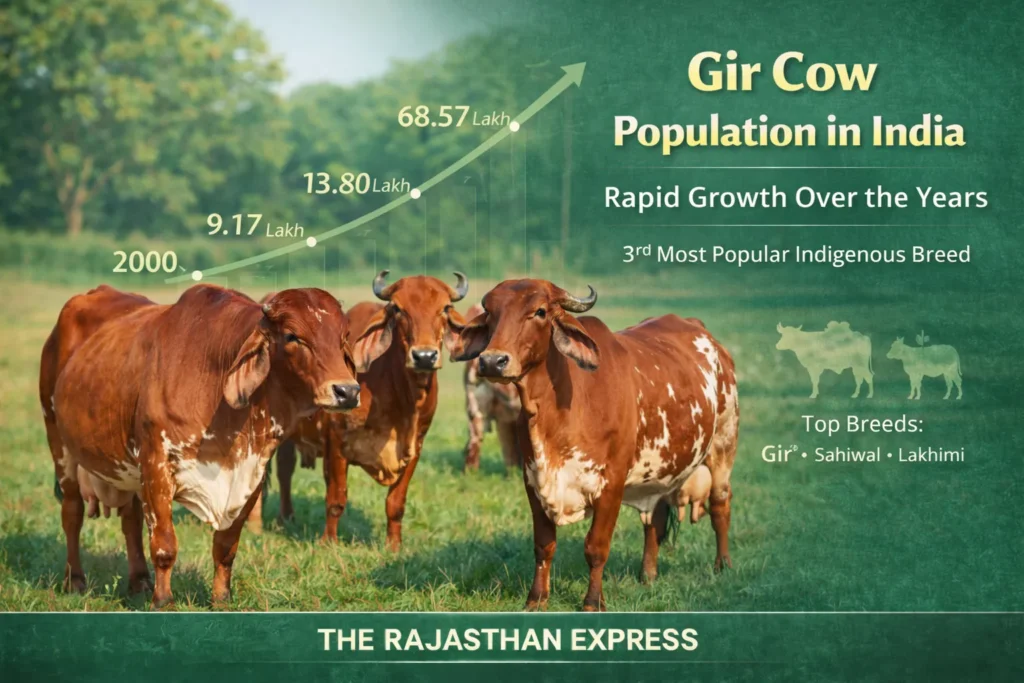
- In the year 2000, the number of Gir cows was approximately 9.17 lakh (917,000).
- By the year 2013, it had increased to approximately 13.80 lakh.
- In the 20th Livestock Census (2019), Gir was the third most numerous indigenous cow breed in the country, with a population of more than 68.57 lakh (6,857,784).
- Top indigenous breeds: According to the 2019 census, the top three indigenous cow breeds in terms of population were: Gir, Lakhimi, and Sahiwal.
People Also Ask
What is a Gir cow?
The Gir cow is one of India’s most famous and registered indigenous breeds. It originated in the Kathiawar region of Gujarat and the Gir forests, which is why it is named ‘Gir’. It is primarily a milch breed, reared for milk production.
What are the other names of Gir cow?
It is also called Kathiyawadi, Surti, Ajmera, Renda (in Rajasthan), Bhodali, Sorthi, and Desi Gir. All these are regional names for the same breed.
What is the origin of Gir cow?
Gir cow origin is the Gir forests of the Saurashtra region of Gujarat. Its official breeding tract includes Amreli, Bhavnagar, Junagadh, and Rajkot districts of Gujarat.
Is the Gir cow found in Rajasthan?
Yes, the gir cow in rajasthan is found abundantly in Ajmer, Pali, Jodhpur, Chittorgarh, Bundi, Kota, Bhilwara, and Tonk districts, where it is locally called ‘Renda’ or ‘Ajmera’.
What is the average milk yield of a Gir cow per day?
Gir cow milk per day for a normal cow is 6‑12 litres. High‑yielding Gir cows produce about 15‑20 litres per day.
What is the total milk capacity of a Gir cow per lactation?
Gir cow milk capacity averages 2,110 kg (litres) per lactation, with a range of 800 kg to 3,300 kg as per ICAR‑NBAGR. The lactation period is about 325 days – the longest among Indian indigenous cows.
What is the fat percentage in Gir cow milk?
Gir cow milk contains 4.6% fat on average (range 3.9%‑5.1%). Normal cow milk has 3‑4% fat.
What is the price of a Gir cow?
Gir cow price varies: ordinary Gir cow ₹40,000‑80,000; good milch Gir cow ₹80,000‑1,50,000; cow with complete records + high milk yield up to ₹2 lakh. Original Gir Cow price in Gujarat is generally lower than in other states. Gir cow price in UP ranges ₹35,000‑1,20,000.
What is the price of a baby Gir cow (calf)?
Baby gir cow (female calf) price is approximately ₹10,000‑25,000. Gir cow calf price depends on purity and health records.
What is the price of a Gir bull?
Gir bull price for breeding purposes ranges from ₹50,000 to ₹2,00,000 depending on genetics and pedigree.
Where can I find a Gir cow for sale?
Gir Cow for sale is available from government gaushalas, private registered breeders, and dairy cooperatives, especially in Gujarat, Rajasthan, and Uttar Pradesh. Always verify pedigree and health records.
What are the physical characteristics (identification) of a Gir cow?
Gir cattle characteristics include: red, brown, or spotted skin; prominent forehead (Doli); long, hanging, leaf‑shaped ears; half‑moon shaped horns; large hump; strong, deep body; prominent hip bone. Gir cattle colour is usually deep red to brown with black or white spots.
What is the weight of a Gir cow and Gir bull?
Gir cow weight: approximately 310 kg (female) and 544 kg (male). Height at shoulder: cow ~131 cm, bull ~160 cm.
What is the age at first calving for a Gir cow?
Average age at first calving is 46.08 months (about 3 years 10 months), with a range of 39 to 59 months.
What is the calving interval of a Gir cow?
The calving interval (time between two calves) is approximately 13.4 months (387 days), which is ideal (12‑14 months).
Is the Gir cow good for hot and humid climates?
Yes. Research in Konkan (hot, humid area) showed that the Gir cow has excellent fertility and adapts well. Service period was only 108 days, and breeding efficiency was 89.29%.
What is the longest lactation period among Indian indigenous cows?
The Gir cow has the longest lactation period – about 325 days.
Which is the highest milk‑producing indigenous cow in India?
India’s highest milk‑producing indigenous cow is the Sahiwal. However, Gir is known for the longest lactation.
What is the population of Gir cow in India?
According to the 20th Livestock Census (2019), the gir cow population was more than 68.57 lakh (6,857,784), making it the third most numerous indigenous cow breed after Lakhimi and Sahiwal.
What is India’s first cloned Gir cow?
India’s first cloned gir cow is named “Ganga”, created using Handmade Cloning (HMC) and OPU technology without killing the cow. She was born from a surrogate mother and her DNA exactly matched the donor Gir cow.
What is India’s first cloned buffalo?
India’s first living cloned buffalo is “Garima”, created at NDRI, Karnal in 2010. She gave birth to 7 offspring, proving cloned animals are healthy and can reproduce.
What is the difference between cloning and embryo transfer?
Cloning creates an exact genetic copy of an animal. Embryo transfer (used for India’s first horse foal “Raj‑Shital”) involves taking an embryo from a donor mare and placing it into a surrogate mare – it is not cloning.
What is the trend of indigenous cow population in India?
According to the 20th Livestock Census (2019), total indigenous/unclassified cow population declined by 6% compared to 2012, while exotic/crossbred cows increased by 26.9%. Female cow population increased by 18.0%.
What are the three main classifications of Indian Zebu breeds based on utility?
They are: (1) Milch breeds (e.g., Gir, Sahiwal), (2) Dual‑purpose breeds (e.g., Hariana, Ongole, Kankrej), and (3) Draught breeds (e.g., Amritmahal, Nagori, Khillari).
What is special about the Kankrej breed?
Kankrej is India’s heaviest cow breed, known for its “Sawai Chal” (fast, special gait). It was used along with Gir to develop the American Brahman in the USA.
What is the most expensive cow breed in India?
India’s most expensive cow breed is considered to be Ongole. In Brazil, it is called Nelore. In 2025, a Nelore cow named “Viatina‑19” sold for approximately ₹40‑41 crore.
What is the smallest cow breed in the world?
The world’s smallest cow breed is Vechur from Kerala.
What is the disease resistance of Tharparkar cow?
Among indigenous breeds, the highest disease resistance is found in the Tharparkar cow, which also has the ability to change colour. It is the highest milk‑producing cow in Rajasthan.
What is the most intelligent cow breed?
The most intelligent cow breed is considered to be Red Sindhi (also called Red Karachi).
What is the Rathi cow?
The Rathi cow was created by mixing Red Sindhi, Sahiwal, Tharparkar, and Dhani breeds. It is called Rajasthan’s Kamadhenu.