 By
ByWhat is Livestock? Definition, Types, Classification & Examples (Complete Guide)
What is Livestock?
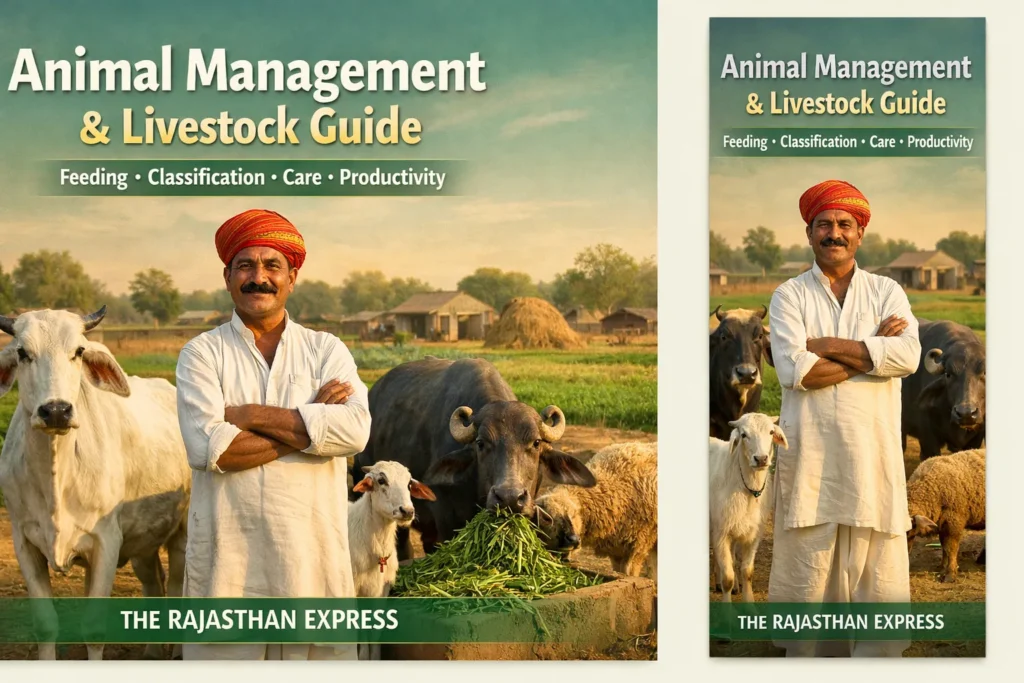
- Livestock refers to those domesticated animals from which we obtain income. In other words, these animals serve as a source of earning for us.
How is Income Generated from Livestock?
Income is generated from the products obtained from these animals, such as:
- Milk (cow, buffalo, goat)
- Meat (goat, sheep, pig)
- Leather (buffalo, cow)
- Wool (sheep)
- Load carrying (horse, donkey, camel, bullock)
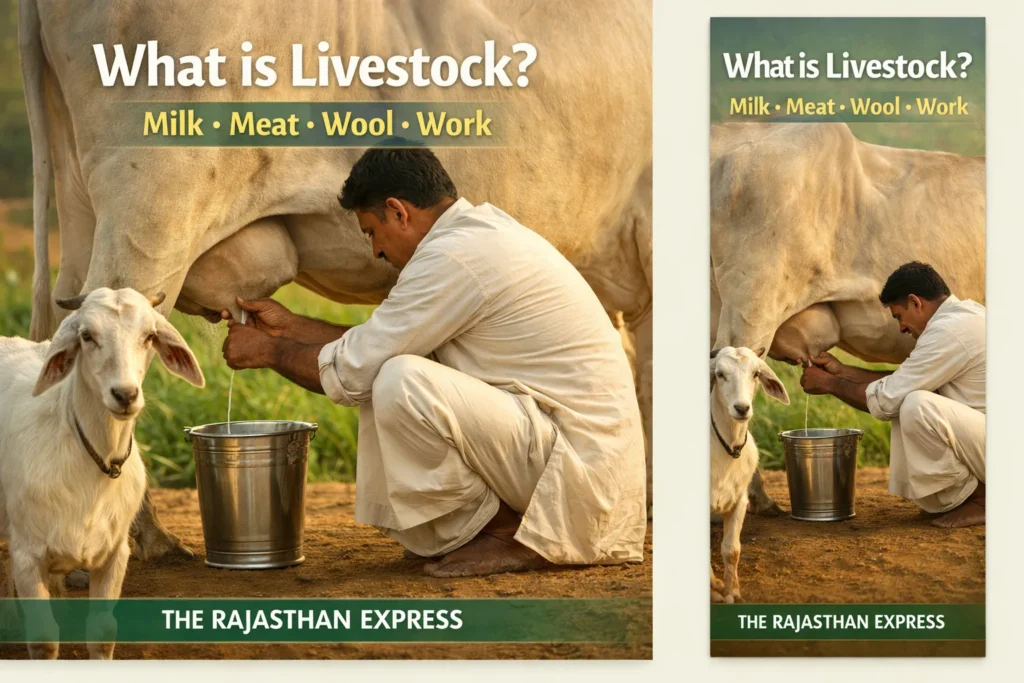
Examples of Livestock
- Cow, buffalo, sheep, goat, pig, camel, horse, donkey, mule, yak, mithun.
Dog, cat, rabbit, and poultry (chicken) are not counted under livestock because they are mainly kept for home security, hobby, or eggs/meat purposes. Traditionally, they are not included in the livestock category as prominently as the animals listed above.
THE RAJASTHAN EXPRESS
Livestock: Definition, Types & Classification
| Definition | Domesticated animals raised for economic purposes such as food, fiber, labor, and income generation. |
|---|---|
| Core Concept | Animals that generate income directly or indirectly through products or services. |
| Major Income Sources |
|
| Examples of Livestock | Cow, buffalo, goat, sheep, pig, camel, horse, donkey, mule, yak, mithun |
| Not Typically Included | Dog, cat, rabbit, poultry (mainly kept for hobby, security, or eggs/meat in smaller systems) |
| Livestock Unit (LU) |
Standard Comparison: 1 Cow/Buffalo = 2 Pigs = 3 Calves = 5 Sheep/Goats |
| Historical Facts |
|
| Classification Basis |
Animals are classified based on:
|
| Based on Food |
|
| Feeding Types |
|
| Based on Stomach Type |
|
| Ruminant Stomach |
|
| Special Facts |
|
| Stomach Compartments |
|
| Special Animal Cases |
|
| Rabbit Digestion | Practices coprophagia (eats soft feces) to absorb nutrients produced in caecum. |
| Calf Development |
|
| Key Digestive Flow | Rumen → Reticulum → Omasum → Abomasum |
| Importance of Livestock |
|
| Sources: THE RAJASTHAN EXPRESS :Your Trusted Source for Animal Care and Veterinary Science. | |
Livestock Unit (LU) – Explained in Simple Language
This is a method to express how one animal compares to others in value or equivalence. Generally:
- 1 cow or buffalo = 2 pigs = 3 calves = 5 sheep or goats
History of Domesticated Animals (Interesting Facts)
- The first animal domesticated by humans was the dog.
- The first milk-giving animal: Goat.
- The last domesticated animal: Horse.
- The first bird domesticated: Pigeon.
- The first animals used as a food source belonged to the Bovidae family (cow, buffalo, goat, sheep family).
Read More About : Why Can’t Horses Breathe Through Their Mouth?
Animal Classification: Types of Animals Based on Different Criteria
Animals can mainly be classified on three bases:
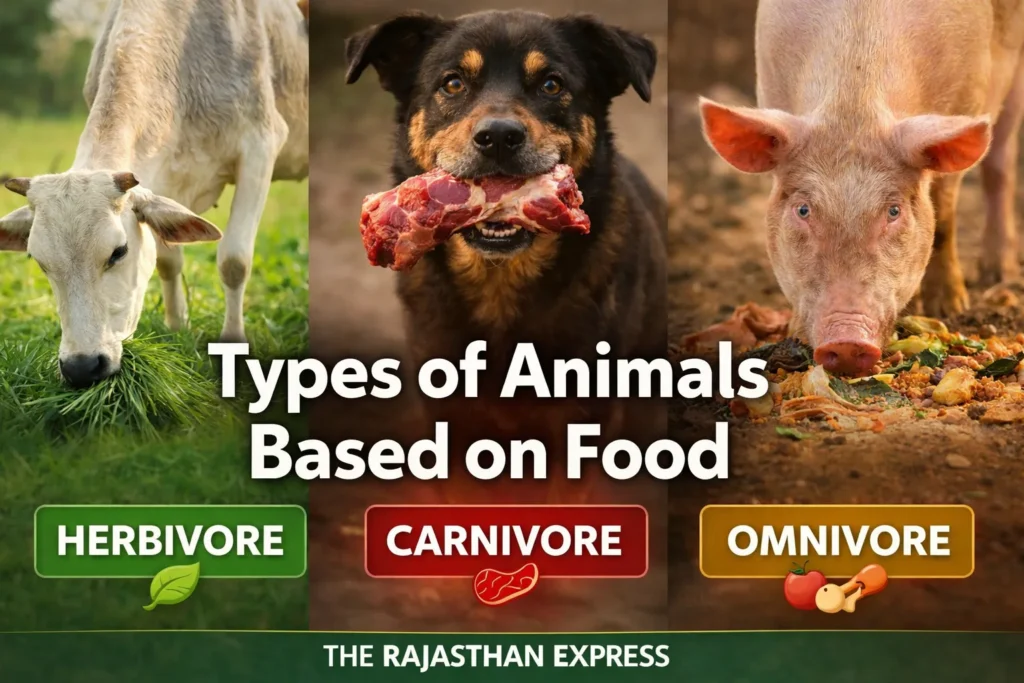
1. Types of Animals Based on Food
| Types of Animals Based on Food | ||
| Category | Definition | Examples |
|---|---|---|
| Herbivores 🌿 | Eat only plants, grass, leaves | Cow, buffalo, goat, sheep, horse, rabbit, camel, giraffe |
| ↳ Grazer | Graze grass growing on the ground | Cow, buffalo, sheep, horse, rabbit |
| ↳ Browser | Eat leaves and twigs of trees/plants | Goat, giraffe, camel |
| Carnivores 🥩 | Eat only meat | Dog, cat, lion, tiger |
| Omnivores 🍽️ | Eat both plants and meat | Pig, human, bear, chicken (to some extent) |
| The Rajasthan Express : Animal Classification Based on Food | ||
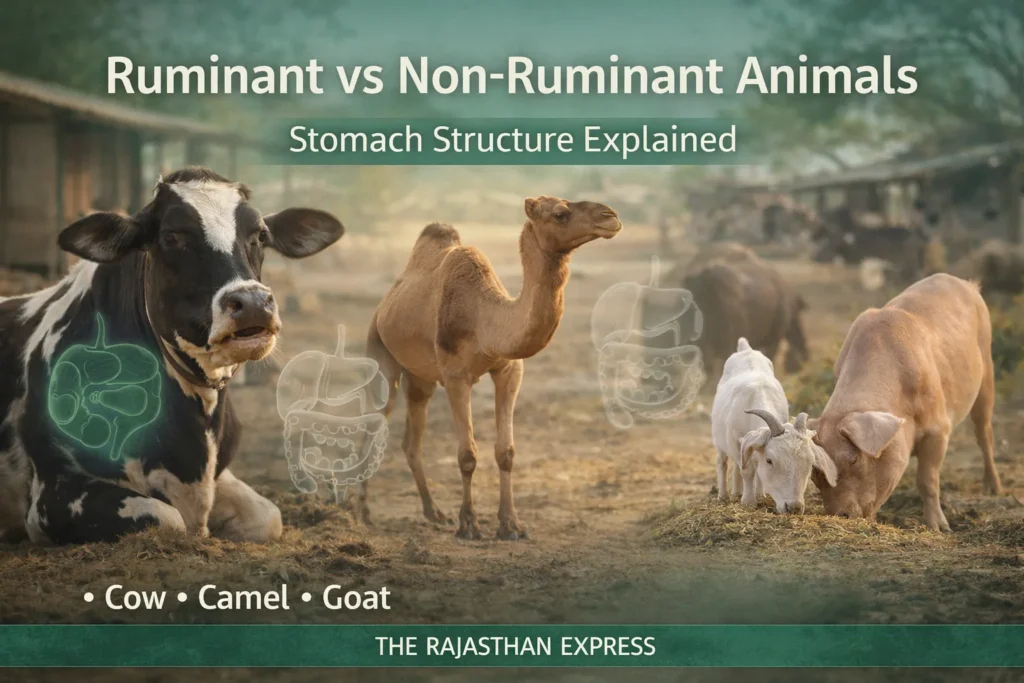
2. Types of Animals Based on Stomach
| Types of Animals Based on Stomach | |||
| Category | Rumination | Parts of Stomach | Examples |
|---|---|---|---|
| Ruminants 🐄 | ✔ Do (true rumination) | 4 parts – rumen, reticulum, omasum, abomasum | Cow, buffalo, goat, sheep, yak, giraffe, deer |
| Pseudo-ruminants 🐫 | ✔ Do (without omasum) | 3 parts – rumen, reticulum, abomasum | Camel, llama, alpaca, vicuña |
| Non-ruminants 🐖 | ✘ Do not ruminate | 1 part (simple stomach) | Pig, horse, donkey, dog, cat, rabbit, elephant, monkey |
| The Rajasthan Express : Classification Based on Stomach Type | |||
Special Notes:
- Horse is non‑ruminant, but its large intestine (cecum) plays a special role in digesting grass.
- Rabbit is non‑ruminant, yet it obtains nutrition by eating soft feces at night (coprophagia); this is called “pseudo‑rumination.”
3. Classification Based on Number of Stomach Compartments
| Classification Based on Number of Stomach Compartments | |||
| Category | Stomach Compartments | Which animals | Examples |
|---|---|---|---|
| Monogastric | 1 part | All non-ruminants | Pig, horse, dog, rabbit, human, chicken |
| Polygastric | More than 1 part | Ruminants + pseudo-ruminants | Cow (4 parts), camel (3 parts), buffalo (4 parts) |
| The Rajasthan Express : Stomach Classification | |||
1. Types of Animals Based on Food (Herbivores, Carnivores, Omnivores)
(A) Herbivores (Herbivores)
- These animals eat only grass, leaves, straw, etc.
- Examples: Cow, buffalo, goat, sheep, camel, horse, rabbit, giraffe, etc.
Herbivorous animals are divided into two parts based on their method of eating:
| Types of Feeding Behavior (Grazer vs Browser) | ||
| Type | What do they eat? | Examples |
|---|---|---|
| Grazer | They graze grass grown on the ground. | Cow, buffalo, sheep, horse, rabbit |
| Browser | They eat leaves and twigs of trees and plants. | Goat, giraffe, camel |
| The Rajasthan Express : Feeding Behavior Classification | ||
Easy Language:
- Grazer = “Grass cutters” – They bend down and graze on grass.
- Browser = “Leaf pluckers” – They stretch upward and eat leaves.
(B) Carnivores (Carnivores)
- These animals eat meat.
- Examples: Dog, cat, lion, tiger, wolf, etc.
(C) Omnivores (Omnivores)
- These animals eat both grass and meat.
- Examples: Pig, human, bear, chicken (to some extent).
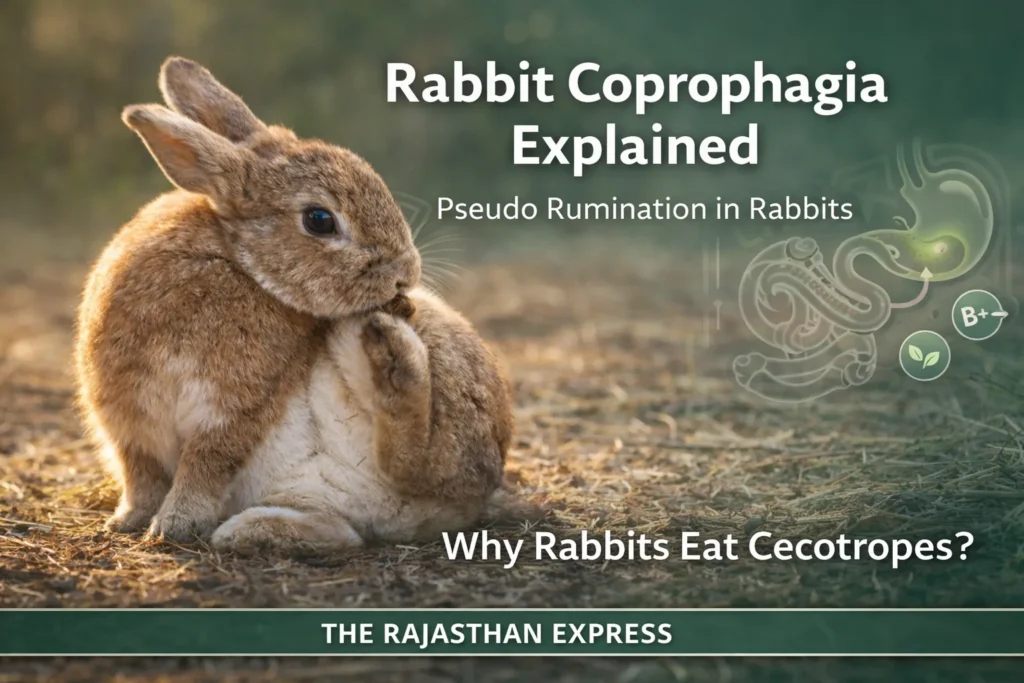
Rabbit and Pseudo Rumination (Coprophagia / Caecotrophy)
The rabbit is a non-ruminant animal, meaning its stomach has only one compartment. Still, it fulfills its nutrition through a special method called pseudo rumination.
What is the meaning of Coprophagia?
- The rabbit excretes hard feces (pellet-shaped) during the day. At night, it excretes soft feces (cecotropes).
It immediately eats this soft feces – directly from the anus to the mouth (this is not normal feces but is rich in nutrients). - This process is called Pseudo Rumination, Coprophagia, or Caecotrophy.
Why Does It Do This?
- Microorganisms in the rabbit’s intestine break down fibrous food (grass), but this digestion happens in the large intestine (caecum).
- The vitamins (especially B-complex) and proteins formed during this process are expelled through feces.
- By eating them again, the rabbit absorbs the nutrients a second time.
When does coprophagia start in rabbits?
- This process begins in rabbits from the age of 3 weeks (21 days).
Simple Understanding:
- The rabbit excretes hard feces during the day and soft feces at night – which is full of real nutrition. It immediately eats it. It does this so that it can fully obtain nutrition from grass. This is its pseudo rumination.
Types of Animals Based on Stomach (Ruminants, Pseudo-Ruminants, Non-Ruminants)
Now we understand how the stomach of these animals works. In fact, animals are divided into parts based on the structure of their stomach:
1. Ruminants (Cud-Chewing Animals)
These are animals that eat grass and chew cud. Rumination means swallowing food and then bringing it back to the mouth to chew again (regurgitation).
- They ruminate (chew food again and again after regurgitating it).
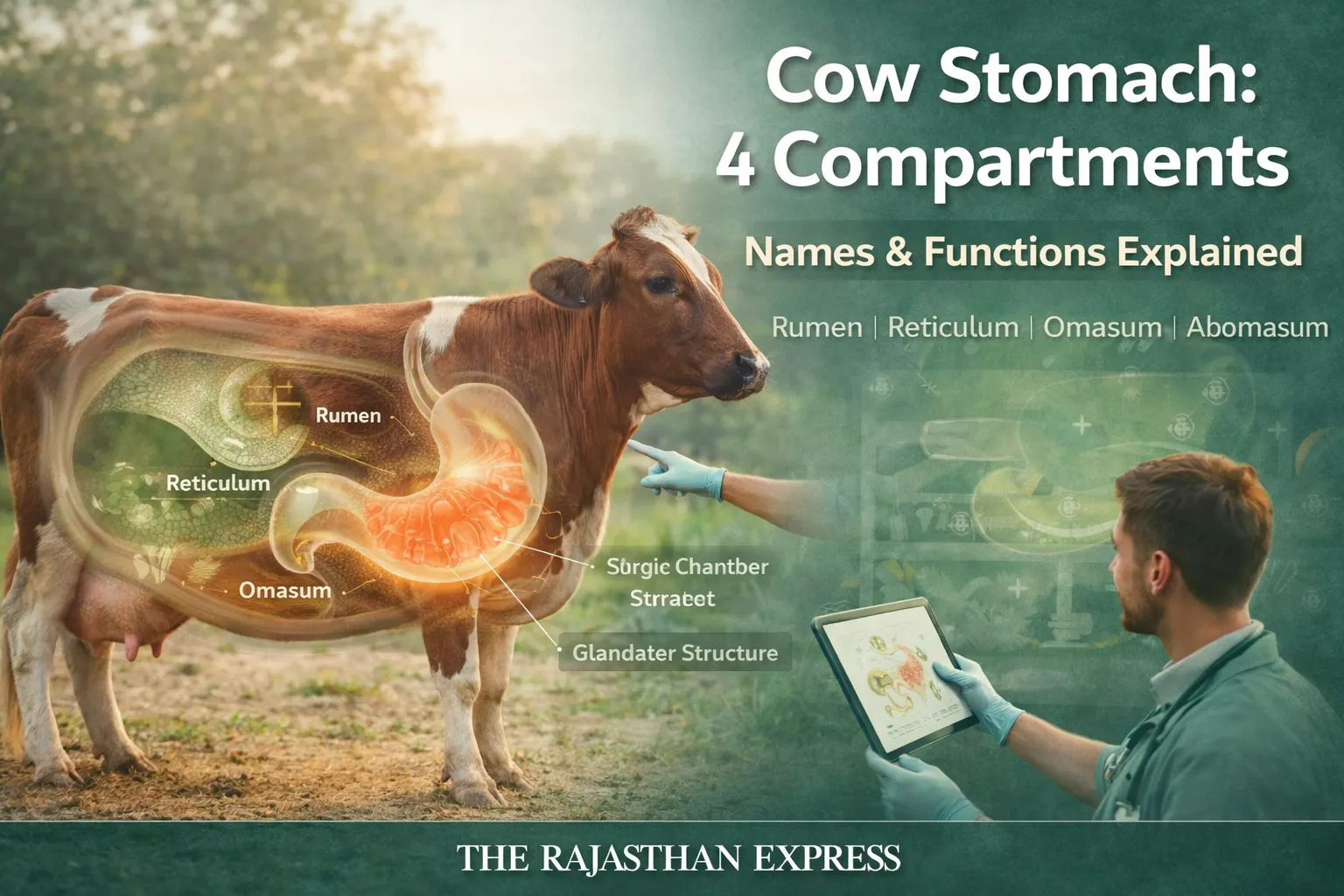
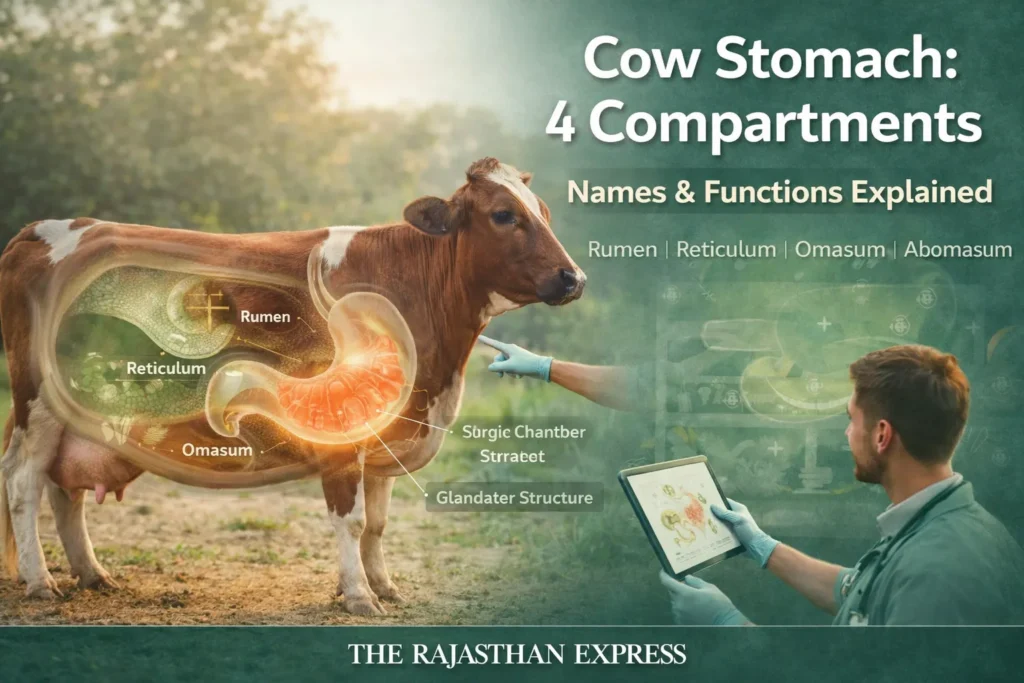
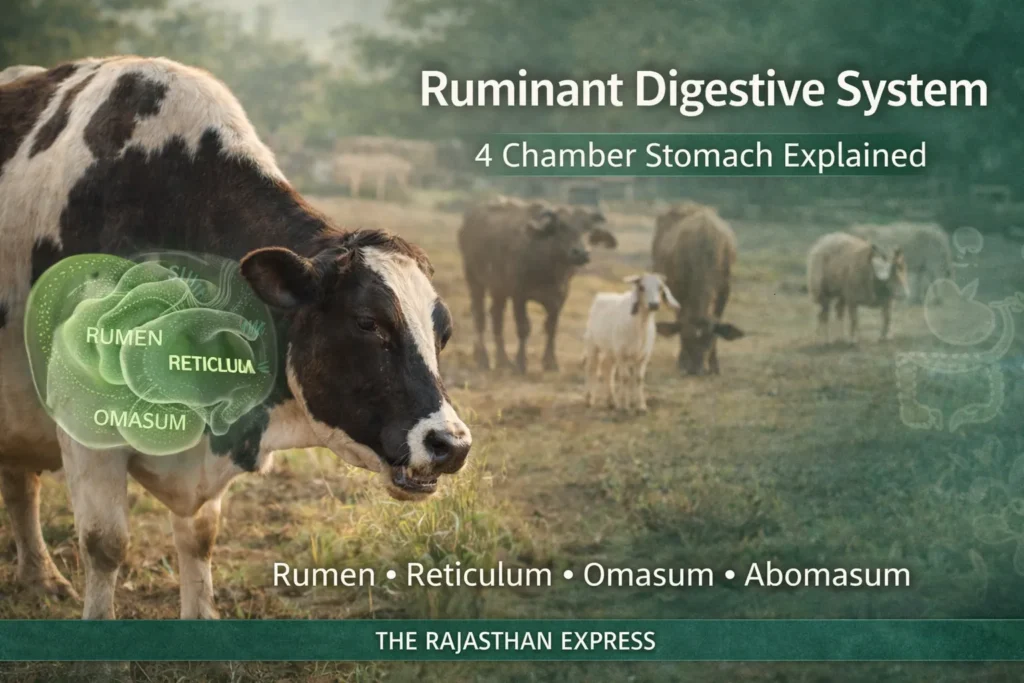
- Their stomach has 4 compartments: Rumen, Reticulum, Omasum, Abomasum.
- Examples: Cow, buffalo, goat, sheep, yak, mithun, giraffe, deer, nilgai.
- Their stomach is compound, having four parts:
(1) Rumen – The Largest Part
- The largest part (70–80% of the entire stomach).
- Shape: Like a Turkish towel.
- Function: Food is fermented here. Billions of microorganisms break down grass.
- pH: 6.5–6.8 (slightly acidic, like curd).
- Movement: Contracts 3 times every 2 minutes (motility).
Easy Words: This is the “storage chamber.” The animal quickly eats grass and stores it here, then later brings it back to chew comfortably.
(2) Reticulum – “Honeycomb Small Part”
- The smallest part (only 5% capacity). It is the smallest part of the stomach.
- It is the second compartment based on food flow.
- Shape: Like a honeycomb. Also called “net” or “boni.”
- Function: Rumination starts here. Food comes back to the mouth from here.
- It filters small and large particles. This is the place from where the animal regurgitates food.
Special Fact: If an animal swallows sharp objects like nails or wires, they get stuck here. That’s why it is called a “Tool Box.” This condition is known as Hardware Disease.
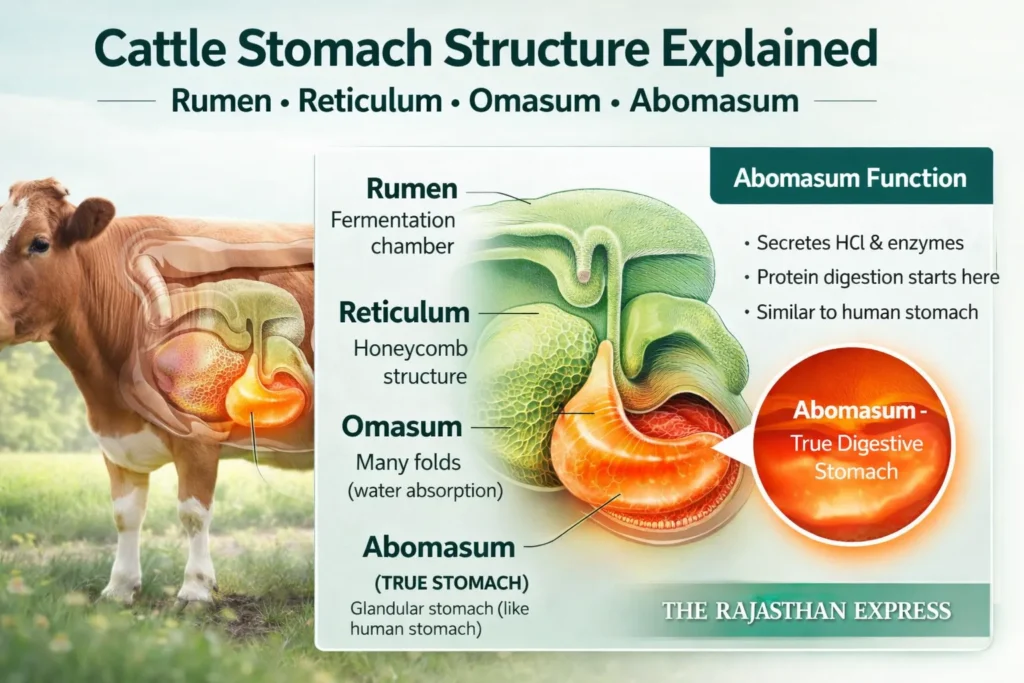
(3) Omasum – Leafy Part (Book Stomach)
- The third part of the stomach with a capacity of 7–8%.
- Also called “oda” or “leaf.”
- Shape: Contains many layers (like leaves), hence called Book Stomach.
- Function: Absorbs water from food and temporarily holds it.
Note: This part is absent in pseudo-ruminant animals (camel, llama, etc.).
Easy Words: It is a “leafy pump” that removes extra water from food.
- Omasum is also called Many-Plies because it contains many folds, hence also called Book Stomach.
- It has leaf-like layers inside. It absorbs water and nutrients. Water is removed from food here.
Note: In poultry, the crop performs a function similar to the omasum. In animals, omasum temporarily stores food, while in poultry, this function is done by the crop (an expanded part of the oesophagus).
(4) Abomasum – True Stomach
- The fourth and second-largest part (7–8% capacity).
- Function: Digestive juices (acid, enzymes) are produced here. Real digestion occurs here.
- pH: 2 (acidic, like the human stomach).
- Also called True Stomach or Rennet, as it secretes rennin enzyme (for milk curdling).
The abomasum is called the True (Glandular) Stomach because digestive glands are present here. Real digestion occurs here.
It is the final (fourth) part and the second-largest in capacity.
Easy Words: This is the real “gastric stomach.” The other three parts only do pre-processing; digestion happens here. It is exactly like the human stomach. Gastric juice (acid) is secreted here, which digests bacteria and proteins.
Size Order of Compartments:
- Rumen (70–80%) > Abomasum (7–8%) > Omasum (7–8%) > Reticulum (5%)
Food Flow Sequence:
- Rumen → Reticulum → Omasum → Abomasum
How Does Rumination Occur?
- Food comes back to the mouth from the reticulum, then the animal chews it again and swallows it.
Calf Stomach Development (Birth to 6 Months)
- At birth: The most developed part is the abomasum, because the calf drinks only milk and this part digests milk.
- At 6 months: The rumen becomes fully developed. Now the calf can digest grass.
| Key Points to Remember | |
| Feature | Description (Easy Language) |
|---|---|
| Rumen pH | 6.5–6.8 (slightly acidic) – “good bacteria” live here |
| Rumen Movement | Contracts 3 times every 2 minutes – helps mix food |
| Omasum | Absent in pseudo-ruminants (camel, etc.) |
| Abomasum | True stomach where acid is produced |
| The Rajasthan Express : Key Points | |
2. Pseudo-Ruminants (Appear Like Ruminants)
- Animals that ruminate but lack one of the four stomach compartments (omasum) are called pseudo-ruminants.
- They also chew cud, but their stomach lacks the omasum. The remaining three parts are present: Rumen, Reticulum, Abomasum.
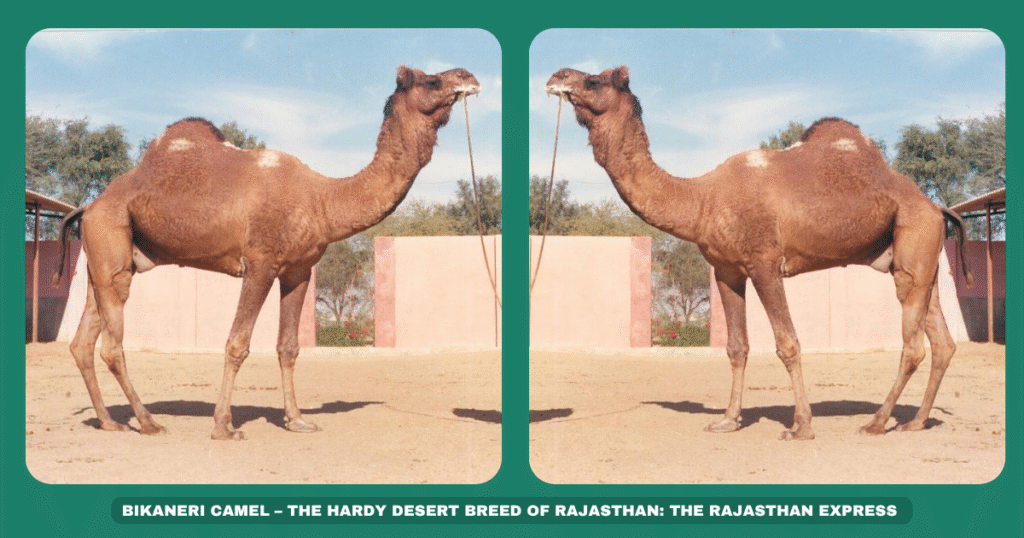
Examples: Camel, llama, vicuna, alpaca.
Special Fact: In camels, “true rumination” occurs, yet they are called pseudo-ruminants because their stomach has 3 parts instead of 4.
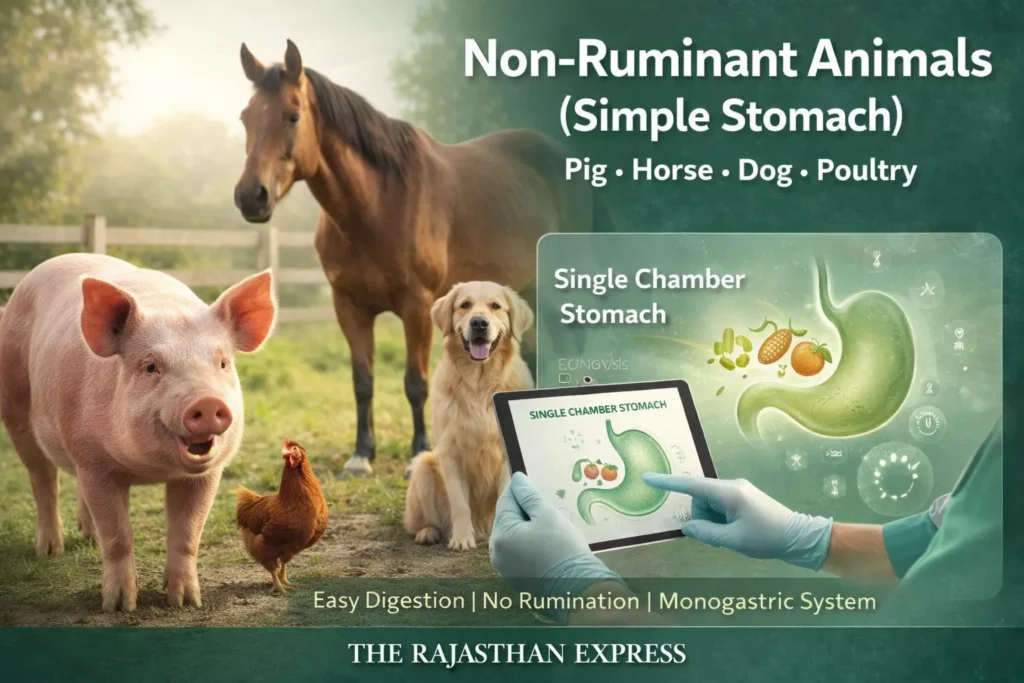
3. Non-Ruminants (Simple Stomach Animals)
- These animals have a simple stomach like humans. Their stomach has only one compartment (monogastric).
Their Stomach:
- It is like a single sac where acid and enzymes are released.
- They cannot digest fibrous feed (cellulose) like cows.
- They require easily digestible food (grains, feed, meat, fruits).
Animals that do not ruminate are called non-ruminants.
Examples of Non-Ruminant Animals:
- Pig, horse, donkey, mule, dog, cat, rabbit, chicken (poultry).
Read More About : Why Horses Cannot Kick Sideways
Horses and donkeys also eat grass, but their stomach is not like cows. They digest grass with the help of bacteria in the large intestine (caecum), so they are still called non-ruminants.
Special Note: Horses and donkeys also eat grass, but their stomach is not like cows. They digest grass with the help of bacteria in the large intestine (caecum), so they are still called non-ruminants.
The Rajasthan Express: Your Trusted Source for Animal Care and Veterinary Science.
Where does rumination start in ruminants?
- Rumination starts from the Reticulum.
- Food is brought back to the mouth from the reticulum for re-chewing.
Which stomach part is developed at birth in calves?
- At birth, the Abomasum is the most developed part.
- This is because the calf drinks only milk, and digestion happens in the abomasum.
Which is the largest and smallest stomach compartment in ruminants?
- Largest part: Rumen (70–80%)
- Smallest part: Reticulum (about 5%)
At what age does the rumen develop in calves?
- The Rumen becomes fully developed at around 6 months of age.
Classification of Animals Based on Number of Stomach Chambers (Monogastric vs Polygastric)
1. Monogastric Animals (Single-Stomach Animals)
Definition
- Animals whose stomach has only one compartment are called monogastric animals.
Which Animals Fall in This Category?
All non-ruminant animals fall under this category.
Examples
- Pig, horse, donkey, mule, dog, cat, rabbit, monkey, elephant, human, chicken (poultry).
- These animals have only one stomach pouch where food enters, mixes with acid, and digestion takes place—just like in humans.
2. Polygastric Animals (Multi-Chambered Stomach Animals)
Definition
- Animals whose stomach has more than one compartment (chambers) are called polygastric animals.
Types of Polygastric Animals
(A) Ruminants
- They have 4 stomach compartments: Rumen, Reticulum, Omasum, Abomasum.
- Examples: Cow, buffalo, goat, sheep, yak, mithun, giraffe, deer.
(B) Pseudo-Ruminants
- They have 3 stomach compartments: Rumen, Reticulum, Abomasum (Omasum is absent).
- Examples: Camel, llama, alpaca, vicuña.
Easy Explanation
- Their stomach has more than one chamber. In the first chambers, food is stored and microorganisms make it digestible. The last chamber (abomasum) is the true stomach where acid is produced.
Important Points About Horse and Pig Stomach
1. Horse Stomach (Horse Digestive System)
- The horse is a non-ruminant animal. Its stomach has only one compartment, but its structure and function are quite unique.
Shape and Structure
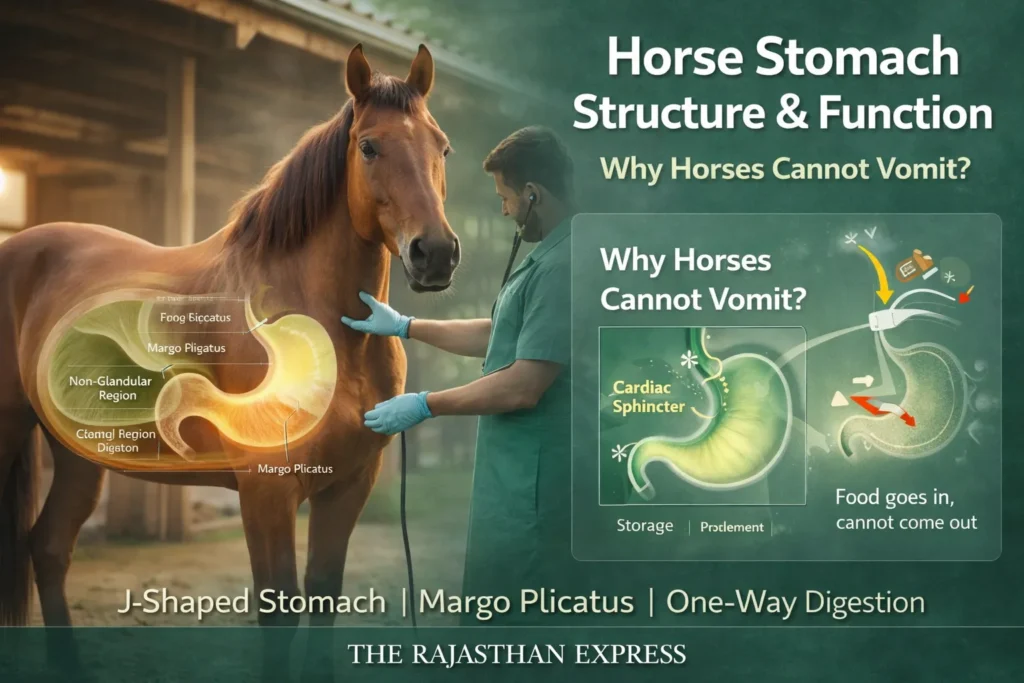
- The horse’s stomach is J-shaped.
- There is a line on the inner wall called Margo Plicatus, which divides the stomach into two parts:
| Horse Stomach (Horse Digestive System) | ||
| Part | Name | Feature |
|---|---|---|
| Upper part | Non-Glandular Part | No digestive glands are present. It temporarily stores food. |
| Lower part | Glandular Part | Digestive glands are present. Acid and enzymes are produced. Real digestion happens here. |
| The Rajasthan Express : Horse Stomach | ||
Easy Explanation
- The horse’s stomach is shaped like a “J”. The upper part stores food, while the lower part digests it.
Why Can’t Horses Vomit? (Most Important Concept)
- The waves (peristalsis) in the horse’s oesophagus move only in one direction—from mouth to stomach. This means food can go in, but cannot come back.
- At the upper opening of the stomach (cardiac sphincter), there is a special feature: as soon as food enters the stomach, this opening closes tightly and does not reopen.
Result
- A horse can never vomit. If vomiting occurs, it indicates a very serious condition (such as stomach rupture).
Easy Explanation
- Once the “lid” (valve) of the horse’s stomach closes, it does not open again. That is why horses cannot vomit. This is also why colic (abdominal pain) in horses is very dangerous.
2. Pig Stomach (Pig Digestive System)
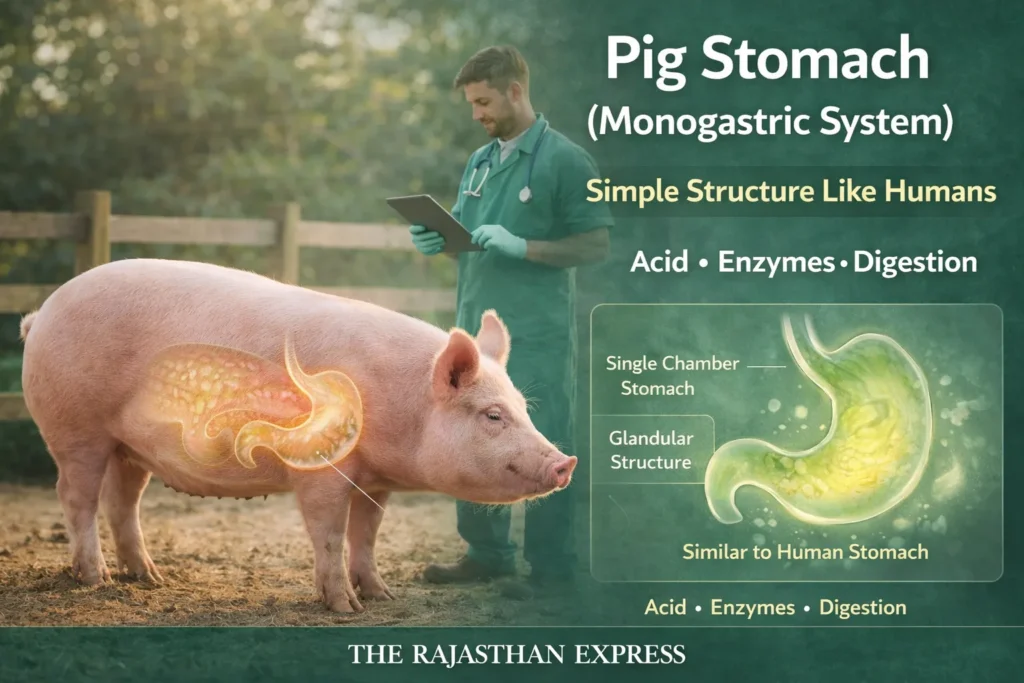
- The pig is also a non-ruminant and monogastric animal. Its stomach is very similar to that of humans.
Shape and Structure
- The shape of the pig’s stomach resembles that of a human embryo stomach.
- It is a single pouch where food enters, mixes with acid and enzymes, and digestion occurs.
- Unlike the horse, it does not have two separate parts (glandular/non-glandular); the entire stomach contains glands.
Easy Explanation
- The pig’s stomach is just like a human’s—one pouch, acid inside, food gets digested, and vomiting can occur.
| Comparison Between Horse and Pig Stomach | ||
| Feature | Horse | Pig |
|---|---|---|
| Type | Non-ruminant (Monogastric) | Non-ruminant (Monogastric) |
| Stomach Shape | J-shaped | Resembles human embryo |
| Special Structure | Divided into two parts by Margo Plicatus (glandular/non-glandular) | Entire stomach is glandular |
| Vomiting | Cannot vomit (cardiac sphincter does not reopen once closed) | Can vomit (like humans) |
| Diet | Mainly fibrous feed (grass, bran) – digestion occurs in large intestine | Omnivorous (grains, vegetables, protein) |
| The Rajasthan Express : Horse vs Pig Stomach | ||
Key Points to Remember
- Horse – J-shaped stomach, Margo Plicatus, cannot vomit (this is the most unique feature).
- Pig – Human-like stomach, can vomit, omnivorous.
- Although the horse is non-ruminant, it can still digest grass—this digestion occurs in the large intestine (caecum), not in the stomach.
- The upper (non-glandular) part of the horse’s stomach is more prone to ulcers because it has less protective lining against acid.
Complete guide to ruminant vs non-ruminant digestive systems: cattle (4-chamber stomach), horse (single stomach, cannot vomit), pig (monogastric), pseudo-ruminants, and rabbit coprophagia. The Rajasthan Express.
THE RAJASTHAN EXPRESS