 By
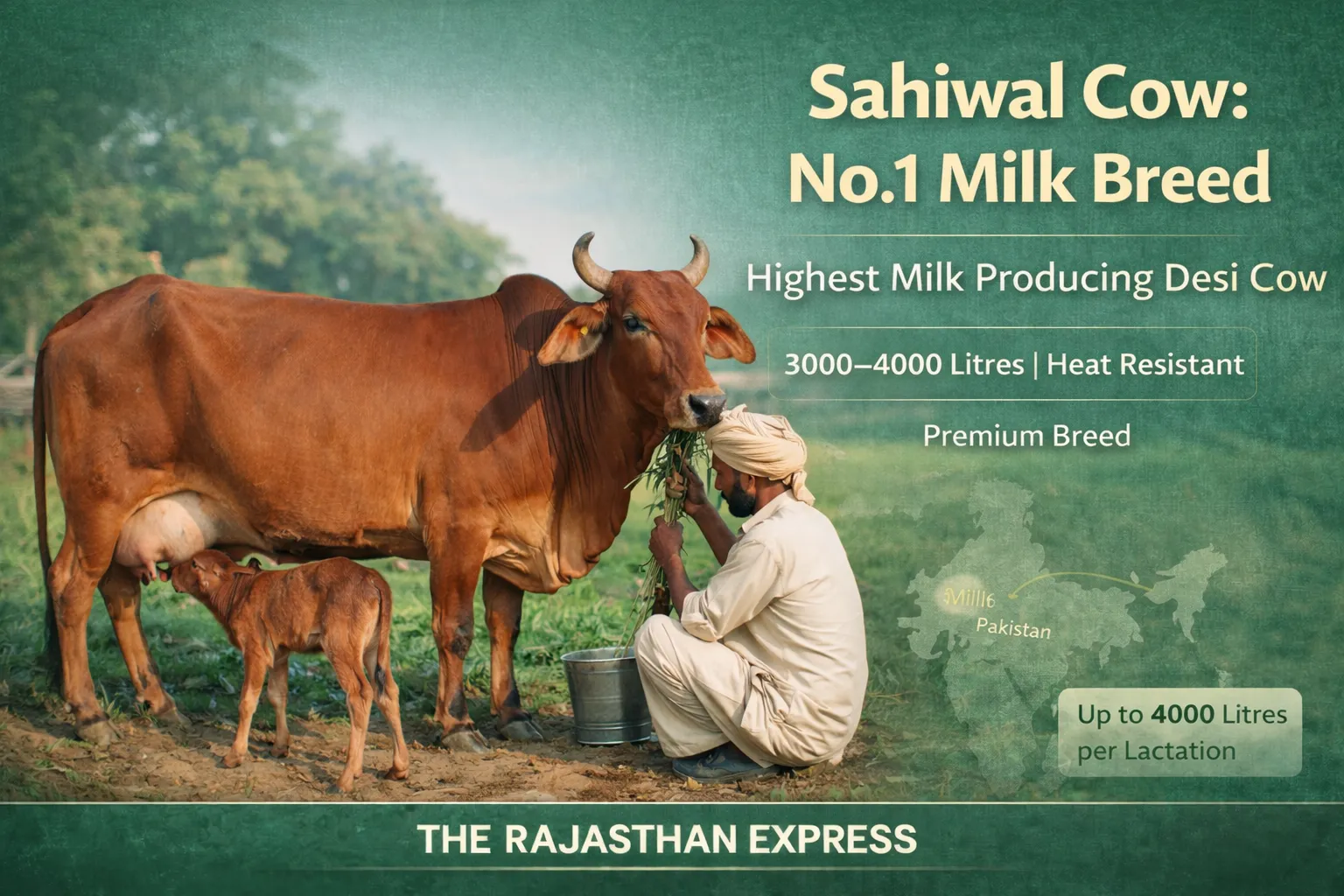
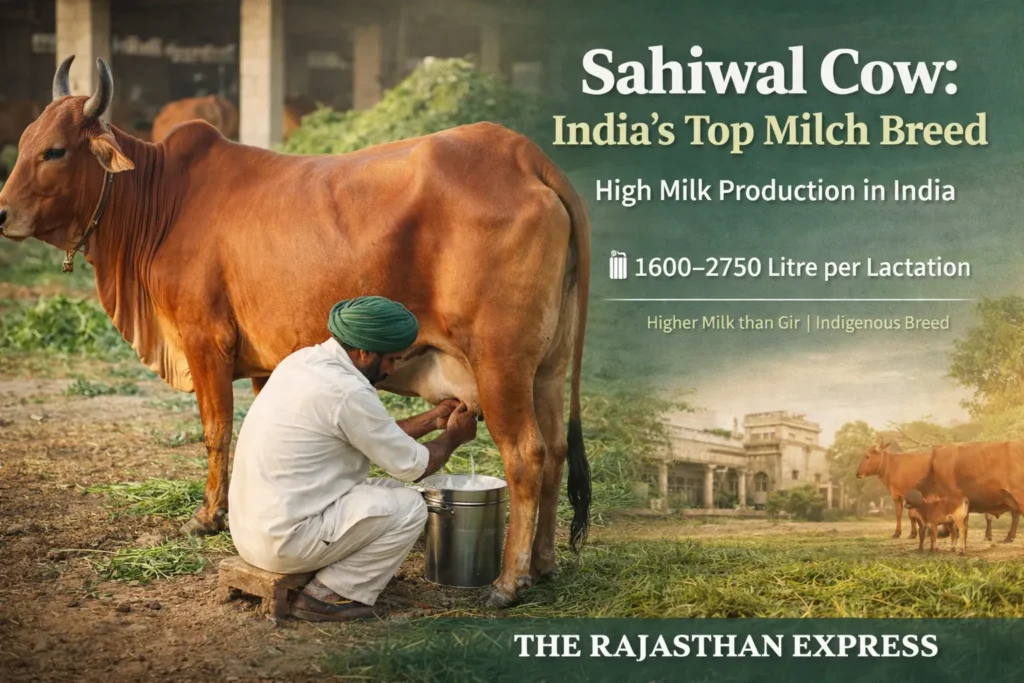
ByThe Sahiwal cow is one of India’s most famous and registered indigenous breeds. The Sahiwal cow is one of the most famous and important indigenous milch breeds of India and Pakistan. It is known for its high milk‑producing capacity, heat tolerance, and disease resistance. The Sahiwal cow originated in a district of Pakistan. The name of that district was Montgomery. But later, this district was renamed Sahiwal. And since this cow was found in that district, it got the name ‘Sahiwal’. Exactly like the Gir cow was named after the Gir forests.
So remember: The original land of the Sahiwal cow is the Sahiwal district of Pakistan (which in olden times was called Montgomery district). In earlier times, Sahiwal cows were reared in very large herds. These herds were looked after by professional herders called “Jungli”. These herders used to move from place to place with their herds (nomadic life).
But then time changed. Irrigation (canals, water systems) started in that region. When water came to the fields, farmers began to settle and cultivate permanently. Now they needed not only milk but also animals for ploughing. So they started rearing Sahiwal cows in small herds. Now these cows gave milk and their bullocks also pulled the plough. Gradually, this breed became the farmers’ first choice. The Sahiwal cow is primarily reared for milk. That is, it is a pure milch breed. It is not reared as much for ploughing fields as for milking.
And here comes the biggest speciality:
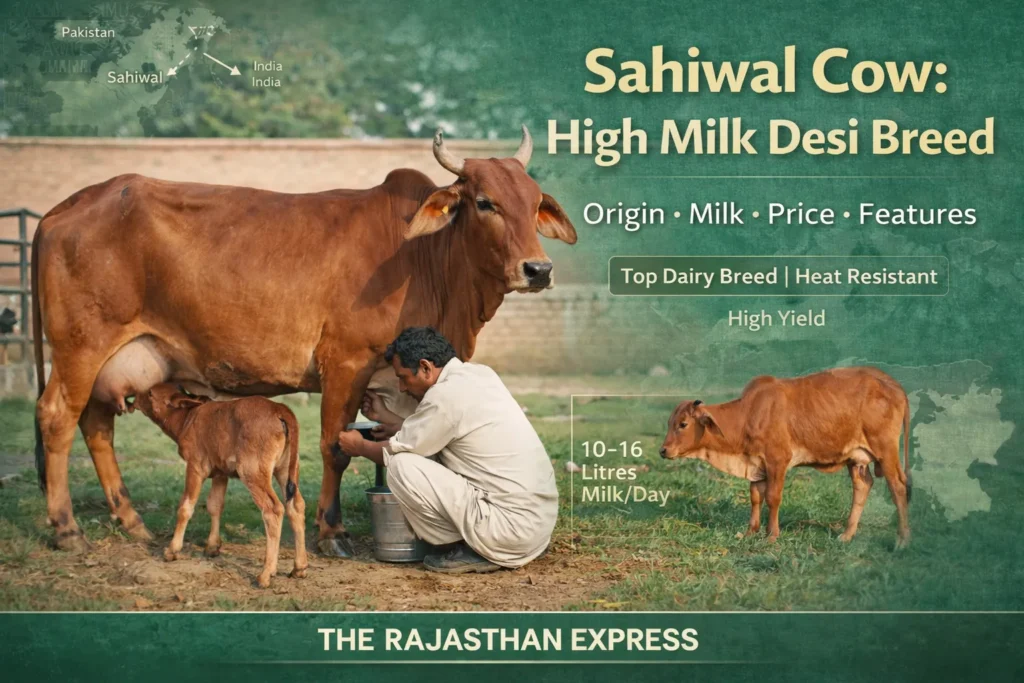
Highest Milk Producing Indigenous Cow
Among all registered indigenous breeds of India, the Sahiwal cow gives the highest amount of milk! Yes, you heard right. The Gir cow has the longest lactation period, but in total litres of milk, the Sahiwal cow gives the most.
Sahiwal Cow Milk Per Day & Lactation Yield
- Average milk per lactation: 2325 kg (approx. 1600–2750 liters)
- High-performing cows: 3000–4000 liters
So, if you want the highest milk-producing indigenous cow, Sahiwal is the best choice.
Although it originated in Pakistan, after partition it also came to India in large numbers. Today it is mainly found in three Indian states:
- Punjab
- Haryana
- Rajasthan
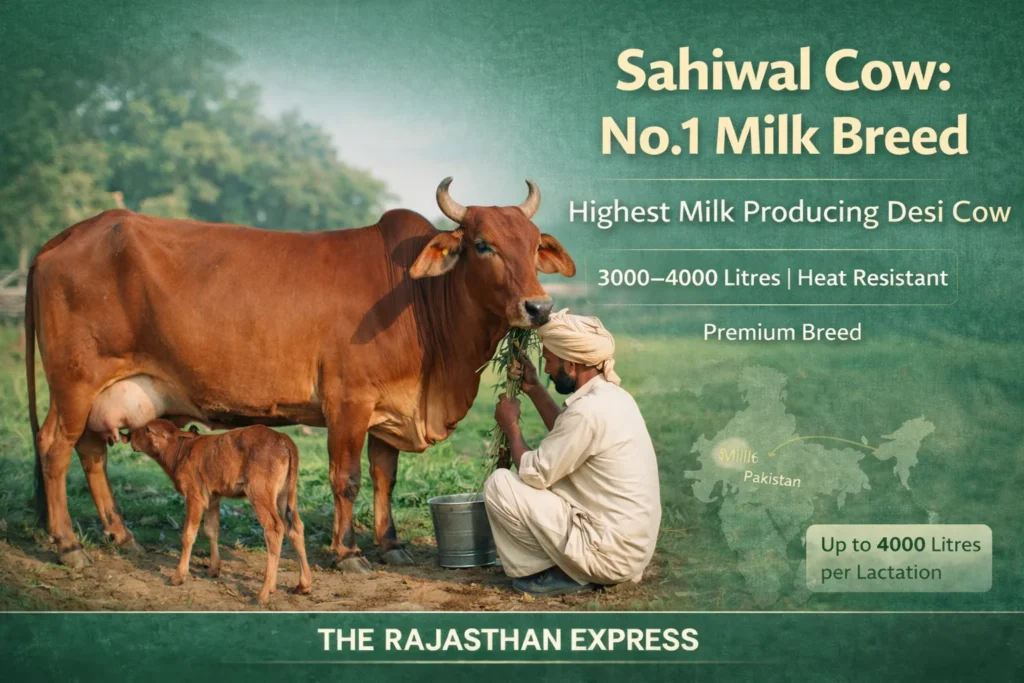
Besides, in Pakistan it is also found in its original area, Sahiwal district, and surrounding regions.
Now, regarding registration: Indigenous breeds are registered by NBAGR (National Bureau of Animal Genetic Resources) located in Karnal, Haryana. To register any breed, it is necessary that at least 1000 animals of that breed exist in the country.
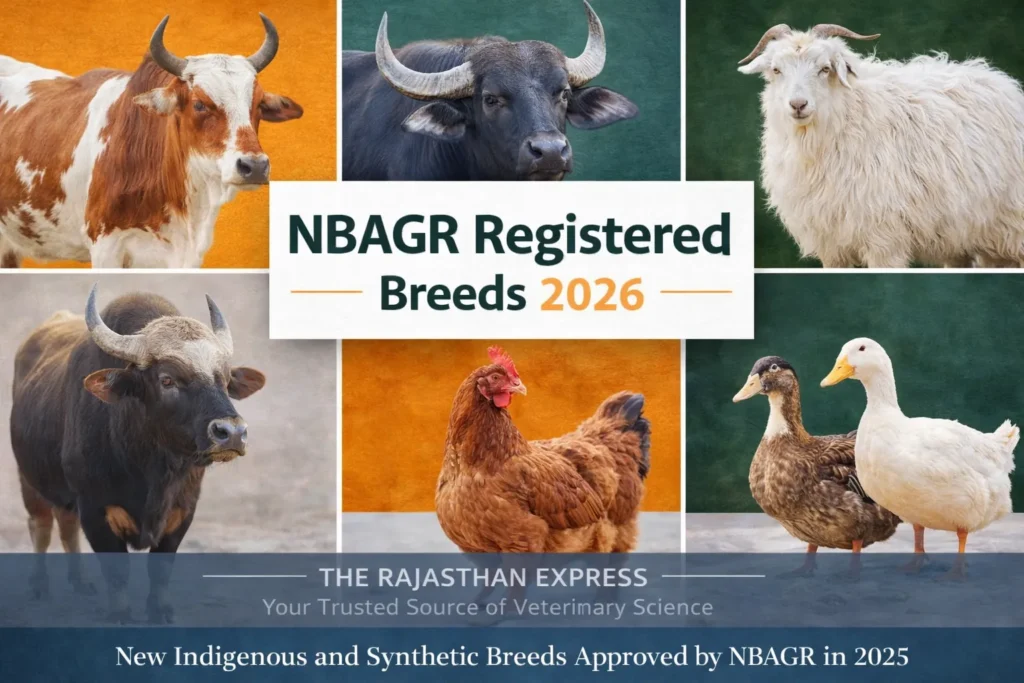
In India, indigenous cows are divided into three categories:
- Milch breeds (such as Gir and Sahiwal)
- Dual-purpose breeds (such as Hariana and Ongole, useful for both milk and ploughing)
- Draught breeds (such as Hallikar and Amritmahal, mainly used for pulling work)
Interestingly, India’s first synthetic (crossbred) cow is Frieswal, developed by combining Sahiwal (37.5%) and Holstein Friesian (62.5%). Scientists mixed these two to create a new breed that would have Sahiwal’s heat tolerance and Holstein’s high milk yield. And this experiment was largely successful. But remember – Friswal is a mixed breed, not pure indigenous. Among pure indigenous breeds, even today Sahiwal and Gir hold their own special and high position.
Classification of Indigenous Cattle Based on Utility
Indian Zebu breeds are divided into three main categories based on their primary utility:
1. Milch Breeds (Milk Breeds)
These breeds are mainly reared for high milk production. They are tolerant to different climatic conditions and produce high-quality milk.
Examples: Gir Cow, Sahiwal Cow, Tharparkar Cow, Rathi Cow, Sanchori Cow, etc.
- Gir: Origin is the Gir forest area of Gujarat. They have a reddish‑brown colour and long, drooping ears. Considered best for milk production.
- Sahiwal: This breed originally belongs to the Punjab region of Pakistan (Montgomery district), but it is also widely reared in India. It is a red‑coloured, calm‑temperament breed.
- Red Sindhi: This breed originates from the Sindh province of Pakistan. It is deep red in colour and has the ability to give good milk even in adverse conditions.
- Tharparkar: Originates from the Thar desert of Rajasthan. It is white or light grey and highly tolerant to drought and hot climates.
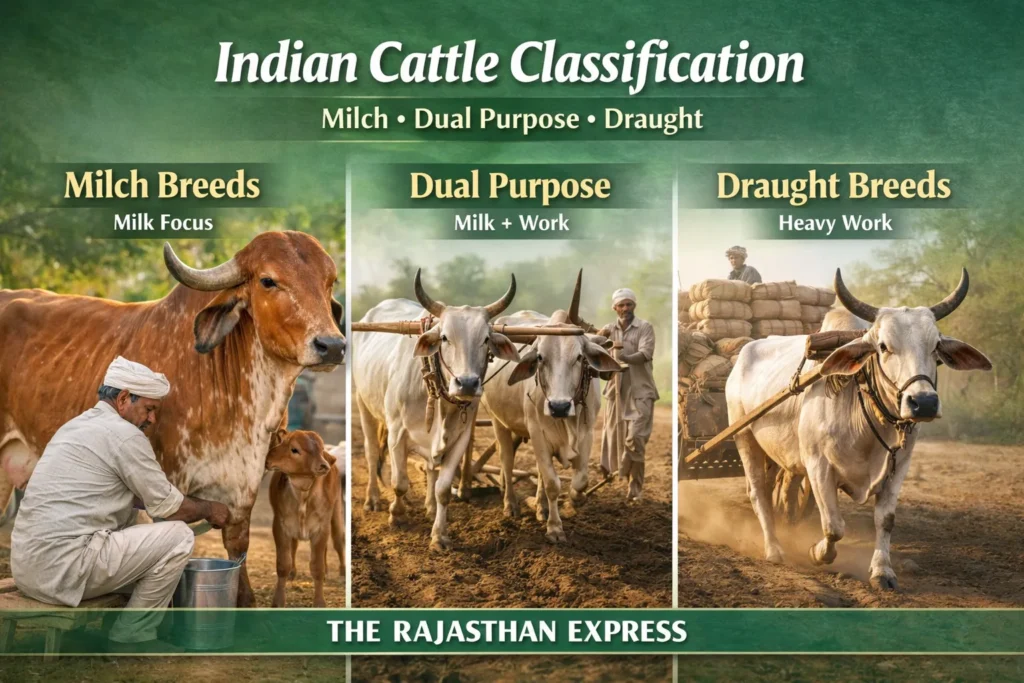
2. Dual‑Purpose Breeds
These breeds are equally suitable for both milk production and agricultural work (e.g., ploughing, carrying loads).
Examples: Ongole cow, Hariana, Kankrej, Mewati cow, Dangi, Deoni, Nimari, Nari, etc.
- Hariana: Found in Haryana and neighbouring states, this breed is known for its balanced performance in both tasks.
- Kankrej: This breed from Gujarat and Rajasthan is known for its large size and powerful build. Its special gait is famous as “Sawaichal”.
- Ongole: Originating in the Prakasam district of Andhra Pradesh, this breed is extremely powerful. Interestingly, Brazil imported this breed and crossbred it to develop a new breed called Nellore, which is very popular in Brazil today.
- Deoni: This breed developed in the Latur district of Maharashtra from crossing Gir, Dangi, and local breeds. It is a strong and reliable dual‑purpose breed.

3. Draught Indigenous Breeds
These breeds are mainly developed for carrying loads and agricultural work. Their muscles are extremely strong, and they are capable of performing hard physical labour.
Examples: Amritmahal, Nagori, Khillari, Hallikar, Malvi, Vechur, Bachaur, Panwar, Siri, Kangayam, Badri, Pullikulam, Punganur, etc.
- Amritmahal: This breed from Karnataka is considered one of India’s best draught breeds. It was developed by the rulers of Mysore for the “Milk Department” (Amritmahal) to provide strong bullocks for the army.
- Nagori: This breed from Rajasthan is famous for its extraordinary speed and stamina.
- Khillari: This is a major draught breed from Maharashtra, known for its strength and toughness.
- Vechur: This is a dwarf breed from Kerala, which, despite its small size, has good draught capacity. Its milk is also considered highly nutritious.
Sahiwal Cow Origin (Sahiwal Cow Origin & History)
The Sahiwal breed originated in the arid Punjab region located along the Indus River. This region is now spread across both India and Pakistan.
In Pakistan, this breed is mainly found in Punjab province. The Sahiwal cow originated in Montgomery district of Punjab province, Pakistan, which is today called Sahiwal district. The breed was named Sahiwal after this district. Apart from Sahiwal district, it is also found in areas like Okara, Pakpattan, and Khanewal.
This breed is also known by several other names based on its region and characteristics,
- Lambi Bar
- Lola
- Montgomery
- Multani
- Teli
In earlier times, animals of this breed were reared in large herds by professional herders. These herders were called “Junglis”.
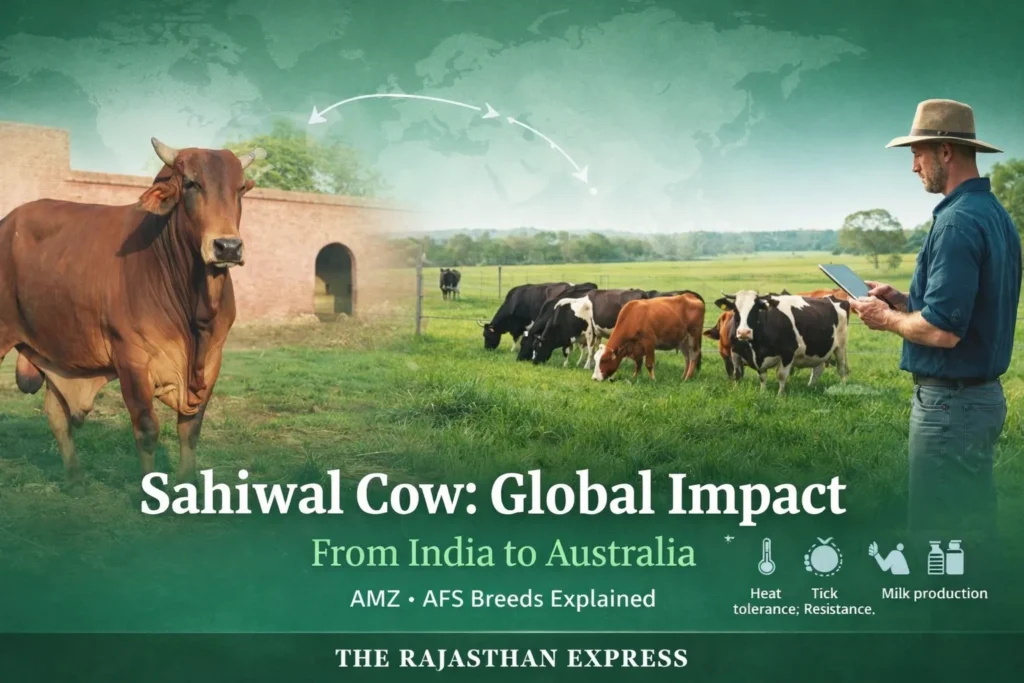
The Sahiwal breed is known for its high heat tolerance and high milk production. For this reason, the breed has been exported to Australia, Africa, Caribbean countries, and other Asian countries. In Australia, this breed has also been used to develop new breeds, such as the Australian Milking Zebu.
(A) Arrival of Sahiwal Cow in India
After the partition of India and Pakistan in 1947, millions of people went from one side to the other. Along with them, livestock (cows, buffaloes, goats) also crossed the border. The original area of the Sahiwal cow (Sahiwal district) went to Pakistan. But the Sahiwal cows that lived near the Indian border, or those that people brought with them when they came to India, also came into India. Gradually, this breed spread in India, especially in areas where the climate was similar to that of Sahiwal in Pakistan. Slowly, the population of Sahiwal cows in India began to increase. Today the situation is:
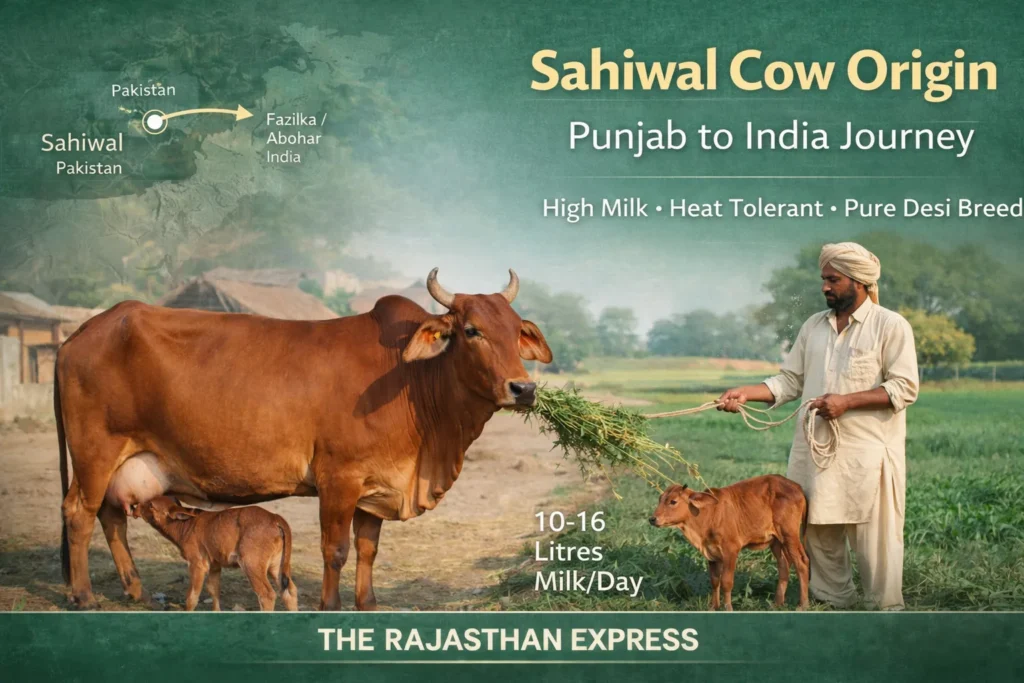
- In Pakistan – the breed is still found in the original area (Sahiwal district) and surrounding regions.
- In India – this breed has spread mainly in three states. In India, the Sahiwal cow is mainly found in the north‑western belt.
(B) Present Distribution in India (Sahiwal Cow of Punjab)
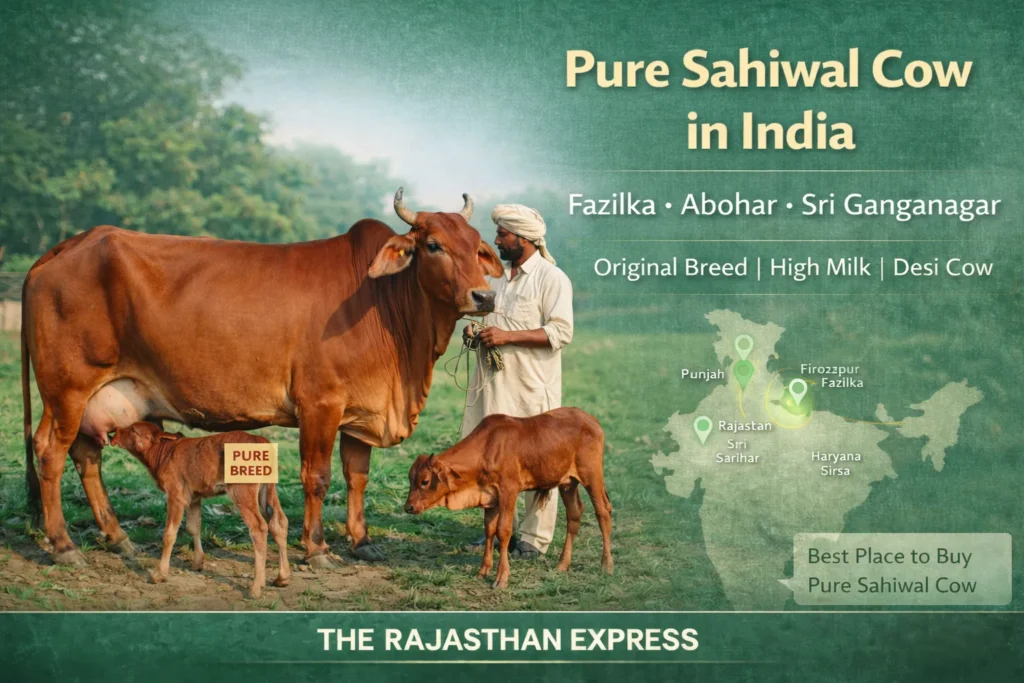
- Punjab: Firozpur (especially around Fazilka and Abohar), Amritsar
- Rajasthan: Sri Ganganagar (pure herds of Sahiwal are also found here)
- Haryana: Sahiwal cows are also found in significant numbers in Haryana state. Many districts of Haryana (such as Hisar, Sirsa, Fatehabad) also rear plenty of Sahiwal cows.
Note: Around Fazilka and Abohar towns of Firozpur district, some herds of pure Sahiwal cows still exist today. These are the areas where the purity of the breed has been maintained. In other areas, often a cross of Sahiwal is found.
This point is very important because:
- In other regions, Sahiwal has been crossbred with other breeds (such as Hariyana, Tharparkar, or even foreign breeds).
- But the Fazilka‑Abohar area remained relatively backward and isolated, where people traditionally kept Sahiwal pure.
- Even today, some livestock keepers there have Sahiwal cows with genetically pure lineage.
- Main point: If a scientist or livestock keeper wants to buy a real, pure Sahiwal cow, they should go to Fazilka or Abohar. Elsewhere, Sahiwal may sometimes be mixed (crossbred).
(C) Geographical Range of Sahiwal Breed
| Geographical Range (Latitude & Longitude) | ||
| Parameter | Minimum | Maximum |
|---|---|---|
| Longitude | 73° 6′ | 74° 4′ |
| Latitude | 29° 10′ | 30° 55′ |
| The Rajasthan Express : Geographical Range | ||
This entire area is near the India‑Pakistan border, combining Firozpur, Fazilka, Abohar in Punjab and the Sahiwal district of Pakistan.
(D) The Mystery Behind the Name “Sahiwal Cow” (Sahiwal Cow Origin)
The Meaning of ‘Sahi’ + ‘Wal’ in Sahiwal Cow Breed
An interesting point: Some believe that the name ‘Sahiwal’ is derived from two words – ‘Sahi’ (meaning ‘good’ or ‘excellent’) and ‘wal’ (meaning ‘one who possesses’ or ‘related to’). But most historians agree that it is named after the district.
Another interesting fact: The Sahiwal district of Pakistan was earlier called Montgomery because the British had named it after Sir Robert Montgomery, who was the Governor of Punjab. After India‑Pakistan independence, the Islamic name ‘Sahiwal’ was adopted, which may be associated with a Sufi saint ‘Sahi’ of that region.
In simple language: Whatever the name, this cow is known for its milk and strength.
How did the old name – Montgomery – come about?
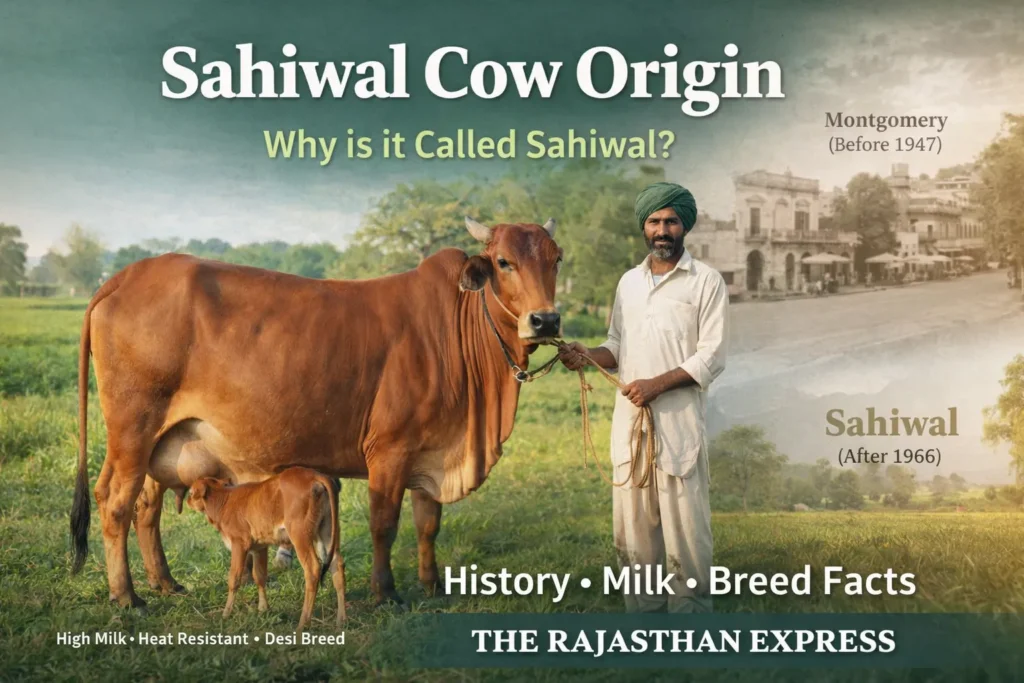
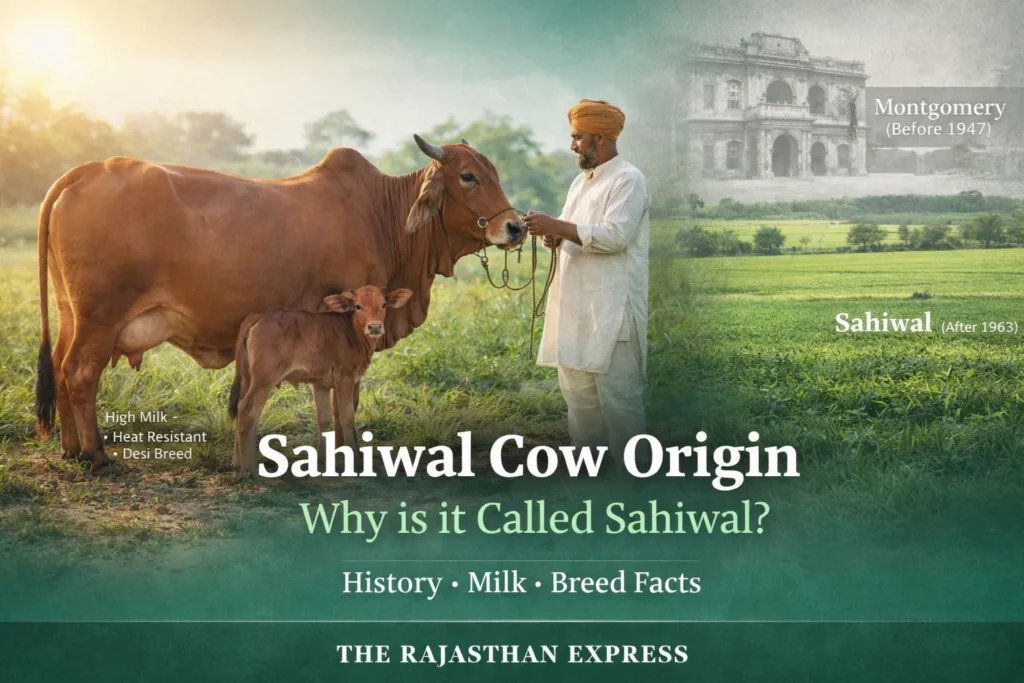
- When the British ruled India, they had a habit of naming important places after their officers. The same happened with Sahiwal city (which is now in Pakistan). At that time, the Lieutenant‑Governor of Punjab (the chief officer of the province) was Sir Robert Montgomery. The British named this city ‘Montgomery’ in his honour. This name continued until the end of British rule (until 1947). Even after Pakistan was formed, the name continued for some years.
When and how did it change back to the Pakistani name – Sahiwal?
Around 1966 or 1967 (sources vary slightly), the Government of Pakistan decided that the era of English names should end. The country needed to be connected to its original heritage. Therefore, the name ‘Montgomery’ was changed to ‘Sahiwal’. This name change was not limited to just a city; the entire district was also named Sahiwal. Today, Sahiwal district exists in Punjab province of Pakistan, with its headquarters at Sahiwal city.
In simple language: Pakistan changed its city’s name from the English ‘Montgomery’ to the indigenous name ‘Sahiwal’ around 1966‑67.
The real secret – Where did the name ‘Sahiwal’ come from?
Now the most interesting question:
What is the real meaning of the name ‘Sahiwal’? Which tribe or person is behind it?
From the ‘Sahi’ tribe
- Most historians and experts agree that the name ‘Sahiwal’ is derived from a tribe called ‘Sahi’. ‘Wal’ means ‘one who possesses’ or ‘related to’. Combined – the area of the Sahi tribe or the place settled by the Sahi tribe.
Now, who is this ‘Sahi’ tribe?
- Sahi is a clan of Kharal Rajputs. That is, within Kharal Rajputs, there is a sub‑group called ‘Sahi’. This tribe historically lived in the fertile region between the Ravi and Sutlej rivers. This area is very fertile – good farming, good pastures. The people of the Sahi tribe were livestock keepers and farmers, and they established a strong influence in this area.
History and impact of Sahiwal cow abroad
The journey of the Sahiwal cow to Australia
The original home of the Sahiwal cow is India and Pakistan. This breed is famous for its strength, heat tolerance, and disease resistance.
In the early 1950s, Australia received some Sahiwal cows and bulls. They did not go directly from India but reached Australia via New Guinea. (New Guinea is a neighbouring island to Australia.) When these cows arrived in Australia, the farmers and scientists there saw that they were very strong. They thought of using them for two purposes:
- For milk – because Sahiwal gives good milk.
- For meat – because it can live in tropical (hot and humid) areas without much trouble.
Therefore, initially it was called a dual‑purpose breed. Farmers began to rear it, especially in northern parts of Australia, where heat is extreme and other breeds (like Jersey or Holstein) find it difficult to survive.
As time passed, scientists in Australia realised that the northern parts of the country have high heat and humidity. There are also many insects (ticks) that make cows sick. European breeds (like Holstein‑Friesian) cannot survive there for long – their milk production drops, they fall sick, and their fertility (ability to give calves) also decreases.
But Sahiwal had all the qualities needed there:
- Heat tolerance
- Tick resistance
- Ability to survive on low and poor quality fodder
Yes, there was one drawback – Sahiwal’s milk is not as high as that of European breeds. So scientists thought: “Why not combine Sahiwal’s hardiness with the high milk‑producing ability of European breeds?” Thus began the era of crossbreeding.
1. First new breed – Australian Milking Zebu (AMZ)
This work was first done by CSIRO (Commonwealth Scientific and Industrial Research Organisation), a major scientific institution in Australia. They crossbred Sahiwal and Red Sindhi (another Indian breed, as strong as Sahiwal) bulls with Jersey cows. Jersey is a European breed that gives very good, creamy milk but cannot tolerate heat and ticks. The crossbreeding of these three cows gave rise to a new breed today called the Australian Milking Zebu (AMZ).
Features of this breed:
- In appearance, it looks like Jersey – brown or yellow colour, Jersey‑like body.
- But its skin is loose, which is a gift from Sahiwal and Red Sindhi. Loose skin helps sweat escape in heat.
- It can tolerate heat, fight ticks, and gives quite good milk.
- Thus Australia got a dairy cow that could survive in the northern regions.
2. Second new breed – Australian Friesian Sahiwal (AFS)
The AMZ breed was successful, but scientists felt that if milk yield could be increased further, farmers would benefit more. So in the 1960s, the Queensland Government’s Department of Primary Industries started another new experiment. They crossbred Sahiwal with Australian Holstein‑Friesian (also called Friesian). Holstein‑Friesian is the highest milk‑yielding breed in the world, but it cannot tolerate heat at all; it needs cool climates. The crossbreeding of these two breeds gave rise to another new breed today known as the Australian Friesian Sahiwal (AFS).
Features of the Australian Friesian Sahiwal breed:
- Heat tolerance – it has the hardiness of Sahiwal.
- Tick resistance – this cow remains protected from diseases caused by insects.
- Better fertility – it conceives easily and gives calves even in heat.
- Good milk production – not as high as Holstein, but significantly higher than Sahiwal.
Thus the AFS breed became a boon for farmers who wanted to do dairy farming in northern Australia.
Now you must have understood that the Sahiwal breed did no small work in Australia. There, it did not just remain a foreign cow, but gave birth to two entirely new breeds (AMZ and AFS). Even today, in the tropical regions of Australia, these very breeds are the backbone of the dairy industry.
Other Names of Sahiwal Cow (Sahiwal Cow Breed Names)
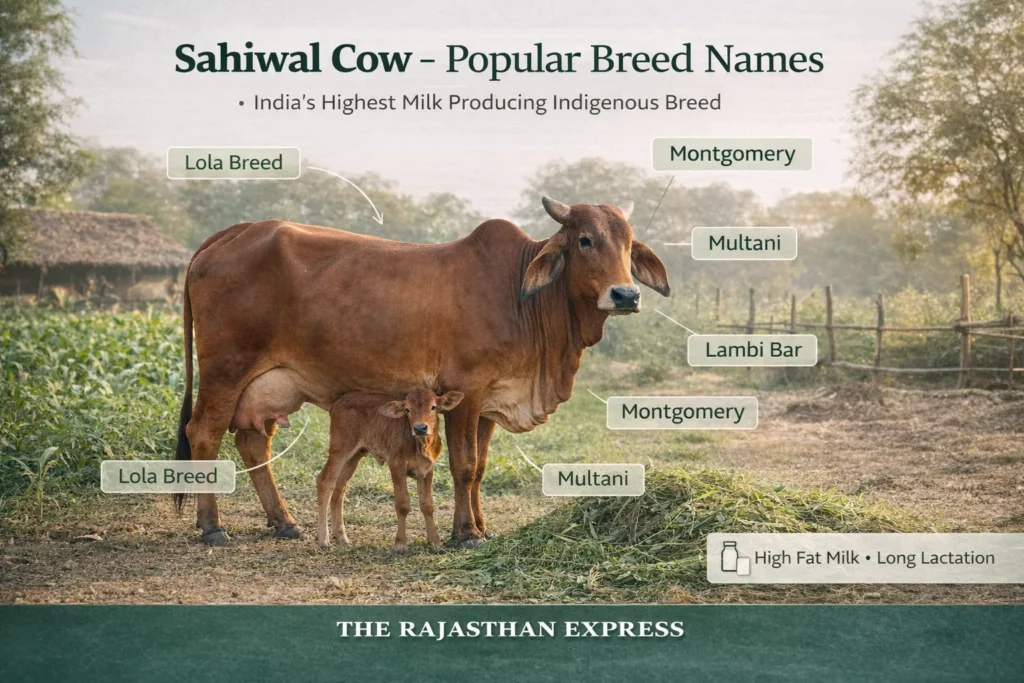
The Sahiwal cow is also known by several other names such as Lola breed, Lambi Bar, Montgomery, Multani, and Teli.
Sahiwal cow is mainly reared for milk, which is why it is called a milch breed. Among all registered indigenous breeds in India, it is the highest milk-producing cow breed.
Just like the Gir cow, the Sahiwal cow is also known by many names. People lovingly call it by different names:
Main Names of Sahiwal Cow
- Sahiwal – This is the main and official name, derived from the Sahiwal district (formerly Montgomery), where the breed originated.
- Lola Breed – In some areas, it is called “Lola” due to its loose body, thin skin, and drooping ears, which distinguish it from other breeds.
- Lambi Bar – his name possibly came from its long and well‑developed udder and relatively long lactation period. The Sahiwal cow has the ability to give milk for a long time, hence this name became prevalent. This name is popular for two reasons:.
- Its long and large udder that holds a larger quantity of milk.
- Its long lactation period – after the Gir cow, the Sahiwal cow gives milk for the longest time
- Montgomery – In earlier times, when the district was called Montgomery, this breed was also known by that name. Even today, elderly people sometimes use this name.
- Multani – The reason is that the original breeding area of the Sahiwal breed was not limited only to Sahiwal district, but extended to a vast area including Multan. Therefore, the local people also called this particular breed of cow found in this area ‘Multani’.
- Teli – “The milk of the Sahiwal cow is the thickest and richest in fat (fat) compared to other indigenous cows. Hence, due to the high fat percentage, it was given the title ‘Teli’ (oily / one with oil).”
| Comparison of Milk Fat % in Indigenous Breeds | ||
| Breed Name | Average Milk Fat (%) | Comparative Status |
|---|---|---|
| Sahiwal | 4.5% – 5.0% | Highest category |
| Gir | 4.5% – 4.8% | High |
| Red Sindhi | 4.3% – 4.5% | Medium-High |
| Tharparkar | 4.0% – 4.3% | Medium |
| Harianvi | 3.8% – 4.2% | Medium |
| Kankrej | 3.5% – 4.0% | Medium-Low |
| The Rajasthan Express : Milk Fat Comparison of Breeds | ||
Main point:
- The milk of the Sahiwal cow is considered the thickest among all Zebu (humped) breeds. This means that compared to all indigenous cows, the fat percentage in Sahiwal milk is the highest – approximately 4.5% to 5.0%. For this reason, Sahiwal milk is considered very good for making yoghurt, ghee, and other dairy products.
Sahiwal Cow in India: Uses & Milk Production
Sahiwal Cattle Milk Production (Sahiwal Cow Milk Per Day)
The Sahiwal cow is a major indigenous milch breed. It is reared in India mainly for milk production. It is considered the highest milk‑giving breed among indigenous cows.
- A Sahiwal cow gives approximately 1600 to 2750 kilograms of milk per lactation, while its average milk production is about 2325 kilograms.
Among indigenous breeds, while the Sahiwal cow is famous for giving more milk, the Gir cow has a longer lactation period.
- In earlier times, Sahiwal breed bullocks were used for ploughing fields and heavy work, but in the present time, this breed is reared mainly for the purpose of high milk production.
How to Identify Sahiwal Cow (Sahiwal Cow Characteristics)
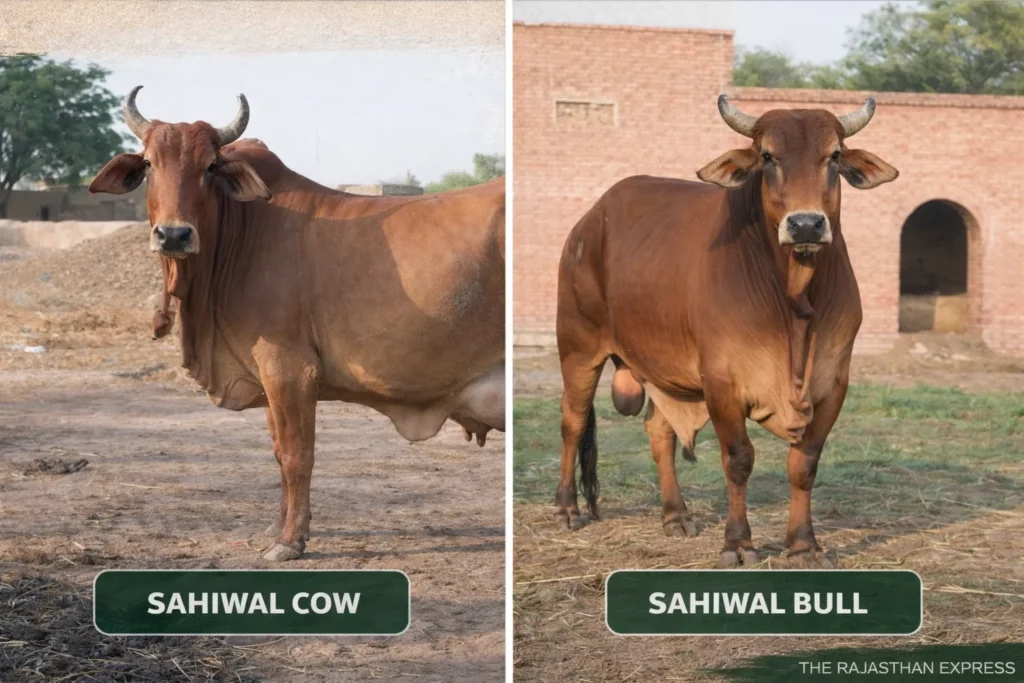
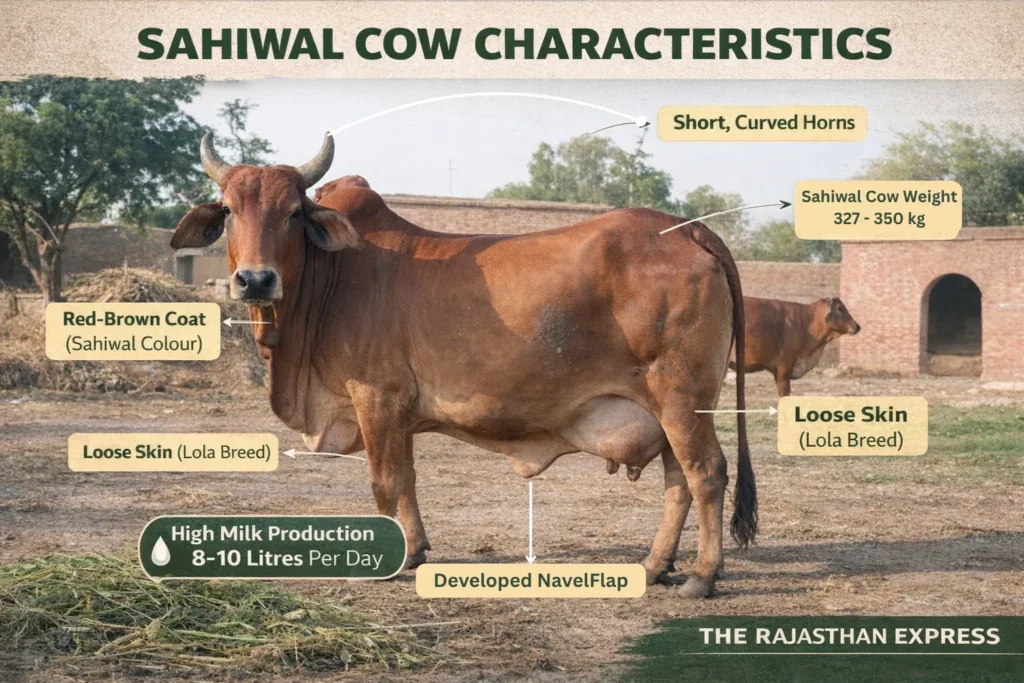
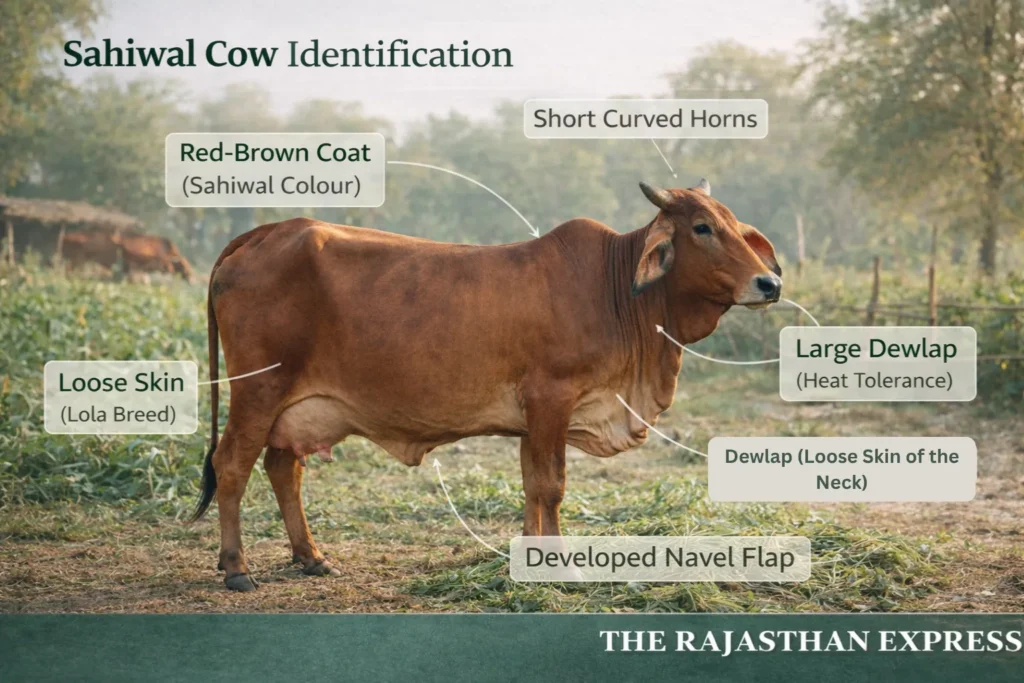
The Sahiwal cow is one of the best indigenous breeds of India. There are some special markers to identify it at first glance. Through these, you can identify the Sahiwal cow.
1. Colour (Sahiwal Cow Colour)– Deep red to brownish‑red
- The colour of the Sahiwal cow is usually deep red‑brown (brownish red). Sometimes this colour looks like mahogany red (a deep red‑brown), sometimes a little greyish red.
- Special point: In bulls (males), the colour of the legs and the ends of the head and tail is darker than the rest of the body. Sometimes there may be white patches on the body, but these are rarely seen.
In simple language: If you see a cow that is red‑brown in colour, with short horns and loose hanging skin – then understand that it is Sahiwal or a cross of it.
2. Skin – Loose skin, therefore called “Lola breed”
- The biggest identification of Sahiwal is its loose skin. The skin on the body is so loose that it keeps moving. Because of this, people lovingly call it “Lola breed”. In hot weather, this loose skin is very useful – it helps the cow sweat and keep the body cool.
3. Dewlap and Navel Flap – Highly developed
- Dewlap: The loose skin under the cow’s neck. In Sahiwal, this is very large and loose. It hangs down, like the beard of an old bull.
- Navel flap (or sheath): The skin hanging under the belly (near the navel) is called the navel flap. In Sahiwal, this is also well‑developed, meaning long and loose.
Both of these organs help in tolerating heat and protecting against insects. Among all indigenous breeds, the Sahiwal cow has the most developed dewlap (loose skin of the neck) and navel flap, which are the main identification of the Sahiwal cow.
4. Horns – Short and peculiar
- The Sahiwal has two horns on its head. These horns are stumpy – meaning not very long. Length is short to medium.
- The shape of the horns is special: first they go outward, then turn upward, and finally bend inward (towards each other).
In simple words: The horns of Sahiwal are neither straight nor very large. They appear crooked, curved, and small.
5. Milk – Highest milk‑giving indigenous breed of India
- The Sahiwal cow gives the most milk among indigenous breeds. A Sahiwal cow can give on average 1600 to 2750 kilograms of milk per lactation (i.e., the entire milk period after one calving).
- The milk of the Sahiwal cow has the highest fat among all indigenous breeds – about 4.5% to 5%. Therefore, this milk is thick and creamy.
Sahiwal Cow Size, Weight & Body Measurements
1. Height at shoulder – Male: 170 cm, Female: 124 cm
- 170 cm means about 5 feet 7 inches (since 1 foot = 30.48 cm). That is, the height at the shoulder of a Sahiwal bull is about equal to the height of an average man. Standing with head up, it becomes over 6 feet.
- 124 cm means about 4 feet 1 inch – this is the height of a Sahiwal cow. That means the cow is about one and a half feet shorter than the bull.
2. Body length – Male: 150 cm, Female: 131 cm
- Body length means from the tip of the nose to the beginning of the tail (or end of the loin).
- 150 cm (about 5 feet) – the bull’s body is quite long.
- 131 cm (about 4 feet 3.5 inches) – the cow’s body is about 19 cm (about 0.75 foot) shorter than the bull.
- Meaning: The Sahiwal bull is not only tall but also long. He is a heavy, masculine animal.
3. Heart girth – Male: 190 cm, Female: 164 cm
- Heart girth means the circumference of the chest – it is the measurement around the body just behind the front legs (where the heart is). This measurement tells how bulky and sturdy the animal is.
- 190 cm means about 6 feet 3 inches of girth – showing the very wide and heavy chest of the bull.
- 164 cm means about 5 feet 4.5 inches – the cow’s chest is also wide, but less than the bull.
- In simple language: The bull’s chest is like that of a strong wrestler – wide and rounded. The cow’s chest is normal and feminine.
4. Weight – Male: 540 kg, Female: 327 kg
- This is the most important difference. 540 kg means a little more than half a ton – that is the weight of a large bull.
- 327 kg means about 3 quintals (1 quintal = 100 kg) – this is the normal weight of a good milch indigenous cow.
- The bull is about 213 kg heavier than the cow – i.e., two‑thirds more than the cow’s weight.
- A Sahiwal bull weighs about as much as 5‑6 heavy men. The cow weighs about as much as 3‑4 men. (A fun way to remember the fact.)
5. Birth weight – Male: 22.4 kg, Female: 20.7 kg
- This is the weight of the calf (newborn animal).
- The male calf is born slightly heavier than the female calf – about 1.7 kg more.
- Both have a birth weight around 20‑22 kg, which is 5‑7 times more than the weight of a healthy newborn human baby (2.5‑4 kg). That is, the Sahiwal calf is quite strong from birth.
| Measurements of Sahiwal Cow and Bull | ||
| Measurement | Male (Bull) | Female (Cow) |
|---|---|---|
| Height at shoulder | 170 cm | 124 cm |
| Body length | 150 cm | 131 cm |
| Heart girth (chest circumference) | 190 cm | 164 cm |
| Weight | 540 kg | 327 kg |
| Birth weight | 22.4 kg | 20.7 kg |
| The Rajasthan Express : Sahiwal Cow vs Bull Measurements | ||
Sahiwal Cattle Milk Production
Milk production in Sahiwal cow (How much milk does a Sahiwal cow give?)
A Sahiwal cow gives on average 2325 kilograms of milk per lactation (the entire milk‑giving period after one calving). Cow’s milk is slightly heavier than water. Approximately 1 kg milk = 0.97 litres (almost 1 litre). So 2325 kg milk ≈ 2257 litres (because 2325 × 0.97 = 2255.25).
According to ICAR‑NBAGR (a major institution of India that sets the identification and standards for indigenous breeds):
- Lowest: 1600 kg (approx 1550 litres)
- Average: 2325 kg
- Highest: 2750 kg (approx 2667 litres)
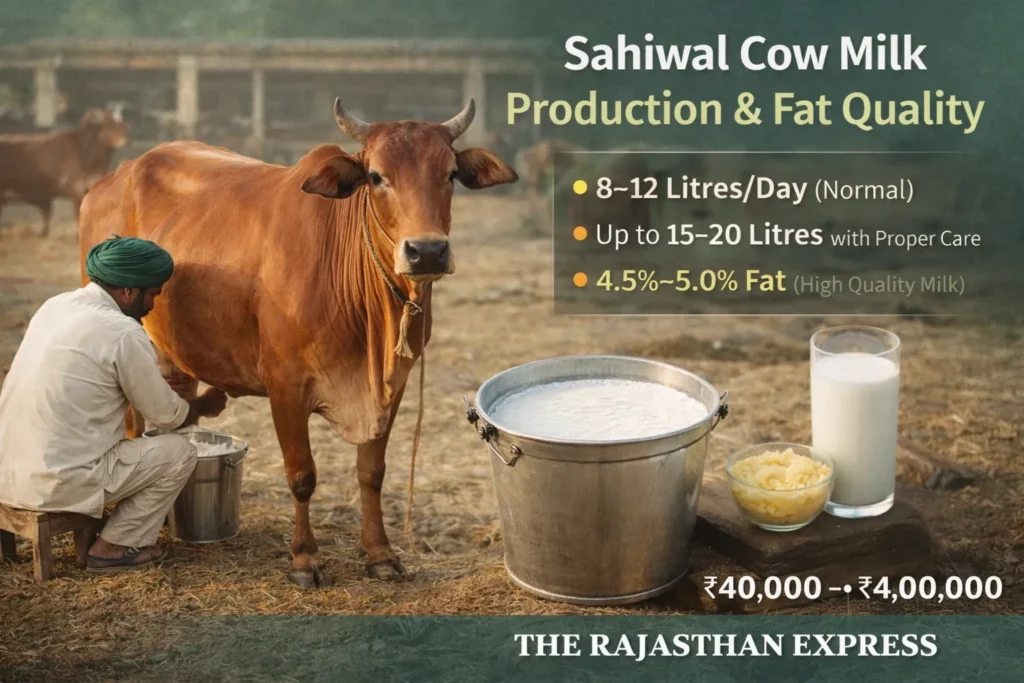
Sahiwal Cow Milk Per Day: A normal Sahiwal cow, under normal care, gives 8 to 12 litres of milk per day.
If the farmer keeps the cow scientifically – timely feed and fodder, balanced diet (green fodder + dry fodder + mineral mixture + clean water), regular deworming, clean shed, extra nutrition after calving – then milk can reach 15 to 20 litres per day.
- A Sahiwal cow’s milk depends on its care, diet, weather, and genetics. Some cows give less (1600 kg), some give very well (2750 kg), but most good cows give around 2300‑2400 kg.
Sahiwal Cow Milk Fat – Highest Among Desi Breeds
Sahiwal milk has the highest fat content among indigenous cows, around:
- 4.5% to 5.0%
- More precise data: Average 4.9% (Minimum 4.8%, Maximum 5.1%)
What does this mean?
- Higher fat milk is thicker and creamier. Yoghurt, ghee, butter, paneer made from it are very tasty and nutritious.
For comparison: ordinary European breeds (like Holstein‑Friesian) have 3.5% to 3.8% fat. That means Sahiwal milk has 1% more fat – this is a huge difference!
Example: If 100 litres of milk has 4.9% fat, then it will yield 4.9 kg of ghee‑making butter. Whereas Holstein’s 100 litres yields only 3.5 kg. That is 40% more ghee per litre from Sahiwal.
Farmer’s benefit: Even if milk quantity is less, more ghee and butter are obtained, so the price is good. Milk companies often pay according to fat – more fat = more price.
When does a Sahiwal cow give birth for the first time? (Age at First Parturition)
- Average 41.7 months, i.e., about 3 years and 6 months (because 12 × 3.5 = 42 months).
- A Sahiwal heifer (female calf) becomes pregnant for the first time at about 2.5 to 3.5 years of age and then calves after 9 months (gestation period). Altogether, by 3.5 years of age, it gives its first calf.
- Specialty of indigenous cows: European breeds (Jersey, Holstein) calve earlier – in about 2 years. But Sahiwal matures a little later, yet gives milk for a long time (12‑15 years). Early calving weakens the cow; Sahiwal does not have this drawback.
| Performance Record of Sahiwal Cattle | |||
| Parameter | Average | Minimum | Maximum |
|---|---|---|---|
| Age at first parturition (months) | 41.7 | 30 | 50 |
| Parturition interval (months) | 15.6 | 13 | 18 |
| Milk yield per lactation (kg) | 2325 | 1600 | 2750 |
| Milk fat (%) | 4.9 | 4.8 | 5.1 |
| The Rajasthan Express : Sahiwal Cattle Performance | |||
Sahiwal Cow Price in Rajasthan & India (2026)
Sahiwal Cattle Price – What Factors Affect Cost?
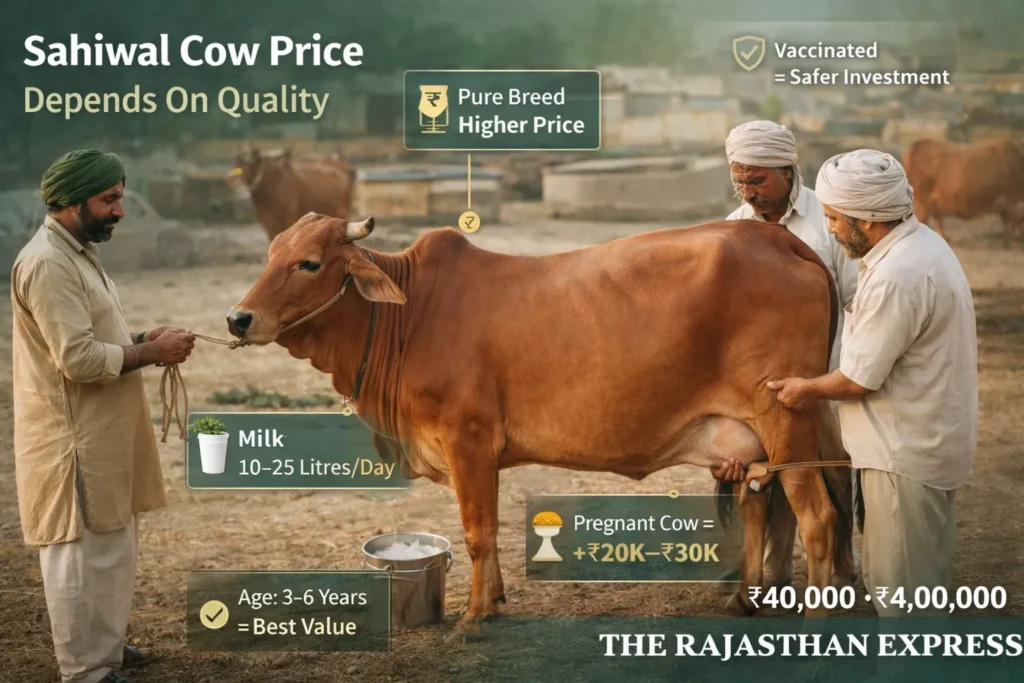
Buying a Sahiwal cow is a big investment. There is no fixed price here – a cow can be found for ₹40,000, and also for ₹4 lakh. The difference depends only on the quality of the cow. Let us understand each reason.
1. How much milk does it give? (More milk = higher price)
This is the biggest factor. After all, the main purpose of keeping a cow is milk.
- Ordinary village cow: 8 to 12 litres per day (on desi fodder)
- Good farm cow: 20 to 25 litres per day (balanced diet, better care)
- Fat in milk: 4.5% to 5.5% – i.e., milk is creamy and thick. Milk companies pay higher prices for such milk.
A cow giving 10 litres per day will cost around ₹80,000 to ₹1 lakh. A cow giving 20‑25 litres per day will directly reach ₹1.5 to ₹2.5 lakh. The more the milk, the higher the price – that is simple math.
2. How pure is the breed? (Registered cow = expensive cow)
Purity means that the cow’s parents, grandparents are all pure Sahiwal, without any crossbreeding with another breed.
- Cow without documents: cheap, but risky – it may not be pure.
- Registered / certified cow: whose name is recorded in a government society (e.g., NBAGR) or a recognised farm. It has papers.
Just as a pedigree dog is expensive, similarly a pedigree cow is also expensive. A registered Sahiwal can cost 30‑50% more than the same unregistered cow.
3. What is the age of the cow? (Young cow is most expensive)
The age of the cow directly affects the price because an old cow will give less milk and die sooner.
- Heifer – 1 to 2.5 years old, has not started giving milk yet: Price ₹40,000 – ₹70,000 (low, because future milk is uncertain)
- Young milch cow – 3 to 6 years old (after first or second calving): This sells the most expensive – because it will still give milk for 8‑10 more years. Milk capacity is at its peak.
- Old cow – above 10 years: Price drops sharply – may even go for meat or butcher price.
A healthy 3‑year‑old Sahiwal giving 15 litres per day will sell for a higher price than a 7‑8 year old cow giving the same milk. Age = remaining earning years.
4. Is the cow pregnant? (If yes, price increases)
A pregnant cow (i.e., with a calf in her womb) gives double benefit – milk + a calf. If the cow is pregnant, within a few months of purchase you will get a new calf (male or female). If it is a heifer (female), she will give milk in the future – your herd will grow. If it is a bull calf (male), you can raise it as a bullock for ploughing or sell for meat.
The price of a pregnant cow is at least ₹20,000‑₹30,000 more than the same non‑pregnant cow. Because you are getting “two for the price of one”.
5. Is the cow’s pedigree record (ancestry) available?
Pedigree means the history of the cow up to great‑grandparents. It records:
- How much milk its mother and grandmother gave.
- How many days its ancestors kept giving milk.
- What diseases they had or did not have.
- Breeding (calving) history.
Just as a person with good genes is tall and strong, similarly pedigree tells that the cow’s calves will also be good. A cow with recorded pedigree can be twice as expensive as an ordinary cow. (For example, a ₹1 lakh cow sells for ₹2 lakh if its family history is excellent.)
6. Has the cow been vaccinated?
Healthy cow = less disease = less expense = higher price.
Full vaccination means:
- Lumpy Skin Disease (LSD)
- Foot and Mouth Disease (FMD)
- Haemorrhagic Septicaemia (HS)
- Brucellosis (to prevent abortion)
- And other regional disease vaccines
If the cow has a certificate from a government veterinary hospital that vaccines have been given, its price directly increases. An unvaccinated cow may cost you thousands in treatment later, so it sells cheaper in the market.
A vaccinated cow costing ₹1.5 lakh, the same cow without vaccines will not sell for more than ₹1.2 lakh – because it carries disease risk.
7. Where are you buying? (Prices vary by state)
This is a game of supply and demand.
- In the original area of Sahiwal (Punjab, Haryana, Rajasthan, western Uttar Pradesh): There are many breeders, cows are easily available. Price is cheaper.
- In distant states (Bihar, West Bengal, Odisha, Madhya Pradesh, South India): Sahiwal is rare. It has to be brought from other states. Transport cost, middleman commission, and local demand increase the price by 20‑40%.
A cow that is ₹80,000 in Punjab becomes ₹1.2 lakh by the time it reaches Mumbai or Chennai. If you buy directly from a local farm, it is cheaper.
📌 Estimated price (as of 2026):
- Heifer / young cow: ₹40,000 – ₹70,000
- Ordinary Sahiwal cow (low milk): ₹50,000 – ₹80,000
- Good milch Sahiwal cow (8‑15 litres/day): ₹80,000 – ₹1,50,000
- High‑yielding Sahiwal cow (20‑25 litres/day): ₹1,50,000 – ₹2,50,000
- Cow with complete records (milk record, calving birth, heat period, calving time, conception rate, pedigree, vaccination – everything with documents) + extremely high milk‑yielding: ₹2.5 lakh to ₹4 lakh
A big leap in indigenous breed improvement: Production of Sahiwal calves using advanced breeding techniques
You know, India has many good indigenous cow breeds, such as Sahiwal, Gir, Tharparkar, etc. These cows can survive in harsh environments and their milk is also very beneficial. But there is one problem – to get more and more milk from these cows, and to rapidly multiply good traits, we did not have sufficient technology earlier.
The traditional method is to take semen from a good bull and do artificial insemination (AI) in cows. But in this process, only one calf is produced from one cow per year. That is, spreading the qualities of a good cow takes a lot of time.
So scientists thought – why not use a technique by which dozens of calves can be produced in one year from an excellent cow? Just like one plant of a good variety can produce thousands of plants (like tissue culture). And with this dream, scientists at ICAR‑IVRI, Izatnagar, Bareilly got to work.
ICAR‑IVRI full name is – Indian Council of Agricultural Research – Indian Veterinary Research Institute. It is located in Izatnagar, Bareilly (Uttar Pradesh). It is India’s oldest and largest animal science research centre. Just as AIIMS is for humans, similarly IVRI is for animals.
OPU, IVF and ET technology
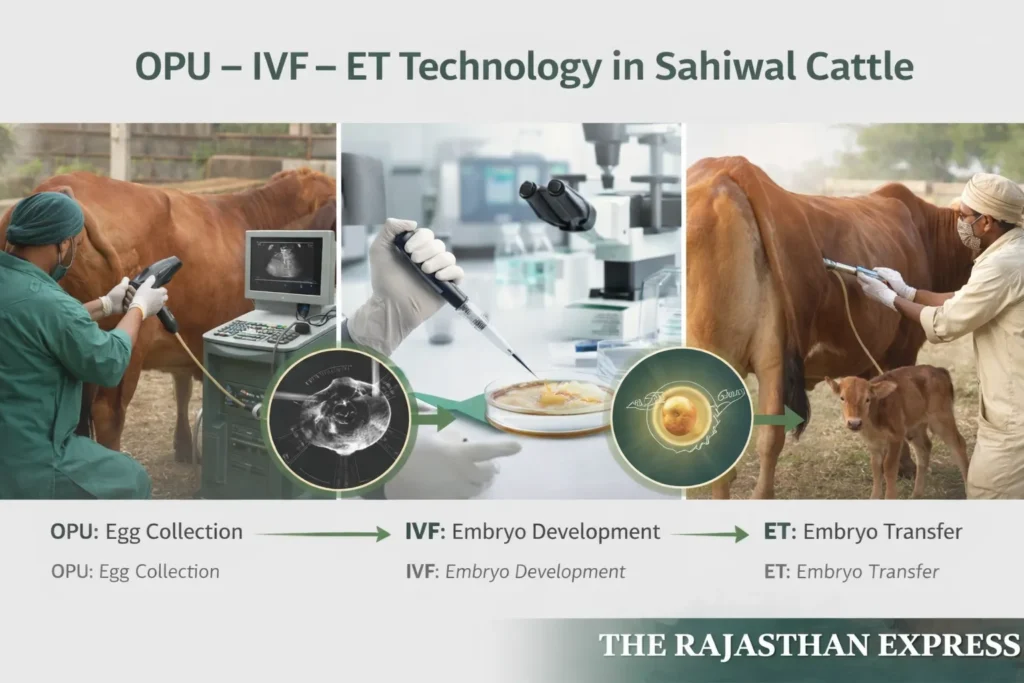
Now let us come to the technology called OPU‑IVF‑ET. This is a combination of three different technologies. These are called Assisted Reproductive Technologies (ART). Let us understand them very simply.
1. OPU – Egg collection machine
- OPU means – Ovum Pick‑Up. ‘Ovum’ means the egg (the female egg that meets the sperm to create a baby).
- What used to happen earlier? To extract eggs from a cow, hormonal drugs had to be given and then surgery performed. This caused discomfort to the cow and only a few eggs were obtained at a time.
- What happens now? Scientists insert a thin needle (attached to ultrasound) into the cow’s ovary. While viewing with the help of ultrasound, they suck out the oocytes directly from the ovary without any incision (surgery), without troubling the cow much.
- Best part: This procedure can also be done without hormonal stimulation (without injections). That is, eggs can be collected every 10‑15 days in the cow’s natural cycle. In this way, 50‑60 eggs can easily be obtained from one cow in a year!
2. IVF – Embryo is created in the lab
- IVF means – In Vitro Fertilization. ‘In vitro’ means ‘in a glass vessel’, i.e., in the lab, outside the body.
- We have collected the eggs via OPU. Now we need bull semen (sperm). Scientists took semen from a proven bull – i.e., a bull whose mother gave very high milk (up to 3320 kg).
- Now in the lab, in a dish (Petri plate), the egg and sperm are placed together. Natural conditions are created (correct temperature, nutrient fluid). Here the sperm and egg meet (fertilisation), and an embryo is formed – which will later become a baby.
3. ET – Transferring the embryo to another cow’s womb
ET means – Embryo Transfer.
- Now we have one or more embryos ready in the lab. Now they need to be placed into the uterus of a cow that is cheap, easily available, and healthy. This cow is called a surrogate (rental mother). This cow is not genetically related to the calf; she just carries it in her womb and gives birth after nine months.
- In this way, we can create hundreds of embryos from an excellent milch cow (donor), and by implanting them into cheap, ordinary cows, we can produce dozens of offspring from that one excellent cow in a year.
Let us understand even better with an example: Imagine, a hen’s egg cannot produce hundreds of chicks. But if you take that hen’s egg (ovum) and a good rooster’s sperm, mix them in the lab to create many embryos, and then put those embryos into other hens’ wombs, then hundreds of chicks can be produced from one good hen. OPU‑IVF‑ET is exactly the same for cows.
Success story – Five calves in five days
- Scientists started this programme in 2022‑23. Their goal was to make this OPU‑IVF‑ET technology fully successful in Indian conditions. They worked on three breeds – Sahiwal, Tharparkar (cows) and Murrah (buffalo).
- After about 3‑4 years of hard work, precision and learning, the golden day of success arrived. Starting from 28 February 2026, within just five days – 5 healthy Sahiwal calves were born! That is, about one calf per day. This is a huge achievement, because earlier producing so many calves in such a short time was impossible.
Which calves were born?
- Donor mother: A high milk‑producing Sahiwal cow that gave more than 12 litres of milk per day. (A normal Sahiwal gives 6‑8 litres, so this is very good.)
- Genetic father (bull): A bull whose mother’s milk production was 3320 kg per lactation (in about 300 days). That is, a very excellent pedigree.
So the born calves will have the same good qualities – high milk, disease resistance, and ability to adapt to local weather. Scientists tried this technology on different breeds. The results were very encouraging:
| Oocyte Collection and Embryo Formation in Different Breeds | ||
| Breed | Average oocytes collected per session | Embryo formation success rate |
|---|---|---|
| Tharparkar (cow) | Approximately 14.5 | More than 47% (lab-made embryos reached blastocyst) |
| Sahiwal (cow) | Approximately 13.14 | More than 47% |
| Murrah (buffalo) | 4.5 – 5.5 | More than 42% |
| The Rajasthan Express : Oocyte & Embryo Performance | ||
What is a blastocyst?
- A stage of embryo development when it is fully ready to implant in the uterus. 47% or 42% means that among all the fertilisations done in the lab, about half the embryos were of very good quality. This is equal to global standards – meaning performance as good as good labs in America or Europe.
Why is this success such a big deal?
You may ask – well, a few calves were born, what is new about that? It is very new, listen:
- First time: In the history of ICAR‑IVRI, this technology has been fully successful for the first time. That is, it has now become a proven method.
- Rapid genetic improvement: Earlier it took one year to produce one offspring from a good cow. Now 20‑30 calves can be produced from the same cow in one year (by repeatedly collecting eggs and implanting embryos into different surrogate cows). This will give farmers good breeds very quickly.
- Without hormones: The most special thing – they collected eggs without hormonal stimulation. This means no extra drug pressure on the donor cow. It is more natural and safe.
- Saving endangered breeds: With this technology, we can save those cows of the country that are decreasing (like some breeds of eastern India). We can freeze their eggs and semen, and later implant them into surrogates to reproduce them.
- Success in buffaloes too: This technology also worked in Murrah buffalo (very famous for milk). IVF in buffaloes is considered more challenging, yet 42% success was achieved.
Key Points About Indigenous Cows in India (Desi Cow Facts)
- India’s best draught (load‑carrying) breed is Amrit Mahal.
- Maharashtra’s best draught breed is Khillari.
- Rajasthan’s best load‑carrying breed is Nagori.
- India’s best dual‑purpose (milk + work) breed is Hariana.
- The world’s smallest cow breed is Vechur.
- India’s heaviest cow breed is Kankrej.
- The Kankrej breed exhibits a “Sawai Chal” (fast and special gait).
- Deoni cow was created by crossing Gir, Dangi, and local cows.
- Nimari cow was created by mixing Gir and Khillari breeds.
- India’s most expensive cow breed is considered to be Ongole. In Brazil, this same breed is called Nelore. At the beginning of the year 2025, a Nelore cow named “Viatina‑19” was sold for approximately ₹40‑41 crore. It also set a Guinness World Record. “Viatina‑19” weighed about 1100 kg, which is much more than a normal cow. The first Ongole cows were taken from India to Brazil in 1868. Later, by 1960, about 7000 cattle were sent there. In Brazil, this breed was named “Nelore”, after the Nellore district of Andhra Pradesh.
- Among indigenous cows, the longest lactation period is of the Gir cow (about 325 days). The Gir cow originated in the Gir forests of Kathiawar, Gujarat. The Gir cow is also called Kathiyawadi, Ajmera, Renda, Surti.
- Among buffaloes, the longest lactation period is of the Mehsana buffalo (about 352 ± 15 days).
- Identification of Gir cow:
- Red, brown, or spotted skin
- Prominence on forehead
- Long, hanging, leaf‑shaped ears
- Half‑moon shaped horns
- India’s highest milk‑producing indigenous cow is Sahiwal.
- In the Sahiwal cow, the dewlap (loose skin of the neck) and Nawelflap are more developed. This is the main identification of the Sahiwal cow. The Sahiwal cow originated in Montgomery (Pakistan), Punjab, Haryana. The Sahiwal cow is also called Lola breed, Multani, Montgomery, Lambi Bar.
- Because the Sahiwal cow’s skin is loose, it is also called the Lola breed.
- The most intelligent cow breed is considered to be Red Sindhi. The Red Sindhi cow originated in Karachi, Hyderabad (Sindh), Pakistan. The Red Sindhi cow is also called Red Karachi.
- Among indigenous breeds, the highest disease resistance is found in the Tharparkar cow, which is found in the state of Rajasthan, India. The Tharparkar cow originated in the Tharparkar district of Sindh province in Pakistan and in Gudamalani, Barmer. It is also known as White Sindhi, Grey Sindhi, or Thari and Malani. This breed is named after the Thar Desert, which extends from Sindh to the Kutch district of Gujarat and to the Barmer, Jaisalmer, and Jodhpur districts of Rajasthan, India.
- The Tharparkar cow also has the ability to change colour.
- The highest milk‑producing cow in Rajasthan is Tharparkar.
- The Rathi cow was created by mixing Red Sindhi, Sahiwal, Tharparkar, and Dhani breeds. The Rathi cow is also called Rajasthan’s Kamadhenu.
Livestock Population in India (20th Livestock Census 2019)
| Livestock Population in India (20th Livestock Census, 2019) | ||
| Particulars | 20th Livestock Census (2019) figure | Change from previous census (2012) |
|---|---|---|
| Total livestock | 53.58 crore (535.78 million) | +4.6% (increase) |
| Total cows (all types) | 19.25 crore (192.49 million) | +0.8% (increase) |
| Indigenous/unclassified cows | 14.21 crore (142.11 million) | -6% (decline) |
| Exotic/crossbred cows | 5.04 crore (50.42 million) | +26.9% (remarkable increase) |
| Female cows (Cows) | 14.51 crore (145.12 million) | +18.0% (much higher than previous census) |
| Buffaloes | 10.98 crore (109.85 million) | +1.0% |
| Goats | 14.89 crore (148.88 million) | +10.1% |
| Sheep | 7.43 crore (74.26 million) | +14.1% |
| The Rajasthan Express : Livestock Census 2019 | ||
Important point:
- While the total cow population has increased marginally by 0.8%, the population of female cows has seen a large increase of 18.0%. In contrast, the total population of indigenous cows (both male and female) has declined by 6%. These figures indicate that attention to milk production has increased, due to which the number of female animals has increased.
Sahiwal Cow Population in India & Worldwide
| Sahiwal Cow Population in India & Worldwide | ||||
| Year | Country / Region | How many cows? (Number) | Is it pure or mixed? | Source |
|---|---|---|---|---|
| 2013 | India | 10,92,459 (approx 10.92 lakh) | Pure Sahiwal | 2013 Breed Survey Report of the Department of Animal Husbandry, Government of India |
| 2013 | India | 37,89,835 (approx 37.90 lakh) | Graded (meaning mixed / crossbred) | The same report also stated this |
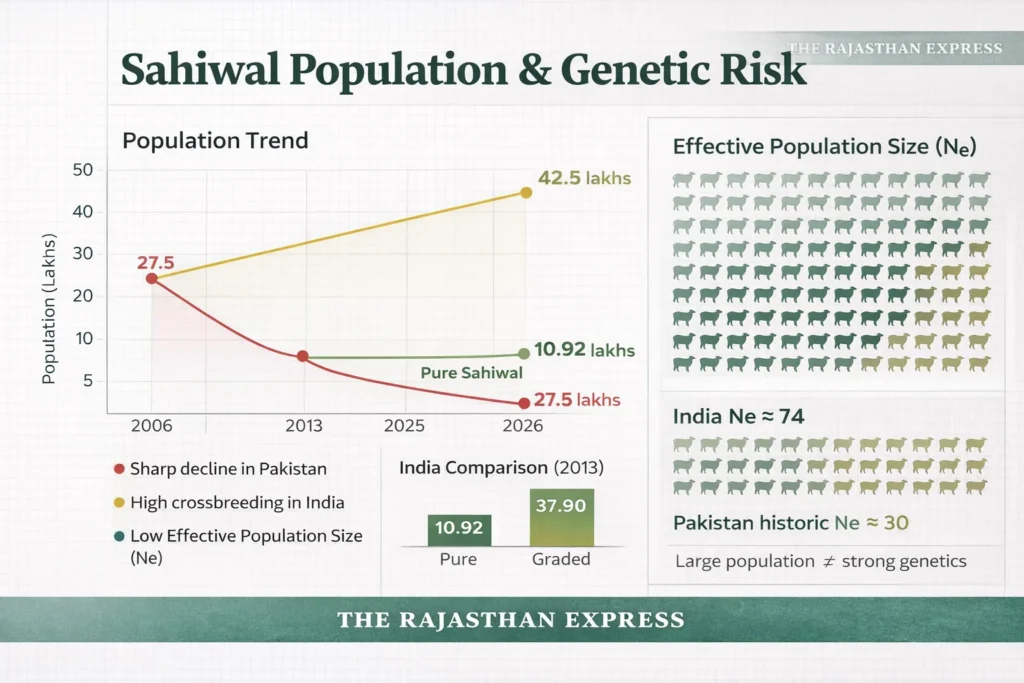
| 2006 | Pakistan | 27.5 lakh (2.75 million) | Pure (at that time) | FAO (Food and Agriculture Organization) gave this figure |
| 2026 | Pakistan (only Punjab province) | Approximately 5,00,000 (5 lakh) | Pure | Punjab Livestock Department, Pakistan |
| 2025 | Whole world | Estimated 42.5 lakh (4.25 million) | Both pure and mixed | DAD-IS (International Animal Diversity Database) |
| The Rajasthan Express : Sahiwal Population Data | ||||
Source By:
- http://14.139.252.116/agris/breed.aspx
- https://www.fao.org/4/ah806e/AH806E08.htm
- https://agris.fao.org/search/zh/records/65df7e094c5aef494fe2dffd
- https://www.app.com.pk/punjab/punjab-launches-initiative-to-promote-indigenous-livestock-breeds/
- https://en.wikipedia.org/wiki/Sahiwal_(cattle)
Sahiwal in India – quantity is okay, but…
- In 2013, India had 10.92 lakh pure Sahiwal cows. This is no small number. If you look only at the number, this breed seems safe. But at the same time, there were 37.90 lakh graded (mixed) Sahiwal.
- That is, for every one pure Sahiwal, there were about 3.5 mixed cows. This indicates that farmers were gradually moving away from pure Sahiwal towards crossbred cows, because they got more milk from them (even if they fell sick more often).
Situation in Pakistan – very severe decline
- In 2006, Pakistan had 27.5 lakh pure Sahiwal cows. That is, at that time, Pakistan had more Sahiwal than India. But by 2026, only 5 lakh remain in just Punjab province (and including other parts of Pakistan, perhaps 7‑8 lakh).
Why such a rapid decline?
- Pakistan started indiscriminate crossbreeding. Farmers thought that by crossing with Friesian (foreign breed) they could get more milk.
- Result: The pure Sahiwal population fell from 27.5 lakh to less than 5 lakh.
- Now the Government of Pakistan has started a Sahiwal conservation project (from 2005), but by then a lot of damage had already been done.
Global estimate – 4.25 million (42.5 lakh)
- If you add all pure and mixed Sahiwal worldwide, the number comes to about 42.5 lakh. But how many of these are truly pure Sahiwal? This question is still unanswered. Most experts believe that the global pure Sahiwal population is not more than 10‑12 lakh – and it is continuously declining.
Sahiwal of Kenya – a story that started with 60 animals
- Another astonishing example is that of Kenya (Africa). There, Sahiwal cows number about 3,000. But all of these are descendants of just 60 bulls and 12 cows that were taken from India‑Pakistan to Kenya between 1939 and 1963.
What happened?
- Initially there were only 72 animals.
- Now from that same lineage, 3,000 animals have grown.
- But there is almost no genetic diversity among them. That is, they are almost like twins.
If a new disease strikes Sahiwal in Kenya, the entire population could be wiped out. Therefore, scientists are advising the Kenyan government to import new and different Sahiwal bulls from India or Pakistan to bring in new blood (genes).
The biggest threat – “Effective Population Size (Ne)”
Now we come to the most complex but most important point. People often think – “There are lakhs of cows, so what’s the worry?” But in biology (genetics), there is a clever formula called effective population size.
What is effective population size?
- Suppose a village has 1000 cows. But only 20 bulls are actually mating (the rest are sterile or have been killed), and only 100 cows are capable of calving (the rest are old or sick). Then the actual genetic strength of the whole herd depends only on those few animals. That is, out of the entire 1000, the effective population size would be only around 120.
- And this is exactly what is happening with Sahiwal!
What is the effective population size of Sahiwal?
- In India: A recent study found it to be only 74 (seventy‑four).
- In Pakistan: Between 1980‑84, it was only 30 (thirty)!
What does this mean?
- Even if the numbers are in lakhs, very little genetic diversity remains.
- When thousands of cows are impregnated by the same bull, future generations become alike.
- If a new disease arrives, all will fall sick (because their disease resistance is the same).
- The real threat of extinction of a breed comes not from total numbers, but from low effective population size.
Simple example: Suppose a class has 100 children, but only one child answers all the questions, and the rest just copy him. If that one child falls sick, the whole class will fail. That is the situation with Sahiwal.
Summary
The Sahiwal cow originated in the arid Punjab region of Pakistan, but today it is the pride of India’s dairy industry. It is named after a district, and its body is shaped for harsh conditions. In India, Punjab (Firozpur/Fazilka) and Rajasthan (Ganganagar) are the best breeding tracts. If you want a cow that gives abundant milk on low fodder, in scorching heat, without falling sick – there is none better than Sahiwal.
Know Sahiwal cow milk per day (8‑20L), price in Rajasthan (₹40k‑₹4L), origin, pure desi status, characteristics, colour, and population. Complete guide with images.
Sahiwal Cow: Milk Per Day, Price in Rajasthan, Pure Desi Breed Origin & Characteristics
People Also Ask About Sahiwal Cow
What is a Sahiwal cow? Is Sahiwal cow desi or not?
The Sahiwal cow is one of India’s most famous and registered indigenous (desi) milch breeds. It is known for high milk production, heat tolerance, and disease resistance. Sahiwal cow is desi – a pure indigenous Zebu breed, fully registered with NBAGR. It originated in the Sahiwal district of Pakistan (formerly Montgomery) and is now widely reared in India, especially in Punjab, Haryana, and Rajasthan.
What is the origin of Sahiwal cow? (Sahiwal Cow origin / Sahiwal cattle origin)
Sahiwal cow origin is the arid Punjab region along the Indus River, specifically the Montgomery district (now called Sahiwal district) of Pakistan. The breed is named after this district. In India, after the 1947 partition, Sahiwal cows spread mainly to Punjab (Fazilka/Abohar), Haryana (Hisar/Sirsa), and Rajasthan (Sri Ganganagar).
How much milk does a Sahiwal cow give per day? (Sahiwal cow milk per day / Sahiwal cattle milk per day)
Sahiwal cow milk per day under normal care is 8 to 12 litres. With scientific management (balanced diet, clean water, deworming, proper shed, extra nutrition after calving), it can reach 15 to 20 litres per day. The average milk yield per lactation is 2325 kg (approx 2257 litres), with a range of 1600‑2750 kg according to ICAR‑NBAGR.
What is the price of a Sahiwal cow in Rajasthan? (Sahiwal cow price Rajasthan / Sahiwal cattle price)
Sahiwal cow price Rajasthan varies based on milk yield, purity, age, pregnancy, pedigree, vaccination, and location. Estimated prices (2026):
- Heifer / young cow: ₹40,000 – ₹70,000
- Ordinary Sahiwal cow (low milk): ₹50,000 – ₹80,000
- Good milch (8‑15 litres/day): ₹80,000 – ₹1,50,000
- High‑yielding (20‑25 litres/day): ₹1,50,000 – ₹2,50,000
- Complete record + high milk: ₹2.5 lakh – ₹4 lakh
What are the characteristics of Sahiwal cow? (Sahiwal cow characteristics / Sahiwal cattle characteristics)
Sahiwal cow characteristics include:
- Colour: Deep red to brownish‑red (mahogany red or greyish red).
- Skin: Very loose and hanging – hence called “Lola breed”.
- Dewlap & Navel flap: Highly developed, helping in heat tolerance.
- Horns: Short, stumpy, curved outward then inward (half‑moon shape).
- Milk fat: Highest among indigenous breeds – 4.5% to 5.1% (average 4.9%).
- Temperament: Calm and docile.
What is the colour of Sahiwal cow? (Sahiwal cow colour)
Sahiwal cow colour is typically deep red to brownish‑red. Sometimes it appears mahogany red or greyish red. In bulls, the legs and ends of head/tail are darker than the rest of the body. White patches are rare but may occur.
What is the fat percentage in Sahiwal milk? (Sahiwal cattle milk production fat content)
The milk fat percentage in Sahiwal cows is the highest among all indigenous Zebu breeds – averaging 4.9%, with a range of 4.8% to 5.1%. For comparison, Holstein‑Friesian milk has only 3.5‑3.8% fat. Sahiwal milk yields 40% more ghee per litre, making it ideal for yoghurt, ghee, butter, and paneer.
Where can I find pure Sahiwal cows in India? (Sahiwal cow of Punjab / Sahiwal cow in India)
The purest herds of Sahiwal cow of Punjab are found around Fazilka and Abohar in Firozpur district. In Rajasthan, Sri Ganganagar has pure herds. In Haryana, Hisar, Sirsa, and Fatehabad districts also have significant populations. For a genetically pure Sahiwal, these are the recommended areas.
What is the effective population size of Sahiwal cattle?
The effective population size (Ne) of Sahiwal in India is only 74, and in Pakistan (1980‑84) it was only 30. This is dangerously low, meaning that despite having lakhs of cows, very few bulls are actually used for breeding, and genetic diversity is extremely limited. This makes the breed vulnerable to new diseases.
How much does a Sahiwal bull weigh? (Sahiwal cattle weight)
A full‑grown Sahiwal bull weighs approximately 540 kg, while a cow weighs around 327 kg. The bull is about 213 kg heavier than the cow. Height at shoulder: bull 170 cm, cow 124 cm.
What are the three main classifications of Indian Zebu breeds based on utility?
They are: (1) Milch breeds (e.g., Gir, Sahiwal), (2) Dual‑purpose breeds (e.g., Hariana, Ongole, Kankrej), and (3) Draught breeds (e.g., Amritmahal, Nagori, Khillari).
What is special about the Kankrej breed?
Kankrej is India’s heaviest cow breed, known for its “Sawai Chal” (fast, special gait). It was used along with Gir to develop the American Brahman in the USA.
What is the most expensive cow breed in India?
India’s most expensive cow breed is considered to be Ongole. In Brazil, it is called Nelore. In 2025, a Nelore cow named “Viatina‑19” sold for approximately ₹40‑41 crore.
What is the smallest cow breed in the world?
The world’s smallest cow breed is Vechur from Kerala.
What is the disease resistance of Tharparkar cow?
Among indigenous breeds, the highest disease resistance is found in the Tharparkar cow, which also has the ability to change colour. It is the highest milk‑producing cow in Rajasthan.
What is the most intelligent cow breed?
The most intelligent cow breed is considered to be Red Sindhi (also called Red Karachi).
What is the Rathi cow?
The Rathi cow was created by mixing Red Sindhi, Sahiwal, Tharparkar, and Dhani breeds. It is called Rajasthan’s Kamadhenu.