 By
ByTharparkar Cow in India: Origin, Price, Milk Capacity & Tharparkar Cow Breed Guide
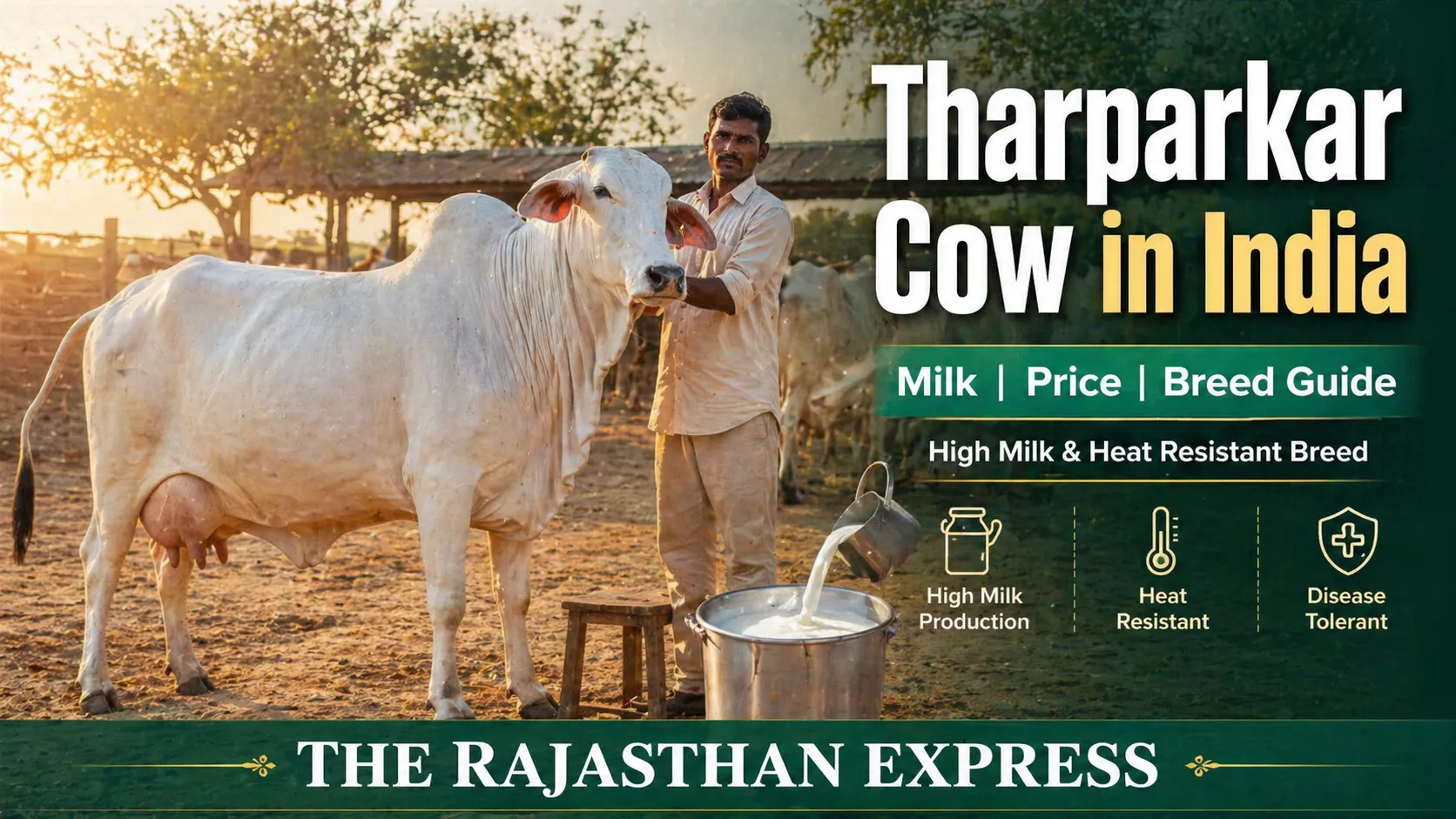
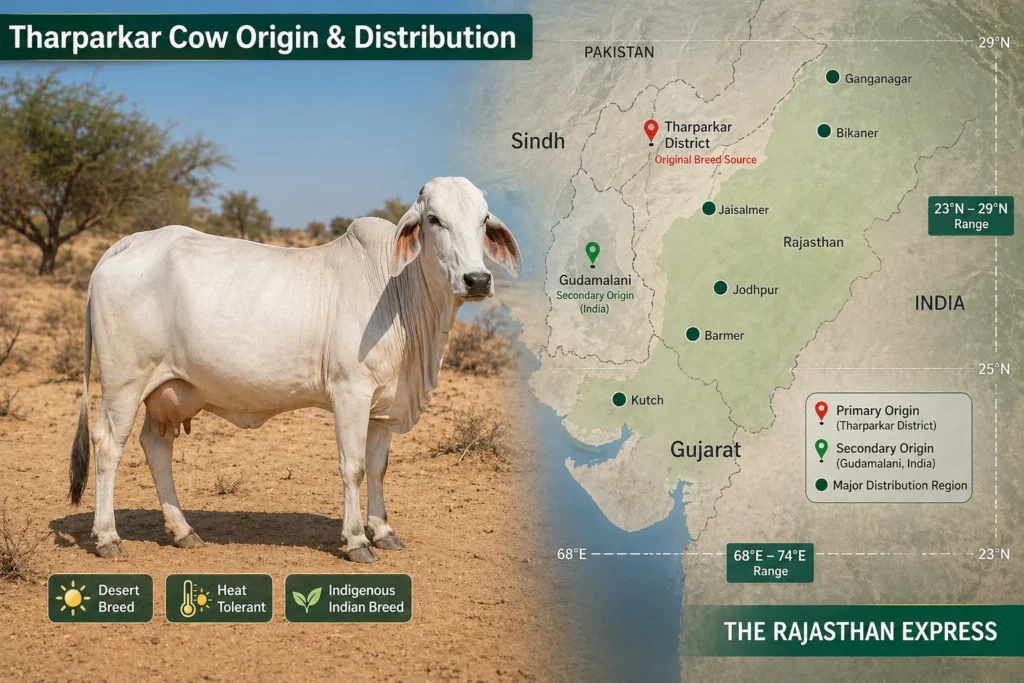
The Tharparkar cow is one of the prominent indigenous breeds of India, known throughout the world for its disease resistance. The origin of the Tharparkar cow is from Tharparkar district of Sindh province, Pakistan, and also from the Gudamalani area of Barmer district, Rajasthan, because the border of Barmer district touches Tharparkar district of Sindh province, Pakistan. The Tharparkar cow is mainly found in Rajasthan’s areas bordering Pakistan – such as Jaisalmer, Jodhpur, Ganganagar, and the Malani area of Barmer.
Tharparkar Cow Dairy Farm Benefits: Milk Production & Tharparkar Cow Milk Per Day
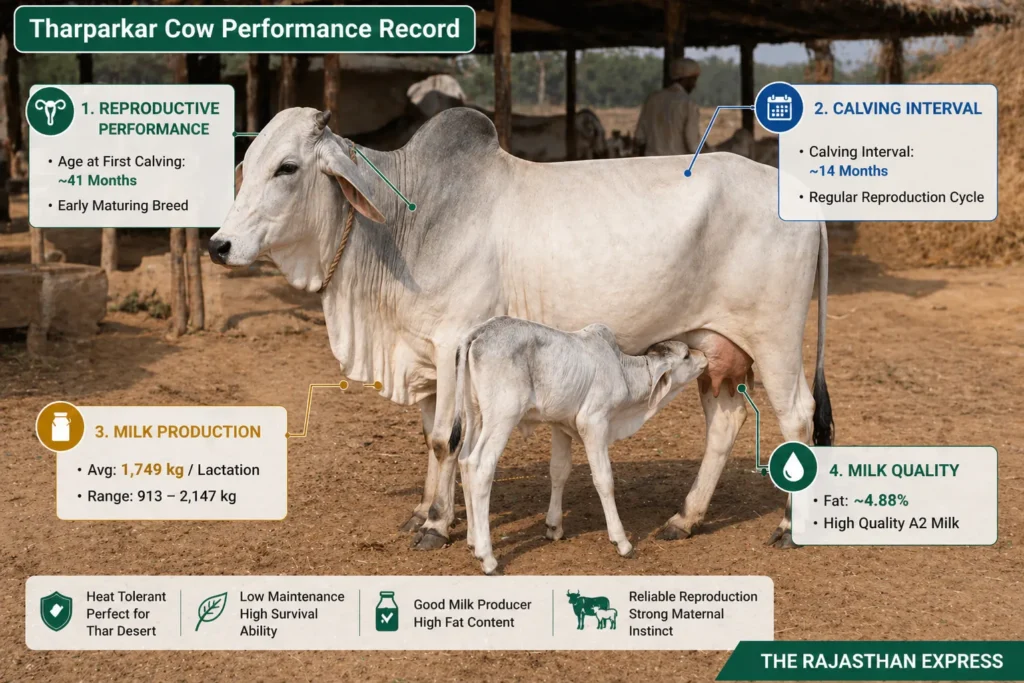
The Tharparkar cow is primarily reared for milk production, therefore it is called a ‘milch breed’. It can give on average 1,749 kilograms (approximately 1,700 litres) of milk per lactation (the period after giving birth), but with good care it gives even more. The biggest speciality of the Tharparkar breed is that among all indigenous cows of Rajasthan, this one gives the highest milk (according to veterinary literature). However, looking at some government portal reports, the Sanchori breed, which comes from the Sanchor area of Jalore district, Rajasthan, is said to have even higher milk production than the Sahiwal cow. Additionally, it has a very good ability to tolerate heat and diseases, which helps it adapt easily to different climates. By the way, the highest milk‑producing indigenous cow in India is Sahiwal.
Tharparkar Cow (Thari / Malani)
| Conservation Status | Indigenous / Domesticated (Declining Pure Breed) |
|---|---|
| Scientific Classification |
|
| Scientific Name | Bos indicus |
| Other Names | Thari, Malani, White Sindhi, Grey Sindhi |
| Origin | Tharparkar District (Sindh, Pakistan) & Gudamalani (Barmer, Rajasthan, India) |
| Distribution | Rajasthan (Barmer, Jaisalmer, Jodhpur, Bikaner, Ganganagar), Gujarat (Kutch), Pakistan (Sindh) |
| Breed Type | Milch Breed (High milk indigenous breed of Rajasthan) |
| Main Uses |
|
| Milk Production |
|
| Milk Quality |
|
| Physical Characteristics |
|
| Weight & Size |
|
| Reproductive Traits |
|
| Special Traits |
|
| Management System |
|
| Price (India 2026) |
|
| Crossbreeds Developed |
|
| Global Importance |
|
| Population (India) | ~1.97 lakh (2013 Breed Survey estimate) |
| Source: ICAR-NBAGR, Department of Animal Husbandry (India), The Rajasthan Express | |
Breed Registration & Classification in India
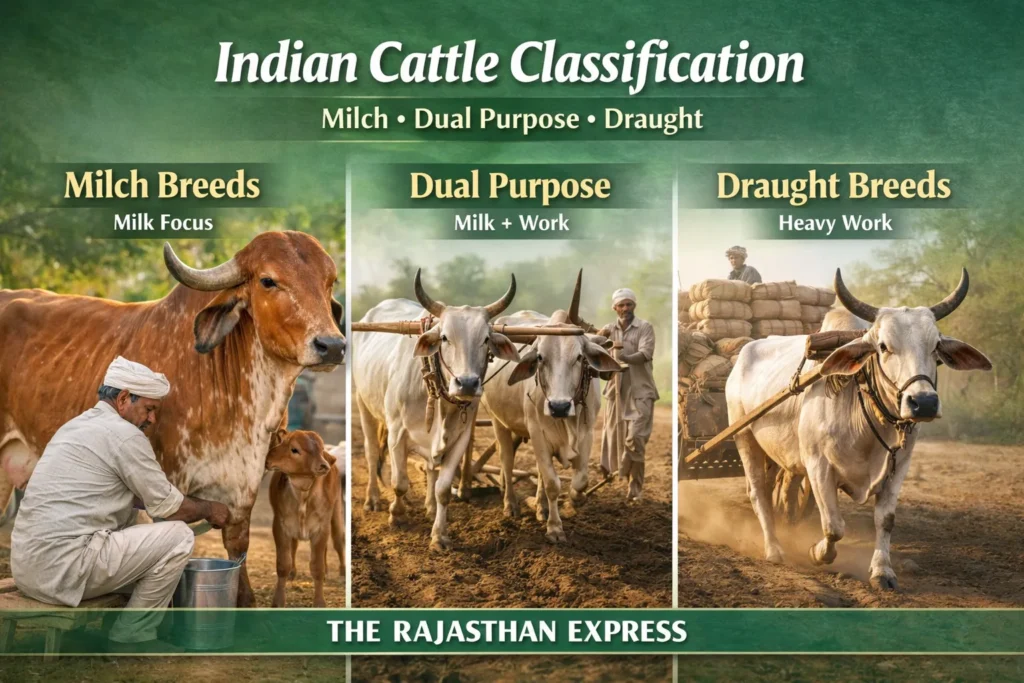
Now regarding registration: the registration of indigenous breeds is done by the NBAGR (National Bureau of Animal Genetic Resources) located in Karnal, Haryana. For any breed to be registered, at least 1000 animals of that breed must be present in the country. Indigenous cows in India are divided into three categories: first, milch breeds (such as Gir and Sahiwal); second, dual‑purpose breeds (such as Hariana and Ongole, which are good for both milk and ploughing); and third, draught breeds (such as Hallikar and Amritmahal, mainly used for pulling). It is also interesting to know that India’s first synthetic (mixed) cow is Friswal, created by crossing Sahiwal (37.5%) and Holstein Friesian (62.5%), but among pure indigenous breeds, the Gir cow holds a unique and high position.
Classification of Indigenous Cattle Based on Utility
Indian Zebu breeds are divided into three main categories based on their primary utility:
1. Milch Breeds (Milk Breeds)
These breeds are mainly reared for high milk production. They are tolerant to different climatic conditions and produce high-quality milk.
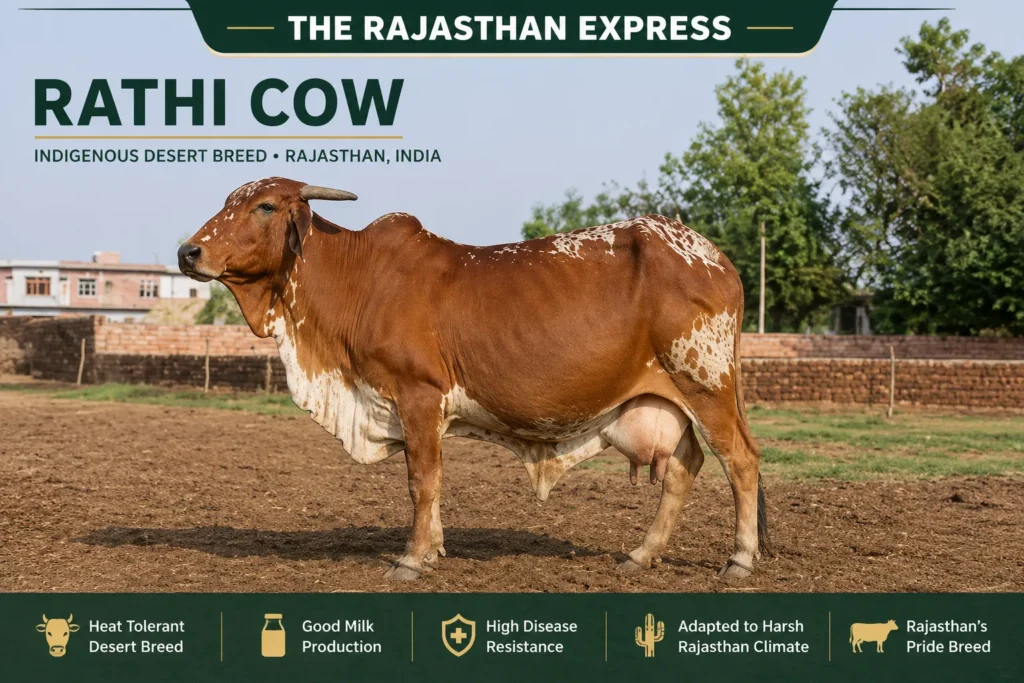
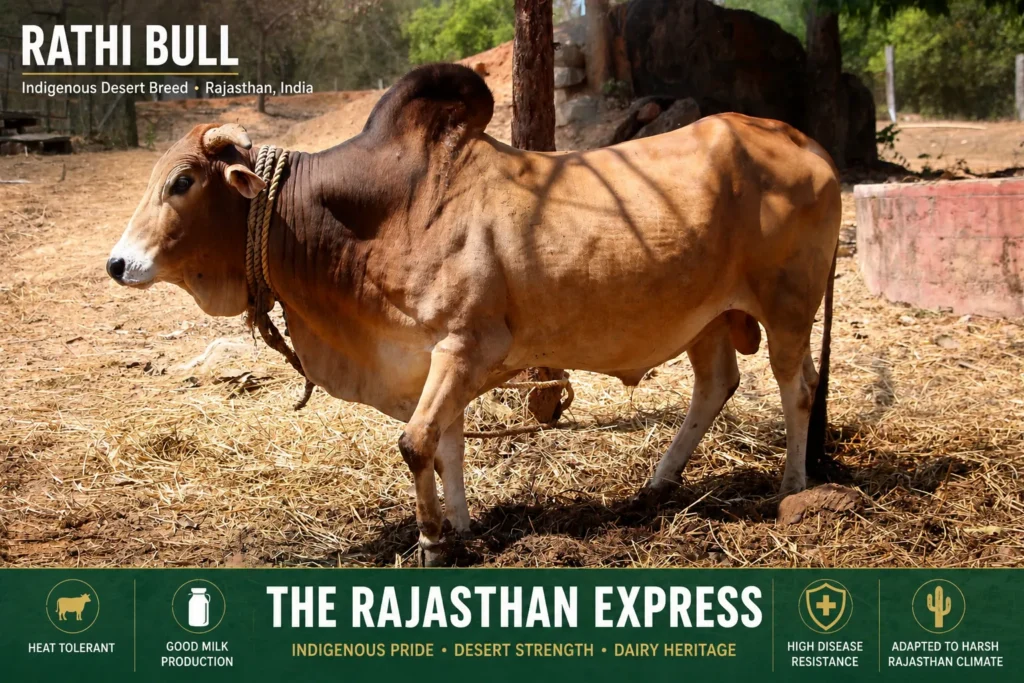
Examples: Gir Cow, Sahiwal Cow, Tharparkar Cow, Rathi Cow, Sanchori Cow, etc.
- Gir: Origin is the Gir forest area of Gujarat. They have a reddish‑brown colour and long, drooping ears. Considered best for milk production.
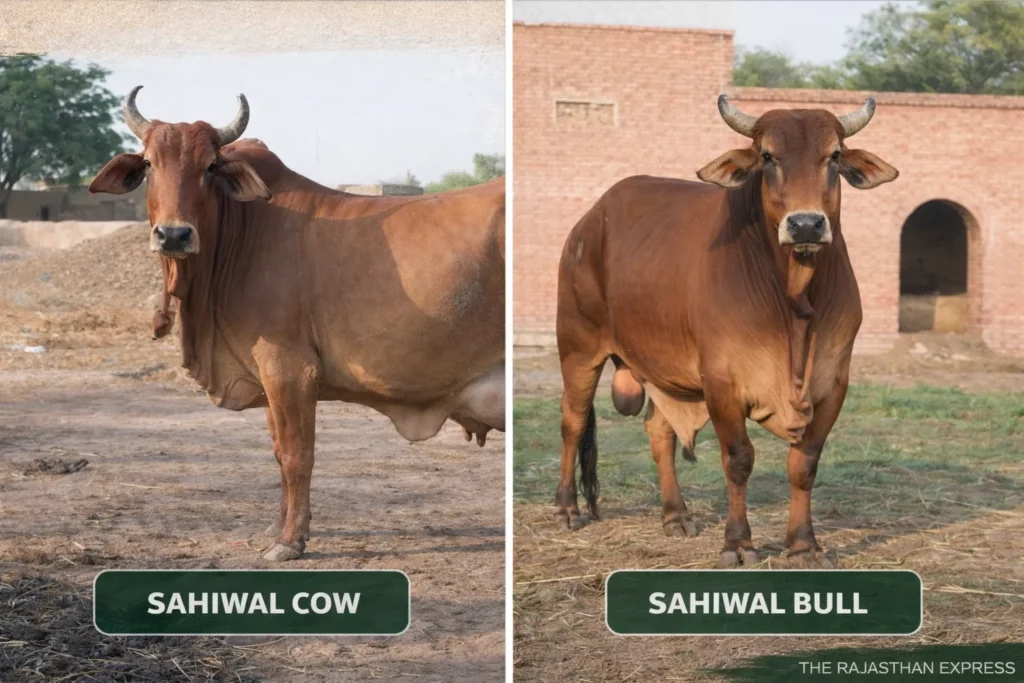
- Sahiwal: This breed originally belongs to the Punjab region of Pakistan (Montgomery district), but it is also widely reared in India. It is a red‑coloured, calm‑temperament breed.
- Red Sindhi: This breed originates from the Sindh province of Pakistan. It is deep red in colour and has the ability to give good milk even in adverse conditions.
- Tharparkar: Originates from the Thar desert of Rajasthan. It is white or light grey and highly tolerant to drought and hot climates.
2. Dual‑Purpose Breeds
These breeds are equally suitable for both milk production and agricultural work (e.g., ploughing, carrying loads).
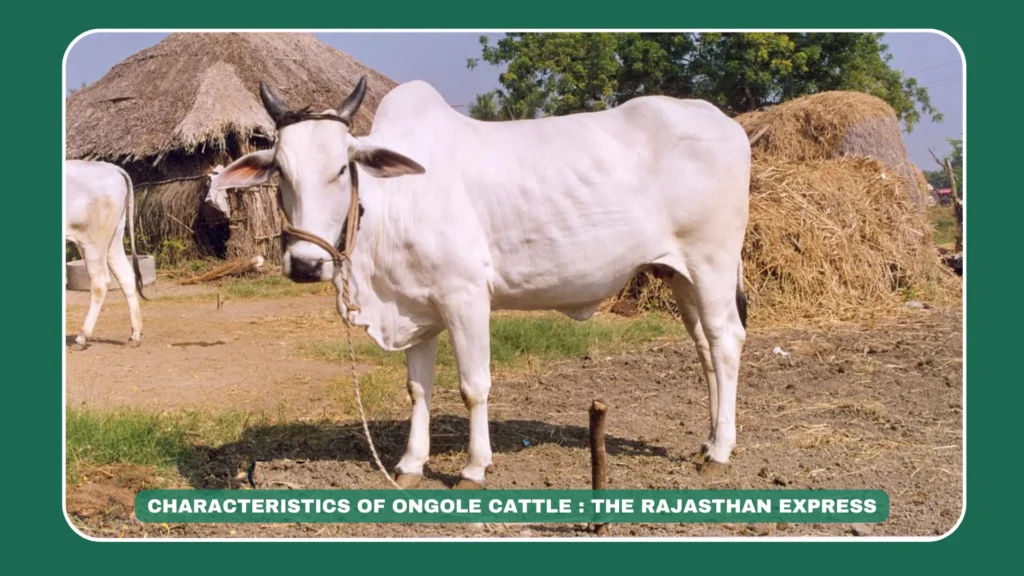
Examples: Ongole cow, Hariana, Kankrej, Mewati cow, Dangi, Deoni, Nimari, Nari, etc.
- Hariana: Found in Haryana and neighbouring states, this breed is known for its balanced performance in both tasks.
- Kankrej: This breed from Gujarat and Rajasthan is known for its large size and powerful build. Its special gait is famous as “Sawaichal”.
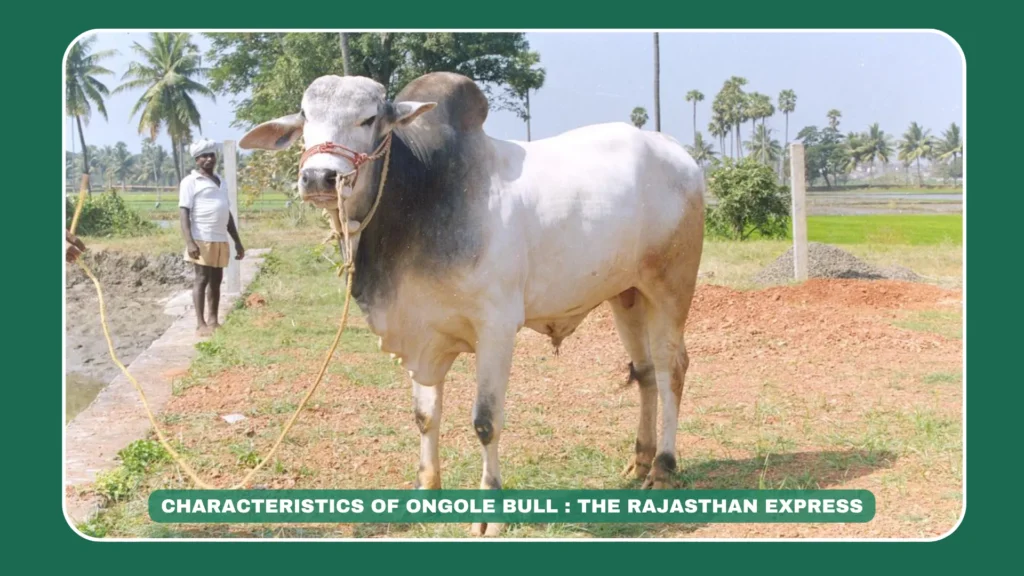
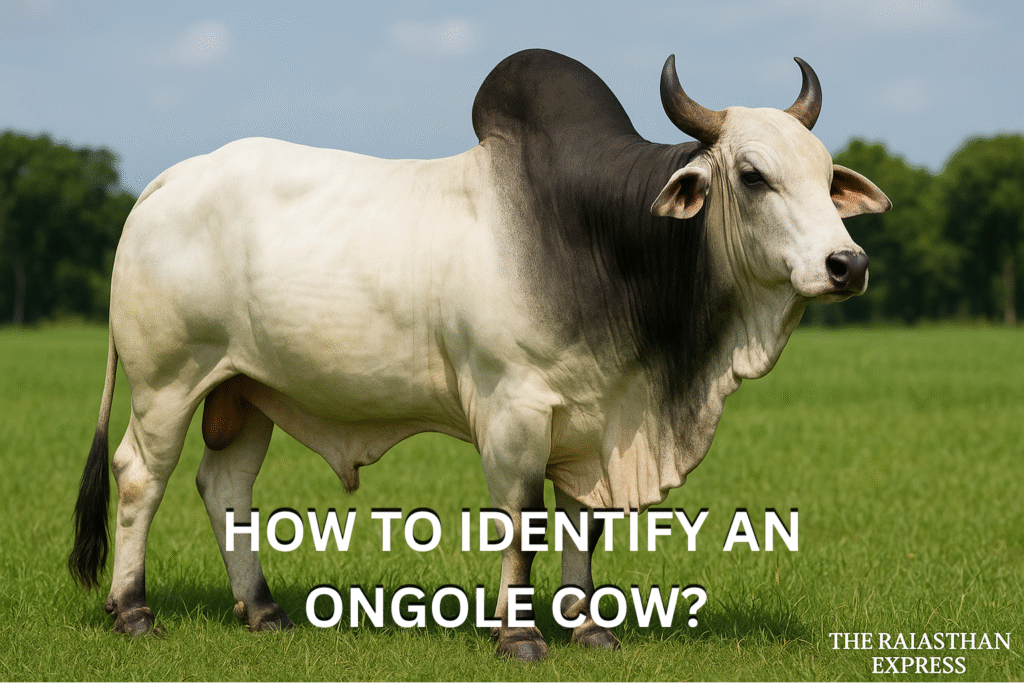
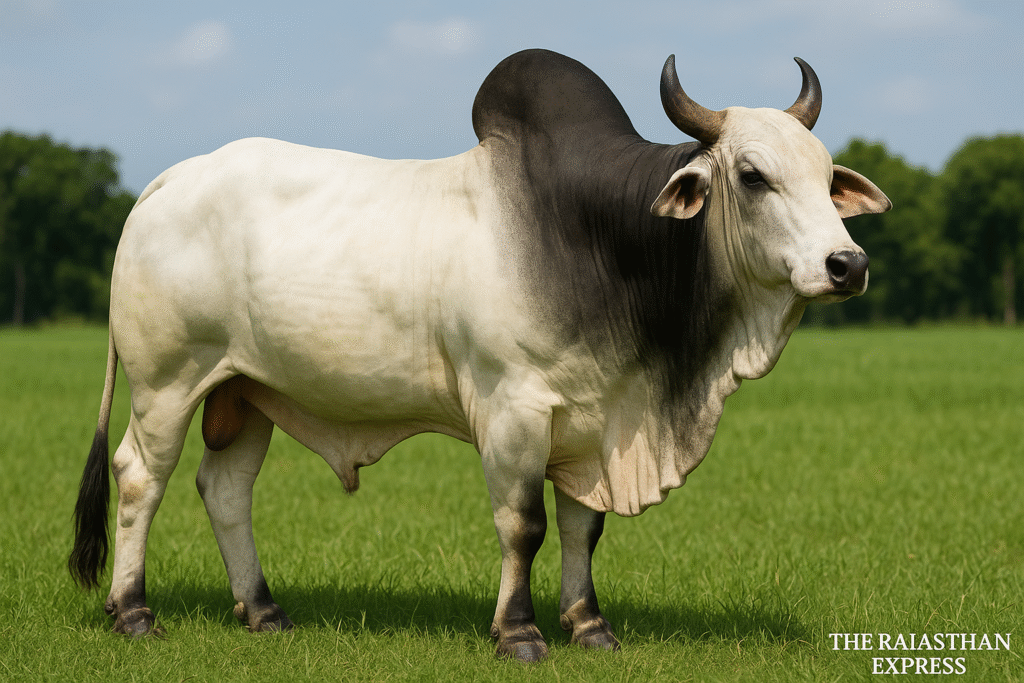
- Ongole: Originating in the Prakasam district of Andhra Pradesh, this breed is extremely powerful. Interestingly, Brazil imported this breed and crossbred it to develop a new breed called Nellore, which is very popular in Brazil today.
- Deoni: This breed developed in the Latur district of Maharashtra from crossing Gir, Dangi, and local breeds. It is a strong and reliable dual‑purpose breed.

3. Draught Indigenous Breeds
These breeds are mainly developed for carrying loads and agricultural work. Their muscles are extremely strong, and they are capable of performing hard physical labour.
Examples: Amritmahal, Nagori, Khillari, Hallikar, Malvi, Vechur, Bachaur, Panwar, Siri, Kangayam, Badri, Pullikulam, Punganur, etc.
- Amritmahal: This breed from Karnataka is considered one of India’s best draught breeds. It was developed by the rulers of Mysore for the “Milk Department” (Amritmahal) to provide strong bullocks for the army.
- Nagori: This breed from Rajasthan is famous for its extraordinary speed and stamina.
- Khillari: This is a major draught breed from Maharashtra, known for its strength and toughness.
- Vechur: This is a dwarf breed from Kerala, which, despite its small size, has good draught capacity. Its milk is also considered highly nutritious.
Tharparkar Cow Origin: History of Thar Cow & Tharparkar Breed
Tharparkar Cow Origin in India and Pakistan
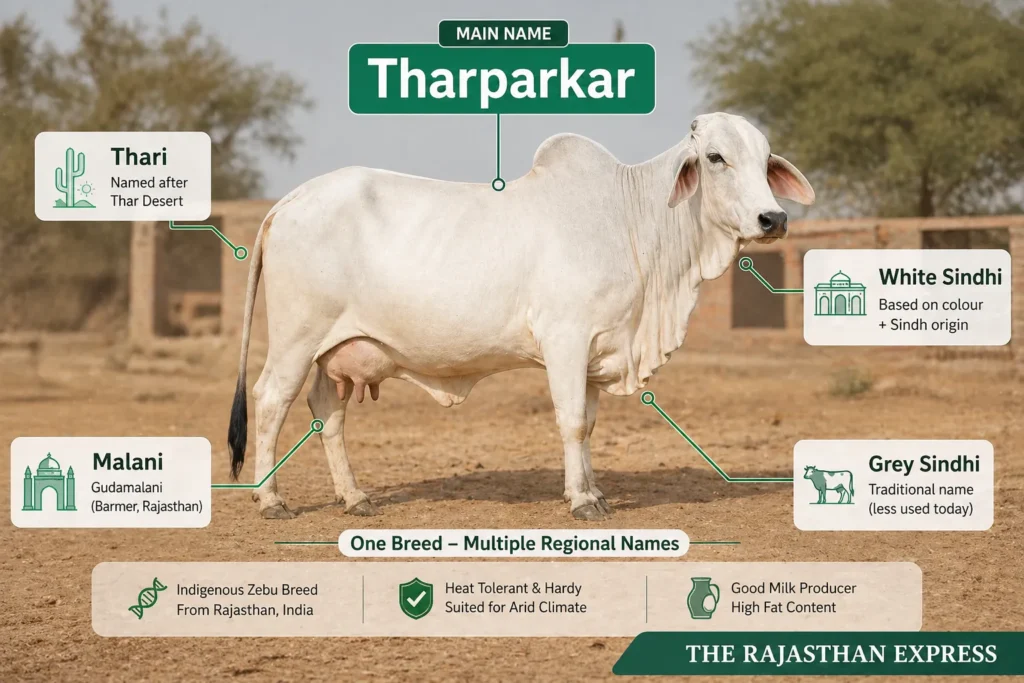
The Tharparkar cow was born in the Thar Desert. This breed is named after Tharparkar district of Sindh province, Pakistan. In addition, the Gudamalani area of Barmer district, Rajasthan is also considered the original birthplace of this breed. That is why this breed is found in abundance in the areas near the India‑Pakistan border. This breed is known by several names based on its native region, such as – ‘Thari’ (because of the Thar Desert), ‘White Sindhi’, ‘Grey Sindhi’ (based on Sindh province and colour), or ‘Malani’ (because of the Gudamalani area).
Tharparkar Cow in Rajasthan & India: Distribution and Geographic Range
In India, this breed is mainly spread in areas adjacent to the India‑Pakistan border. Primarily, it is found in Rajasthan’s Marwar region (Jaisalmer, Barmer, Jodhpur, Bikaner, Ganganagar) and the Kutch region of Gujarat.
Geographic Range of Tharparkar Breed
- Longitude – East‑west boundary
- Minimum: 68° 4′ East – this shows roughly the western part of Kutch (Gujarat) and Barmer (Rajasthan) near the Pakistan border.
- Maximum: 74° East – this extends to the eastern parts of Jodhpur, Bikaner and Ganganagar districts of Rajasthan.
- Latitude – North‑south boundary
- Minimum: 23° 15′ North – this shows the area near the Rann of Kutch, Gujarat.
- Maximum: 29° 19′ North – this takes up to the northern parts of Bikaner and Ganganagar districts of Rajasthan, near the India‑Pakistan border.
Tharparkar Cow Breed History: Global Recognition & Development
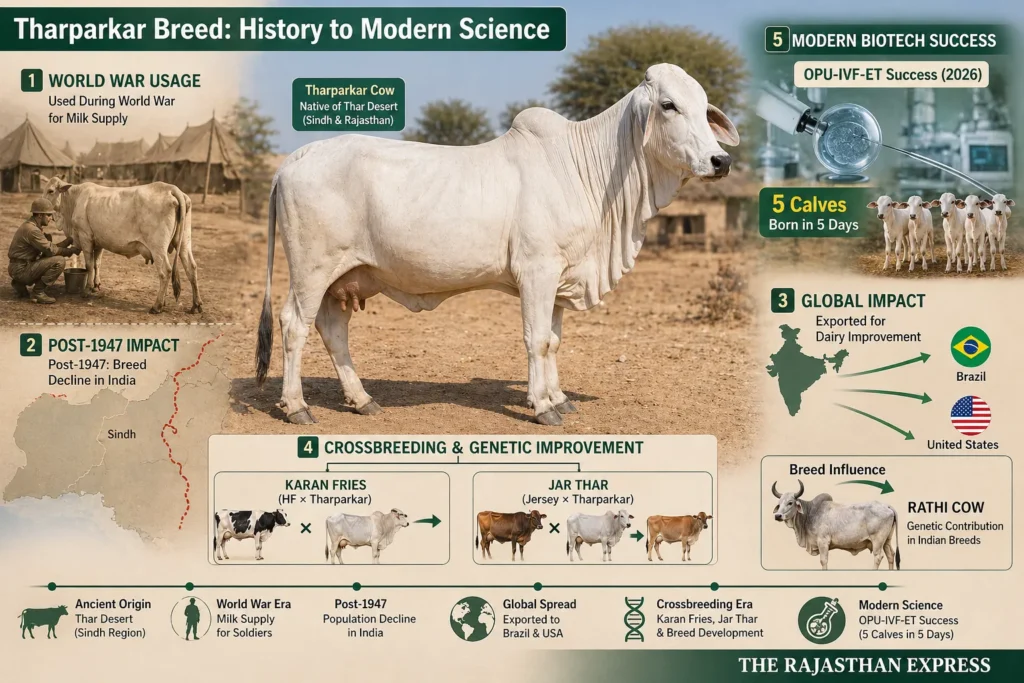
- World War Recognition of Tharparkar Cow : During World War I, some animals of this breed were taken to supply milk to military camps in the Near East. Despite the harsh conditions and extremely low fodder there, their tremendous milk production capacity caught the world’s attention, and the breed became globally famous.
- Impact of Partition on Tharparkar Cow in India: After the partition of India, obtaining pure Tharparkar animals from Sindh (Pakistan) became extremely difficult for livestock keepers. This adversely affected the number and quality of the pure breed in India.
- Tractor Use and Crossbreeding Impact on Tharparkar Breed: After partition, the government promoted the use of tractors in agriculture, reducing the demand for bullocks. Consequently, the maintenance of pure breeding stock suffered. In the pursuit of higher milk production, livestock keepers began crossbreeding them with foreign breeds, putting the pure Tharparkar breed in crisis.
Tharparkar Cow Dairy Farm & Crossbreeding: International Contribution
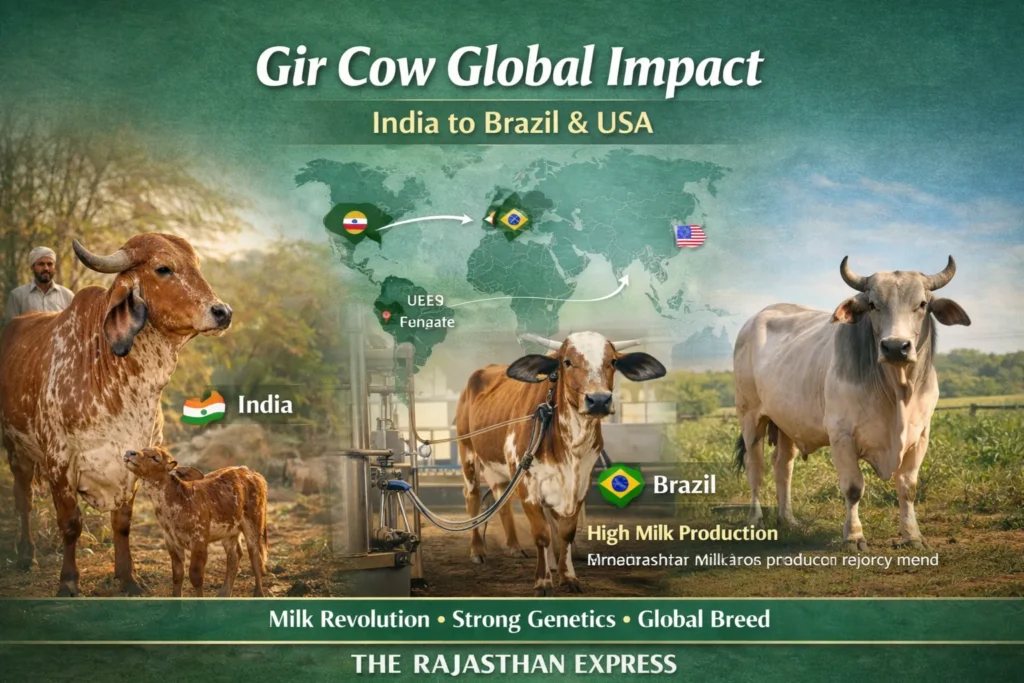
- Export of Tharparkar Cow : The Tharparkar breed was exported to many countries, with Brazil and the United States importing it the most. Brazil crossbred this breed with its local cattle to achieve a tremendous increase in milk production. Seeing Brazil’s success, the Punjab government also went there for study.
- Crossbreeds Developed from Tharparkar Cow Breed: Considering this cow’s ability to tolerate heat and fight diseases, scientists used it to create several new crossbreeds. For example, the Karan Fries breed was created by crossing Holstein Friesian (HF) with Tharparkar, while the Jar Thar breed was produced by crossing Jersey with Tharparkar. Both these new breeds give higher milk and also survive in Indian heat.
- Karan Fries: Holstein Friesian × Tharparkar
- Jar Thar: Jersey × Tharparkar
- Role of Tharparkar in Rathi Cow Breed: The Rathi cow, called ‘Rajasthan’s Kamadhenu’, was created by mixing four different breeds – Red Sindhi, Sahiwal, Tharparkar, and Dhani. Thus, Tharparkar genes are still present in Rajasthan’s best milch cows.
Modern breeding technology and golden success (2026)
- Scientists started an ambitious programme in 2022‑23 with the goal of making OPU‑IVF‑ET (Ovum Pick‑Up – In Vitro Fertilization – Embryo Transfer) technology fully successful in Indian conditions. For this, they worked on three breeds – Sahiwal, Tharparkar (cow), and Murrah (buffalo). After about 3‑4 years of hard work, starting from 28 February 2026, within just five days, 5 healthy Sahiwal calves were born – that is, about one calf per day. This is a historic achievement because earlier producing so many high‑quality calves in such a short time was considered impossible. The Tharparkar breed also played an important role in this success.
Other Names of Tharparkar Cow (Tharparkar Gay / Thar Cow)
The birthplace of the Tharparkar cattle is considered to be Tharparkar district, Pakistan. Because of this, it is called Tharparkar. Tharparkar breed cows are also called Thari, Malani, White Sindhi, and Grey Sindhi.
The Tharparkar breed is known by several different names based on its birthplace, local dialect, and appearance. All these names are one identity of this breed.
- Tharparkar: This is the most common name, named after Tharparkar district of Sindh province, Pakistan.
- Thari: This name is lovingly used by local people because of its association with the Thar Desert.
- Malani: This name became prevalent because it is found in the Gudamalani area of Barmer district, Rajasthan.
- White Sindhi or Grey Sindhi: In earlier times, due to its white or light slate colour and because it came from Sindh province, this name was given, although it is less used now.
Main use of Tharparkar cow in India
The Tharparkar cow is primarily a milch breed, meaning it is reared in Rajasthan mainly for milk production. The biggest speciality of this breed is that among all indigenous cows of Rajasthan, this is the highest milk‑giving breed.
Tharparkar Cow Milk Capacity: Milk Yield, Fat % & Dairy Value
The milk production of this cow per lactation (milk period after calving) is as follows:
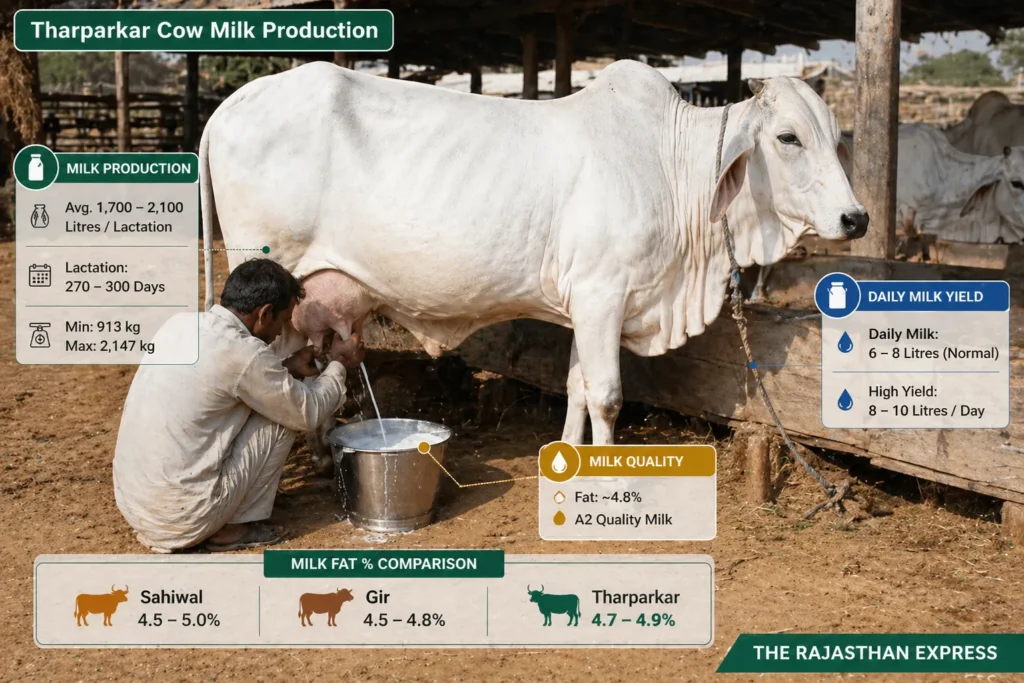
- Average production: 1,749 kg (due to milk density of approx 1.03 kg/litre, this equals about 1,700 litres)
- Minimum production: 913 kg (approx 886 litres)
- Maximum production: 2,147 kg (approx 2,084 litres)
Additionally, the fat content in its milk is found to be on average 4.88%, which makes the milk quite thick and nutritious. For this reason, the Tharparkar cow has the distinction of being the highest milk‑producing indigenous cow breed of Rajasthan.
Tharparkar Cow Characteristics: Identification of Tharparkar Breed
Tharparkar Cow Color and Appearance
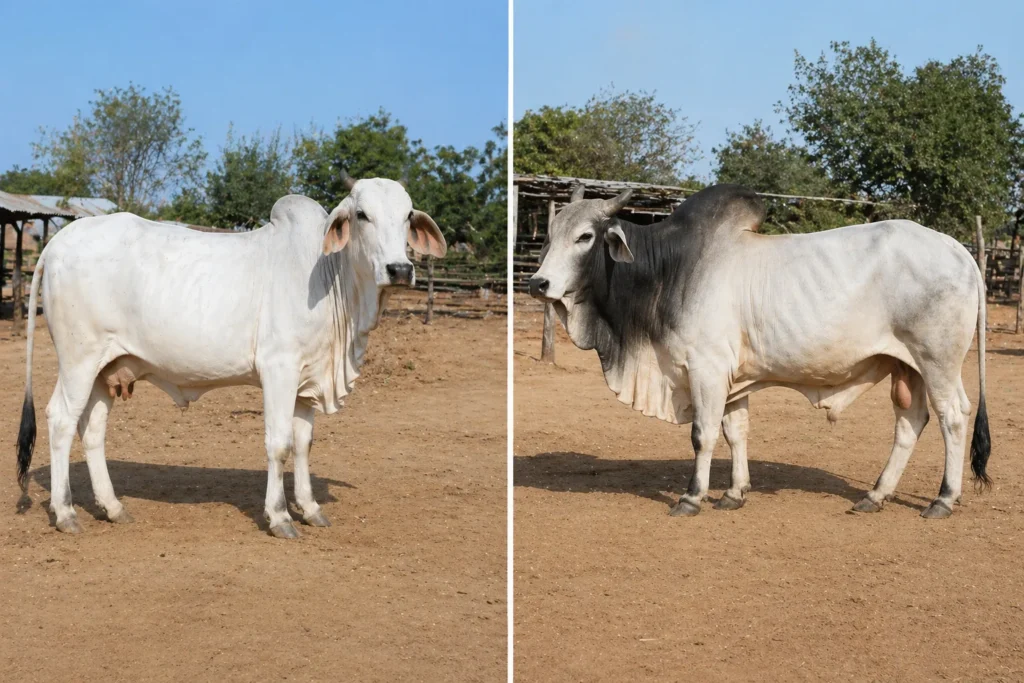
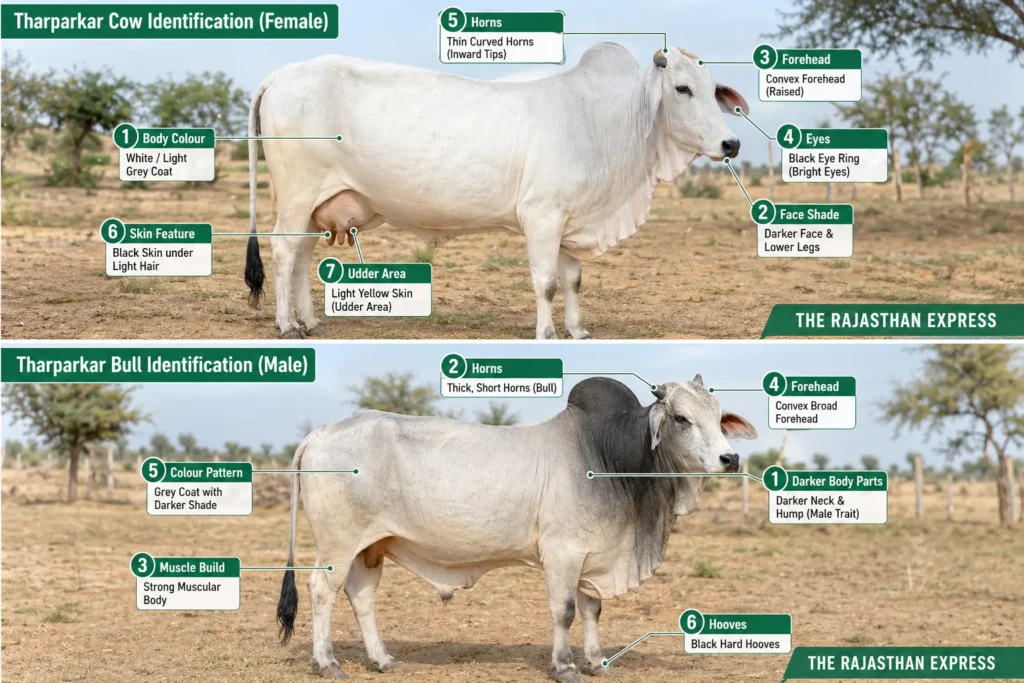
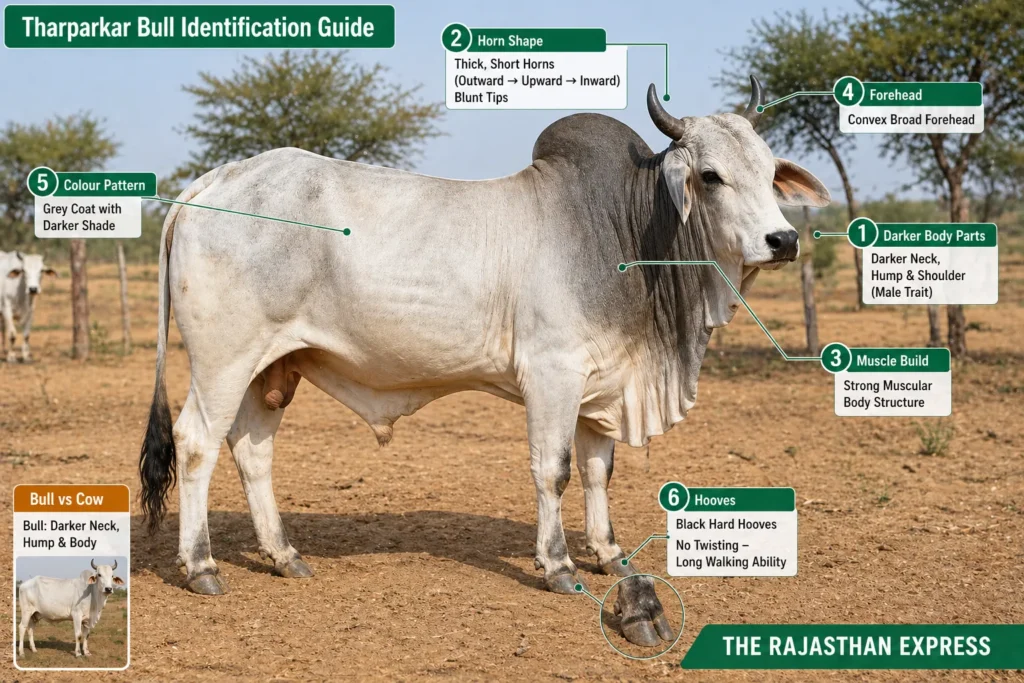
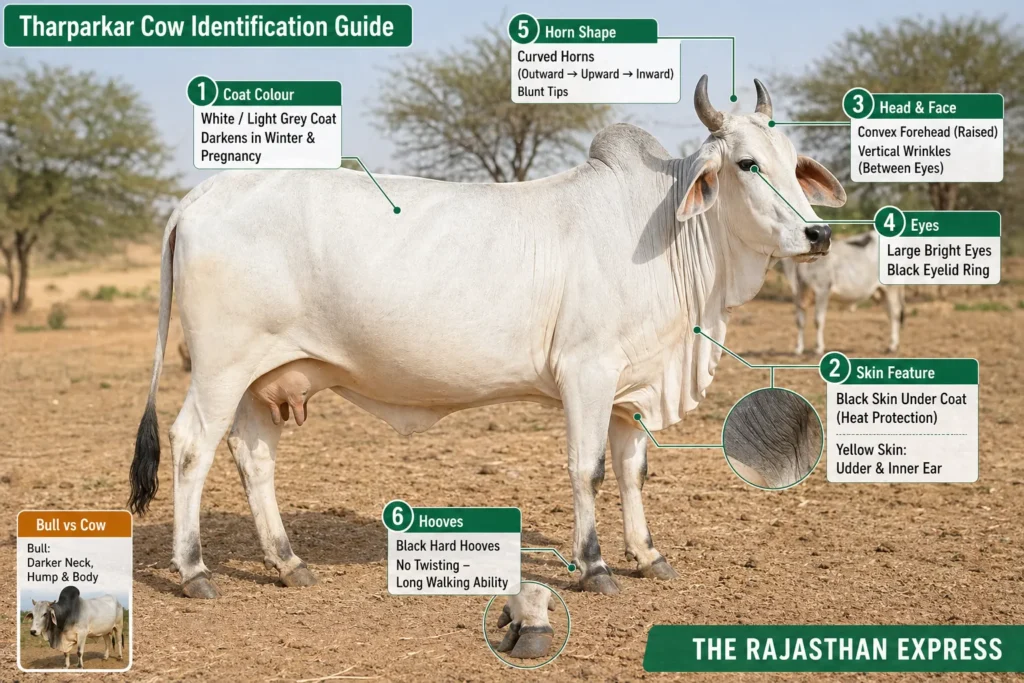
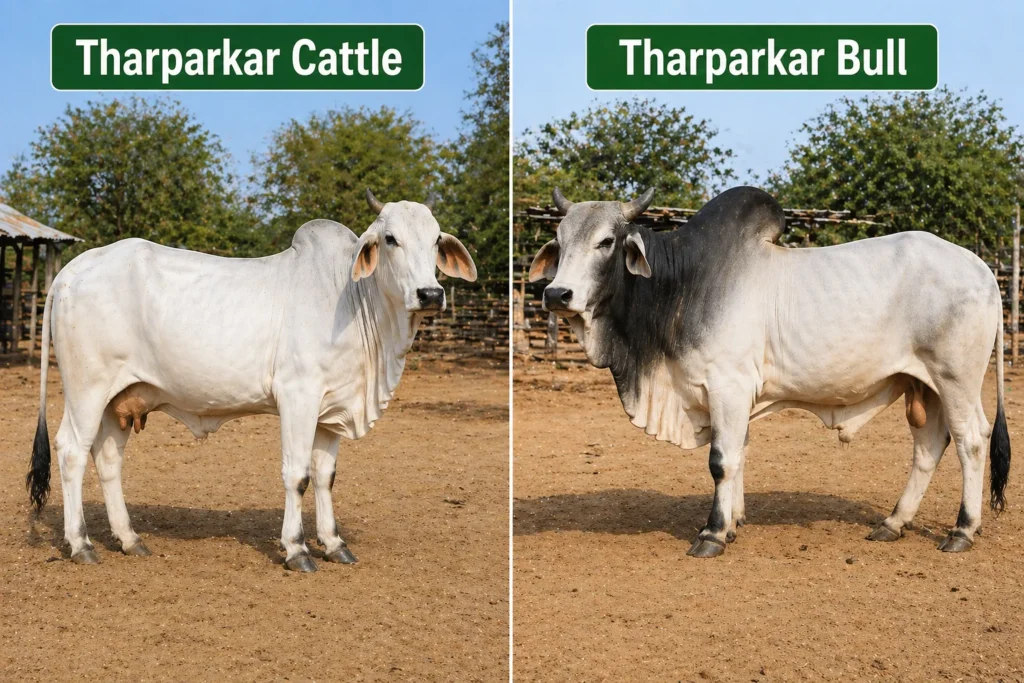
- Generally, the colour of the Tharparkar cow is white or light slate (grey). In winter and during pregnancy, the colour becomes slightly darker. The front and rear parts of bulls are often darker slate. There is a light slate stripe along the spine. (Due to the influence of Red Sindhi and Gir, sometimes a mixture of black and red is also seen.)
- The face and lower parts of the legs are slightly darker in shade than the body.
- In bulls, the neck, hump, and fore and rear parts (the area above the front and hind legs) also become darker.
- This means that the bull may appear darker than the female as age increases. A special thing is that the Tharparkar cow also has the ability to change colour.
Head and Face of Tharparkar Cow
The Tharparkar cow’s head is medium‑sized and recognisable.
- Forehead: The forehead is wide and flat, but just above the eyes it remains slightly raised. For this reason, its frontal bone (the front part of the forehead) appears convex (raised outward). The front part of the horns and the face are almost in line.
- Wrinkles: Often vertical wrinkles are seen on the skin between the eyes – a special identification of this breed.
- Eyes: The eyes are large, full, and bright. The hair on the eyelids is black, and there is a black ring around the edges of the eyelids, which further enhances the eyes.
- Nose: Their nose is large, matching the overall width and strength of the face.
Horns Shape in Tharparkar Cow
This is the most special identification of Tharparkar:
- Setting: The horns are set well apart from each other and gradually curve upward and outward in line with the forehead.
- Tips: The tips of the horns are blunt (not sharp) and turn inward.
- Base circumference: The circumference of the horn just above the skin is between 12.5 to 17.5 cm. That means they are quite thick at the root.
- Difference between male and female: The horns of the bull are thicker and slightly shorter than those of the cow.
Hooves of Tharparkar Cow
- The hooves of Tharparkar are black, hard, and medium‑sized. The best thing is that they have no tendency to twist or turn out, making them perfect for walking long distances.
Skin Color of Tharparkar Cow
This is a very interesting and unique feature of Tharparkar:
- The skin colour of the whole body is black – but externally the hair appears light (white/grey).
- However, the skin colour of some specific parts is light yellow, such as:
- Udder
- Underbelly
- Inner parts of the ears
This yellow and black colour contrast makes it very easy to identify this breed. The black skin under light white/slate hair helps protect it from intense sunlight and heat.
Tharparkar Cow Identification: Visible Characteristics of Thar Cow
- Convex (raised) forehead: The forehead structure of the Tharparkar cow is convex, i.e., slightly raised outward. It is not flat but has a curvature above the eyes – a clear visible identification of this breed.
Tharparkar Cow Adaptability: Disease Resistance & Survival Ability
The Tharparkar cow is considered to have the highest disease resistance among indigenous breeds. The biggest reason for this is its birthplace – the Thar Desert. Living from birth in such a harsh, hot, and dry environment naturally develops their body’s ability to fight diseases to a very high degree. That is why this breed is extremely resistant to all kinds of tropical diseases.
It is expert at grazing and filling its stomach on its own and easily endures the most difficult seasonal conditions. It maintains its milk production capacity even on low and poor‑quality fodder.
Although this breed is quite hardy and strong, traditionally it was never reared for meat production, so livestock keepers did not pay special attention to the quality of its meat. Its main use has always been for milk and agricultural work.
Tharparkar Cow Characteristics: Peculiarity of Tharparkar Breed
Based on all the characteristics of the Tharparkar cow that we have read so far, this breed has some unique and distinctive features that set it apart from other indigenous breeds:
- Highest disease resistance: Due to being born in the Thar Desert, it has developed tremendous strength to fight diseases. It is considered the hardiest among indigenous breeds.
- Queen of the desert: Even in severe heat, water scarcity, and poor fodder, it not only survives but also maintains its milk production.
- Dual‑purpose breed: It not only gives thick milk with 4.9% fat, but its bullocks are also extremely strong for farming and carrying loads. However, from a scientific perspective, the Tharparkar cow is primarily a good milch breed.
- Unique skin colour combination: Black skin under white‑slate hair, and deep yellow skin on the udder, belly, and inside the ears – this combination is rarely seen in any other breed. This black skin protects against intense sunlight.
- Economical rearing: It is expert at grazing and filling its stomach. Instead of relying on expensive concentrates, it manages even with shrubs and dry grass. In India, stray bulls of the Tharparkar breed are seen on streets and roads, which, despite eating low‑quality food, develop quite a large body compared to other breeds.
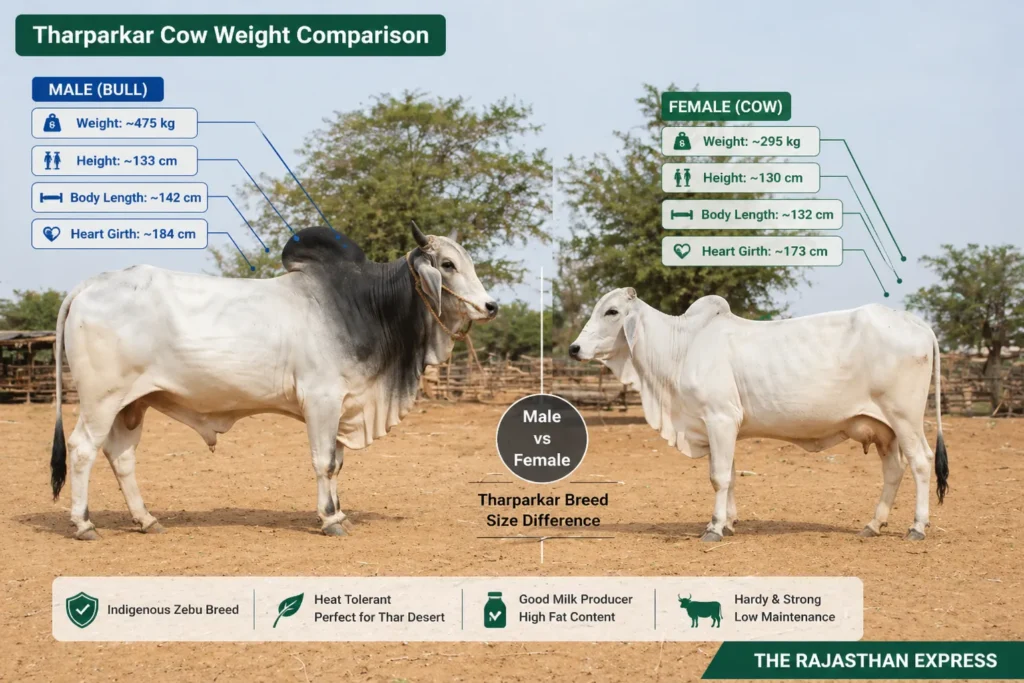
Tharparkar Cow Weight: Male vs Female
| Measurement | Male | Female | Meaning |
|---|---|---|---|
| Height (cm) | 133 | 130 | Cow ~4 ft 3 in, bull slightly taller |
| Body Length (cm) | 142 | 132 | Length from shoulder to hip |
| Heart Girth (cm) | 184 | 173 | Chest circumference behind ribs |
| Weight (kg) | 475 kg | 295 kg | Male ~4.75 quintal, female ~3 quintal |
| Birth Weight (kg) | 23.1 | 22.4 | Average calf weight ~22–23 kg |
| Note:Weight figures may vary slightly across different sources. Some reports mention the cow’s average weight around 400 kg, but the 295 kg given here is closer to actual field records (ICAR‑NBAGR). With better feed, this weight can increase. | |||
Tharparkar Cow Milk Capacity: Milk Production per Lactation
The Tharparkar cow produces on average 1,749 kilograms (approximately 1,700 litres) of milk per lactation. According to ICAR‑NBAGR, a Tharparkar cow produces between a minimum of 913 kg and a maximum of 2,147 kg per lactation. Meaning: The Tharparkar cow gives on average 1,700 – 2,100 litres of milk after giving birth once.
Tharparkar Cow Milk Per Day (Daily Yield in India)
The lactation period is usually considered to be 270 to 300 days. Based on this, the average daily milk production is as follows:
- A normal Tharparkar cow produces about 6 to 8 litres of milk per day.
- An advanced/high‑yielding Tharparkar cow can produce about 8 to 10 litres per day.
Note: These figures are averages and can vary depending on the animal’s care, fodder quality, and weather.
Tharparkar Cow Milk Quality: Fat Percentage & A2 Milk
- The milk of the Tharparkar cow contains on average 4.88% fat. This high fat percentage makes its milk quite thick, nutritious, and of A2 quality.
Main point: The Tharparkar cow is primarily a milch breed, meaning it is reared in Rajasthan mainly for milk production. The biggest speciality of this breed is that among all indigenous cows of Rajasthan, this is the highest milk‑giving breed.
| Comparison of Milk Fat % in Indigenous Breeds | ||
| Breed Name | Average Milk Fat (%) | Comparative Status |
|---|---|---|
| Sahiwal | 4.5% – 5.0% | Highest category |
| Gir | 4.5% – 4.8% | High |
| Red Sindhi | 4.3% – 4.5% | Medium-High |
| Tharparkar | 4.72% – 4.9% | Medium-High |
| Harianvi | 3.8% – 4.2% | Medium |
| Kankrej | 3.5% – 4.0% | Medium-Low |
| The Rajasthan Express : Milk Fat Comparison of Breeds | ||
Main point:
- The milk of the Sahiwal cow is considered the thickest among all Zebu (humped) breeds. This means that compared to all indigenous cows, the fat percentage in Sahiwal milk is the highest – approximately 4.5% to 5.0%. For this reason, Sahiwal milk is considered very good for making yoghurt, ghee, and other dairy products.
Reproductive and milk production performance of Tharparkar cow (Performance Record)
The reproductive and milk production statistics of the Tharparkar cow prove it to be an economical and reliable breed. The table below gives average, minimum, and maximum values to provide farmers with a complete picture.
| Trait | Average | Minimum | Maximum | Meaning |
|---|---|---|---|---|
| Age at first calving (months) | 41.03 | 36.71 | 52.5 | Gives first calf at about three and a half years. This is an early‑maturing breed. |
| Calving interval (months) | 14.18 | 13.42 | 18.82 | Gives one calf on average every 14 months, indicating a regular and good reproductive cycle. |
| Milk yield per lactation (kg) | 1749 | 913 | 2147 | Average 1,749 kg per lactation. Note: with good care in villages, it has been found up to 1,980 kg, and in dry pastures up to 1,135 kg. |
| Milk fat percentage (%) | 4.88% | 4.72% | 4.9% | Fat in milk up to about 4.9%, considered very good quality for A2 milk. |
| The Rajasthan Express: Your Trusted Source for Animal Care and Veterinary Science. | ||||
Tharparkar Cow Dairy Farm Management in India
The way the Tharparkar cow is reared is a mix of the area’s geographical difficulties and traditional methods.
1. Management System
- Semi‑Intensive: This is neither completely open grazing (very extensive) nor completely tied in a shed (intensive). Animals are left open for grazing but are also controlled when necessary.
2. Mobility
- Stationary: These animals stay in one place. The Maldar (herders) do not undertake long‑distance nomadism with them; instead, they are reared near the village or settlement.
3. Feeding of Adults
- Grazing and Concentrate: The main diet is grass and shrubs obtained by open grazing. In addition, only pregnant cows close to delivery and milking cows are given concentrate (feed).
4. Environmental challenges for Tharparkar cow
This is the most challenging and interesting part of rearing the Tharparkar cow, which explains the real reason for its hardiness:
- Severe shortage of fodder and water: This entire region (Thar Desert) constantly struggles with local scarcity of fodder and water, which becomes extremely severe during summer (April to June).
- Barren land: The whole area is sandy and almost devoid of vegetation except for small shrubs. Only a few Khejri trees are seen here and there.
- Main fodder: Sewan grass is the only main fodder, whether green or dry (as straw) – that is all that is available.
- When is concentrate given? As mentioned above, concentrate is given only to those cows that are either close to calving or are milking. The rest depend solely on grazing.
- Housing: Generally, animals are not provided any roof or shed throughout the year. Only during some extremely cold nights or severe summer season are arrangements made to cover them.
- Animal shelter: Whenever shelters are built, they have mud walls and are covered with Sewan grass thatch. That is, very simple and natural construction.
- Breeding system: There is no planned mating system here. Farmers usually select a bull based on its appearance (phenotype), and sometimes also consider the bull’s mother’s milk production.
Tharparkar Cow Price in India 2026 (Tharparkar Cow Dairy Farm Investment Guide)
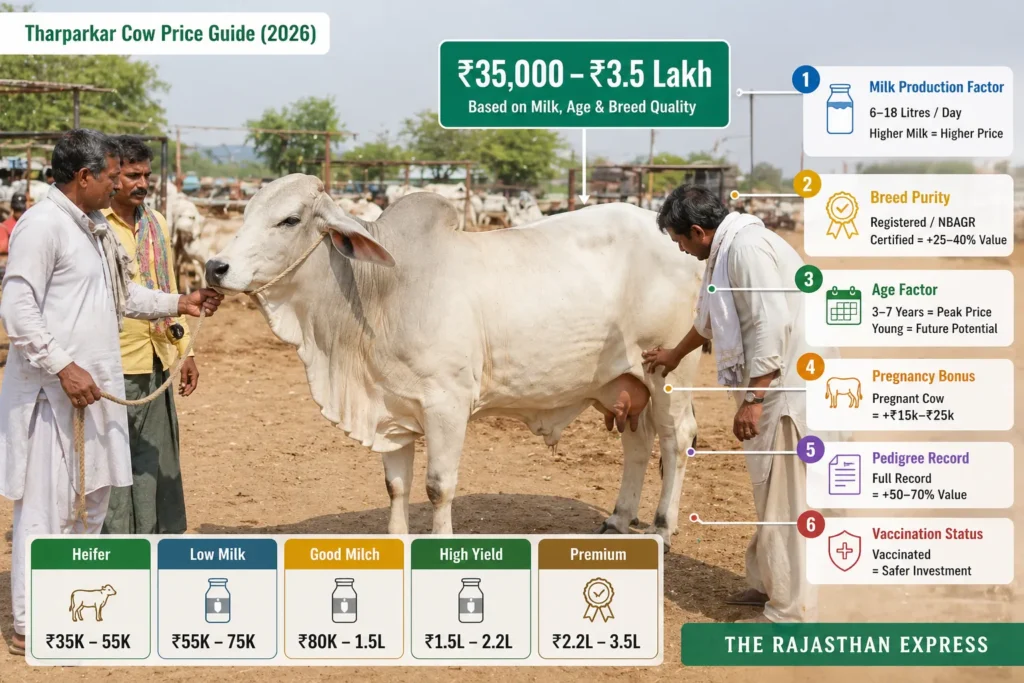
Buying a Tharparkar cow is also a decision to be taken thoughtfully. This breed is the queen of Rajasthan’s desert areas and is famous for giving milk even in drought and harsh conditions. There is no single price – you will find Tharparkar cows in the market ranging from ₹35,000 to ₹3.5 lakh.
1. How much milk does it give? (More milk = higher price)
This determines how quickly your investment will be recovered. Tharparkar is a milch breed; its milk production is lower compared to foreign breeds, but with good care it increases significantly.
- Ordinary village Tharparkar: 6 to 10 litres per day (on open grazing and dry fodder)
- Good farm/dairy Tharparkar: 12 to 18 litres per day (balanced diet and proper water)
- Fat in milk: 4.2% to 4.8% – thick and nutritious milk, excellent for sweets and ghee.
- A cow giving 8 litres per day will cost approximately ₹60,000 – ₹80,000.
- A cow giving 15‑18 litres per day will directly reach ₹1.5 lakh to ₹2.2 lakh. The more milk, the higher the price – this math applies here as well.
2. How pure is the breed? (Registered Tharparkar = expensive)
Purity means that the cow’s ancestors are completely of the Tharparkar breed, not mixed with Kankrej, Gir, or Red Sindhi.
- Cow without papers: Easily found in Rajasthan’s villages; cheap but risky – it might turn out to be a mixed breed.
- Registered / certified cow: One obtained from NBAGR or a recognised dairy/farm of the state animal husbandry department. It has an ear tag and certificate.
- A registered Tharparkar cow sells for 25‑40% more than an unregistered cow with the same milk capacity. Just like a pedigree dog, the purity of this breed also commands a price.
3. What is the age of the cow? (Young Tharparkar is most expensive)
Age is directly related to the future milk and number of calves.
- Heifer – 1 to 2.5 years: Has not yet given birth. Price: ₹35,000 – ₹55,000 (low, because there is no proof of its milking ability yet)
- Young milch cow – 3 to 7 years (after first or second calving): This sells the most expensive, because it has started giving milk and will give for 8‑10 more years. Milk is at its peak.
- Old cow – above 10 years: Price drops sharply because milk decreases and risk of diseases increases.
- A healthy 4‑year‑old Tharparkar giving 12 litres will cost 30‑40% more than an 8‑year‑old cow with the same capacity. Age = remaining earning years.
4. Is the cow pregnant? (If yes, price increases)
Buying a pregnant Tharparkar is like getting “two for the price of one”.
- If the cow is pregnant, within a few months of purchase you will get a calf (male or female) for free.
- If it is a heifer (female), your herd will grow and she will give milk in the future.
- If it is a bull calf, you can raise it as a bullock for farming or sell it at a good price – Tharparkar bulls are known for their strength.
- A pregnant Tharparkar cow costs at least ₹15,000 – ₹25,000 more than a non‑pregnant one.
5. Is pedigree record (ancestry) available?
This is the biggest premium. If the cow comes with a written record of its ancestors:
- How much milk its mother and grandmother gave.
- What was the production in each lactation.
- History of diseases and fertility rate.
- Then such a cow inspires much more trust, because her calves will also produce well.
- A Tharparkar cow with recorded pedigree can sell for 50‑70% more than an unrecorded cow giving the same milk. (For example, a ₹1 lakh cow can sell for ₹1.7 lakh if its entire family’s milk record is excellent.)
6. Has the cow been fully vaccinated?
Buying a healthy cow means saving on future veterinary expenses.
- Full vaccination includes: Foot and Mouth Disease (FMD), Haemorrhagic Septicaemia (HS), Brucellosis (to prevent abortion), and other local diseases.
- A Tharparkar with a government veterinary hospital’s vaccination card can be ₹5,000 – ₹10,000 more than an unvaccinated cow.
- A cheap unvaccinated cow may end up costing thousands in treatment later, and milk production may drop.
7. Where are you buying from? (Price varies by location)
Availability of Tharparkar is highest in its native area.
- Native area (Rajasthan – Barmer, Jaisalmer, Jodhpur, Ganganagar, and Kutch region of Gujarat): Here cows are abundant and breeders sell directly. Price is the lowest.
- Distant states (Punjab, Haryana, Uttar Pradesh, Madhya Pradesh, South India): Tharparkar is rare there. Due to transport, middlemen commission, and high demand, the price increases by 20‑40%.
- A cow costing ₹70,000 in Barmer can become over ₹1 lakh by the time it reaches Bangalore or Lucknow. If possible, buying directly from the native area is always cheaper.
| Category | Price Range |
|---|---|
| Heifer / young unbred cow (1‑2.5 years) | ₹35,000 – ₹55,000 |
| Ordinary Tharparkar (low milk, 6‑8 litres/day) | ₹55,000 – ₹75,000 |
| Good milch Tharparkar (10‑15 litres/day) | ₹80,000 – ₹1,50,000 |
| High‑yielding Tharparkar (16‑20 litres/day) | ₹1,50,000 – ₹2,20,000 |
| Complete record + high‑yielding (milk record, calving birth, heat period, calving time, conception rate, pedigree, vaccination – everything with documents) + extremely high milk yield | ₹2.2 lakh – ₹3.5 lakh |
| 📌 Estimated prices for Tharparkar cows as of 2026. Actual prices may vary based on region, health, and market conditions. | |
Top 10 Highest Milk Producing Cow Breeds in India : By The Rajasthan Express
Must Read for Dairy Farmers & Livestock Owners
- Sahiwal Cow Characteristics
- Tharparkar Cow Milk Per Day
- Red Sindhi Cow Milk Per Day
- Rathi Cow Cow Milk Per Day
- Sanchori Cow Cow Milk Per Day
- Deoni Cow Cow Milk Per Day
- Hariana Cow Cow Milk Per Day
- Ongole Cow Characteristics
- Nimari Cow Milk Production
Key Points About Indigenous Cows in India (Desi Cow Facts)
- India’s best draught (load‑carrying) breed is Amrit Mahal.
- Maharashtra’s best draught breed is Khillari.
- Rajasthan’s best load‑carrying breed is Nagori.
- India’s best dual‑purpose (milk + work) breed is Hariana.
- The world’s smallest cow breed is Vechur.
- India’s heaviest cow breed is Kankrej.
- The Kankrej breed exhibits a “Sawai Chal” (fast and special gait).
- Deoni cow was created by crossing Gir, Dangi, and local cows.
- Nimari cow was created by mixing Gir and Khillari breeds.
- India’s most expensive cow breed is considered to be Ongole. In Brazil, this same breed is called Nelore. At the beginning of the year 2025, a Nelore cow named “Viatina‑19” was sold for approximately ₹40‑41 crore. It also set a Guinness World Record. “Viatina‑19” weighed about 1100 kg, which is much more than a normal cow. The first Ongole cows were taken from India to Brazil in 1868. Later, by 1960, about 7000 cattle were sent there. In Brazil, this breed was named “Nelore”, after the Nellore district of Andhra Pradesh.
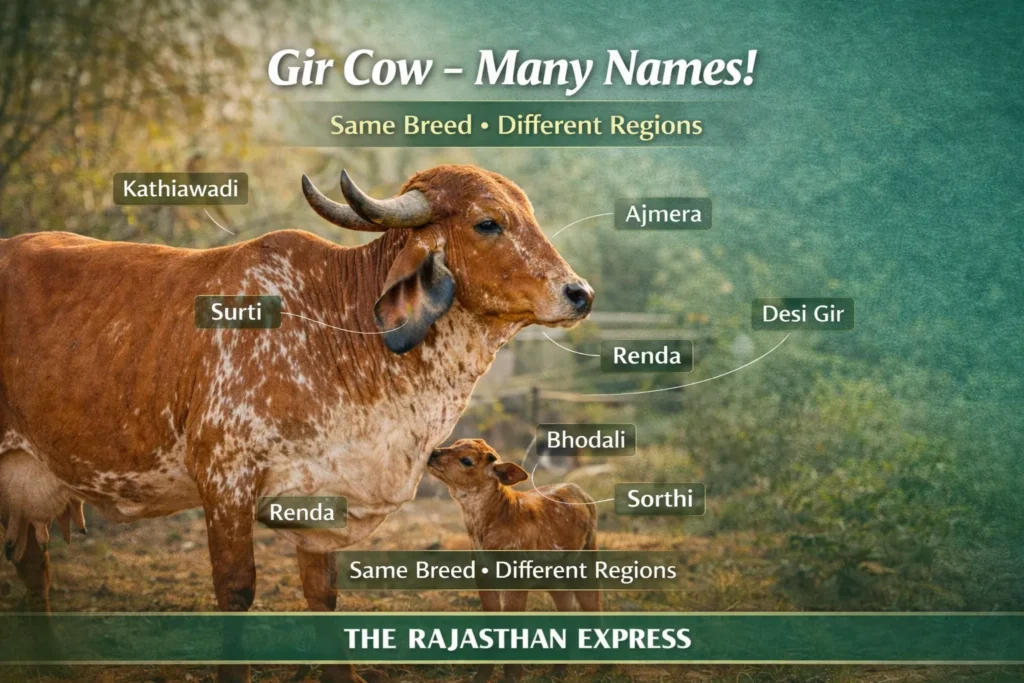
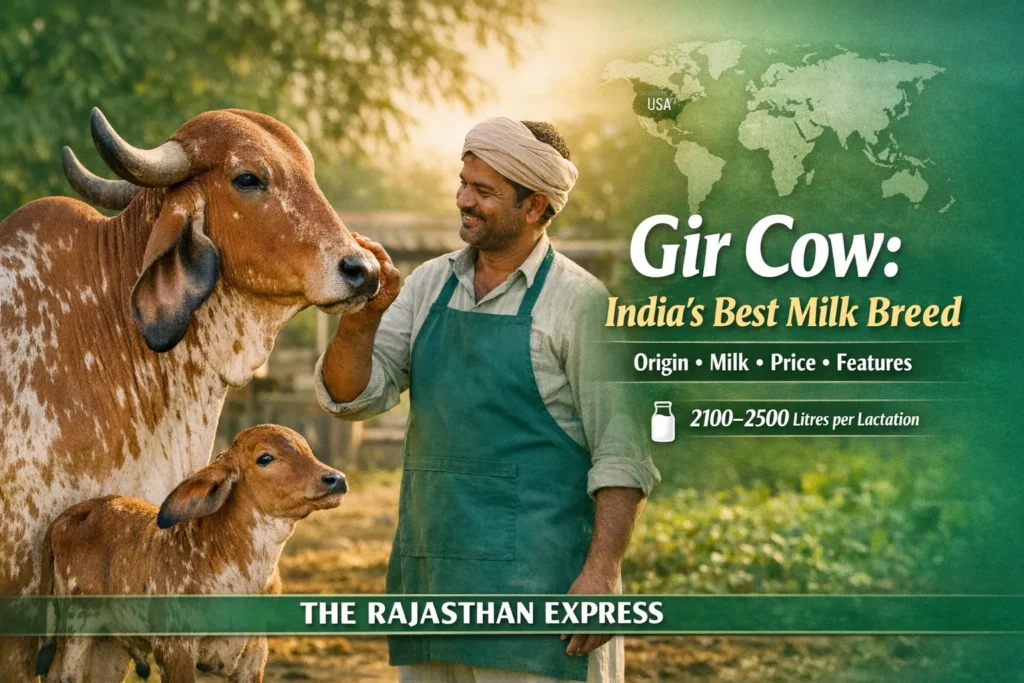
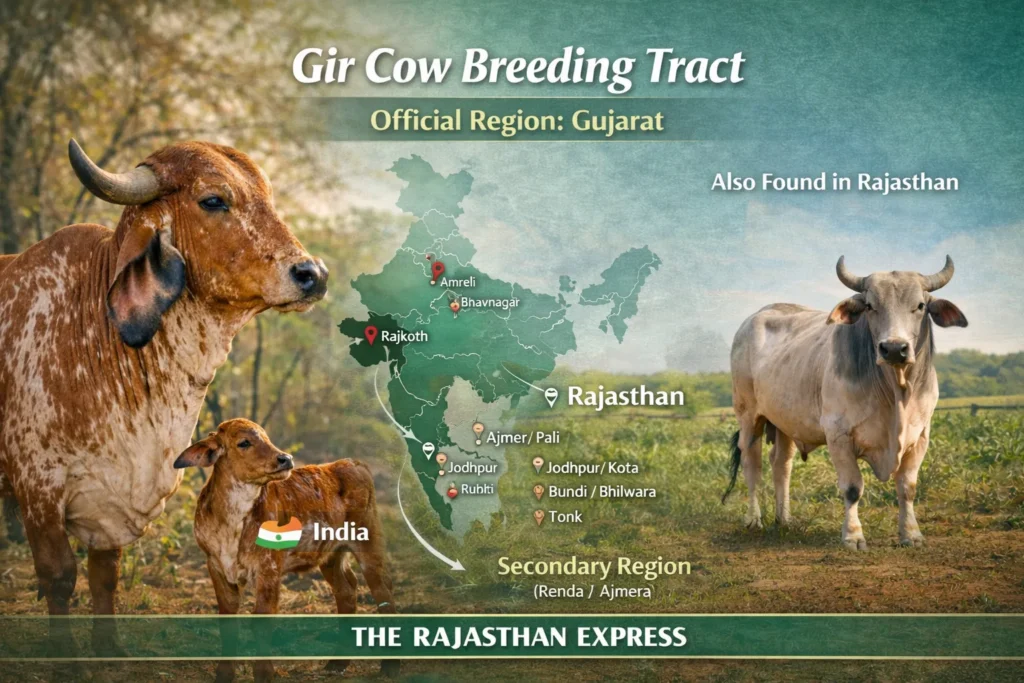
- Among indigenous cows, the longest lactation period is of the Gir cow (about 325 days). The Gir cow originated in the Gir forests of Kathiawar, Gujarat. The Gir cow is also called Kathiyawadi, Ajmera, Renda, Surti.
- Among buffaloes, the longest lactation period is of the Mehsana buffalo (about 352 ± 15 days).
- Identification of Gir cow:
- Red, brown, or spotted skin
- Prominence on forehead
- Long, hanging, leaf‑shaped ears
- Half‑moon shaped horns
- India’s highest milk‑producing indigenous cow is Sahiwal.
- In the Sahiwal cow, the dewlap (loose skin of the neck) and Nawelflap are more developed. This is the main identification of the Sahiwal cow. The Sahiwal cow originated in Montgomery (Pakistan), Punjab, Haryana. The Sahiwal cow is also called Lola breed, Multani, Montgomery, Lambi Bar.
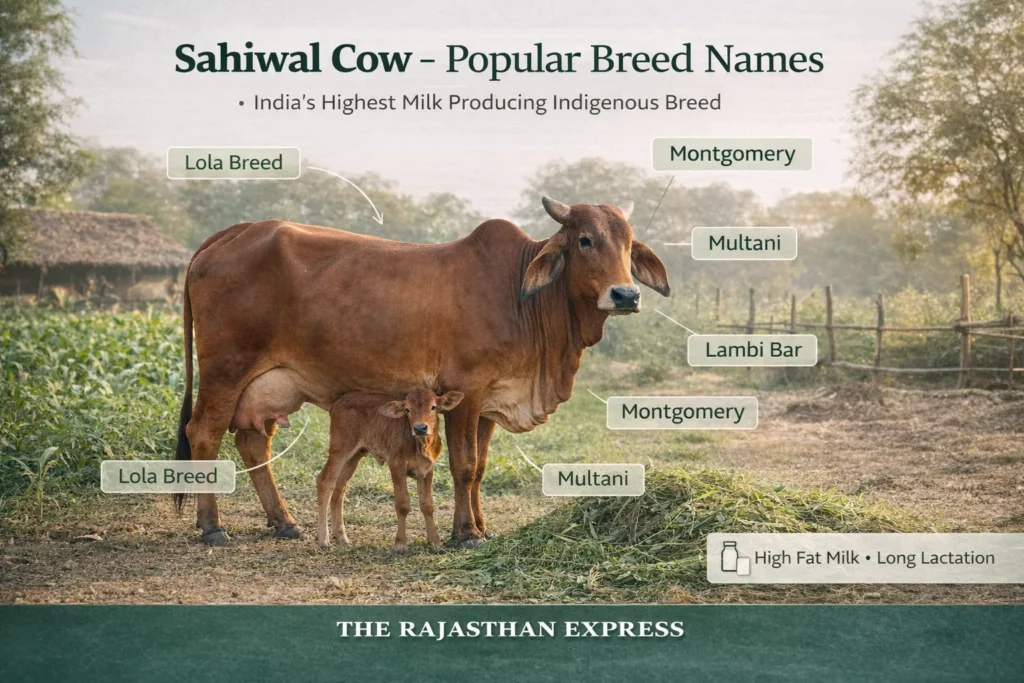
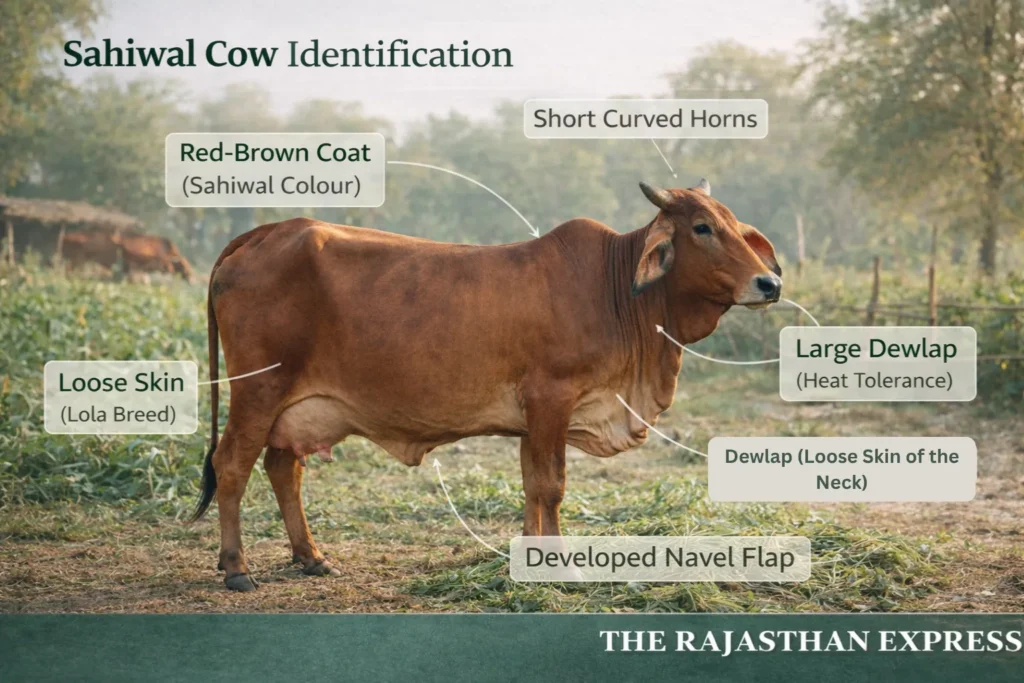
- Because the Sahiwal cow’s skin is loose, it is also called the Lola breed.
- The most intelligent cow breed is considered to be Red Sindhi. The Red Sindhi cow originated in Karachi, Hyderabad (Sindh), Pakistan. The Red Sindhi cow is also called Red Karachi.
- Among indigenous breeds, the highest disease resistance is found in the Tharparkar cow, which is found in the state of Rajasthan, India. The Tharparkar cow originated in the Tharparkar district of Sindh province in Pakistan and in Gudamalani, Barmer. It is also known as White Sindhi, Grey Sindhi, or Thari and Malani. This breed is named after the Thar Desert, which extends from Sindh to the Kutch district of Gujarat and to the Barmer, Jaisalmer, and Jodhpur districts of Rajasthan, India.
- The Tharparkar cow also has the ability to change colour.
- The highest milk‑producing cow in Rajasthan is Tharparkar.
- The Rathi cow was created by mixing Red Sindhi, Sahiwal, Tharparkar, and Dhani breeds. The Rathi cow is also called Rajasthan’s Kamadhenu.
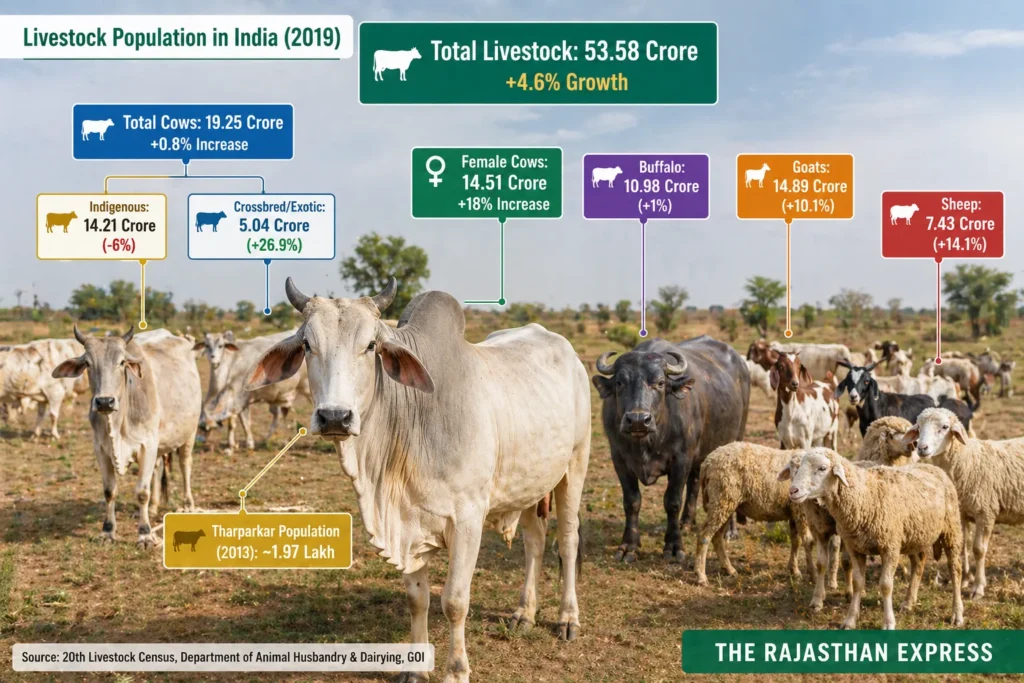
Livestock Population in India (20th Livestock Census 2019)
| Livestock Population in India (20th Livestock Census, 2019) | ||
| Particulars | 20th Livestock Census (2019) figure | Change from previous census (2012) |
|---|---|---|
| Total livestock | 53.58 crore (535.78 million) | +4.6% (increase) |
| Total cows (all types) | 19.25 crore (192.49 million) | +0.8% (increase) |
| Indigenous/unclassified cows | 14.21 crore (142.11 million) | -6% (decline) |
| Exotic/crossbred cows | 5.04 crore (50.42 million) | +26.9% (remarkable increase) |
| Female cows (Cows) | 14.51 crore (145.12 million) | +18.0% (much higher than previous census) |
| Buffaloes | 10.98 crore (109.85 million) | +1.0% |
| Goats | 14.89 crore (148.88 million) | +10.1% |
| Sheep | 7.43 crore (74.26 million) | +14.1% |
| The Rajasthan Express : Livestock Census 2019 | ||
Important point:
- While the total cow population has increased marginally by 0.8%, the population of female cows has seen a large increase of 18.0%. In contrast, the total population of indigenous cows (both male and female) has declined by 6%. These figures indicate that attention to milk production has increased, due to which the number of female animals has increased.
Tharparkar Cow Population in India: Tharparkar Breed Census & Data (2013)
In the year 2013, the population of Tharparkar cows in India was approximately 197,291.
👉 Source: Estimated livestock population based on the 2013 Breed Survey conducted by the Department of Animal Husbandry, Dairy and Fisheries (DADF), Government of India.
Tharparkar cow – India’s highest milk‑giving indigenous breed in Rajasthan. Learn milk per day (6‑10 litres), price (₹35k‑₹3.5L), characteristics, origin, and management. Complete guide.
The Rajasthan Express: Your Trusted Source for Animal Care and Veterinary Science.
People Also Ask – Tharparkar Cow
What is the origin of the Tharparkar cow?
How much milk does a Tharparkar cow give per day?
What is the price of a Tharparkar cow in Rajasthan?
- Heifer / young unbred cow: ₹35,000 – ₹55,000
- Ordinary Tharparkar (6‑8 litres/day): ₹55,000 – ₹75,000
- Good milch Tharparkar (10‑15 litres/day): ₹80,000 – ₹1,50,000
- High‑yielding (16‑20 litres/day): ₹1,50,000 – ₹2,20,000
- Complete record + high‑yielding (documented pedigree, vaccination): ₹2.2 lakh – ₹3.5 lakh
What are the main characteristics (Tharparkar cow characteristics)?
- Colour: White or light slate (grey), darkens in winter/pregnancy. Ability to change colour.
- Head: Wide, flat forehead with convex (raised) shape above eyes; vertical wrinkles between eyes.
- Horns: Thick, blunt tips, curve outward and upward then turn inward. Base circumference 12.5‑17.5 cm.
- Skin: Black skin under white hair; yellow skin on udder, underbelly, inner ears – unique combination.
- Hooves: Black, hard, medium‑sized, no twisting.
- Hardiness: Highest disease resistance among indigenous breeds; queen of the desert.
Is Tharparkar a desi (indigenous) cow?
What is the Tharparkar cow population in India?
How much does a Tharparkar bull and cow weigh?
- Height at shoulder: Male 133 cm, Female 130 cm
- Body length: Male 142 cm, Female 132 cm
- Heart girth: Male 184 cm, Female 173 cm
- Adult weight: Male 475 kg, Female 295 kg
- Birth weight: Male 23.1 kg, Female 22.4 kg