 By
ByRed Sindhi Cow: Milk Per Day, Characteristics, Price in India & Red Sindhi vs Sahiwal
Introduction to Red Sindhi Cow (Lal Sindhi Cow | Red Sindhi Cattle Characteristics)
The Red Sindhi cow is one of the prominent indigenous milch breeds of India, known especially for its remarkable heat tolerance. The origin of this breed is from the Sindh province of Pakistan (around Karachi), and because of its red colour, it is easily recognisable from a distance. It is also called ‘Red Karachi’, ‘Malir’, or simply ‘Sindhi’. It is believed that this breed developed from the Las Bela cows of the Bela region of Balochistan.
The Red Sindhi is primarily reared for milk production. Its biggest strength is that even when heat and drought are at their peak, it continues to give excellent milk. In India, organised herds of this breed are found in states like Odisha, Tamil Nadu, Bihar, Kerala, and Assam. By the way, the highest milk‑producing indigenous cow in India is Sahiwal.
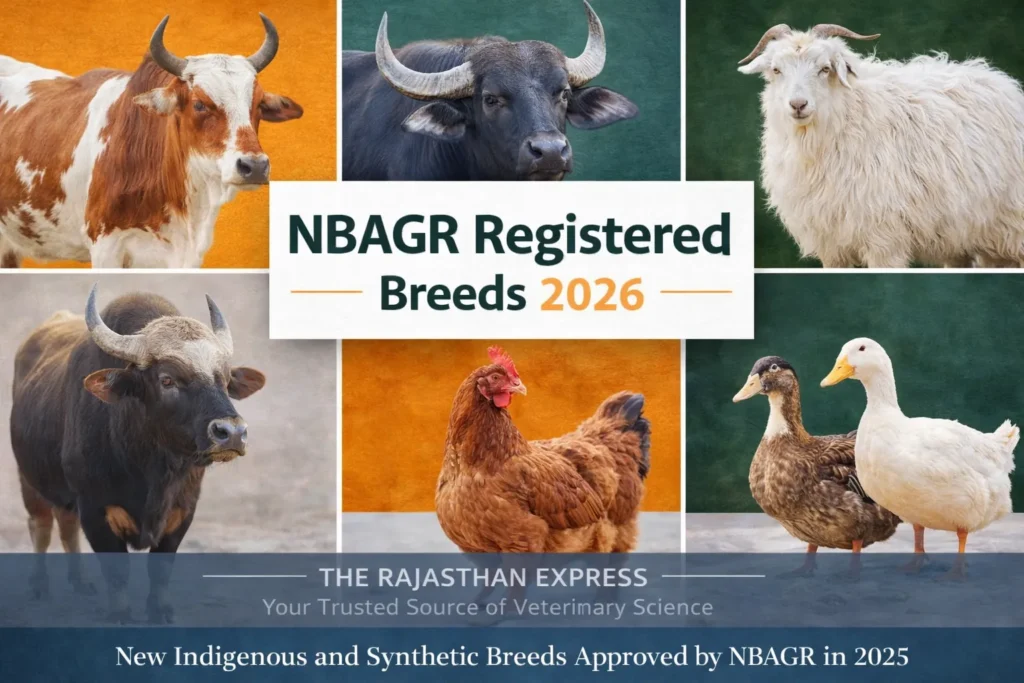
Breed Registration & Classification in India
Now regarding registration: the registration of indigenous breeds is done by the NBAGR (National Bureau of Animal Genetic Resources) located in Karnal, Haryana. For any breed to be registered, at least 1000 animals of that breed must be present in the country. Indigenous cows in India are divided into three categories: first, milch breeds (such as Gir and Sahiwal); second, dual‑purpose breeds (such as Hariana and Ongole, which are good for both milk and ploughing); and third, draught breeds (such as Hallikar and Amritmahal, mainly used for pulling). It is also interesting to know that India’s first synthetic (mixed) cow is Friswal, created by crossing Sahiwal (37.5%) and Holstein Friesian (62.5%), but among pure indigenous breeds, the Gir cow holds a unique and high position.
Red Sindhi Cow (Lal Sindhi / Red Karachi / Mahi)
| Conservation Status | Indigenous / Domesticated (At Genetic Risk – Declining Pure Population) |
|---|---|
| Scientific Classification |
|
| Scientific Name | Bos indicus |
| Other Names | Red Karachi, Sindhi, Malir, Mahi, Lal Sindhi |
| Origin | Sindh Province (Karachi, Hyderabad, Malir, Mahal Kohistan – Pakistan) |
| Distribution | India (Odisha, Tamil Nadu, Bihar, Kerala, Assam, Rajasthan, Punjab, Haryana), Pakistan (Sindh), also exported to Brazil, USA, Australia, Bangladesh, Sri Lanka |
| Breed Type | Milch Breed (High heat-tolerant dairy breed) |
| Main Uses |
|
| Milk Production |
|
| Milk Quality |
|
| Physical Characteristics |
|
| Weight & Size |
|
| Reproductive Traits |
|
| Special Traits |
|
| Global Importance |
|
| Management System |
|
| Price (India 2026) |
|
| Population Status |
|
| Genetic Risk |
|
| Major Threats |
|
| Red Sindhi vs Sahiwal (Quick Difference) |
|
| Source: ICAR-NBAGR, Department of Animal Husbandry (India), Livestock Census 2013, The Rajasthan Express | |
Classification of Indigenous Cattle Based on Utility
Indian Zebu breeds are divided into three main categories based on their primary utility:
1. Milch Breeds (Milk Breeds)
These breeds are mainly reared for high milk production. They are tolerant to different climatic conditions and produce high-quality milk.
Examples: Gir Cow, Sahiwal Cow, Tharparkar Cow, Rathi Cow, Sanchori Cow, etc.
- Gir: Origin is the Gir forest area of Gujarat. They have a reddish‑brown colour and long, drooping ears. Considered best for milk production.
- Sahiwal: This breed originally belongs to the Punjab region of Pakistan (Montgomery district), but it is also widely reared in India. It is a red‑coloured, calm‑temperament breed.
- Red Sindhi: This breed originates from the Sindh province of Pakistan. It is deep red in colour and has the ability to give good milk even in adverse conditions.
- Tharparkar: Originates from the Thar desert of Rajasthan. It is white or light grey and highly tolerant to drought and hot climates.
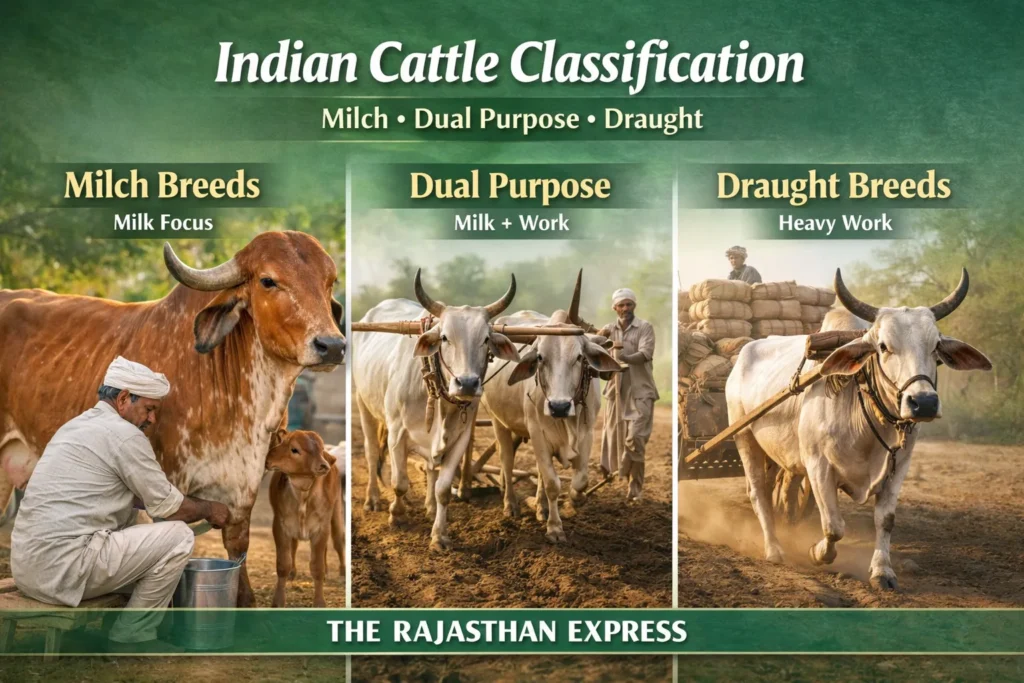
2. Dual‑Purpose Breeds
These breeds are equally suitable for both milk production and agricultural work (e.g., ploughing, carrying loads).
Examples: Ongole cow, Hariana, Kankrej, Mewati cow, Dangi, Deoni, Nimari, Nari, etc.
- Hariana: Found in Haryana and neighbouring states, this breed is known for its balanced performance in both tasks.
- Kankrej: This breed from Gujarat and Rajasthan is known for its large size and powerful build. Its special gait is famous as “Sawaichal”.
- Ongole: Originating in the Prakasam district of Andhra Pradesh, this breed is extremely powerful. Interestingly, Brazil imported this breed and crossbred it to develop a new breed called Nellore, which is very popular in Brazil today.
- Deoni: This breed developed in the Latur district of Maharashtra from crossing Gir, Dangi, and local breeds. It is a strong and reliable dual‑purpose breed.

3. Draught Indigenous Breeds
These breeds are mainly developed for carrying loads and agricultural work. Their muscles are extremely strong, and they are capable of performing hard physical labour.
Examples: Amritmahal, Nagori, Khillari, Hallikar, Malvi, Vechur, Bachaur, Panwar, Siri, Kangayam, Badri, Pullikulam, Punganur, etc.
- Amritmahal: This breed from Karnataka is considered one of India’s best draught breeds. It was developed by the rulers of Mysore for the “Milk Department” (Amritmahal) to provide strong bullocks for the army.
- Nagori: This breed from Rajasthan is famous for its extraordinary speed and stamina.
- Khillari: This is a major draught breed from Maharashtra, known for its strength and toughness.
- Vechur: This is a dwarf breed from Kerala, which, despite its small size, has good draught capacity. Its milk is also considered highly nutritious.
Red Sindhi Cow Origin and History (Red Sindhi Scientific Name & Breed Origin)
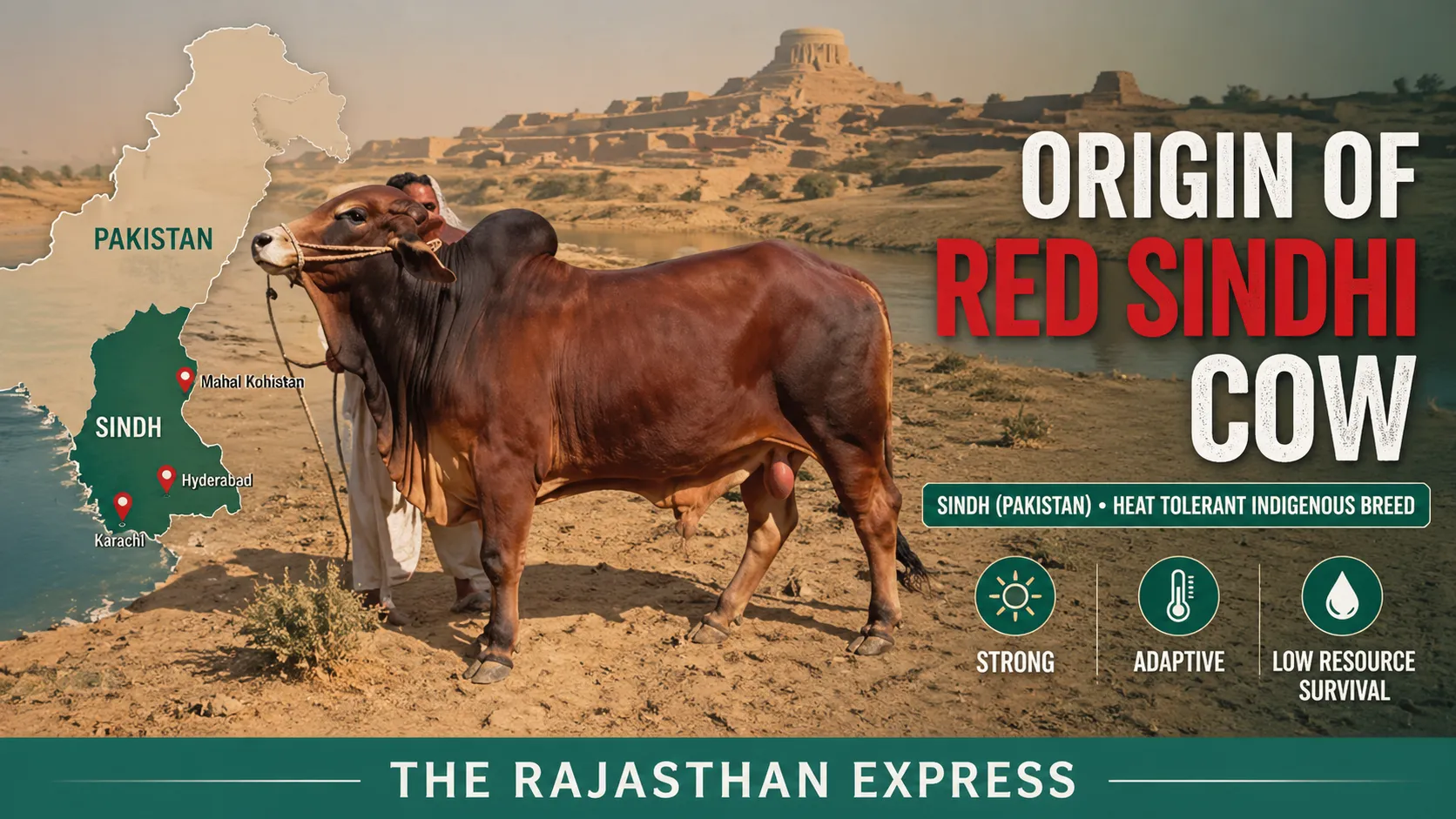
The Red Sindhi cow, also called Red Karachi and Sindhi, is originally a native of the Sindh province of Pakistan. Its original place is considered to be the areas around Karachi and Hyderabad in Sindh province, especially the hilly region called Mahal Kohistan. Its name comes from its red skin colour and Sindh province. This cow is very famous in both India and Pakistan and is considered the most intelligent and learning‑oriented cow among indigenous breeds.
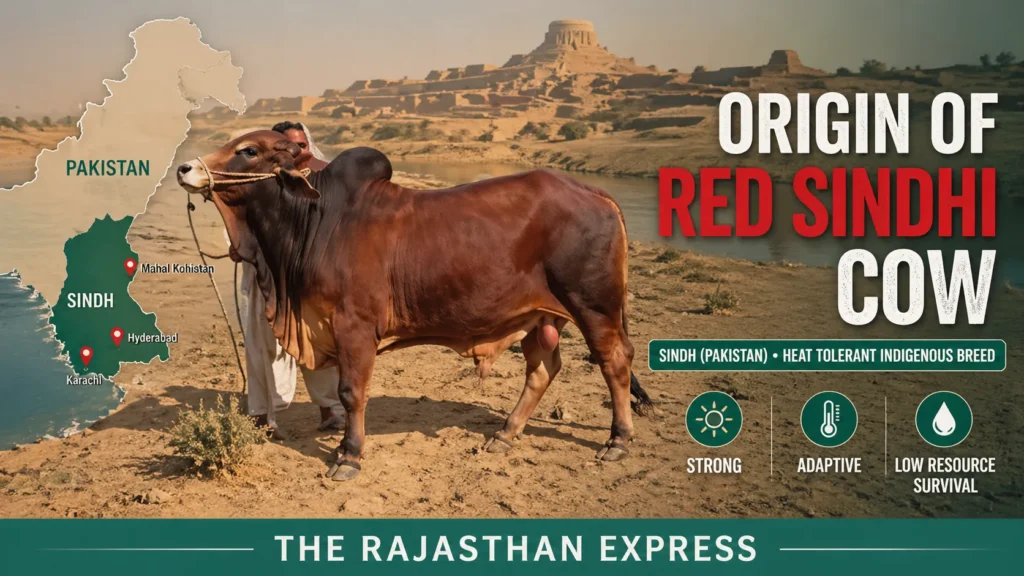
Now let’s talk about its history and geographical spread. Sindh province, which is in south‑eastern Pakistan, is situated along the Indus River. This is the same place where the ancient Indus Valley Civilisation (such as Mohenjo‑Daro) flourished. This land is hot and dry, so the cows here have a natural ability to fight heat and diseases. The Red Sindhi cow grew up in those areas where fodder was scarce and water was in short supply, therefore this breed is very strong and economical to rear.
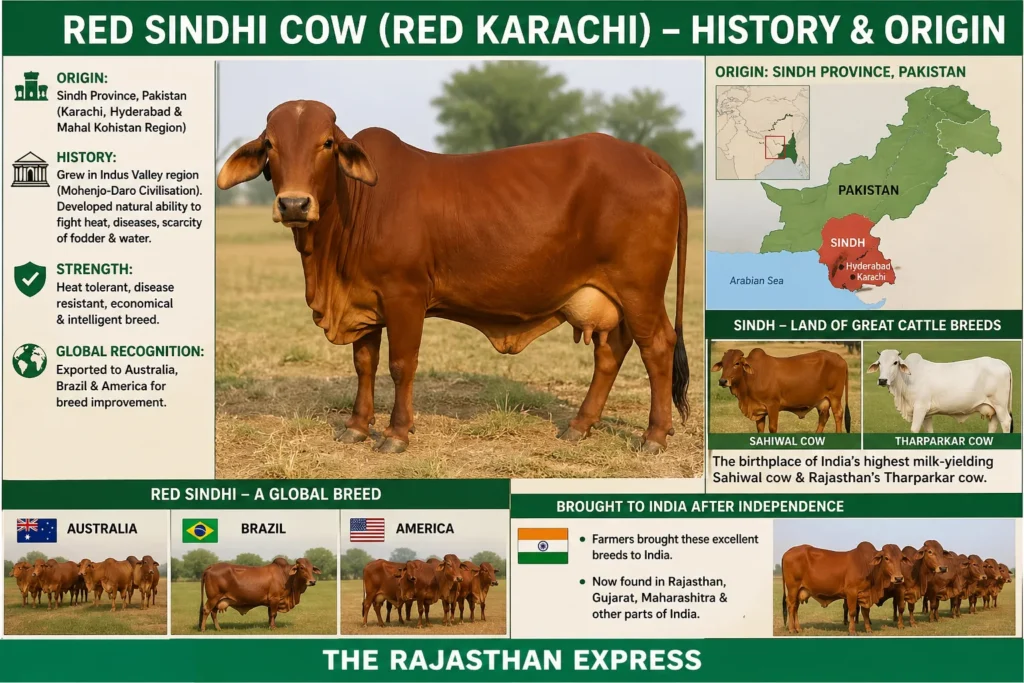
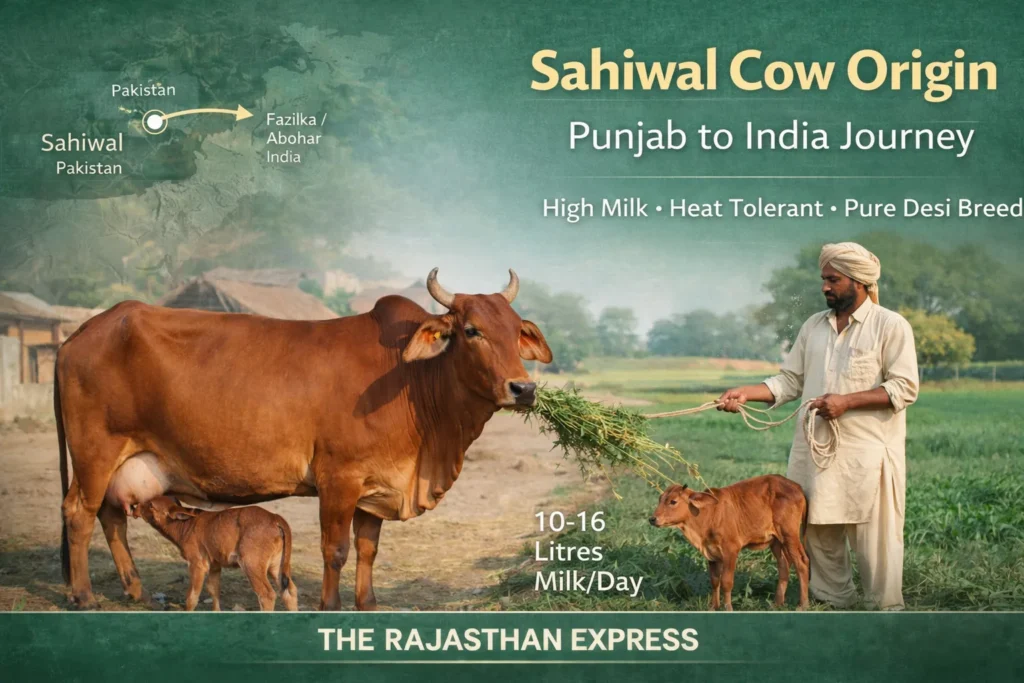
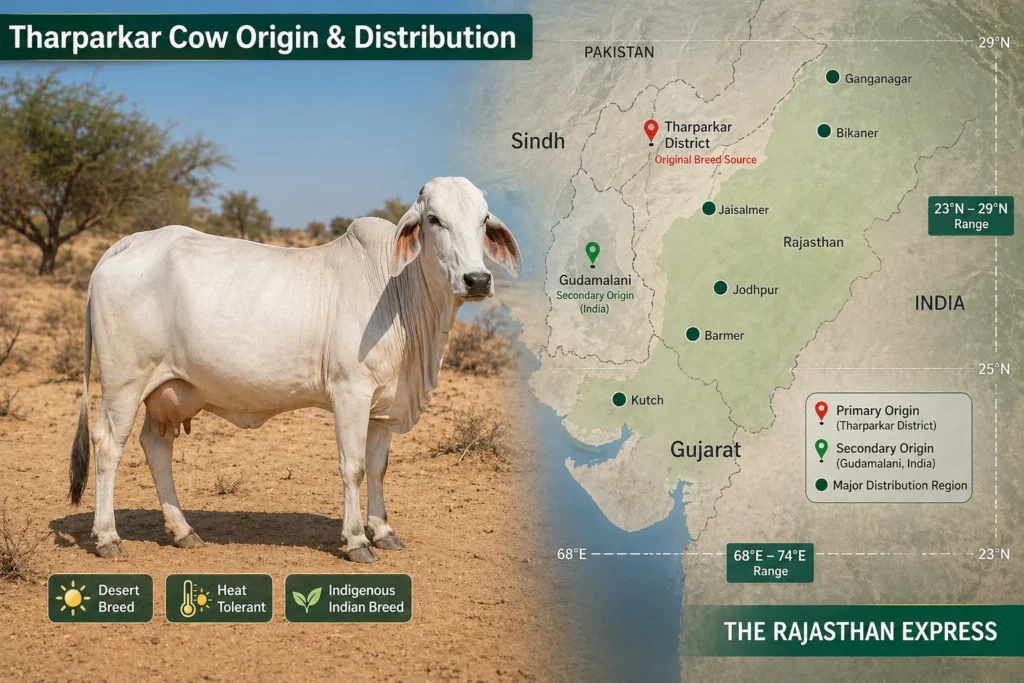
An interesting fact is that the birthplace of India’s highest milk‑yielding Sahiwal cow and Rajasthan’s Tharparkar cow is also the Sindh province of Pakistan. The Sahiwal cow came from the Montgomery (now Sahiwal) area of Sindh, while the Tharparkar cow originated from Tharparkar district of Sindh. After independence, when the country was partitioned, farmers brought these excellent breeds with them to India. Therefore today these cows are found in both India (especially Rajasthan, Gujarat, and Maharashtra) and Pakistan. The Red Sindhi cow was also very well liked abroad, and it was taken to countries like Australia, Brazil, and America, where it was used to improve local breeds.
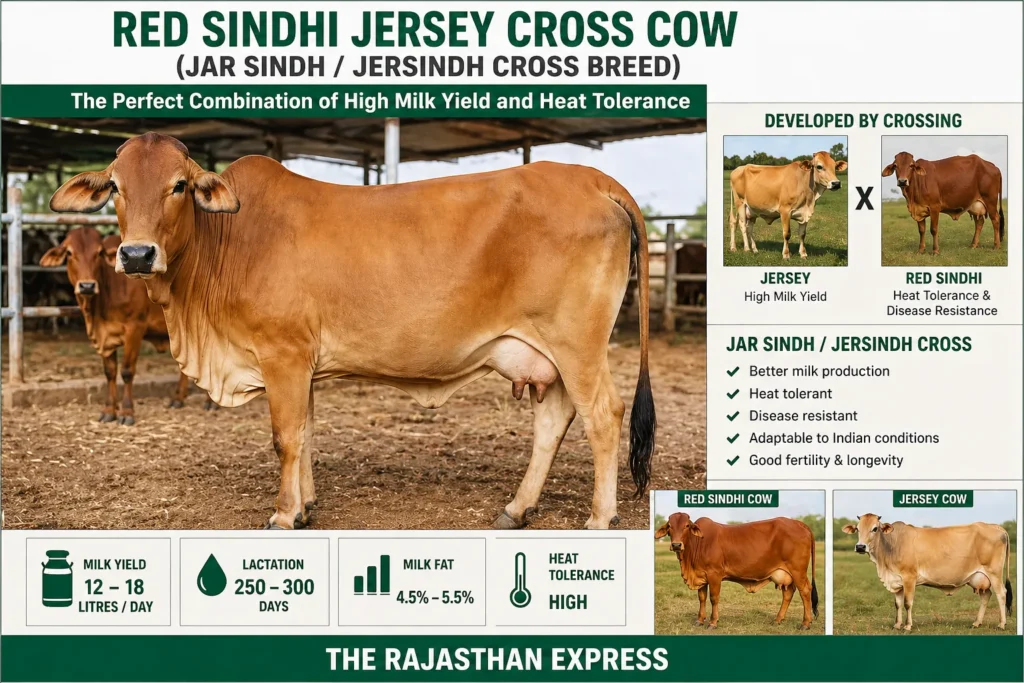
Red Sindhi Jersey Cross Cow (Jar Sindh / Jersindh Cross Breed) –
The Jar Sindh cow is a synthetic/crossbred milch breed developed by crossing Jersey and Red Sindhi breeds. It is an excellent example of how a better animal can be created by combining the higher milk‑yielding ability of a foreign breed with the heat tolerance and disease resistance of an indigenous breed.
🇮🇳 Red Sindhi Which State: Expansion of Red Sindhi Cow in India
Among India’s excellent milch breeds, the Red Sindhi (Lal Sindhi) holds a special place. Famous for its deep red colour and sweet milk, this breed originally came from Sindh province (now Pakistan). When we look at the map of India, this cow appears spread across the country, but its actual presence is not uniform. Especially in western and north‑western India, farmers rear it with great enthusiasm for milk. However, it is important to understand that this breed is not found in every village or with every farmer, but is mainly limited to organised dairy farms and select livestock keepers. The Red Sindhi cow is originally from Sindh province (now in Pakistan), but due to its excellent characteristics, it has spread to many states of India. In India, this cow is reared especially in government farms, research centres, and organised dairy farms.
Major States Where Red Sindhi Cow is Found
- Western and Central India: Rajasthan, Punjab, Haryana. In western India, farmers mainly rear the Red Sindhi cow for milk production. Among these, it is reared more in border states like Rajasthan and Punjab which share a border with Pakistan. Just as Sahiwal and Tharparkar cows are found in the western border districts of Rajasthan, similarly the Red Sindhi cow is also found in the same pattern.
- Eastern and North‑eastern India: Odisha, Bihar, Jharkhand, Chhattisgarh, Bengal (West Bengal), Assam. In these states, this breed is found mainly in limited numbers for experimental or crossbreeding purposes.
- South India: Tamil Nadu, Kerala, Karnataka. In South India, this breed plays an important role in organised dairy farming and crossbreeding programmes.
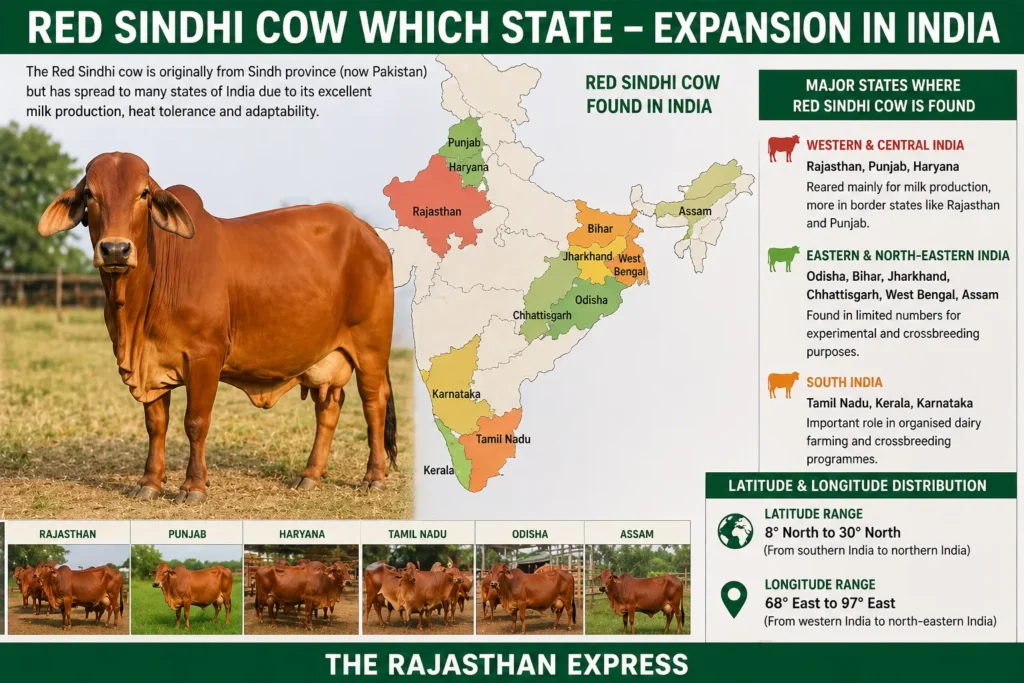
Special situation in western and north‑western India:
- In western and north‑western India, the Red Sindhi cow is mainly reared in Rajasthan, Punjab, and Haryana. Farmers in these regions primarily rear this breed for milk production. Especially in states bordering Pakistan like Rajasthan and Punjab, its rearing is seen relatively more, because its native region was Sindh and it easily adapts to the climate and environment.
- However, it would be more accurate to say that the Red Sindhi cow is found in these regions among organised dairy farms and select farmers, not uniformly everywhere. Just as Sahiwal and Tharparkar cows are found more in the western border districts of Rajasthan, similarly the Red Sindhi cow is also found in these regions, but its numbers are very low.
Latitude & Longitude Distribution (Red Sindhi Which State Range)
The distribution of this breed in India is seen over a wide geographical area, which can be understood within the following limits:
- Latitude range: Approximately 8° North to 30° North – i.e., from almost the southernmost part of India (such as Kerala, Tamil Nadu) to the northern part (such as Punjab, Haryana).
- Longitude range: Approximately 68° East to 97° East – i.e., from western states (such as Rajasthan) to north‑eastern states (such as Assam).
This cow is spread from the western end of India (Rajasthan) to the eastern end (Assam) and from the northern part (Punjab) to the southern part (Tamil Nadu).
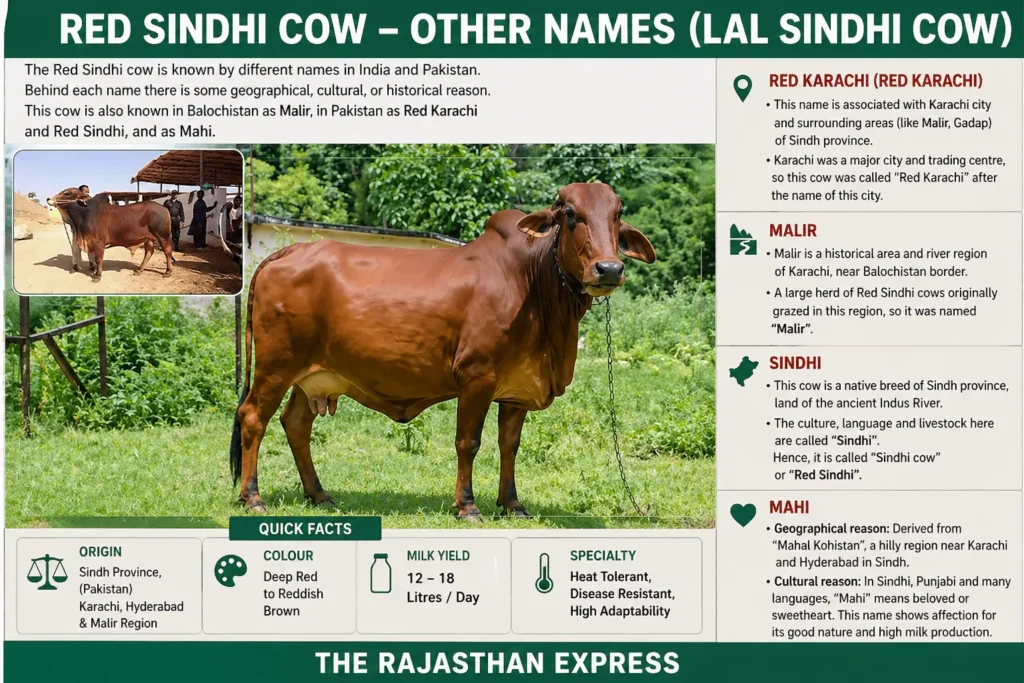
Red Sindhi Cow Other Names (Lal Sindhi Cow)
The Red Sindhi cow is known by different names in India and Pakistan. Behind each name there is some geographical, cultural, or historical reason. The Red Sindhi cow is also known in Balochistan as Malir, in Pakistan as Red Karachi and Red Sindhi, and as Mahi.
- Red Karachi (Red Karachi) – Reason for the name:
This name is directly associated with Karachi city and its surrounding areas (such as Malir and Gadap). The Red Sindhi cow was found in Karachi city and its surrounding areas (like Malir, Gadap) of Sindh province. Since Karachi was the major city and a large trading centre of this entire region, the British and traders started calling this cow “Red Karachi” after the name of this city. This name simultaneously reflects the cow’s deep red colour and its deep association with the Karachi region. - Malir – Reason for the name:
Malir is a historical area and river region of Karachi city, located very close to the border of Balochistan. A large herd of Red Sindhi cows originally grazed and lived in this very Malir region and surrounding hills (Mahal Kohistan). This is why local people around Balochistan and Karachi gave it the name “Malir”. This name is completely related to geographical locality – just as we say “hilly” or “riverside”, similarly this was called the “cow from Malir”. - Sindhi –
This is the simplest and most common name, based on the cow’s original origin. This cow is a native breed of Sindh province, whose ancient name is associated with the Indus River. The culture, language, and livestock here are all called “Sindhi”. For this reason, this cow came to be called simply “Sindhi cow” or based on its red colour “Red Sindhi” (Lal Sindhi). This name identifies its original place (Sindh province). - Mahi –
The Red Sindhi cow is often also known by the name ‘Mahi’. Two main reasons are believed behind this name:- Geographical origin (Mahal Kohistan): According to one belief, the name “Mahi” is derived from the word “Mahal Kohistan”. Mahal Kohistan is a hilly area near Karachi and Hyderabad in Sindh province, Pakistan, where this breed was originally found. Possibly the local people started calling this cow ‘Mahal’ or in its corrupted form ‘Mahi’ to identify its place of origin.
- Affectionate cultural meaning: The second reason is related to the affectionate meaning of this name. In Sindhi, Punjabi and many other regional languages, the word ‘Mahi’ means ‘beloved’, ‘sweetheart’, or ‘lover’. This name is used lovingly for something very dear. The Red Sindhi cow came to be lovingly called ‘Mahi’ for its good temperament and abundant milk‑giving ability, just as a beloved family member is called.
Main Use of Red Sindhi Cow (Red Sindhi Milk Per Day & Lactation Period)
The Red Sindhi cow is primarily a milch breed, meaning it is reared in India and Pakistan mainly for higher milk production. The biggest speciality of this breed is that among all indigenous cows, this is the most intelligent or smartest cow breed.
The milk production of the Red Sindhi cow per lactation (milk period after calving) is as follows:
| Production Level | In Kilograms (kg) | In Litres (approx.) |
|---|---|---|
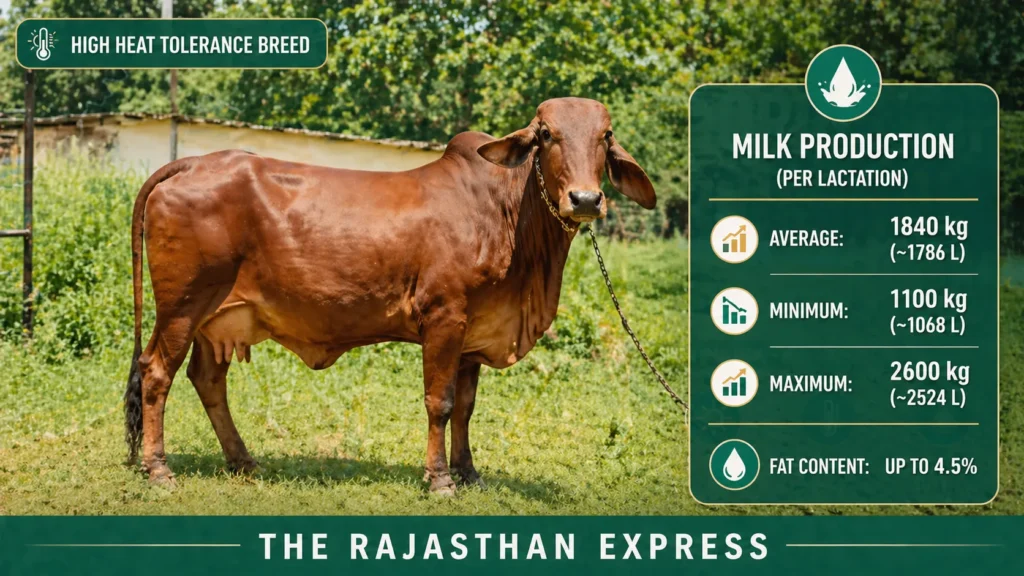
| Average production | 1840 kg | ≈ 1786 litres |
| Minimum production | 1100 kg | ≈ 1068 litres |
| Maximum production | 2600 kg | ≈ 2524 litres |
| Tharparkar cow milk production range: Average 1840 kg per lactation (≈1786 litres), with a maximum recorded up to 2600 kg (≈2524 litres). | ||
Calculation method: Litres = Kilograms ÷ 1.03 *Example: 1840 ÷ 1.03 = 1786.4 litres (approx)*
- Fat content in milk: On average found up to 4.5%, which makes the milk quite thick and nutritious.
- This breed is capable of giving 1068 to 2524 litres of high‑quality milk per lactation even on low fodder and normal care, making it an excellent choice for small and marginal farmers.
How to identify the Red Sindhi cow? Red Sindhi Cattle Characteristics
This breed is quite similar to Sahiwal, yet there are some special features that make it different. Let us understand in detail:
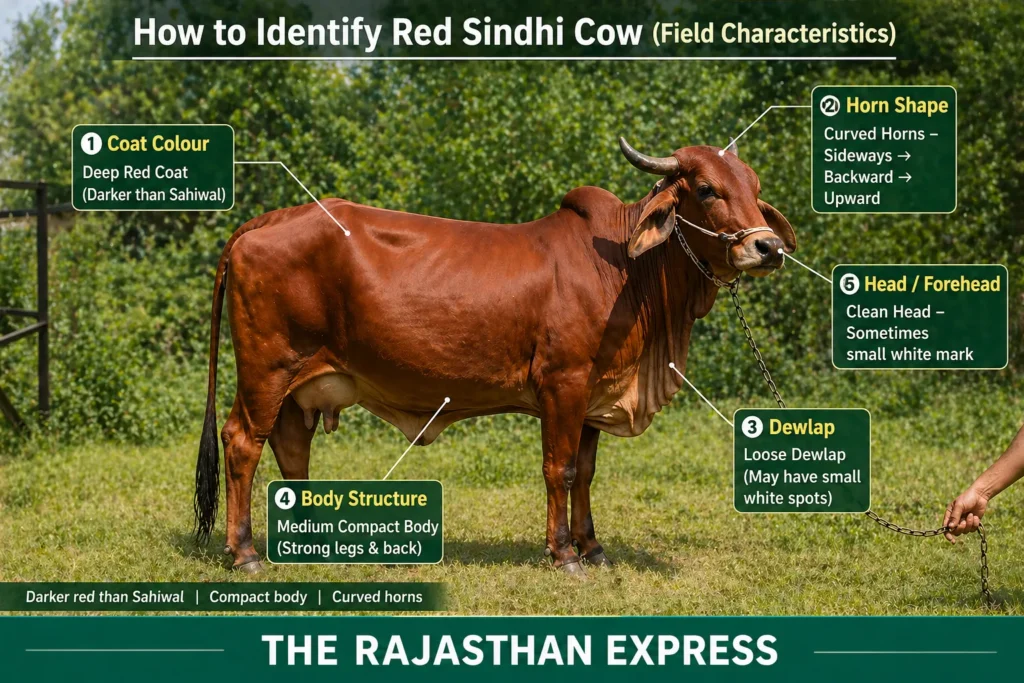
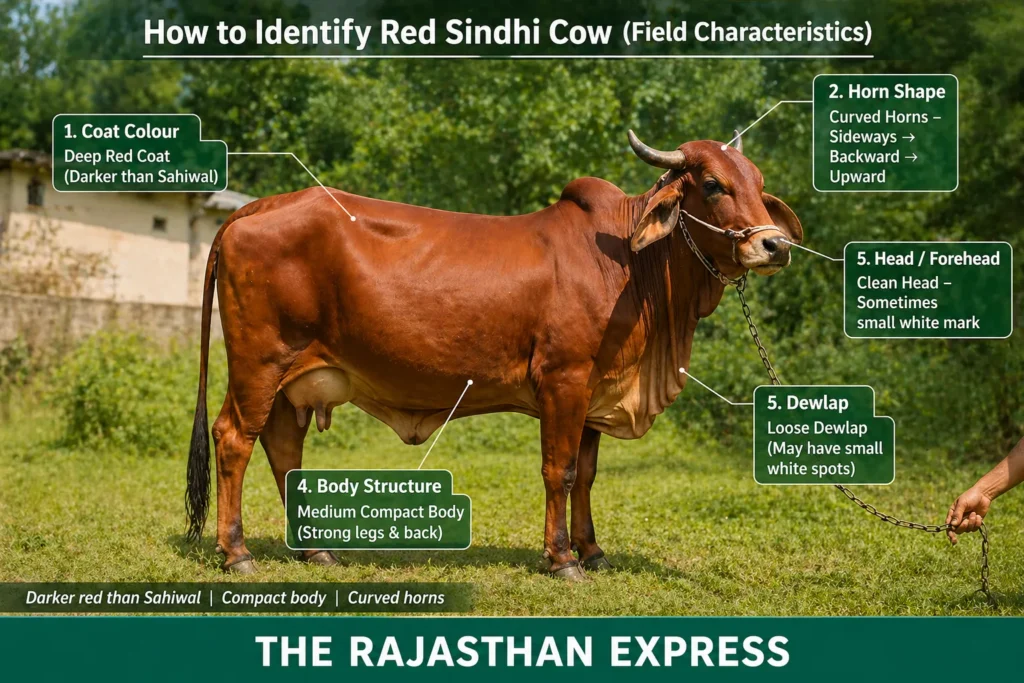
1. Colour of Red Sindhi cow
- The colour of this cow ranges from light to deep red. It is called Red Karachi because of this red colour. Compared to the Sahiwal cow, the red colour of Red Sindhi appears darker and clearer.
- Sometimes there may be small white spots on its forehead or hanging dewlap, but there are no large white spots on the whole body. In males (bulls), the colour becomes darker on the shoulders and thighs.
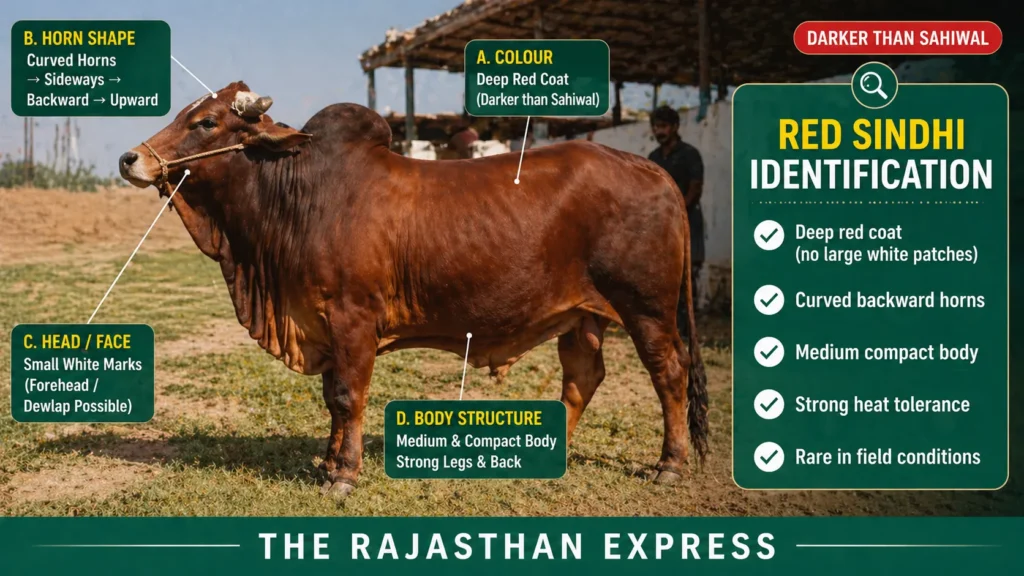
2. Horns
- Number: 2
- Shape and direction: The horns of this cow are very special. They are not straight, but are thick at the base, go out to the side, then turn backwards and rise upward. You can call them “curved” or “twisted” horns that rise upward from the back side.
- Special identification: These backward‑rising curved horns distinguish them from other cows.
3. Morphology & Body Shape
- Stature: The body is medium and compact. This cow is neither very heavy nor very small – we would call it “medium height”. Its body is ‘compact’, meaning a body that is slightly long and wide, agile rather than heavy. Its legs and back are strong and well‑built (meaty), while the chest appears refined (trimmed).
- Details:
- Legs and back have strength and thickness (well‑built).
- The chest shows fineness and cleanliness (refined chest).
- Comparison: This breed is darker red than Sahiwal and has some differences in body structure.
In India, this breed is rarely seen in ordinary fields. Here it is found mostly only in government or large organised farms. If you find a red‑coloured cow whose horns go sideways and then curve backwards, and body is medium, then understand that it is Red Sindhi or a very similar breed.
| Feature | Description |
|---|---|
| Colour | Distinctive red; deep red to light yellow. No large white spots on body. Bulls’ shoulders/thighs darker. |
| Horns | Thick at base, go sideways and then curve upward. |
| Visible Traits | Darker red than Sahiwal. Small white marks possible on dewlap and forehead. |
| Performance | Excellent performance in hot and dry environments. Very high milk quality. |
| Current Availability | Not easily available in field conditions in India; limited to select farms. |
| Tharparkar – A resilient red breed known for heat tolerance and premium A2 milk. | |
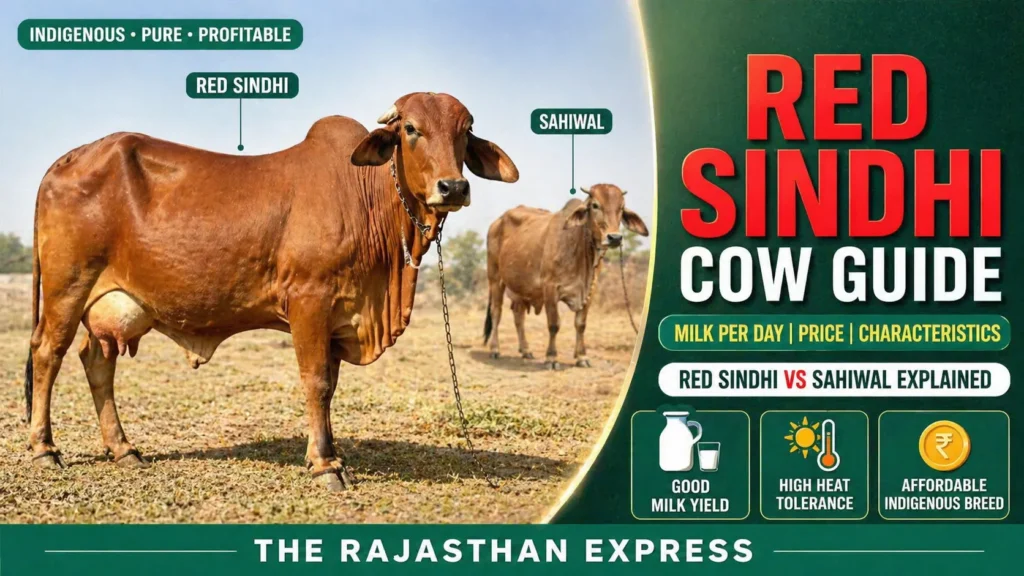
Comparison between Red Sindhi and Sahiwal cows (Red Sindhi vs Sahiwal)
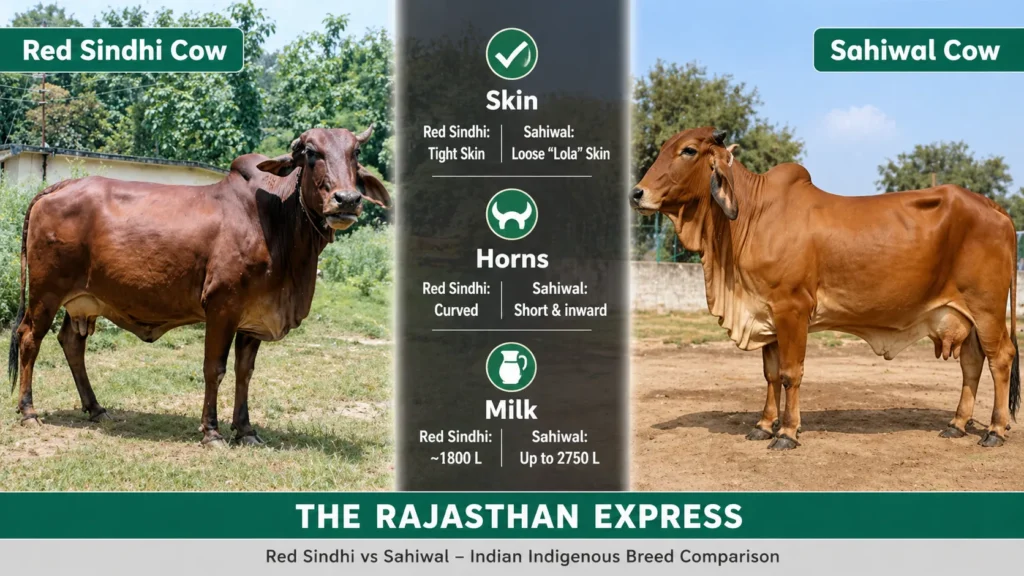
1. Origin and native place
- Red Sindhi – Sindh province of Pakistan (Karachi, Hyderabad, Malir region).
- Sahiwal – Sahiwal (old Montgomery) area of Pakistan, as well as Punjab, Haryana, and Rajasthan in India.
2. Colour
- Red Sindhi – Light to deep red colour. The redness is clearer and darker compared to Sahiwal. No large white spots on body (occasionally small spots on forehead or dewlap).
- Sahiwal – Deep reddish‑brown colour, sometimes mahogany red, sometimes light slate red. The colour of legs, head, and tail ends of bulls is darker than the body. Occasionally white spots may also be seen.
3. Skin – biggest difference
- Red Sindhi – Its skin is normal, not loose. It is not called “Lola“.
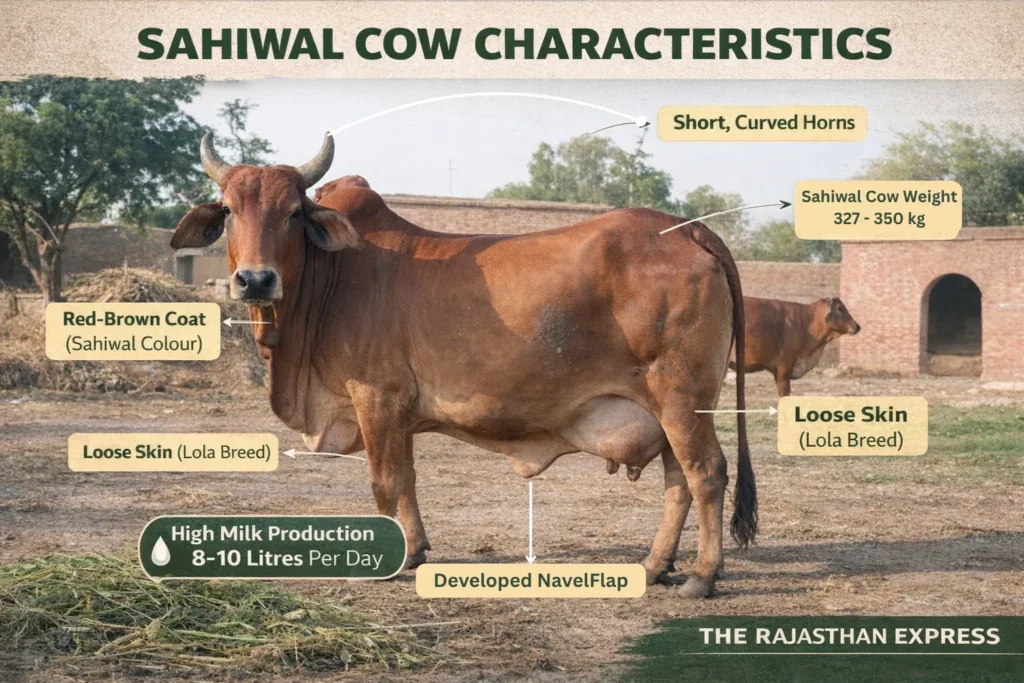
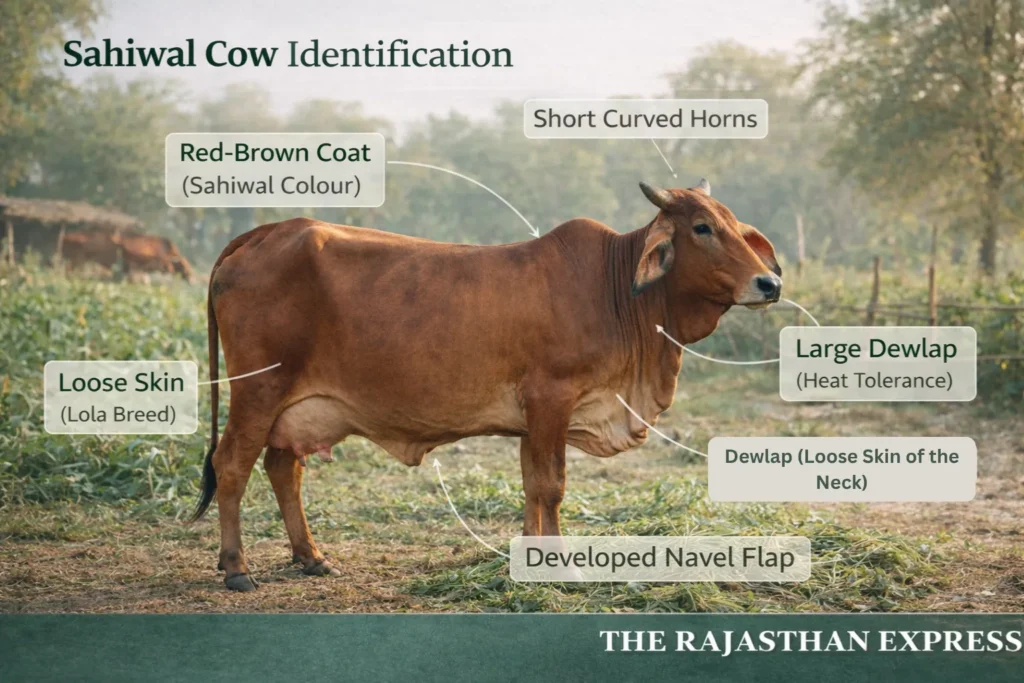
- Sahiwal – Its biggest identification is loose skin. It hangs all over the body, therefore it is lovingly called “Lola breed”. In heat, this skin helps in sweating and keeping the body cool.
4. Dewlap and Navel Flap
- Red Sindhi – Chest is refined (trimmed). Less hanging under the neck and belly.
- Sahiwal – The dewlap (loose skin under the neck) is very large and loose, like an old bull’s beard. The navel flap under the belly is also highly developed (long and loose). Both these loose skin organs protect Sahiwal from heat and insects. Among all indigenous breeds, Sahiwal has the most developed dewlap & Navel Flap.
5. Horns
- Red Sindhi – Horns thick at base, go sideways and then turn backward and rise upward (curved).
- Sahiwal – Horns short (stumpy). First go sideways, then upward, and finally bend inward (towards each other). They are never large.
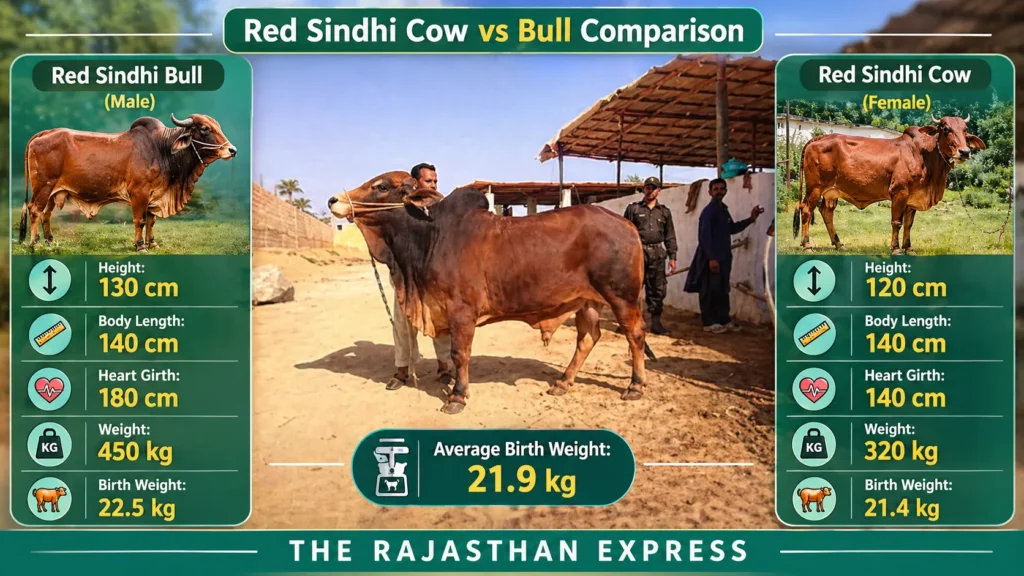
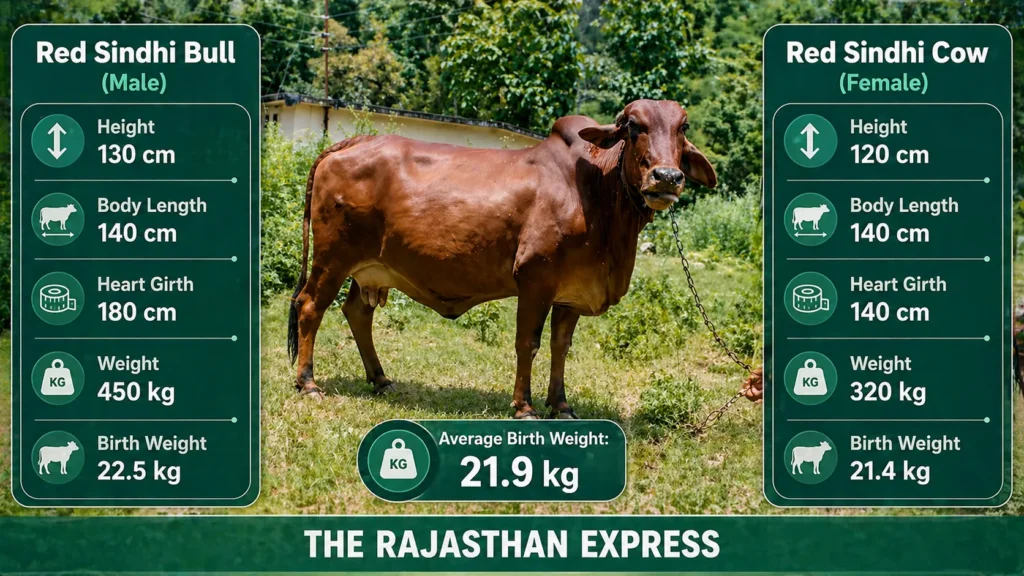
6. Size, stature, and weight (according to NBAGR and ICAR data)
| Feature | Red Sindhi Male | Red Sindhi Female | Sahiwal Male | Sahiwal Female |
|---|---|---|---|---|
| Height at shoulder (cm) | 130 cm | 120 cm | 170 cm | 124 cm |
| Body length (cm) | 140 cm | 140 cm | 150 cm | 131 cm |
| Chest girth (cm) | 180 cm | 140 cm | 190 cm | 164 cm |
| Weight (kg) | 450 kg | 320 kg | 540 kg | 327 kg |
| Birth weight (kg) | 22.5 kg (M), 21.4 (F) | – | 22.4 kg (M), 20.7 (F) | – |
| Source: NBAGR & ICAR data | All measurements are averages; birth weight given as male/female where available. | ||||
In simple words:
- The male Sahiwal (bull) is much larger and heavier than the male Red Sindhi – about 90 kg heavier and 40 cm taller at the shoulder.
- Females have almost similar height (120 vs 124 cm), but the Sahiwal cow has a wider chest (164 vs 140 cm). Weight is also slightly higher for Sahiwal (327 vs 320 kg).
7. Milk capacity (most important difference) (Red Sindhi vs Sahiwal Milk)
- Red Sindhi – This is also a good milk‑giving breed; its genetic potential is considered equal to Sahiwal, but in practice its average production is lower than Sahiwal. A Red Sindhi cow gives on average about 1840 kg (≈1786 litres) of milk per lactation.
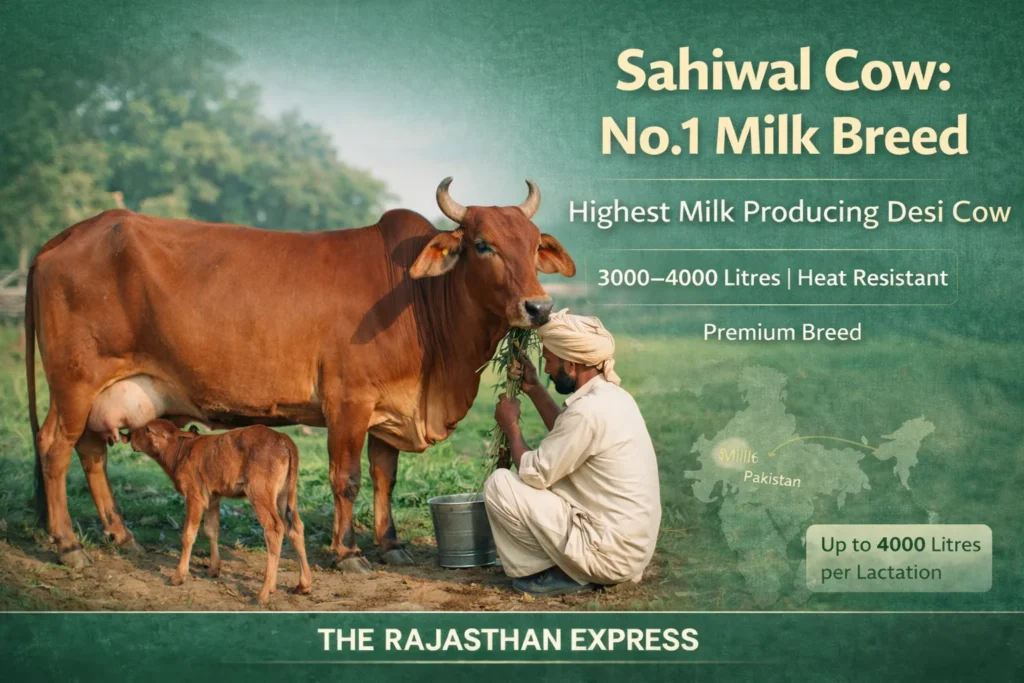
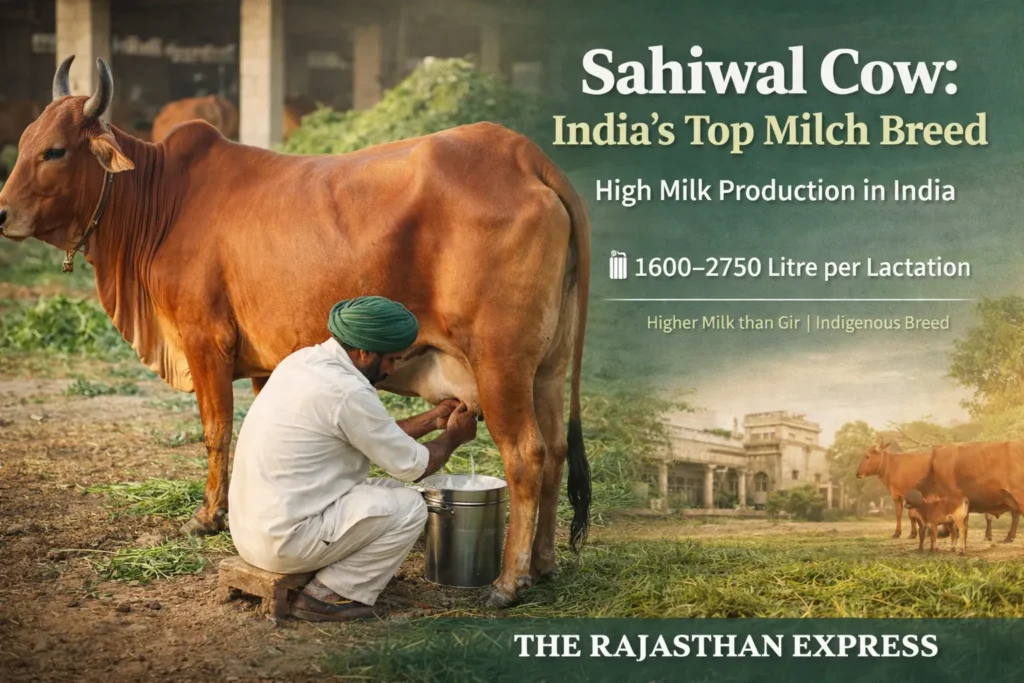
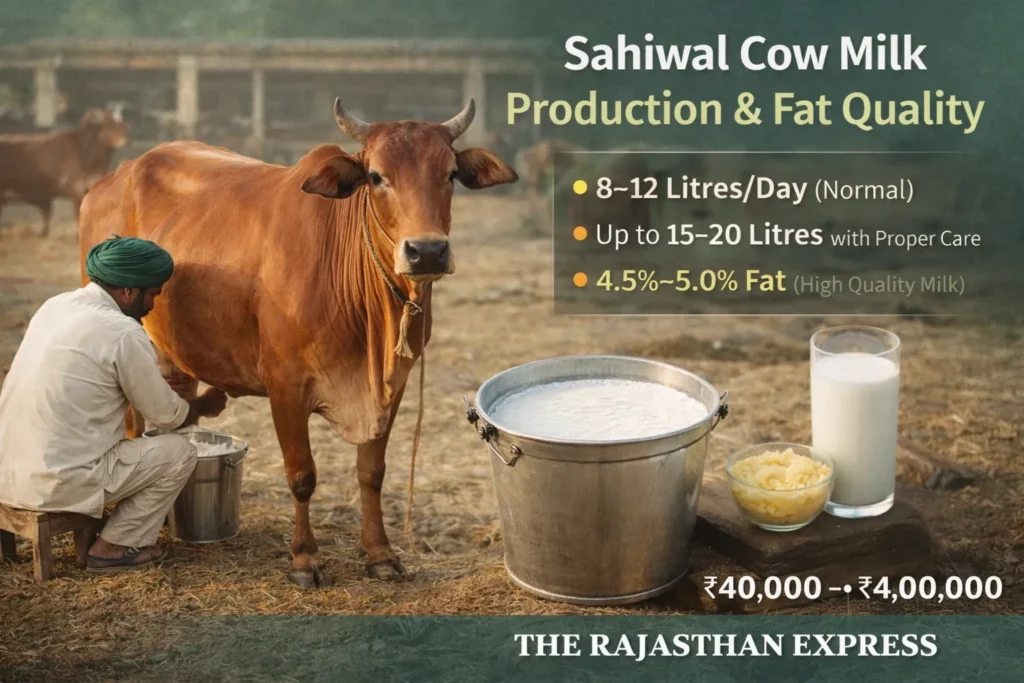
- Sahiwal – This is the highest milk‑giving indigenous breed of India. It gives on average 1600‑2750 kg of milk per lactation. Milk fat is also the highest (4.5%‑5%) – therefore it gives thick and creamy milk.
8. Climate tolerance
- Red Sindhi – Excellent performance in heat and drought. It was raised in harsh, low‑fodder areas.
- Sahiwal – Also does well in hot, humid areas. Its loose skin greatly helps in heat tolerance.
9. Availability in India
- Red Sindhi – Rare in ordinary fields; mostly only in government or large organised farms.
- Sahiwal – Most popular among indigenous cows; abundantly found in Punjab, Haryana, Rajasthan, Uttar Pradesh. Dairy farmers prefer it the most.
Identification of Red Sindhi and Sahiwal in one line:
- Red colour, curved horns, normal skin – Red Sindhi.
- Deep reddish‑brown colour, short crooked horns, loose hanging skin all over body (Lola), large dewlap, and highest milk – Sahiwal.
Red Sindhi Cow Performance Record: Milk Per Day, Lactation Period & Price in India
Red Sindhi Cow Milk Per Day & Lactation Performance Record
These figures are based on scientific studies and farm records. They show how advanced this breed is.
1. Age at first parturition (Red Sindhi Lactation Period Start)
- Average: 43.54 months (approximately 3 years 7 months)
- Minimum: 31.97 months (approximately 2 years 8 months)
- Maximum: 51.32 months (approximately 4 years 3 months)
In simple words: This cow gives her first calf at an average age of three and a half years. With good rearing, she can give as early as two and a half years, but sometimes it may take up to four and a half years. This is within the normal range for indigenous breeds.
2. Parturition Interval – time between two calves
- Average: 14.57 months (approximately 14.5 months)
- Minimum: 12.5 months
- Maximum: 18.09 months (approximately 18 months)
In simple words: The Red Sindhi cow gives one calf every 14-15 months. In a very good farm, she can calve once a year (12.5 months). That is, about one calf every year – this is a good reproductive level.
3. Red Sindhi Cow Milk yield per lactation
The Red Sindhi cow produces on average 1,840 kilograms (approximately 1,786 litres) of milk per lactation. According to ICAR‑NBAGR, a Red Sindhi cow produces between a minimum of 1,100 kg and a maximum of 2,600 kg of milk per lactation.
Meaning: The Red Sindhi cow gives on average 1,786 litres of milk after giving birth once.
Milk Yield Per Day
The lactation period is usually considered to be 270 to 300 days. Based on this, the average daily milk production is as follows:
- A normal Red Sindhi cow produces about 6 to 7 litres of milk per day.
- An advanced/high‑yielding Red Sindhi cow can produce about 8 to 10 litres per day.
Note: These figures are averages and can vary depending on the animal’s care, fodder quality, and weather.
Milk Fat Percentage (Red Sindhi Cattle Characteristics)
- The milk of the Red Sindhi cow contains on average 4.5% fat. This high fat percentage makes its milk quite thick, nutritious, and of A2 quality.
Main point:
- The Red Sindhi cow is primarily a milch breed, meaning it is reared in India and Pakistan mainly for highest milk production. Red Sindhi milk is quite thick and creamy. 4.5% fat means that every litre of milk contains 45 grams of ghee-like fat. This is equal to Sahiwal (4.5-5%) and much higher than foreign breeds like Jersey/Holstein. The biggest speciality of this breed is that among all indigenous cows, this is the most intelligent or smartest cow breed.
| Parameter | Average | Minimum | Maximum |
|---|---|---|---|
| Age at first parturition (months) | 43.54 | 31.97 | 51.32 |
| Parturition interval (months) | 14.57 | 12.5 | 18.09 |
| Milk yield per lactation (kg) | 1840 kg | 1100 kg | 2600 kg |
| (in litres approx) | 1786 L | 1068 L | 2524 L |
| Milk fat percentage | 4.5% | 4.0% | 5.2% |
| Red Sindhi cow performance – Average lactation yield ≈1840 kg (≈1786 litres) with 4.5% fat. Daily milk yield (approx.) = 1840 kg ÷ 305 days (typical lactation length) ≈ 6.0 kg/day. | |||
Red Sindhi Cattle Characteristics (Peculiarity of the Breed)
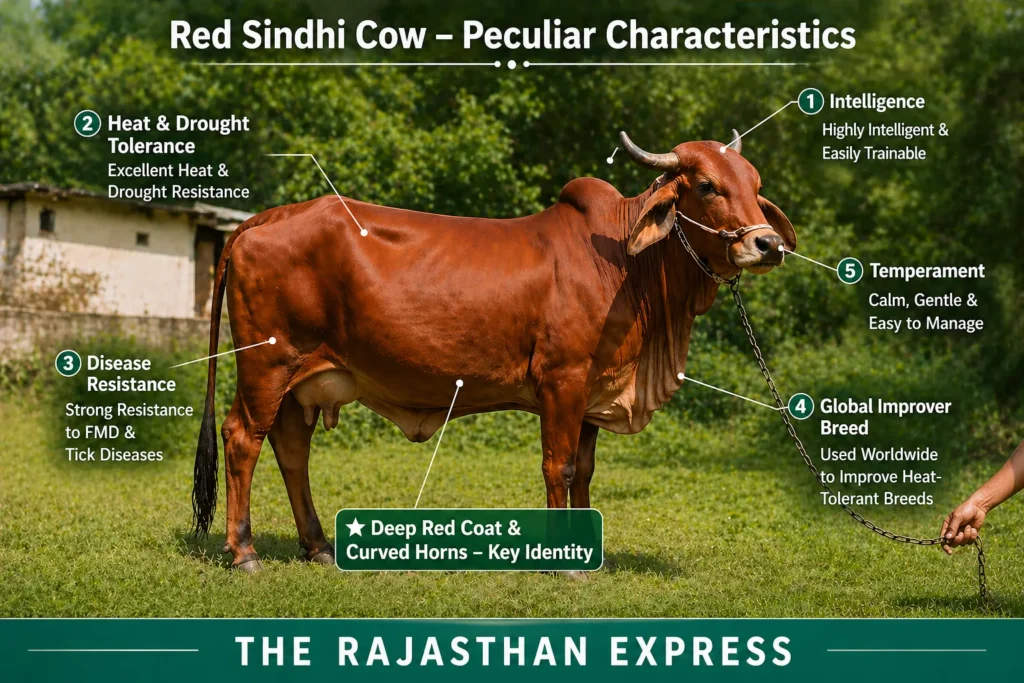
“Peculiarity” means such a quality or characteristic that makes it completely different from other breeds. For Red Sindhi, these are:
- Most intelligent breed – It is considered the smartest and most trainable cow among all indigenous cows. On the farm, it learns faster than others.
- Excellent in heat and drought – This breed belongs to desert and semi‑desert areas. It tolerates low water, low fodder, scorching heat – everything. Where other breeds fall sick, this one continues to give milk.
- Disease resistance – Its resistance to tick‑borne diseases (such as pyroplasmosis, anaplasmosis) and Foot‑and‑Mouth Disease (FMD) is considered the best. Abroad, it is considered the best breed for hot regions.
- Improver breed abroad – In countries like Australia, America, and Brazil, it has been used to improve local heat‑tolerant breeds (such as Brahman, Jersey). Australian Red Sindhi has become a separate brand.
- Calm and sweet temperament – This cow is very peaceful, gentle, and sociable. It can be easily reared. This is why even women can rear it without fear.
- Depth of red colour and horn shape – Its deep bright red colour and sideways backward‑rising curved horns are its unique identification, distinguishing it from other red breeds (such as Lal Lal cow).
What factors does the price of a Red Sindhi cow depend on? (Red Sindhi Cattle Price In India)
Red Sindhi Price in India (Red Sindhi Cattle Price Factors)
Buying a Red Sindhi cow is a big investment, and since this breed has now become very limited and rare, even more fluctuation is seen in its price. There is no fixed price here – an ordinary cow can be found for ₹40,000, while a pure, high‑milk‑capacity registered cow can go above ₹3 lakh. The difference depends only on the quality of the cow. But a mixed breed Red Sindhi cow can be found within ₹30,000. Let us understand each reason.
1. How much milk does it give? (More milk = higher price)
This is the biggest factor. The daily milk production of Red Sindhi depends on its care and breed purity.
- Ordinary care cow: 6 to 8 litres per day (on traditional fodder).
- Advanced good farm cow: 8 to 12 litres per day (on balanced diet and better care).
- Fat in milk: Average 4.5% (4.0% to 5.2%) – i.e., the milk is very thick and nutritious.
A cow giving 6-7 litres per day will cost approximately ₹50,000 – ₹80,000. One giving 10-12 litres per day reaches ₹1.5 lakh. The more milk, the higher the price – that is straightforward math.
2. How pure is the breed? (Registered cow = expensive cow)
Purity of Red Sindhi is the biggest challenge today. Pure breed means that the cow’s parents, grandparents are all pure Red Sindhi, without any mixing of Jersey or Sahiwal.
- Cow without documents: Can be found cheap in a regular market, but there is a risk it may not be pure, because finding pure Red Sindhi in open areas is rare.
- Registered / certified cow: One recorded in a government farm (such as NBAGR) or recognised dairy. It has complete documentation.
Due to the very limited availability of pure Red Sindhi, the price of a registered cow can be 40-60% higher than an unregistered cow.
3. What is the age of the cow? (Young cow is most expensive)
Age directly affects future earnings.
- Heifer – 1 to 2.5 years: Has not yet given birth. Price: ₹40,000 – ₹70,000 (future milk uncertain).
- Young milch cow – 3 to 6 years (after first or second calving): This sells the most expensive, because milk production is at its peak and it will give for 8‑10 more years.
- Old cow – above 10 years: Price drops sharply.
A healthy 3‑year‑old Red Sindhi giving 10 litres per day will sell for much more than a 7‑8 year old cow.
4. Is the cow pregnant? (If yes, price increases)
A pregnant cow gives double benefit – milk plus a calf. In the case of Red Sindhi, this is even more important, because every new pure calf is precious for breed conservation.
- If it is a heifer (female), she will become a future milch cow.
- If it is a bull calf, it can be used as a bull or for breeding.
A pregnant Red Sindhi cow costs at least ₹25,000 – ₹40,000 more than the same non‑pregnant cow, because you are getting “two for the price of one”.
5. Is the cow’s pedigree record (ancestry) available?
Pedigree means the recorded history of the cow’s ancestors. It records:
- Mother’s and grandmother’s milk production.
- Calving interval and fertility.
- Absence of genetic diseases.
For Red Sindhi, a pedigree record is even more precious, because its effective population size is very low (approximately 126). A cow with recorded pedigree proves that she is not part of a limited gene pool and has good genetic diversity. Such a cow can sell for up to double the normal price.
6. Has the cow been vaccinated?
A cow with full vaccination (FMD, HS, Brucellosis, etc.) is a safe investment. Buying an unvaccinated cow may end up costing thousands in treatment later. A healthy, vaccinated cow sees a 10-15% increase in price.
7. Where are you buying? (Price varies by state)
The native areas of Red Sindhi are now very limited. It is found mainly in organised farms of Odisha, Tamil Nadu, Bihar, Kerala, and Assam.
- States where farms exist: Buying directly from the farm keeps the price relatively controlled.
- Distant states (Punjab, Haryana, Rajasthan, Madhya Pradesh, Uttar Pradesh): Pure Red Sindhi is rare there. Transport and middleman commission add 25‑50% to the price.
A cow bought directly from a government farm in Odisha will be cheaper, while the same cow in Delhi or Mumbai may sell very expensively.
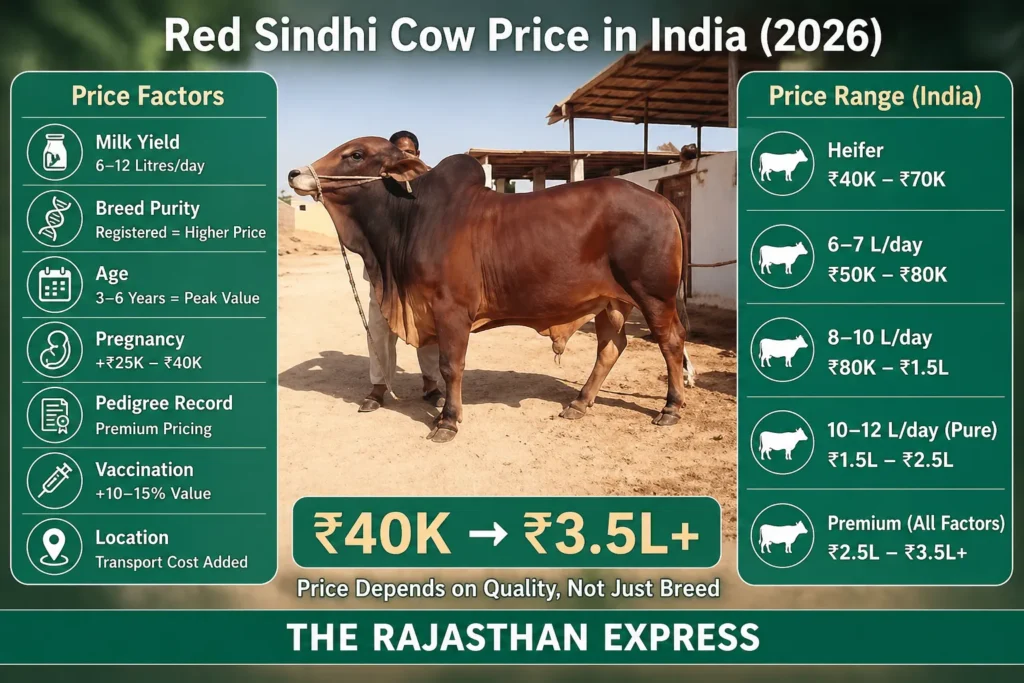
| Red Sindhi Price in India (2026 Estimated Range) : The Rajasthan Express: Your Trusted Source for Animal Care and Veterinary Science. | |
| Category | Estimated Price (₹) |
|---|---|
| Heifer / young unbred cow | ₹40,000 – ₹70,000 |
| Ordinary Red Sindhi (6‑7 litres/day) | ₹50,000 – ₹80,000 |
| Good milch Red Sindhi (8‑10 litres/day) | ₹80,000 – ₹1,50,000 |
| High‑yielding pure Red Sindhi (10‑12 litres/day, registered) | ₹1,50,000 – ₹2,50,000 |
| Complete record Red Sindhi (pedigree, milk record, vaccination, pregnant & high milk capacity) | ₹2,50,000 – ₹3,50,000+ |
| 📌 Estimated prices for Red Sindhi cows as of 2026. Actual prices vary by region, health, lactation stage, and market demand. | |
Key Points About Indigenous Cows in India (Desi Cow Facts)
- India’s best draught (load‑carrying) breed is Amrit Mahal.
- Maharashtra’s best draught breed is Khillari.
- Rajasthan’s best load‑carrying breed is Nagori.
- India’s best dual‑purpose (milk + work) breed is Hariana.
- The world’s smallest cow breed is Vechur.
- India’s heaviest cow breed is Kankrej.
- The Kankrej breed exhibits a “Sawai Chal” (fast and special gait).
- Deoni cow was created by crossing Gir, Dangi, and local cows.
- Nimari cow was created by mixing Gir and Khillari breeds.
- India’s most expensive cow breed is considered to be Ongole. In Brazil, this same breed is called Nelore. At the beginning of the year 2025, a Nelore cow named “Viatina‑19” was sold for approximately ₹40‑41 crore. It also set a Guinness World Record. “Viatina‑19” weighed about 1100 kg, which is much more than a normal cow. The first Ongole cows were taken from India to Brazil in 1868. Later, by 1960, about 7000 cattle were sent there. In Brazil, this breed was named “Nelore”, after the Nellore district of Andhra Pradesh.
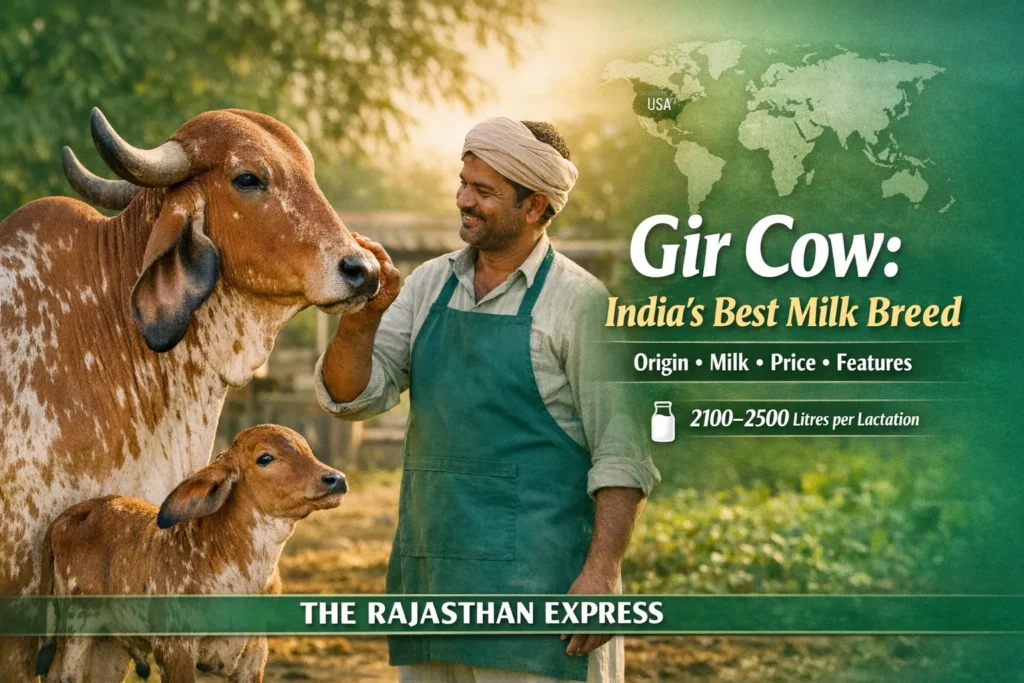
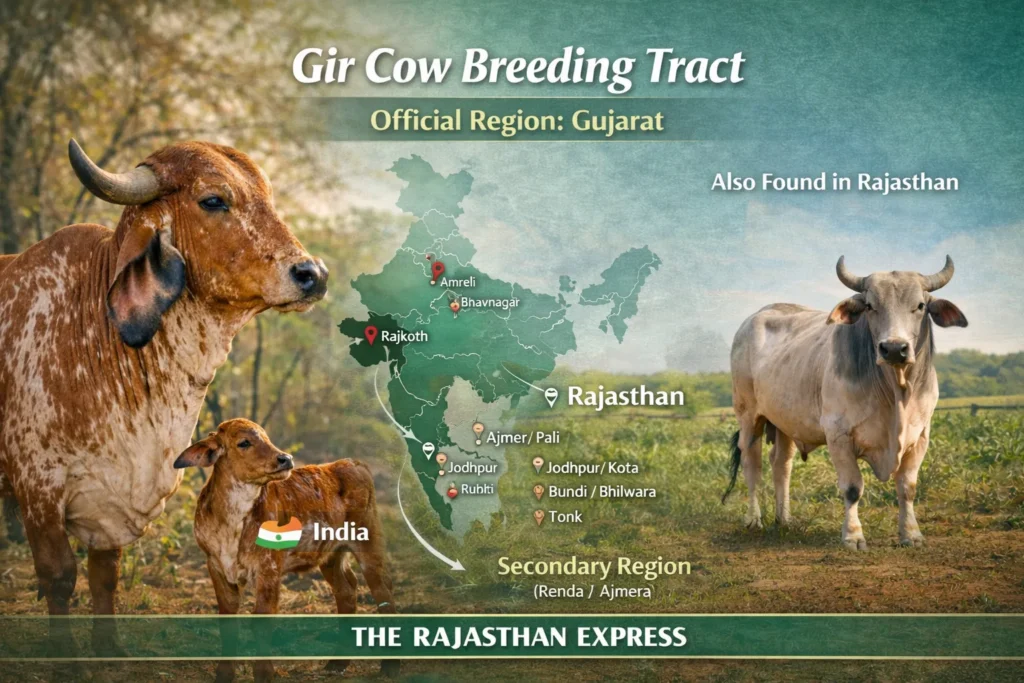
- Among indigenous cows, the longest lactation period is of the Gir cow (about 325 days). The Gir cow originated in the Gir forests of Kathiawar, Gujarat. The Gir cow is also called Kathiyawadi, Ajmera, Renda, Surti.
- Among buffaloes, the longest lactation period is of the Mehsana buffalo (about 352 ± 15 days).
- Identification of Gir cow:
- Red, brown, or spotted skin
- Prominence on forehead
- Long, hanging, leaf‑shaped ears
- Half‑moon shaped horns
- India’s highest milk‑producing indigenous cow is Sahiwal.
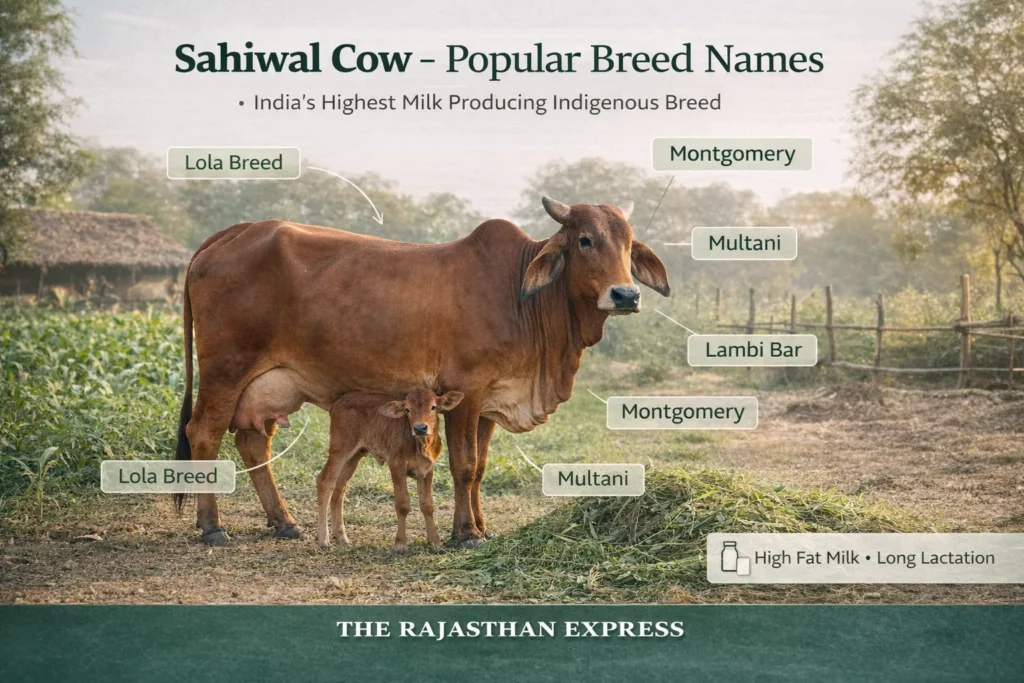
- In the Sahiwal cow, the dewlap (loose skin of the neck) and Nawelflap are more developed. This is the main identification of the Sahiwal cow. The Sahiwal cow originated in Montgomery (Pakistan), Punjab, Haryana. The Sahiwal cow is also called Lola breed, Multani, Montgomery, Lambi Bar.
- Because the Sahiwal cow’s skin is loose, it is also called the Lola breed.
- The most intelligent cow breed is considered to be Red Sindhi. The Red Sindhi cow originated in Karachi, Hyderabad (Sindh), Pakistan. The Red Sindhi cow is also called Red Karachi.
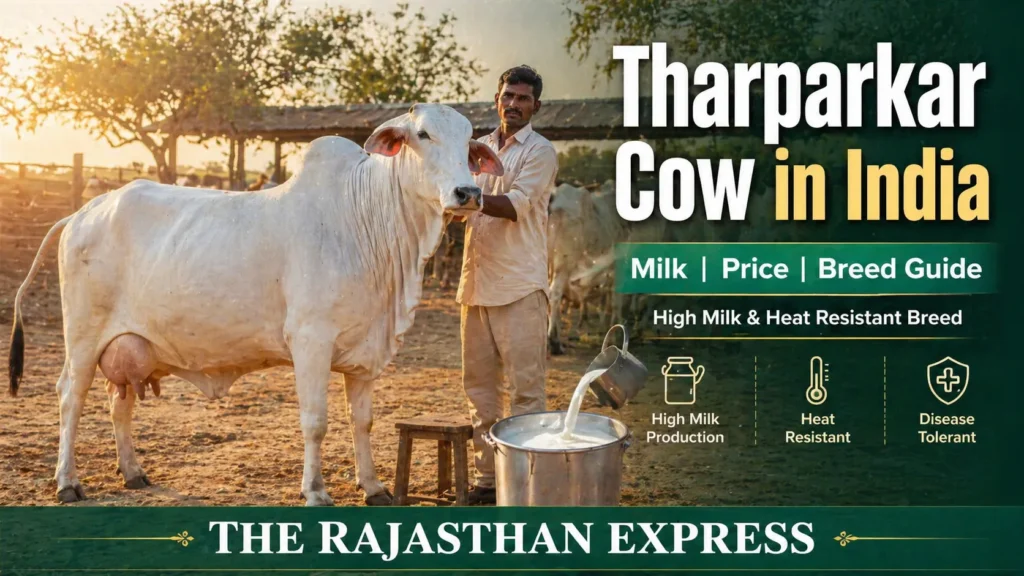
- Among indigenous breeds, the highest disease resistance is found in the Tharparkar cow, which is found in the state of Rajasthan, India. The Tharparkar cow originated in the Tharparkar district of Sindh province in Pakistan and in Gudamalani, Barmer. It is also known as White Sindhi, Grey Sindhi, or Thari and Malani. This breed is named after the Thar Desert, which extends from Sindh to the Kutch district of Gujarat and to the Barmer, Jaisalmer, and Jodhpur districts of Rajasthan, India.
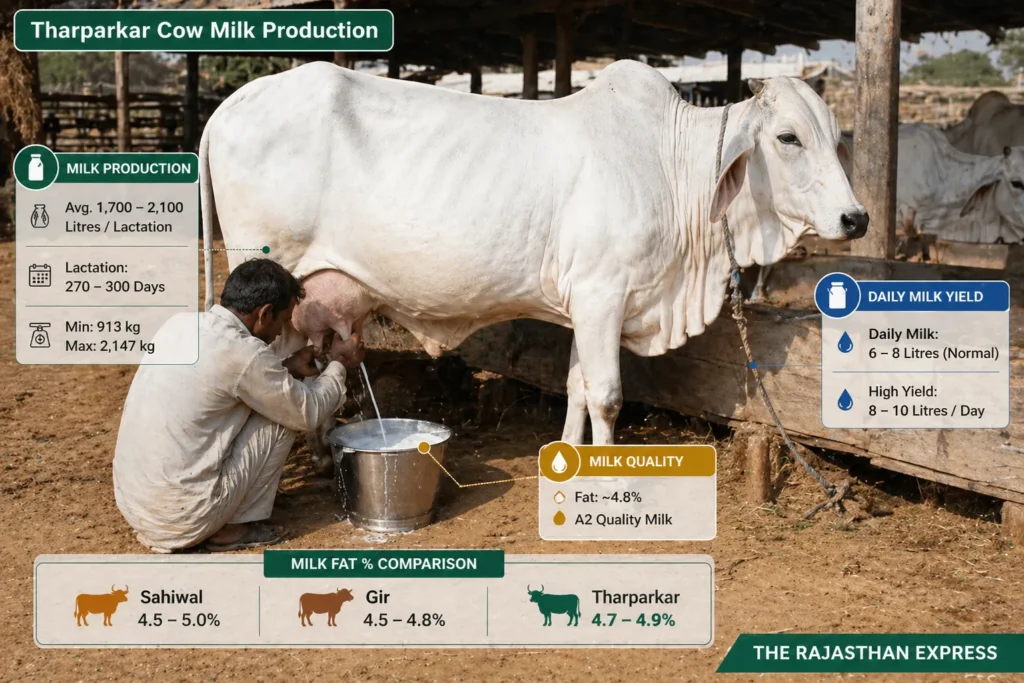
- The Tharparkar cow also has the ability to change colour.
- The highest milk‑producing cow in Rajasthan is Tharparkar.
- The Rathi cow was created by mixing Red Sindhi, Sahiwal, Tharparkar, and Dhani breeds. The Rathi cow is also called Rajasthan’s Kamadhenu.
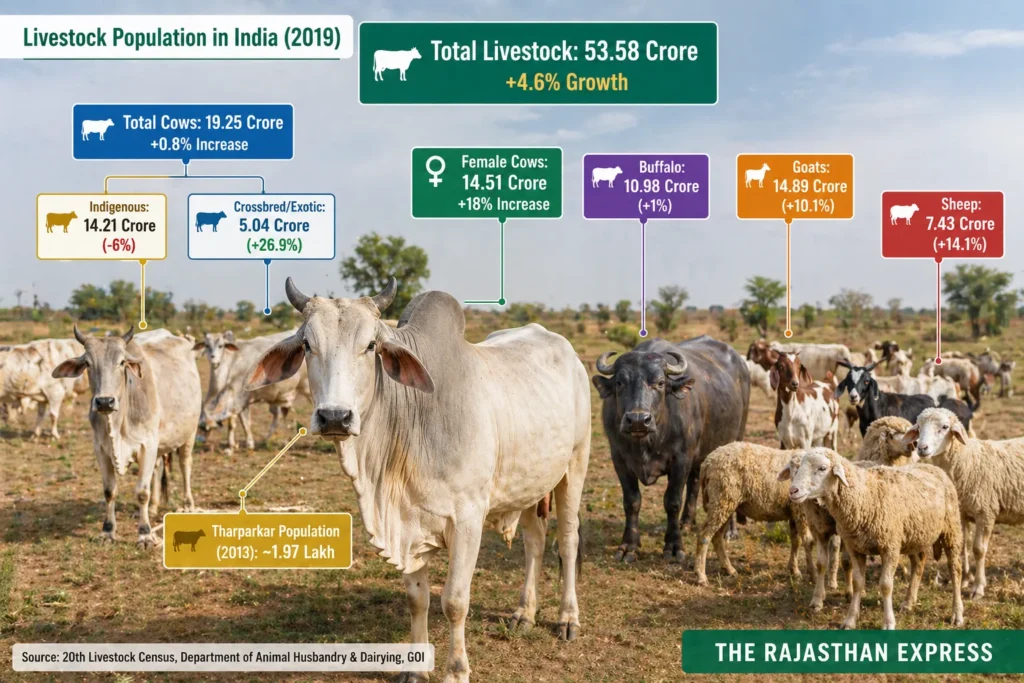
Livestock Population in India (20th Livestock Census 2019)
| Livestock Population in India (20th Livestock Census, 2019) | ||
| Particulars | 20th Livestock Census (2019) figure | Change from previous census (2012) |
|---|---|---|
| Total livestock | 53.58 crore (535.78 million) | +4.6% (increase) |
| Total cows (all types) | 19.25 crore (192.49 million) | +0.8% (increase) |
| Indigenous/unclassified cows | 14.21 crore (142.11 million) | -6% (decline) |
| Exotic/crossbred cows | 5.04 crore (50.42 million) | +26.9% (remarkable increase) |
| Female cows (Cows) | 14.51 crore (145.12 million) | +18.0% (much higher than previous census) |
| Buffaloes | 10.98 crore (109.85 million) | +1.0% |
| Goats | 14.89 crore (148.88 million) | +10.1% |
| Sheep | 7.43 crore (74.26 million) | +14.1% |
| The Rajasthan Express : Livestock Census 2019 | ||
Important point:
- While the total cow population has increased marginally by 0.8%, the population of female cows has seen a large increase of 18.0%. In contrast, the total population of indigenous cows (both male and female) has declined by 6%. These figures indicate that attention to milk production has increased, due to which the number of female animals has increased.
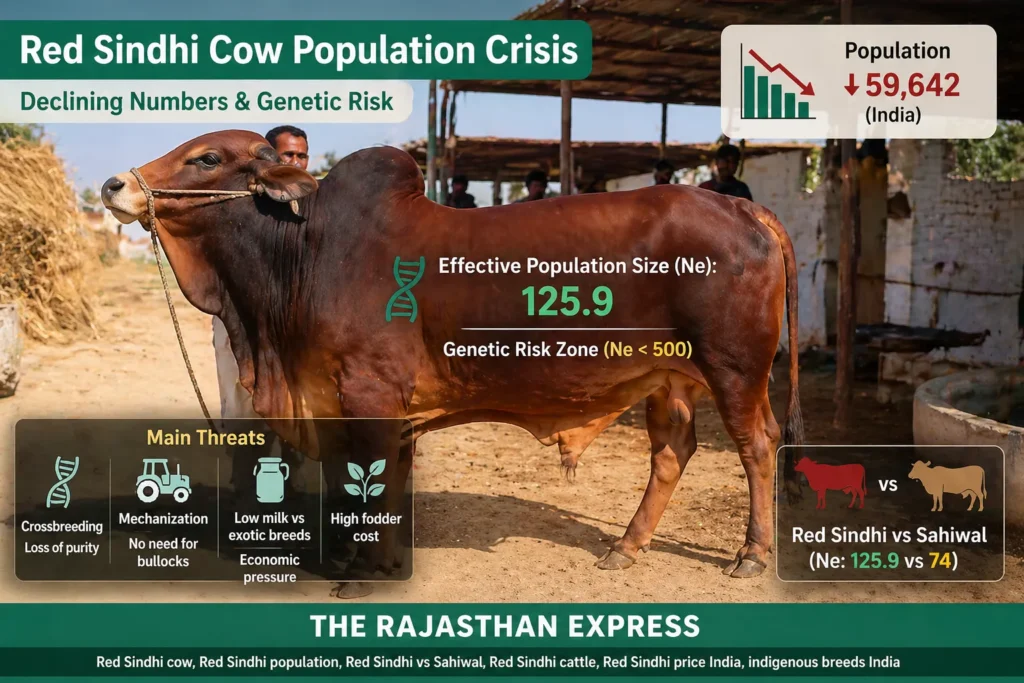
Red Sindhi Cow Population: Current Status, Genetic Risk & Red Sindhi vs Sahiwal Analysis
Red Sindhi Cow Population Crisis (Lal Sindhi Cow)
The Red Sindhi cow, which we also lovingly call ‘Mahi’, once used to be the most reliable milch breed of the hot and dry regions of South Asia. But today this breed is going through a serious crisis. Both government data and scientific studies are warning that if attention is not paid now, future generations may be deprived of even seeing this pure breed.
1. According to the 2013 Livestock Census
- Total number of Red Sindhi cows in the country: 59,642 (approximately 60 thousand).
- Where Are Red Sindhi Cows Found?
- These cows are no longer found in open fields or with ordinary farmers, but have become confined mainly to government and organised farms. These farms are located in states like Odisha, Tamil Nadu, Bihar, Kerala, and Assam.
- Source: This data is based on the “Breed-wise Livestock Assessment” conducted by the Department of Animal Husbandry, Dairying and Fisheries, Government of India.
2. Red Sindhi Cow Population in Pakistan & Other Countries
It is also important to know that the true reach of Red Sindhi is not limited to India alone:
- Pakistan (original home): Pakistan has the largest population of the Red Sindhi breed, but the situation is not good. In 2006, there were approximately 30 lakh (3 million) Red Sindhi cows here, which have now reduced considerably. There too, increasing crossbreeding has greatly harmed their numbers.
- Other countries: Due to its heat tolerance, it has also been taken to Brazil, Bangladesh, Sri Lanka, Colombia, and Australia. In these places, it is used mainly for breed improvement and crossbreeding. The Jar Sindh cow is a synthetic/crossbred milch breed developed by crossing Jersey and Red Sindhi breeds.
3. Five major reasons for the declining population
Several interconnected reasons lie behind the continuous decline in the number of Red Sindhi cows:
- Strong competition from foreign breeds: This is the biggest reason. Foreign cows like Holstein‑Friesian or Jersey can give 20‑25 litres of milk per day, while Red Sindhi gives 8‑10 litres. This large difference turned the interest of dairy farmers towards foreign breeds.
- Unscientific crossbreeding: Indiscriminate mixing of pure Red Sindhi cows with crossbreeds was done, due to which the number of the pure breed kept decreasing.
- Changing agriculture: Earlier, Red Sindhi bullocks were used for ploughing and pulling carts. With the arrival of tractors and machines, the need for bullocks ended, causing farmers to stop rearing this breed.
- Economics of low milk production: When faced with rising fodder costs, if milk quantity is low, dairy businessmen avoid rearing this breed.
- Lack of systematic breeding: Rising fodder costs and the absence of proper breeding plans have further increased the difficulties for livestock keepers.
4. The biggest threat: “Effective Population Size (Ne)”
To understand the status of any animal breed, it is not enough to just look at its total number; it is more important to understand how many animals in that population are actually producing the next generation. This actual number is called the effective population size (Ne).
What is effective population size?
Suppose a village has 1000 cows. But only 20 bulls are actually mating (the rest are sterile or have been killed), and only 100 cows are capable of calving (the rest are old or sick). Then the actual genetic strength of the whole herd depends only on those few animals. That is, out of the entire 1000, the effective population size would be only around 120. And this is exactly what is happening with Red Sindhi and Sahiwal!
- Effective population size (Ne) is the number that is actually passing on genes to the next generation.
- Even with a large population, if only a few bulls are used for breeding, Ne can become very low.
- Sahiwal had a pure population of 10.92 lakh in India in 2013, yet its Ne is only 74. This means that despite the population being in lakhs, genetic diversity is very limited.
- Red Sindhi has a pure population of barely around 60 thousand, but its Ne (125.9) is slightly higher than Sahiwal (74). The reason could be that Red Sindhi is still somewhat scattered across different farms, while in Sahiwal there has been excessive use of selected bulls.
When the effective population size becomes low, the biggest threat is inbreeding (breeding between closely related animals). This gradually leads to weaknesses in the breed, such as increased susceptibility to diseases, reduced fertility, and negative impact on production (like milk). According to genetics, if Ne falls below 50, the risk of these problems increases very rapidly, while if it remains below 500, the adaptability of the breed is affected in the long term.
Both breeds are in the genetic risk zone – especially Sahiwal – and controlled breeding and genetic conservation are extremely necessary for them.
| Sahiwal vs Red Sindhi – Comparison of Effective Population Size : The Rajasthan Express | |||
| Breed | Country | Effective Population Size (Ne) | Study Period / Source |
|---|---|---|---|
| Sahiwal | India | 74 | Recent genetic study |
| Sahiwal | Pakistan | 30 | Assessment between 1980‑84 |
| Red Sindhi | India | 125.9 | Decreased from 2387 to 125.9 over past 13 generations (≈50 years) |
| Color Means: 🔴 Very low Ne (≤30) 🟠 Low Ne (31‑74) 🟢 Moderate Ne (≥125) | Effective population size (Ne) below 100 indicates genetic vulnerability. | |||
Learn Lal Sindhi cow identification, Red Sindhi cow milk per day, lactation, characteristics, and daily milk production with complete breed details.
The Rajasthan Express: Your Trusted Source for Animal Care and Veterinary Science.
People Also Ask About Red Sindhi Cow
What is the average milk yield of a Red Sindhi cow per day?
A normal Red Sindhi cow produces about 6 to 7 litres of milk per day under ordinary care. With better management and balanced diet, a high‑yielding Red Sindhi cow can produce 8 to 10 litres per day. The milk has an average fat content of 4.5%, making it thick, nutritious, and rich in A2 quality.
What is the price of a pure Red Sindhi cow in India?
Red Sindhi price in India varies widely based on milk yield, purity, age, pregnancy, and documentation. Estimated prices (2026) are:
- Heifer / young unbred cow: ₹40,000 – ₹70,000
- Ordinary Red Sindhi (6‑7 litres/day): ₹50,000 – ₹80,000
- Good milch (8‑10 litres/day): ₹80,000 – ₹1,50,000
- High‑yielding pure registered (10‑12 litres/day): ₹1,50,000 – ₹2,50,000
- Complete record + high milk capacity: ₹2,50,000 – ₹3,50,000+
Due to extreme rarity, pure certified animals can sometimes reach ₹4 lakh. A mixed breed Red Sindhi cow may be found for around ₹30,000.
What is the difference between Red Sindhi and Sahiwal cows?
Key differences (Red Sindhi vs Sahiwal):
- Colour: Red Sindhi is deep bright red; Sahiwal is reddish‑brown.
- Skin: Red Sindhi has normal skin; Sahiwal has very loose hanging skin (Lola breed).
- Horns: Red Sindhi has sideways backward‑curving horns; Sahiwal has short, stumpy inward‑curving horns.
- Milk yield: Sahiwal gives more total milk (~2325 kg/lactation) than Red Sindhi (~1840 kg/lactation).
- Dewlap: Sahiwal has a much larger, well‑developed dewlap and navel flap.
Red Sindhi and Sahiwal muzzle difference: Both have dark muzzles, but Red Sindhi has a more refined face while Sahiwal has loose skin folds on the forehead.
What is the origin of Red Sindhi cow?
Red Sindhi cow origin is the Sindh province of Pakistan (around Karachi and Hyderabad), especially the hilly region called Mahal Kohistan. It is also known as Red Karachi, Malir, Sindhi, and Mahi. The breed developed in hot, dry areas with scarce fodder and water, giving it excellent heat tolerance and disease resistance.
What are the characteristics of Red Sindhi cow?
Red Sindhi cattle characteristics include:
- Colour: Light to deep red, darker and clearer than Sahiwal.
- Horns: Thick at base, go sideways, then turn backward and rise upward (curved).
- Body: Medium, compact, strong legs and back, refined chest.
- Most intelligent breed: Smartest and most trainable cow among indigenous breeds.
- Heat & drought tolerance: Excellent even in extreme conditions.
- Disease resistance: Highest resistance to tick‑borne diseases and FMD.
- Calm temperament: Peaceful, gentle, and sociable – easy to rear.
What is the lactation period of Red Sindhi cow?
Red Sindhi lactation period is typically 270 to 300 days per calving. Average milk yield per lactation is 1,840 kg (≈ 1,786 litres), ranging from 1,100 kg to 2,600 kg. Age at first parturition averages 43.54 months (≈3 years 7 months), and calving interval averages 14.57 months.
What is the population of Red Sindhi cows in India?
According to the 2013 Breed‑wise Livestock Assessment, the total number of pure Red Sindhi cows in India was approximately 59,642 (60 thousand). They are now confined mainly to government and organised farms in Odisha, Tamil Nadu, Bihar, Kerala, and Assam. The breed is in serious decline due to competition from foreign breeds, unscientific crossbreeding, and changing agricultural practices.
In which states is Red Sindhi cow found in India?
Red Sindhi which state? The breed is found mainly in organised farms in:
- Western & Central India: Rajasthan, Punjab, Haryana (border districts)
- Eastern & North‑eastern India: Odisha, Bihar, Jharkhand, Chhattisgarh, West Bengal, Assam (limited, experimental)
- South India: Tamil Nadu, Kerala, Karnataka (organised dairy farming)
Pure Red Sindhi cows are rarely found in open fields or with ordinary farmers.
What is the effective population size (Ne) of Red Sindhi cow?
The effective population size (Ne) of Red Sindhi in India is 125.9, down from 2,387 over the past 13 generations (≈50 years). In comparison, Sahiwal has a Ne of only 74 in India and 30 in Pakistan. A low Ne leads to inbreeding, reduced fertility, increased disease susceptibility, and lower milk production. Both breeds are in the genetic risk zone and require urgent conservation.
What is Red Sindhi Jersey cross cow (Jar Sindh)?
The Red Sindhi Jersey cross cow – also called Jar Sindh or Jersindh – is a synthetic/crossbred milch breed developed by crossing Jersey and Red Sindhi. It combines Jersey’s high milk yield with Red Sindhi’s heat tolerance and disease resistance. This cross is popular in organised dairy farms, especially in tropical regions.
Is Red Sindhi a desi cow?
Yes, Red Sindhi is a pure indigenous (desi) Zebu breed, registered with NBAGR (National Bureau of Animal Genetic Resources). It is one of the prominent milch breeds of the Indian subcontinent, along with Sahiwal, Gir, and Tharparkar.
What are the other names of Red Sindhi cow?
Red Sindhi cow is also known as:
- Red Karachi – named after Karachi city where it was historically found
- Malir – after the Malir region near Karachi
- Sindhi – indicating its origin from Sindh province
- Mahi – derived from Mahal Kohistan (its hilly origin) or meaning ‘beloved’
- Lal Sindhi cow – Hindi name for Red Sindhi
What is the fat percentage in Red Sindhi cow milk?
Red Sindhi cow milk contains on average 4.5% fat (range 4.0% to 5.2%). This high fat percentage makes the milk thick, creamy, and highly nutritious – ideal for making ghee, butter, yoghurt, and paneer. It is comparable to Sahiwal (4.5‑5%) and much higher than foreign breeds like Holstein (3.5‑3.8%).
What is the price of Red Sindhi cow in Odisha or government farms?
Prices are lower when buying directly from government organised farms in Odisha, Tamil Nadu, Bihar, Kerala, and Assam. A good milch Red Sindhi (8‑10 litres/day) may cost ₹80,000 – ₹1,50,000 from a government farm, whereas the same cow in distant states (Punjab, Haryana, Rajasthan, UP) may cost 25‑50% more due to transport and middleman commission.
Why is Red Sindhi considered the most intelligent cow breed?
Among all indigenous cows, Red Sindhi is considered the smartest and most trainable. It learns quickly on the farm – for example, understanding milking routines, feeding times, and even responding to its name. This intelligence, combined with its calm temperament, makes it easy for small farmers and even women to rear without fear.
What is the scientific name of Red Sindhi cow?
The Red Sindhi scientific name is Bos indicus (Zebu cattle). It is a humped breed originating from the Indian subcontinent, known for its heat tolerance, disease resistance, and high milk fat percentage.
Where can I find Red Sindhi cow images?
Red Sindhi cow images are available on official websites of NBAGR (Karnal), ICAR, and government livestock portals. You can also find verified images from government farms in Odisha, Tamil Nadu, Bihar, Kerala, and Assam.
What is the age at first calving and calving interval of Red Sindhi cow?
Age at first parturition: Average 43.54 months (approx 3 years 7 months), ranging from 31.97 to 51.32 months.
Calving interval (parturition interval): Average 14.57 months (about 14.5 months), ranging from 12.5 to 18.09 months. This means the Red Sindhi cow gives one calf every 14‑15 months – a good reproductive level.