 By
ByCow Breeds in India: Complete List of 55 Indigenous Cattle Breeds (NBAGR Registered)
Indian Cow Breeds Name and Classification (NBAGR Registered 55 Breeds)
India is famous worldwide for its colorful and unique breeds of indigenous cows. Whenever we see a cow in fields or on roads, a natural question arises in the mind: after all, how many breeds of cows are there in India? Which among these is the highest milk‑giving breed? And if I am keeping a cow in my house, which breed is it and how much milk will it give per lactation (after giving birth)?
The official institution that answers these questions is the National Bureau of Animal Genetic Resources (NBAGR) , headquartered in Karnal (Haryana). Under the Indian Council of Agricultural Research (ICAR), the Breed Registration Committee (BRC) , chaired by the Deputy Director General (DDG) of the Animal Science Division, is the highest recognized authority for the registration of new animal species and breeds in the country. For any breed to be registered, it is necessary that at least 1000 animals of that breed are present in the country.
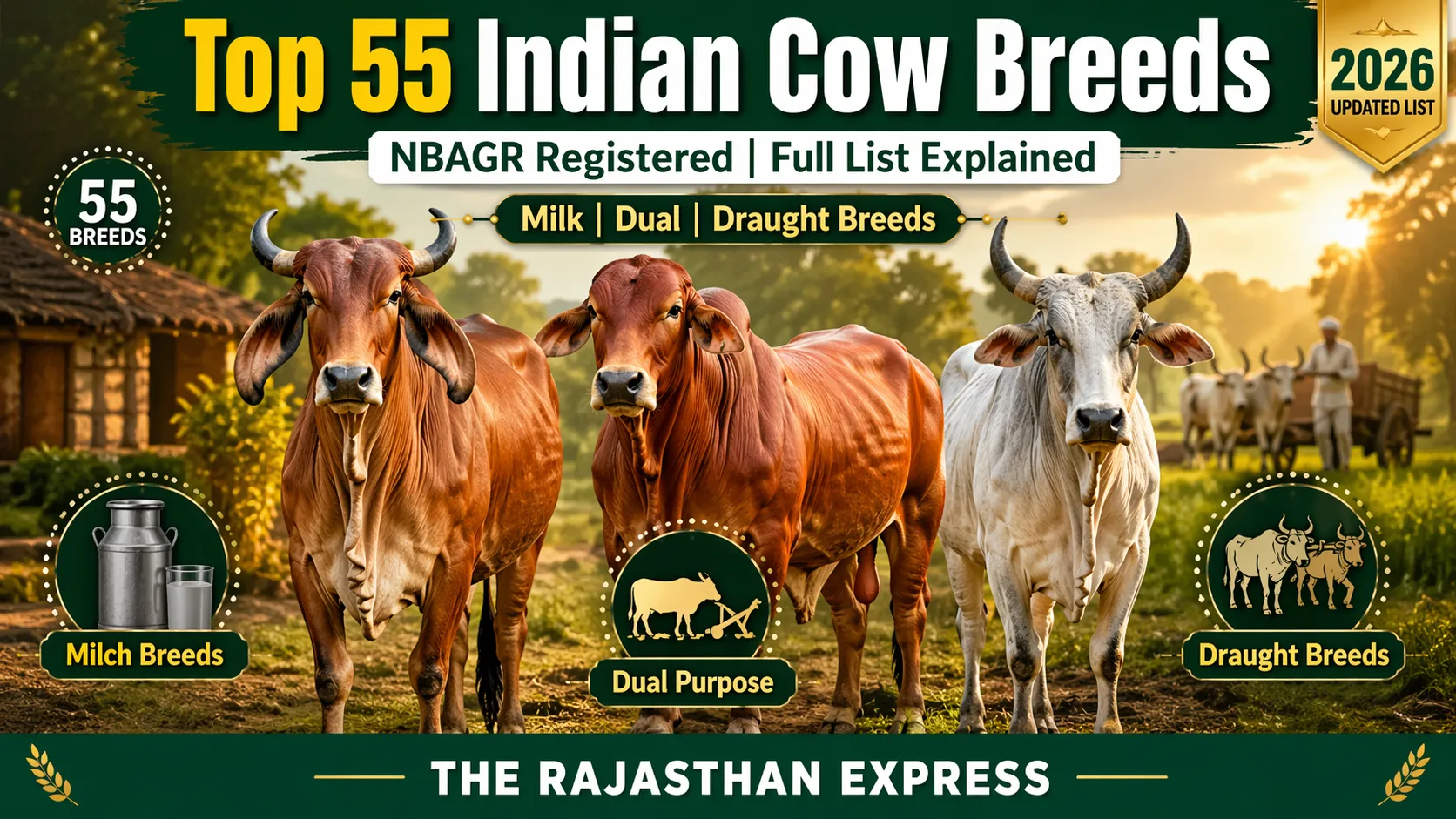
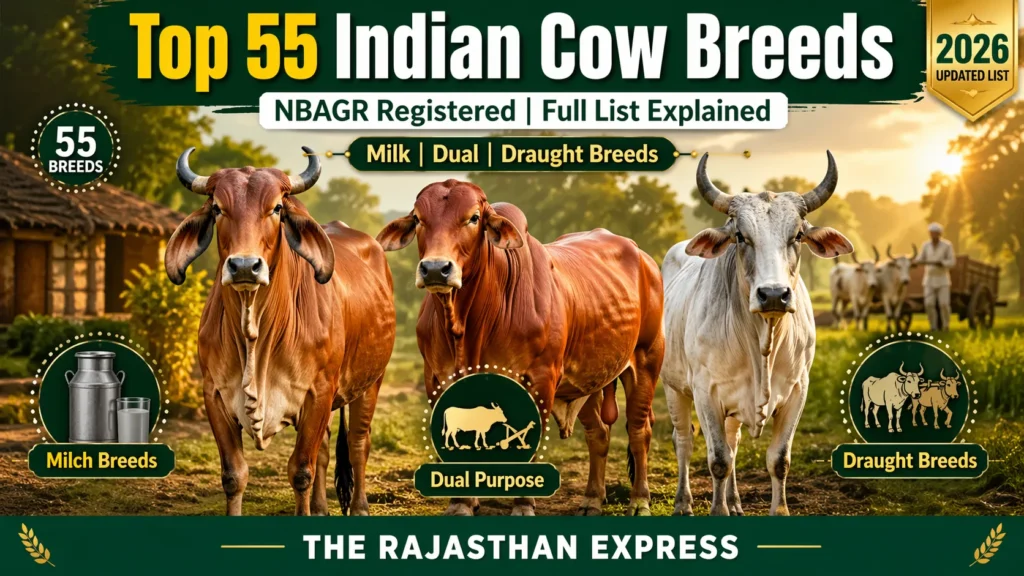
Currently, NBAGR has registered a total of 55 indigenous cow breeds and 3 crossbred (synthetic) cow breeds of India (According To February , 2026) . Among these, the prominent ones include: Gir, Sahiwal, Red Sindhi, Tharparkar, Kankrej, Rathi, Hariana, Ongole, Hallikar, Amritmahal, Vechur, Deoni, Kosali, Gaolao, Kathani, Sanchori, Masilum, Medini, Rohilkhandi, Nagori, Krishna Valley, Malvi, Punganur, Kasaragod, Siri, Kherigarh, Motu, Bachaur, Dhanni, Bargur, Kanniyadu, Umblachery, Pulikulam, Alambadi, Nimari, Gond, Gangatiri, Binjharpuri, Kalahandi, Chippiparai, Malnad Gidda, etc.
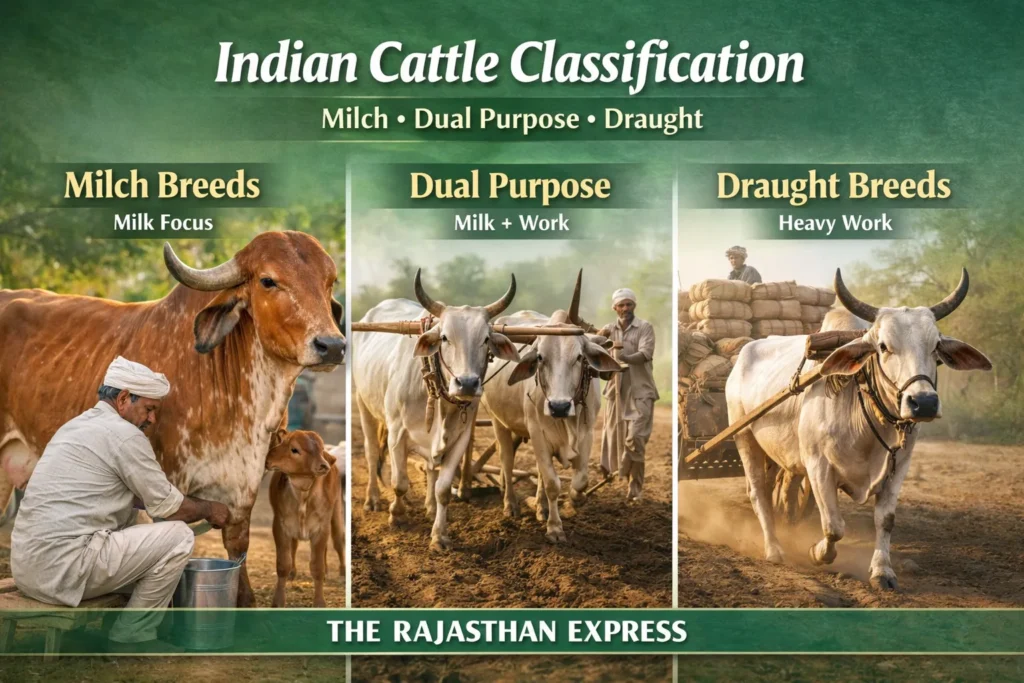
These breeds are divided into three main categories based on their utility:
- Milch breeds: Reared only for milk production. (e.g., Gir, Sahiwal)
- Dual‑purpose breeds: Give milk and are also useful for farming / carrying loads. (e.g., Hariana, Ongole)
- Draught breeds: Reared mainly for pulling heavy loads through bullocks. (e.g., Amritmahal, Hallikar)
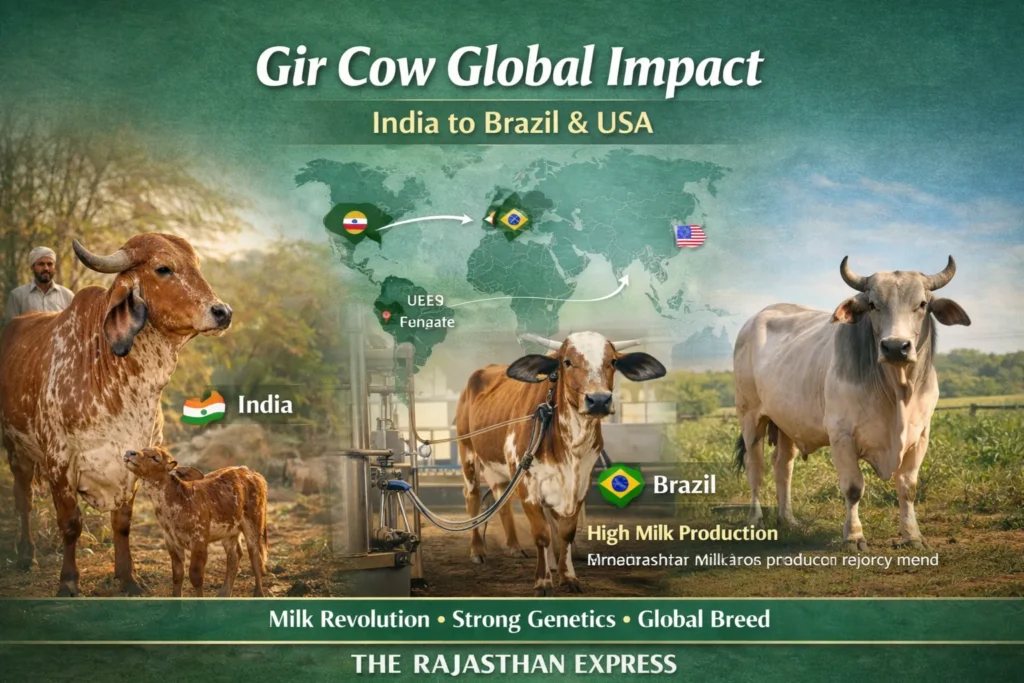
Which is the best breed? It completely depends on your need. If your goal is to obtain high milk and you live in a hot area, then Gir and Sahiwal cows are considered the best. These breeds give more milk on less fodder, are capable of fighting diseases, and their speciality is that they are being successfully reared even in countries like Brazil, America, and Mexico.
It is also interesting to know that India’s first synthetic (mixed) cow is Friswal, which was created by mixing Sahiwal (37.5%) and Holstein Friesian (62.5%), but among pure indigenous breeds, the Gir cow holds a unique and high position.
Globally, cows are classified mainly on two bases: physical structure and utility.
| Indigenous Cattle Breeds of India (NBAGR Registered) | |
| Total Registered Indigenous Breeds | 55 (as of February 2026) – plus 3 synthetic (crossbred) cow breeds |
|---|---|
| Governing Authority | National Bureau of Animal Genetic Resources (NBAGR), Karnal, Haryana (ICAR) |
| Classification by Utility |
|
| Highest Milk Yield (kg/lactation) | Sanchori – 2,769 kg (average) | Sahiwal – 2,325 kg (best dairy breed title) |
| Highest Milk Fat (%) | Sahiwal – 4.9% (max 5.1%); Nimari – 4.9%; Deoni – up to 5.3% |
| Heaviest Indigenous Breed | Kankrej – India’s heaviest cow breed; exhibits “Sawai Chal” (fast special gait) |
| Smallest Breed (World Record) | Vechur (Kerala) – world’s smallest cow breed |
| Longest Lactation Period | Gir – about 325 days (also highest stress tolerance, exported globally) |
| Most Expensive Breed | Ongole – called Nelore in Brazil; a Nelore cow (“Viatina‑19”) sold for ₹40‑41 crore (Guinness World Record, 2025) |
| Highest Disease Resistance | Tharparkar (also changes colour, highest milk in Rajasthan) |
| Best Dual‑Purpose Breed | Hariana – India’s best dual‑purpose breed (milk + bullock work) |
| Synthetic (Crossbred) Breeds | Frieswal, Karan Fries, Vrindavani (NBAGR registered) |
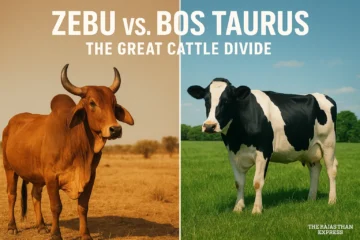
| Zebu vs. Exotic | Indian humped cattle = Bos indicus (Zebu); humpless = Bos taurus (exotic, e.g., Jersey) |
| Source: The Rajasthan Express – Animal Care and Veterinary Science (based on NBAGR data, February 2026) | |
Humped Cattle vs. Humpless Cattle: A Physical Classification
A. Humped Cattle Breeds (Zebu – Bos indicus)
Indigenous breed cows have a fully developed hump and are easily identified by it. This is why they are called Humped Cattle.
Their scientific name is Bos indicus, and they are collectively known as Zebu cattle.
- Zebu cattle have a fully developed dewlap.
- Zebu cattle have fully developed and large horns.
- Despite lower milk production compared to exotic breeds, they have higher disease resistance and are adapted to the Indian climate and fodder.

B. Humpless Cattle Breeds (Exotic – Bos taurus)
These breeds do not have a hump and are mainly native to temperate regions. This is why they are called Humpless Cattle.
Their scientific name is Bos taurus.
- Exotic cattle have a less developed dewlap.
- Exotic cattle have less developed and small horns.
- They are known for high milk production and are often used in cross-breeding with local breeds to combine the traits of higher production and local adaptation. Example: Jersind (Jersey ✕ Red Sindhi).

| Zebu vs. Exotic Cattle: A Detailed Feature Comparison; The Rajasthan Express | ||
| Feature | Bos indicus / Zebu | Bos taurus / Exotic |
|---|---|---|
| Scientific Classification | Bos indicus | Bos taurus |
| Primary Identification | Distinct hump on the back | Hump absent |
| Horns | Fully developed and large | Less developed |
| Dewlap | Fully developed | Less developed |
| Other Names | Humped Cattle | Humpless Cattle |
| Origin & Adaptation | Highly adapted to tropical climates | Adapted to temperate climate |
| Genetic Diversity | Low genetic diversity among Indian breeds | High genetic diversity among breeds (~40%) |
| Milk Production Capacity | Generally low | Selected for high milk yield |
| Disease Resistance | High | Comparatively low |
| Role in Cross-Breeding | Provides local adaptation capacity | Provides high production capacity |
| Zebu vs. Exotic Cattle: A Detailed Feature Comparison; The Rajasthan Express | ||

Classification of Indigenous Cattle Based on Utility
Indian Zebu breeds are divided into three main categories based on their primary utility:
1. Milch Breeds (Milk Breeds)
These breeds are mainly reared for high milk production. They are tolerant to different climatic conditions and produce high-quality milk.
Examples: Gir Cow, Sahiwal Cow, Tharparkar Cow, Rathi Cow, Sanchori Cow, etc.
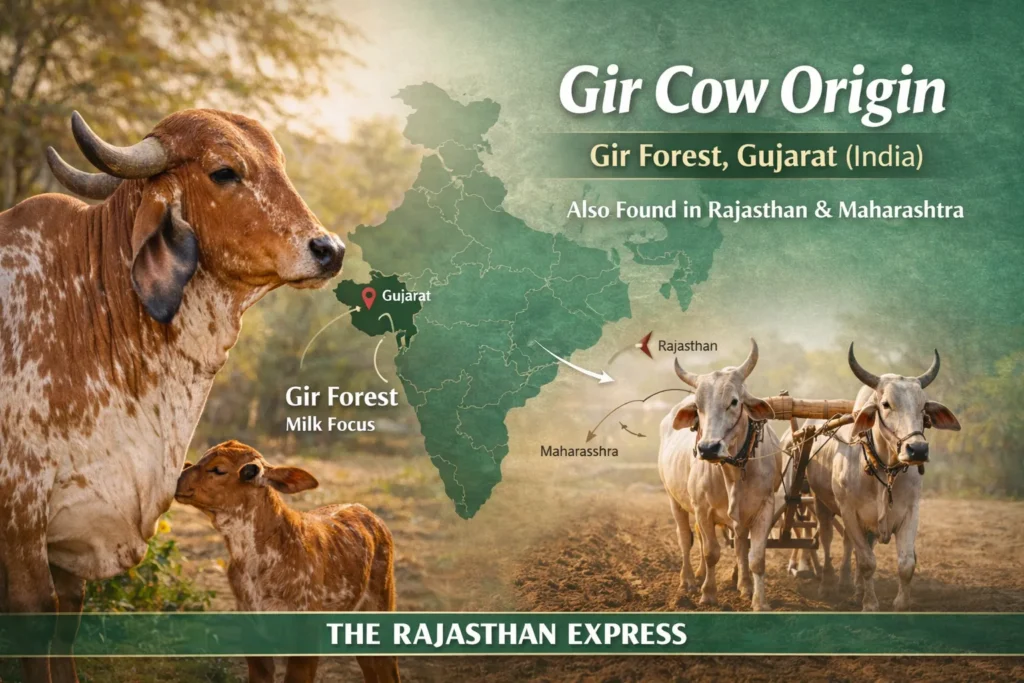
- Gir: Origin is the Gir forest area of Gujarat. They have a reddish‑brown colour and long, drooping ears. Considered best for milk production.
- Sahiwal: This breed originally belongs to the Punjab region of Pakistan (Montgomery district), but it is also widely reared in India. It is a red‑coloured, calm‑temperament breed.
- Red Sindhi: This breed originates from the Sindh province of Pakistan. It is deep red in colour and has the ability to give good milk even in adverse conditions.
- Tharparkar: Originates from the Thar desert of Rajasthan. It is white or light grey and highly tolerant to drought and hot climates.
2. Dual‑Purpose Breeds
These breeds are equally suitable for both milk production and agricultural work (e.g., ploughing, carrying loads).
Examples: Ongole cow, Hariana, Kankrej, Mewati cow, Dangi, Deoni, Nimari, Nari, etc.
- Hariana: Found in Haryana and neighbouring states, this breed is known for its balanced performance in both tasks.
- Kankrej: This breed from Gujarat and Rajasthan is known for its large size and powerful build. Its special gait is famous as “Sawaichal”.
- Ongole: Originating in the Prakasam district of Andhra Pradesh, this breed is extremely powerful. Interestingly, Brazil imported this breed and crossbred it to develop a new breed called Nellore, which is very popular in Brazil today.
- Deoni: This breed developed in the Latur district of Maharashtra from crossing Gir, Dangi, and local breeds. It is a strong and reliable dual‑purpose breed.

3. Draught Indigenous Breeds
These breeds are mainly developed for carrying loads and agricultural work. Their muscles are extremely strong, and they are capable of performing hard physical labour.
Examples: Amritmahal, Nagori, Khillari, Hallikar, Malvi, Vechur, Bachaur, Panwar, Siri, Kangayam, Badri, Pullikulam, Punganur, etc.
- Amritmahal: This breed from Karnataka is considered one of India’s best draught breeds. It was developed by the rulers of Mysore for the “Milk Department” (Amritmahal) to provide strong bullocks for the army.
- Nagori: This breed from Rajasthan is famous for its extraordinary speed and stamina.
- Khillari: This is a major draught breed from Maharashtra, known for its strength and toughness.
- Vechur: This is a dwarf breed from Kerala, which, despite its small size, has good draught capacity. Its milk is also considered highly nutritious.
Cattle Classification and Scientific Information (Cattle Bio-Data)
- Scientific Name:
- Indigenous cow (with hump): Bos Indicus
- Foreign cow (without hump): Bos Taurus
- Family – Bovidae
- Kingdom – Animalia
- Phylum – Chordata (animals with backbone)
- Class – Mammalia (mammals)
- Order – Artiodactyla (even‑toed ungulates)
- Genus – Bos
- Species – Indicus (for Indian breeds)
- Use – Milk production, ploughing fields, carrying loads, dual‑purpose (milk + farming), and dung (manure)
- Ruminant (cud‑chewing animal): Cow chews cud (after eating grass, it brings it back and chews)
- It is called a “Large Ruminant”
- Dressing Percentage – Approximately 55% (meaning: after slaughter, only 55% of the total body remains usable)
- Average lifespan – 20 years
- Puberty – 18 to 24 months (1.5 to 2 years)
- Gestation period – Approximately 283 to 290 days (about 9 to 9.5 months)
- Age at first calving – 3 to 3.5 years
- Offspring at one time – Normally 1 calf (twins are very rare)
Total Registered Cattle Breeds in India (2026 Update)
As of February 2026, a total of 242 indigenous livestock and poultry breeds have been registered in the country. In addition, 3 crossbred (synthetic) cow breeds and 1 crossbred sheep breed have also been registered.
In India, as of February 2026, a total of 55 indigenous cow breeds and 3 Synthetic Cattle Breeds are registered. Among them, the prominent breeds are: Gir cow, Sahiwal, Red Sindhi, Tharparkar, Ongole, Kankrej, Rathi, Sanchori, Deoni, Devni, Vechur, Bachaur, Punganur, Nagori, Amritmahal, Khillari, Kangayam, Hariana.
| Registered Indigenous Livestock Breeds in India (Total 242) | ||
| S.N. | Animal Species | Number of Registered Breeds |
|---|---|---|
| 1 | Cow | 55 |
| 2 | Buffalo | 22 |
| 3 | Goat | 43 |
| 4 | Sheep | 46 |
| 5 | Horse & Pony | 8 |
| 6 | Camel | 9 |
| 7 | Pig | 15 |
| 8 | Donkey | 4 |
| 9 | Dog | 5 |
| 10 | Yak | 2 |
| 11 | Chicken | 21 |
| 12 | Duck | 9 |
| 13 | Goose | 2 |
| 14 | Mithun | 1 |
| Total (Indigenous Breeds) | 242 | |
| The Rajasthan Express : Indigenous Livestock Breeds in India | ||
| Indigenous Cattle Breeds of India (Complete List) | |||
| S.N. | Breed | Home Tract | Accession Number |
|---|---|---|---|
| 1 | Amritmahal | Karnataka | INDIA_CATTLE_0800_AMRITMAHAL_03001 |
| 2 | Bachaur | Bihar | INDIA_CATTLE_0300_BACHAUR_03002 |
| 3 | Bargur | Tamil Nadu | INDIA_CATTLE_1800_BARGUR_03003 |
| 4 | Dangi | Maharashtra and Gujarat | INDIA_CATTLE_1104_DANGI_03004 |
| 5 | Deoni | Maharashtra and Karnataka | INDIA_CATTLE_1108_DEONI_03005 |
| 6 | Gaolao | Maharashtra and Madhya Pradesh | INDIA_CATTLE_1110_GAOLAO_03006 |
| 7 | Gir | Gujarat | INDIA_CATTLE_0400_GIR_03007 |
| 8 | Hallikar | Karnataka | INDIA_CATTLE_0800_HALLIKAR_03008 |
| 9 | Hariana | Haryana, UP, Rajasthan | INDIA_CATTLE_0520_HARIANA_03009 |
| 10 | Kangayam | Tamil Nadu | INDIA_CATTLE_1800_KANGAYAM_03010 |
| 11 | Kankrej | Gujarat and Rajasthan | INDIA_CATTLE_0417_KANKREJ_03011 |
| 12 | Kenkatha | UP and Madhya Pradesh | INDIA_CATTLE_2010_KENKATHA_03012 |
| 13 | Kherigarh | Uttar Pradesh | INDIA_CATTLE_2000_KHERIGARH_03013 |
| 14 | Khillar | Maharashtra and Karnataka | INDIA_CATTLE_1108_KHILLAR_03014 |
| 15 | Krishna Valley | Karnataka | INDIA_CATTLE_0800_KRISHNAVALLEY_03015 |
| 16 | Malvi | Madhya Pradesh | INDIA_CATTLE_1000_MALVI_03016 |
| 17 | Mewati | Rajasthan, Haryana, UP | INDIA_CATTLE_1705_MEWATI_03017 |
| 18 | Nagori | Rajasthan | INDIA_CATTLE_1700_NAGORI_03018 |
| 19 | Nimari | Madhya Pradesh | INDIA_CATTLE_1000_NIMARI_03019 |
| 20 | Ongole | Andhra Pradesh | INDIA_CATTLE_0100_ONGOLE_03020 |
| 21 | Ponwar | Uttar Pradesh | INDIA_CATTLE_2000_PONWAR_03021 |
| 22 | Punganur | Andhra Pradesh | INDIA_CATTLE_0100_PUNGANUR_03022 |
| 23 | Rathi | Rajasthan | INDIA_CATTLE_1700_RATHI_03023 |
| 24 | Red Kandhari | Maharashtra | INDIA_CATTLE_1100_REDKANDHARI_03024 |
| 25 | Red Sindhi | Organized farms only | INDIA_CATTLE_0000_REDSINDHI_03025 |
| 26 | Sahiwal | Punjab and Rajasthan | INDIA_CATTLE_1617_SAHIWAL_03026 |
| 27 | Siri | Sikkim and West Bengal | INDIA_CATTLE_2221_SIRI_03027 |
| 28 | Tharparkar | Rajasthan | INDIA_CATTLE_1700_THARPARKAR_03028 |
| 29 | Umblachery | Tamil Nadu | INDIA_CATTLE_1800_UMBLACHERY_03029 |
| 30 | Vechur | Kerala | INDIA_CATTLE_0900_VECHUR_03030 |
| 31 | Motu | Odisha, Chhattisgarh, Andhra Pradesh | INDIA_CATTLE_1526_MOTU_03031 |
| 32 | Ghumusari | Odisha | INDIA_CATTLE_1500_GHUMUSARI_03032 |
| 33 | Binjharpuri | Odisha | INDIA_CATTLE_1500_BINJHARPURI_03033 |
| 34 | Khariar | Odisha | INDIA_CATTLE_1500_KHARIAR_03034 |
| 35 | Pulikulam | Tamil Nadu | INDIA_CATTLE_1800_PULIKULAM_03035 |
| 36 | Kosali | Chhattisgarh | INDIA_CATTLE_2600_KOSALI_03036 |
| 37 | Malnad Gidda | Karnataka | INDIA_CATTLE_0800_MALNADGIDDA_03037 |
| 38 | Belahi | Haryana and Chandigarh | INDIA_CATTLE_0532_BELAHI_03038 |
| 39 | Gangatiri | Uttar Pradesh and Bihar | INDIA_CATTLE_2003_GANGATIRI_03039 |
| 40 | Badri | Uttarakhand | INDIA_CATTLE_2400_BADRI_03040 |
| 41 | Lakhimi | Assam | INDIA_CATTLE_0200_LAKHIMI_03041 |
| 42 | Ladakhi | Jammu and Kashmir | INDIA_CATTLE_0700_LADAKHI_03042 |
| 43 | Konkan Kapila | Maharashtra and Goa | INDIA_CATTLE_1135_KONKANKAPILA_03043 |
| 44 | Poda Thurpu | Telangana | INDIA_CATTLE_3600_PODATHURPU_03044 |
| 45 | Nari | Rajasthan and Gujarat | INDIA_CATTLE_1704_NARI_03045 |
| 46 | Dagri | Gujarat | INDIA_CATTLE_0400_DAGRI_03046 |
| 47 | Thutho | Nagaland | INDIA_CATTLE_1400_THUTHO_03047 |
| 48 | Shweta Kapila | Goa | INDIA_CATTLE_3500_SHWETAKAPILA_03048 |
| 49 | Himachali Pahari | Himachal Pradesh | INDIA_CATTLE_0600_HIMACHALIPAHARI_03049 |
| 50 | Purnea | Bihar | INDIA_CATTLE_0300_PURNEA_03050 |
| 51 | Kathani | Maharashtra | INDIA_CATTLE_1100_KATHANI_03051 |
| 52 | Sanchori | Rajasthan | INDIA_CATTLE_1700_SANCHORI_03052 |
| 53 | Masilum | Meghalaya | INDIA_CATTLE_1300_MASILUM_03053 |
| 54 | Medini | Jharkhand | INDIA_CATTLE_2500_MEDINI_03054 |
| 55 | Rohilkhandi | Uttar Pradesh | INDIA_CATTLE_2000_ROHILKHANDI_03055 |
| The Rajasthan Express : Indigenous Cattle Breeds | |||
| Synthetic Cattle Breeds of India | |||
| S.N. | Breed | Home Tract | Accession Number |
|---|---|---|---|
| 1 | Frieswal | Uttar Pradesh & Uttarakhand | INDIA_CATTLESYNTHETIC_2024_FRIESWAL_04001 |
| 2 | Karan Fries | Haryana | INDIA_CATTLESYNTHETIC_0500_KARANFRIES_04002 |
| 3 | Vrindavani | Uttar Pradesh | INDIA_CATTLESYNTHETIC_2000_VRINDAVANI_04003 |
| The Rajasthan Express : Synthetic Cattle Breeds | |||
Top 10 Cow Breeds in Rajasthan: Indigenous Cow Breeds and Their Characteristics
Indigenous Cow Breeds Found in Rajasthan (Cow Breeds Indian)
| Indigenous Cattle Breeds of India | |||
| S.No. | Breed Name | Origin / Home Tract | Main Characteristics (Origin & Main Points) |
|---|---|---|---|
| 1 | Hariana | Haryana, Western Uttar Pradesh, Rajasthan (Alwar, Bharatpur region) | Origin: This is a famous dual‑purpose (milk and bullock) breed originating from the Rohtak, Hisar area of Haryana. The Hariana cow is India’s best dual‑purpose breed. Main points: Hariana cow’s colour is white or light grey, face narrow, horns short and pointed. Bullocks are very agile and working, especially in light loamy soil. Milk production average 600‑1000 litres per lactation. |
| 2 | Kankrej | Gujarat (northern), Rajasthan (Barmer, Jalore, Sirohi) | Origin: The Kankrej cow originated from the Kankrej taluka of Gujarat. It is counted among India’s best draught (load‑carrying) breeds. Main points: Colour silvery grey to steel black. Its large, half‑moon, sword‑like curved horns (lyre horns) are its identification. India’s heaviest cow breed is Kankrej. The Kankrej breed exhibits a “Sawai Chal” (fast and special gait). Bullocks are very powerful and suitable for pulling carts in sandy areas. Cow’s milk production approx 1700 litres/lactation. |
| 3 | Mewati | Rajasthan (Alwar, Bharatpur), Haryana (Mewat), Western Uttar Pradesh | Origin: Mewat region (developed by the Meo community of Alwar and Bharatpur). Also called ‘Kosi’ breed after the Kosi river. Main points: Colour mainly white, sometimes grey spots. Face long and ears hanging. It is a good milch and draught breed. Milk production approx 900‑1200 litres/lactation. |
| 4 | Nagori | Rajasthan (Nagaur, Jodhpur, Bikaner) | Origin: Originated from Nagaur district of Rajasthan, hence called ‘Nagori’. Nagori breed is a draught breed mainly used for agricultural work and carrying loads. Main points: Colour white, brown eyelids above the eyes, long neck and sturdy body. It is world‑famous for its fast gait and chariot‑pulling ability. It is mainly reared for bullocks (load carrying), milk is low. Rajasthan’s best load‑carrying breed is Nagori. |
| 5 | Rathi | Rajasthan (Bikaner, Ganganagar, Hanumangarh) | Origin: Reared by the Rath Rajputs of Bikaner. Created by mixing Red Sindhi, Sahiwal, Tharparkar and Dhani breeds. The Rathi cow is also called Rajasthan’s Kamadhenu. Rathi breed is a milch breed, reared mainly for milk production. Main points: Colour brown, red‑brown or white spotted. It is the main milch breed of Rajasthan. It performs excellently in desert climate. Milk production average 1500‑2500 litres/lactation. |
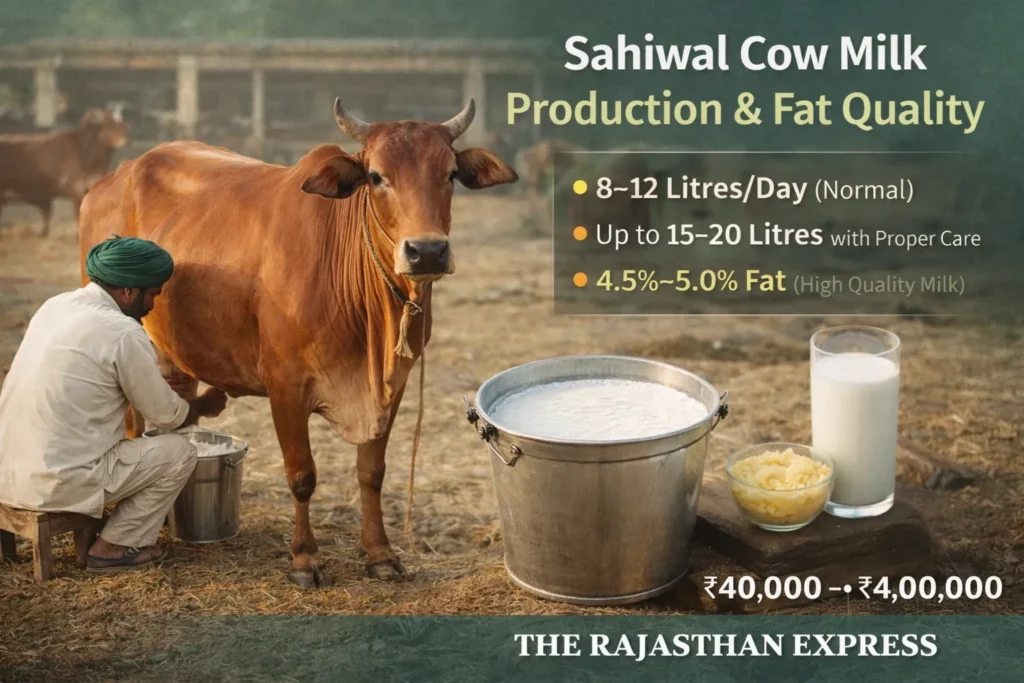
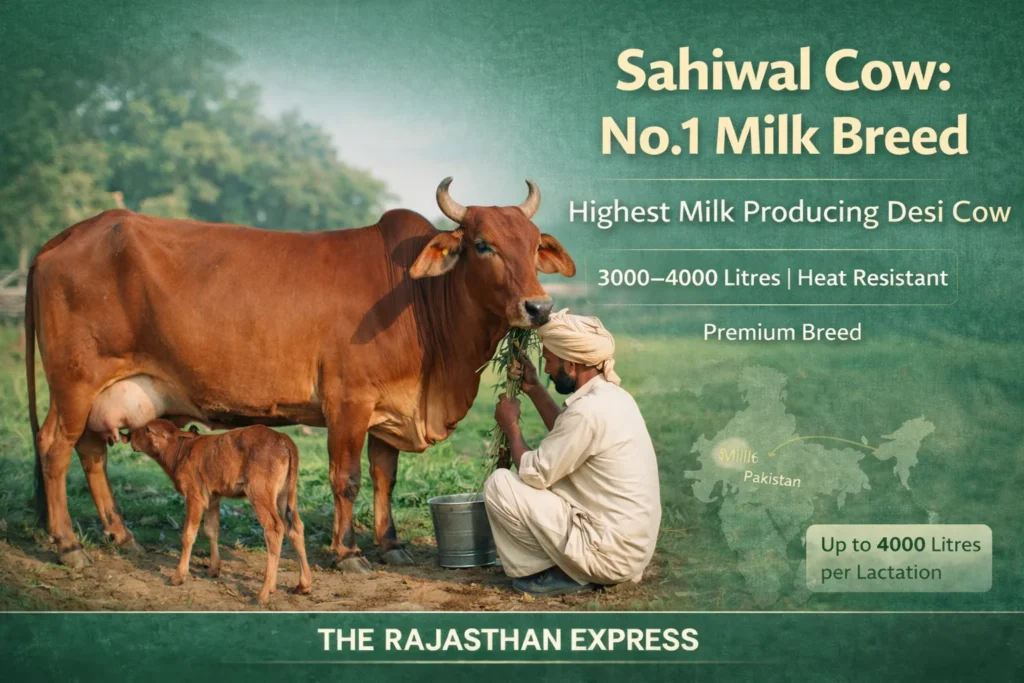
| 6 | Sahiwal | Punjab (originally Montgomery, now Pakistan), Rajasthan (Ganganagar) | Origin: Sahiwal cow originated from Sahiwal district of Montgomery (Pakistan) in Punjab province. In India, it is found in Firozpur, Amritsar and Sri Ganganagar. Sahiwal cow is also called Lola breed, Multani, Montgomery, Lambi Bar. Because of its loose skin, it is called Lola breed. Main points: Colour red‑brown, loose skin, heavy body. It is one of India’s best indigenous milch breeds. India’s highest milk‑giving indigenous cow is Sahiwal. A Sahiwal cow gives on average 2325 kg of milk per lactation (approx 1600‑2750 litres). Compared to all indigenous cows, the fat percentage in Sahiwal milk is the highest – about 4.5% to 5.0%. |
| 7 | Tharparkar | Rajasthan (Barmer, Jaisalmer, Jodhpur), Pakistan border area | Origin: Originated from Tharparkar district (Sindh, now Pakistan). In Rajasthan, it is known as ‘Malani’. Main points: Colour white or light grey, humped at shoulder. It is a milch breed – reared mainly for milk production. Milk production 1800‑2600 litres/lactation. Excellent ability to survive in drought and famine conditions. |
| 8 | Nari | Rajasthan (Dungarpur, Banswara), Gujarat (Sabarkantha) | Origin: Originated from the Aravalli hills on the Rajasthan‑Gujarat border. Popular in tribal areas. Main points: Colour white or light grey, horns long and protruding outward. |
| 9 | Sanchori | Rajasthan (Jalore, Sirohi) | Origin: Originated from Sanchor tehsil area of Rajasthan. It is considered a local type of the Kankrej breed. But Sanchori is a milch breed reared mainly for milk production, whereas Kankrej is a dual‑purpose breed reared for milk production and agricultural work. Main points: Slightly smaller than Kankrej in size. Colour grey or reddish grey. |
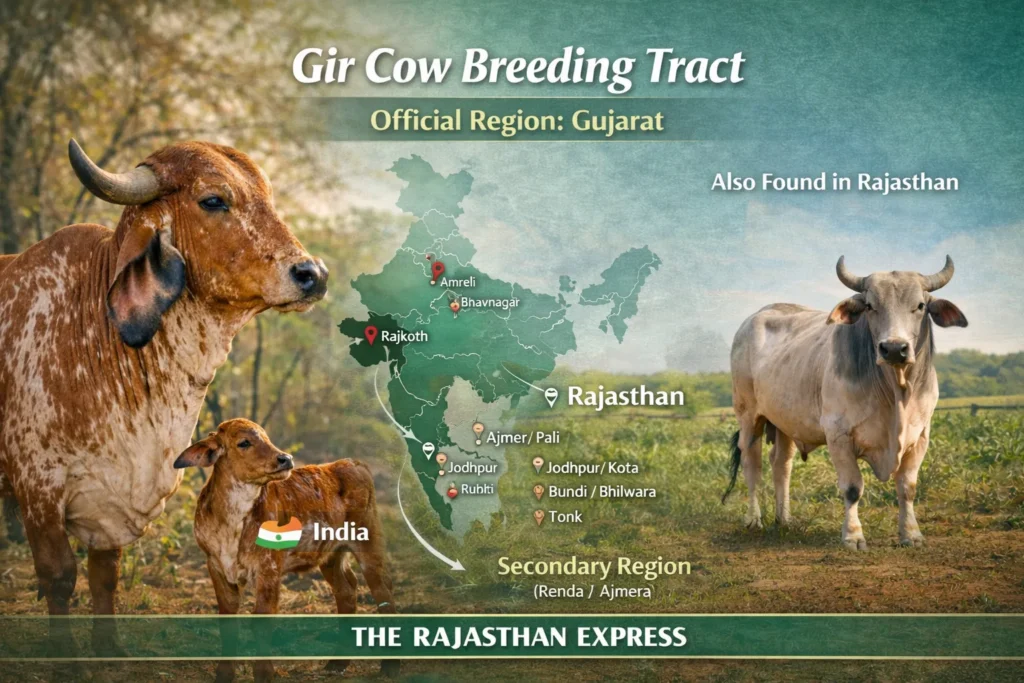
| 10 | Gir | Originated from the Gir forests of Kathiawar, Gujarat. In Rajasthan, it is found especially in south‑eastern areas such as Ajmer, Chittorgarh, Bundi, Kota, Bhilwara and Tonk districts, where it is locally called ‘Renda’. | Origin: Gir cow is one of India’s most famous and registered indigenous breeds. It originated in the Kathiawar region of Gujarat and the Gir forests, which is why it is named ‘Gir’. People also call it Kathiyawadi, Surti or in Rajasthan Ajmera Renda. Main points: Gir cow is primarily reared for milk, hence called a ‘milch breed’. It can give on average 2100 to 2500 litres per lactation, but with good care it gives even more. The biggest speciality of the Gir breed is that among all Indian indigenous cows, it has the longest lactation period. Identification of Gir cow: red, brown or spotted skin, prominence on forehead, long hanging leaf‑shaped ears, half‑moon shaped horns. Among indigenous cows, the longest lactation period is of the Gir cow (about 325 days). |
| Indigenous Cattle Breeds – Origin & Main Characteristics | |||
Top 10 Highest Milk Producing Cow Breed in India (Top 10 Cow Breeds In India)
India’s cows are famous worldwide for their diverse varieties and ability to give milk in all kinds of weather. Some breeds are particularly good in terms of milk production. The list below includes ten breeds that either give the highest milk, or have the highest fat percentage in milk, or have the unique ability to give excellent milk even with little fodder and water.
1. Sahiwal
- Origin region: Punjab (Firozpur, Amritsar) and Rajasthan (Ganganagar)
- Key performance figures:
- Average milk per lactation: 2,325 kg (maximum 2,750 kg)
- Milk fat: 4.9% (maximum 5.1%)
- Age at first calving: 41.7 months (early maturing)
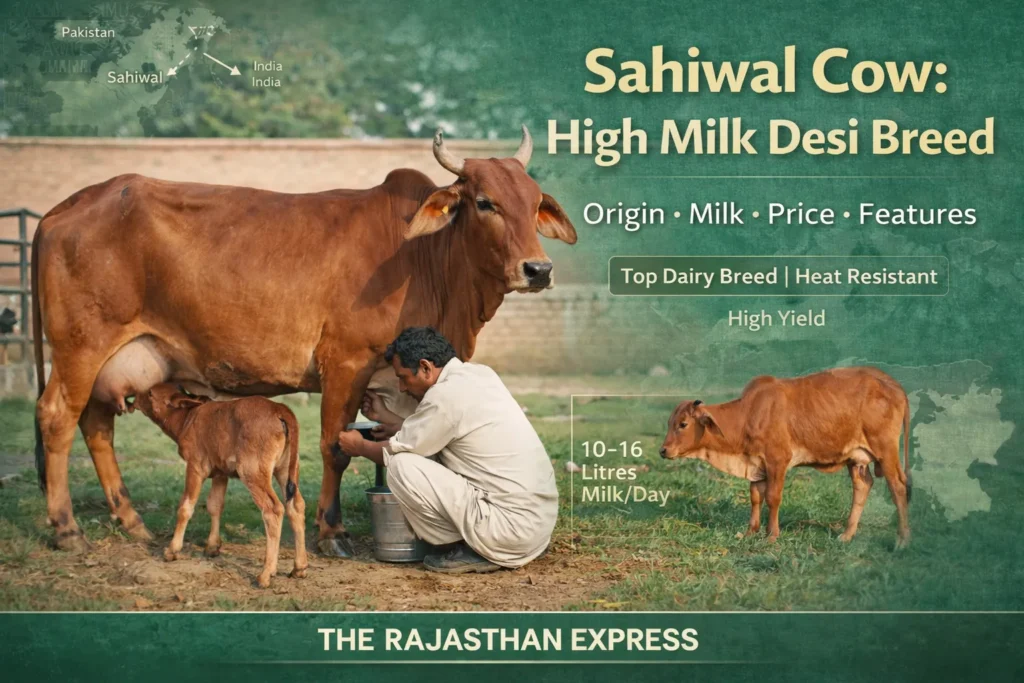
- Special reason: The name of the best indigenous dairy breed.
- According to government data, the combination of Sahiwal’s average milk (2,325 kg) and fat percentage (4.9%) makes it India’s highest milk‑giving indigenous breed. Giving first calf at 41.7 months makes it very profitable to rear.
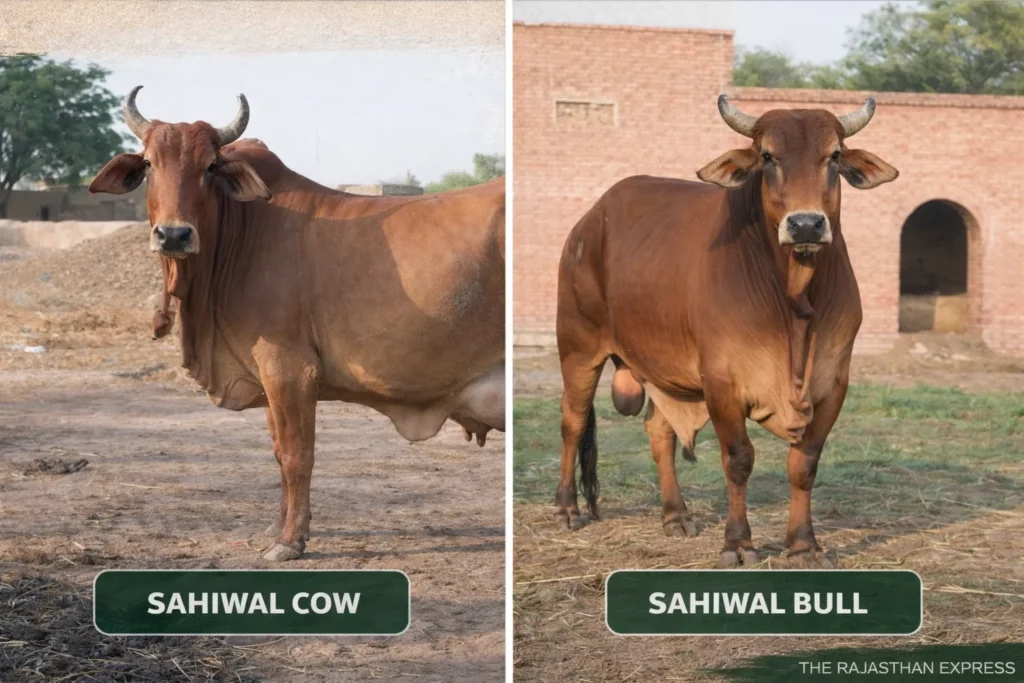
Read More About : Sahiwal Cow Milk Per Day
2. Sanchori 🎖️
- Origin region: Rajasthan (Sanchor area of Jalore)
- Key performance figures:
- Average milk per lactation: 2,769 kg (maximum 3,268 kg)
- Milk fat: 3.94% (maximum 4.5%)
- Age at first calving: 29.3 months (very early maturing)
- Special reason: Astonishing milk quantity and short calving intervals.
- This breed is a hidden gem. Because when it comes to highest milk production, Sahiwal is usually mentioned. Sanchori’s name is not heard elsewhere. Average milk of 2,769 kg and first calving at only 29.3 months makes it the most profitable and fastest payback breed among the Top 10 Highest Milk Breeds. Moreover, its calving interval is only 12.4 months, which is much lower than any other breed.
3. Gir
- Origin region: Gujarat (Saurashtra region and Gir forest)
- Key performance figures:
- Average milk per lactation: 2,110 kg (maximum up to 3,300 kg)
- Milk fat: 4.6% (maximum 5.1%)
- Age at first calving: 46 months
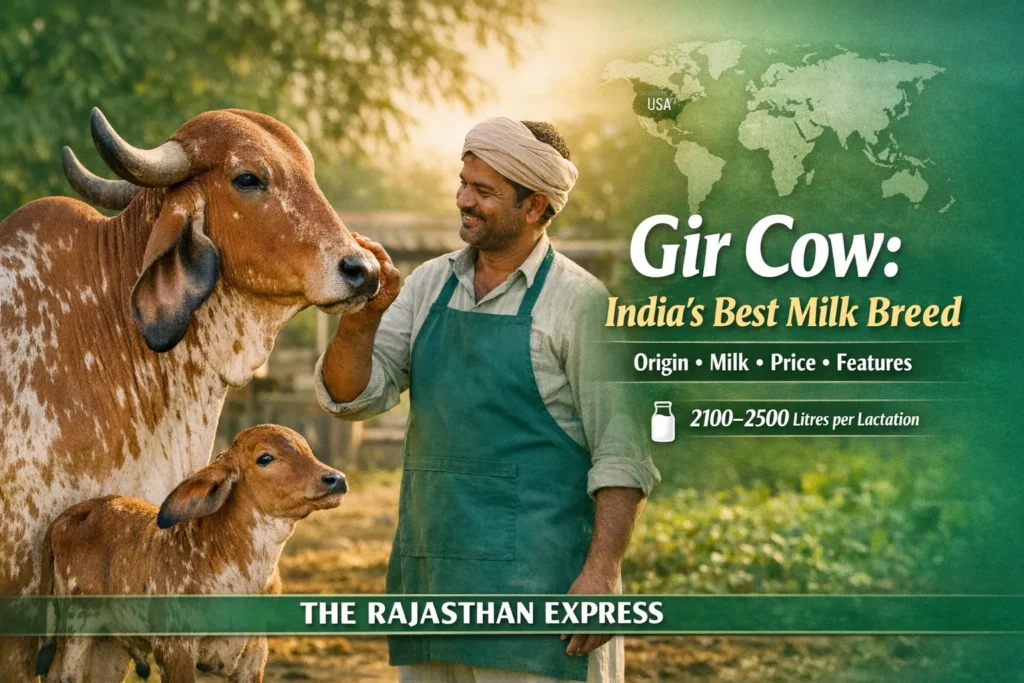
- Special reason: High milk production along with tolerance to harsh conditions.
- The biggest strength of the Gir breed is that it keeps giving milk even in the worst conditions, without much fodder. Among indigenous cows, the longest lactation period is of the Gir cow (about 325 days). This breed is also exported abroad (e.g., Brazil, USA) and is known for giving milk over a long period. Figures show it can give up to 3,300 kg of milk, placing it at the top among indigenous breeds.
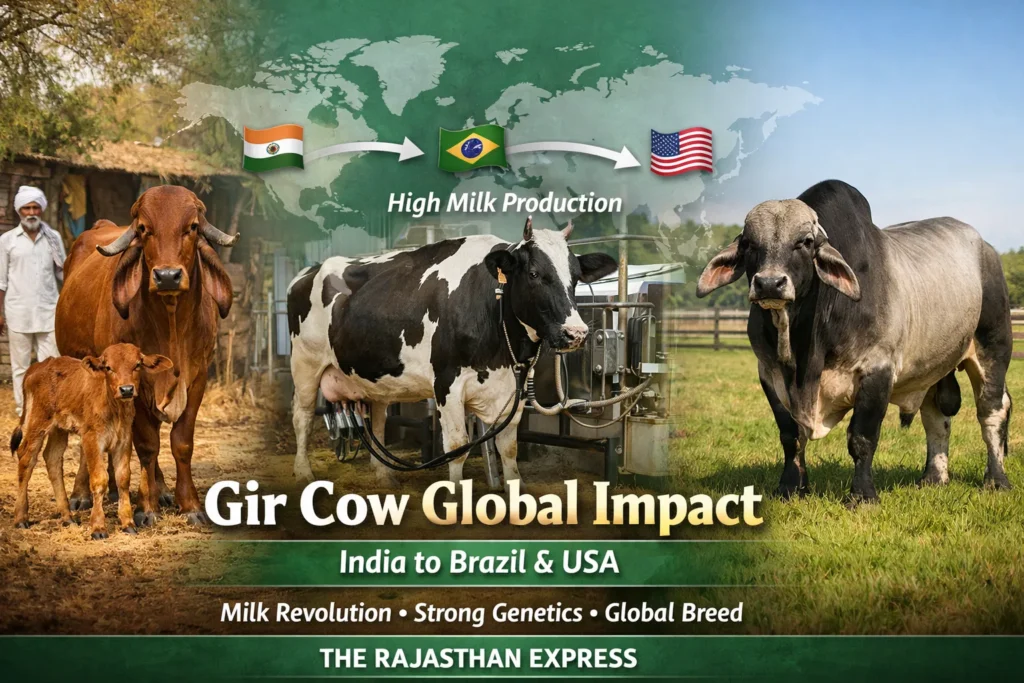
Read More About : Gir Cow Milk Per Day
4. Red Sindhi
- Origin region: Pakistan (original), found in large organised farms in India.
- Key performance figures:
- Average milk per lactation: 1,840 kg (maximum 2,600 kg)
- Milk fat: 4.5% (maximum 5.2%)
- Age at first calving: 43.5 months
- Special reason: The most suitable breed for hot and humid areas.
- Red Sindhi is used worldwide in hot countries to improve their local cattle breeds. Its milk‑giving ability (up to 2,600 kg) and disease resistance make it a precious breed for coastal and humid areas.
5. Tharparkar
- Origin region: Rajasthan (Barmer, Jaisalmer, Jodhpur) and Gujarat (Kutch)
- Key performance figures:
- Average milk per lactation: 1,749 kg (maximum 2,147 kg)
- Milk fat: 4.88% (maximum 4.9%)
- Age at first calving: 41.0 months (early maturing)
- Special reason: Consistent milk fat even in arid areas.
- The milk fat of this breed remains stable (minimum 4.72% to maximum 4.9%). It continues to give milk even in severe famine and drought. The Tharparkar cow also has the ability to change colour. In Rajasthan, the highest milk‑giving cow is Tharparkar. Its age at first calving (41 months) makes it ready for milk production early.
6. Rathi
- Origin region: Rajasthan (Bikaner, Ganganagar, Jaisalmer)
- Key performance figures:
- Average milk per lactation: 1,560 kg (maximum 2,810 kg)
- Milk fat: exact figure not available (but generally between 4.0% to 5.3%)
- Age at first calving: 46.4 months
- Special reason: The Rathi cow was created by mixing Red Sindhi, Sahiwal, Tharparkar and Dhani breeds. It is called Rajasthan’s Kamadhenu. That is, it is the progeny of breeds like Red Sindhi, Sahiwal and Tharparkar.
- The biggest speciality of the Rathi breed is its very high milk‑giving capacity. Where its average is 1,560 kg, the highest recorded milk yield is 2,810 kg. This proves that in a place like the Thar desert, where fodder and water are scarce, this breed fully displays its genetic excellence.
7. Hariana
- Origin region: Haryana (Hisar, Rohtak, Sonipat)
- Key performance figures:
- Average milk per lactation: 997 kg (maximum 1,745 kg)
- Milk fat: 4.5% (maximum 5.3%)
- Age at first calving: 51.3 months
- Special reason: High milk fat and useful for two purposes (milk and farming).
- Hariana is often reared for its bullocks, but the milk of its cows, especially the fat percentage (up to 5.3%), is highly commendable. It is an excellent balanced breed for the plains of North India. Figures show that well‑cared cows can give up to 1,745 kg of milk.
8. Deoni
- Origin region: Maharashtra (Latur, Nanded) and Karnataka (Bidar)
- Key performance figures:
- Average milk per lactation: 868 kg (maximum 1,229 kg)
- Milk fat: 4.3% (maximum 5.3%)
- Age at first calving: 45.7 months
- Special reason: Ability to give the highest fat (5.3%) and strength for heavy work.
- This breed, created from Gir and Dangi, is suitable for farmers who want less but very thick and nutritious A2 milk.
9. Ongole
- Origin region: Andhra Pradesh (Prakasam, Nellore, Guntur)
- Key performance figures:
- Average milk per lactation: 798 kg
- Milk fat: 3.79%
- Age at first calving: 45.5 months
- Calf birth weight: 27 kg (highest in the list, meaning strong calves)
- Special reason: A2 milk quality and global demand.
- Although Ongole’s milk record is lower than others, this breed is recognised worldwide for its A2 beta‑casein protein milk. It is the only breed that America, Brazil and Australia have imported for both meat and milk. Its ability to survive on dry fodder and remain disease‑free makes it very important for future milk production.
10. Nimari
- Origin region: Madhya Pradesh (Kharagone, Barwani)
- Key performance figures:
- Average milk per lactation: 766.9 kg (maximum 954 kg)
- Milk fat: 4.9%
- Age at first calving: 54.1 months
- Special reason: Highest fat milk (almost 5%).
- Although Nimari is mainly used for draught work, its value for milk is due to its high fat content. Milk with 4.9% fat is very valuable for ghee and sweet makers. This breed, created from Gir and Khillar, is capable of giving good quality milk even in difficult areas.
Main Summary
The analysis of government data above clearly shows that not just one or two, but many breeds from different corners of India are excellent in milk production.
- For high quantity milk production: Sanchori and Sahiwal are at the forefront.
- For milk fat and quality: Deoni and Nimari are the best.
- For difficult and adverse conditions: Gir, Rathi and Tharparkar are outstanding.
- For early calving and early milk production: Sanchori (29.3 months) is ahead.
| India’s Top 10 Milch Cow Breeds (Ranked by Milk Production) | ||||||
| Rank | Breed Name | Average Milk per Lactation (kg) | Milk Fat (%) | Age at First Calving (months) | Calving Interval (months) | Special Note |
|---|---|---|---|---|---|---|
| 1 | Sanchori | 2,769 | 3.94% | 29.3 | 12.4 | Highest milk‑giving indigenous breed. Gives calf at youngest age and shortest calving interval. Most economically profitable breed. But according to veterinary literature, the highest milk‑giving indigenous breed is Sahiwal. |
| 2 | Sahiwal [Info] | 2,325 | 4.9% | 41.7 | 15.6 | Title of best dairy breed. Compared to all indigenous cows, Sahiwal milk has the highest fat percentage – about 4.5% to 5.0%. |
| 3 | Gir [Info] | 2,110 | 4.6% | 46.0 | 13.4 | Example of stress tolerance. Popular breed exported worldwide. Among indigenous cows, longest lactation period is of Gir (about 325 days). |
| 4 | Red Sindhi | 1,840 | 4.5% | 43.5 | 14.6 | Excellent for hot and humid areas. Used worldwide for breed improvement. |
| 5 | Tharparkar [Info] | 1,749 | 4.88% | 41.0 | 14.2 | Stable fat milk in desert. Highest disease resistance among indigenous breeds. Highest milk‑giving cow in Rajasthan is Tharparkar. |
| 6 | Rathi | 1,560 | 4% (approx) | 46.4 | 17.1 | High productivity in desert. Record of up to 2,810 kg with limited resources. Rathi cow created from Red Sindhi, Sahiwal, Tharparkar and Dhani. Called Rajasthan’s Kamadhenu. |
| 7 | Hariana [Info] | 997 | 4.5% | 51.3 | 15.9 | Dual‑purpose (milk and work) breed. Good milk fat, famous for bullocks. India’s best dual‑purpose breed is Hariana. |
| 8 | Deoni [Info] | 868 | 4.3% (max 5.3%) | 45.7 | 14.7 | Highest fat potential. Known for thick A2 milk. But among all indigenous breeds, highest fat % is in Sahiwal milk. |
| 9 | Ongole [Info] | 798 | 3.79% | 45.6 | 13.1 | Global fame and A2 milk. Disease resistance and strong calves (birth weight 27 kg) are its features. India’s most expensive cow breed is Ongole. In Brazil, this breed is called Nelore. In early 2025, a Nelore cow named “Viatina‑19” sold for approx ₹40‑41 crore and set a Guinness World Record. It weighed about 1100 kg. |
| 10 | Nimari | 767 | 4.9% | 54.1 | 17.1 | High fat percentage milk. Very valuable for ghee and sweets. |
| Top 10 Highest Milk Producing Cow Breed in India – Comparative Data By The Rajasthan Express | ||||||
Top 5 Best Cow Breeds in India for Dual Purpose (Milk & Draught)
| Top 5 Best Cow Breeds in India for Dual Purpose (Milk & Draught) | ||||||
| Rank | Breed Name | Average Milk per Lactation (kg) | Milk Fat (%) | Age at First Calving (months) | Calving Interval (months) | Special Note |
|---|---|---|---|---|---|---|
| 1 | Kankrej | 1,738 | 2.9 – 4.2 | 47.3 | 15.1 | One of the heaviest and strongest indigenous breeds. Bullocks famous for pulling heavy carts. Also highest milk production among dual‑purpose breeds. India’s heaviest cow breed is Kankrej. Kankrej exhibits “Sawai Chal” (fast special gait). |
| 2 | Hariana | 997 | 4.5% (max 5.3%) | 51.3 | 15.9 | Best balance of milk and work. |
| 3 | Deoni | 868 | 4.3% (max 5.3%) | 45.7 | 14.7 | Famous for thick, high‑fat milk. Bullocks suitable for heavy work. Considered a breed developed from crossing Gir and Dangi. |
| 4 | Ongole | 798 | 3.79% | 45.6 | 13.1 | Globally demanded A2 milk breed. |
| 5 | Nimari | 767 | 4.9% | 54.1 | 17.1 | High fat percentage quality milk. Unique combination of strength and tolerance due to being a mix of Gir and Khillar. |
| India’s Top Dual‑Purpose Breeds – Milk Yield & Work Capacity | ||||||
Milk Purpose Breed vs Dual Purpose Breed
| Breed | Primary Use | Milk Production Capacity | Draught Capacity |
|---|---|---|---|
| Sahiwal | Milk | Highest | Low |
| Gir | Milk | Very High | Low |
| Rathi | Milk | High | Low |
| Tharparkar | Milk | High | Medium |
| Red Sindhi | Milk | High | Low |
| Hariana | Dual‑purpose | Medium | Very High |
| Kankrej | Dual‑purpose | High | Very High |
| Ongole | Dual‑purpose | Medium to High | Very High |
| Nimari | Dual‑purpose | Low to Medium | High |
| Deoni | Dual‑purpose | Low to Medium | High |
| The Rajasthan Express: Your Trusted Source for Animal Care and Veterinary Science. | |||
Key Points About Indigenous Cows in India (Desi Cow Facts)
- India’s best draught (load‑carrying) breed is Amrit Mahal.
- Maharashtra’s best draught breed is Khillari.
- Rajasthan’s best load‑carrying breed is Nagori.
- India’s best dual‑purpose (milk + work) breed is Hariana.
- The world’s smallest cow breed is Vechur.
- India’s heaviest cow breed is Kankrej.
- The Kankrej breed exhibits a “Sawai Chal” (fast and special gait).
- Deoni cow was created by crossing Gir, Dangi, and local cows.
- Nimari cow was created by mixing Gir and Khillari breeds.
- India’s most expensive cow breed is considered to be Ongole. In Brazil, this same breed is called Nelore. At the beginning of the year 2025, a Nelore cow named “Viatina‑19” was sold for approximately ₹40‑41 crore. It also set a Guinness World Record. “Viatina‑19” weighed about 1100 kg, which is much more than a normal cow. The first Ongole cows were taken from India to Brazil in 1868. Later, by 1960, about 7000 cattle were sent there. In Brazil, this breed was named “Nelore”, after the Nellore district of Andhra Pradesh.
- Among indigenous cows, the longest lactation period is of the Gir cow (about 325 days). The Gir cow originated in the Gir forests of Kathiawar, Gujarat. The Gir cow is also called Kathiyawadi, Ajmera, Renda, Surti.
- Among buffaloes, the longest lactation period is of the Mehsana buffalo (about 352 ± 15 days).
- Identification of Gir cow:
- Red, brown, or spotted skin
- Prominence on forehead
- Long, hanging, leaf‑shaped ears
- Half‑moon shaped horns
- India’s highest milk‑producing indigenous cow is Sahiwal.
- In the Sahiwal cow, the dewlap (loose skin of the neck) and Nawelflap are more developed. This is the main identification of the Sahiwal cow. The Sahiwal cow originated in Montgomery (Pakistan), Punjab, Haryana. The Sahiwal cow is also called Lola breed, Multani, Montgomery, Lambi Bar.
- Because the Sahiwal cow’s skin is loose, it is also called the Lola breed.
- The most intelligent cow breed is considered to be Red Sindhi. The Red Sindhi cow originated in Karachi, Hyderabad (Sindh), Pakistan. The Red Sindhi cow is also called Red Karachi.
- Among indigenous breeds, the highest disease resistance is found in the Tharparkar cow, which is found in the state of Rajasthan, India. The Tharparkar cow originated in the Tharparkar district of Sindh province in Pakistan and in Gudamalani, Barmer. It is also known as White Sindhi, Grey Sindhi, or Thari and Malani. This breed is named after the Thar Desert, which extends from Sindh to the Kutch district of Gujarat and to the Barmer, Jaisalmer, and Jodhpur districts of Rajasthan, India.
- The Tharparkar cow also has the ability to change colour.
- The highest milk‑producing cow in Rajasthan is Tharparkar.
- The Rathi cow was created by mixing Red Sindhi, Sahiwal, Tharparkar, and Dhani breeds. The Rathi cow is also called Rajasthan’s Kamadhenu.
Cow Breeds Indian Guide: Basic Terminology, Anatomy & Scientific Facts
Basic Terminology Related to Cow (Cattle Breeds Name)
Bull – Male Cow (Adult)
- Bull, adult male cow. Bull means a male cow that has fully grown (usually more than 3 years old). It is used for breeding (producing calves) and sometimes for ploughing fields or pulling carts.
Example:
- In our village, there is a strong bull that makes all the cows pregnant.
- This bull is very powerful – its weight is 500-600 kg.
Special point:
- A male bull whose testicles have been removed – this process is called castration. A castrated bull is called a bullock or steer, but in common language “bull” can mean any male cow. In correct English, “bull” means a male capable of breeding.
Cow – (adult female)
- Cow is a female cow that has given birth at least once (a calf), or is at least 2-3 years old and suitable for breeding. That is, a cow that can give milk.
Example:
- This Sahiwal cow is a cow – it gave a calf last year and now gives 10 litres of milk daily.
- A 4-year-old cow is called a “cow”, not a 1-year-old.
Special point:
- The word “cow” is generally used for an adult female. A heifer (which has not yet given birth) is called a “heifer”.
Calf – Male or female, young baby
- The baby born after a cow gives birth is called a calf. Its age is approximately 0-12 months (1 year).
Bull Calf – Male Young Baby
- Bull calf is a male calf (male sex). It will become a bull in the future.
Heifer Calf – Female Calf
Heifer calf is a female calf. When it grows up but has not yet given birth, it is called a “heifer”. It will become a milk‑giving cow in the future.
Example:
- This heifer calf is one and a half years old – it hasn’t given birth yet, but we will breed it next year.
- We should keep the female calf because she will give milk later.
Special point:
- As long as a heifer calf is small (under 1 year), it is called a “calf”. A female from 1 to 2.5 years that has not given birth is called a “heifer”. After giving birth, she becomes a “cow”.
Herd – Group of Animals
Herd means a group of cows, buffaloes or other animals that live or graze together. It can range from a few animals to hundreds.
Example:
- In the morning, the cowherd took his herd out to graze.
- This dairy farm has a herd of 50 cows.
- A herd of wild buffaloes was seen by the river.
Special point
- A herd can include not only cows but also bulls, calves, and buffaloes. A group of livestock is called a “herd”.
Barn / Byre – Animal Shelter
Barn or byre is a building or covered space where cows, buffaloes or other animals are kept. That is, the shelter for cows and buffaloes is called a barn or byre. It has space for them to stand, lie down, eat and drink. The word byre is specifically used for a cow shelter.
Example:
- It’s raining, bring all the cows inside the barn.
- Our farm has a large byre where 20 cows can comfortably stay.
- The cows are tied in the barn at night.
Special point:
- Barn: generally a large building on farms where animals, fodder, machinery are kept.
- Byre: a shelter made only for cows (cow-shed). But in common language, understand both as “cow’s home”.
Bullock / Steer (Castrated Male Cow)
- When a male bull is castrated (sterilised), i.e., its testicles are removed, then it cannot produce offspring. Such a bull is called a bullock or steer. It is used for ploughing fields, pulling carts or carrying loads.
Teaser Bull / Vasectomy Bull
What is it?
- In this bull, the vas deferens (sperm duct) is cut and both ends are tied.
Result
- Sperm continues to be produced,
- But at the time of ejaculation, the sperm do not come out – only seminal fluid comes out.
- Therefore, this bull cannot make a cow pregnant.
- It is used to detect heat (oestrus / readiness for breeding) in cows. This bull will mount the cow but will not make her pregnant. This helps identify which cow is ready for breeding.
External Body Parts of Cow (Indian Cow Breeds Anatomy)
Dewlap (गलकम्बल)
- The loose layer of skin hanging under the cow’s neck is called the dewlap. The most developed dewlap is found in the Sahiwal breed of cow.
Brisket
- The space between the two front legs of a cow, buffalo, sheep, goat, etc. – where the chest is – is called the brisket.
Navel Flap
- The loose skin hanging below the cow’s navel (belly button) is called the navel flap. The most developed navel flap is also found in the Sahiwal breed.
Heart Girth
- Heart girth means the circumference of the animal’s chest (the length around the chest). It is used to estimate the animal’s weight.
Flank
What is it?
This is the area above the flank (the part below the ribs), towards the back of the abdomen.
Importance:
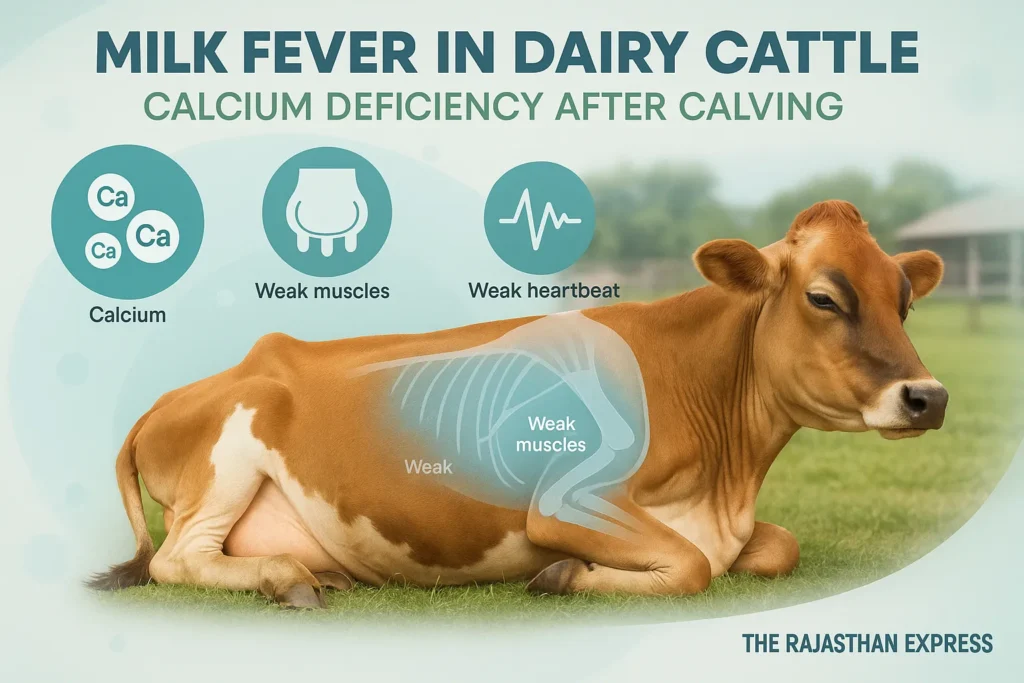
- Milk fever in cows and buffaloes: The sick animal keeps its neck turned towards the flank. This is a specific symptom.
- Colic (abdominal pain) in horses: The horse also turns its neck towards the flank – this is a symptom of colic (intestinal pain).
Hump (कूबड़)
- The protruding hump on the back of an indigenous cow is called the hump. It is formed by the 3rd and 4th thoracic vertebrae (back bones).
Types of Animals Based on Feeding
Cows, buffaloes, sheep, and goats are herbivorous animals. Cows and buffaloes are grazers, meaning they feed on pasture grass.
Types of Animals Based on Food (Herbivores, Carnivores, Omnivores)
(A) Herbivores (Herbivores)
- These animals eat only grass, leaves, straw, etc.
- Examples: Cow, buffalo, goat, sheep, camel, horse, rabbit, giraffe, etc.
Herbivorous animals are divided into two parts based on their method of eating:
| Types of Feeding Behavior (Grazer vs Browser) | ||
| Type | What do they eat? | Examples |
|---|---|---|
| Grazer | They graze grass grown on the ground. | Cow, buffalo, sheep, horse, rabbit |
| Browser | They eat leaves and twigs of trees and plants. | Goat, giraffe, camel |
| The Rajasthan Express : Feeding Behavior Classification | ||
Easy Language:
- Grazer = “Grass cutters” – They bend down and graze on grass.
- Browser = “Leaf pluckers” – They stretch upward and eat leaves.
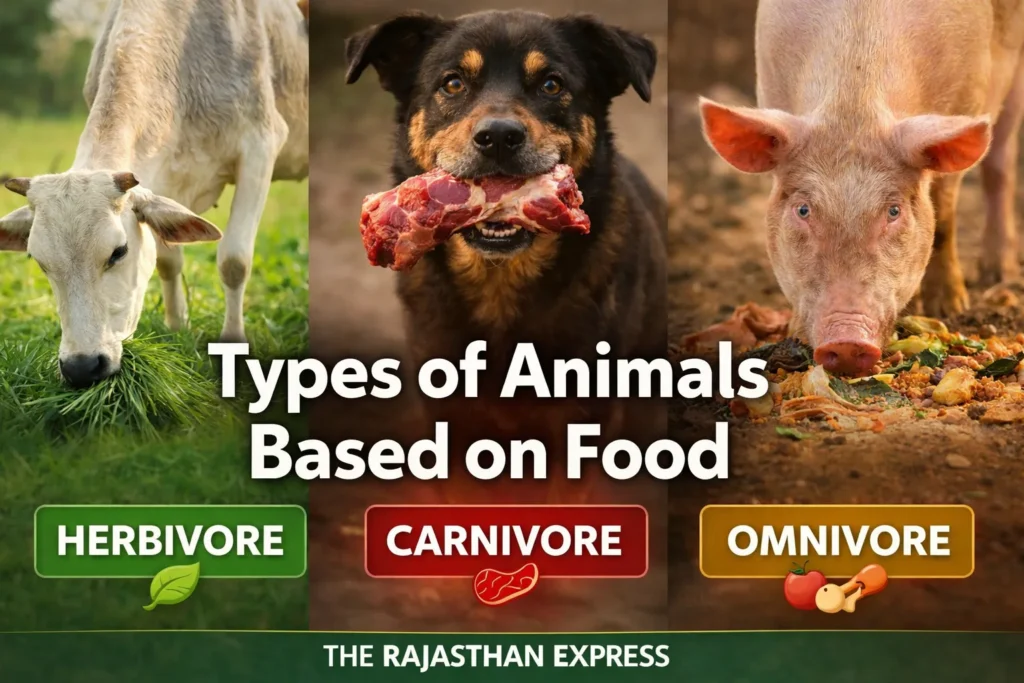
(B) Carnivores (Carnivores)
- These animals eat meat.
- Examples: Dog, cat, lion, tiger, wolf, etc.
(C) Omnivores (Omnivores)
- These animals eat both grass and meat.
- Examples: Pig, human, bear, chicken (to some extent).
Rabbit and Pseudo Rumination (Coprophagia / Caecotrophy)
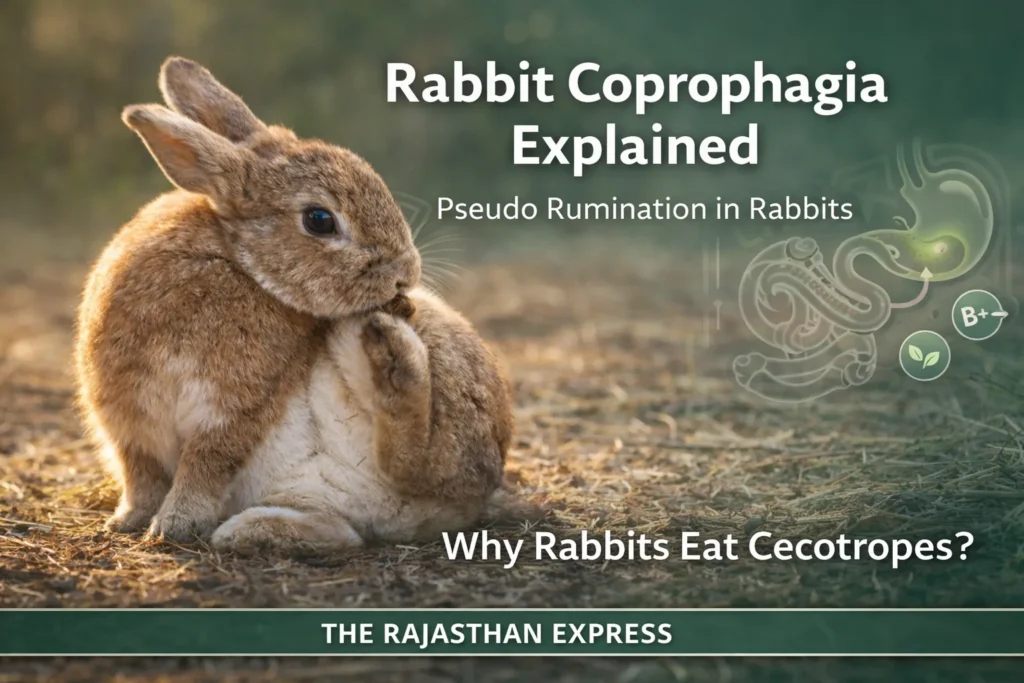
The rabbit is a non-ruminant animal, meaning its stomach has only one compartment. Still, it fulfills its nutrition through a special method called pseudo rumination.
What is the meaning of Coprophagia?
- The rabbit excretes hard feces (pellet-shaped) during the day. At night, it excretes soft feces (cecotropes).
It immediately eats this soft feces – directly from the anus to the mouth (this is not normal feces but is rich in nutrients). - This process is called Pseudo Rumination, Coprophagia, or Caecotrophy.
Why Does It Do This?
- Microorganisms in the rabbit’s intestine break down fibrous food (grass), but this digestion happens in the large intestine (caecum).
- The vitamins (especially B-complex) and proteins formed during this process are expelled through feces.
- By eating them again, the rabbit absorbs the nutrients a second time.
When does coprophagia start in rabbits?
- This process begins in rabbits from the age of 3 weeks (21 days).
Simple Understanding:
- The rabbit excretes hard feces during the day and soft feces at night – which is full of real nutrition. It immediately eats it. It does this so that it can fully obtain nutrition from grass. This is its pseudo rumination.
Types of Animals Based on Stomach
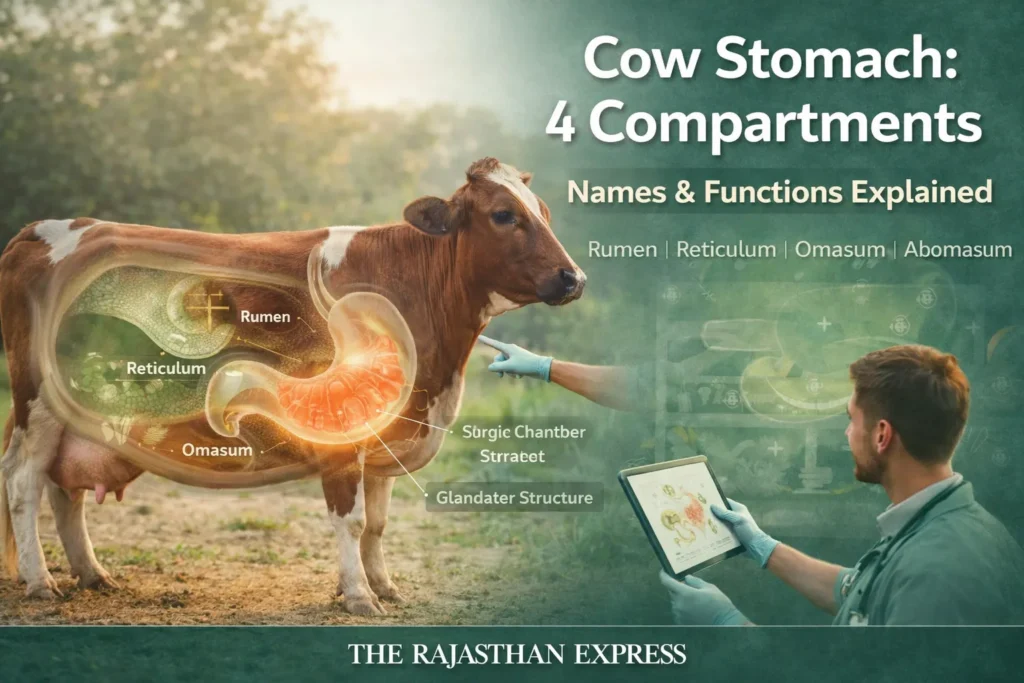
Cows are ruminant animals that chew cud. Their stomach has four compartments, with rumen being the largest.
Animals are classified into three types based on stomach structure.
Types of Animals Based on Stomach (Ruminants, Pseudo-Ruminants, Non-Ruminants)
Now we understand how the stomach of these animals works. In fact, animals are divided into parts based on the structure of their stomach:
1. Ruminants (Cud-Chewing Animals)
These are animals that eat grass and chew cud. Rumination means swallowing food and then bringing it back to the mouth to chew again (regurgitation).
- They ruminate (chew food again and again after regurgitating it).
- Their stomach has 4 compartments: Rumen, Reticulum, Omasum, Abomasum.
- Examples: Cow, buffalo, goat, sheep, yak, mithun, giraffe, deer, nilgai.
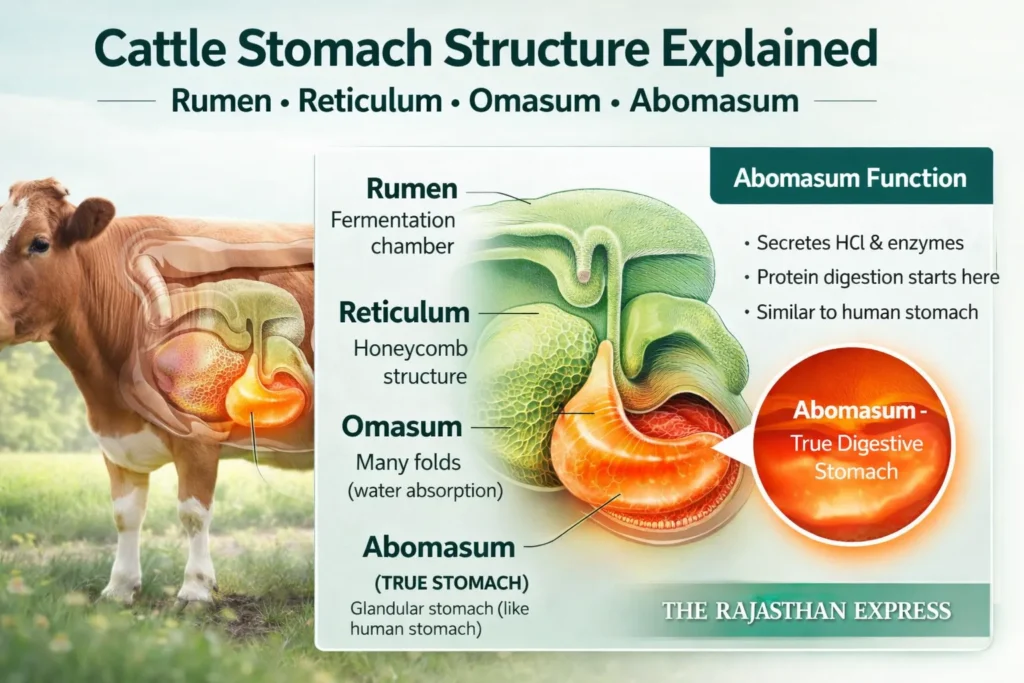
- Their stomach is compound, having four parts:
(1) Rumen – The Largest Part
- The largest part (70–80% of the entire stomach).
- Shape: Like a Turkish towel.
- Function: Food is fermented here. Billions of microorganisms break down grass.
- pH: 6.5–6.8 (slightly acidic, like curd).
- Movement: Contracts 3 times every 2 minutes (motility).
Easy Words: This is the “storage chamber.” The animal quickly eats grass and stores it here, then later brings it back to chew comfortably.
(2) Reticulum – “Honeycomb Small Part”
- The smallest part (only 5% capacity). It is the smallest part of the stomach.
- It is the second compartment based on food flow.
- Shape: Like a honeycomb. Also called “net” or “boni.”
- Function: Rumination starts here. Food comes back to the mouth from here.
- It filters small and large particles. This is the place from where the animal regurgitates food.
Special Fact: If an animal swallows sharp objects like nails or wires, they get stuck here. That’s why it is called a “Tool Box.” This condition is known as Hardware Disease.
(3) Omasum – Leafy Part (Book Stomach)
- The third part of the stomach with a capacity of 7–8%.
- Also called “oda” or “leaf.”
- Shape: Contains many layers (like leaves), hence called Book Stomach.
- Function: Absorbs water from food and temporarily holds it.
Note: This part is absent in pseudo-ruminant animals (camel, llama, etc.).
Easy Words: It is a “leafy pump” that removes extra water from food.
- Omasum is also called Many-Plies because it contains many folds, hence also called Book Stomach.
- It has leaf-like layers inside. It absorbs water and nutrients. Water is removed from food here.
Note: In poultry, the crop performs a function similar to the omasum. In animals, omasum temporarily stores food, while in poultry, this function is done by the crop (an expanded part of the oesophagus).
(4) Abomasum – True Stomach
- The fourth and second-largest part (7–8% capacity).
- Function: Digestive juices (acid, enzymes) are produced here. Real digestion occurs here.
- pH: 2 (acidic, like the human stomach).
- Also called True Stomach or Rennet, as it secretes rennin enzyme (for milk curdling).
The abomasum is called the True (Glandular) Stomach because digestive glands are present here. Real digestion occurs here.
It is the final (fourth) part and the second-largest in capacity.
Easy Words: This is the real “gastric stomach.” The other three parts only do pre-processing; digestion happens here. It is exactly like the human stomach. Gastric juice (acid) is secreted here, which digests bacteria and proteins.
Size Order of Compartments:
- Rumen (70–80%) > Abomasum (7–8%) > Omasum (7–8%) > Reticulum (5%)
Food Flow Sequence:
- Rumen → Reticulum → Omasum → Abomasum
How Does Rumination Occur?
- Food comes back to the mouth from the reticulum, then the animal chews it again and swallows it.
Calf Stomach Development (Birth to 6 Months)
- At birth: The most developed part is the abomasum, because the calf drinks only milk and this part digests milk.
- At 6 months: The rumen becomes fully developed. Now the calf can digest grass.
Conclusion (Best Cow Breed in India & Cattle Breeds Knowledge)
Understanding cow terminology, anatomy, and physiology is essential for better management of Indian cow breeds, improving productivity, and selecting the best cow breed in India for milk or dual purpose.
This knowledge also helps in identifying the Top 10 cow breeds in India and understanding their structure, health, and performance.
Explore Top 10 Indian cow breeds, highest milk producing cow breed in India, cattle terminology, anatomy & best cow breeds for milk and dual purpose.
THE RAJASTHAN EPRESS
People Also Ask
How many indigenous cow breeds are registered in India?
Which is the highest milk producing cow breed in India?
What are the top 10 cow breeds in India for milk production?
1. Sanchori (2,769 kg/lactation)
2. Sahiwal (2,325 kg/lactation)
3. Gir (2,110 kg/lactation)
4. Red Sindhi (1,840 kg/lactation)
5. Tharparkar (1,749 kg/lactation)
6. Rathi (1,560 kg/lactation)
7. Hariana (997 kg/lactation)
8. Deoni (868 kg/lactation)
9. Ongole (798 kg/lactation)
10. Nimari (767 kg/lactation)
Which is the best dual‑purpose cow breed in India (milk + work)?
Which indigenous cow has the longest lactation period?
Which indigenous cow breed gives the highest fat milk?
Which is the most expensive cow breed in India?
Which is the heaviest cow breed in India?
What is the world’s smallest cow breed?
What is special about the Sanchori cow breed?
How many bones does a cow have in its body?
How many compartments does a cow’s stomach have? Which is the largest?
What is the difference between a bull and a bullock / steer?
What is the normal body temperature, respiration rate, and pulse rate of a cow?
What is a teaser bull and what is its purpose?
What are dewlap, navel flap, and heart girth in a cow?
– Navel flap: The loose skin hanging below the cow’s navel. Also most developed in Sahiwal.
– Heart girth: The circumference of the cow’s chest, used to estimate body weight.
What are dewclaws in a cow?
What is the vertebral formula of a cow?
– C7: 7 cervical (neck) vertebrae, including Atlas and Axis.
– T13: 13 thoracic (chest) vertebrae, with 13 pairs (26) of ribs.
– L6: 6 lumbar (loin) vertebrae.
– S5: 5 sacral vertebrae fused together.
– Cy15-25: 15 to 25 coccygeal (tail) vertebrae.
What is the difference between a cow, a heifer, and a calf?
– Heifer: A young female cow between 1 and 2.5 years old that has not yet given birth.
– Calf: A baby cow (male or female) up to 12 months of age.
What is the normal lifespan of red blood cells (RBC) and white blood cells (WBC) in a cow?
– RBC lifespan: 120 to 150 days.
– WBC (monocytes): 1 to 1.5 days.
– WBC (B‑lymphocytes): 3 to 4 days.
– WBC (T‑lymphocytes): 1 to 3 years.
– WBC (granulocytes): 5 to 20 hours.
– Platelet lifespan: 8 to 12 days.