 By
ByUpward Fixation or Upward Luxation of Patella (Saran)
There is a strange disease in the hind legs of animals, which is called “Saran” in villages. In English, it is called Upward Fixation or Upward Luxation of Patella. This disease is common in buffaloes and cows/bulls, especially in areas where strong and heavy breeds are reared. Recently, in Churu district of Rajasthan, Dr. Virender Bhagat and his team successfully operated on a 1.5‑year‑old buffalo suffering from this disease and gave it a new life. Let us understand this disease in depth – what it is, why it happens, in which areas and which breeds it is seen more, and how it is treated.
Upward Fixation (Luxation) of Patella (Saran)
| Common Name | Saran |
|---|---|
| Veterinary Name | Upward Fixation of Patella (UFP) / Upward Luxation of Patella |
| Disease Type | Orthopedic / Musculoskeletal Disorder |
| Affected Species |
|
| Affected Body Part | Stifle Joint of Hind Limb |
| Anatomical Structures Involved |
|
| Definition | A condition in which the patella becomes trapped on the medial trochlear ridge of the femur, causing the hind limb to remain locked in an extended position. |
| Common Symptoms |
|
| Patellar Ligaments |
|
| Primary Cause | Upward displacement and fixation of the patella over the trochlear ridge due to ligament laxity, conformational defects, muscular imbalance, or hereditary predisposition. |
| Predisposing Factors |
|
| Breeds Commonly Affected |
|
| Regions with Higher Incidence |
|
| Diagnosis | Clinical examination of stifle joint and observation of characteristic hind limb locking and gait abnormalities. |
| Surgical Treatment |
|
| Meaning of MPD |
|
| Medicinal Therapy |
|
| Mechanism of Chloroform | Produces mild controlled irritation leading to fibrosis and tightening around the joint, preventing upward patellar displacement. |
| Mechanism of Turpentine Oil | Acts as a counter-irritant, increases local blood circulation, enhances fibrosis response, and provides mild antiseptic action. |
| Camel Consideration | MPD surgery is ineffective because camels lack a true Medial Patellar Ligament. Injectable therapy remains the preferred treatment. |
| Recent Notable Case | Successful bilateral MPD surgery performed on a 1.5-year-old buffalo at Gram Nawan, Rajgarh Tehsil, Churu District, Rajasthan on 28 May 2026. |
| Lead Veterinary Surgeon | Dr. Virender Bhagat (Incharge Senior Veterinary Officer, First Class Veterinary Hospital, Chandgothi) |
| Surgical Team |
|
| Prognosis | Excellent when treated early through MPD surgery or appropriate injectable therapy. |
| Farmer Advisory | Animals affected with Saran should not be prematurely sold. Early veterinary intervention can successfully restore normal mobility and productivity. |
| Sources: Veterinary Surgery (Medial Patellar Desmotomy), Large Animal Orthopedics, Clinical Veterinary Anatomy, Government Veterinary Hospital Chandgothi (Rajgarh), Field Reports from Gram Nawan (Churu, Rajasthan), The Rajasthan Express. | |
Successful operation of a buffalo suffering from “Saran” in Gram Nawan (Churu)
Something similar happened in Gram Nawan of Rajgarh tehsil, Churu district, Rajasthan. There was a retired soldier who was a livestock keeper. He had a 1.5‑year‑old buffalo that fell prey to the “Saran” disease. Both hind legs of the buffalo became completely straight and stiff, and she could not walk. In the entire Churu district, there were only one or two veterinarians who performed surgery for this disease. Then he came to know that Dr. Virender Bhagat, Senior Veterinary Officer in charge of First Class Veterinary Hospital, Chandgothi (Rajgarh), and his team could perform this difficult operation. Without delay, Dr. Bhagat along with his team reached Gram Nawan on 28 May 2026 at around 11:30 AM and performed this operation, giving the buffalo a new life.
Surgical Team:
In this noble work, Dr. Bhagat was accompanied by:
- Dr. Virender Bhagat (Incharge Senior Veterinary Officer, SVO)
- Shri Veer Singh (Livestock Extension Officer, LEO, Chandgothi Veterinary Hospital)
- Shri Rakesh Kumar (Livestock Inspector, LI, Government Veterinary Sub‑Centre, Jaswantpura)
- Shri Suresh Kumar (Livestock Inspector, LI, Government Veterinary Sub‑Centre, Harpalu Sawal)
How was the operation performed?
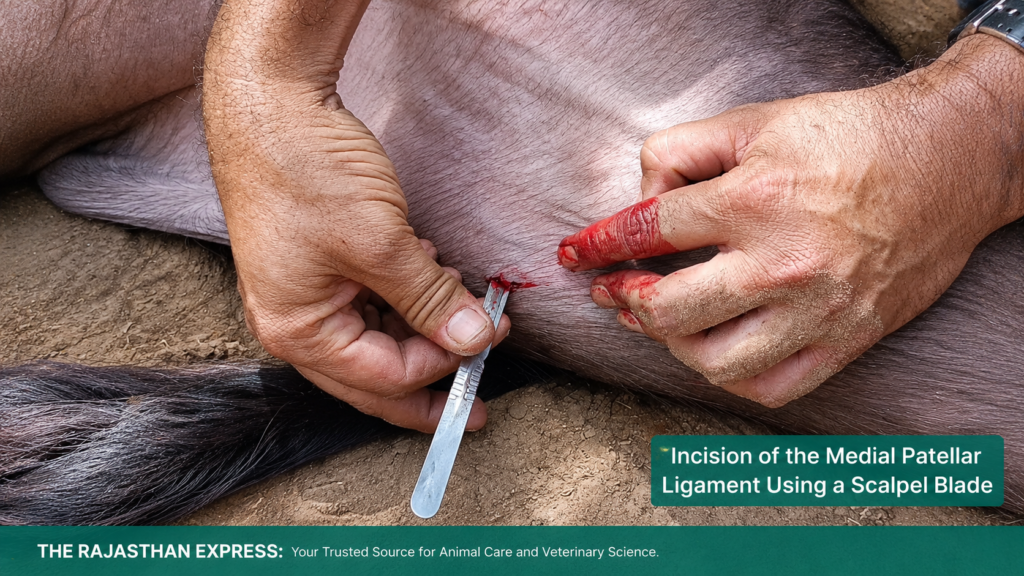
This operation was performed on 28 May 2026 at around 11:30 AM. Amidst limited resources in the village, without any large operation theatre, the animal was laid on the ground and given only local anaesthesia, and MPD (Medial Patellar Desmotomy) surgery was performed. In this small surgery, the Medial Patellar Ligament that traps the patella bone is cut, due to which the bone returns to its place and the leg starts bending normally. In the Gram Nawan case, the buffalo was suffering from Saran in both hind legs. This surgery is called MPD (Medial Patellar Desmotomy).
As soon as the operation was finished, the buffalo stood on its feet and started walking and moving perfectly. Post‑operative health was completely fine. The happiness and peace on the face of that retired soldier cannot be expressed.
This incident is proof that now skilled veterinarians are present even in villages, and “Saran” is no longer an incurable disease. The need is only to reach the right doctor at the right time, not to give up and sell the animal. This successful MPD operation performed by Dr. Virender Bhagat (SVO) and his team in Gram Nawan is proof that skilled hands are available even at the village level.
What is the Patella and how does “Saran” occur?
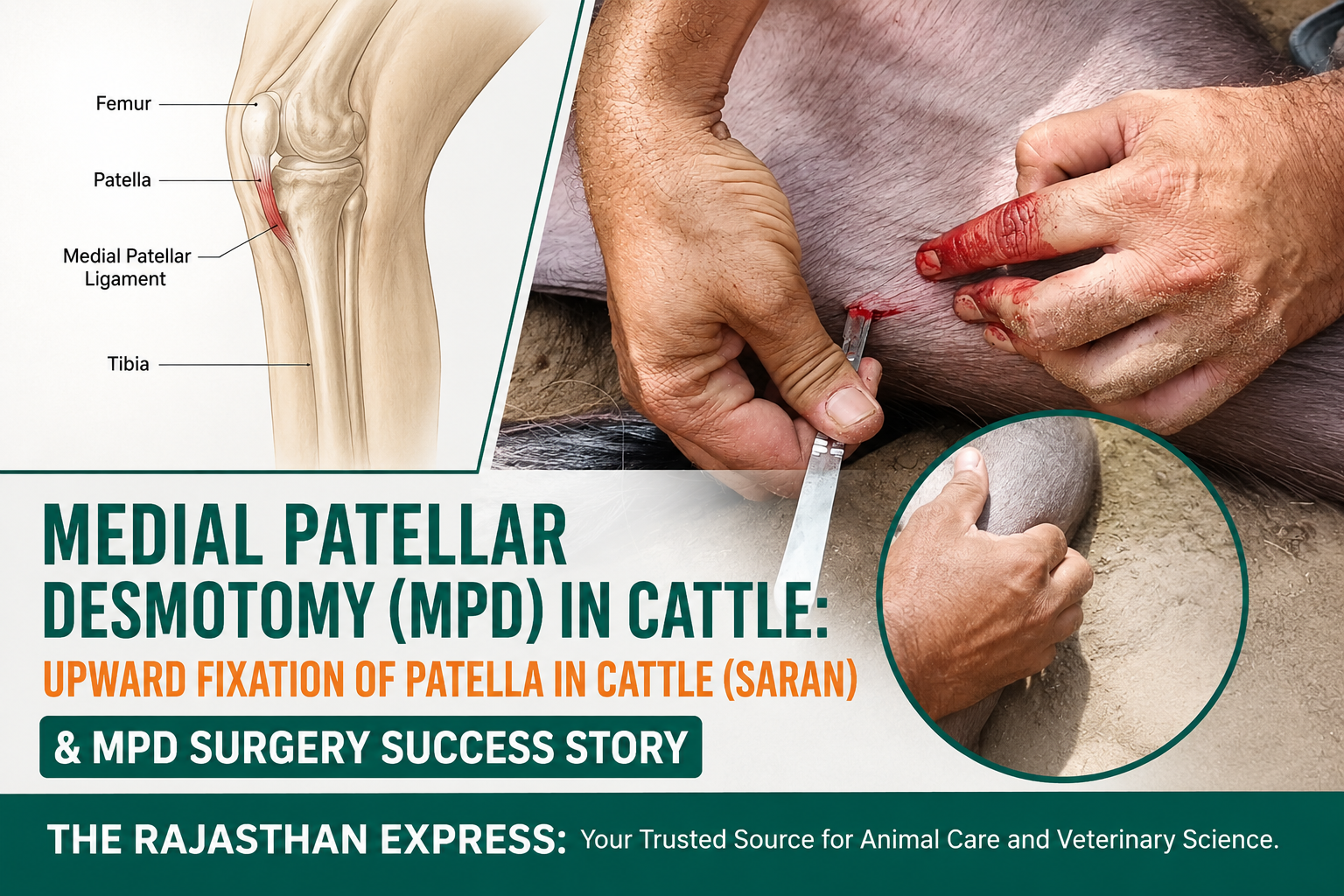
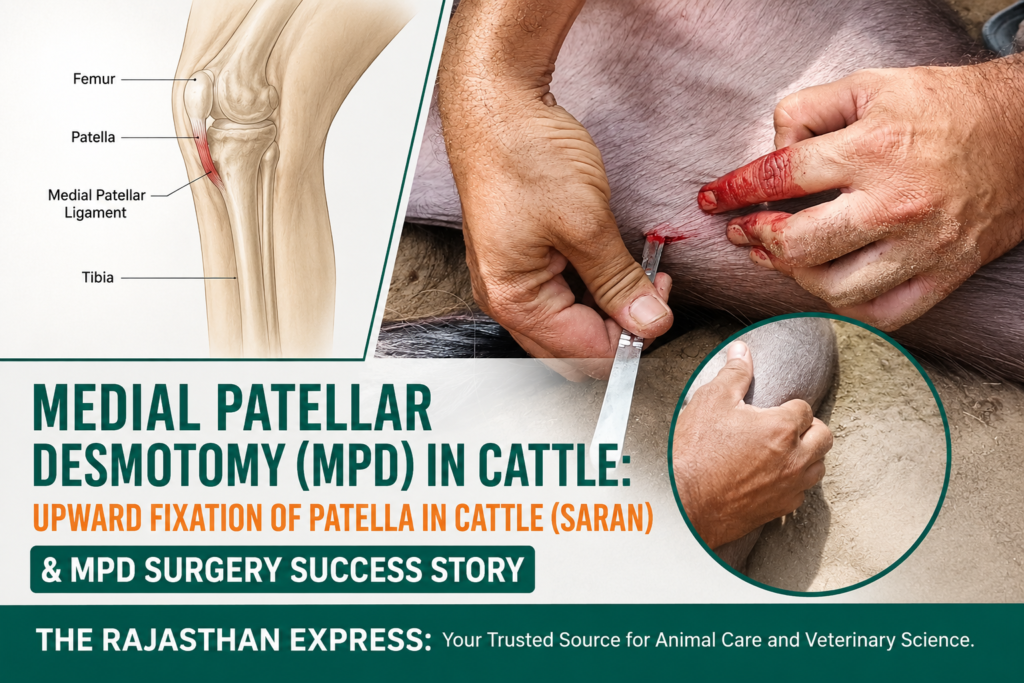
In our and animals’ hind legs, above the knee, there is a Stifle Joint. This joint is made of three bones – Femur (thigh bone), Tibia and Fibula (shin bones). In front of this joint, there is a small flat bone called the Patella. It is a sesamoid bone, meaning it is not attached to another bone, but acts like a pulley between muscles and ligaments. Its function is to help in bending and straightening the leg.
What happens in Saran?
- When the patella bone slips from its place and climbs up onto the Trochlea (groove) of the femur and gets stuck there, the leg suddenly becomes completely straight (stiff) and cannot bend. This condition is called Upward Fixation of Patella or Saran. The animal at that time drags its leg backwards while walking, until the bone returns to its place on its own. This can happen repeatedly. If it becomes permanent, the animal cannot walk or move.
Internal structure of the patella bone
The joint above the knee of the hind leg is called the Stifle Joint. This joint is made of three bones:
- Femur – thigh bone.
- Tibia and Fibula – shin bones.
- Patella – a small, flat bone that is present in front of this joint.
The patella bone resides in this stifle joint and acts as a pulley between muscles, allowing the leg to bend and straighten easily.
When the patella bone climbs up onto the Trochlea (groove) of the femur in the stifle joint and gets stuck upward, the leg becomes completely straight and stiff, and does not bend. This condition is called Saran. It can occur in one hind leg or both legs. To keep the patella bone in its place, there are three strong ligaments. All three originate from the patella and attach to the Tibial Tuberosity (the bump on the tibia) below.
The three ligaments that hold the patella – names, location, and function
To keep the patella bone in its place, nature has created three strong ropes (ligaments). All three originate from the upper part of the patella and attach to the Tibial Tuberosity (bump on the shin bone) below. Their names and functions are as follows:
| The Three Ligaments That Hold the Patella – Names, Location, and Function | ||
| Ligament Name | Location (in the Leg) | Main Function |
|---|---|---|
| 1. Medial Patellar Ligament | Innermost side (towards the middle of the body) | Prevents the patella from being pulled inward. This same ligament traps the patella by causing it to climb upward in “Saran”. |
| 2. Intermediate Patellar Ligament | Exactly in the middle | Responsible for the direct balance and main movement of the patella. |
| 3. Lateral Patellar Ligament | Outermost side among the three | Prevents the patella from slipping outward. |
| The Rajasthan Express : Patellar Ligaments – Names, Location and Function | ||
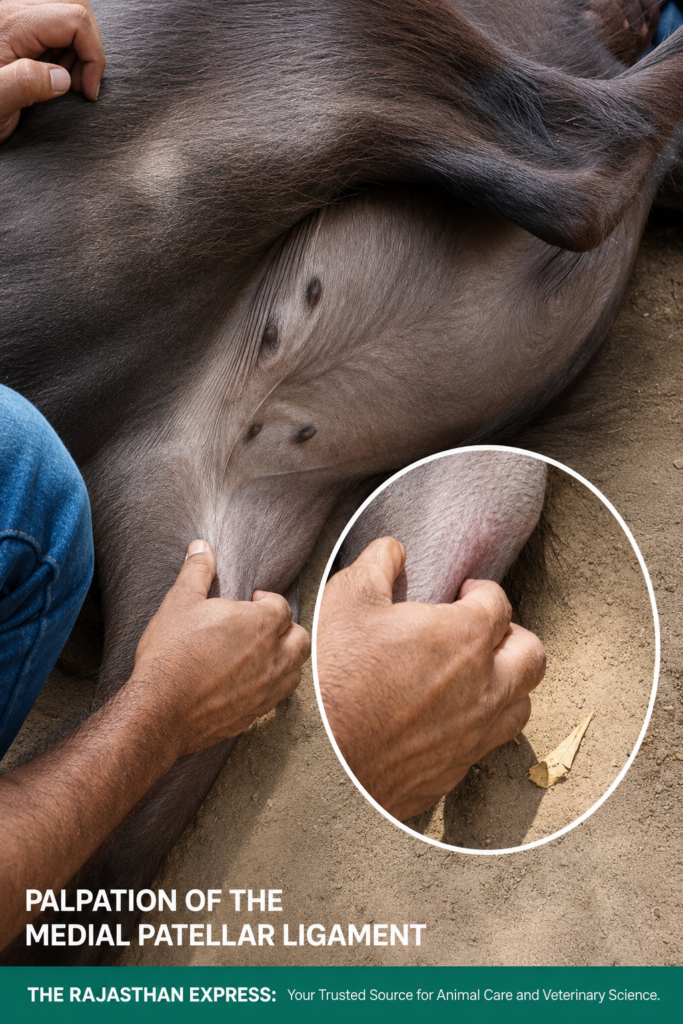
Treatment of Saran (Medial Patellar Desmotomy (MPD) Operation)
“Saran” is a problem that troubles farmers greatly, because the animal suffering from it often has to be sold to the butcher since in rural areas there are only a handful of veterinarians who can successfully treat it. But modern veterinary science has two solid answers to this – MPD surgery and chloroform‑turpentine injection. The successful MPD operation performed in Gram Nawan by Dr. Virender Bhagat (Incharge Senior Veterinary Officer, First Class Veterinary Hospital, Chandgothi) and his team (Shri Veer Singh (Livestock Extension Officer, Veterinary Hospital Chandgothi), Shri Rakesh Kumar (Livestock Inspector, Government Veterinary Sub‑Centre Jaswantpura), and Shri Suresh Kumar (Livestock Inspector, Government Veterinary Sub‑Centre Harpalu Sawal) is proof that skilled hands are available even at the village level. Meanwhile, for camel owners, injectable therapy is the only recourse. Both treatments are cheap, accessible, and effective; the only need is to take the right decision at the right time.
Medial Patellar Desmotomy (MPD) Operation – What is it and how is it performed?
Full name of MPD: Medial Patellar Desmotomy
- Medial : inner (side)
- Patellar : related to the patella
- Desmotomy : cutting of a ligament (Desmo = ligament, tomy = cutting).
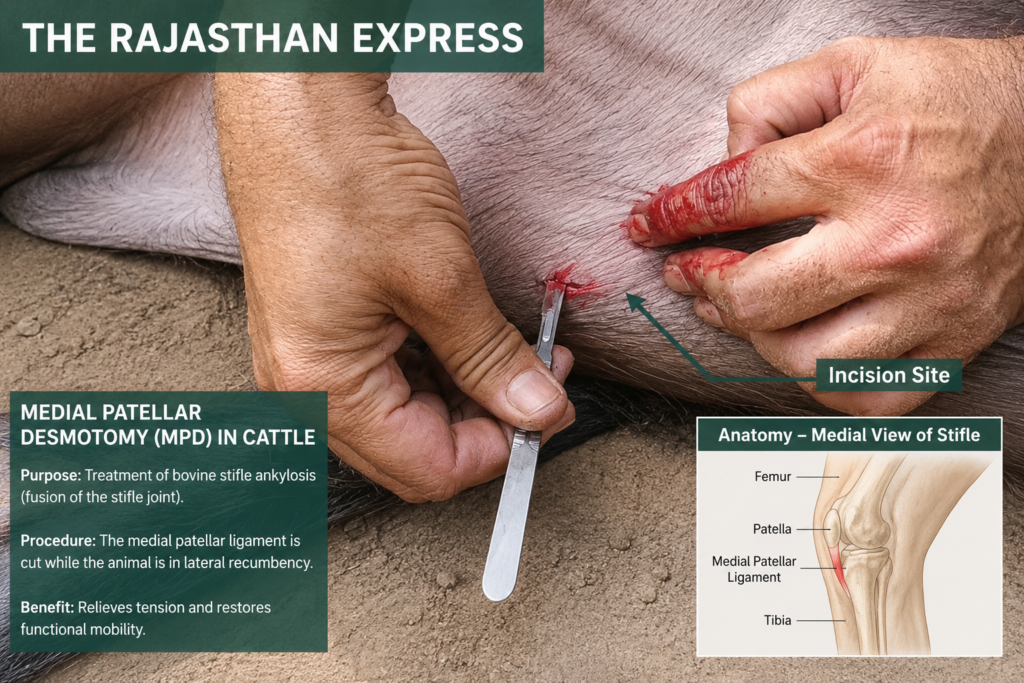
In this operation, only and only the Medial Patellar Ligament is cut with a surgical blade. The other two ligaments (Intermediate and Lateral) are not touched at all, so the leg retains its strength and stability.
Important point related to veterinary anatomy:
- This MPD surgery is effective only in cows and buffaloes. It is not effective in large animals like camels, because in the anatomical structure of the camel’s stifle joint, the Medial Patellar Ligament is completely absent. Therefore, surgery is not possible in camels.
Injectable treatment (medicinal therapy)
This treatment is useful in situations where surgery is not possible, especially in camels where it remains the only treatment.
| Injectable Treatment of Upward Fixation of Patella (UFP) / MPD (Medicinal Therapy) | |||
| Animal | Chloroform | Turpentine Oil | Site of Administration |
|---|---|---|---|
| Cow & Buffalo | 5 ML | 5 ML | Directly into the stifle joint |
| Camel | 15 ML | 15 ML | Directly into the stifle joint |
| The Rajasthan Express : Injectable Treatment of Upward Fixation of Patella (UFP/MPD) | |||
Mechanism of Action of the drugs:
1 Work of Chloroform:
- This drug enters the joint and creates a mild irritation (chemical itching/irritation). This irritation does not cause any harm.
- Due to this irritation, the body automatically starts forming fibrous scar tissue (fibrosis) to heal that area. We can understand this like a slight hard scar forming inside the flesh after an injury.
- This scar tissue tightens the loose areas around the joint. When the joint becomes tight, the patella bone can no longer easily slip upward and remains in its place. This is the main secret of this treatment.
2. Work of Turpentine Oil:
- This is a counter‑irritant (an adjuvant that increases irritation). It itself also produces mild heat.
- Its biggest function is – increasing blood flow (circulation) around the joint. When blood flows faster, the effect of chloroform spreads evenly throughout the joint. No corner is left out.
- Along with this, turpentine oil also has antiseptic properties, which greatly reduces the risk of any kind of infection at the injection site.
In which areas is this disease seen more?
This disease is found throughout India, but in some states and geographical regions, cases are relatively more common:
- Haryana, Punjab, Delhi, and Western Uttar Pradesh: This area is the stronghold of Murrah buffalo and Sahiwal/Hariana cows. Heavy‑bodied, high milk‑yielding breeds are reared here. Cases of “Saran” are often seen in these breeds.
- Rajasthan: Especially in desert and semi‑desert areas like Churu, Jhunjhunu, Sikar, Bikaner. Large numbers of Murrah buffalo and cows like Rathi, Tharparkar are reared here. The recent surgery was also performed in Chandgothi (Rajgarh), Churu district, Rajasthan.
- Central India and Gujarat: Draught bullocks (such as Malvi, Hallikar, Kankrej) here also get this problem because their legs are subjected to heavy strain.
- South India: Some areas of Tamil Nadu, Karnataka, and Andhra Pradesh also see this, especially in heavy buffaloes and working bullocks.
Geographically, this disease is more common in areas where:
- Animals are given high‑protein fodder (making them heavy quickly).
- They have to walk on paved roads or slippery ground.
- They suddenly have to run fast or jump.
The location of the recent case – Gram Nawan (First Class Veterinary Hospital, Chandgothi (Rajgarh, Churu district, Rajasthan) – is proof that earlier farmers had to run to big cities for difficult operations like “Saran”. But in a small town like Chandgothi, at a government hospital itself, Dr. Virender Bhagat and his team successfully performed this surgery. This is proof that now even remote villages have good veterinary facilities and skilled doctors.
In which breeds does this disease occur more?
Not all breeds have this problem. Heavy‑bodied, fast‑growing, and muscular breeds are more susceptible.
A. Buffalo breeds:
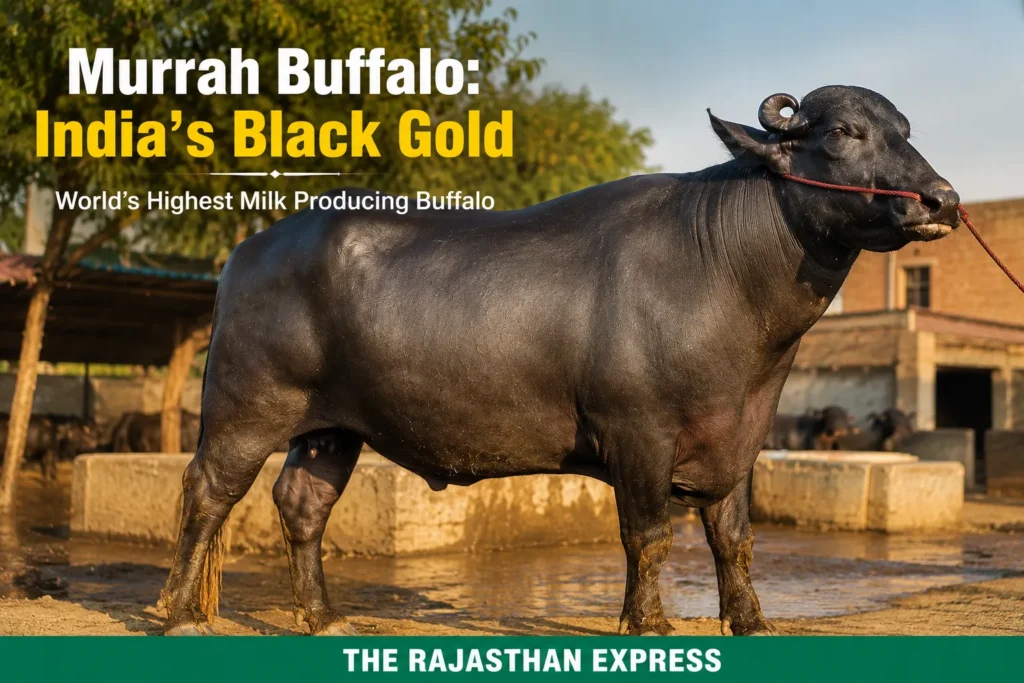
- Murrah: This heavy‑bodied, strong‑thighed breed is most sensitive to “Saran”. Especially in 1‑2 year‑old heifers/bulls, it is very common. (The buffalo operated on in Churu was 1.5 years old, possibly a Murrah or Murrah‑cross breed.)
- Nili‑Ravi: Its body is also heavy and height is greater, so the patella is prone to slipping.
- Mehsana and Surati: These Gujarat breeds can also be affected by this disease.
B. Cow and bull breeds:
- Hariana: This dual‑purpose breed is known for its strength and work capacity. Saran cases are seen frequently in its bullocks.
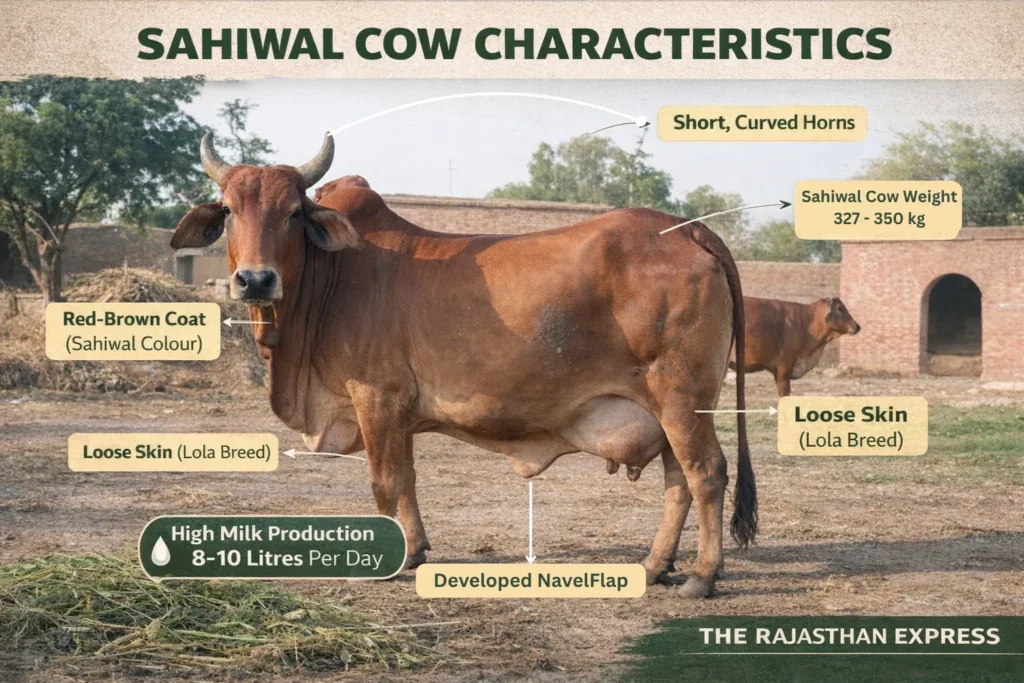
- Sahiwal: This heavy‑bodied, fast‑growing cow can also be affected.
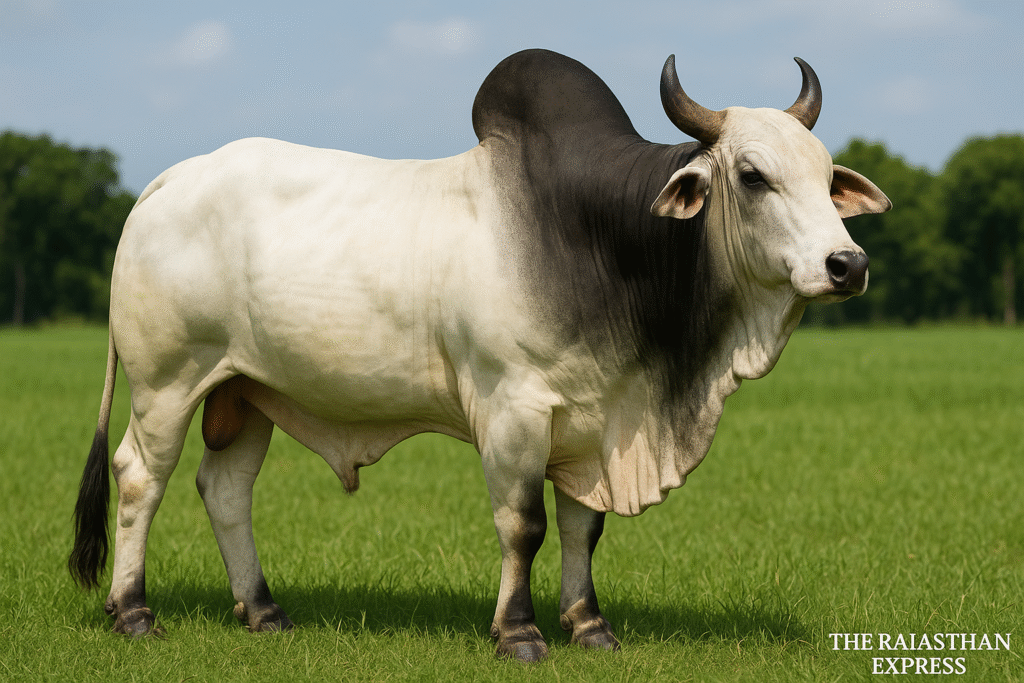
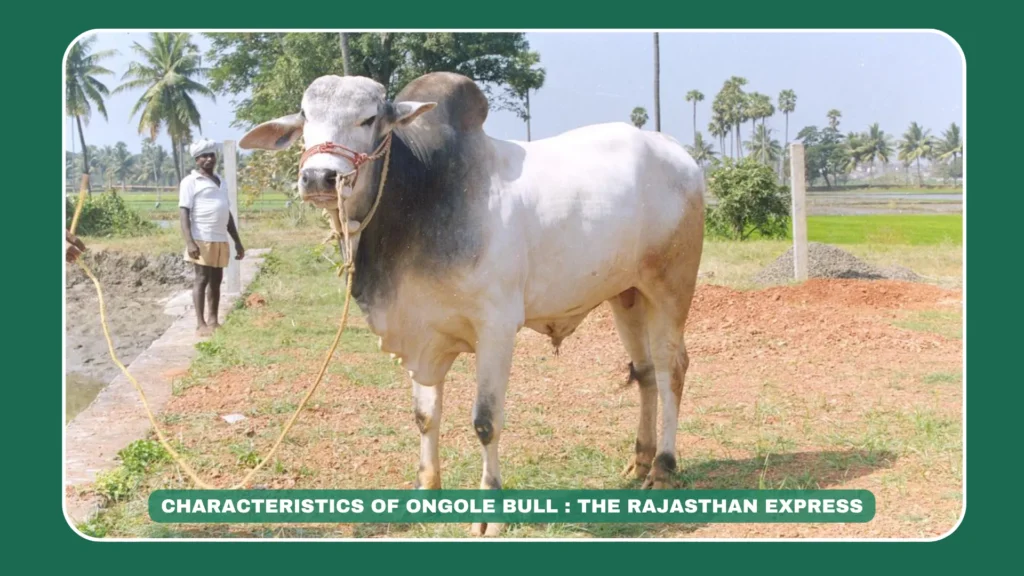
- Kankrej and Ongole: These large‑sized dual‑purpose breeds – their bullocks get this problem due to pulling work.
- Draught breeds (Amritmahal, Hallikar, Khillar, Malvi): These are all bull breeds that pull heavy loads on hilly and rough terrain. Their legs bear extra pressure, increasing the incidence of patellar slipping.
Top 10 Highest Milk Producing Cow Breeds in India : By The Rajasthan Express
Must Read for Dairy Farmers & Livestock Owners
- Sahiwal Cow Characteristics
- Tharparkar Cow Milk Per Day
- Red Sindhi Cow Milk Per Day
- Rathi Cow Cow Milk Per Day
- Sanchori Cow Cow Milk Per Day
- Deoni Cow Cow Milk Per Day
- Hariana Cow Cow Milk Per Day
- Ongole Cow Characteristics
- Nimari Cow Milk Production
Main reason among breeds:
Rapid muscle development and a specific angle of the femur (thigh bone) that cannot hold the patella in place – this is found more in some breeds genetically. That is why this has become a common surgical case in breeds like Murrah and Hariana.

Learn about upward fixation of patella (Saran) in cattle and buffaloes. Discover MPD surgery (medial patellar desmotomy), injectable treatment, affected breeds, and a successful surgery case from Rajasthan. Includes anatomy of patellar ligament in cattle.
The Rajasthan Express: Your Trusted Source for Animal Care and Veterinary Science.
People Also Ask
What is “Saran” in cattle and buffaloes?
What is MPD surgery and how is it performed?
Is MPD surgery effective in camels?
What is the non‑surgical treatment for Saran?
– Cow & Buffalo: 5 ml chloroform + 5 ml turpentine oil
– Camel: 15 ml chloroform + 15 ml turpentine oil
Chloroform creates mild irritation leading to fibrosis (scar tissue) that tightens the joint, while turpentine oil increases blood flow and provides antiseptic action.
Which animal breeds are most affected by upward fixation of patella?
Buffalo breeds: Murrah (most sensitive), Nili-Ravi, Mehsana, Surati.
Cattle breeds: Hariana, Sahiwal, Kankrej, Ongole, and draught breeds like Amritmahal, Hallikar, Khillar, Malvi.
In which regions of India is Saran most common?
– Haryana, Punjab, Delhi, Western UP (Murrah buffalo and Sahiwal/Hariana belt)
– Rajasthan (Churu, Jhunjhunu, Sikar, Bikaner) – the recent MPD surgery was done in Churu district
– Central India and Gujarat (draught bullocks like Malvi, Hallikar, Kankrej)
– South India (Tamil Nadu, Karnataka, Andhra Pradesh) in heavy buffaloes and working bullocks.
Can a cow or buffalo with Saran recover completely after MPD surgery?
How long is the recovery time after patellar desmotomy in cattle?
Why does Saran happen more in Murrah buffaloes?
What is the anatomy of patellar ligament in cattle?
1. Medial Patellar Ligament (innermost) – prevents inward slipping; in Saran, this ligament is too tight and causes the patella to climb upward.
2. Intermediate Patellar Ligament (middle) – responsible for balance and main movement.
3. Lateral Patellar Ligament (outermost) – prevents outward slipping.
MPD surgery cuts only the medial ligament while leaving the other two intact.