By
ByZebu Cattle vs. Exotic Cattle: A Comprehensive Guide to Indigenous Indian Cattle Breeds
India is globally renowned for the unique richness and diversity of its indigenous cow breeds. All these breeds are a prime example of centuries of natural selection and adaptation to the local environment, fulfilling the country’s diverse agricultural and dairy needs.
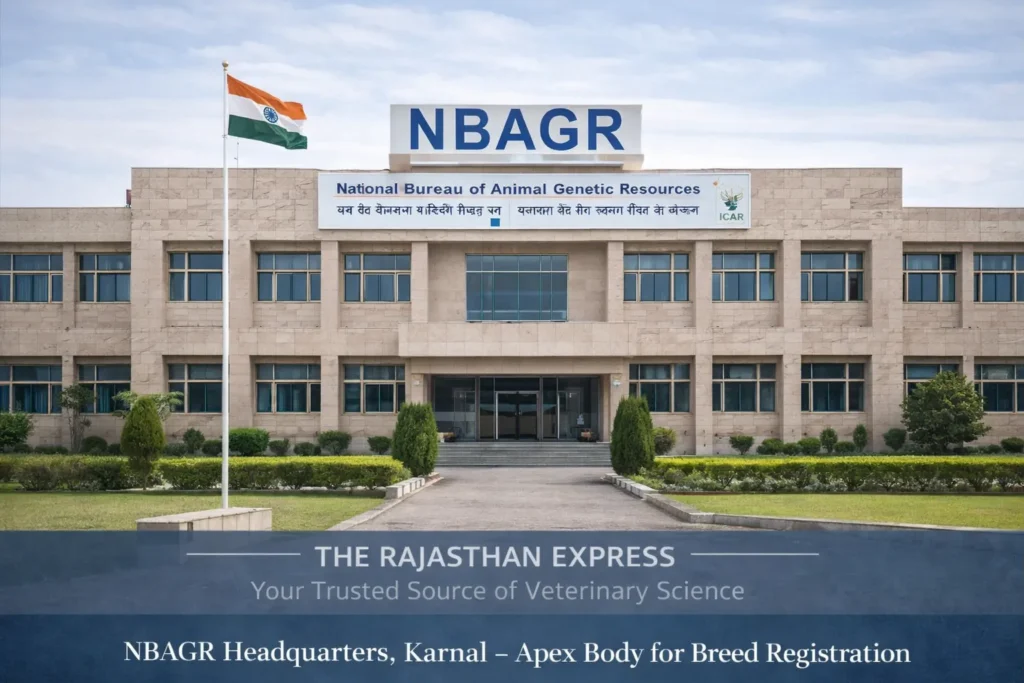
The responsibility for registering indigenous breeds of livestock and poultry in India lies with the National Bureau of Animal Genetic Resources (NBAGR), headquartered in Karnal, Haryana. Under the Indian Council of Agricultural Research (ICAR), the Breed Registration Committee (BRC), constituted under the chairmanship of the Deputy Director General (DDG) of the Animal Science Division, is the supreme recognized body for the registration of new animal species and breeds in the country.
Zebu (Bos indicus) vs Taurine (Bos taurus) — Advanced Scientific Comparison
| Feature | Zebu Cattle (Bos indicus) | Taurine Cattle (Bos taurus) |
|---|---|---|
| Scientific Name | Bos indicus | Bos taurus |
| Common Names | Humped Cattle, Indigenous/Indian Cattle | Exotic/European Cattle, Humpless Cattle |
| Primary Identification | Prominent cervico-thoracic hump, loose skin/dewlap, long ears | No hump, tighter skin, smaller ears |
| Origin & Adaptation | Originated in South Asia; highly adapted to tropical and subtropical climates with heat, humidity, and parasite stress. | Originated in temperate Eurasia; adapted to cool climates and intensive production systems. |
| Heat Tolerance Mechanisms |
|
|
| Disease & Parasite Resistance |
|
|
| Meat Production |
|
|
| Milk Production |
|
|
| Temperament |
|
|
| Genetic Diversity | Lower within-breed diversity among Indian native cattle, though high inter-population variability; conserved adaptive alleles for heat tolerance and disease defense. | Higher genetic diversity among global breeds (~40% total cattle diversity); advanced genomic selection and heterosis utilization. |
| Genomic & Epigenetic Insights |
| |
| Sources: Scheffler et al. (2022) Animals; Kuhnert et al. (2024) Frontiers in Microbiology; Mukesh et al. (2022) Frontiers in Genetics; Al Kalaldeh et al. (2023) Frontiers in Genetics; Jang et al. (2021) BMC Genomics; Ameni et al. (2007) Clin. Vaccine Immunol.; FAO & NBAGR Reports ; The Rajasthan Express | ||

NBAGR Registered New Breeds: 12th and 13th BRC Meetings (2025)
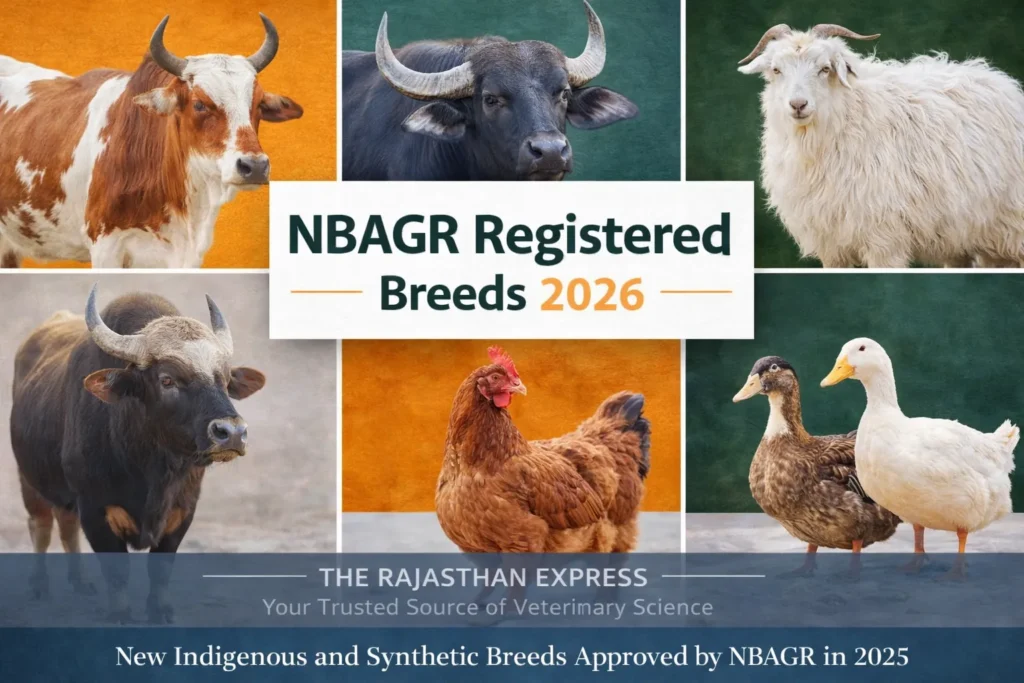
The 12th meeting of the Breed Registration Committee (BRC) was held on 6 January 2025 at NASC, New Delhi. In this meeting, under the chairmanship of Dr. Raghavendra Bhatta (DDG, Animal Science), 10 new livestock and poultry breeds from different states were approved.
Subsequently, the 13th meeting was held on 12 November 2025 in New Delhi. In this meeting, 13 indigenous (native) and 3 synthetic breeds were approved.
Major Breeds Approved in November 2025
The major breeds approved in November 2025 include:
- Medini Cattle (Jharkhand)
- Rohilkhandi Cattle (Uttar Pradesh)
- Melghati Buffalo (Maharashtra)
- Palamu Goat (Jharkhand)
- Udaypuri Goat (Uttarakhand)
- Nagami Mithun (Nagaland)
- Mala Chicken (Jharkhand)
- Kodo Duck (Jharkhand)
- Kudu Duck (Odisha)
- Kuttanad Duck (Kerala)
- Manipuri Duck (Manipur)
- Nagi Duck (Assam)
- Rajdigheli Goose (Assam)
In addition, the following synthetic breeds were also approved:
- Karan Fries Synthetic Cow (Haryana)
- Vrindavani Synthetic Cow (Uttar Pradesh)
- Avishan Synthetic Sheep (Rajasthan)
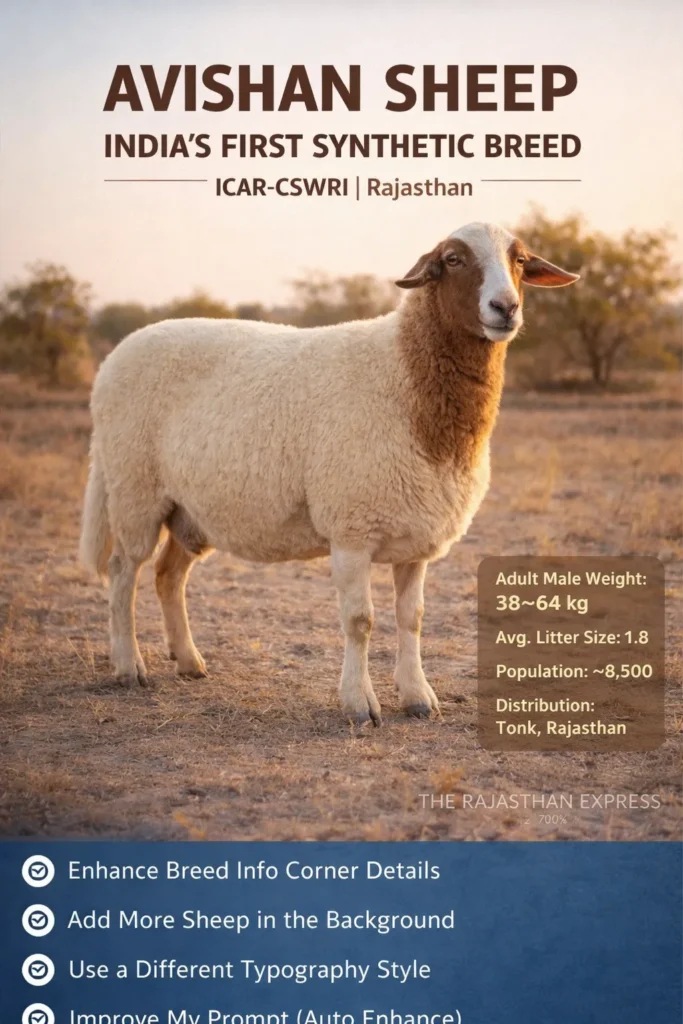
An important condition for the registration of any breed is that at least 1,000 animals of that breed must exist in the country.
| 12 Nov 2025 – Registered New Breeds | ||||
| S.N. | Species | Breed | Native Tract | Accession Number |
|---|---|---|---|---|
| 1 | Cattle | Medini | Jharkhand | INDIA_CATTLE_2500_MEDINI_03054 |
| 2 | Cattle | Rohilkhandi | Uttar Pradesh | INDIA_CATTLE_2000_ROHILKHANDI_03055 |
| 3 | Buffalo | Melghati | Maharashtra | INDIA_BUFFALO_1100_MELGHATI_01022 |
| 4 | Goat | Palamu | Jharkhand | INDIA_GOAT_2500_PALAMU_06042 |
| 5 | Goat | Udaipuri | Uttarakhand | INDIA_GOAT_2400_UDAIPURI_06043 |
| 6 | Mithun | Nagami | Nagaland | INDIA_MITHUN_1400_NAGAMI_08001 |
| 7 | Chicken | Mala | Jharkhand | INDIA_CHICKEN_2500_MALA_12021 |
| 8 | Duck | Kodo | Jharkhand | INDIA_DUCK_2500_KODO_11005 |
| 9 | Duck | Kudi | Odisha | INDIA_DUCK_1500_KUDU_11006 |
| 10 | Duck | Kuttanad | Kerala | INDIA_DUCK_0900_KUTTANAD_11007 |
| 11 | Duck | Manipuri | Manipur | INDIA_DUCK_1200_MANIPURI_11008 |
| 12 | Duck | Nagi | Assam | INDIA_DUCK_0200_NAGI_11009 |
| 13 | Geese | Rajdigheli | Assam | INDIA_GEESE_0200_RAJDIGHELI_18002 |
| 14 | Synthetic Cattle | Karan Fries | Haryana | INDIA_CATTLESYNTHETIC_0500_KARANFRIES_04002 |
| 15 | Synthetic Cattle | Vrindavani | Uttar Pradesh | INDIA_CATTLESYNTHETIC_2000_VRINDAVANI_04003 |
| 16 | Synthetic Sheep | Avishaan | Rajasthan | INDIA_SHEEPSYNTHETIC_1700_AVISHAAN_15001 |
| The Rajasthan Express: Your Trusted Source for Animal Care and Veterinary Science. | ||||
NBAGR Registered Breeds Total in India (2026 Update)
By the end of 2024, a total of 220 breeds were registered in India. After the addition of 10 new breeds in January 2025, this number increased to 230.
By February 2026, a total of 242 indigenous livestock and poultry breeds have been registered in the country. In addition, 3 crossbred cow breeds and 1 crossbred sheep breed have also been registered.
| Indigenous Livestock Breeds Registered So Far (Total: 242) | ||
| S. No. | Animal Species | Number of Registered Breeds |
|---|---|---|
| 1 | Cattle | 55 |
| 2 | Buffalo | 22 |
| 3 | Goat | 43 |
| 4 | Sheep | 46 |
| 5 | Horse & Pony | 8 |
| 6 | Camel | 9 |
| 7 | Pig | 15 |
| 8 | Donkey | 4 |
| 9 | Dog | 5 |
| 10 | Yak | 2 |
| 11 | Chicken | 21 |
| 12 | Duck | 9 |
| 13 | Geese | 2 |
| 14 | Mithun | 1 |
| Total (Indigenous Breeds) | 242 | |
| The Rajasthan Express: Your Trusted Source for Animal Care and Veterinary Science. | ||
| Registered Synthetic Breeds | ||
| S. No. | Animal Species | Number of Registered Synthetic Breeds |
|---|---|---|
| 1 | Synthetic Cattle | 3 |
| 2 | Synthetic Sheep | 1 |
| Total (Synthetic Breeds) | 4 | |
| The Rajasthan Express: Your Trusted Source for Animal Care and Veterinary Science. | ||

- Milch Breeds (Primarily for milk production)
- Dual-Purpose Breeds (For both milk production and agricultural work)
- Draught Breeds (Primarily for agricultural and transport work)
Globally, cattle are classified mainly on two bases: physical structure and utility.
Humped Cattle vs. Humpless Cattle: A Physical Classification
A. Humped Cattle Breeds (Zebu – Bos indicus)
Indigenous breed cows have a fully developed hump and are easily identified by it. This is why they are called Humped Cattle.
Their scientific name is Bos indicus, and they are collectively known as Zebu cattle.
- Zebu cattle have a fully developed dewlap.
- Zebu cattle have fully developed and large horns.
- Despite lower milk production compared to exotic breeds, they have higher disease resistance and are adapted to the Indian climate and fodder.

| Indigenous Cattle Breeds of India | |||||
| S.N. | Breed | Home Tract | Accession Number | Link | |
|---|---|---|---|---|---|
| 1 | Amritmahal | Karnataka | INDIA_CATTLE_0800_AMRITMAHAL_03001 | – | |
| 2 | Bachaur | Bihar | INDIA_CATTLE_0300_BACHAUR_03002 | – | |
| 3 | Bargur | Tamil Nadu | INDIA_CATTLE_1800_BARGUR_03003 | – | |
| 4 | Dangi | Maharashtra and Gujarat | INDIA_CATTLE_1104_DANGI_03004 | – | |
| 5 | Deoni | Maharashtra and Karnataka | INDIA_CATTLE_1108_DEONI_03005 | – | |
| 6 | Gaolao | Maharashtra and Madhya Pradesh | INDIA_CATTLE_1110_GAOLAO_03006 | – | |
| 7 | Gir | Gujarat | INDIA_CATTLE_0400_GIR_03007 | – | |
| 8 | Hallikar | Karnataka | INDIA_CATTLE_0800_HALLIKAR_03008 | – | |
| 9 | Hariana | Haryana, UP, Rajasthan | INDIA_CATTLE_0520_HARIANA_03009 | – | |
| 10 | Kangayam | Tamil Nadu | INDIA_CATTLE_1800_KANGAYAM_03010 | – | |
| 11 | Kankrej | Gujarat and Rajasthan | INDIA_CATTLE_0417_KANKREJ_03011 | – | |
| 12 | Kenkatha | UP and Madhya Pradesh | INDIA_CATTLE_2010_KENKATHA_03012 | – | |
| 13 | Kherigarh | Uttar Pradesh | INDIA_CATTLE_2000_KHERIGARH_03013 | – | |
| 14 | Khillar | Maharashtra and Karnataka | INDIA_CATTLE_1108_KHILLAR_03014 | – | |
| 15 | Krishna Valley | Karnataka | INDIA_CATTLE_0800_KRISHNAVALLEY_03015 | – | |
| 16 | Malvi | Madhya Pradesh | INDIA_CATTLE_1000_MALVI_03016 | – | |
| 17 | Mewati | Rajasthan, Haryana, UP | INDIA_CATTLE_1705_MEWATI_03017 | – | |
| 18 | Nagori | Rajasthan | INDIA_CATTLE_1700_NAGORI_03018 | – | |
| 19 | Nimari | Madhya Pradesh | INDIA_CATTLE_1000_NIMARI_03019 | – | |
| 20 | Ongole | Andhra Pradesh | INDIA_CATTLE_0100_ONGOLE_03020 | – | |
| 21 | Ponwar | Uttar Pradesh | INDIA_CATTLE_2000_PONWAR_03021 | – | |
| 22 | Punganur | Andhra Pradesh | INDIA_CATTLE_0100_PUNGANUR_03022 | – | |
| 23 | Rathi | Rajasthan | INDIA_CATTLE_1700_RATHI_03023 | – | |
| 24 | Red Kandhari | Maharashtra | INDIA_CATTLE_1100_REDKANDHARI_03024 | – | |
| 25 | Red Sindhi | Organized farms only | INDIA_CATTLE_0000_REDSINDHI_03025 | – | |
| 26 | Sahiwal | Punjab and Rajasthan | INDIA_CATTLE_1617_SAHIWAL_03026 | – | |
| 27 | Siri | Sikkim and West Bengal | INDIA_CATTLE_2221_SIRI_03027 | – | |
| 28 | Tharparkar | Rajasthan | INDIA_CATTLE_1700_THARPARKAR_03028 | – | |
| 29 | Umblachery | Tamil Nadu | INDIA_CATTLE_1800_UMBLACHERY_03029 | – | |
| 30 | Vechur | Kerala | INDIA_CATTLE_0900_VECHUR_03030 | – | |
| 31 | Motu | Odisha, Chhattisgarh, Andhra Pradesh | INDIA_CATTLE_1526_MOTU_03031 | – | |
| 32 | Ghumusari | Odisha | INDIA_CATTLE_1500_GHUMUSARI_03032 | – | |
| 33 | Binjharpuri | Odisha | INDIA_CATTLE_1500_BINJHARPURI_03033 | – | |
| 34 | Khariar | Odisha | INDIA_CATTLE_1500_KHARIAR_03034 | – | |
| 35 | Pulikulam | Tamil Nadu | INDIA_CATTLE_1800_PULIKULAM_03035 | – | |
| 36 | Kosali | Chhattisgarh | INDIA_CATTLE_2600_KOSALI_03036 | – | |
| 37 | Malnad Gidda | Karnataka | INDIA_CATTLE_0800_MALNADGIDDA_03037 | – | |
| 38 | Belahi | Haryana and Chandigarh | INDIA_CATTLE_0532_BELAHI_03038 | – | |
| 39 | Gangatiri | Uttar Pradesh and Bihar | INDIA_CATTLE_2003_GANGATIRI_03039 | – | |
| 40 | Badri | Uttarakhand | INDIA_CATTLE_2400_BADRI_03040 | – | |
| 41 | Lakhimi | Assam | INDIA_CATTLE_0200_LAKHIMI_03041 | – | |
| 42 | Ladakhi | Jammu and Kashmir | INDIA_CATTLE_0700_LADAKHI_03042 | – | |
| 43 | Konkan Kapila | Maharashtra and Goa | INDIA_CATTLE_1135_KONKANKAPILA_03043 | – | |
| 44 | Poda Thurpu | Telangana | INDIA_CATTLE_3600_PODATHURPU_03044 | – | |
| 45 | Nari | Rajasthan and Gujarat | INDIA_CATTLE_1704_NARI_03045 | – | |
| 46 | Dagri | Gujarat | INDIA_CATTLE_0400_DAGRI_03046 | – | |
| 47 | Thutho | Nagaland | INDIA_CATTLE_1400_THUTHO_03047 | – | |
| 48 | Shweta Kapila | Goa | INDIA_CATTLE_3500_SHWETAKAPILA_03048 | – | |
| 49 | Himachali Pahari | Himachal Pradesh | INDIA_CATTLE_0600_HIMACHALIPAHARI_03049 | – | |
| 50 | Purnea | Bihar | INDIA_CATTLE_0300_PURNEA_03050 | – | |
| 51 | Kathani | Maharashtra | INDIA_CATTLE_1100_KATHANI_03051 | – | |
| 52 | Sanchori | Rajasthan | INDIA_CATTLE_1700_SANCHORI_03052 | – | |
| 53 | Masilum | Meghalaya | INDIA_CATTLE_1300_MASILUM_03053 | – | |
| 54 | Medini | Jharkhand | INDIA_CATTLE_2500_MEDINI_03054 | – | |
| 55 | Rohilkhandi | Uttar Pradesh | INDIA_CATTLE_2000_ROHILKHANDI_03055 | – | |
| The Rajasthan Express: Your Trusted Source for Animal Care and Veterinary Science. | |||||
| Synthetic Cattle Breeds of India | |||
| S.N. | Breed | Home Tract | Accession Number |
|---|---|---|---|
| 1 | Frieswal | Uttar Pradesh & Uttarakhand | INDIA_CATTLESYNTHETIC_2024_FRIESWAL_04001 |
| 2 | Karan Fries | Haryana | INDIA_CATTLESYNTHETIC_0500_KARANFRIES_04002 |
| 3 | Vrindavani | Uttar Pradesh | INDIA_CATTLESYNTHETIC_2000_VRINDAVANI_04003 |
| The Rajasthan Express: Your Trusted Source for Animal Care and Veterinary Science. | |||
B. Humpless Cattle Breeds (Exotic – Bos taurus)
These breeds do not have a hump and are mainly native to temperate regions. This is why they are called Humpless Cattle.
Their scientific name is Bos taurus.
- Exotic cattle have a less developed dewlap.
- Exotic cattle have less developed and small horns.
- They are known for high milk production and are often used in cross-breeding with local breeds to combine the traits of higher production and local adaptation. Example: Jersind (Jersey ✕ Red Sindhi).

| Zebu vs. Exotic Cattle: A Detailed Feature Comparison; The Rajasthan Express | ||
| Feature | Bos indicus / Zebu | Bos taurus / Exotic |
|---|---|---|
| Scientific Classification | Bos indicus | Bos taurus |
| Primary Identification | Distinct hump on the back | Hump absent |
| Horns | Fully developed and large | Less developed |
| Dewlap | Fully developed | Less developed |
| Other Names | Humped Cattle | Humpless Cattle |
| Origin & Adaptation | Highly adapted to tropical climates | Adapted to temperate climate |
| Genetic Diversity | Low genetic diversity among Indian breeds | High genetic diversity among breeds (~40%) |
| Milk Production Capacity | Generally low | Selected for high milk yield |
| Disease Resistance | High | Comparatively low |
| Role in Cross-Breeding | Provides local adaptation capacity | Provides high production capacity |
| Zebu vs. Exotic Cattle: A Detailed Feature Comparison; The Rajasthan Express | ||

Scientific Research and Genomic Analysis
Genetic Differences and Origin
Molecular studies indicate that Bos indicus and Bos taurus originated from a common ancestor and diverged millions of years ago. The Indian subcontinent is considered a primary center for Bos indicus. One study reveals that the genetic variation among different Indian Bos indicus breeds is very low, while this variation among different Bos taurus dairy breeds was found to be up to approximately 40%.
Genomic Basis of Production Capacity
A genomic study on crossbreeds revealed that there are genomic regions with positive effects on milk production from both Bos indicus and Bos taurus. In some specific genomic regions (such as on chromosome BTA5), the presence of an allele of Bos indicus origin was associated with nearly 10% higher production, indicating that local breeds also possess genes for high production potential.

Role in the Indian Dairy Industry
In India, a large share (about 55%) of total milk production comes from crossbreeds of Bos indicus and Bos taurus (mainly Holstein Friesian and Jersey). The goal of these crosses is to create a favorable combination of the high production capacity of Bos taurus and the environmental adaptation capacity of Bos indicus (such as heat tolerance and disease resistance).
From a scientific perspective, the difference between Bos indicus (Zebu) and Bos taurus (Exotic) is not limited to physical structure. This difference is the result of millions of years of separate evolution, different environmental pressures, and distinct husbandry objectives. In the Indian context, the crossbreeding of the two has proven to be a successful experiment, aiding the country in becoming the world’s leading milk producer. In the future, based on genomic research, the development of more efficient crossbreeds is possible.


Advanced Scientific Research Report on Indigenous Indian Cattle Breeds
Based on available scientific data and research, this is a detailed report on the classification, genetic benefits, and nutritional quality of indigenous Indian cow breeds.
Research on Milk Composition and Nutritional Quality
Recent scientific studies highlight the superior nutritional quality of milk from indigenous breeds.
Milk Fat Profile
- According to a 2018 study, Sahiwal (Bos indicus) milk was found to have the lowest Saturated Fatty Acids (SFA) (68.0%) and the highest total Unsaturated Fatty Acids (UFA) (32.1%). This profile is considered more favorable for human heart health.

Minerals and Vitamins
- The concentration of minerals like Zinc (Zn), Iron (Fe), Phosphorus (P), and Copper (Cu), as well as most vitamins, was found to be significantly higher in the milk of indigenous breeds grazing on pastures compared to exotic breeds.
A2 Beta-Casein Protein
- The milk of Indian indigenous cows primarily contains A2 protein, which is considered easier to digest and healthier than the A1 protein found in exotic breeds.
Scientific evidence confirms that the milk of Indian indigenous cows, especially from animals raised on traditional pasture systems, is nutritionally superior and health-promoting. Initiatives like the Rashtriya Gokul Mission are extremely important for the conservation of this biodiversity and for genetic improvement.
Government Genetic Improvement Programs
The Government of India is running scientific programs for the conservation of indigenous breeds and enhancing their productivity.
1. Rashtriya Gokul Mission
- Its objective is the conservation of indigenous breeds, increasing milk productivity, and genetic upgradation.
2. Artificial Insemination Campaign
- Coverage has been increased to 8.32 crore animals across the country, with 12.20 crore artificial inseminations performed.
3. Progeny Testing
- A program for selecting high-genetic-quality bulls for breeds like Gir, Sahiwal, Tharparkar, Hariana, and Kankrej. So far, 3,988 such bulls have been developed.
4. Advanced Breeding Techniques
- 22 In-Vitro Fertilization (IVF) laboratories have been established for rapid genetic improvement. Sex-sorted semen facilities are also operational for the production of female calves.

Classification of Indigenous Indian Cattle Breeds by Utility
Indian Zebu breeds are divided into three main categories based on their primary utility.
1. Milch / Dairy Breeds
- These breeds are primarily raised for their high milk production. They are tolerant to the climates of various regions and yield high-quality milk.
Gir
- Native place is the Gir forest region of Gujarat. Their color is red-brown, and they have long, pendulous ears. They are considered the best for milk production.

Sahiwal
- This breed is originally from the Punjab region (Montgomery district) of Pakistan, but it is also widely reared in India. It is a red-colored breed with a calm temperament.
Red Sindhi
- The native place of this breed is the Sindh province of Pakistan. It is dark red in color and has the ability to yield good milk even in adverse conditions.
Tharparkar
- Native place is the Thar desert of Rajasthan. It is white or light grey in color and is highly tolerant to drought and hot climates.
2. Dual-Purpose Breeds
These breeds are equally suitable for both milk production and agricultural work (like plowing, carrying load).
Hariana
- Found in Haryana and neighboring states, this breed is famous for its balanced performance in both tasks.
Kankrej
- This breed from Gujarat and Rajasthan is known for its large size and powerful build. Its unique gait is famously known as “Sawai Chal.”
Ongole
- Originating in the Prakasam district of Andhra Pradesh, this breed is extremely powerful. Interestingly, Brazil imported this breed and, by crossbreeding with it, developed a new breed named Nellore, which is very popular in Brazil today.


Deoni
- This breed developed in the Latur district of Maharashtra from the crossbreeding of Gir, Dangi, and local breeds. It is a strong and reliable dual-purpose breed.
3. Draught Indigenous Breeds
These breeds were developed primarily for carrying load and agricultural work. Their muscles are very powerful, and they are capable of performing hard physical labor.
Amritmahal
- This breed from Karnataka is considered one of the best draught breeds in India. It was developed by the rulers of Mysore for the “Milk Department” (Amritmahal) to provide strong bullocks for the army.
Nagori
- This breed from Rajasthan is famous for its exceptional speed and stamina.
Khillari
- This is a major draught breed from Maharashtra, known for its strength and toughness.
Vechur
- This is a dwarf breed from Kerala, which, despite its small size, has good draught capacity. Its milk is also considered highly nutritious.
Synthetic Breed
Frieswal
This is India’s first recognized synthetic dairy cattle breed. It was developed on Indian military dairy farms by crossbreeding Sahiwal (50%) and Holstein Friesian (50%). Its goal was to bring together the tolerance of Sahiwal and the high milk production of Friesian.
Conclusion
India’s indigenous cow breeds are the backbone of the country’s agriculture and animal husbandry system. They not only provide economic benefits but also play a crucial role in balancing the ecosystem and promoting sustainable agriculture. The conservation and promotion of these breeds is in the national interest.

Compare Zebu (humped) and Bos Taurus (humpless) cattle. Discover which breed is superior for heat tolerance, disease resistance, A2 milk production, and resilience.
THE RAJASTHAN EXPRESS