 By
Cockapoo Dog Breed: What Is a Cockapoo? Cocker Spaniel Poodle Mix, Origin, History & Characteristics
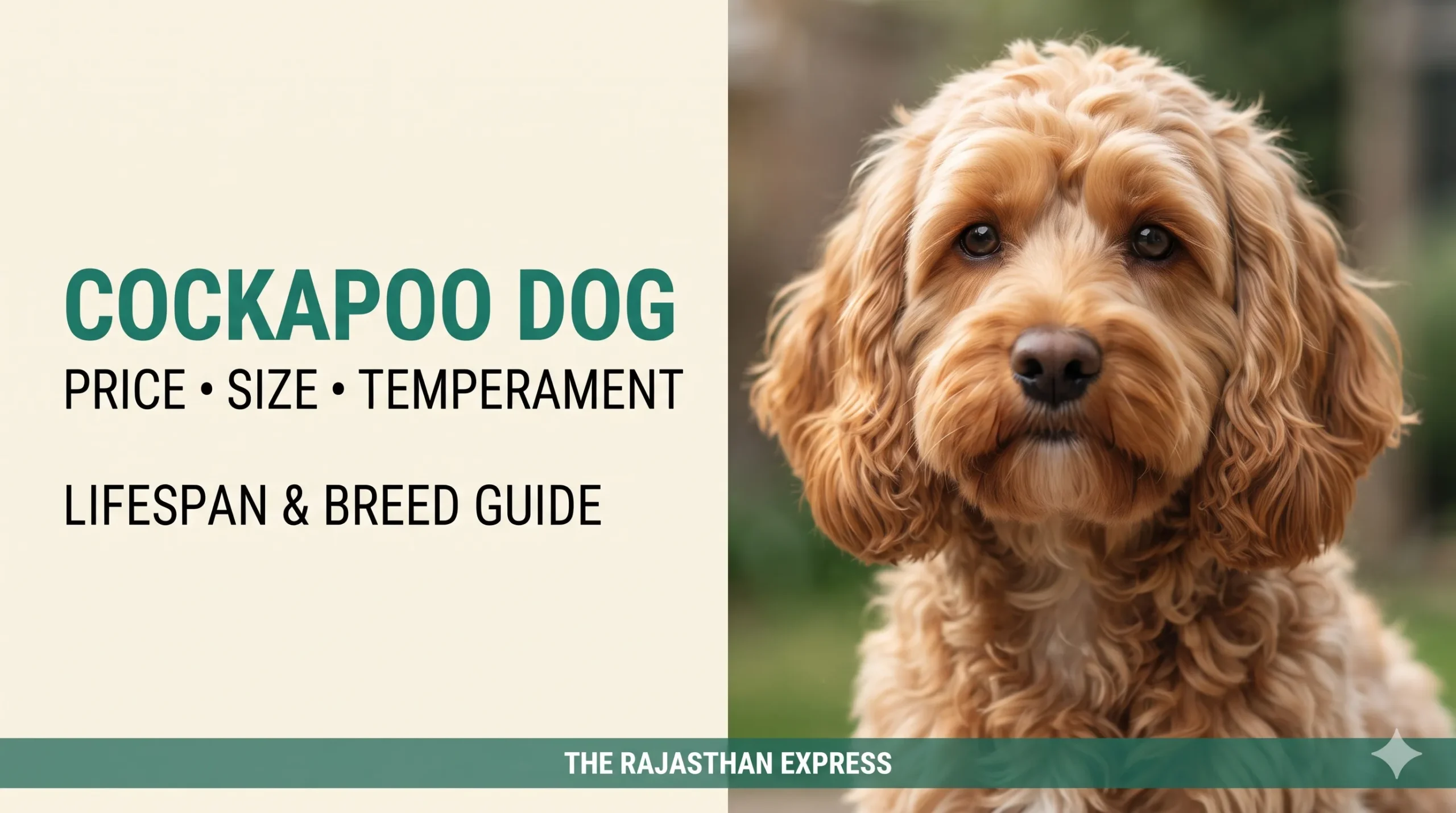
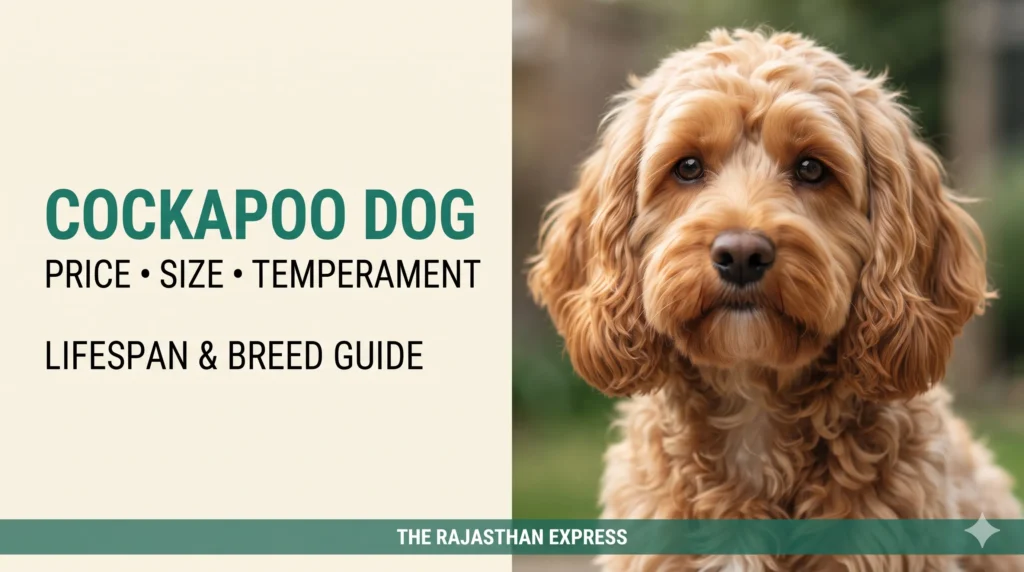
People often ask, “What is a Cockapoo?” The Cockapoo is a dog that is very cute in appearance and very good in temperament. It is not an old pure breed. It has been created by crossbreeding two dogs – one is the American Cocker Spaniel and the other is the Poodle. The puppies born from crossbreeding these two are called Cockapoos. Some people also call it “Cockadoodle,” but in common language, it is called Cockapoo.
Now listen to an interesting fact. The Cockapoo is considered the oldest designer dog in the world. When dogs like the Goldendoodle, Labradoodle, and Bernedoodle did not exist, the Cockapoo was still found in America. Its mention is found from the 1950s. At that time, people’s thinking was to create a dog that was healthy, intelligent, mingled with people, and shed less hair. From this very thinking, the Cockapoo was created.
But understand one important thing here. The Cockapoo is not a pure breed. Major organizations like the American Kennel Club (AKC) do not recognize it as a pure breed. It also has no single fixed standard for exactly how a Cockapoo should look, how tall it should be, or how heavy it should be. Therefore, every Cockapoo can be slightly different. Some will be small, some big. Some will have curly hair, some wavy, some straight. Colours will also be different – cream, golden, red, brown, black, silver, and mixed colours.
Why Was the Cockapoo Developed?
The thinking behind creating the Cockapoo was just one – the good qualities of both parents should come into one dog.
- Cocker Spaniel: From the Cocker Spaniel, it gets love, affection, playfulness, and the habit of mingling with people.
- Poodle: From the Poodle, it gets sharp intelligence, quick learning ability, and curly or wavy hair. That is why the Cockapoo is generally considered a loving, friendly, playful, and quick‑learning dog. It is good with children, likes to spend time with the family, and learns new things quickly.
But always remember one thing here. It is not necessary that every puppy gets the qualities of both parents in equal halves. Some puppies may show more Cocker Spaniel qualities, others more Poodle qualities. Puppies born in the same litter can have different coat, colour, size, and temperament. Therefore, it is not correct to fully identify a Cockapoo just by name or appearance.
Cockapoo Characteristics: What Does a Cockapoo Look Like?
The Cockapoo’s body is small to medium‑sized. The face is cute, eyes are expressive, and ears are hanging. Because the ears are hanging, dirt and moisture can accumulate quickly in them, so regular ear cleaning is necessary. If the hair is curly or wavy, brushing several times a week is necessary to avoid tangles. According to the size of the Poodle parent, the Cockapoo can be Toy, Miniature, or Standard size. The average lifespan of a Cockapoo is generally considered to be around 12 to 15 years.
Cockapoo Health Issues: What Health Problems Should You Be Aware Of?
The Cockapoo can have some health problems, such as ear infections, skin allergies, eye problems, hip dysplasia, and some knee problems. Therefore, while getting a puppy, definitely ask the breeder about the parents’ health tests and genetic testing. Vaccination, deworming, and regular veterinary check‑ups are very necessary.
Are Cockapoos hypoallergenic?
Now understand one thing very clearly. The Cockapoo cannot be called “hypoallergenic” or “allergy‑free” just by looking at its name or appearance.
- Due to Poodle genes, some Cockapoos may shed less hair, but the amount of shedding is not the same in all.
- And the truth is that no dog is completely allergy‑free. Allergies are caused by proteins present in the dog’s saliva, skin particles, and urine. Therefore, if someone is allergic to dogs, they should consult a veterinarian or allergy specialist before getting a puppy.
What Is a Cockapoo Dog?
In simple words, Cockapoo = Cocker Spaniel × Poodle. It is a companion dog, created to live with the family. Its coat, colour, size, and temperament depend on the genes received from both parents.
- It can be a good option for families who want a loving, friendly, playful, and quick‑learning dog. But for this, you will have to give it time, teach it with love, exercise it daily, introduce it to other people and animals, and do regular grooming. If you can do all this, the Cockapoo can become a loving member of your home.
What breeds make a Cockapoo?
- It has been created by crossbreeding two dogs – one is the American Cocker Spaniel and the other is the Poodle.
Is a Cockapoo a Doodle?
- Yes, the Cockapoo is a Doodle or designer dog. The reason is that the Cockapoo has been developed by crossbreeding the American Cocker Spaniel and Poodle.
- Usually, in the names of hybrid dogs created by crossing the Poodle with another dog breed, the word Doodle or Poo is used. For example, the cross of the Golden Retriever and Poodle is the Goldendoodle, while the cross of the Cocker Spaniel and Poodle is the Cockapoo.
How Is a Cockapoo Bred?
- In simple words, Cockapoo = Cocker Spaniel × Poodle – created by crossbreeding.
How long does a Cockapoo live?
- The average lifespan of a Cockapoo is generally considered to be around 12 to 15 years.
Cockapoo Origin and History : Where Did the Cockapoo Originate?
When Were Cockapoos First Bred?
- Look, the Cockapoo is not an old pure breed. It is a designer or hybrid dog created in America. It is believed that it was first deliberately bred in America in the 1960s. According to some sources, it had already started in the late 1950s. According to some veterinary sources, the first recorded record of the Cockapoo is found in the 1950s. By the 1960s, it had started to build a separate identity in America. But no single definite date, no single founder breeder, or no verified first litter of its origin is available. That is, it cannot be called the result of any one person or any one programme.
Where did Cockapoos originate?
- The origin of the Cockapoo is considered to be in America.
Which Two Breeds Are Crossed to Produce a Cockapoo?
- The Cockapoo was mainly created by combining the American Cocker Spaniel and Miniature Poodle. The purpose of creating it was to prepare a dog that had the loving, affectionate, and friendly temperament of the Cocker Spaniel, along with the sharp intelligence and low‑shedding coat of the Poodle. In the beginning, it was not developed to meet any particular physical standard, but as a healthy and good companion dog. That is why it is also considered a symbol of the beginning of the “designer dog” revolution.
Cockapoo vs Cocker Spaniel: What Is the Difference?
Look, the Cockapoo and Cocker Spaniel may look somewhat similar in appearance, but there is a very big fundamental difference between the two. The Cocker Spaniel is a pure breed, while the Cockapoo is a crossbreed. The Cockapoo is created by mixing the Cocker Spaniel and Poodle. Because of this, differences arise in both’s size, temperament, coat, care, and health‑related matters.
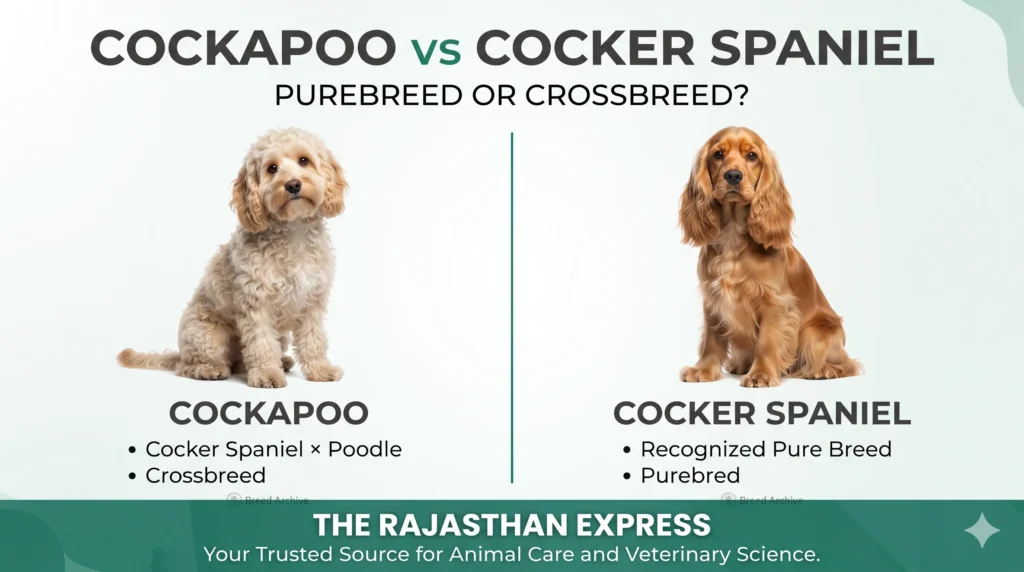
First understand this. The Cocker Spaniel has a fixed standard. That is, its size, coat, and temperament can be largely predicted in advance. But this is not the case with the Cockapoo. Puppies born in the same litter of Cockapoos can have different size, coat (curly or wavy), and temperament. Because every puppy brings different qualities from its parents.
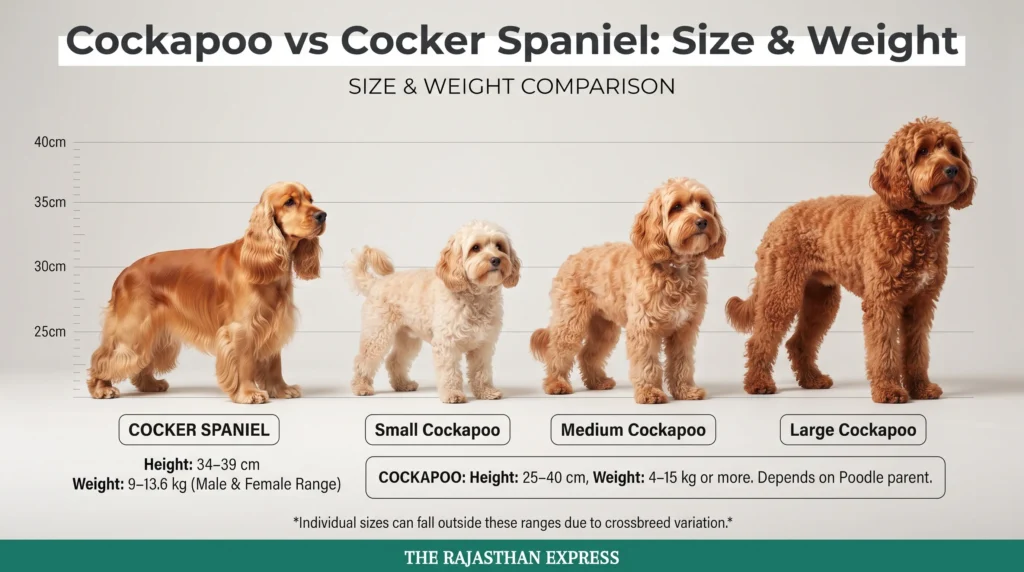
Cockapoo vs Cocker Spaniel Size and Weight
The Cocker Spaniel’s size is largely fixed.
- Cocker Spaniel male weight is usually between 11.3 to 13.6 kg and female between 9 to 11.3 kg.
- Cocker Spaniel height is about 34 to 39 cm.
The Cockapoo’s size depends on which size of Poodle was used to create it – Toy Cockapoo, Miniature Cockapoo / Mini Cockapoo, or Standard Cockapoo.
- Therefore, a Cockapoo can be from 4 kg to 15 kg or even more.
- Height can be from 25 to 40 cm. That is, the Cockapoo’s size depends on its parents, especially the Poodle.
| Cocker Spaniel vs Cockapoo: Key Differences | ||
| Feature | Cocker Spaniel | Cockapoo |
|---|---|---|
| Breed Type | Pure breed | Crossbreed |
| Average Height | About 34–39 cm | 25–40 cm (depends on Poodle size) |
| Average Weight | 9–13.6 kg | 4–15 kg (depends on Poodle size) |
| Coat | Silky, wavy, double coat | Curly or wavy |
| Shedding | Moderate | May be low, but not guaranteed |
| Grooming | Daily brushing necessary | Brushing 3–5 times a week and professional grooming |
| Temperament | Cheerful, affectionate, slightly reserved | Affectionate, friendly, more variable |
| Average Lifespan | 10–14 years | 12–16 years |
| The Rajasthan Express : Cocker Spaniel vs Cockapoo: Key Differences | ||
Where Did the History of the Cockapoo Begin?
- The origin of the Cockapoo is considered to be in America. In the 1940s and 1950s, both the Cocker Spaniel and Poodle were very popular dogs in America. Both had their own special qualities, so the puppies born from their mix attracted people’s attention. In the beginning, some crossbreeding may have happened by chance, but later breeders began deliberately mixing these two breeds. The breeders’ purpose was to create a companion dog that could easily live with the family and also be good at training.
American Cockapoo vs English Cockapoo: What Is the Difference?
Look, the American Cockapoo and English Cockapoo – both are designer dogs created by crossbreeding the Cocker Spaniel and Poodle. In both, the Poodle is one parent. But the biggest difference is which Cocker Spaniel is the other parent.
- American Cockapoo = American Cocker Spaniel × Poodle
- The American Cocker Spaniel’s body is usually more compact and rounded.
- English Cockapoo = English Cocker Spaniel × Poodle
- The English Cocker Spaniel’s body is more athletic. This difference can also be seen in their Cockapoo puppies. But it is not necessary for every puppy to be like this.
That is, in both, the Poodle is the same, but the type of Cocker Spaniel is different. Because of this, some differences can be seen in their body, face, ears, coat, and temperament. But remember that these are only general tendencies, not fixed rules. Because the Cockapoo itself is a crossbreed, the build and temperament of two puppies in the same litter can also be different.
American Cockapoo vs English Cockapoo: Comparison Chart
| American Cockapoo vs English Cockapoo: Comparison Chart | ||
| Basis | American Cockapoo | English Cockapoo |
|---|---|---|
| Parents | American Cocker Spaniel × Poodle | English Cocker Spaniel × Poodle |
| Body | Relatively compact and strong | Relatively athletic and slightly longer |
| Head and Face | Round head and shorter muzzle may be seen | Relatively longer muzzle may be seen |
| Ears | Long, hanging, and densely haired | Long, hanging, and haired |
| Coat | Can be wavy or curly | Can be wavy or curly |
| Temperament | Often friendly, affectionate, and playful | Often friendly, active, and enthusiastic |
| The Rajasthan Express : American Cockapoo vs English Cockapoo | ||
History of the Cockapoo Parent Breeds
Cocker Spaniel Dog:
- The Cocker Spaniel is originally a hunting and sporting dog. The Cocker Spaniel originated in Spain. It was developed for hunting birds and finding and retrieving hunted birds. In the 20th century, it was one of the most popular breeds in America. From it, the Cockapoo can get qualities like long hanging ears, expressive eyes, affectionate temperament, and playful behaviour. But it is not necessary that these qualities appear the same in every Cockapoo.
Poodle Dog:
- The word “Poodle“ comes from the German word “Pudel,” which means “to splash in water or play with water.” The Poodle’s origin is considered to be in Germany around the 1400s, where it was reared for hunting waterfowl and retrieving things fallen in water. Later, it became very popular in France and developed a separate identity there. Due to Poodle genes, the Cockapoo can show a curly or wavy coat, good learning ability, and low‑shedding quality. The Poodle’s curly coat and low‑shedding quality are the biggest reason for the popularity of the Cockapoo, Bordoodle, Goldendoodle, Bernedoodle, and Aussie Doodle.
Cockapoo’s Journey from America to Other Countries
- In the 1950s and 1960s, the Cockapoo was mainly building its identity in America. Gradually, it also became popular among dog lovers in other countries. In the United Kingdom, the popularity of the Cockapoo increased especially after the 1990s and in the 2000s. There it is generally called Cockapoo, although in Australia it is also called “Spoodle.” Today it is seen as a pet dog in countries like America, Britain, Australia, Canada, and New Zealand. In 2021, it was at the top among the most kept dogs in New York and Chicago. A big reason for its popularity is its companion dog temperament and availability in different sizes.
Is the Cockapoo Recognised by the AKC?
- The Cockapoo has not received official breed status from the American Kennel Club (AKC) or any major international kennel club, because it is not a pure breed and has no stable, generation‑after‑generation consistent standard. But it is registered in many hybrid and designer dog registries.
- The Cockapoo Club of America was established in 1998 and it registers the Cockapoo. The American Cockapoo Club also registers it and is working on developing a breed standard for it. Besides, organizations like the Designer Breed Registry and Designer Dogs Kennel Club also register them.
The Cockapoo: A Symbol of the Designer Dog Revolution
The Cockapoo is often considered the first real “designer breed,“ which started the era of other crossbreed dogs like the Labradoodle and Goldendoodle. It came into existence long before the “Doodle craze” of the 1980s. That is, when the trend of Doodle dogs had not even started, the Cockapoo was already present in America.
Cockapoo Geographical Distribution and Popularity
Now let’s talk about where the Cockapoo is actually found and where it is more popular. First of all, understand that the Cockapoo has no “native place” or ancestral area, because it is not a wild or naturally developed breed. It is a hybrid dog created by humans by crossbreeding the Cocker Spaniel and Poodle. Therefore, its distribution is not determined by any river, mountain, or forest, but by people’s preference, pet dog breeding, and the movement of dogs between countries.
Where Did the Cockapoo Originate?
- The origin of the Cockapoo is considered to be in America. From here it gradually reached other countries. Today it is not limited to America alone. It is found in Australia, New Zealand, Britain, and many countries of Europe. In Asian countries like India, its awareness and availability are also increasing, although here it is not yet very common and is mainly available through big cities or professional breeders.
- In different countries, its names also change. In Australia and New Zealand, it is called “Spoodle.” In Sweden, it is called “Cockerpoo.“ But all these names refer to the same dog – a cross of the Cocker Spaniel and Poodle.
Now let’s talk about popularity. In 2021, the Cockapoo was at the top of the list of most kept dogs in New York and Chicago. In Britain, it is considered one of the most popular dog breeds today. That is, in both America and Britain, it has become people’s first choice. A big reason for its popularity is its companion dog temperament, friendliness, intelligence, and availability in different sizes.
If its geographical map were made, it would not look like the shape of any one country. It would mainly be found centred in North America, Europe, and Oceania (Australia and New Zealand). In Asia, it is still emerging. It can be called a “map of popularity,” because wherever there are lovers of designer dogs and breeders are active, the Cockapoo is found there.
One important thing is that no official or globally accepted survey is available that tells the actual country‑wise number of Cockapoos. Therefore, it would not be correct to state the exact number or ranking in any country. The figures available are estimates based on breeders, pet dog databases, or local surveys.
Cockapoo Geographical Distribution by Region
| Cockapoo Geographical Distribution by Region | |
| Geographical Area | Cockapoo Distribution and Status |
|---|---|
| North America | Origin in America; breeding and keeping also in Canada |
| Europe | Especially popular in Britain; also available in other European countries |
| Oceania | Companion dog in Australia and New Zealand |
| Asia | Availability and growing awareness in some countries including India |
| The Rajasthan Express : Cockapoo Geographical Distribution by Region | |
So overall, the distribution of the Cockapoo is mainly spread across North America, Europe (especially Britain), and Australia. Its spread has not happened through natural migration like birds, but through humans taking dogs from one country to another and breeding them there.
Cockapoo Classification and Other Names : What is a Cockapoo also called?
Look, to understand the Cockapoo, the first thing that must be known is that it is not a single pure breed. It is not like any one purebred dog, but has been created by combining two different breeds. Therefore, it is called a hybrid or crossbreed. And because it has been deliberately created to bring together the good qualities of two breeds, it is also called a designer dog. That is, the Cockapoo is basically a family companion dog, created by combining the Cocker Spaniel and Poodle.
| Cockapoo Classification | |
| Category | Information |
|---|---|
| Common Name | Cockapoo |
| Type of Dog | Hybrid / Crossbreed |
| Breed Category | Designer Dog |
| Main Purpose | Companion / Family Dog |
| First Parent Breed | Cocker Spaniel |
| Second Parent Breed | Poodle |
| Country of Origin | United States of America |
| Size Category | Small to Medium |
| Recognition | Not recognized as a pure breed by AKC |
| Coat Type | Wavy, curly, or straight |
| General Temperament | Friendly, intelligent, and affectionate |
| The Rajasthan Express : Cockapoo Classification | |
What is a Cockapoo also called? (Cockapoo Alternative Names)
The Cockapoo is known by many names in different countries and breeding communities. Now understand these names one by one.
- Cockapoo: This is the most used and internationally recognized name. This name is made by combining the names Cocker Spaniel and Poodle. “Cock” comes from Cocker Spaniel and “Poo” comes from Poodle.
- Cockerpoo: This is another way of writing Cockapoo. Especially in some breeding communities in Britain, this name is also seen. Meaning the same dog, just a different way of writing.
- Spoodle: In Australia and New Zealand, the cross of the Cocker Spaniel and Poodle is called Spoodle. This name is also used for the Cockapoo. That is, if someone in Australia says Spoodle, understand that it is the Cockapoo itself.
- Cock-a-poo: This is another way of writing the name Cockapoo. Some people write it like this.
- Cockerdoodle: Some breeders and dog lovers also use this name. This also refers to the Cockapoo.
- Cocker Spaniel Poodle Mix: This is a descriptive name, which directly tells which two breeds it is made from. Just by reading it, one understands who its parents are.
Cockapoo and Spoodle generally refer to the same type of Cocker Spaniel and Poodle cross. That is, the names are different, but the dog is the same. However, from the names used in different countries, it is not always clear which type of Cocker Spaniel was used – American or English. So overall, the Cockapoo is a designer hybrid dog, created from the mix of the Cocker Spaniel and Poodle. It is known by many names like Cockapoo, Cockerpoo, Cock-a-poo, Spoodle, Cockerdoodle, and Cocker Spaniel Poodle Mix. But all these names mean the same thing – a cross of the Cocker Spaniel and Poodle. It is a family companion dog, which is small to medium‑sized and whose temperament is generally friendly, intelligent, and affectionate.
Cockapoo Dog Identification and Physical Characteristics
Look, the Cockapoo cannot be identified just by its curly hair or teddy bear‑like face. It is a crossbreed of the Cocker Spaniel and Poodle, so it can have qualities of both. But it is not a pure breed and has no single fixed breed standard. Therefore, the things described below are general identifications; it is not necessary that they apply exactly to every Cockapoo.
General Body Build
Is a Cockapoo a small or medium‑sized dog?
Yes, the Cockapoo is usually a small to medium‑sized dog. Its body looks balanced and well‑proportioned. Some Cockapoos may have a strong and slightly broad body like the Cocker Spaniel, while others may be lighter and longer like the Poodle. The neck is of medium length and appears well‑connected to the body. The build of the chest and shoulders can change according to the parents. The back is usually strong and almost flat. The tail of some may be long and natural, while the build of others may be slightly different. Just by looking at the tail, it cannot be said which generation the Cockapoo belongs to.
Cockapoo Size and Weight: Toy, Mini, Standard and Full Grown Cockapoo Size Chart
What Are the Different Sizes of Cockapoos?
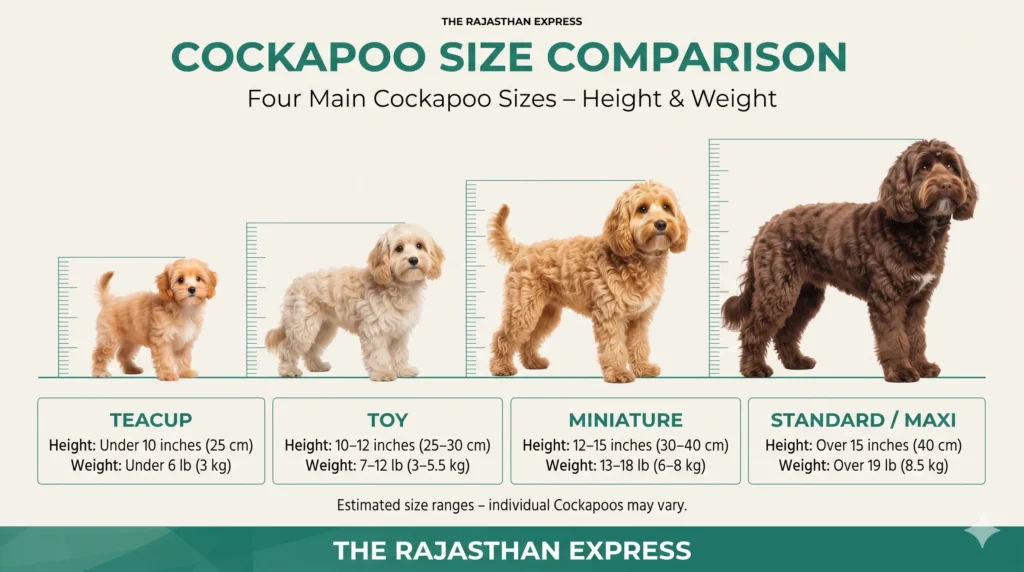
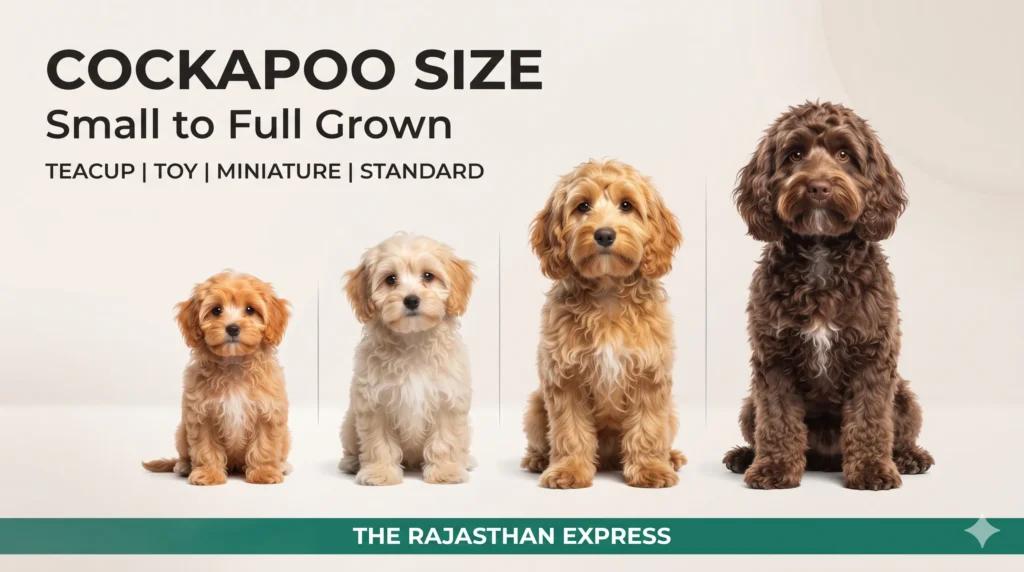
- The Cockapoo’s size is not uniform. It depends on which size of Poodle was used to create it – Toy Cockapoo, Miniature Cockapoo, or Standard Cockapoo. Along with this, the size of the Cocker Spaniel parent, genetics, and the puppy’s own growth also matter. Therefore, the Cockapoo is mainly divided into four categories: Teacup, Toy Cockapoo , Miniature Cockapoo , and Standard Cockapoo /Maxi. But understand that the Cockapoo is not a pure breed, so the sizes of these categories can also be slightly different in every dog.
| Cockapoo Size Comparison Chart: Four Main Cockapoo Sizes | |||
| Cockapoo Size | Estimated Height at the Shoulder | Estimated Weight | Key Characteristics |
|---|---|---|---|
| Teacup Cockapoo | Under 10 inches (approximately 25 cm) | Under 6 pounds (approximately 3 kg) | The smallest size, suitable for small apartments, but requires special attention to health |
| Toy Cockapoo | 10–12 inches (approximately 25–30 cm) | 7–12 pounds (approximately 3–5.5 kg) | Playful, small, and an adorable companion |
| Miniature Cockapoo | 12–15 inches (approximately 30–40 cm) | 13–18 pounds (approximately 6–8 kg) | The most common and popular size, offering a balanced build |
| Standard/Maxi Cockapoo | Over 15 inches (approximately 40 cm) | Over 19 pounds (approximately 8.5 kg); some may weigh 25 pounds or more | The largest size, but still has a friendly temperament |
| The Rajasthan Express : Cockapoo Size Comparison Chart | |||
What Is a Toy Cockapoo?
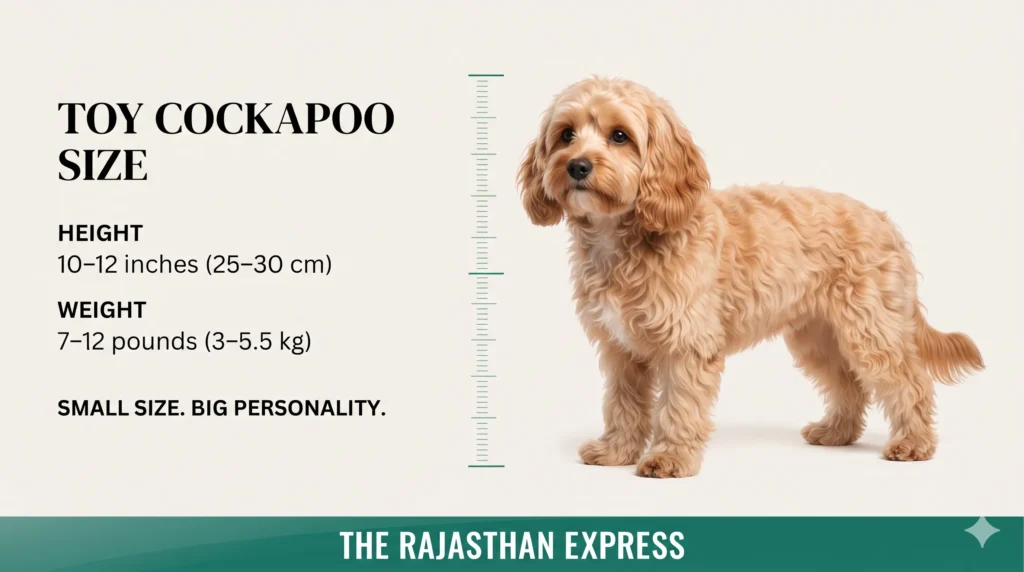
- The Toy Cockapoo is slightly larger than the Teacup. Its height is usually 10 to 12 inches (about 25 to 30 cm) . It is considered a playful‑tempered and attractive companion for families. It can adapt well to small homes or apartments, provided it gets daily play and walks.
Read More About :
- Cockapoo Generations: F1 Cockapoo, F1B Cockapoo, F2 & F2B Cockapoo
- What is the difference between Cockapoo and Cocker Spaniel?
How Big Does a Toy Cockapoo Get?
- The Toy Cockapoo is slightly larger than the Teacup. Its weight is between 7 to 12 pounds, i.e., about 3 to 5.5 kilograms.
- Toy Cockapoo Size, Height and Weight
- Toy Cockapoo Height: 10–12 inches (approximately 25–30 cm).
- Toy Cockapoo Weight: 7–12 pounds (approximately 3–5.5 kg).
What Is a Mini Cockapoo? (Miniature Cockapoo)
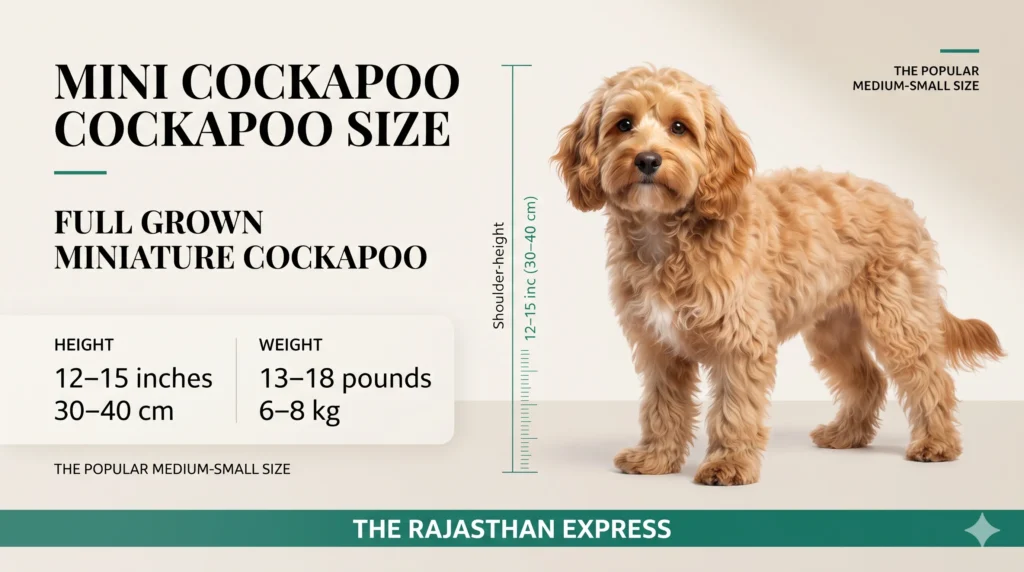
- This is the most common and popular type. Its height is usually 12 to 15 inches (about 30 to 40 cm) . This size gives a good balance of size and temperament. Neither too small nor too large. Therefore, most families prefer this category. It needs daily walks, play, and mental activity.
How Big Does a Mini Cockapoo Get? (Mini Cockapoo Size)
- This is the most common and popular type. The Mini Cockapoo’s weight is 13 to 18 pounds, i.e., about 6 to 8 kilograms.
- Mini Cockapoo Size, Height and Weight
- Mini Cockapoo Height: 12–15 inches (approximately 30–40 cm).
- Mini Cockapoo Weight: 13–18 pounds (approximately 6–8 kg).
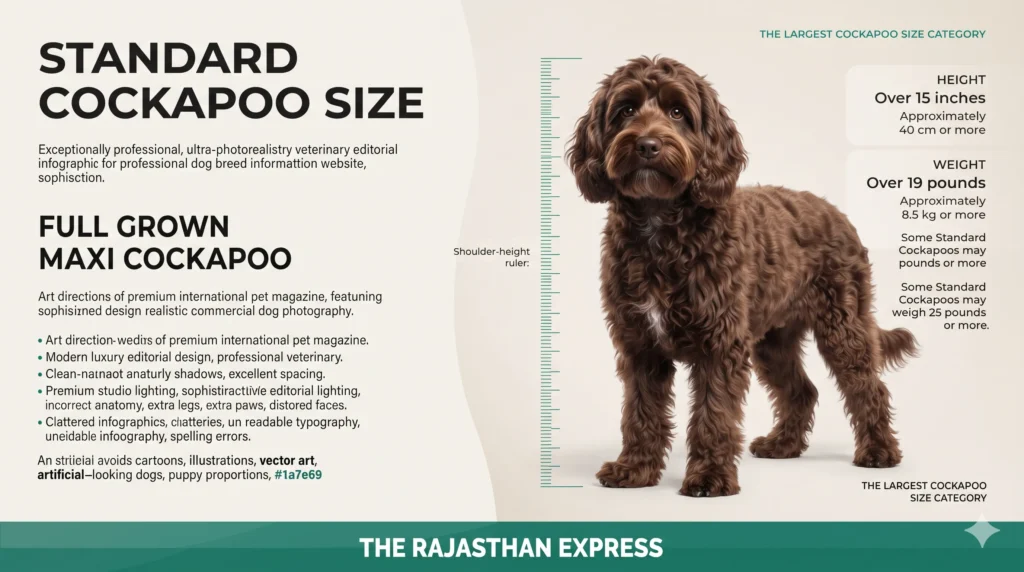
What Is a Standard Cockapoo? (Standard or Maxi Cockapoo)
- The Standard Cockapoo, also known as the Maxi Cockapoo, is the largest type.
- Its height can be more than 15 inches (about 40 cm) and weight more than 19 pounds (about 8.5 kg) . Some sources state 25 pounds or even more. Despite its large size, it can maintain its loving, friendly, and affectionate temperament. But due to its larger body, it may need more space, more food, and more exercise.
- Standard Cockapoo Size, Height and Weight
- Standard Cockapoo Height: Over 15 inches (approximately 40 cm).
- Standard Cockapoo Weight: Over 19 pounds (approximately 8.5 kg).
- Some Standard Cockapoos: May weigh 25 pounds or more.
When Is a Cockapoo Fully Grown? (Full Grown Cockapoo)
- Look, the Cockapoo usually becomes fully grown between 12 to 18 months of age. But this time depends on what size it is – Toy Cockapoo, Miniature Cockapoo, or Standard Cockapoo. Along with this, parents’ size, genetics, diet, and health also matter. Therefore, every Cockapoo does not grow at the same time.
When Do Cockapoo Height and Weight Stop Increasing?
- Height: Most Cockapoos reach their full height by 9 to 12 months of age.
- Weight: Weight gain can continue for a little longer. Some dogs may gain a little weight even up to 18 months of age. According to one study, adult weight is measured from the average after 18 months. That is, height stops first, weight continues to increase a little longer.
What Is the Full Grown Cockapoo Size?
The full grown Cockapoo size depends mainly on its size category and the genetics inherited from its parents.
According to the size estimates discussed above:
- A Teacup Cockapoo may weigh under 6 pounds.
- A Toy Cockapoo generally weighs 7–12 pounds.
- A Miniature Cockapoo / Mini Cockapoo generally weighs 13–18 pounds.
- A Standard Cockapoo or Maxi Cockapoo generally weighs over 19 pounds, with some weighing 25 pounds or more.
These are estimated ranges, not fixed measurements for every adult Cockapoo.
How Fast Do Cockapoos Grow?
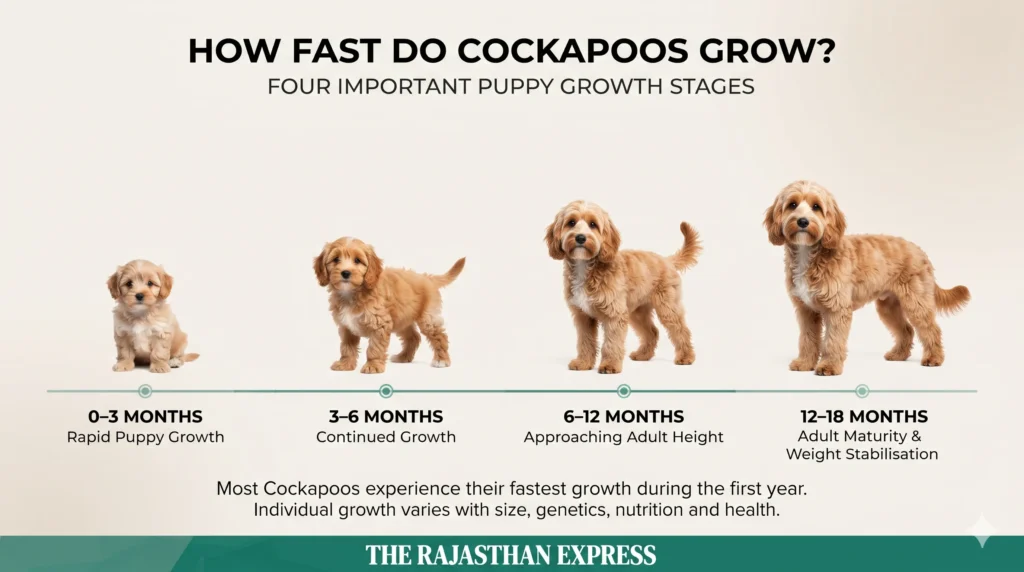
The fastest growth of a Cockapoo happens in the first year of its life.
Cockapoo Puppy Growth Stages
- 0–3 months – Rapid Puppy Growth: This is the fastest growth period. During this time, the puppy’s weight and size increase rapidly.
- 3–6 months – Continued Growth: Growth continues, but becomes slightly slower than before.
- 6–12 months – Approaching Adult Cockapoo Size : In this period, most Cockapoos reach close to their adult height and weight gain continues.
- 12–18 months – Full Grown Cockapoo : Most Cockapoos become fully mature by this age and their weight stabilises.
How Much Should a Cockapoo Weigh at Different Ages?
The chart below is only an estimate. Every dog is different, so do not consider it a fixed rule. The Cockapoo usually becomes fully grown in 12 to 18 months. Height almost stops in 9 to 12 months, while weight can increase a little up to 18 months. The chart is only an estimate; actual growth is different in every dog.
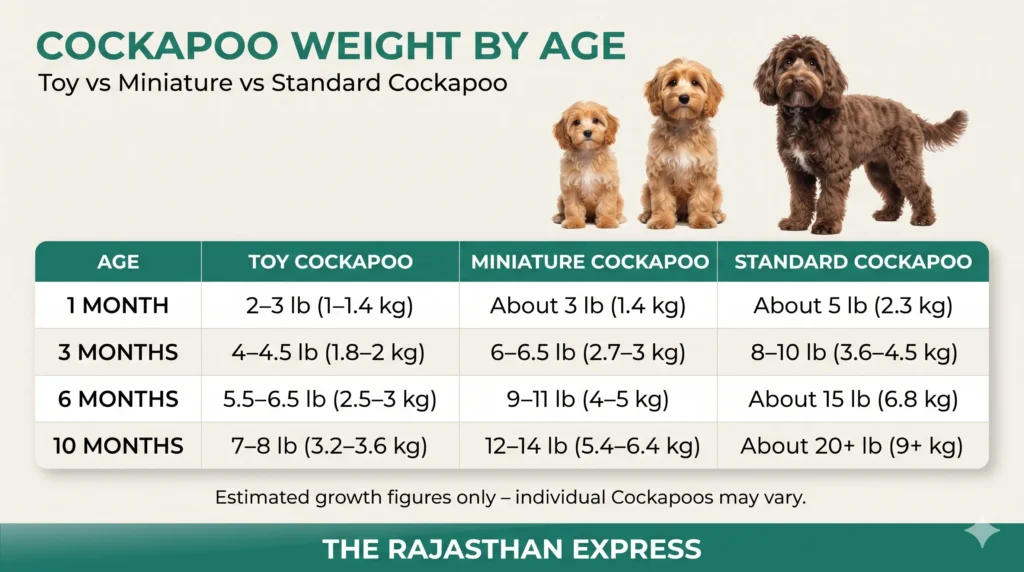
| Cockapoo Size Chart: Weight by Age | |||
| Age | Toy Cockapoo Weight | Miniature Cockapoo Weight | Standard Cockapoo Weight |
|---|---|---|---|
| 1 month | 2–3 pounds (about 1–1.4 kg) | About 3 pounds (1.4 kg) | About 5 pounds (2.3 kg) |
| 3 months | 4–4.5 pounds (1.8–2 kg) | 6–6.5 pounds (2.7–3 kg) | 8–10 pounds (3.6–4.5 kg) |
| 6 months | 5.5–6.5 pounds (2.5–3 kg) | About 9–11 pounds (4–5 kg) | About 15 pounds (6.8 kg) |
| 10 months | 7–8 pounds (3.2–3.6 kg) | About 12–14 pounds (5.4–6.4 kg) | About 20+ pounds (9+ kg) |
| The Rajasthan Express : Cockapoo Size Chart: Weight by Age | |||
Cockapoo Coat Types: What Are the Different Types of Cockapoo Coats?
The biggest and most beautiful identification of the Cockapoo is its coat. But understand one thing first – the Cockapoo’s coat is not uniform. Because it is a mixture of both the Cocker Spaniel and Poodle, and the hair texture of both is completely different. The Cocker Spaniel’s hair is straight and silky, while the Poodle’s hair is curly and dense. When the genes of both mix, each puppy receives qualities in different amounts. That is why Cockapoo puppies born in the same litter can have different hair. Some will have straight hair, some wavy, and some completely curly.
What Are the Different Cockapoo Coat Types? Cockapoo Coat Types
Do Cockapoos Have Curly or Wavy Hair?
- The Cockapoo’s coat can mainly be of three types. The Cockapoo’s hair is mainly of three types, which depend on which parent it inherited more qualities from. But Cockapoos can have curly hair and wavy hair.
1. Straight Cockapoo coat:
- In this, the hair is straight, flat, and silky like the Cocker Spaniel. This coat is less curly and the Cocker Spaniel’s influence is more clearly visible. Care of such a coat is slightly easier, but regular brushing is still necessary.
2. Wavy Cockapoo coat:
- This is considered the most common type. In this, the hair is soft, slightly wavy, and a little loose. It shows a balanced mixture of both parents’ qualities and gives the Cockapoo that lovely “teddy bear” appearance for which it is so popular.
3. Curly Cockapoo coat:
- In this, the hair is tight, dense, and curly like the Poodle. This coat demands the most care, because curly hair can tangle quickly and form mats. But it is considered low‑shedding.
Silky Coat Cockapoo
- Besides these, some Cockapoos also have a silky coat, in which the hair is very soft and smooth. It looks even more beautiful after grooming.
What the Cockapoo’s coat will be like cannot be decided just by generation names like F1, F1B, or F2. For this, the hair qualities of the parents, the genes inherited, and each dog’s own genetic variation are responsible.
Cockapoo Coat Length and Texture: What Type of Coat Does a Cockapoo Have?
What Type of Coat Does a Cockapoo Have?
- The Cockapoo’s hair can range from short to long. The Cockapoo’s coat is usually soft and dense. The hair can be long all over the body, on the legs, and around the muzzle (mouth). These long hairs give it the lovely teddy bear look. The hair can be loosely curly, but should not be too tight or kinky. If the hair is very tight and rough, it is not a sign of good health or proper grooming.
Do Cockapoos Shed? Do Mini Cockapoos Shed?
One of the most common questions people ask is, “Do Cockapoos shed?” Another frequently searched question is, “Do Mini Cockapoos shed?” The answer is that all Cockapoos, including the Mini Cockapoo, generally shed very little (low‑shedding) . This quality comes mainly from the Poodle.
The amount of shedding depends on the coat type: if the dog has a Poodle‑like curly coat, it will shed very little. On the other hand, if it has a Cocker Spaniel‑like straight or wavy coat, it will shed more compared to the curly coat.
Are Cockapoos Hypoallergenic Dogs?
- Cockapoos generally shed very little (low‑shedding) , which is why they are often called “hypoallergenic.” But the truth here is slightly different. According to experts, no dog is 100% allergy‑free.
- Allergies are not caused only by hair, but also by the dog’s dead skin layer (dander) and proteins present in saliva. Therefore, low shedding is definitely an advantage, but it is not a guarantee that allergies will be completely eliminated. If someone is allergic to dogs, they should definitely consult a veterinarian or allergy specialist before getting a puppy.
Are Cockapoos Good for People With Allergies?
- The direct answer to this question is – yes, but with conditions. The Cockapoo is often called a “hypoallergenic” dog, but this is not completely true. Let us understand this in detail.
What Is the Common Belief About Cockapoos and Allergies?
- People believe that since the Cockapoo sheds less hair, it is good for people with allergies. This is partially true, because due to Poodle genes, the Cockapoo gets a curly coat which reduces shedding. Less shedding also means fewer allergy‑causing particles spread in the house with the hair.
- According to veterinary experts, no dog is 100% hypoallergenic. The Cockapoo is no exception.
Allergies are mainly caused by the dog’s dander (dead skin layer) and proteins in saliva, not just hair. Hair only spreads those allergy particles in the house. Therefore, low shedding does not mean the dog has no dander or saliva on its body. When the dog licks itself, scratches, or moves, dander and saliva particles keep spreading in the air and on surrounding objects.
Cockapoo Grooming Requirements: How Much Grooming Does a Cockapoo Need?
- Clear up a very common misconception here. Low shedding does not mean low maintenance. Regular brushing is very necessary to prevent matting (tangles) in the Cockapoo’s coat, especially for Cockapoos with curly coats.
- If the hair is not brushed properly, it can tangle, damage the skin, and cause pain. Hair around the eyes should be trimmed regularly so that it does not obstruct vision and cleanliness is maintained around the eyes.
- Hair around the ears should also be trimmed from time to time, because moisture and dirt accumulate quickly in hanging ears.
Cockapoo Coat Colours: What Colours Do Cockapoos Come In?
People often ask, “What colours are Cockapoos?” The direct answer is that the Cockapoo can be in any colour found in the Poodle or Cocker Spaniel. Therefore, its list of colours is quite long.
Solid colours include black, white, cream, apricot (light orange like apricot), red, chocolate, silver, gold, and buff. These colours are uniform all over the body.
Common solid Cockapoo coat colours include:
- Black Cockapoo
- White Cockapoo
- Cream Cockapoo
- Apricot (a light orange shade) Cockapoo
- Red Cockapoo
- Chocolate Cockapoo
- Silver Cockapoo
- Gold Cockapoo
- Buff Cockapoo
Cockapoo Colours and Coat Patterns: What Is the Rarest Cockapoo Colour?
- Some people ask, “What is the rarest Cockapoo colour?” In the Cockapoo, the Merle coat pattern is counted among the rare and less commonly seen patterns. However, an interesting fact is that neither the Cocker Spaniel nor the Poodle has the merle gene, so a “true” merle Cockapoo is possible only due to a genetic mutation, which is extremely rare. Besides the Cockapoo, the merle gene is also found in Blue Merle Aussie & Aussiedoodle. Besides this, other rare patterned colours in the Cockapoo include several special designs.
- Parti-Colour Cockapoo: In parti‑color, there are spots of another colour on a white body.
- Phantom Cockapoo: In phantom, on a dark‑coloured body, there are lighter‑coloured markings on the face, legs, and chest.
- Merle Cockapoo: In merle, there is a spotted mixture of colours, often with blue or light spots. The merle pattern comes due to the merle gene. Besides this, the merle pattern is also found in Blue Merle Aussie. In reality, a Blue Merle Australian Shepherd is originally a black dog affected by the merle gene. This gene randomly lightens black into grey (blue‑grey) , while some parts remain completely black. This creates a marble‑like pattern of silver‑grey spots and black patches on the coat. In scientific language, this is pigment dilution caused by the merle gene.
- Roan Cockapoo: In roan, there is a uniform mixture of white and coloured hair, which looks like fine spots.
- Sable and Tricolour Cockapoo: Besides these, patterns like sable and tricolor are also seen. Some Cockapoos commonly have two‑colour combinations like black‑white, red‑white, and chocolate‑white.
Cockapoo Nose Colour: The nose colour is usually black or brown (liver) , which depends on the coat colour. Light‑coloured dogs may have a brown or liver‑coloured nose.
Do Cockapoo Puppies Change Colour as They Grow?
- Some people ask, “Why is my Cockapoo changing colour?” Here is an interesting and important thing – the Cockapoo keeps changing its coat colour over time. The Cockapoo’s coat colour can change with age. Especially in some dogs with Poodle genes, there is a tendency for the colour to lighten or fade. That is, a puppy that looks dark chocolate or black at birth may become light brown, grey, or silver as it grows. Therefore, the initial colour of the puppy cannot give a complete guarantee of its colour after growing up. If you are getting a puppy hoping for a particular colour, definitely ask the breeder about the parents’ colours and their previous litters.
Now let’s talk about what the Cockapoo looks like. Keep in mind, because it is a crossbreed, every Cockapoo will not be exactly the same. Some will show more Cocker Spaniel qualities, others more Poodle. But there are some things that are generally seen in the Cockapoo. Let us understand them one by one.
Cockapoo Physical Appearance: Head, Face, Eyes, Ears, Neck and Tail
Cockapoo Head and Face
- The Cockapoo’s head is moderately round. That is, neither too prominent nor completely flat. Looking at it, it feels like a cute round balloon covered with a layer of soft hair.
Cockapoo Eyes and Nose
- Its eyes are large, round, and well‑set. Most Cockapoos have dark brown eyes, but if the nose is light‑coloured, the eyes can also be light – hazel or green. The expression of the eyes looks very loving and intelligent. As if the dog is looking at you and saying, “I understand!”
Cockapoo Ears: Why Do Cockapoos Have Floppy Ears?
- The ears are the most special identification of the Cockapoo. These are long, hanging, and very soft. The ears start from the top of the head and hang down even below eye level. They have good hair (feathering) . These ears should never be erect. This quality comes from the Cocker Spaniel and is the Cockapoo’s identification.
Cockapoo Neck, Body and Tail
- Cockapoo Neck :
- The neck rises strongly from the shoulders and is slightly arched. It is held proudly high. There should be no loose skin on the neck.
- Cockapoo Tail :
- The tail is of medium length and set along the back line. While moving, it is held straight or slightly curved and its movement looks very cheerful. Earlier, some owners used to dock the tail, but now undocked tails are more preferred.
- The Cockapoo looks like a cute teddy bear. The reason is its dense, soft, and wavy or curly coat. In puppies, the paws often look large and out of proportion to the body, which makes them even more adorable. Its round head, big lovely eyes, and long hanging ears together create a very attractive appearance.
Cockapoo Temperament, Personality, Grooming, Exercise & Feeding Guide
Now let’s talk about the Cockapoo’s temperament. This is the part that determines whether the Cockapoo is right for your home or not. Because being cute in appearance is one thing, and being good in temperament is another. The Cockapoo is generally considered a very friendly, loving, and intelligent dog. But always remember one thing here – it is a crossbreed, so every Cockapoo’s temperament will not be the same. Some will show more Cocker Spaniel qualities, others more Poodle.
Cockapoo Temperament and Personality: What Is a Cockapoo’s Temperament Like?
- The Cockapoo is generally considered a friendly, affectionate, intelligent, playful and people-oriented companion dog.
- It often enjoys spending time with its family, playing with people and learning new activities. However, not every Cockapoo will have exactly the same personality.
Are Cockapoos Good With Children?
- The Cockapoo is usually a very friendly and social dog. If it is introduced to different people, animals, and environments from a young age, it mingles easily with family members and familiar people. It does not fear strangers, but likes to make friends. That is why it is considered a good family dog.
Are Cockapoos Good Family Dogs?
- Cockapoos are considered good family dogs because the Cockapoo attaches very quickly to its family members. It loves to spend time with the family, stay around them, and play with them. If you are at home, it will keep following you. If you sit, it will want to sit in your lap or near you. This is its way of showing love.
Are Cockapoos Intelligent Dogs?
- Yes, Cockapoos are intelligent dogs. Due to Poodle genes, the Cockapoo has good learning ability. It can quickly learn basic commands, house rules, and some interactive activities. It is also good at problem‑solving.
- Like, if a toy is stuck somewhere, it finds a way to take it out. Because of its intelligence, it needs mental work. It is not satisfied with just physical exercise. Puzzle toys, new commands, and scent‑finding games are very good for it.
Are Cockapoos High-Energy Dogs?
The Cockapoo cannot be called a completely “high‑energy” or completely “relaxed” dog. It is a medium to high energy breed.
Their energy level depends on which parent they received more qualities from:
- If the Poodle quality is more dominant: The Cockapoo can be slightly calmer, more controlled, and plays thoughtfully.
- If the Cocker Spaniel quality is more dominant: The Cockapoo can be more enthusiastic, lively, sniffing and exploring everything, and continuously active.
Are Cockapoos Easy to Train?
- Yes, training a Cockapoo is easy because the Cockapoo responds well to positive training – teaching with love and rewards. Food rewards, praise, and regular training sessions make its learning process easier. Teaching it by shouting or hitting is not right. This can make it fearful or stubborn. Taught with love, it learns quickly and remains happy.
Do Cockapoos Get Along With Other Dogs and People?
- If it is socialised properly, it behaves well with other dogs and familiar people. But every dog’s behaviour depends on its genetics, early experiences, and training. Therefore, it is very important to introduce the puppy to different people, animals, sounds, and places from a young age.
Can a Cockapoo Be Left Alone? Separation Anxiety in Cockapoos
- The Cockapoo can develop a very deep attachment to its family. Therefore, when left alone for long periods, some dogs may develop problems like barking, restlessness, chewing things, or creating mischief in the house. This is called separation anxiety. Therefore, the puppy should be gradually habituated to being alone from the beginning. If you stay out of the house for long periods during the day, then the Cockapoo may not be right for you.
Do Cockapoos Bark a Lot?
- Some Cockapoos may bark more when alert or excited. Like when someone comes to the door or when they are very excited in play. The Cockapoo is less energetic compared to other dogs. Generally, the Cockapoo is a companion dog, created to live with the family.
Do Cockapoos Have a High Prey Drive?
- Due to the Cocker Spaniel’s hunting quality, some Cockapoos may have a tendency to chase birds or small moving animals. Therefore, do not leave it off‑leash in open spaces, especially until it has been well trained in “come back” (recall training) .
Bordoodle Temperament vs Cockapoo Temperament: What Is the Difference?
If we compare the Cockapoo with the Bordoodle, there is a big difference between the two.
Bordoodle Temperament
- The Bordoodle is a mix of Border Collie and Poodle, so it has more passion for work and herding instinct. It can be more energetic, wanting more mental challenge, and sometimes stubborn.
Cockapoo Temperament
- On the other hand, the Cockapoo is a mix of Cocker Spaniel and Poodle, so it can be comparatively calmer, more loving, and one that sits with the family.
If the Bordoodle does not get mental work, it can learn wrong things. The Cockapoo also needs mental work, but its energy is slightly lower. Both have a deep attachment to their owners and do not like being alone. Therefore, both should be habituated to being alone from childhood.
What Is the Cockapoo’s Temperament Like Overall?
- So overall, the Cockapoo is a friendly, loving, intelligent, playful, and family‑centered dog. It is good with children, quick to learn, and likes to spend time with its people.
- But it does not like loneliness, it needs mental exercise, it is necessary to socialise it from the beginning, and its barking and prey drive should be controlled through training. If you give it time, love, training, and the right environment, it can become the best companion of your family. But if you stay out of the house for long periods and cannot give the dog much time, then the Cockapoo will not be right for you.
Cockapoo Care Guide: Grooming, Exercise and Feeding
The Cockapoo is a loving, intelligent, and energetic designer dog, created from the crossbreed of the Cocker Spaniel and Poodle. Looking at it, it feels like a walking teddy bear. If brushing and grooming are not done on time, the hair tangles and forms mats, which can be very painful for the dog. Therefore, keeping a Cockapoo means – regular effort, some expense, and a lot of love.
Cockapoo Grooming: Coat Care and Maintenance
- The biggest speciality of the Cockapoo’s coat is that it sheds less, but keeps growing continuously. Due to Poodle genes, its coat can be curly, wavy, or straight. Care is also different according to each coat type.
How Often Should You Groom a Cockapoo?
Brushing is the most important part of Cockapoo grooming. If you ignore it, the hair will tangle near the skin and the dog will remain troubled. The frequency of brushing depends on the coat type:
- Curly Coat: Brush such Cockapoos daily. Curly hair tangles quickly and forms mats underneath.
- Wavy or Fleece Coat: These should be brushed every 1 to 2 days.
- Straight Coat: Brushing 2 to 3 times a week may be sufficient, but regularity is still necessary.
Which Brush Is Best for a Cockapoo?
- For brushing, use both a slicker brush and a metal comb. The best technique is “line‑brushing”. In this, you divide the hair into different sections down to the skin and brush from bottom to top. This removes tangles near the skin, and the coat looks clean from the outside without knots forming inside.
How Often Should a Cockapoo Visit a Professional Groomer?
- Besides brushing at home, the Cockapoo should be taken to a professional groomer every 6 to 8 weeks. There, bathing, trimming, and nail clipping are done.
What Is the Best Haircut for a Cockapoo?
- The most popular cut for the Cockapoo is the “Teddy Bear Cut”, in which the face is kept round and the body hair is kept 1 to 2 inches long. This cut makes it very attractive, but regular grooming is necessary to maintain it.
How Often Should a Cockapoo Be Bathed?
Bathe the Cockapoo once every 3 to 4 weeks, or when it really gets dirty. Bathing too much is also not good for the skin. After bathing, dry the coat well and then brush it thoroughly again, so that the hair does not tangle.
Cockapoo Ear, Eye and Nail Care
- Cockapoo ear cleaning: The Cockapoo’s ears are hanging, so dirt and moisture accumulate quickly in them. Check and clean the ears once a week. If there is smell from the ear, it looks red, or the dog scratches its ear repeatedly, show it to the doctor.
- Cockapoo eye care: Trim the hair around the eyes regularly, so that it does not get into the eyes and cause vision problems. Watering or redness in the eyes is not normal – do not ignore it.
- Cockapoo nail trimming: Cut nails every 2‑3 weeks. Long nails cause pain while walking.
Cockapoo Exercise Needs: How Much Exercise Does a Cockapoo Need?
The Cockapoo is very energetic. It should play and run daily. If it does not get sufficient exercise, it gets bored and may start barking, chewing, or creating mischief in the house.
How Much Exercise Does a Cockapoo Need Per Day?
- A large Cockapoo needs about 60 minutes of physical activity daily. This can be split into 30 minutes in the morning and 30 minutes in the evening. Some more energetic Cockapoos may need 1 to 2 hours. This depends on the dog’s age, size, and energy.
- Cockapoo Daily Exercise Routine
- A balanced Cockapoo exercise routine can include:
- Morning walking
- Evening walking
- Fetch and outdoor play
- Interactive toys
- Basic obedience training
- Scent-finding games
- Combining walking, play and training gives your dog opportunities for both physical activity and mental stimulation.
Is Walking Enough Exercise for a Cockapoo?
- Just walking is not enough. The Cockapoo is intelligent, so give it thinking games. Fetch, puzzle toys, finding hidden things, and basic training (like sit, come) are very good. Games like agility are also great for them.
Cockapoo Puppy Exercise: Special Care for Growing Puppies
- Puppies’ bones and joints are still weak. Do not make them run too much or too hard. If the puppy starts panting a lot, sits down, or refuses to walk, understand that it is tired. Reduce play accordingly.
Cockapoo Feeding Guide: Food, Nutrition and Daily Feeding Schedule
Feed the Cockapoo according to its age, size, and activity. Special attention needs to be paid to their stomach and joints.
What Is the Best Food for a Cockapoo?
Good quality protein is necessary – 25 to 30 percent of total food. This is good for muscles and hair. Fat should be 12 to 15 percent. It should contain Omega‑3 fatty acids (like fish oil), which make the skin and hair shiny.
How much should a Cockapoo eat? And How Many Times a Day Should You Feed a Cockapoo?
- Puppies: From 8 weeks to 6 months, feed 3‑4 times a day in small amounts. From 6 months to 1 year, reduce to 2‑3 times.
- Adult Cockapoos: Feed 2 times a day. A Cockapoo weighing about 7 kg may need 1 to 1.5 cups of dry food (kibble) daily. But this can change according to the dog’s activity and body.
How to Choose the Best Dog Food for a Cockapoo
- Choose food where the first ingredient is clearly meat – like chicken or salmon. Grain or by‑products as the first ingredient are not considered good. If the dog has skin or stomach problems, give hypoallergenic or limited‑ingredient food on the doctor’s advice. Supplements like glucosamine and chondroitin can be beneficial for joints, but give them only on the doctor’s advice.
Cockapoo Weight Management: How to Prevent Obesity
- The Cockapoo has a tendency towards obesity. Do not let it become fat. Seen from above, the waist should be visible and the ribs should be felt with a light hand. If the ribs are not visible or the waist seems missing, reduce food and consult the doctor.
Cockapoo Types: F1 Cockapoo, F1B Cockapoo, F2 Cockapoo & F2B – The Rajasthan Express
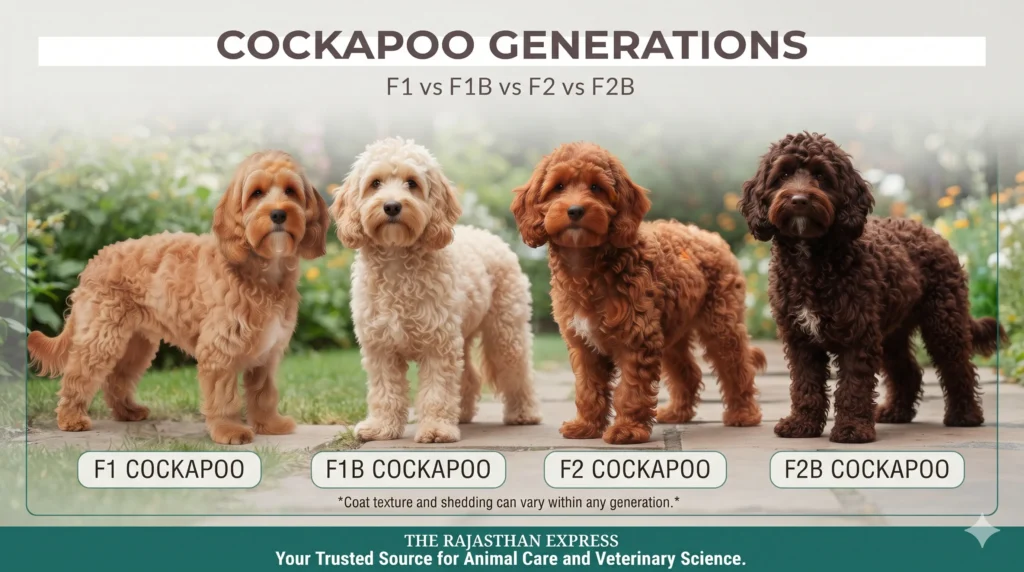
The Cockapoo is a crossbreed (hybrid) dog. It is created by crossbreeding the Cocker Spaniel and Poodle. Since it is not a pure breed, different generations are seen in its breeding. Understanding these generations is important because it reveals who the puppy’s parents are, what the estimated share of Cocker Spaniel and Poodle is in it, and what can be expected regarding its coat, shedding, temperament, and health.
The percentages given in generation names, such as 50%‑50% or 75%‑25% , are only paper‑based ancestry, i.e., pedigree‑based expected ancestry. These are not an exact measure of every gene, every physical trait, or temperament of a puppy. Puppies born in the same litter can also receive different genes. Therefore, it is wrong to assume that an F1B puppy will 100% shed less or that an F1 puppy will always have a wavy coat. No generation guarantees any trait completely.
What Are Cockapoo Generations?
- F means Filial, i.e., offspring or generation.
- F1 means the first offspring of parents of two different pure breeds.
- F1B means crossing the F1 Cockapoo back with one of its original breeds – Cocker Spaniel or Poodle. This is called Backcross.
- F2 means crossing two F1 Cockapoos with each other.
- F3 or Multi‑generational means continuing to cross Cockapoos with Cockapoos for many generations.
1. F1 Cockapoo – What Is an F1 Cockapoo?
What is an F1 Cockapoo?
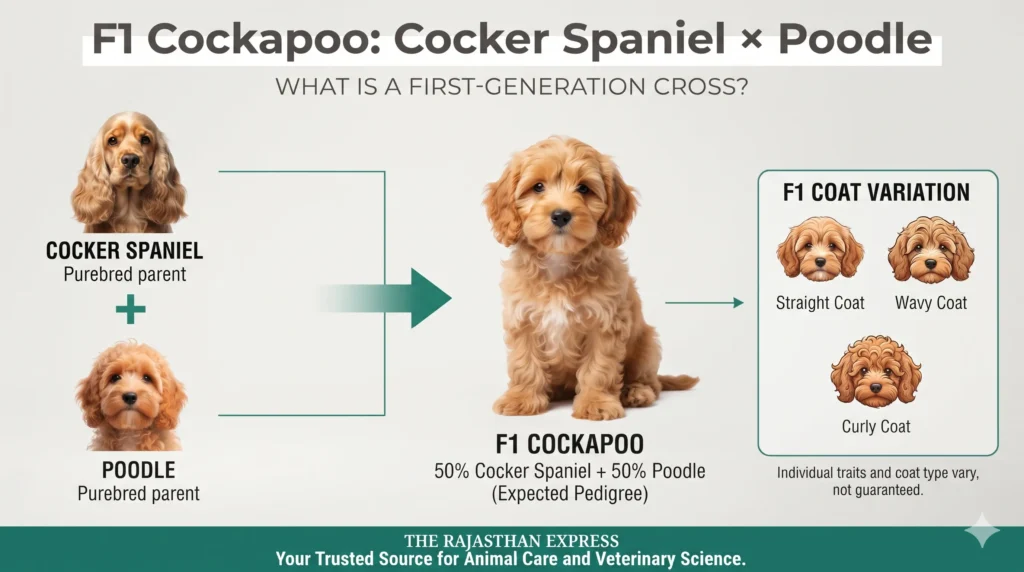
- An F1 Cockapoo is created when a pure Cocker Spaniel and a pure Poodle are directly crossbred. Its estimated ancestry is approximately 50% Cocker Spaniel and 50% Poodle.
- This is considered the most common and oldest cross. It shows a mixture of qualities from both parents. The coat can be straight, wavy, or slightly curly. Puppies with different coats can be found in the same litter. Shedding can generally be medium to low, but may be lower if a Poodle‑like curly coat is inherited. The temperament is affectionate, playful, and friendly. Some may show Cocker Spaniel‑like sensitivity and others Poodle‑like sharp intelligence.
- Advantage of F1:
- It can show a balanced mixture of both breeds and is generally considered to have good health potential.
- Drawback:
- It is difficult to predict the coat and shedding. Puppies in the same litter can look very different. It is not always the best option for people with allergies.
2. F1B Cockapoo – What Is an F1B Cockapoo?
What is an F1B Cockapoo?
- An F1B Cockapoo is created when an F1 Cockapoo is crossed back with one of its original breeds. This is called Backcross. There are two main types.
F1B Poodle Backcross
- In this, the F1 Cockapoo is crossed with the Poodle. The estimated ancestry is approximately 25% Cocker Spaniel and 75% Poodle.
- Advantage: The possibility of a more curly and low‑shedding coat increases. It is often considered a better option for people with allergies. It can receive more Poodle‑like sharp intelligence and training ability.
- Drawback: There is a higher risk of matting (tangles) in the curly coat. Regular brushing and professional grooming become very necessary. Some puppies may also have a more sensitive or irritable Poodle‑like temperament.
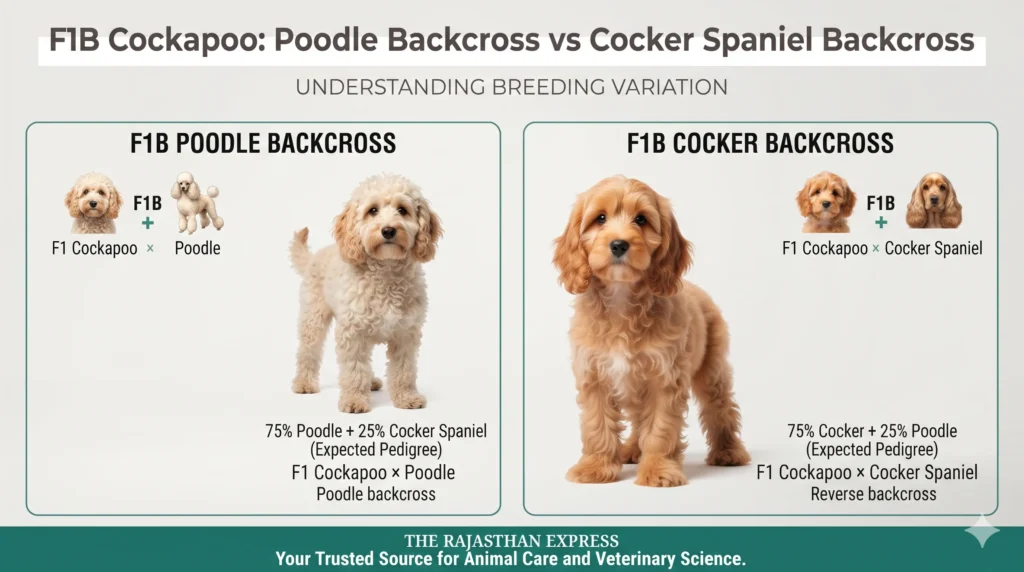
F1B Cocker Spaniel Backcross
- In this, the F1 Cockapoo is crossbred with the Cocker Spaniel. The estimated ancestry is approximately 75% Cocker Spaniel and 25% Poodle. It is sometimes also called F1 Reverse B or Reverse Backcross.
- Advantage: It can have a more affectionate, calm, and family‑oriented Cocker Spaniel‑like temperament. The coat can be more silky and wavy. The ears and face can show beautiful Cocker‑like features.
- Drawback: Shedding can be higher than the Poodle backcross. The risk of Cocker Spaniel‑related ear problems and skin allergies can increase. It is not always ideal for people with allergies.
What is the difference between F1 and F1B Cockapoo?
The main difference between F1 and F1B Cockapoo is their parents and the genes received from them. F1 is the first generation, while F1B is prepared by crossing the F1 Cockapoo back with the Poodle.
1. F1 Cockapoo (First Generation)
- The F1 Cockapoo is produced by crossing a pure Cocker Spaniel and a pure Poodle.
- It has approximately 50‑50% genes of both parents.
- Its hair can be straight, wavy, or curly. Differences can be seen even in the hair of puppies from the same mother.
- It is difficult to predict how much it will shed. Some shed less, some more.
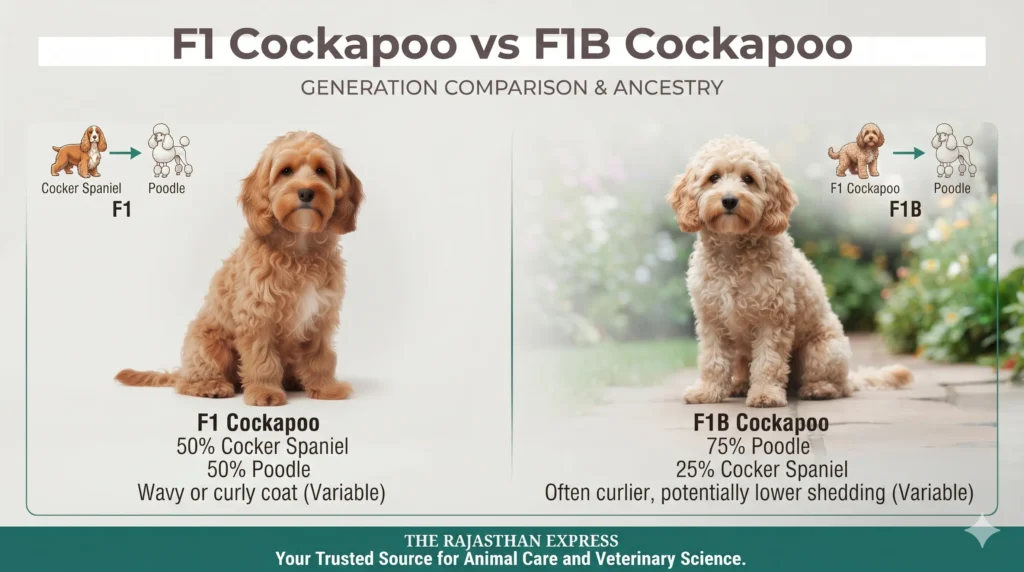
2. F1B Cockapoo (Second Cross with Poodle)
- To prepare an F1B Cockapoo, the F1 Cockapoo is crossed again with a pure Poodle. This is called Backcross.
- It has approximately 75% Poodle and 25% Cocker Spaniel genes.
- Its hair is often more curly and shedding may be less.
| F1 vs F1B Cockapoo: What Is the Difference? | ||
| Feature | F1 Cockapoo | F1B Cockapoo |
|---|---|---|
| Cross | Cocker Spaniel × Poodle | F1 Cockapoo × Poodle |
| Poodle Genes | Approximately 50% | Approximately 75% |
| Cocker Spaniel Genes | Approximately 50% | Approximately 25% |
| Hair Texture | Straight, wavy, or curly | Often more curly |
| Shedding | Can be low or high | Generally can be lower |
| Grooming | Regular need | Regular and possibly more care needed |
| The Rajasthan Express : F1 vs F1B Cockapoo: What Is the Difference? | ||
3. F1BB Cockapoo
- An F1BB Cockapoo is created when an F1B Cockapoo (which is a Poodle backcross) is crossbred again with the Poodle. The estimated ancestry is approximately 12.5% Cocker Spaniel and 87.5% Poodle.
- This is considered the most Poodle‑like Cockapoo. The coat can be very curly and low‑shedding. It can be a strong option for people with allergies, but it is not 100% allergy‑free. Grooming is needed a lot. Curly hair tangles quickly, so daily brushing and professional grooming every 6‑8 weeks may be necessary. The temperament may show Poodle‑like sharp intelligence, activeness, and sometimes sensitivity.
- F1BB is good for people who want a low‑shedding dog and who can give the time and expense for regular grooming.
4. F2 Cockapoo – What Is an F2 Cockapoo?
What is an F2 Cockapoo?
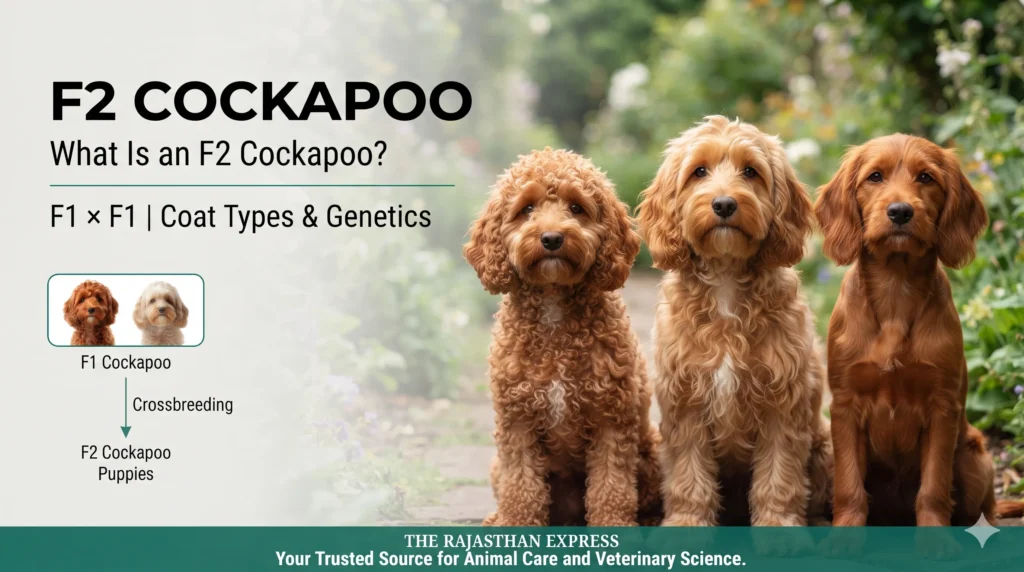
- An F2 Cockapoo is created when two F1 Cockapoos are crossbred with each other. The estimated ancestry is approximately 50% Cocker Spaniel and 50% Poodle.
- In appearance, it may look like F1, but internally it can be much more diverse. The genes of both F1 parents mix in different ways, so in the same litter, some puppies can be very curly, some with straight hair, some more Cocker‑like, and some more Poodle‑like. Coat, shedding, size, and temperament are the hardest to predict. Some puppies may have stronger Poodle or Cocker Spaniel qualities.
- The biggest drawback of F2 is that it can be risky for allergy‑prone families, because shedding and coat cannot be predicted.
5. F2B Cockapoo – What Is an F2B Cockapoo?
What is an F2B Cockapoo?
- An F2B Cockapoo is created when an F2 Cockapoo is crossed again with the Poodle or Cocker Spaniel. This is the same principle as F1B, but because of F2’s instability, the results can be even more uncertain. In the Poodle backcross, the possibility of low shedding increases. In the Cocker backcross, a more affectionate and Cocker‑like appearance can be obtained.
What is the difference between F1 and F2 Cockapoo?
The biggest difference between F1 and F2 Cockapoo is their parents. F1 is the first generation, in which a direct cross of Cocker Spaniel and Poodle is made. Whereas in F2, two F1 Cockapoos are crossed with each other.
1. F1 Cockapoo (First Generation)
- The F1 Cockapoo is produced by crossing a pure Cocker Spaniel and a pure Poodle.
- It has approximately 50‑50% genes of both parents.
- Its hair can be straight, wavy, or curly.
- Its temperament and hair texture can show qualities of both parents, but these qualities are not the same in every puppy.
2. F2 Cockapoo (Second Generation)
- An F2 Cockapoo is produced when two F1 Cockapoos are crossed with each other.
- It also has an average genetic share of approximately 50% Cocker Spaniel and 50% Poodle.
- But predicting the hair texture, colour, size, and temperament of its puppies can be a little difficult.
- For example, one puppy from the same mother may have more curly hair, while another may have wavy or relatively straight hair. Similarly, there can be differences in the amount of shedding.
Why is this difference seen in F2?
- The reason is that the genes received from both parents mix in different ways. In the F2 generation, new combinations of genes are formed. Therefore, some puppies may show more Cocker Spaniel qualities, while others may show more Poodle qualities.
6. F3 and Multi‑generational Cockapoo
What is a Multigenerational Cockapoo?
- F3 is created when two F2 Cockapoos are crossed, or F2 is crossed with F1B. Multi‑generational means continuing to cross Cockapoos with Cockapoos for many generations.
- Over time, some qualities can become stable, such as coat type or size. But this is not a complete guarantee. Do not assume just by hearing the name “Multi‑generational” that the dog will automatically be healthier or better; parents’ health testing and the breeder’s credibility are more important.
Which Cockapoo generation sheds the least hair?
- F1B Cockapoo (which is crossed back with the Poodle) generally has the highest likelihood of low shedding.
- Why?
- F1B Cockapoo has approximately 75% Poodle and 25% Cocker Spaniel genes. Because of more Poodle genes, its hair is often more curly and may shed less.
- F1BB Cockapoo: In this, the share of Poodle genes can increase further. Therefore, it may also have a higher likelihood of low shedding.
- Important point:
- Being F1B or F1BB does not mean the dog’s hair will not shed at all. Every dog sheds some hair and dead skin cells (dander). Therefore, no Cockapoo is completely hair‑free or allergy‑free.
Cockapoo Generations : F1 Cockapoo Vs F1B Cockapoo Vs F2 Cockapoo Vs F2B Cockapoo
| Cockapoo Generations Comparison Table | ||||
| Generation | Breeding Combination | Estimated Ancestry | Key Point | Suitable For |
|---|---|---|---|---|
| F1 Cockapoo | Cocker Spaniel × Miniature Poodle | 50% + 50% | Balanced mix, more diversity | General families, first-time owners |
| F1B Cockapoo (Poodle) | F1 Cockapoo × Poodle | 25% + 75% | More curly, less shedding | Allergy sufferers, those wanting less shedding |
| F1B Cockapoo (Cocker) | F1 Cockapoo × Cocker Spaniel | 75% + 25% | More Cocker-like, affectionate | Those wanting a calm, family companion |
| F1BB Cockapoo | F1B × Poodle | 12.5% + 87.5% | Very curly, very low shedding | Experienced owners with time for grooming |
| F2 Cockapoo | F1 × F1 | 50% + 50% (estimated) | Much more diversity | Only experienced owners who can handle uncertainty |
| F2B Cockapoo | F2 × Poodle/Cocker | According to backcross | Mixed, uncertain | On the advice of a specialist breeder |
| F3 Cockapoo / Multi-generation Cockapoo | Cockapoo × Cockapoo, many generations | Around 50/50 | Some qualities may become stable | Advanced owners wanting a predictable puppy |
| The Rajasthan Express : Cockapoo Generations Comparison Table | ||||
Which Cockapoo generation is the best?
Which Cockapoo generation is best depends on your needs. If you want a dog that shows good qualities of both the Cocker Spaniel and Poodle, then the F1 Cockapoo can be a good option. On the other hand, if you want the dog’s hair to shed less, then the F1B Cockapoo may be better for you.
1. F1 Cockapoo (Mix of Both Parents)
- The F1 Cockapoo is produced when a pure Cocker Spaniel and a pure Poodle are crossed with each other. It has approximately 50‑50% of both parents.
- It can show the Cocker Spaniel’s friendly and loving temperament.
- At the same time, like the Poodle, it can also be intelligent and quick to learn.
2. F1B Cockapoo (Higher Chance of Low Shedding)
- If you want your dog’s hair to shed less, then the F1B Cockapoo can be a good option. To create it, the F1 Cockapoo is crossed again with the Poodle.
- It has approximately 75% Poodle and 25% Cocker Spaniel genes.
- Because of more Poodle genes, its hair can be more curly and low‑shedding.
- It can be a good option for people who want to reduce the trouble of dog hair shedding in the house.
Explore Cockapoo generations, including F1, F1B, F1BB, F2 and F2B Cockapoo types. Learn their differences, ancestry, coat types and shedding.
Cockapoo Generations: F1 Cockapoo, F1B Cockapoo, F2 & F2B Cockapoo – The Rajasthan Express
Cockapoo Price in 2026–2027: Puppy Cost in the USA, UK, Australia, Canada & India
The Cockapoo is today a popular designer dog in countries like America, Britain, Australia, and Canada. It is prepared from the crossbreed of the Cocker Spaniel and Poodle. Its attractive face, friendly temperament, different types of coat, and tendency to bond quickly with the family make it a favourite for many people. But while buying a Cockapoo, looking only at the price or appearance is not enough. It is a crossbreed, so it has no single official breed standard and every puppy’s qualities are not the same. Cockapoo price depends on the breeder’s reliability, parents’ health testing, the puppy’s generation, coat, age, early care, and the country of purchase.
Cockapoo Price in 2026–2027: How Much Does a Cockapoo Cost?
The Cockapoo’s price is not decided just by colour or appearance. Many things affect it:
- What kind of breeder it is: A good breeder gets the parents’ health tests done, keeps the puppies in a clean environment, and gives records of vaccination and care. Such puppies can be expensive. Cheap breeders do not provide all these things.
- The puppy’s generation: Names like F1 Cockapoo , F1B Cockapoo , F1BB Cockapoo , F2 Cockapoo tell how much Cocker Spaniel and Poodle mix is in the puppy. In some markets, F1B or multi‑generational puppies can be more expensive, but this is not always necessary.
- Coat, colour, and size: Curly hair, special colours, or small‑sized puppies may be in higher demand. But do not blindly trust claims like “zero shedding” or “100% allergy‑free”.
- Age and training: A young puppy can be cheaper. A young dog with some training or a fully trained dog can be expensive.
- Health testing and records: Parents’ eye, joint, and genetic disease tests, puppy’s vaccination, deworming, and veterinary examination – all these add to the price.
- Country and source of purchase: Demand and availability are different in every country, so the price is also different.
Estimated prices in different countries
These are only estimated rates, not any fixed or government price.
Cockapoo Price in the USA
- How much is a Cockapoo in America?
- In America, the price of a Cockapoo puppy from a responsible breeder is usually between $1,500 and $2,700. Some lower‑priced listings can be found between $800 and $1,500, while in some expensive breeding programmes, the puppy’s price can be more than $3,000.
Cockapoo Price in the UK
How much does a Cockapoo puppy cost in the UK?
- In Britain, the normal price of a Cockapoo puppy can be seen at around £700 to £1,200. Puppies from good breeders with health testing can cost around £1,000 to £1,800 or more.
- In a marketplace analysis in November 2026, based on 6,978 listings, the average price was stated as £939.
Cockapoo Price in Australia
How much does a Cockapoo cost in Australia?
- In Australia, the Cockapoo is also called Spoodle. Here its price can be around AUD $3,000 to $6,500. The price depends on the breeder’s reputation, health testing, puppy’s size, and availability.
Cockapoo Price in Canada
How much does a Cockapoo puppy cost in Canada?
- In Canada, a practical estimate of a Cockapoo puppy’s price is around CAD $1,800 to $3,500. While buying a puppy from a good breeder, definitely see health testing, vaccination, and parents’ records. Some breeders’ prices can be higher than this.
Cockapoo Price in India
How much does a Cockapoo puppy cost in India?
- The Cockapoo is still less common. Normal local listings can be from ₹35,000 to ₹60,000. Puppies with better care and health records can be ₹60,000 to ₹1,20,000 or more.
What Is the Cheapest Price of a Cockapoo?
- If the budget is low and you want a Cockapoo, you can get one through rescue or adoption. In America, through rescue or adoption, a Cockapoo can be brought home for an adoption fee of about $50 to $500. In some rescue organisations, this fee can be $450 to $700.
F1B Cockapoo Price: How Much Does an F1B Cockapoo Cost?
- In America, the price of an F1B Cockapoo can be estimated at around $1,500 to $3,000. Some breeders may ask more than this.
- In an F1B Cockapoo, the F1 Cockapoo is usually crossed again with a Poodle. This gives the puppy an expected Poodle ancestry of about 75%. But being F1B does not mean its coat will always be curly or its hair will shed very little.
Mini Cockapoo Price: How Much Does a Mini Cockapoo Cost?
In America, the price of a Mini Cockapoo can usually be around $1,500 to $2,500. If small‑sized puppies are in higher demand, their price can increase. However, there is no single official size limit for the Mini Cockapoo, and just having the name Mini does not make the puppy expensive.
| Cockapoo Puppy Price by Country: 2026–2027 Comparison | ||
| Country | Estimated Normal Market Price | Estimated Price from a Good Breeder |
|---|---|---|
| USA | $800–$1,500 | $1,500–$2,700 |
| UK | £700–£1,200 | £1,000–£1,800 |
| Australia | AUD 3,000–4,500 | AUD 3,500–5,500 |
| Canada | CAD 1,800–2,500 | CAD 2,300–3,500 |
| India | ₹35,000–₹60,000 | ₹60,000–₹1,20,000 |
| Note: These are estimated price ranges, not any country’s official or fixed price. The actual price can change according to city, breeder, availability, health testing, and the puppy’s characteristics. | ||
| The Rajasthan Express : Cockapoo Puppy Price by Country (2026–2027) | ||
What to keep in mind while buying?
- See the puppy’s mother and get information about her health and behaviour.
- Ask for the parents’ health testing and genetic test reports.
- See the puppy’s vaccination and deworming record.
- Do not send money just by looking at photos.
- Do not blindly trust claims like “100% hypoallergenic” or “absolutely no hair will shed”.
- Before paying more for a merle‑coloured puppy, definitely ask about the parents’ information and DNA testing.