 By
ByBlue Merle Aussie: Blue Merle Australian Shepherd History, Origin, Characteristics and Genetics
What Is a Blue Merle Australian Shepherd? Blue Merle Aussie Explained
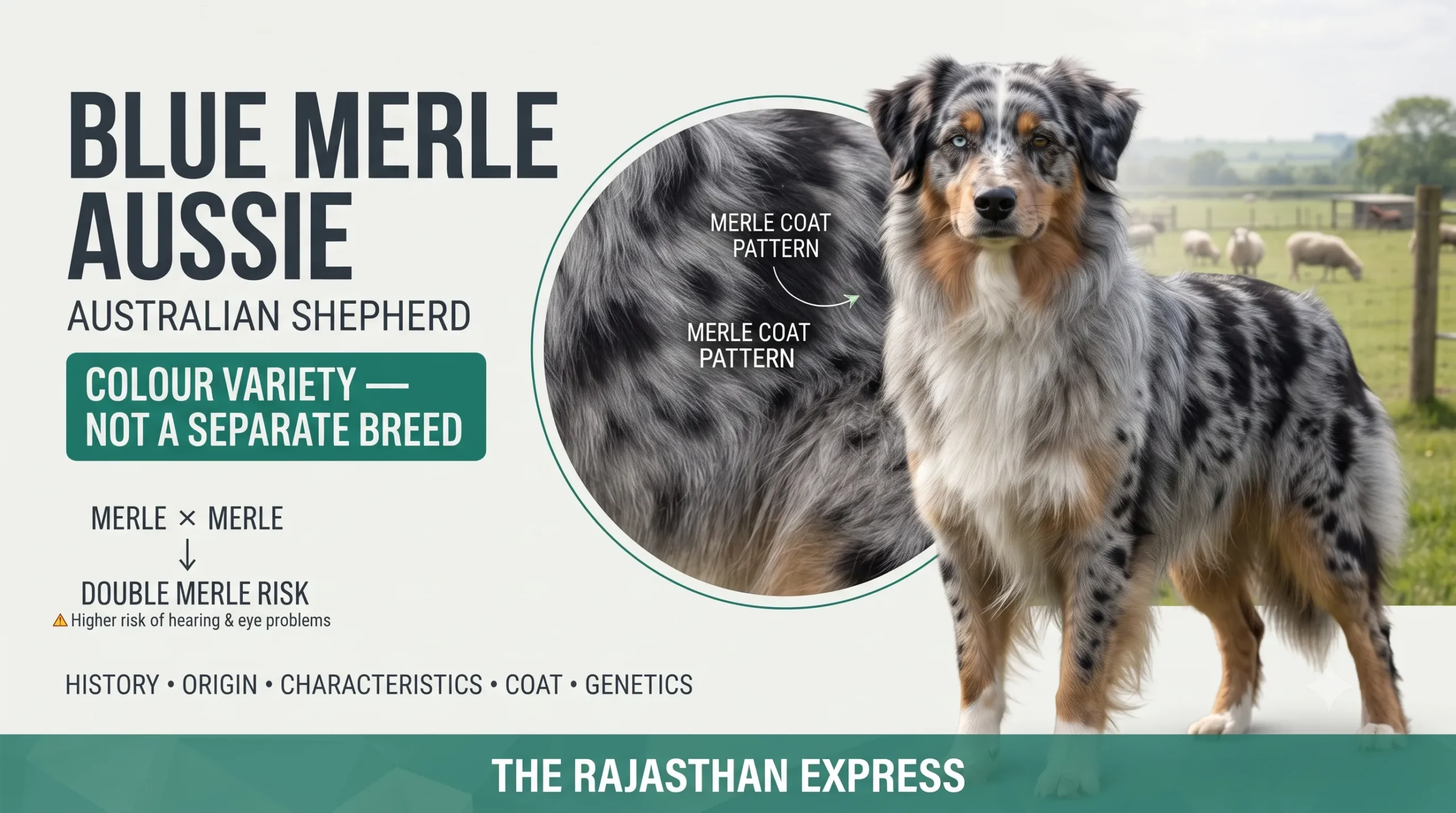
Look, whenever there is talk about the Blue Merle Australian Shepherd, people often think it must be a separate breed. But in reality, it is not so. The Blue Merle Australian Shepherd, lovingly also called “Blue Merle Aussie,” is actually a special and extremely attractive colour variety of the Australian Shepherd breed. Its name comes from its unique “merle” coat pattern. In this pattern, on a black background, there are silver‑like grey, i.e., blue‑grey coloured spots and patches. The result is a mottled or marbled appearance that makes the Blue Merle Aussie particularly eye-catching.This dog is as beautiful in appearance as it is intelligent, agile, and hardworking.
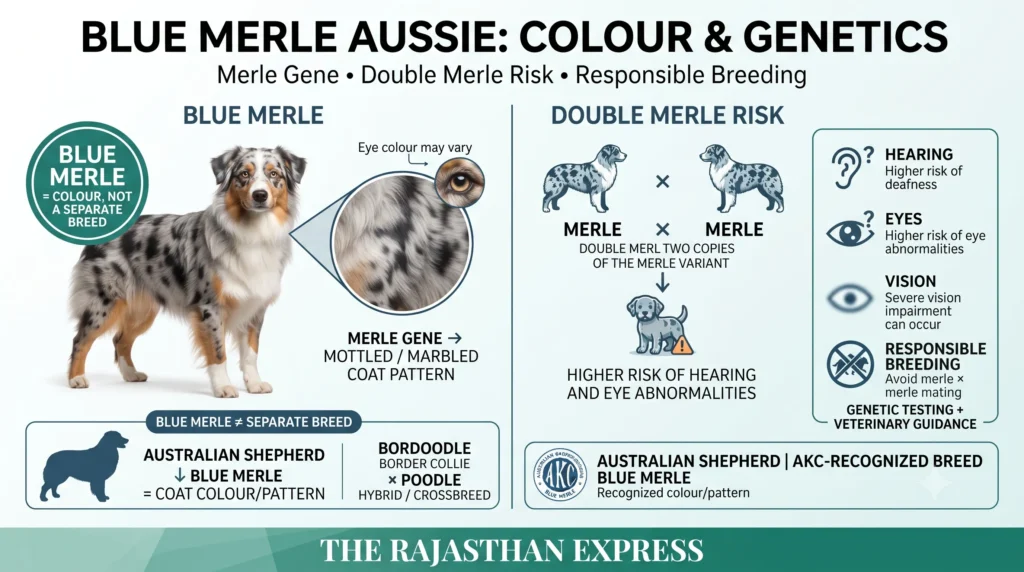
The merle coat pattern occurs due to a gene called the “merle gene.” This gene creates a spotted pattern in the coat and sometimes also affects eye colour. Because of this, some Blue Merle Aussies can have blue eyes, or one blue eye and one brown eye. This variation in eye colour is one of the features that many people associate with the Blue Merle Australian Shepherd. But it is very important to remember that Blue Merle is only a colour, not a separate breed. Therefore, its temperament and physical build are the same as any other colour of Australian Shepherd.
Blue Merle Aussie and the Australian Shepherd Breed
The Australian Shepherd is originally a working and sheep‑goat herding dog. It was reared in fields and ranches to herd sheep, goats, and cattle. Even today, the herding instinct – the tendency to herd animals – remains strong in this breed. Although “Australian” is written in the name, its actual development is believed to have happened in the western states of America. In the 19th century, Basque shepherds first went to Australia with their sheep and dogs, and from there reached the western coast of America. In America, farmers and ranchers started calling these dogs “Australian Shepherd” because they had come via Australia. Later, through crossbreeding with Collies and other herding dogs, today’s breed was developed. In 1993, it received recognition from the American Kennel Club (AKC) , and Blue Merle has been a recognized colour of this breed from the beginning.
Blue Merle Aussie Distribution: Where Is the Blue Merle Australian Shepherd Found?
Today, the Blue Merle Aussie is found in America, Canada, Europe, Australia, and many countries of Asia. It is an active, energetic, and intelligent dog. It needs sufficient daily physical exercise and mental challenge. Just taking it for a walk is not enough for it; it loves running, playing, learning new commands, puzzle‑like activities, and agility. In terms of temperament, the Blue Merle Aussie temperament is generally described as loyal, alert, social, and family-oriented. It can behave well with children, but proper socialisation and training are necessary. Leaving it alone for long periods is not good, because when bored, it may bark, chew, or engage in other destructive behaviours.
Its coat is medium‑long, dense, and double‑layered. Therefore, regular brushing, ear cleaning, dental care, and veterinary check‑ups are necessary. A very important scientific warning is that if two merle dogs are bred together, “double merle” puppies can be born. Such puppies have a higher risk of deafness, vision defects, eye problems, or other health issues. Therefore, responsible breeders do not breed merle with merle and get genetic testing done. Overall, the Blue Merle Aussie is a good companion for active keepers who can give it time, exercise, training, and love.
History and Origin of the Blue Merle Australian Shepherd Dog
Look, whenever there is talk about the Blue Merle Australian Shepherd or “Blue Merle Aussie,” people often think it must be a separate breed. But in reality, it is not so. It is a colour of the Australian Shepherd dog. It is called Blue Merle because on its coat, on a black background, silver‑like grey, i.e., blue‑grey coloured spots and patches are seen. So understand, this is not a separate breed, just a different form of colour.
Where Did the Australian Shepherd Come From?
Now look at its history. Although “Australian” is written in the name, its actual development happened in America. The story is something like this – the ancestors of this breed were mountain dogs of the Basque region of Europe. The Basque region lies between Spain and France. The shepherds there reared expert dogs for herding sheep. Those dogs sometimes had merle coats and blue eyes as well. This same merle quality later became the identity of the Australian Shepherd and Blue Merle Aussie.
How Did the Australian Shepherd Get Its Name?
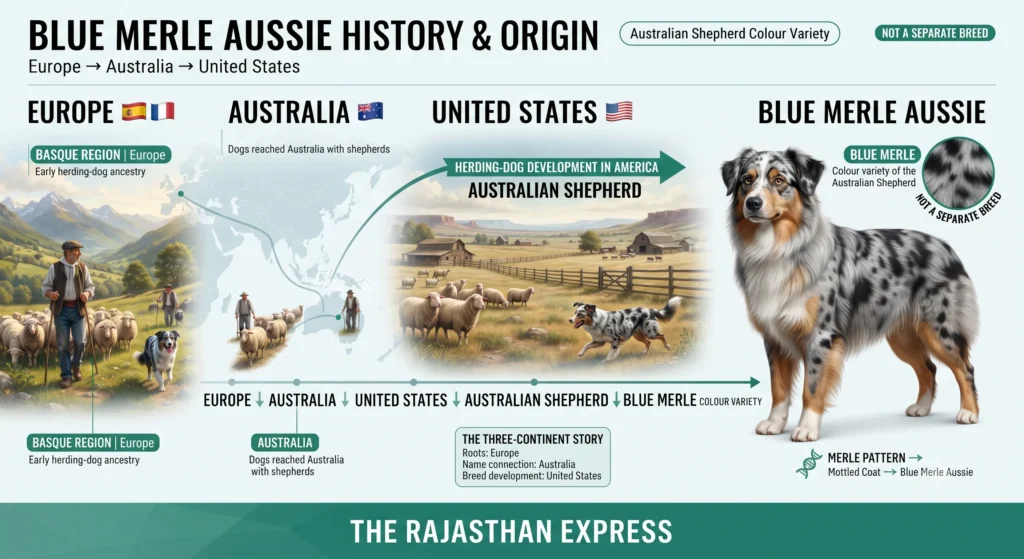
- It is a matter of the 19th century. From the Basque region of Europe, shepherds first went to Australia with their sheep and dogs, and from there reached the western coast of America. In America, farmers and ranchers started calling these dogs “Australian Shepherd” because they had come via Australia. But an interesting story begins here.
- Now break down the word “Shepherd” itself. It is made from the English words “sheep” (sheep) and “herd” (flock). In old English, it was called “sceaphierde,” which means herder of sheep. So the direct meaning of “Australian Shepherd” is Australia’s sheep‑herding dog. But in reality, this dog is neither from Australia, nor did its development happen in Australia. It developed completely in America. This name was given only because these dogs reached America via Australia. So this is a historical mistake, which has today become an identity. This is one of the biggest curiosities of this breed.
Why Is the Blue Merle Aussie Called Australian?
- Now add science to this. The dogs that came with the Basque shepherds were European mountain dogs, which sometimes had merle coats and blue eyes. In America, they were mixed with Collies and other herding dogs. The new breed that resulted from this crossbreeding was called the Australian Shepherd. But from a genetics perspective, it is a mixture of Basque dogs, Collies, and other breeds. That is, the name has Australia, the roots are in Europe, and the development happened in America. This story of three continents is summed up in one name. And this is what makes it even more interesting.
- Therefore, the historical sequence can be understood as: European herding dogs → Australia → United States → development of the Australian Shepherd → Blue Merle Australian Shepherd as an accepted colour variety.
- One more interesting thing is that the word “Shepherd” is used for many breeds, such as German Shepherd, Belgian Shepherd, Dutch Shepherd. These are all actually sheep‑herding dogs. But with the Australian Shepherd, the funny thing is that it is neither from Australia, nor does its name truly connect to that place. It is an American crossbreed whose name came from Australia. So next time you see an Australian Shepherd, remember that it is neither Australian, nor was it born as a Shepherd. It is a historical mistake that tells the story of science and breeding.
From Europe to America: Basque Shepherds and the Collie Family
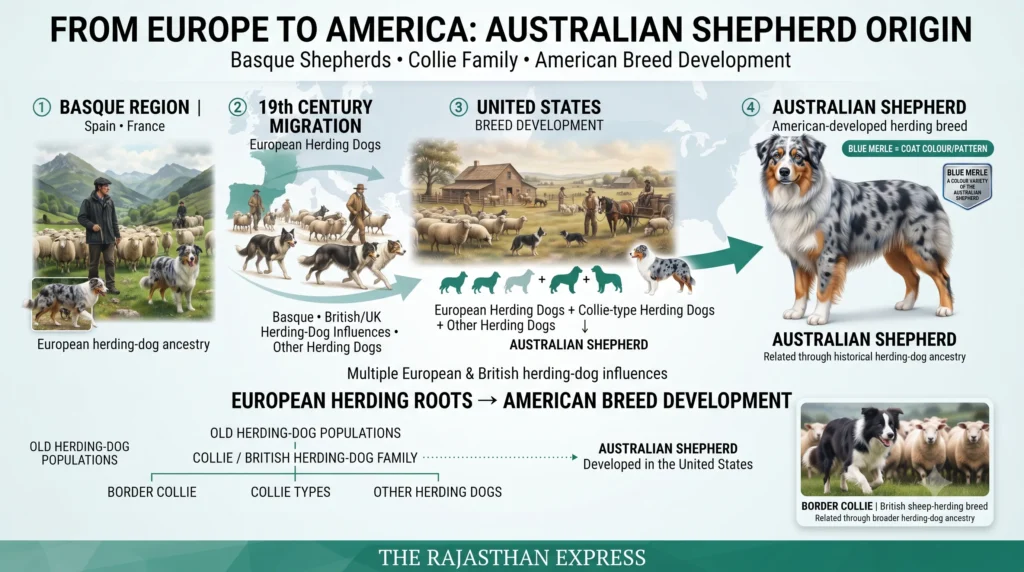
- The ancestors of this breed were mountain dogs of the Basque region of Europe. The Basque region lies between Spain and France. The shepherds there reared expert dogs for herding sheep. Those dogs sometimes had merle coats and blue eyes as well. This same merle quality later became the identity of the Australian Shepherd and Blue Merle Aussie.
- In the 19th century, Basque shepherds and other European immigrants went to America with sheep‑herding dogs. These dogs also included ancestors of the Collie. These dogs came from the group of herding dogs found in rural areas of the UK. That is, they were different members of the same large dog family, who reached different places and developed into different breeds.
Development of the Australian Shepherd: Shepherd + Collie Mix
- After reaching America, these European herding dogs were mixed with Collies and other herding dogs. The breed that resulted from this crossbreeding was called the Australian Shepherd.
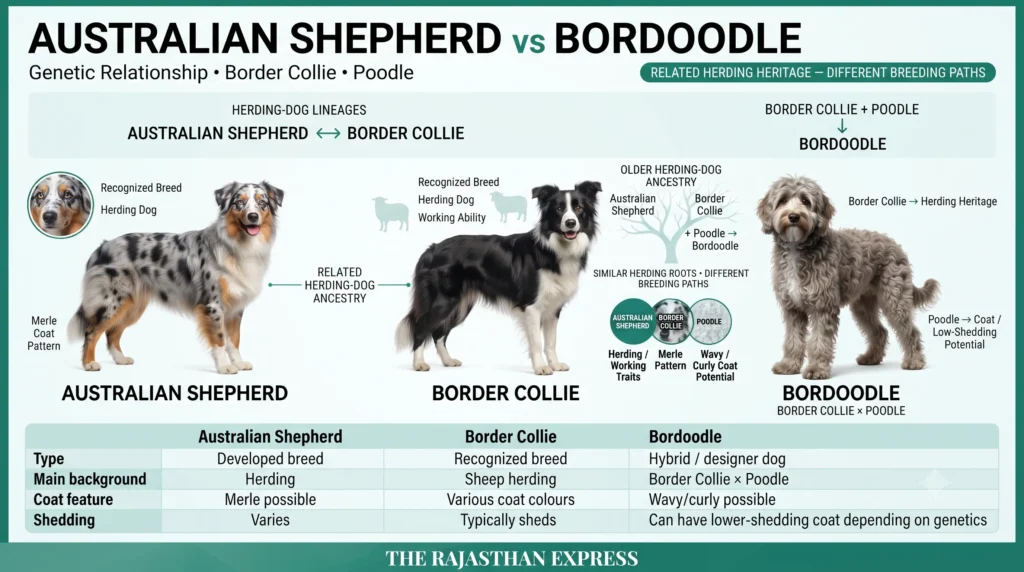
- Understand one thing clearly here. The Australian Shepherd is not the result of just one breed. It is made from a mix of many breeds. It has roots of Basque herding dogs, the contribution of Collies, and a mixture of some other European herding dogs. According to genetic studies, the Australian Shepherd and Collie or Border Collie both fall into the same group of dogs found in rural areas of the UK.
- That is, they are all branches of the same old dog family. The Collie family, which includes the Border Collie, has made a very important contribution to the genetic basis and development of the American breed Australian Shepherd during the 19th century.
- In America, these dogs were bred with Collies and other herding dogs. From this breeding, the Australian Shepherd got its current physical build, sharp intelligence, strong herding temperament, and merle coat pattern. In 1993, it received recognition from the American Kennel Club (AKC) . And Blue Merle has been a standard and acceptable colour of this breed from the beginning.
Border Collie – The Sharp‑Minded Branch of the Same Collie Family
- The Border Collie is also part of this Collie family. Its origin happened on the border of England and Scotland. It was developed for herding sheep, but it was specially made so that it does not bite or bark at sheep, but controls them only through intense gaze and physical signals. This is why the Border Collie is considered the most intelligent dog in the world. It can be called the “cousin brother” of the Australian Shepherd, because the roots of both meet in the same Collie family.
Birth of the Bordoodle: Border Collie + Poodle
- The Bordoodle is a crossbreed or hybrid dog breed. The Bordoodle dog was created by crossbreeding between the Border Collie and Poodle. That is, if you connect the back link, the story becomes something like this.
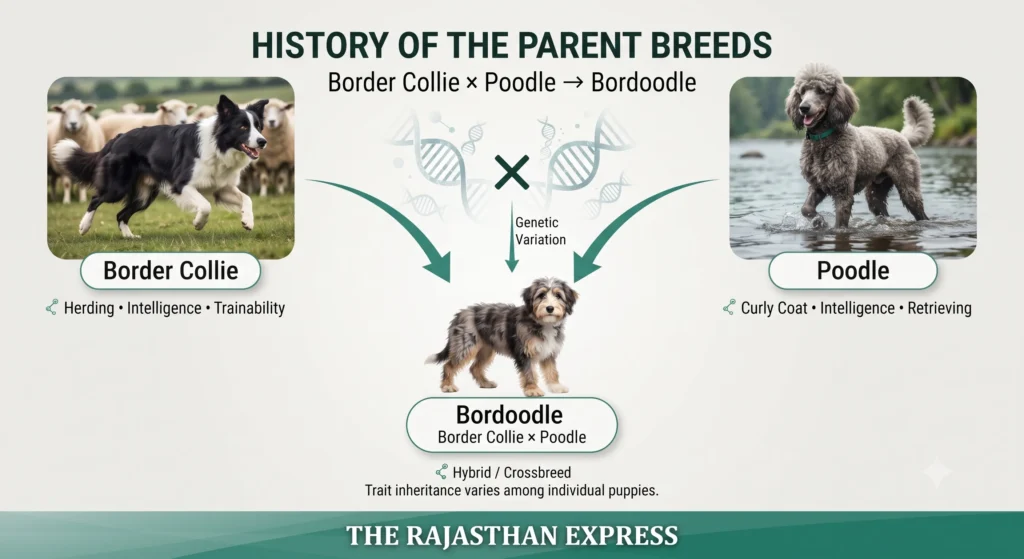
- First, European herding dogs went to America. There, through mixing with Collies and other breeds, the Australian Shepherd was created. A branch of that same Collie family is the Border Collie, which is known for its sharp intelligence.
- And when the Border Collie was mixed with the Poodle, the Bordoodle came into existence. That is, both the Australian Shepherd and Bordoodle have the contribution of the Collie family in their ancestors. The only difference is that the Australian Shepherd is a mix of Collie and other herding dogs, while the Bordoodle is a direct mix of Border Collie and Poodle.
Genetic Relationship: What is Similar and Different Between Australian Shepherd and Bordoodle?
- In the language of science, the Australian Shepherd, Border Collie, and Bordoodle all have genetic similarity, but all three are at different levels.
- The Australian Shepherd is a developed breed, which the AKC recognized in 1993. The Border Collie is also a recognized breed, known worldwide for its working ability.
- But the Bordoodle is a hybrid or designer dog, which the AKC does not recognize. In the Bordoodle, due to Poodle genes, the quality of low shedding comes, which is not present in the Border Collie.
- Similarly, in the Australian Shepherd, the merle coat pattern comes, which is less seen in the Border Collie. That is, all three are offspring of the same old dog family, but have walked different paths and created different identities.
“What is the reason for the colour of the Blue Merle Aussie dog?
- Merle occurs due to a gene. This gene creates a spotted pattern in the coat. But here is an important thing. If two merle dogs are mated together, their puppies can be “double merle.” Double merle means the puppy received the merle gene from both parents.
What Causes the Blue Merle Aussie Colour?
- Such puppies have a higher risk of deafness, eye problems, small or undeveloped eyes, and other health issues. In some cases, double merle puppies can be born completely blind or deaf. Therefore, responsible breeders do not breed merle with merle. They follow genetic testing and veterinary advice.
Blue Merle Australian Shepherd Recognition: AKC and Hybrid Registries
- The Australian Shepherd was recognized by the American Kennel Club (AKC) in 1993. Blue Merle has been a standard and acceptable colour of this breed from the beginning. In the standards of the AKC and other major kennel organizations, Blue Merle is considered a recognized colour of the Australian Shepherd.
- However, it is necessary to understand that Blue Merle is only a colour, not a breed. On the other hand, the Bordoodle is not recognized by the AKC, because it is not a pure breed. It is registered in hybrid registries like the American Canine Hybrid Club, Designer Breed Registry, and International Designer Canine Registry.
So overall, the Blue Merle Aussie (Blue Merle Australian Shepherd) is very beautiful in appearance, sharp in mind, and hardworking in work. But it is only a colour, not a breed. Similarly, the Bordoodle is a hybrid dog, made from the mix of Border Collie and Poodle. The roots of both meet in the same Collie family, but both have different builds, temperaments, and needs. The Australian Shepherd is a fully developed herding breed, while the Bordoodle is a family companion dog. Keeping them requires time, love, exercise, and a little understanding. If you live an active lifestyle and are looking for a companion who can run and play with you, then the Blue Merle Aussie or Bordoodle can prove good for you. But always remember that before adopting any dog, it is most important to understand its needs, health risks, and the responsibility of long‑term care.
Blue Merle Australian Shepherd Distribution and Geographical Map
Where Are Blue Merle Aussie Dogs Found?
The Blue Merle Australian Shepherd / Blue Merle Aussie is not a separate breed. It is a colour of the Australian Shepherd dog. Therefore, its distribution – where it is found in the world – is exactly the same as the distribution of the Australian Shepherd breed. Wherever the Australian Shepherd is found, Blue Merle coloured dogs are also found there.
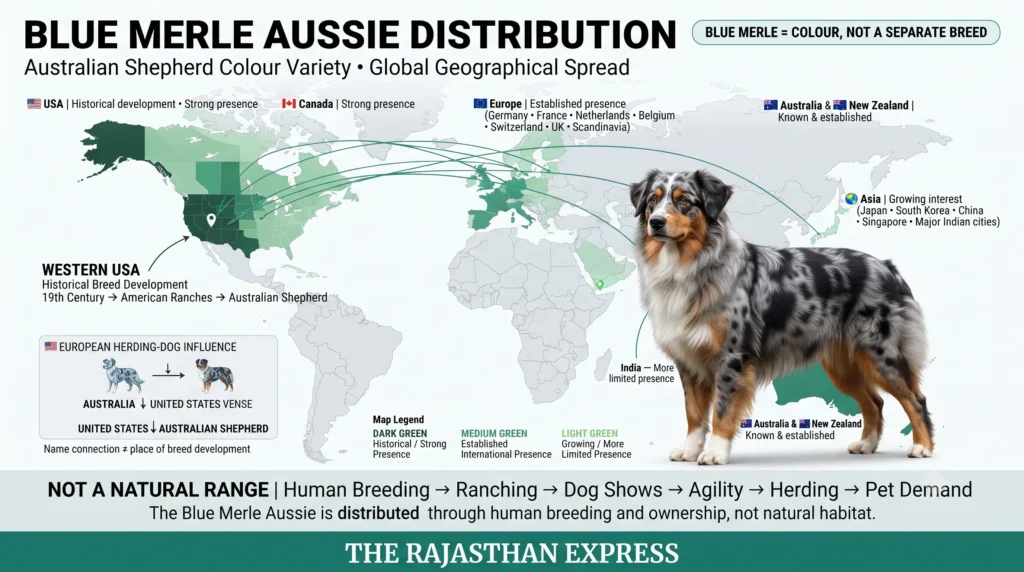
Its place of origin is considered to be the United States of America. Especially the western states of America are called its historical development area. These states include areas like California, Colorado, Wyoming, Idaho, Montana, Oregon, and Washington. In the 19th century, Basque shepherds first went to Australia with their sheep and dogs, and from there reached the western coast of America. In America, farmers and ranchers started calling these dogs “Australian Shepherd” because they had come via Australia. Later, by crossbreeding them with Collies and other herding dogs, today’s breed was created. That is, the name came from Australia, but the actual development of the breed happened in America.
Blue Merle Australian Shepherd Distribution Around the World
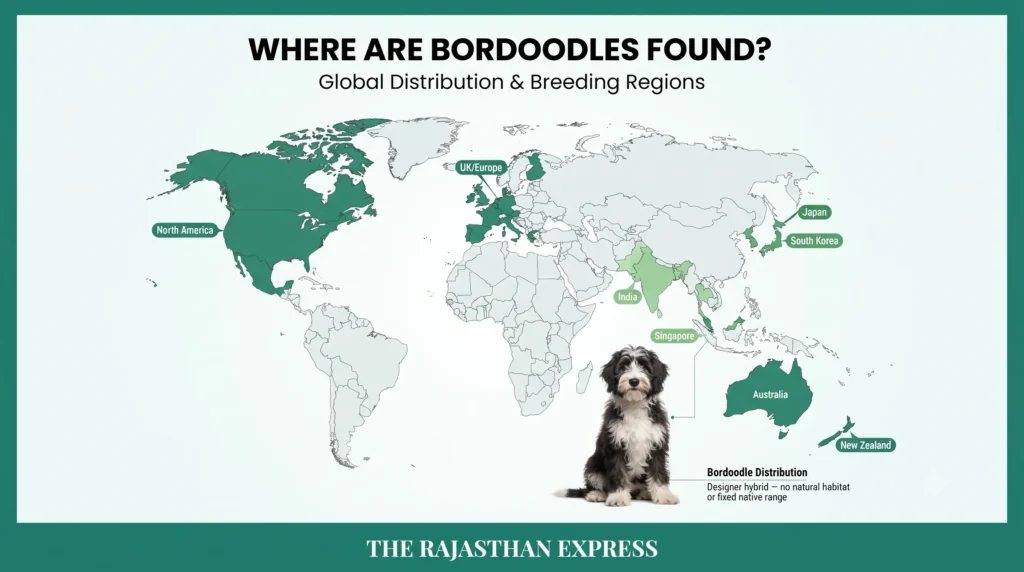
- Today, this breed has become popular all over the world. It is very common in America and Canada.
- In Europe too, it is reared a lot, especially in Germany, France, the Netherlands, Belgium, Switzerland, the United Kingdom, and Scandinavian countries.
- In Australia and New Zealand too, this breed is known. In Asia, demand is increasing in Japan, South Korea, China, Singapore, and major cities of India.
- In India, it is not yet very common, but pet lovers take it through imports or from select breeders.
Blue Merle Aussie Geographical Map
Talking about a geographical map, it does not have any one specific “place of origin.” It is not a natural breed of any forest, mountain, or river valley. It is a breed completely created and spread by humans. Its spread has happened not by natural selection, but by human breeding, ranching, dog shows, agility, herding, and pet demand. Therefore, its geographical map will not look like the shape of any one country, but like scattered spots in many parts of the world. The deepest spot will fall on the western states of America, because that is where it began. After that, its expansion will be seen in Europe, Australia, and major cities of Asia.
Blue Merle Aussie Category and Other Names
What Category Does the Blue Merle Australian Shepherd Belong To?
- The Blue Merle Aussie is not a separate breed. It is a colour of the Australian Shepherd dog. Therefore, its category is also exactly like the Australian Shepherd breed. It is called “Blue Merle Aussie” because on its coat, on a black background, silver‑like grey, i.e., blue‑grey coloured spots and patches are seen.
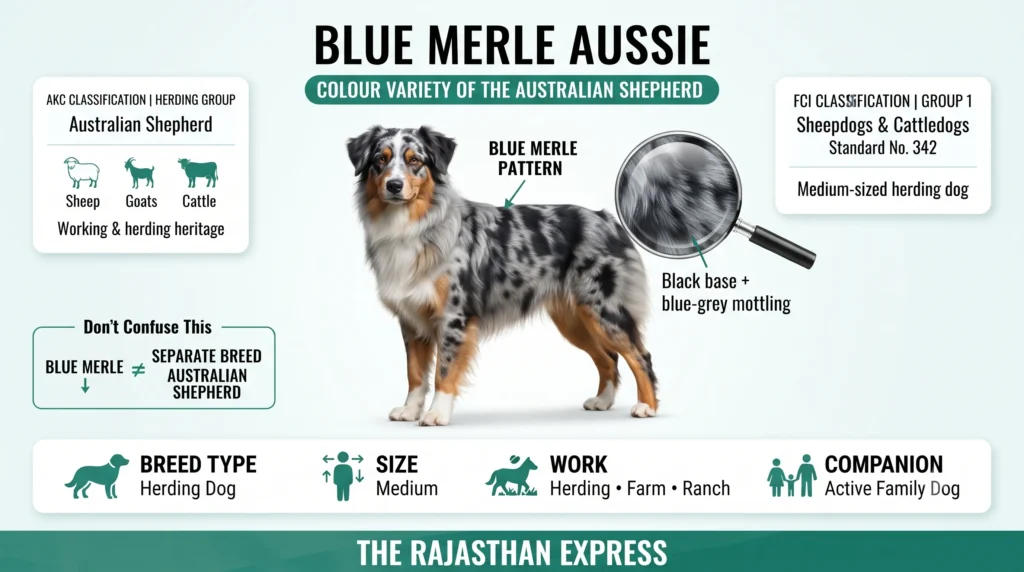
- According to the American Kennel Club (AKC) , the Australian Shepherd is placed in the Herding Group. This means it is originally a working dog that herds sheep, goats, and cattle. Even today, the herding instinct – the tendency to herd animals – remains strong in this breed.
- Internationally, according to FCI (Fédération Cynologique Internationale) , the Australian Shepherd is placed in Group 1. This group is of sheep and cattle herding dogs. FCI standard number is 342. It is considered a medium‑sized herding dog. That is, neither very small nor very large. Its body is strong, agile, and athletic.
- So in direct words, the category of the Blue Merle Aussie is:
- AKC: Herding Group
- FCI: Group 1, Number 342
- Type: Medium‑sized herding dog
- Main work: Herding sheep and cattle, farm and ranch work, as well as family companion
By what other names is the Blue Merle Australian Shepherd or Blue Merle Aussie known? (Alternative Names)
The Blue Merle Australian Shepherd is called by many names by different places and different people. Some of these names are given with love, some are historical, and some are related to its body or colour.
- Aussie –
- The most common and loving name is Aussie. People shorten it and call it Aussie. This name is used the most all over the world. When someone says “Aussie,” it means Australian Shepherd itself.
- Spanish Shepherd –
- The second name is Spanish Shepherd. This name is connected to the historical ancestors of this breed. It is believed that its ancestors were mountain herding dogs of the Basque region of Europe. The Basque region lies between Spain and France. Because of this, some people also call it Spanish Shepherd. However, this is not an official name.
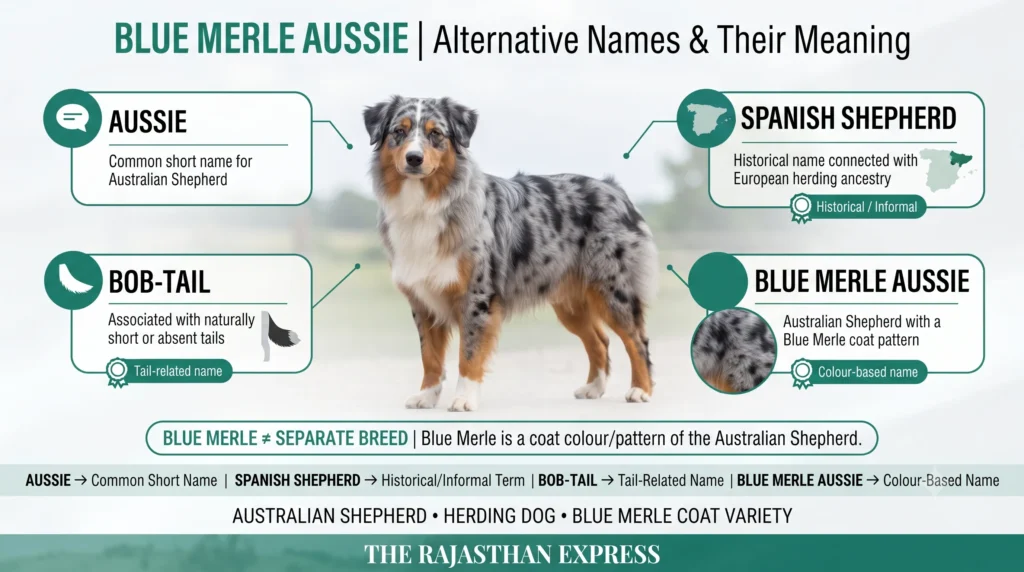
- Bob‑Tail –
- The third name is Bob‑Tail. This name was given because the Australian Shepherd’s tail is usually short or absent from birth. It has a special gene called Natural Bobtail (NBT) . Because of this gene, some puppies are born without a tail or with a short tail. Earlier, in many places, there was also a tradition of tail docking, but now in many countries this practice has been stopped or limited. Therefore, the name “Bob‑Tail” only tells about the speciality of its tail.
- Blue Merle Aussie –
- The fourth name is Blue Merle Aussie. This name is directly related to its colour. When the Australian Shepherd’s coat has a Blue Merle pattern, it is called Blue Merle Aussie. This is not a separate breed, but a colour form of the same breed.
Besides these, in some places it is simply called Australian Shepherd, and based on colour, the word Blue Merle is added. In some places, it is written as Australian Shepherd (Blue Merle) . But remember, all these names mean the same dog. It is a medium‑sized, intelligent, agile, and hardworking herding dog, whose Blue Merle colour makes it even more attractive.
For what purpose is the Blue Merle Aussie dog reared?
Historically, the Blue Merle Aussie (Australian Shepherd) is originally a working herding dog. It was reared in fields and ranches to herd sheep, goats, and cattle. The word “Shepherd” itself means one who herds sheep. The roots of this breed are found in the mountain herding dogs of the Basque region of Europe, Collies, and other European herding dogs. In America, they were developed by crossbreeding with Collies and other herding dogs. That is why the herding instinct – the tendency to herd animals – is very strong in it.
Blue Merle Aussie Herding Work
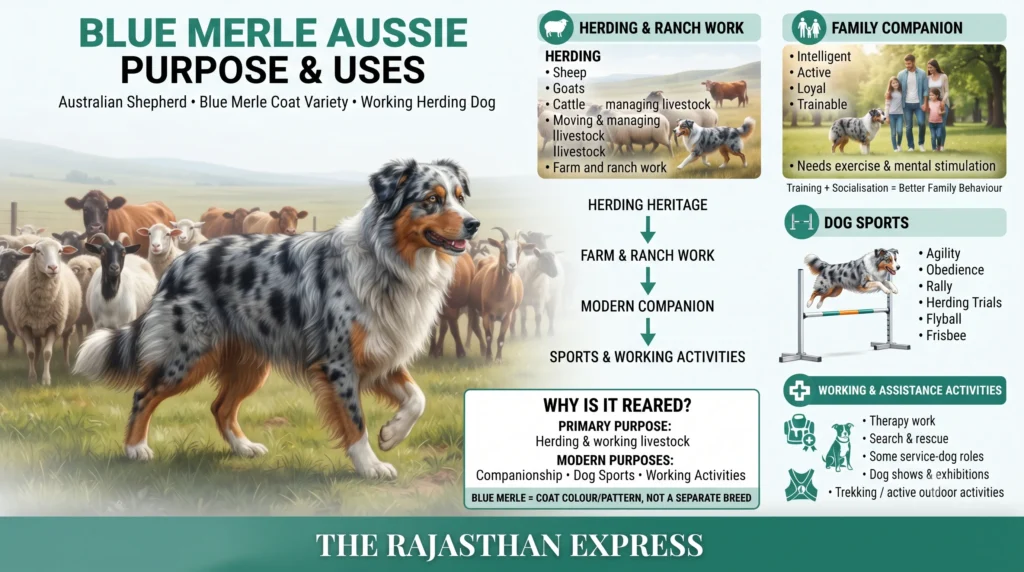
- In herding work, this dog is the helper of the shepherd. It helps in moving the flock of sheep, goats, or cattle from one place to another, bringing them to the pen, changing pastures, bringing back separated animals, and separating sick or injured animals.
- It controls the animals through its sharp gaze, physical signals, barking, and fast running. It is the shepherd’s assistant, whose job is to move and manage the flock in the right direction. Yes, it remains alert towards its family and home, so it can also be seen as a watchdog.
Blue Merle Aussie as a Family Companion –
- In today’s time, the Blue Merle Aussie is not limited only to farms and ranches. It is mainly reared as a family companion dog. It is intelligent, loyal, active, and quick to learn, so it is good for families who can give it time, love, exercise, and mental challenge. It can behave well with children, but proper socialisation and training are necessary. Leaving it alone for long periods is not good, because when bored, it may bark, chew, or engage in other destructive behaviours.
Blue Merle Australian Shepherd for Dog Sports and Working Activities
- In the modern era, it is also used in many dog sports and service works. It is trained for activities like agility, obedience, rally, herding trials, flyball, frisbee, and trekking. Due to its sharp intelligence and learning ability, it is also prepared as a therapy dog, search and rescue dog, and in some cases, a service dog. Besides, it is also shown in dog shows and exhibitions, where the Blue Merle colour is considered quite attractive.
Overall, the Blue Merle Aussie is mainly reared for herding, farm‑ranch work, family companionship, dog sports, and service work. It is not just a beautiful‑coloured dog, but an intelligent, hardworking, and energetic companion. Before keeping it, it is very important to understand that it needs sufficient exercise, training, mental stimulation, and love. If it gets these things, it can prove to be an excellent companion for its owner.
Blue Merle Aussie
How to Identify a Blue MerBlue Merle Australian Shepherd Identification: How to Identify a Blue Merle Aussie?
The Blue Merle Australian Shepherd, lovingly called “Blue Merle Aussie,” is a special and extremely attractive colour variety of the Australian Shepherd breed. It is not a separate breed. “Blue Merle” means silver‑like grey, i.e., blue‑grey coloured spots and patches on a black background. This pattern is created by the “merle gene.” Therefore, its temperament, physical build, and working ability are the same as any other colour of Australian Shepherd. The best way to identify it is to understand its unique coat pattern, eye colour, and physical build. It is a medium‑sized, strong, agile, and extremely intelligent herding dog.
Blue Merle Aussie Size and Body Structure
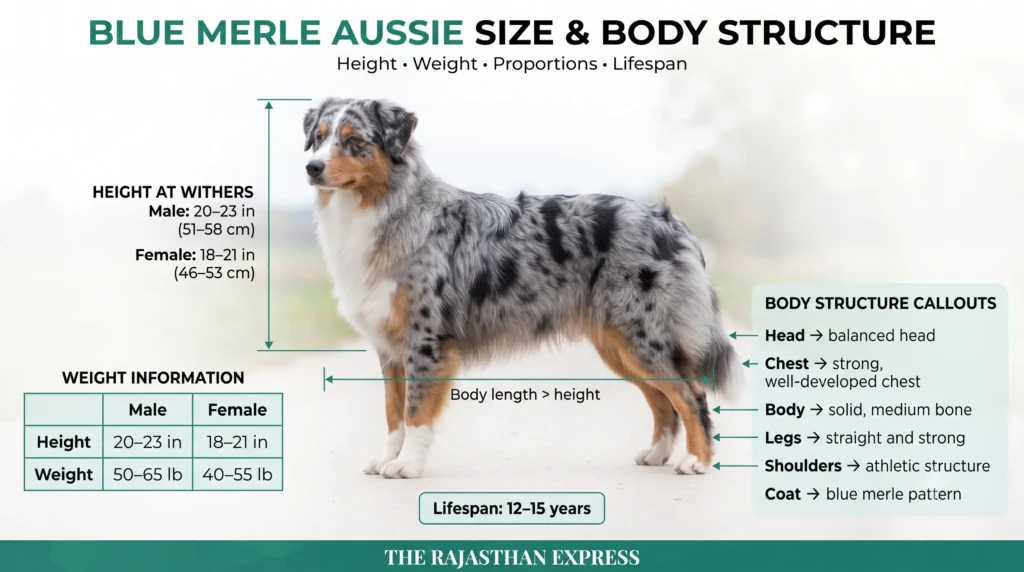
The Blue Merle Aussie is a medium‑sized, well‑built, and muscular dog. Its body is slightly longer than tall – meaning length exceeds height. It is strong, agile, and flexible, which gives it the ability to work for long periods.
- Blue Merle Australian Shepherd Height (at shoulder) –
- Male 20 to 23 inches (51 to 58 cm) , Female 18 to 21 inches (46 to 53 cm) .
- Blue Merle Aussie Weight-
- Male 50 to 65 pounds (23 to 29 kg) , Female 40 to 55 pounds (18 to 25 kg) .
- Blue Merle Aussie Body: Solid, with medium bone. Masculinity is clear in males, femininity in females.
- Legs: Straight and strong. Front legs drop straight to the ground.
- Blue Merle Australian Shepherd Lifespan:
- The average lifespan is approximately 12–15 years.
Blue Merle Aussie Coat: The Most Important Identification Feature
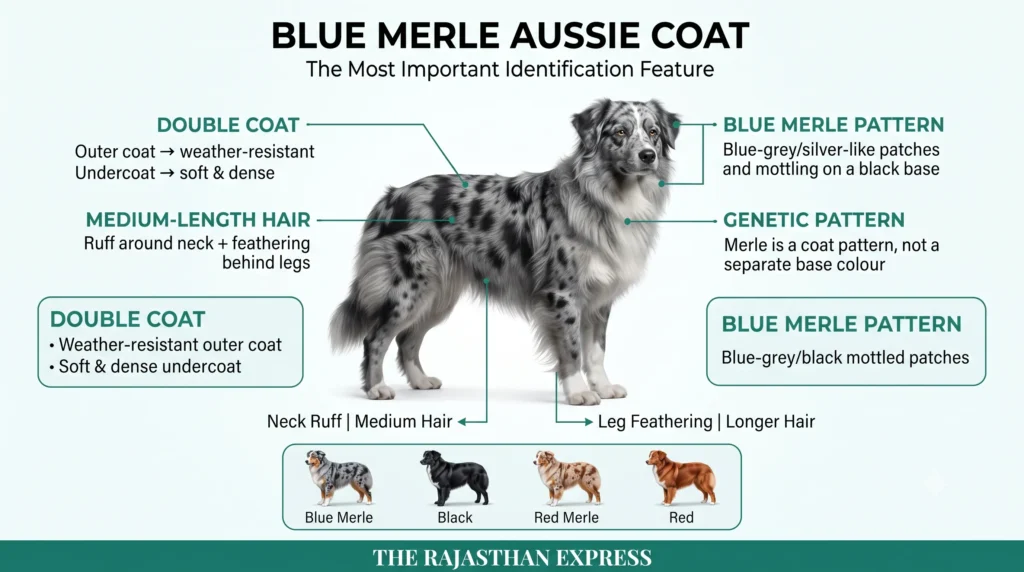
The most distinctive identification of the Blue Merle Aussie is its dense double coat. It is medium‑length and slightly rough.
- Blue Merle Australian Shepherd Coat Type: Double coat. The outer layer is weather‑resistant and the inner layer is soft and dense.
- Blue Merle Aussie Hair Length: Medium. There is a ruff (thicker hair) on the neck and feathering (longer hair) behind the legs.
- Australian Shepherd Coat Colors: Blue Merle, Black, Red Merle, and Red. All colours may be with or without white or tan markings.
- What Does Blue Merle Mean?
- Silver‑like grey (blue‑grey) spots and patches on a black background. This is a genetic pattern, not a separate colour.
How is the Blue Merle Pattern Created?
- It is very important to understand that Blue Merle is not a separate breed.
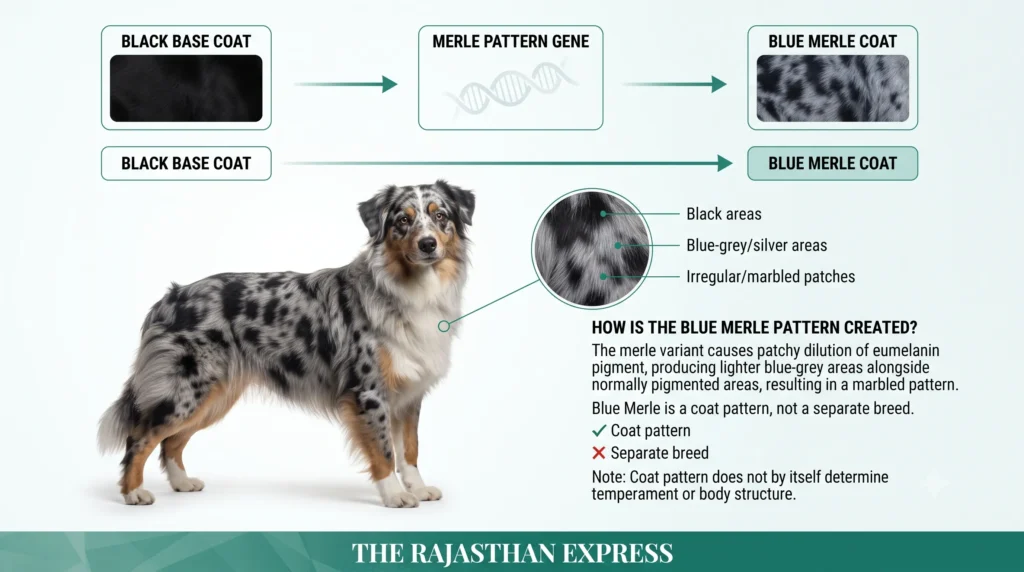
- It is a coat pattern. In reality, a Blue Merle Australian Shepherd is originally a black dog that is affected by the merle gene. This gene randomly lightens the black colour into grey (blue‑grey) . But some parts remain completely black.
- This creates a marble‑like pattern of silver‑grey spots and black patches on the coat. In scientific language, this is pigment dilution caused by the merle gene.
Important: Blue Merle is only a colour, so its temperament and physical build are the same as any other colour of Australian Shepherd.
Blue Merle Aussie Coat Color and Markings
- Main Colour:
- The Blue Merle Aussie is identified not just by its coat, but also by its colour and markings. It is important to understand that Blue Merle is not a separate breed, but a colour pattern of the Australian Shepherd.
- Its main colour is a mix of black and silver‑grey (blue‑grey) spots. This is called Blue Merle. This pattern is created by the merle gene, which randomly lightens black into grey, while some parts remain black.
- Markings:
- Besides this, the dog’s body can have various markings. There can be white markings on the chest, neck, legs, muzzle, and head.
- Copper (tan) markings can also appear on the cheeks, above the eyes, ears, chest, and legs. These markings differ in every dog, because they are determined by the merle gene and other genes.
- Blue Merle Aussie Nose, Lips and Eye-Rim Pigmentation:
- Talking about the nose, lips, and eye rims – in Blue Merle these are usually black. In Red Merle they are brown (liver) coloured. This is called pigmentation. In Blue Merle, the eye rims are black, which is part of the breed standard.
Blue Merle Australian Shepherd Coat Variations
- Blue Merle coat can be of several types. Some dogs have only a silver mix on grey and black, which is called Blue Merle.
- Some have grey, black, white, and copper (tan) markings, which is called Blue Merle Tri‑Colour.
- Some have grey, black, and white markings, which is called Blue Merle and White.
- And some have grey, black, and copper markings, which is called Blue Merle with Tan Points.
The Australian Shepherd has four standard colours:
- Black
- Blue Merle
- Red
- Red Merle
In all these colours, there may be white and/or tan (copper) markings or none at all. But remember, Blue Merle is only a colour pattern. Its temperament, physical build, and needs are the same as any other Australian Shepherd.
Blue Merle Aussie Blue Eyes: One of the Most Noticeable Features
The eyes of the Blue Merle Aussie are its most special identification. This is the organ that makes it different and attractive at first glance. The colour and expression of the eyes reflect both the beauty and temperament of this breed. But it is important to understand that eye colour is also an effect of the merle gene, not a separate breed.
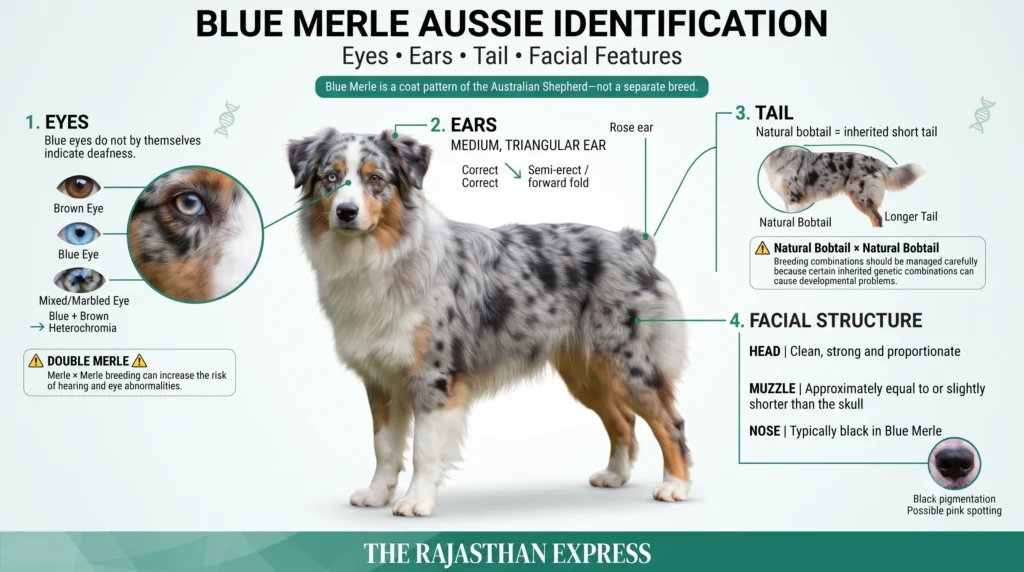
- Colour: Blue Merle Aussie eyes can be brown, blue, or amber. Often they have flecks and marbling – meaning blue and brown spots can be mixed in the same eye. All this happens due to the merle gene, which affects pigment.
- Shape: The eyes are almond‑shaped. They are neither too prominent nor sunken. This shape gives it the expression of an alert and intelligent herding dog.
- Heterochromia: Many Blue Merle Aussies have different coloured eyes – for example, one blue and one brown. This is called heterochromia. This is also an effect of the merle gene and is not considered a disease. In some dogs, two colours can be seen within the same eye, which is called heterochromia iridis.
An Important Caution: Do Blue Merle Aussies With Blue Eyes Have Hearing Problems?
- Blue eyes are common in Blue Merle, but this is not directly linked to deafness. This is a common misconception.
- Deafness usually occurs in double merle dogs – that is, when both parents are merle and the puppy receives the merle gene from both. Additionally, dogs with excessive white on the head also have a higher risk of deafness.
- Therefore, it cannot be said based solely on blue eyes that the dog is deaf. Responsible breeders do not breed merle with merle, so that double merle puppies are not born.
Ears of the Blue Merle Aussie
- The ears of the Blue Merle Aussie are triangular and medium‑sized. When the dog is alert, the ears turn forward and appear semi‑erect. One‑fourth to one‑half of the upper part is bent forward. This special position is called “rose ear.” This is the natural and standard form of the ears.
- If the ears are completely erect (prick ear) or completely hanging (hanging ear) , it is considered a serious fault. That is, according to the breed standard, such ears are not considered correct. Therefore, while identifying a Blue Merle Aussie, one must definitely look at the shape, position, and tilt of the ears.
Blue Merle Aussie Tail: The Bobtail Feature
- Type: Another special identification of the Blue Merle Aussie is its tail. It is called “bobtail.” Its tail is either docked (cut) or naturally short (natural bobbed) . According to the breed standard, the tail length should not exceed 4 inches.
- Natural Bobtail: About 1 in 5 Australian Shepherds is born with a naturally short tail. This is called natural bobtail. Its cause is a genetic mutation in the T‑box transcription factor T gene. This gene affects tail development, making the tail short or absent.
- Warning:
- But here is a very important warning. Two natural bobtail dogs should never be mated together. If this is done, their puppies can have serious congenital defects like spina bifida. In spina bifida, the spinal cord does not close properly, which can affect the nervous system and other body parts. Therefore, responsible breeders pay special attention to this and get genetic testing done.
Blue Merle Australian Shepherd Facial Features
- Blue Merle Aussie Head:
- The Blue Merle Aussie’s head is clean, strong, and dry – meaning it does not have excess fat or loose skin. The forehead is flat to slightly rounded. The length and width of the head are approximately equal. This balanced build gives it the appearance of a smart and alert herding dog.
- Blue Merle Aussie Muzzle:
- The muzzle (front part of the mouth) is equal to or slightly shorter than the forehead. It is not pointed, but has a rounded tip. This build helps it in herding sheep and goats, because the dog can easily grip and not cause injury.
- Blue Merle Aussie Nose:
- In Blue Merle, the nose is black, while in Red Merle it is brown (liver) coloured. In merle dogs, small pink spots can sometimes be seen, but these should not exceed 25%. If there are more pink spots, it is not considered correct according to the breed standard.
Blue Merle Aussie Full Size and Body Structure (Blue Merle Australian Shepherd Size)
The Blue Merle Aussie is a medium‑sized, strong, and agile dog. Its body is slightly longer than tall – meaning length exceeds height. This build enables it to work for long periods, run, and herd in any weather. It is not easily bothered by cold or heat. Its muscles are strong and its gait shows lightness and confidence. Since Blue Merle is only a colour, not a breed, its physical measurements are exactly the same as the Australian Shepherd breed standard.
The table below shows the general physical measurements of the Blue Merle Aussie. Note that these are average ranges. Every dog can be slightly different based on its parents’ genes, diet, exercise, and care.
Blue Merle Australian Shepherd Size Chart
The following table provides the general physical measurements for adult Blue Merle Aussies:
| Blue Merle Australian Shepherd Size Chart | ||
| Characteristic | Male Blue Merle Aussie | Female Blue Merle Aussie |
|---|---|---|
| Height at Shoulder | 20–23 inches (51–58 cm) | 18–21 inches (46–53 cm) |
| Weight | 50–65 lb (23–29 kg) | 40–55 lb (18–25 kg) |
| Lifespan | 12–15 years | 12–15 years |
| The Rajasthan Express : Blue Merle Australian Shepherd Size Chart | ||
This table clearly shows that the male Blue Merle Aussie is slightly larger and heavier than the female. The male’s height is 20 to 23 inches and weight 50 to 65 pounds. The female’s height is 18 to 21 inches and weight 40 to 55 pounds. This difference is part of the breed standard, in which masculinity is clear in males and femininity in females.
Blue Merle Aussie Lifespan
- The average lifespan of both is 12 to 15 years, which is considered good for a medium‑sized working dog. To increase lifespan, balanced diet, regular exercise, proper weight, and veterinary care are very important.
Blue Merle Aussie Price 2026–2027: Blue Merle Australian Shepherd Puppy Cost
The Blue Merle Australian Shepherd (Blue Merle Aussie) is an extremely popular and attractive dog worldwide. It is not a separate breed, but a special coat pattern of the Australian Shepherd, in which there are silver‑like grey spots on a black background. Due to its increasing demand and beautiful appearance, its price varies across the world.
Blue Merle Aussie Price Factors: What Determines the Cost?
This price depends on many factors, such as which country you are in, the breeder’s reputation, the puppy’s lineage, age, coat, health, vaccination, and pedigree.

1. How Much Training Has the Blue Merle Aussie Received? (More training = higher price)
The Blue Merle Aussie is a very intelligent dog. If it has been given basic training, its price increases.
- Untrained Blue Merle Aussie Puppy: Lower price, approximately ₹35,000–₹90,000.
- Blue Merle Aussie With Basic Training: Knows commands like sit, stay, come – price increases by ₹20,000–₹50,000.
- Fully Trained Blue Merle Aussie: Knows house manners, walking on leash, social behaviour, and commands – its price can reach ₹1,50,000–₹3,00,000.
- Blue Merle Aussies with therapy, agility, or show training: Can be even more expensive.
2. Blue Merle Aussie Lineage: Which Bloodline Does It Come From? (The line determines the price)
In the Blue Merle Aussie, lineage has a very big effect.
- Basic Quality Blue Merle Aussie: Suitable for family, but not for show or breeding. Price approximately ₹3,20,000–₹4,00,000.
- KCI Registered Blue Merle Aussie: With Kennel Club of India certificate, verified ancestry, full vaccination, and veterinary health check. Price approximately ₹4,00,000–₹5,00,000.
- Show-Quality Blue Merle Aussie: With good body confirmation, balanced features, and correct proportions. Price approximately ₹60,000–₹90,000.
- Champion Bloodline Blue Merle Aussie: From imported or award‑winning parents, better genetics. Price approximately ₹5,00,000–₹6,00,000+.
3. Blue Merle Aussie Puppy Age: Puppy, Young Dog or Adult? (Puppy, young, adult)
Age is directly related to price.
- Blue Merle Aussie Puppy: 8 Weeks to 6 Months: Most common selling age. Price ₹65,000 to ₹2,50,000.
- 6-Month to 18-Month Blue Merle Aussie: If training has started, price is slightly higher.
- Fully Trained Adult Blue Merle Aussie: If fully trained and healthy, ₹3,00,000 to ₹5,00,000.
- Older Blue Merle Australian Shepherd: Price decreases, but health risk is higher.
4. What is the coat, colour, and size like?
Coat and size contribute greatly to the Blue Merle Aussie’s price.
- Mini Blue Merle Australian Shepherd: More expensive than larger Aussies. Miniature and Toy are in higher demand. Mini Blue Merle Aussie price abroad is up to $2,000–$3,000.
- Curly coat: The Australian Shepherd’s coat is medium‑length and dense double coat. Puppies with curly or wavy coats are in higher demand.
- Rare colours: Extra charge is taken for colours like Blue Merle, Red Merle, Black Tri, Red Tri. Blue Merle Aussie eyes are often blue, which makes it even more attractive.
- Low‑shedding coat: Australian Shepherds shed heavily, so puppies with low‑shedding coats are more preferred by people troubled by allergies, increasing the price.
5. What is the health and vaccination status?
Buying a healthy puppy means saving on future veterinary expenses. In the Blue Merle Aussie, due to the merle gene, there are some health risks, so health checks become even more important.
- Full vaccination: Protection from viral and bacterial diseases – vaccines for rabies, distemper, parvo, hepatitis, etc. in dogs.
- Deworming: Medicine for stomach worms.
- Health certificate: Examination by a veterinarian.
- Parents’ health tests: Hip score, elbow score, eye examination, and genetic testing (MDR1, hip dysplasia, etc.).
- Double Merle Warning: Mating two merle dogs produces double merle puppies, which can have serious problems like deafness and blindness. Therefore, reputable breeders do not sell double merle puppies.
A puppy with a complete vaccination card and health record can cost ₹10,000 to ₹50,000 more.
6. Is there pedigree/record or not?
This is the biggest premium.
- Blue Merle Aussie without papers: Cheaper, but risky. It cannot be known who the parents were and what their health was like.
- Registered/Certified Blue Merle Aussie: Whose parents have health tests, genetic testing, and lineage records. KCI and AKC registration is considered the most reliable in India and United States.
- Blue Merle Aussie with recorded pedigree: Can sell for 50% to 70% more than a similar‑looking puppy without records.
7. Where Are You Buying the Blue Merle Aussie? (Price according to location and source)
The Blue Merle Aussie’s price varies greatly according to the source.
Blue Merle Australian Shepherd Price in USA
- Basic/Backyard Breeder: $800 – $1,200 (approximately ₹66,000 – ₹99,000)
- Mid‑level breeder: $1,200 – $2,000 (approximately ₹99,000 – ₹1,65,000) – includes good health checks and vaccination.
- Reputable/Show Quality Breeder: $2,000 – $3,500+ (approximately ₹1,65,000 – ₹2,90,000+) – these puppies’ parents have champion bloodline, health testing, and AKC registration.
- Rare colour or Miniature: Some breeders charge extra for rare colours (like merle) or miniature size. Price can be up to $2,500 – $3,000.
Blue Merle Australian Shepherd Price in UK
- Ordinary breeder: £1,300 – £2,500 (approximately ₹1,40,000 – ₹2,70,000)
- KC Registered, Health Tested: £2,500 – £3,000 (approximately ₹2,70,000 – ₹3,24,000) – these puppies’ parents have full health checks and pedigree.
- Champion Bloodline: £3,000+ (approximately ₹3,24,000+)
Blue Merle Australian Shepherd Price in Canada
- Ordinary breeder: CAD $750 – $1,800 (approximately ₹45,000 – ₹1,10,000)
- Good quality/Health Tested: CAD $1,800 – $2,500 (approximately ₹1,10,000 – ₹1,52,000)
- Toy/Mini Aussie: CAD $2,000 – $3,000 (approximately ₹1,22,000 – ₹1,83,000)
Blue Merle Australian Shepherd Price in Australia
- Reputable breeder: AUD $1,300 – $3,500 (approximately ₹70,000 – ₹1,90,000)
- Health Tested, Show Quality: AUD $4,000 – $5,000+ (approximately ₹2,17,000 – ₹2,71,000+)
Blue Merle Australian Shepherd Price in Europe
- Germany: €1,200 – €2,200 (approximately ₹1,10,000 – ₹2,00,000)
- Poland/Hungary: €1,500 – €4,000 (approximately ₹1,35,000 – ₹3,60,000) – puppies with pedigree and champion bloodline are expensive.
- France: €1,200 – €1,800 (approximately ₹1,10,000 – ₹1,65,000)
Blue Merle Australian Shepherd Price in Japan
- Ordinary breeder: ¥400,000 – ¥800,000 (approximately ₹2,20,000 – ₹4,40,000)
- High quality/Rare line: ¥484,000+ (approximately ₹2,66,000+)
| Blue Merle Aussie Puppy Price 2026–2027 | ||
| Category | Price in USD ($) | Approximate Price in India (₹) |
|---|---|---|
| Shelter/Rescue Adoption | $55–$280 | ₹5,000–₹25,000, sometimes ₹0 |
| Online Advertisement/Basic Breeder | $390–$1,000 | ₹35,000–₹90,000 |
| Local/Reputable Breeder in India | $1,670–$2,800 | ₹1,50,000–₹2,50,000 |
| Show Quality | $670–$1,000 | ₹60,000–₹90,000 |
| KCI Registered | $4,450–$5,650 | ₹4,00,000–₹5,00,000 |
| Champion Bloodline | $5,550–$6,800+ | ₹5,00,000–₹6,00,000+ |
| Fully Trained Puppy | $1,670–$3,400 | ₹1,50,000–₹3,00,000 |
| Imported from USA/UK | $800–$3,800+ | ₹65,000–₹3,00,000+ |
| The Rajasthan Express : Blue Merle Aussie Puppy Price 2026–2027 | ||
Blue Merle Aussie Cost: Buying the Puppy Is Not the Only Expense
The cost of keeping a Blue Merle Aussie is not limited to just buying the puppy.
- First-Year Blue Merle Aussie Cost: Crate, bed, bowls, leash, toys, vaccination, spay/neuter, and training classes can cost ₹50,000 to ₹1,50,000.
- Annual Blue Merle Aussie Cost: Food, veterinary check‑ups, parasite prevention, grooming, and insurance can cost ₹1,50,000 to ₹4,00,000.
- Blue Merle Aussie Grooming Cost: Due to the Australian Shepherd’s dense double coat, regular brushing and professional grooming are needed, which can cost ₹4,000–₹8,000 per month.
- Average Monthly Blue Merle Aussie Cost: Approximately ₹5,400 (basic) to ₹8,100 (premium) .
The price of a Blue Merle Aussie puppy can range from ₹35,000 (ordinary) to ₹6,00,000+ (records, health tests, champion bloodline) . In India, this breed is rare, so the price can be higher. The best option is to contact a reliable breeder or shelter home, see the parents’ health certificates, ask for the vaccination card, and get the puppy examined by a veterinarian. Do not fall into the temptation of a cheap price, because the puppy’s health and temperament are more important than its price.
People Also Ask
Is Blue Merle Australian Shepherd a separate breed?
Why do Blue Merle Aussies have blue eyes?
How much is a Blue Merle Aussie?
- Shelter/Rescue adoption: ₹5,000 – ₹25,000 (sometimes ₹0)
- Online advertisement/ordinary breeder: ₹35,000 – ₹90,000
- Local/reputable breeder in India: ₹1,50,000 – ₹2,50,000
- KCI Registered: ₹4,00,000 – ₹5,00,000
- Champion Bloodline: ₹5,00,000 – ₹6,00,000+
- Import from abroad (USA/UK): ₹3,00,000 – ₹6,00,000+
What is a Double Merle Australian Shepherd?
Are Blue Merle Aussies aggressive?
What is the difference between a Red Merle and a Blue Merle Aussie?
- Blue Merle: Black background with silver-grey (blue-grey) spots and patches. Nose, lips, and eye rims are black.
- Red Merle: Liver/chocolate background with red-toned spots and patches. Nose, lips, and eye rims are brown (liver).
Are Blue Merle Aussies good family pets?
What health problems do Blue Merle Australian Shepherds have?
- MDR1 gene mutation — increased sensitivity to certain drugs
- Hip dysplasia and elbow dysplasia
- Eye anomalies — cataracts, collie eye anomaly
- Double Merle risks — deafness, blindness (only if both parents are merle)
- Epilepsy and thyroid issues in some lines
What is the size of a Blue Merle Australian Shepherd?
- Height (at shoulder): Male — 20–23 inches (51–58 cm); Female — 18–21 inches (46–53 cm)
- Weight: Male — 50–65 pounds (23–29 kg); Female — 40–55 pounds (18–25 kg)
- Body: Slightly longer than tall, strong, muscular, and agile
- Lifespan: 12–15 years
What is the difference between Mini and Standard Blue Merle Australian Shepherd?
- Standard Blue Merle Aussie: 20–23 inches tall (male), 50–65 pounds
- Mini Blue Merle Aussie: Smaller — typically 13–18 inches tall, 20–40 pounds
- Toy Blue Merle Aussie: Even smaller — under 13 inches, under 20 pounds
Are Blue Merle Australian Shepherds rare?
What is Blue Merle Aussie temperament like?
- Highly intelligent and quick to learn
- Energetic and playful
- Loyal and protective of family
- Alert — makes a good watchdog
- Social — good with children and other pets if socialised early
- Needs mental stimulation — puzzle toys, training, and games
How much exercise does a Blue Merle Aussie need?
- Running, jogging, or brisk walks
- Fetch, frisbee, or ball games
- Agility, obedience, or herding activities
- Puzzle toys and brain games
Are Blue Merle Aussies good with apartment living?
- Multiple daily walks and outdoor play sessions
- Indoor puzzle toys and training games
- Regular trips to a dog park or open space
How to groom a double coat Blue Merle Australian Shepherd?
- Brushing: 2–3 times per week (daily during shedding season)
- Bathing: Every 4–6 weeks or as needed
- Professional grooming: Every 6–8 weeks (₹4,000–₹8,000 per session in India)
- Ear cleaning: Weekly
- Nail trimming: Every 3–4 weeks
- Dental care: Regular brushing
What is the price of a Blue Merle Aussie in India (Delhi, Mumbai, Bangalore)?
- Delhi: ₹1,50,000 – ₹2,50,000 (local/reputable breeder)
- Mumbai: ₹1,50,000 – ₹2,50,000
- Bangalore: ₹1,50,000 – ₹2,50,000
- KCI Registered: ₹4,00,000 – ₹5,00,000
- Import from abroad: ₹3,00,000 – ₹6,00,000+ (including import duty, air travel, quarantine)
What is MDR1 gene mutation in Australian Shepherds?
What is the danger of Merle to Merle breeding?
- Deafness (partial or complete)
- Blindness or severe vision problems
- Small or undeveloped eyes
- Other congenital defects
Do Blue Merle Aussies shed a lot?
What is the difference between a Blue Merle Aussie and a Bordoodle?
- Blue Merle Aussie: A colour variety of the Australian Shepherd — a purebred herding dog with a black and silver-grey merle coat.
- Bordoodle: A hybrid/crossbreed dog created by crossing a Border Collie and Poodle. It is not a pure breed and is not recognized by the AKC.
Are Mini Blue Merle Aussies healthy?
- MDR1 gene mutation
- Hip dysplasia
- Eye anomalies
- Double Merle risks (if both parents are merle)
How big do Miniature Blue Merle Australian Shepherds get?
- Height: 13–18 inches (33–46 cm)
- Weight: 20–40 pounds (9–18 kg)
- Toy Aussies: Under 13 inches, under 20 pounds
What are the red flags when buying a cheap Blue Merle Aussie?
- No health records or vaccination card
- No information about parents or pedigree
- Unusually low price (compared to market rates)
- Breeder refuses home visit or video call
- Puppies kept in poor conditions
- No genetic testing for MDR1, hip dysplasia, etc.
- Selling double merle puppies (which should never be bred)
Where can I find ethical Blue Merle Aussie breeders near me?
- Contact the Kennel Club of India (KCI) for registered breeders
- Ask for health certificates of both parents (hip, elbow, eye, MDR1)
- Visit the breeder’s facility or request a video call
- Meet the puppy’s parents if possible
- Check for AKC/ASCA/KCI registration
- Avoid puppy mills and online scams
Can Blue Merle Aussies be kept in hot climates like India?
- Provide shade and cool resting areas
- Exercise during early morning or late evening (avoid peak heat)
- Ensure constant access to fresh water
- Use cooling mats or fans
- Regular grooming to manage the double coat
- Watch for signs of heatstroke (excessive panting, drooling, weakness)