 By
ByBordoodle Dog Breed: Characteristics, Coat Types, Size, and Temperament
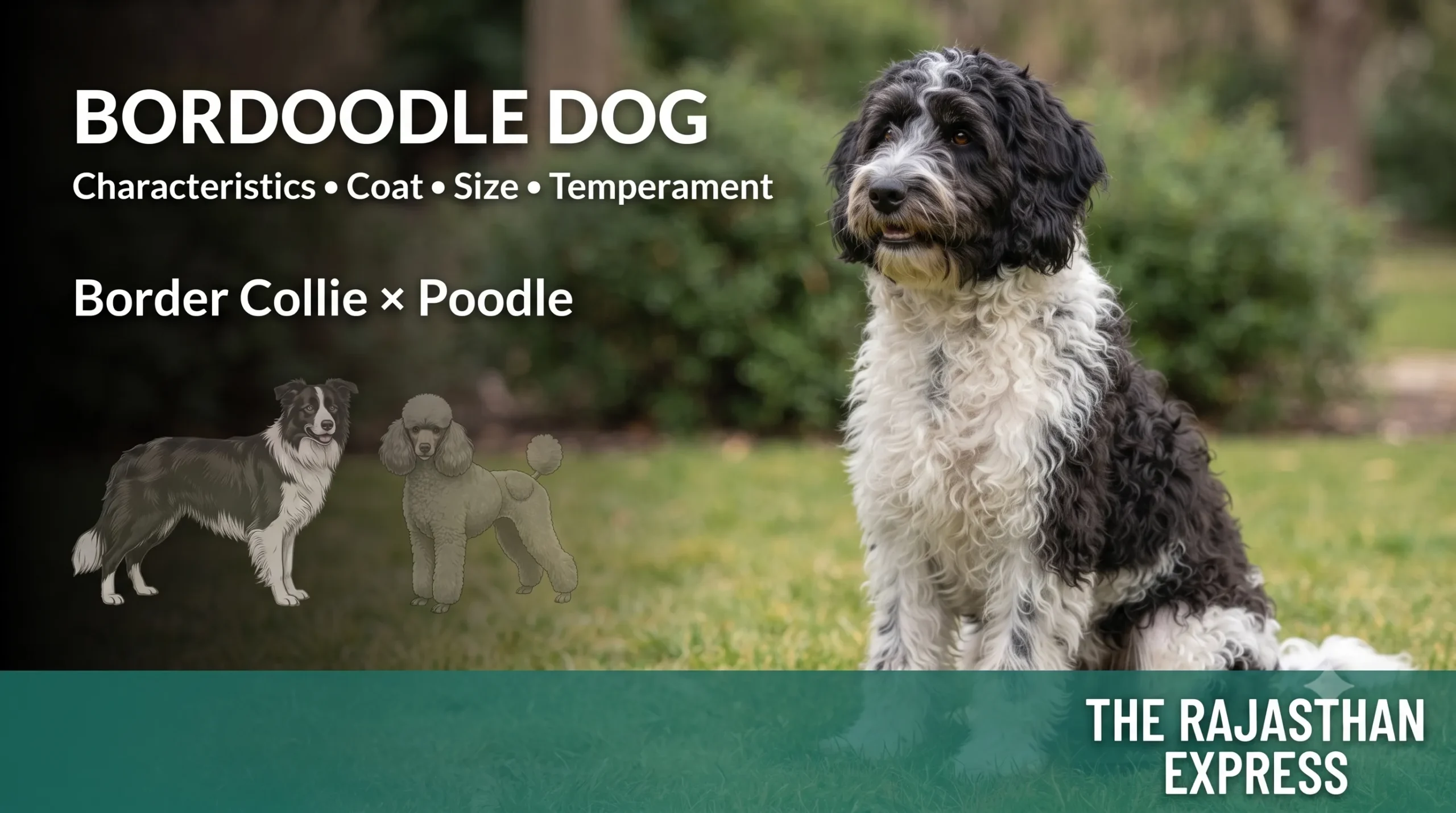
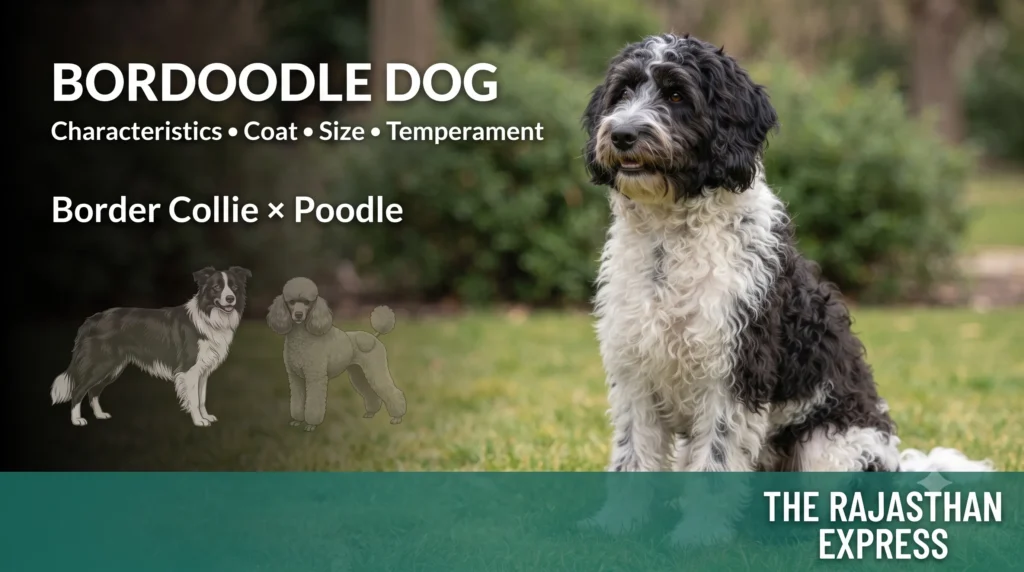
The Bordoodle is a dog that has been produced by crossbreeding the Border Collie and Poodle breeds. People also call it by names like Border Doodle, Borderpoo, or Borpoo. This is not an old or pure breed, but a crossbreed or hybrid dog. It is believed to have been created in America between 1980 and 2000. At that time, people wanted dogs that were both intelligent and shed less hair in the house. With this thought, crossbreeding between the Border Collie and Poodle was done, during which the Bordoodle crossbreed was produced.
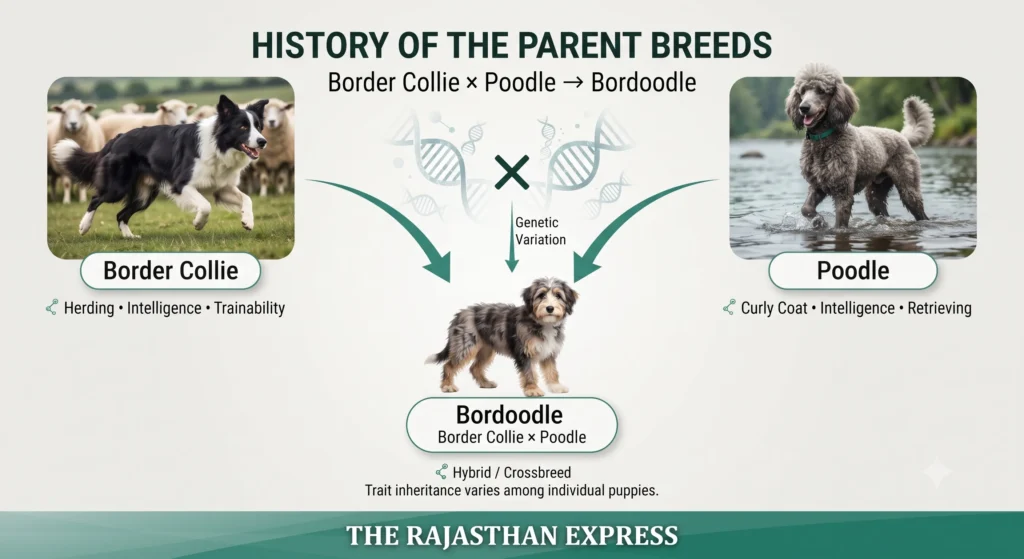
The Bordoodle is called a “designer dog” because it has been created to bring together the best qualities of two special breeds. The Border Collie is counted among the smartest dogs in the world. It learns quickly, loves to work, and understands its owner’s commands quickly. On the other hand, the Poodle is also very intelligent, but its biggest advantage is that it sheds less hair. Therefore, Bordoodle characteristics often include intelligence, strong learning ability, and a low-shedding coat. This is the advantage of crossbreeding technique – the good qualities of two breeds come into one breed (offspring).
The biggest speciality of the Bordoodle dog Breed is its non‑shedding or low‑shedding hair. Many Bordoodles can have curly, wavy, or straight hair. Colours also vary, such as black, white, brown, chocolate, cream, red, grey, and sable. Due to the Poodle’s genes, it is considered a low‑shedding dog. It can be a good option for people who are troubled by dog hair shedding or who are concerned about allergies. But one important thing to remember – no dog is completely allergy‑free. Less shedding is an advantage, but it is not a guarantee that allergies will be completely eliminated.
Another important thing is that the Bordoodle is not recognized as a pure breed by major organizations like the American Kennel Club (AKC) , because it is a mix of two breeds. However, it is registered as a hybrid dog in places like the American Canine Hybrid Club and Designer Breed Registry. While understanding the Bordoodle, it should be kept in mind that crossbreeding does not always produce the same dog. Puppies born in the same litter can have different hair, colour, size, energy, and temperament. There can be a benefit of “hybrid vigor” , but it is not a guarantee. Therefore, while choosing a Bordoodle, it is better to focus not just on the breed name, but on the parents’ health, genetic testing, and the puppy’s behaviour.

Overall, the Bordoodle can be an intelligent, loving, energetic, and loyal companion. It is good for people who want to give it time, teach it, feed it, and exercise it. If you are looking for a dog that mingles with the family and is quick to learn, the Bordoodle can be a good option. But before bringing any dog home, understand that the responsibility of its care, training, and health check‑ups has to be fulfilled for its entire life.
Bordoodle Dog Breed: Characteristics, Size, Coat, Temperament & Price
| Bordoodle Breed Type | Hybrid Dog / Crossbreed / Designer Dog |
|---|---|
| Scientific Classification |
|
| Scientific Name | Canis lupus familiaris (Domestic Dog) |
| Parent Breeds |
|
| Popular Bordoodle Names | Bordoodle, Borderdoodle, Border Doodle, Borderpoo, Borpoo, Borpoodle, Border Collie Poodle Mix, Border Collie Poodle Cross, Border Collie Doodle |
| Bordoodle Origin | Generally associated with the United States; the exact origin and first breeder are not definitively documented. |
| Bordoodle Origin Period | Generally associated with the 1990s–2000s designer-dog period. |
| Breed Recognition | Not recognized as a standardized pure breed by the AKC; registered by some hybrid/designer dog registries. |
| Bordoodle Generations |
|
| Bordoodle Primary Purpose |
|
| Bordoodle Distribution | North America, Europe, Australia, New Zealand and other regions where Border Collie Poodle Mix dogs are bred. |
| Bordoodle Size | Small to medium/large variable size; strongly influenced by the size of the Poodle parent. |
| Bordoodle Height | Approximately 12–22 inches (30–56 cm) at the shoulder; individual size can vary considerably. |
| Bordoodle Weight | Approximately 25–65 lb (11–29 kg); many adult dogs fall around 30–60 lb (14–27 kg). |
| Bordoodle Mini Size | Smaller Bordoodles may result when a Miniature or smaller Poodle is used; size is not determined by the name alone. |
| Bordoodle Body Structure | Athletic, agile, lean and well-proportioned, reflecting traits from both the Border Collie and Poodle. |
| Bordoodle Coat Type | Straight, wavy or curly; coat texture and length can vary between individual dogs and generations. |
| Bordoodle Coat | Usually medium to moderately long; may be soft, dense, wavy, curly or relatively straight. |
| Bordoodle Shedding | Usually low to moderate shedding, but shedding varies according to the coat inherited from the Border Collie and Poodle parents. |
| Bordoodle Colours | Black, white, brown, chocolate, red, cream, grey, fawn, blue and sable; some dogs may have parti or merle patterns. |
| Bordoodle Eyes | Usually brown; eyes may be round or almond-shaped and generally have an alert, expressive appearance. |
| Bordoodle Ears | Drop or semi-drop ears are commonly seen. |
| Bordoodle Nose & Muzzle | Usually a dark nose with a moderately long muzzle; exact features vary according to parental genetics. |
| Bordoodle Tail | Usually long and feathered; tail carriage varies between individual dogs. |
| Bordoodle Temperament |
|
| Bordoodle Personality | Generally affectionate, active, people-oriented and eager to learn, although individual personality can vary. |
| Bordoodle Intelligence | High; inherits strong learning and problem-solving abilities from the Border Collie and Poodle parent breeds. |
| Bordoodle Energy Level | High; requires regular physical exercise and mental stimulation. |
| Bordoodle Training | Generally highly trainable; positive-reinforcement training, consistency and short, engaging sessions are recommended. |
| Bordoodle Exercise Needs | High; daily walks, active play, obedience training, agility, games and other mental activities are beneficial. |
| Bordoodle Grooming | Moderate to high; wavy and curly coats require frequent brushing and regular professional grooming. |
| Bordoodle With Children | Often suitable for families with children when the dog is properly socialised, trained and supervised. |
| Bordoodle With Other Dogs | Generally capable of living well with other dogs following early socialisation and appropriate introductions. |
| Bordoodle Watchdog Ability | Moderate to good; may alert the family to unfamiliar people, sounds or activity. |
| Bordoodle Lifespan | Approximately 11–16 years; lifespan varies with genetics, health and care. |
| Bordoodle Health | Potential health concerns may include hip and elbow dysplasia, eye disorders, epilepsy/seizure disorders, allergies and other conditions associated with the parent breeds. |
| Bordoodle Health Testing | Breeding dogs should be evaluated through appropriate hip and elbow screening, eye examinations and genetic health testing. |
| Is Bordoodle Hypoallergenic? | No dog is completely hypoallergenic. Bordoodles may be low-shedding, but allergy reactions can still occur. |
| Bordoodle Living Environment | Can adapt to a house or suitable apartment when provided with adequate daily exercise, training and mental stimulation. |
| Bordoodle Puppy Price 2026 | Highly variable; approximately ₹25,000 to ₹5,00,000+ depending on country, breeder, generation, health records, training, size and coat. Imported or specially bred dogs may cost more. |
| Bordoodle Cost Factors | Generation, breeder reputation, location, health testing, vaccination, pedigree/records, training, coat type, colour and size. |
| Key Bordoodle Characteristics |
|
| Important Bordoodle Breed Note | The Bordoodle is a crossbreed rather than a standardized pure breed. Therefore, its adult size, coat, colour, shedding level, appearance and temperament can vary considerably between individual dogs and generations. |
| Sources: American Kennel Club (AKC); Border Collie and Poodle breed information; veterinary and canine health references; The Rajasthan Express | |
Bordoodle Origin and History
The Bordoodle is not a very old breed. It is a new crossbreed, created by combining the Border Collie and Poodle. Most experts believe that Bordoodle puppies first appeared in America in the 1990s or early 2000s. At that time, people were trying to create dogs that combined the best qualities of two different breeds. For this reason, it is also called a “designer dog.”
The trend of designer dogs accelerated at the end of the 20th century. After the popularity of crossbreeds like the Labradoodle, people’s curiosity increased to create a new, better, and more attractive dog by combining two pure breeds. The Bordoodle is also a result of this thinking. Its purpose was to combine the Border Collie’s sharp mind and learning ability with the Poodle’s low‑shedding coat and social temperament.
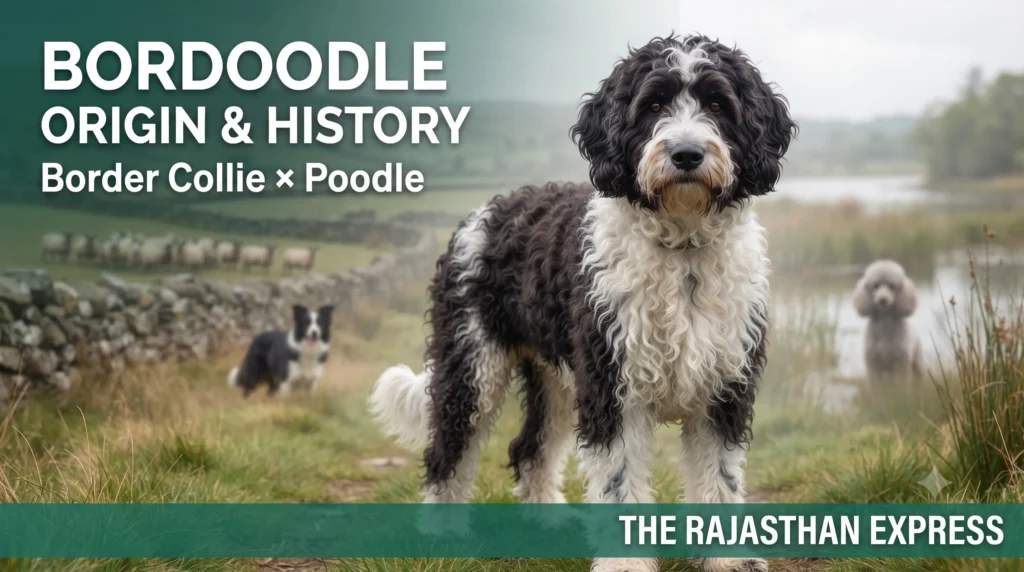
However, there is no single definite and written record of the Bordoodle’s birth. It is believed to have been first developed in America. Some experts also count Australia among its early breeding places, but there is no conclusive proof of this.
History of the Parent Breeds:
- Border Collie: The origin of the Border Collie is considered to be the Northumberland region on the border of England and Scotland. It was developed for herding sheep and other livestock. It is known worldwide for its sharp intelligence, hard‑working nature, and ability to understand the owner’s signals.
- Poodle: The word Poodle comes from the German word “Pudel,” which means “to splash in water or play with water.” The Poodle’s origin is considered to be in Germany around the 1400s, where it was reared for hunting waterfowl and retrieving things fallen in water. Later, it became very popular in France and developed a separate identity there. The Poodle’s curly coat and low‑shedding quality are a major reason for the Bordoodle’s popularity.
Recognition: The Bordoodle is not recognized by the American Kennel Club (AKC) , because it is not a pure breed. The AKC only recognizes breeds that have a stable and consistent standard generation after generation. However, the Bordoodle is registered in many hybrid and designer dog registries. These include organizations like the American Canine Hybrid Club, Designer Breed Registry, Designer Dogs Kennel Club, Dog Registry of America, and International Designer Canine Registry.
Where Are Bordoodle Dogs Found: Distribution and Geographical Map
A Bordoodle dog breed is not a dog native to any particular country or a specific region. It is a designer hybrid, meaning a dog deliberately created by humans by mixing the Border Collie and Poodle. Therefore, it has no old “place of origin” or natural habitat, as a wild or old breed would have. The distribution of the Bordoodle is mainly seen in places where there is high demand for designer dogs, breeders are active, and people are interested in keeping new hybrid dogs.
Initially, the Bordoodle emerged mainly as a designer hybrid in the United States and Australia. It is believed that in the 1990s and early 2000s, the popularity of crossbreeds like the Labradoodle increased in America, and at the same time, work began on creating the Bordoodle by mixing the Border Collie and Poodle. Australia is also considered one of its early breeding places, although no single definite written record is available.
Today, Bordoodle puppies are found in many parts of the world, but their greatest presence can be seen in North America and Europe. In the United States and Canada, it has become quite popular, especially among families who want an intelligent, active, and low‑shedding dog. Demand is also increasing in the United Kingdom, Ireland, Germany, France, the Netherlands, Belgium, Switzerland, and Scandinavian countries. Bordoodles are also found in Australia and New Zealand, because the designer dog culture there has been developed for a long time. In Asia, demand is gradually increasing in Japan, South Korea, Singapore, and major cities of India, although in India it is not yet very common and is mainly available through imports or select breeders.
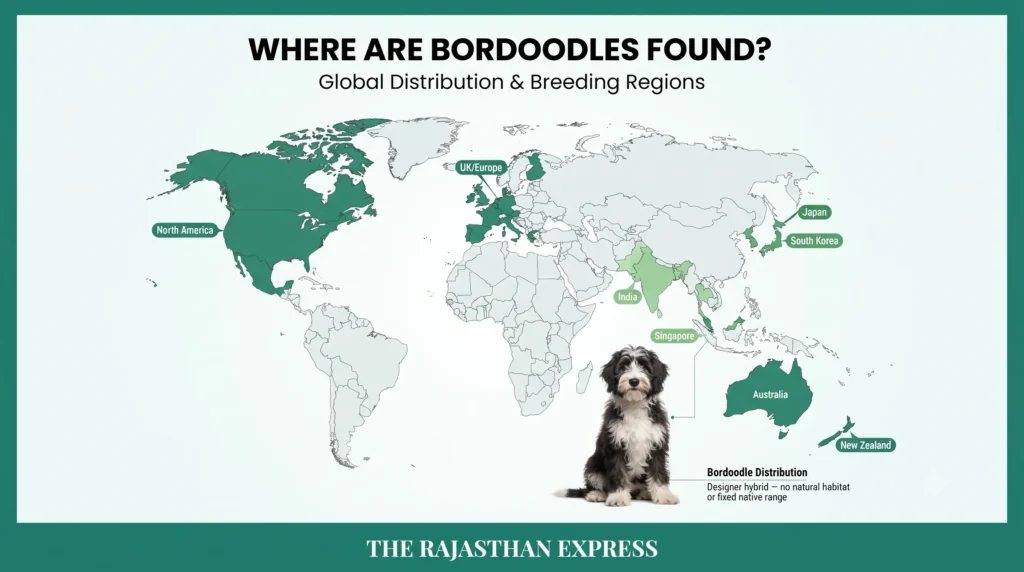
If a geographical map of the Bordoodle were made, it would not appear in the shape of any one country. This map would mainly extend across North America, Europe, Australia, and some major cities of Asia. It can be called a “map of demand,” because wherever there are lovers of designer dogs, both breeders and keepers of the Bordoodle are found. This dog can also live in rural areas, provided it gets open space, exercise, and mental stimulation. But its greatest distribution is seen in urban and suburban areas, because people there prefer small families, apartment life, and low‑shedding dogs.
Talking about breeding centres, the breeding of the Bordoodle mainly happens more in the United States, Australia, and the United Kingdom. Besides, breeders are also found in Canada, Germany, France, the Netherlands, and some other European countries. In India, there are currently very few breeders of the Bordoodle. Most Bordoodles are imported from abroad or are found with professional breeders in some big cities. The reason is that the Bordoodle is a new hybrid breed, and awareness and demand for it in India have not yet increased that much.
It is also necessary to understand that the distribution of the Bordoodle depends on where its parents – the Border Collie and Poodle – are found. The Border Collie is reared all over the world, especially in livestock and farming areas. The Poodle is also found in almost every major country of the world. Therefore, the Bordoodle can also be easily created and reared in places where breeders of these two breeds exist. But since it is not a pure breed, major organizations like the American Kennel Club do not recognize it. This means that it has no official “country of origin” or “national distribution” fixed. Organizations like the American Canine Hybrid Club, Designer Breed Registry, Designer Dogs Kennel Club, Dog Registry of America, and International Designer Canine Registry register it as a hybrid.
There are some special reasons for the increasing popularity of the Bordoodle worldwide. The first reason is its intelligence and quick learning ability. The second reason is its low‑shedding coat, which is liked by people who are troubled by dog hair. The third reason is its loving, friendly, and family‑oriented nature. The fourth reason is that it can adapt to both urban and rural environments, provided it gets daily exercise, play, and mental challenge. But in hot and humid areas, its care has to be a little more. Curly hair needs regular brushing and grooming, otherwise tangles and skin problems can occur. In cold areas, it can live comfortably, but in very cold weather it needs shade, a warm bed, and protection.
Overall, the Bordoodle today is mainly found in America, Canada, Europe, Australia, and New Zealand. In Asia and India, it is still an emerging breed, mainly limited to big cities, pet enthusiasts, and professional breeders. Its geographical spread is not determined by any river, mountain, or country border, but by people’s preference, the availability of breeders, and designer dog culture. So if someone asks where Bordoodles are found, the direct answer is that they are found in places where people want to keep an intelligent, active, and low‑shedding hybrid dog and where breeding facilities for it are available.
What Other Names Is the Bordoodle Dog Known By?
The Bordoodle Dog is mainly considered a hybrid or crossbreed dog. It has been created by combining two different breeds – the Border Collie and Poodle. For this reason, it is placed in the “designer dog” category. It is worth noting that it is not a pure breed, but a crossbred dog. It has no single official name fixed, so it is called by different names among different countries, breeders, and keepers.
The most common name is “Bordoodle” itself. Besides this, it is also known by names like Borderdoodle, Borderpoo, Borpoo, Borpoodle, Border Collie Poodle Mix, and Border Poodle. In some places, it is also called Border Collie Doodle or Border Collie Poodle Cross. All these names mean approximately the same thing – a dog made from the mix of Border Collie and Poodle. The word “Bordoodle” is actually made by combining the words “Border” and “Poodle,” so in some places it is also written as “Bordoodle.”
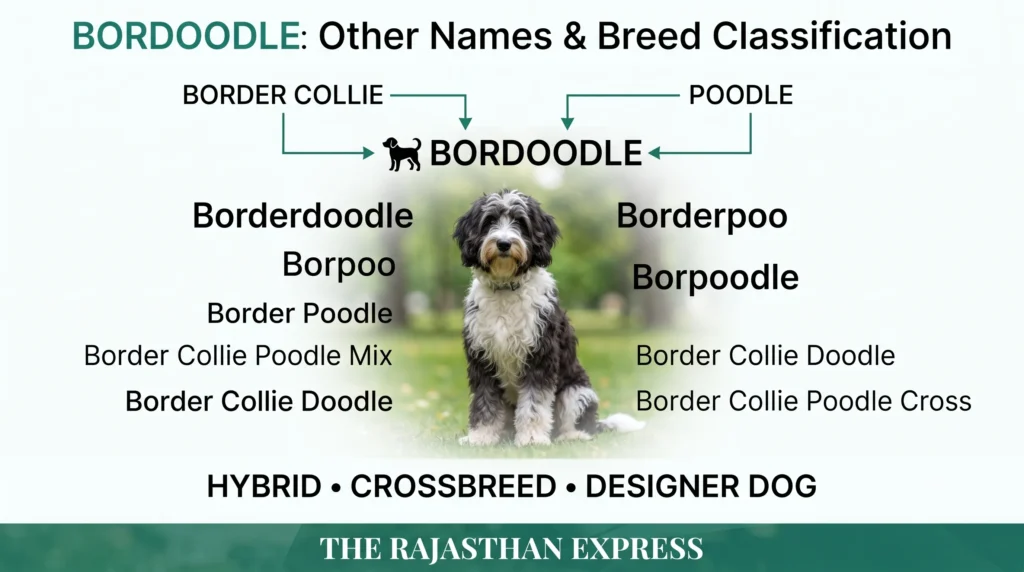
Looking at it by category, the Bordoodle is considered neither a pure breed nor a traditional breed of any one country. It is called a hybrid, crossbreed, or designer dog. Major organizations like the American Kennel Club do not recognize it, because it is not a pure breed. But organizations like the American Canine Hybrid Club, Designer Breed Registry, Designer Dogs Kennel Club, Dog Registry of America, and International Designer Canine Registry register it as a hybrid dog. Based on breeding, it is also divided into categories like F1, F1B, and F2. F1 means a direct mix of Border Collie and Poodle; F1B means re‑mating an F1 Bordoodle with a Poodle; and F2 means mating two Bordoodles with each other. These categories can cause differences in the puppies’ coat, colour, and temperament.
What Are Bordoodle Puppies Bred For?
Talking about the main use, the Bordoodle is generally reared as a companion dog. It likes to live with its family, play, go for walks, and be among people. Due to its sharp intelligence and learning ability, it is not limited to just household hobbies. It can also be trained for tasks like obedience, agility, flyball, trekking, and therapy dog work. But for this, it is necessary that it gets daily physical exercise, mental challenge, and an environment of loving training. Therefore, the Bordoodle is mainly a family companion, active partner, and trainable dog, which is called by different names, but its identity is formed by its temperament, health, and care.

How to Identify a Bordoodle Dog Breed?
Bordoodle Dog Characteristics: Size and Build
The Bordoodle is usually a medium‑sized dog. Its body is athletic, lean, and well‑proportioned. It is neither very heavy in appearance nor very light.
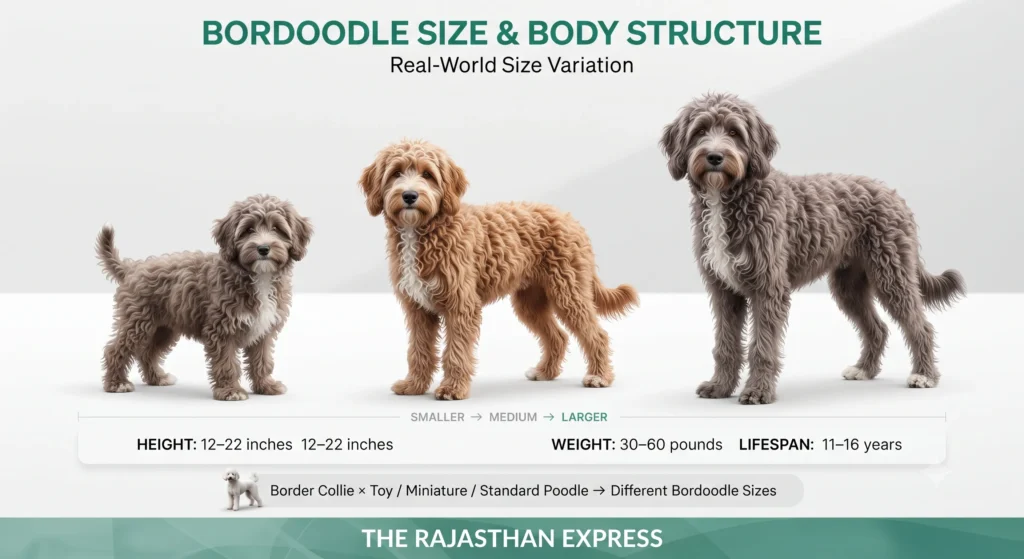
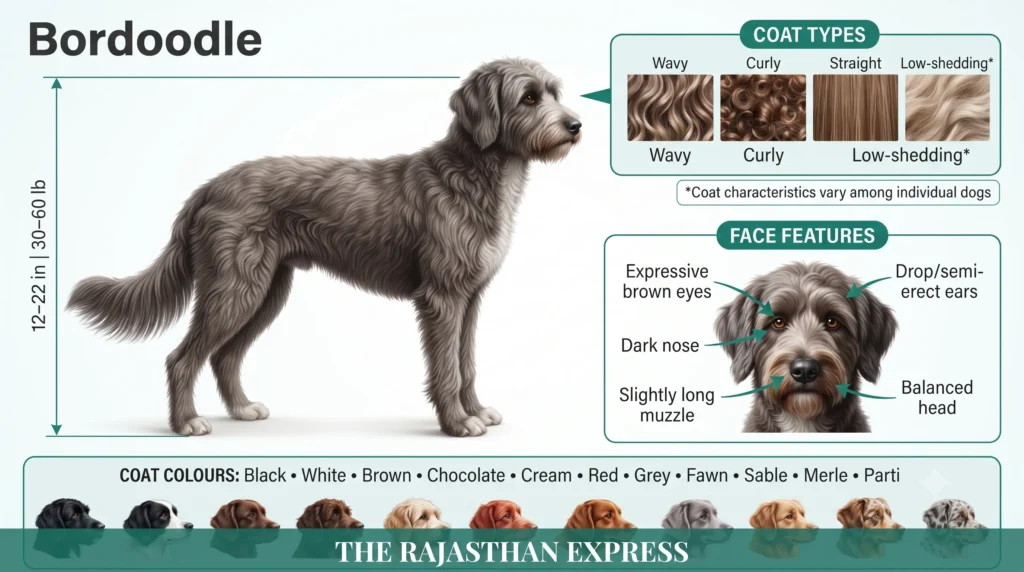
- Height: The shoulder height of a Bordoodle dog can be between 12 and 22 inches, but most Bordoodles are around 16 inches.
- Weight: The weight of a Bordoodle dog ranges from 30 to 60 pounds, i.e., about 13.5 to 27 kilograms. Male Bordoodles are usually slightly larger and heavier than females.
If the Poodle parent was a Miniature, the Bordoodle’s size may remain small. Its legs are long and strong, which help it run fast and jump. The tail is long and often appears feathery. When it is happy or excited, it raises its tail high.
🧥 Bordoodle Coat: The Most Important Bordoodle Dog Characteristic
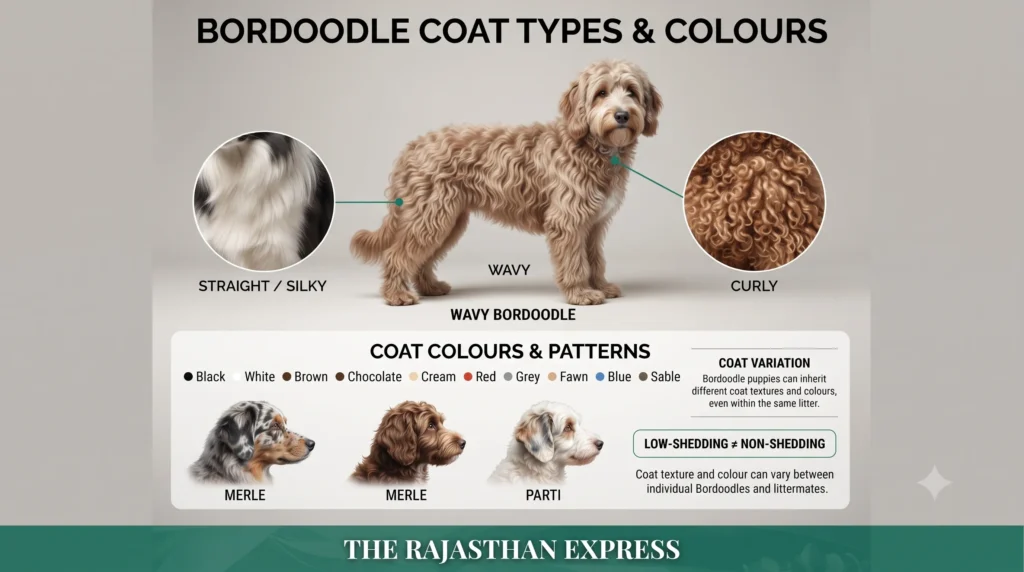
The Bordoodle coat is one of its most distinctive identifying features. It usually has soft, wavy, or curly hair. Due to the Poodle’s genes, its coat is considered low‑shedding. But it is not necessary that every Bordoodle’s coat be the same.
- Bordoodle Coat Type: Some Bordoodle dogs’ hair can be straight or silky, looking like a Border Collie. Some can have completely curly hair, looking like a Poodle. Puppies born in the same litter can also have different coats. Some have medium‑length and wavy hair, while some have dense and curly hair.
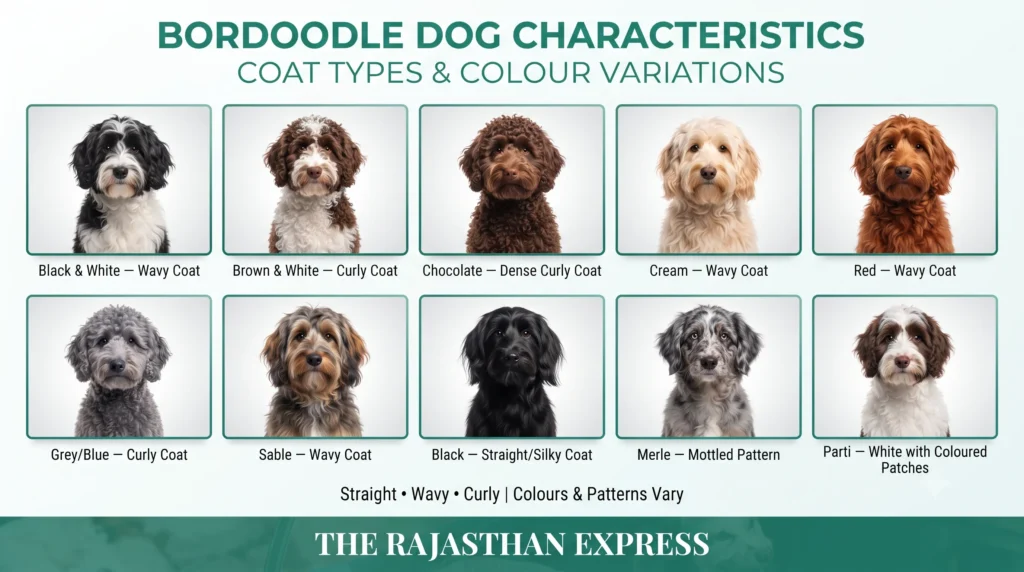
- Bordoodle Colours: Bordoodle coat colours are also of many types. These include black, white, brown, chocolate, cream, red, grey, fawn, blue, and sable. Some Bordoodles can also show patterns like merle or parti. Merle has a mottled colour, and parti has white colour with spots of another colour. Due to this variation in coat, identifying a Bordoodle becomes a little difficult.
👀 Bordoodle Dog Characteristics: Facial Features
- Bordoodle Eyes: The Bordoodle’s eyes are very expressive. These can be round or almond‑shaped and are usually brown in colour. Their eyes show an intelligent and friendly expression, which makes it alert like a Border Collie and loving like a Poodle.
- Bordoodle Ears: Its ears are usually hanging, which gives the face a gentle and loving appearance. Sometimes the ears can also be semi‑erect.
- Bordoodle Nose: Usually small, black, and triangular, similar to the Border Collie. The muzzle (front part of the mouth) is slightly long. The head is well‑balanced and has a layer of soft, curly, or wavy hair on it.
Bordoodle Dog / Borderdoodle Dog Characteristics: Other Identification Points
While identifying a Bordoodle, keep some other things in mind. Its body is strong and agile, which makes it active and playful. Its gait shows lightness and confidence. It is usually friendly with other dogs and humans, but can also remain alert towards strangers. One of its biggest Bordoodle dog characteristics is that it learns very quickly and understands its owner’s signals.
But since it is a hybrid, its temperament and appearance are not always the same. Some Bordoodles can be more energetic and working‑oriented like the Border Collie, while some can be calm and social like the Poodle. Therefore, identifying only by appearance is difficult.
How to Identify a Bordoodle Dog Breed Correctly?
If you think a dog is a Bordoodle, first learn about its parents. If one of the parents is a Border Collie and the other is a Poodle, then the chances of the offspring being a Bordoodle are very high. Ask the breeder which generation the puppy is from – F1, F1B, or F2. F1 means a direct mix of Border Collie and Poodle. F1B means re‑mating an F1 Bordoodle with a Poodle. F2 means mating two Bordoodles with each other. These generations can cause differences in the puppy’s coat, colour, and temperament. If you want to be completely sure, get a DNA test done. This is the most reliable method. The American Kennel Club does not recognize the Bordoodle, so it has no official breed certificate. But organizations like the American Canine Hybrid Club and Designer Breed Registry register it as a hybrid.
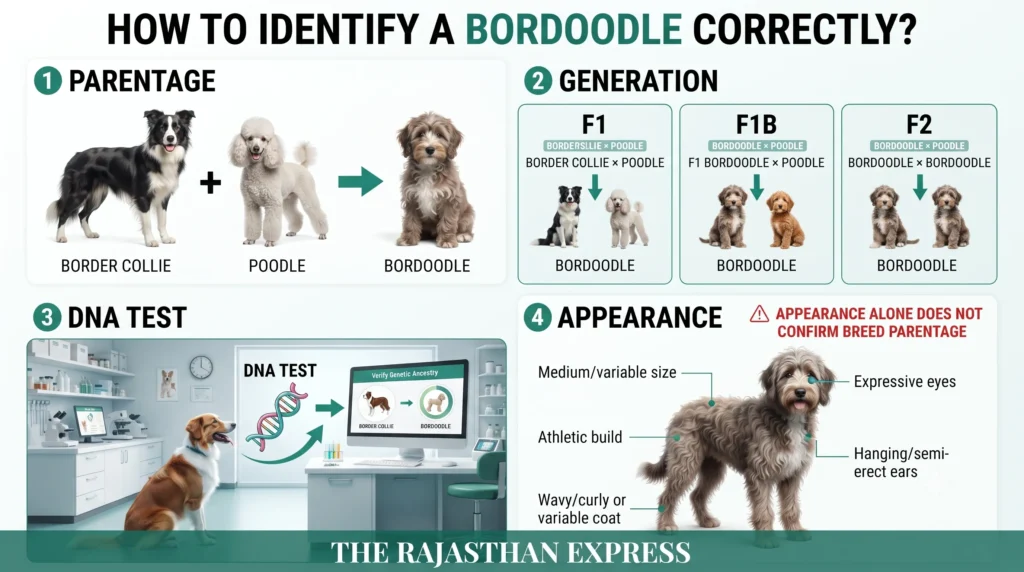
Overall, the Bordoodle can be identified by its medium size, athletic body, low‑shedding wavy or curly coat, expressive eyes, hanging ears, and friendly nature. But remember that every Bordoodle is different, so identifying only by appearance is not always correct. Parents’ information and DNA testing give the most correct answer.
Bordoodle Size, Weight and Body Structure
The Bordoodle size is generally medium to large in appearance. Its body is strong, agile, and athletic, which it gets from the Border Collie’s agility and the Poodle’s beautiful build. Since it is a hybrid dog, every Bordoodle’s size, weight, and colour are not the same. It depends on who its parents were – especially the Poodle’s size (Standard, Miniature, or Toy) and what the Border Collie’s breed was like. Therefore, the information given below indicates the general range, but every dog can be different in itself.
| Bordoodle Size, Weight and Body Structure | |
| Feature | General Range |
|---|---|
| Height | 12 to 22 inches (at shoulder) |
| Weight | 30 to 60 pounds (some sources say 25 to 65 pounds) |
| Lifespan | 11 to 16 years (average 12 to 15 years) |
| Coat Type | Medium, wavy to curly |
| Coat Colour | Black, blue, chocolate, cream, fawn, grey, red, white, merle |
| The Rajasthan Express : Bordoodle Size, Weight and Body Structure | |
Bordoodle Size: Height, Weight and Lifespan
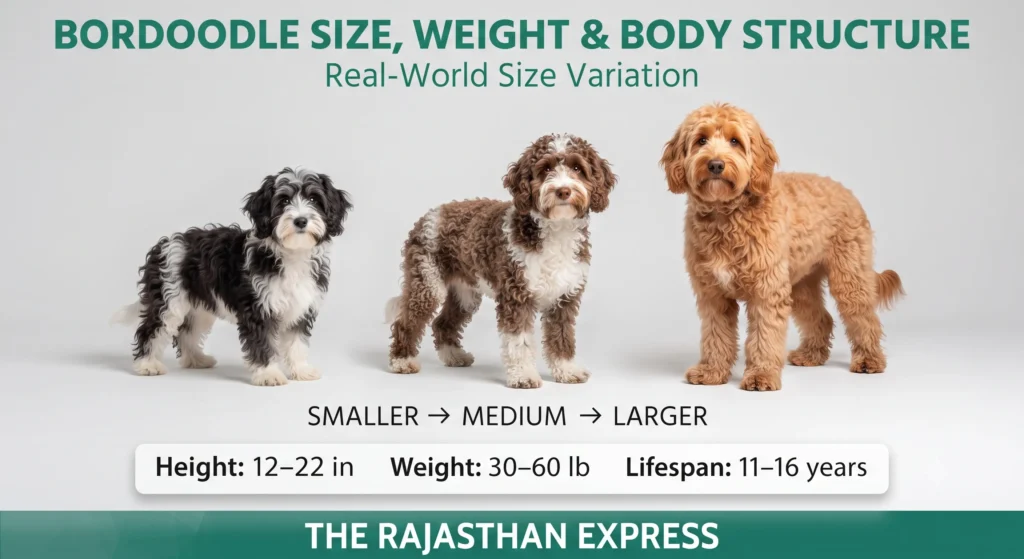
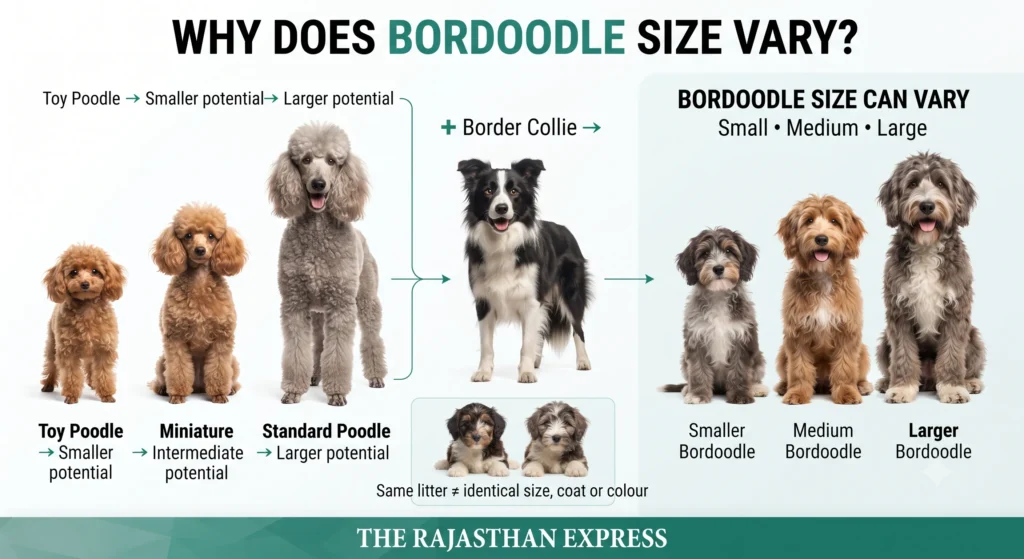
- The shoulder height of a Bordoodle is usually between 12 and 22 inches. Weight can range from 30 to 60 pounds, i.e., about 13 to 27 kilograms. Some sources state this as 25 to 65 pounds as well. If the Poodle parent was Miniature, the Bordoodle’s size remains small.
- Miniature Bordoodles are usually 15 to 17 inches long and weigh 20 to 30 pounds. On the other hand, if the parent was a Standard Poodle, it can be larger and heavier. Its average lifespan is considered to be between 11 and 16 years, but most Bordoodles live 12 to 15 years. Lifespan also depends on care, diet, exercise, and genetic health.
Bordoodle Adult Size and Body Structure
- The Bordoodle adult can vary in size because the Bordoodle is a hybrid of a Border Collie and Poodle. The size of the Poodle parent, whether Standard, Miniature, or Toy, can influence the final size of the adult dog.
- The adult dog can have a strong, agile, and athletic body. However, every Bordoodle adult can be different in height, weight, coat, and colour.
Borderdoodle Mini Size and Appearance
- If the Poodle parent was Miniature or Toy, the resulting dog can be smaller. This variation is why terms such as Borderdoodle Mini may be used when referring to smaller dogs of this type.
Borderdoodle Adult Characteristics
- A Borderdoodle adult may show different physical and behavioural characteristics depending on the genes inherited from its Border Collie and Poodle parents. Some may be more energetic and work-oriented, while others may be calmer and more social.
Borderdoodle Black Coat and Colours
- A Borderdoodle black dog can have a black coat, while other Borderdoodle dogs may have colours such as white, brown, chocolate, cream, red, grey, fawn, blue, or sable. Some may also show merle or parti patterns.
Why Does the Bordoodle Dog’s Size Vary?
The biggest reason for variation in the Bordoodle’s size is that it is a mix of two different breeds. The Poodle comes in three sizes – Standard, Miniature, and Toy. If the Poodle was Miniature or Toy, the Bordoodle will remain small. If it was a Standard Poodle, the Bordoodle can be large and heavy. Similarly, the Border Collie’s size is also medium, but its physical build is agile. When the genes of both combine, the resulting offspring may have some qualities stronger and some weaker. Therefore, puppies born in the same litter can have different height, weight, coat, and colour. This is why the Bordoodle cannot be bound to any one fixed breed standard.
Bordoodle Dog Price 2026: Bordoodle Puppy Price, Cost, Characteristics and Buying Factors
Buying a Bordoodle dog is a decision that should be taken thoughtfully. It is a hybrid dog of the Border Collie and Poodle, so its price is not fixed. In the market, a Bordoodle puppy can be found from ₹25,000 to ₹5 lakh or even more. The Bordoodle dog price depends on where you are getting the puppy from – a reputable breeder, online advertisement, shelter home, or importing from abroad. Additionally, the puppy’s generation, age, coat, colour, size, health, vaccination, training, and pedigree also make the price go up and down a lot.
In India, the Bordoodle is not yet a very common breed. Therefore, its price here can be higher due to import from abroad, quarantine, air travel, breeder availability, and demand.

1. Bordoodle Cost: How Much Training Has the Puppy Received?? (More training = higher price)
The Bordoodle is a very intelligent dog. If it has been given basic training, its price increases.
- Bordoodle Puppies Without Training: Lower price.
- Bordoodle Puppies With Basic Training: Knows commands like sit, stay, come – price increases by ₹20,000–₹50,000.
- Fully Trained Bordoodle Puppy Price: Knows house manners, walking on leash, social behaviour, and commands – its price can reach $5,900, i.e., about ₹4,90,000.
- Bordoodles with therapy, agility, or show training can be even more expensive.
2. Bordoodle Dog Price by Generation: F1, F1B and F2 (F1, F1b, F2 – this is where the price changes)
Generation has a very big effect on the Bordoodle.
- F1 Bordoodle Price: Direct crossbreeding of pure Border Collie and pure Poodle. Most common, medium price. Coat and temperament are mixed. Price approximately ₹2.5 lakh–₹3.5 lakh.
- F1B Bordoodle Price: F1 Bordoodle is again crossed with Poodle. In this, more Poodle qualities come – coat more curly and less shedding. Therefore, it is more expensive, approximately ₹3 lakh–₹4.5 lakh or up to ₹5 lakh.
- F2 Bordoodle Price: Crossbreeding of two Bordoodles with each other. In this, there is a lot of variation in coat, colour, size, and temperament. Price can be lower or higher.
- Multigen or Registered Hybrid Bordoodle Cost: Prepared over many generations, registered in a registry. Due to more stable qualities and documents, the most expensive – ₹4 lakh–₹6 lakh+.
3. What is the age? (Bordoodle Puppies Price by Age: Puppy, Young Dog and Adult)
Age is directly related to price.
- Bordoodle Puppies – 8 Weeks to 6 Months: Most common selling age. Price ₹65,000 to ₹2,50,000.
- Young Bordoodle – 6 to 18 Months: If training has started, price is slightly higher.
- Bordoodle Adult Price – Fully Trained Adult Dog: If fully trained and healthy, ₹3,00,000 to ₹5,00,000.
- Older Bordoodle dog: Price decreases, but health risk is higher.
4. Bordoodle Coat Types, Colours and Size: How They Affect Bordoodle Cost
Coat and size contribute greatly to the Bordoodle’s price.
- Bordoodle Mini and Borderdoodle Mini Price: A Bordoodle Mini can be more expensive than a larger Bordoodle. Smaller sizes can be in greater demand.
- Bordoodle Coat Types and Bordoodle Coat: A curly coat can have greater demand and therefore a higher price. The Bordoodle coat may vary because the dog is a Border Collie and Poodle hybrid. Coat type can therefore influence the market price.
- Bordoodle Colours and Rare Colours: Rare Bordoodle colours may attract an additional charge. Colours such as merle, parti, blue, chocolate, or sable may be priced higher.
- Low-Shedding Bordoodle Coat: More preferred by people troubled by allergies, therefore price increases.
5. What is the health and vaccination status? Bordoodle Puppies: Health and Vaccination Status
Buying a healthy puppy means saving on future veterinary expenses.
- Full vaccination: Protection from viral and bacterial diseases – vaccines for rabies, distemper, parvo, hepatitis, etc. in dogs.
- Deworming: Medicine for stomach worms.
- Health certificate: Examination by a veterinarian.
- Parents’ health tests: Hip score, eye examination, genetic testing.
A puppy with a complete vaccination card and health record can cost ₹10,000 to ₹50,000 more.
6. Is there pedigree/record or not? Bordoodle Dog Price With Pedigree and Records
This is the biggest premium.
- Bordoodle without papers: Cheaper, but risky. It cannot be known who the parents were and what their health was like.
- Registered/Certified Bordoodle: Whose parents have health tests, genetic testing, and generation records.
A Bordoodle with recorded pedigree can sell for 50% to 70% more than a similar‑looking puppy without records.
7. Where are you buying from? Bordoodle Puppies for Sale: Price by Location and Source
The Bordoodle puppies for sale price can vary greatly depending on where and from whom the puppy is purchased.
- Reputable breeder: In America and Canada, $3,000–$4,000, i.e., about ₹2,50,000–₹3,50,000. In Canada, $2,600–$5,400, i.e., ₹2,15,000–₹4,50,000.
- Online advertisement/classified: $800–$1,600, i.e., ₹65,000–₹1,30,000. But risk of fraud and puppy mill.
- UK: £850–£1,500, i.e., about ₹90,000–₹1,60,000.
- Shelter home/rescue: $300–$550, i.e., ₹25,000–₹45,000. Sometimes the fee is zero.
- Local/Imported in India: ₹80,000–₹2,50,000. When importing from abroad, ₹3,00,000–₹6,00,000+.
- Buying from the native region: Buying directly from a breeder in America, Canada, or the UK can be cheaper. In India, import duty, air travel, and quarantine costs are added
- Bordoodle Cost Australia : The bordoodle cost autriliya can vary according to the breeder, generation, size, coat, colour, health records, training, and other factors. The supplied information does not provide a specific Australia price range, so no additional figure is given here.
| Bordoodle Dog Price 2026: Bordoodle Puppy Price, Cost, Characteristics and Buying Factors | |
| Category | Estimated Price |
|---|---|
| Adopting from shelter/rescue | ₹25,000 – ₹45,000 (sometimes ₹0) |
| Online advertisement/ordinary breeder | ₹65,000 – ₹1,30,000 |
| Ordinary puppy in the UK | ₹90,000 – ₹1,60,000 |
| Local/imported puppy in India | ₹80,000 – ₹2,50,000 |
| Reputable foreign breeder (F1/F1b) | ₹2,15,000 – ₹4,50,000 |
| Fully trained puppy | ₹4,90,000+ |
| Record + health test + rare coat/miniature | ₹3,00,000 – ₹6,00,000+ |
| The Rajasthan Express : Bordoodle Dog Price 2026: Bordoodle Puppy Price, Cost, Characteristics and Buying Factors | |
Bordoodle Cost: Expenses Beyond the Purchase Price
- The cost of keeping a Bordoodle is not limited to just buying the puppy. In the first year, ₹50,000 to ₹1,50,000 can be spent on crate, bed, bowls, leash, toys, vaccination, spay/neuter, and training classes.
- Every year, ₹1,65,000 to ₹4,15,000 can be spent on food, veterinary check‑ups, parasite prevention, grooming, and insurance. Due to the Bordoodle’s curly or wavy coat, professional grooming has to be done regularly, which can cost ₹4,000–₹6,600 per month.
- The price of a Bordoodle puppy can range from ₹25,000 (adoption) to ₹4,90,000 (fully trained) or ₹6,00,000+ (records, health tests, rare coat, and miniature) . In India, this breed is rare, so the price can be higher. The best option is to contact a reliable breeder or shelter home, see the parents’ health certificates, ask for the vaccination card, and get the puppy examined by a veterinarian. Do not fall into the temptation of a cheap price, because the puppy’s health and temperament are more important than its price.
Bordoodle Dog Temperament and Behavior: Bordoodle Temperament, Personality and Characteristics
The Bordoodle’s temperament comes from its parents – the Border Collie and Poodle. Both are very intelligent dogs. Therefore, the Bordoodle is also usually very clever, learning‑oriented, loving, and family‑bonded. But every Bordoodle is not the same. Some have more Border Collie qualities, some have more Poodle qualities. Besides, its upbringing, training, and home environment also shape its temperament. Let us understand this in simple language.
How Intelligent Is the Bordoodle Dog Breed?
- The Bordoodle is a very intelligent dog. It can be called “super‑smart.” It learns new things quickly. Sometimes it learns things on its own – sometimes good habits, and sometimes bad habits too, if it does not receive attention and training. It is always ready to please its owner.
- It enjoys learning new commands and tricks. It excels in activities like agility and obedience. But along with this, it also has a bit of stubbornness and self‑will. Therefore, it should be taught with love and patience.
Bordoodle Temperament: Love, Loyalty and Family Bonding
- One of the important features of Bordoodle temperament is its strong attachment to its family. It likes to stay with its owner, play, sit in the lap, and receive love.
- It is friendly and mingles quickly with people, provided it has been socialised from puppyhood. It is loyal to its family and ready to protect them.
- But it does not like being alone. If left alone for long periods, it may become sad, cry, bark, or chew household items.
Bordoodle Puppies Temperament: Energy and Playfulness
- The Bordoodle is a very energetic dog. It needs plenty of exercise daily. Running, jumping, catching a ball, and long walks are very good for it. But it needs not just physical work, but mental work too.
- Puzzle toys, new tricks, and brain games are very important for it. If it does not get enough play and mental work, it gets bored and starts misbehaving.
Bordoodle Dog Characteristics: Mental Stimulation and Brain Games
- The Bordoodle lives very lovingly with children. It hardly ever gets angry even when teased by them. It likes to play and stay with the family.
- But with very small children – under four years of age – a little caution should be maintained. Children and the dog should always be supervised.
- Some Bordoodles have a Border Collie‑like habit – circling around children or lightly nudging them. This can be directed in the right direction through play and training.
Bordoodle Dog Temperament With Other Animals
- The Bordoodle generally gets along well with other dogs, especially if socialised from puppyhood. It can also be fine with cats and small animals, but it is necessary to introduce them to each other from the beginning.
- Due to Border Collie genes, some Bordoodles may see small animals like rabbits or mice as prey. Therefore, be cautious with them. If not socialised with other animals from puppyhood, it can become fearful or aggressive.
Bordoodle Temperament: Alertness and Watchdog Behaviour
- The Bordoodle is very alert. It always remains alert to protect its family. On seeing a stranger, it may bark to alert. Therefore, it can be considered a good watchdog.
- It is protective towards its family but generally not aggressive. Towards strangers, it may be a little shy or cautious, especially if not socialised from puppyhood. It does not bark much, but when alone, it may cry or howl.
Bordoodle Dog Characteristics: Training and Socialisation
- Teaching the Bordoodle with love is the best method. Train it through treats, praise, and play. Shouting or hitting is not good for it. Teach it in short sessions, because its attention can wander quickly.
- From puppyhood, introduce it to different people, places, sounds, and animals. This will make it confident and social. Due to its stubbornness, a little patience may be needed. Keep teaching it puzzle toys and new tricks so that its mind stays sharp and it remains happy.
- Borderdoodle Mini Temperament : A Borderdoodle mini is still a Bordoodle-type hybrid, so its behaviour can vary between individual dogs. Size alone does not determine its complete temperament.
The Bordoodle is an intelligent, loving, energetic, and loyal dog. It forms a deep bond with the family. It can be good with children and other animals if taught and socialised from puppyhood. But it does not like being alone. If it does not get play, walks, and mental work, it can misbehave. Therefore, the Bordoodle is good for people who can give it time, love, and training. Every Bordoodle is a little different, so understanding it and keeping it according to its needs is best.
Bordoodle Dog Temperament: Is It a Good Family Dog?


