 By
Goldendoodle Size Guide: Petite, Mini Goldendoodle, Medium, and Standard Explained
One of the most common questions prospective owners ask is: “How big does a Goldendoodle get?”
The answer is not as straightforward as it is for a pure breed. Because the Goldendoodle is a hybrid or crossbreed — created by crossing the Golden Retriever and the Poodle — its size can vary significantly. The Goldendoodle Association of North America (GANA) recognizes four main size categories: Petite, Miniature, Medium, and Standard.
This guide explains each size category, the factors that influence a Goldendoodle’s final size, and what you should realistically expect when bringing one home.
Read More About Goldendoodle :

Rakesh Kumar is a Rajasthan Government Livestock Inspector and the founder of The Rajasthan Express. With professional experience in animal husbandry, livestock care, and veterinary science, he writes practical, research-based content to help readers make informed decisions about animal breeds, pet care, and livestock management.
About The Author
The Goldendoodle Size Chart: An Overview
The following table provides the generally accepted size ranges for the four Goldendoodle categories, as referenced in breed guidance.
| The Goldendoodle Size Chart: An Overview | ||
| Type | Shoulder Height | General Weight |
|---|---|---|
| Petite / Petite Mini Goldendoodle | Under 14 inches | About 25 pounds or less |
| Mini / Miniature Goldendoodle | 14–17 inches | About 26–35 pounds |
| Medium Goldendoodle | 17–21 inches | About 36–50 pounds |
| Standard Goldendoodle | Over 21 inches | About 51 pounds or more |
| The Rajasthan Express : The Goldendoodle Size Chart: An Overview | ||
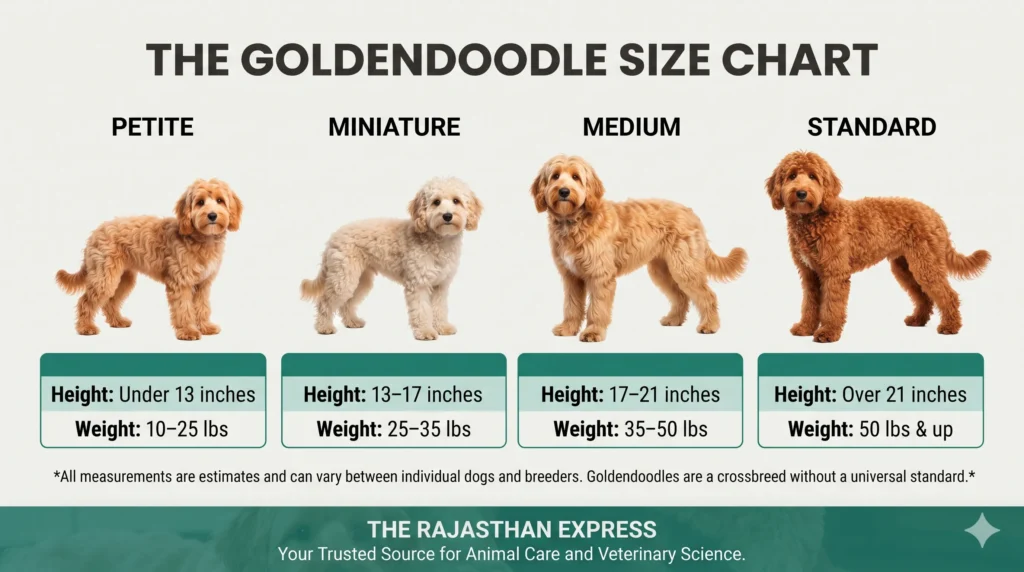
Important Note: These are estimated ranges, not fixed guarantees. Actual adult size depends on genetics, sex, nutrition, and activity level. Individual dogs can fall outside these ranges.
Understanding the Four Goldendoodle Sizes
Petite Goldendoodle
- Height: Under 14 inches at the shoulder
- Weight: Approximately 25 pounds or less
- Best for: Apartment living, smaller homes, owners who prefer a compact companion
- Parent breeds: Typically involves a Toy or small Miniature Poodle
The Petite Goldendoodle is the smallest of the four categories. It is sometimes called a “Petite Mini Goldendoodle.” While some breeders may use the term “Toy Goldendoodle,” this is not an officially recognized category. The Petite size is the closest recognized equivalent.
Miniature Goldendoodle (Mini Goldendoodle)
- Height: 14–17 inches at the shoulder
- Weight: Approximately 26–35 pounds
- Best for: Families in apartments or smaller homes who still want a dog with moderate energy
- Parent breeds: Typically involves a Miniature Poodle
The Mini Goldendoodle is one of the most popular sizes. It is small enough to live comfortably in an apartment but large enough to enjoy outdoor activities. Its exercise needs are moderate, though individual energy levels vary. (For a detailed breakdown, see our dedicated article: “Mini Goldendoodle: Size, Full-Grown Weight, and What to Expect.“)
Medium Goldendoodle
- Height: 17–21 inches at the shoulder
- Weight: Approximately 36–50 pounds
- Best for: Families with more space who want a dog that is substantial but not overly large
- Parent breeds: Can involve a Miniature or Standard Poodle, depending on the breeder’s program
The Medium Goldendoodle sits between the Mini and the Standard. It offers a balance — larger than a Mini but more compact than a Standard. This size can be a good fit for active families who want a dog that can join in outdoor activities without requiring the space of a large breed.
Standard Goldendoodle
- Height: Over 21 inches at the shoulder
- Weight: Approximately 51 pounds or more
- Best for: Families with ample space, active owners, and those who prefer a larger dog
- Parent breeds: Typically involves a Standard Poodle
The Standard Goldendoodle is the largest category. It is a medium to large, strong, agile, and athletic dog. Its build should reflect both the Golden Retriever’s sturdy frame and the Poodle’s agility. Its chest is deep, its back is almost flat, and its legs are straight and strong.
Because of its size, the Standard Goldendoodle needs sufficient space and daily exercise. It may need more physical activity than a Mini or Medium Goldendoodle, though exercise needs should always be assessed based on the individual dog’s age, health, and energy level — not size alone.
Why Goldendoodle Size Varies So Much
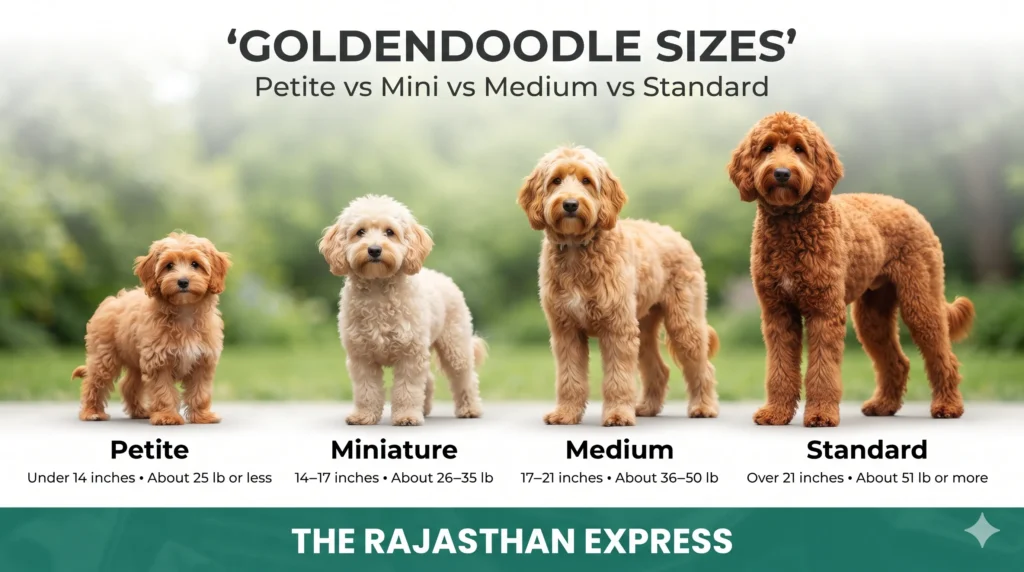
The Goldendoodle’s size is not fixed because it is a crossbreed. Several factors influence how big a puppy will grow.
1. The Size of the Poodle Parent
This is the most significant factor. The Poodle comes in three recognized sizes:
- Standard Poodle — largest, typically producing Standard Goldendoodles
- Miniature Poodle — smaller, typically producing Mini or Medium Goldendoodles
- Toy Poodle — smallest, typically producing Petite Goldendoodles
If a breeder uses a Standard Poodle as the parent, the puppies are more likely to be larger. If a Miniature or Toy Poodle is used, the puppies are more likely to be smaller.
2. Genetics and Individual Variation
- Even within the same litter, puppies can grow to different sizes. Just as siblings in a human family can vary in height, Goldendoodle puppies inherit different combinations of genes from their parents. No two Goldendoodles are genetically identical.
3. Sex
- Male Goldendoodles are often slightly larger and heavier than females, though this varies by individual dog.
4. Nutrition
- Proper nutrition during puppyhood supports healthy growth. Malnutrition or overfeeding can affect development. A balanced diet appropriate for the dog’s age and size is essential.
5. Activity Level
- While activity does not directly determine size, it affects body composition. An active dog may be leaner and more muscular, while a less active dog may carry more weight.
How to Estimate a Goldendoodle Puppy’s Adult Size
There is no guaranteed method to predict a Goldendoodle puppy’s exact adult size. However, the following can provide useful clues:
- Look at the parents. If both parents are known and their sizes are within a certain range, the puppy is more likely to fall within that range.
- Ask about the grandparents. Breeders with detailed records can often provide information about previous generations.
- Consider the generation label. While not a guarantee, F1B Goldendoodles (backcrossed to a Poodle) may have a higher likelihood of inheriting the Poodle parent’s size, depending on whether that Poodle was Standard, Miniature, or Toy.
- Monitor growth rate. Puppies typically experience rapid growth in the first 6–9 months. A veterinarian can help assess whether growth is on track.
Important: Even with all this information, individual variation is normal. A puppy from two Mini Goldendoodle parents can occasionally grow larger than expected, and vice versa.
Which Goldendoodle Size Is Right for You?
Choosing the right size depends on your living situation, activity level, and preferences. Here are some practical considerations.
Living Space
- Apartment or small home: Petite Goldendoodle, Mini Goldendoodle, or Medium Goldendoodles are generally more comfortable in smaller spaces, provided they receive adequate exercise.
- House with a yard: Any size can thrive, but Standard Goldendoodles benefit from more room to move.
Exercise Capacity
- Less active owners: A Petite or Mini Goldendoodle may be a better fit, though all Goldendoodles need daily exercise.
- Active owners: A Medium or Standard Goldendoodle can be a great companion for hiking, running, and outdoor activities.
Grooming and Maintenance
- Larger dogs generally require more grooming time and may cost more to groom professionally.
- Smaller dogs may be easier to handle during grooming sessions.
Budget
- Larger dogs typically eat more, require larger doses of medication, and may incur higher veterinary costs.
- Initial purchase price can also vary by size and generation.
Common Myths About Goldendoodle Size
Myth 1: “A Toy Goldendoodle is an official size.”
- There is no officially recognized “Toy Goldendoodle” category. The smallest recognized category is Petite. Some breeders may use the term informally, but it is not a standardized classification.
Myth 2: “The generation label guarantees size.”
- F1, F1B, F2, and other labels describe ancestry, not adult size. A Goldendoodle’s size depends on the specific dogs in its family tree, not simply on the generation label.
Myth 3: “You can tell adult size from paw size.”
- Paw size is not a reliable predictor of adult size in Goldendoodles. Genetics and parent size are more useful indicators.
Conclusion: What to Expect from Goldendoodle Size
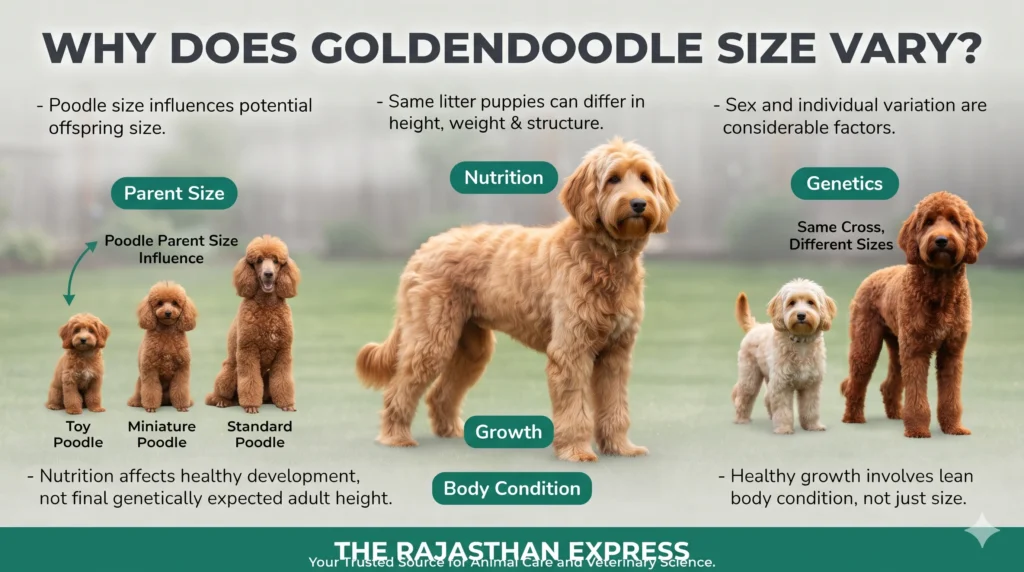
Goldendoodles come in four main size categories — Petite, Miniature, Medium, and Standard — with height and weight ranges that vary depending on genetics, the Poodle parent’s size, and individual development.
- Petite Goldendooodle: Under 14 inches, about 25 pounds or less
- Miniature Goldendooodle: 14–17 inches, about 26–35 pounds
- Medium Goldendooodle: 17–21 inches, about 36–50 pounds
- Standard Goldendooodle: Over 21 inches, about 51 pounds or more
These are estimated ranges, not guarantees. If exact size is important to you, look at the puppy’s parents, ask the breeder for detailed records, and consult a veterinarian as the puppy grows.
Understanding Goldendoodle size categories will help you choose the right dog for your home and lifestyle — and set realistic expectations for the years ahead.