 By
ByAussiedoodle Dog Breed: Origin, History, Characteristics, Temperament and Complete Guide
What Is an Aussiedoodle Dog?
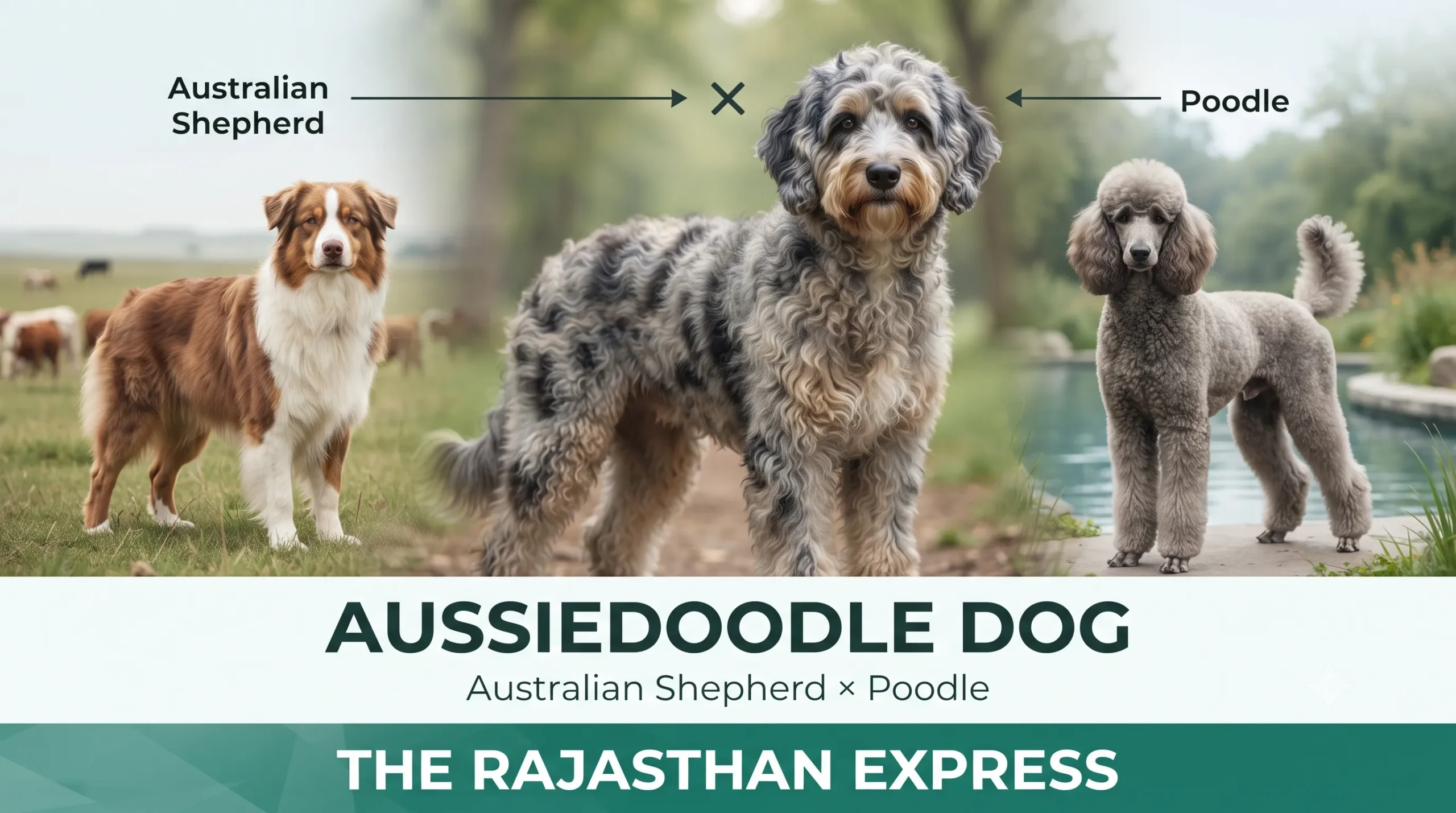
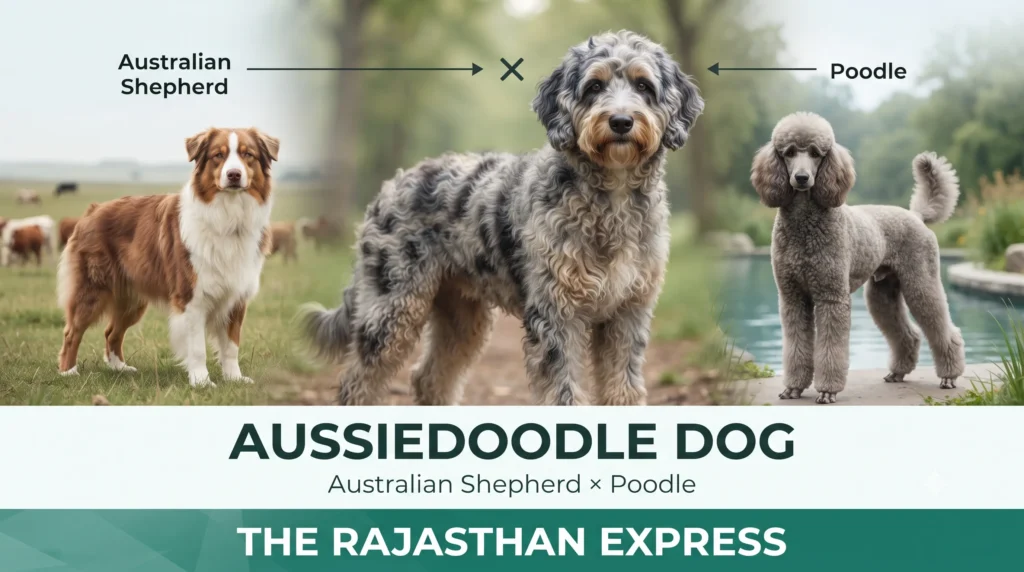
Look, to understand the Aussiedoodle, the first thing that must be made clear is that it is not an old or pure breed. It is a designer hybrid dog, produced by crossbreeding the Australian Shepherd and Poodle. People also call it by names like Aussiepoo or Aussiepoodle. The main purpose of this crossbreeding is to bring the good qualities of two extremely intelligent breeds into one dog. The Australian Shepherd is known for its herding understanding, sharp mind, habit of hard work, and energy, while the Poodle is famous for its sharp intelligence, quick learning ability, social temperament, and low‑shedding coat. The dog created from the combination of these two is often called a “canine overachiever” – meaning a talented dog.
Australian Shepherd: The Working Parent Breed
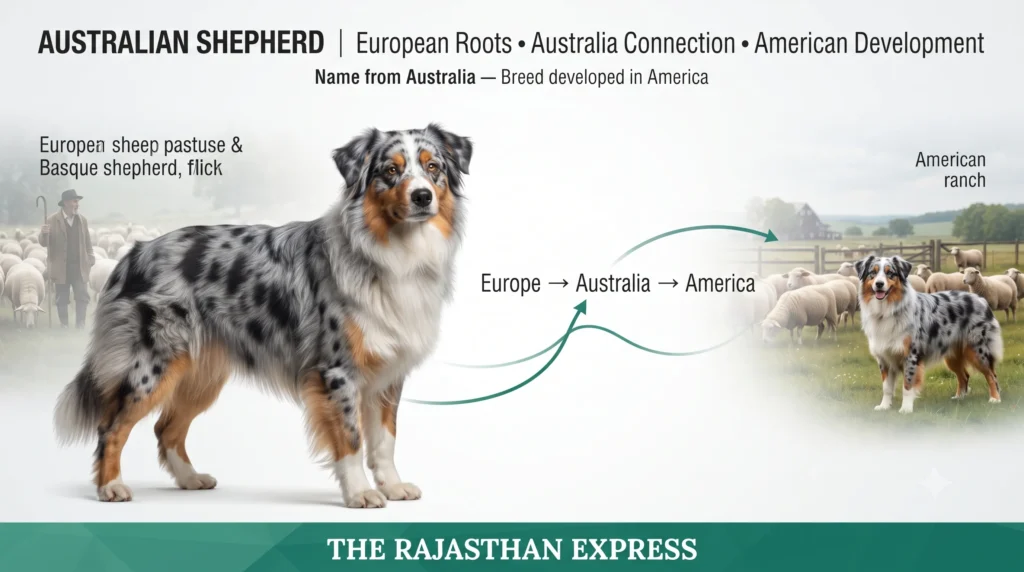
Now let’s talk about the Australian Shepherd. It is originally a working dog, reared in fields and ranches to herd sheep, goats, and cattle. The herding instinct – the tendency to herd animals – remains strong in it even today. Although “Australian” is written in the name, its actual development is believed to have happened in the western states of America. Talking about history, in the 19th century, Basque shepherds first went to Australia with their sheep and dogs, and from there reached the western coast of America. In America, farmers and ranchers started calling these dogs “Australian Shepherd” because they had come via Australia. Later, through crossbreeding with Collies and other herding dogs, today’s breed was developed. In 1993, it received recognition from the American Kennel Club (AKC) . In this breed, Blue Merle is a very popular colour variety, lovingly called “Blue Merle Aussie.“ But it is not a separate breed. It is only a special coat pattern of the Australian Shepherd, in which on a black background, there are silver‑like grey, i.e., blue‑grey coloured spots and patches. This pattern is created by the “merle gene.” This same gene sometimes affects eye colour, causing some dogs to have blue eyes, or one blue and one brown eye. A very important scientific warning is that if two merle dogs are crossbred, “double merle” puppies can be born. Such puppies have a higher risk of deafness, vision defects, eye problems, or other health issues. Therefore, responsible breeders do not crossbreed merle with merle and get genetic testing done.
Poodle: The Elegant, Low-Shedding Parent Breed
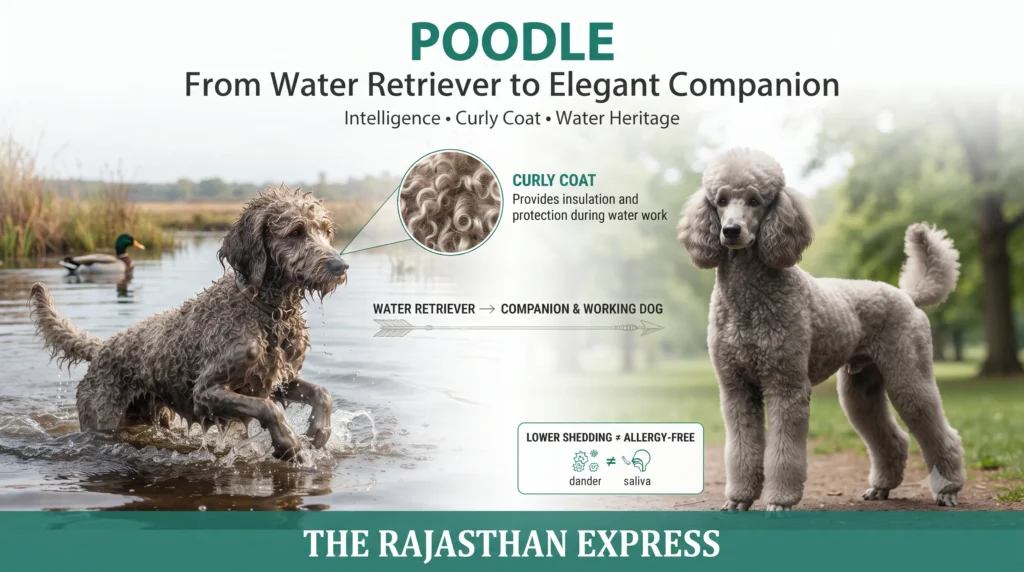
On the other hand, talking about the Poodle, it is known for its sharp intelligence, quick learning ability, curly or wavy coat, and low shedding. The Poodle is originally a water‑retrieving or object‑retrieving dog, whose origin is linked to Germany and France. The Poodle’s coat sheds less, so it is considered allergy‑friendly, but it is important to remember that no dog is completely allergy‑free. When crossbreeding happens between the Australian Shepherd and Poodle, the offspring can get the qualities of both. But this is not a guaranteed thing. Puppies born in the same litter can have different coat, colour, size, energy level, and temperament. This is understood in categories like F1, F1B, and F2.
Aussiedoodle Generations: F1, F1B, and F2
F1 Aussiedoodle:
- In F1, there is a direct crossbreeding between Australian Shepherd and Poodle.
F1B Aussiedoodle:
- In F1B, the Aussiedoodle is again crossbred with the Poodle.
F2 Aussiedoodle:
- In F2, there is crossbreeding between two Aussiedoodles. Because of this, no single fixed breed standard for the Aussiedoodle can be made.
Aussiedoodle Temperament: Loyal, Intelligent, Family-Focused
Now understand the temperament of the Aussiedoodle created from the combination of these two breeds. It is usually intelligent, loyal, affectionate, alert, friendly, and family‑oriented. It can behave well with children, but proper socialisation and training are necessary. It does not like being alone. It is considered a “Velcro dog,” which likes to stick to its owner. It needs sufficient daily physical exercise and mental challenge. Just taking it for a walk is not enough; it loves running, playing, learning new commands, puzzle‑like activities, and agility. When left alone for long periods, it can get bored and may bark, chew, or engage in other destructive behaviours. Therefore, the Aussiedoodle is ideal for active families and individuals who like to spend time outdoors with their dog, train, play, and learn new things.
In terms of care, regular brushing of the Aussiedoodle’s coat, ear cleaning, dental care, and veterinary check‑ups are necessary. Its coat can be wavy, curly, or sometimes straight. Due to Poodle genes, it has a lower chance of shedding, but no dog is completely allergy‑free. In terms of health, it can have problems like hip dysplasia, eye problems, epilepsy, allergies, bloat, and MDR1 gene sensitivity linked to the Australian Shepherd. Therefore, while getting a puppy, definitely ask the breeder about the parents’ health tests, genetic testing, and hip scores. The average lifespan of the Aussiedoodle is considered to be about 10 to 15 years. Overall, the Aussiedoodle is an intelligent, energetic, loyal, and loving companion dog. It is good for people who can give it time, exercise, training, and love.
Aussiedoodle Origin and History
The Rise of the Designer Aussiedoodle Dog
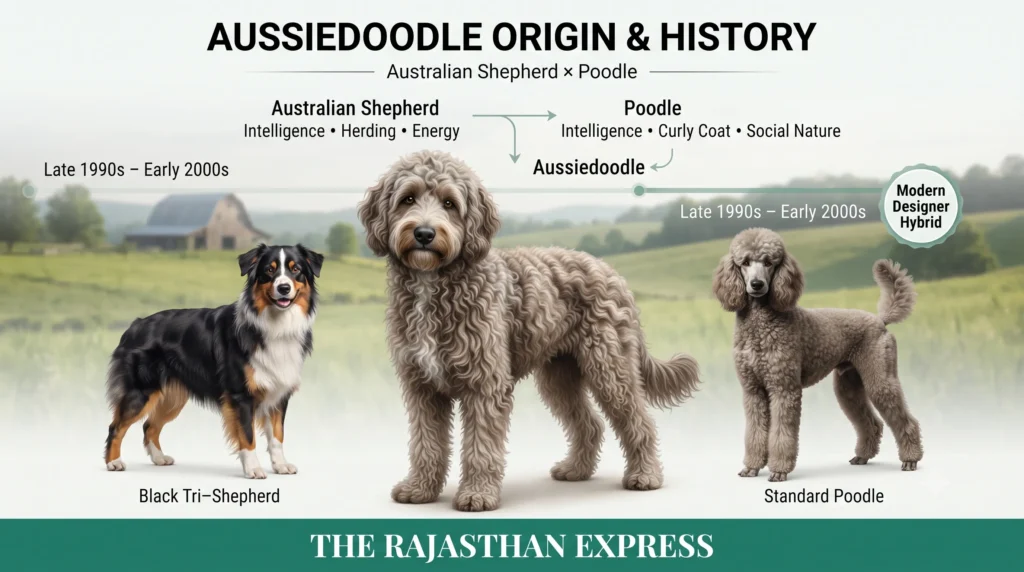
- Look, the Aussiedoodle is not an old breed. It is a completely modern designer dog. It is believed to have originated in North America in the late 1990s or early 2000s. At that time, a special “Doodle craze” was going on. Breeds like Goldendoodle, Labradoodle, Bordoodle, Bernedoodle, and Cockapoo were becoming rapidly popular among people. People wanted dogs that were both intelligent and shed less hair. With this thought, the Aussiedoodle was created by crossbreeding the Australian Shepherd and Poodle.
- The actual birthplace of the Aussiedoodle is considered to be the United States of America. Although some sources also mention Australia, most evidence points towards America. The main purpose of breeders was to combine the Australian Shepherd’s intelligence, herding ability, and energy with the Poodle’s low‑shedding coat and social temperament. This would produce a dog that is not only sharp‑minded but also considered suitable for people troubled by allergies.
- But understand one important thing here. The Aussiedoodle has not received official breed status from major organizations like the American Kennel Club (AKC) or FCI. It is still a hybrid or crossbreed. It is registered in hybrid registries like the American Canine Hybrid Club, Designer Breed Registry, and International Designer Canine Registry. That is, it is a designer dog, not a pure breed.
History of the Aussiedoodle Parent Breeds
Now, to understand the roots of the Aussiedoodle, it is necessary to understand both its parents – the Australian Shepherd and Poodle – in depth. Because until you know the story of these two, the real identity of the Aussiedoodle will not be understood.
1. Australian Shepherd: Australia in the name, roots in Europe, development in America
- Whenever there is talk about the Australian Shepherd, people often think it must be a dog from Australia. But the truth is the opposite. Although its name is “Australian,” its actual development happened in America. The story is something like this – the ancestors of this breed were mountain dogs of the Basque region of Europe. The Basque region lies between Spain and France. The shepherds there reared expert dogs for herding sheep. Those dogs sometimes had merle coats and blue eyes as well. This same merle quality later became the identity of the Australian Shepherd and Blue Merle Aussie.
- It is a matter of the 19th century. From the Basque region of Europe, shepherds first went to Australia with their sheep and dogs, and from there reached the western coast of America. In America, farmers and ranchers started calling these dogs “Australian Shepherd“ because they had come via Australia. Now break down the word “Shepherd” itself. It is made from the English words “sheep” (sheep) and “herd” (flock). In old English, it was called “sceaphierde,” which means herder of sheep. So the direct meaning of “Australian Shepherd” is Australia’s sheep‑herding dog. But in reality, this dog is neither from Australia, nor did its development happen in Australia. It developed completely in America. This name was given only because these dogs reached America via Australia. So this is a historical mistake, which has today become an identity.
- Now add science to this. The dogs that came with the Basque shepherds were European mountain dogs. In America, they were crossbred with Collies and other herding dogs. The new breed that resulted from this crossbreeding was called the Australian Shepherd. But from a genetics perspective, it is a mixture of Basque dogs, Collies, and other breeds. That is, the name has Australia, the roots are in Europe, and the development happened in America. This story of three continents is summed up in one name. And this is what makes it even more interesting.
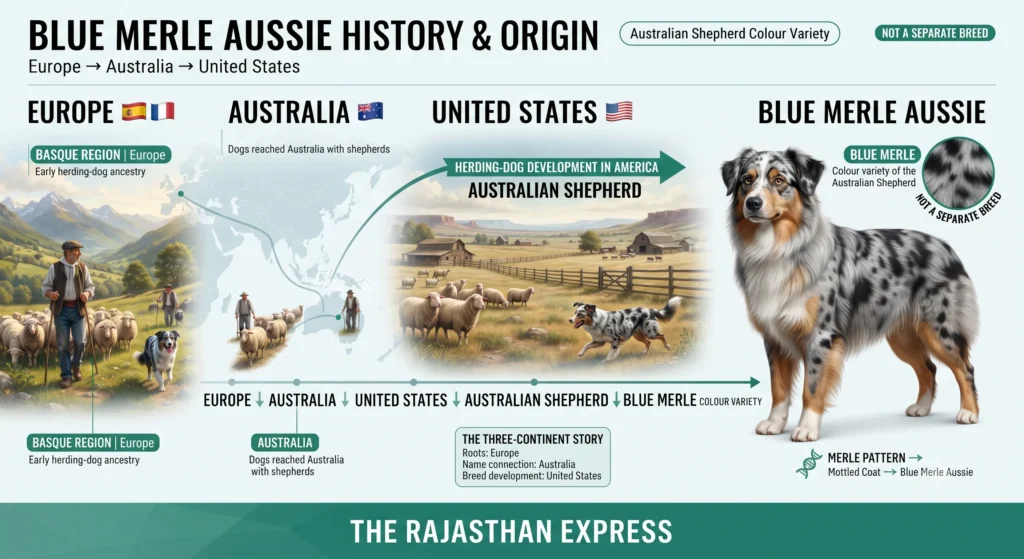
- One more interesting thing is that the word “Shepherd” is used for many breeds, such as German Shepherd, Belgian Shepherd, Dutch Shepherd. These are all actually sheep‑herding dogs. But with the Australian Shepherd, the funny thing is that it is neither from Australia, nor does its name truly connect to that place. It is an American crossbreed whose name came from Australia. In 1993, it received recognition from the American Kennel Club (AKC) .
- Blue Merle Australian Shepherd: Colour, Not Breed
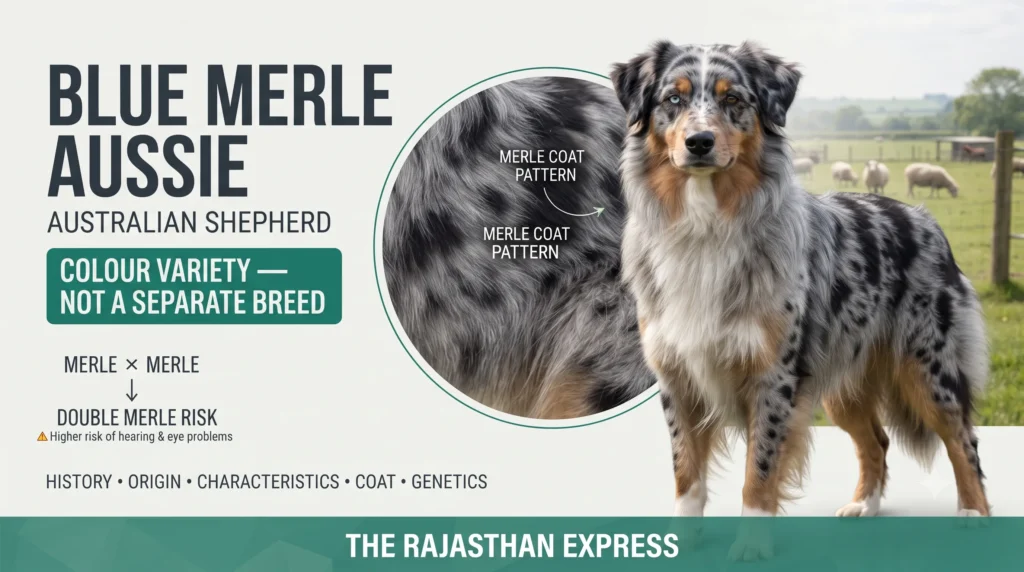
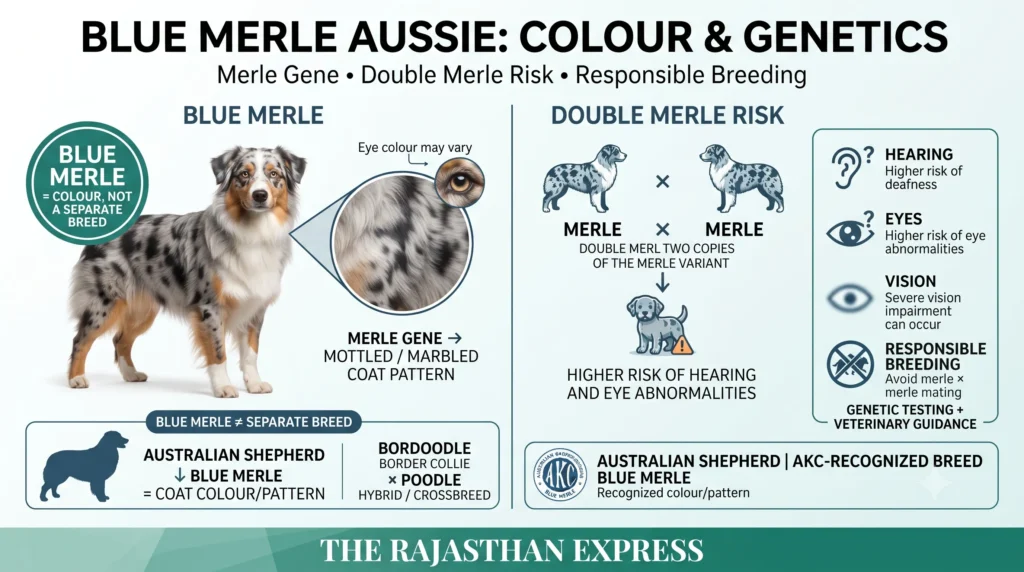
- Now let’s talk about the Blue Merle Australian Shepherd. It is lovingly also called “Blue Merle Aussie.” But in reality, it is not a separate breed. It is a colour of the Australian Shepherd dog. It is called Blue Merle because on its coat, on a black background, silver‑like grey, i.e., blue‑grey coloured spots and patches are seen. So understand, this is not a separate breed, just a different form of colour.
- This merle coat pattern occurs due to a gene called the “merle gene.” This gene creates a spotted pattern in the coat and sometimes also affects eye colour. Because of this, some Blue Merle Aussies can have blue eyes, or one blue eye and one brown eye. But here is a very important scientific warning. If two merle dogs are crossbred, “double merle” puppies can be born.
- Double merle means the puppy received the merle gene from both parents. Such puppies have a higher risk of deafness, vision defects, eye problems, small or undeveloped eyes, and other health issues. In some cases, double merle puppies can be born completely blind or deaf. Therefore, responsible breeders do not breed merle with merle and get genetic testing done. Blue Merle has been a standard and acceptable colour of the Australian Shepherd from the beginning.
2. Poodle: The Elegant Companion from the Water
- Now let’s talk about the second parent breed – the Poodle. The name “Poodle“ comes from the German word “Pudel,” which means “to splash in water.” It was originally a waterfowl hunting dog. That is, initially it was reared to swim in water and catch or retrieve ducks or other waterfowl. Its curly coat helped protect it from cold water. Later, it was developed in France in an elegant form and got a separate identity there.
- The Poodle has served humans in many forms. It has worked as a guide dog, guard dog, service dog, and performing dog. Its sharp intelligence, quick learning ability, and dedication to people make it special. The Poodle comes in three sizes – Toy, Miniature, and Standard. Its coat sheds less, so it is considered allergy‑friendly. But it is important to remember that no dog is completely allergy‑free. Allergies are mainly caused by proteins present in the dog’s saliva, skin flakes, and urine, so a low‑shedding coat can reduce allergies, but not completely eliminate them.
The Collie Family: One Root, Different Branches
- Now understand a very interesting scientific point here. The roots of both the Australian Shepherd and Border Collie meet in the same Collie family. According to genetic studies, the Australian Shepherd and Collie or Border Collie both fall into the same group of dogs found in rural areas of the UK. That is, they are all branches of the same old dog family. The Collie family, which includes the Border Collie, has made a very important contribution to the genetic basis and development of the American breed Australian Shepherd during the 19th century.
- The Border Collie is the sharp‑minded branch of this same Collie family. Its origin happened on the border of England and Scotland. It was developed for herding sheep, but it was specially made so that it does not bite or bark at sheep, but controls them only through intense gaze and physical signals. This is why the Border Collie is considered the most intelligent dog in the world. It can be called the “cousin brother” of the Australian Shepherd, because the roots of both meet in the same Collie family.
Birth of the Bordoodle and Genetic Relationship with Aussiedoodle
- Now the story becomes even more interesting. The dog called the Bordoodle was created by crossbreeding the Border Collie and Poodle. That is, if you connect the back link, the story becomes something like this. First, European herding dogs went to America. There, through crossbreeding with Collies and other breeds, the Australian Shepherd was created. A branch of that same Collie family is the Border Collie, which is known for its sharp intelligence. And when the Border Collie was mixed with the Poodle, the Bordoodle came into existence.
- That is, both the Australian Shepherd and Bordoodle have the contribution of the Collie family in their ancestors. The only difference is that the Australian Shepherd is a mix of Collie and other herding dogs, while the Bordoodle is a direct mix of Border Collie and Poodle. And in the Aussiedoodle, there is a mix of Australian Shepherd and Poodle. Therefore, all three have the contribution of the Poodle, but all three have different builds, temperaments, and needs.
- In the language of science, the Australian Shepherd, Border Collie, Bordoodle, and Aussiedoodle – all four have genetic similarity, but all four are at different levels. The Australian Shepherd is a developed breed, which the AKC recognized in 1993. The Border Collie is also a recognized breed, known worldwide for its working ability. But the Bordoodle and Aussiedoodle are both hybrid or designer dogs, which the AKC does not recognize. In both of these, due to Poodle genes, the quality of low shedding comes, which is not present in the Border Collie and Australian Shepherd. In the Australian Shepherd, the merle coat pattern comes, which is less seen in the Border Collie. That is, all these are offspring of the same old dog family, but have walked different paths and created different identities.
While understanding the Aussiedoodle, it should always be kept in mind that crossbreeding does not always produce the same dog. Puppies born in the same litter can have different coat, colour, size, energy level, and temperament. This is understood in categories like F1, F1B, and F2.
- F1 Aussiedoodle: In F1, there is a direct crossbreeding between Australian Shepherd and Poodle.
- F1B Aussiedoodle: In F1B, the Aussiedoodle is again crossbred with the Poodle.
- F2 Aussiedoodle: In F2, there is crossbreeding between two Aussiedoodles. Because of this, no single fixed breed standard for the Aussiedoodle can be made.
So overall, the story of the Aussiedoodle is linked to three continents, many breeds, and a long breeding history. In its ancestors, there is the contribution of European Basque herding dogs, the Collie family, the Australian Shepherd, and the Poodle – all. It is a modern designer dog, which is a combination of intelligence, energy, loyalty, and low‑shedding qualities. But before adopting it, it is necessary to understand that it is a hybrid, whose every offspring can be different. Therefore, its identity is formed not just by the breed name, but by the parents’ health, genetic testing, and the puppy’s behaviour.
THE RAJASTHAN EXPRESS
Aussiedoodle Distribution and Geographical Spread
- First Understand This: Aussiedoodle Distribution Is Connected to the Australian Shepherd
- The Aussiedoodle is a dog created by crossbreeding the Australian Shepherd and Poodle. Therefore, its distribution is greater in places where the Australian Shepherd is popular and the Poodle is also common. As we read in the distribution section of the Australian Shepherd and Blue Merle Aussie, that breed is found in America, Canada, Europe, Australia, and major cities of Asia.
- The Aussiedoodle is also found in almost the same areas, because it is a new branch of the same Australian Shepherd family. The Blue Merle Aussie is not a separate breed; it is a colour of the Australian Shepherd. Therefore, wherever the Blue Merle Australian Shepherd is found, the Australian Shepherd can be found among the parents of the Aussiedoodle. And if that Australian Shepherd has the merle gene, then the Blue Merle colour can also appear in the Aussiedoodle. But this is not a guaranteed thing.
United States of America: The Largest Centre
- America is the largest centre of the Aussiedoodle. The Doodle craze started from here, and it is believed that the real development of the Australian Shepherd happened here. The western states of America like California, Colorado, Wyoming, Idaho, Montana, Oregon, and Washington are old areas of the Australian Shepherd. Therefore, breeders of the Aussiedoodle also grew rapidly there. Today, hundreds of breeding centres in America are rearing Aussiedoodles. There is demand for it in both urban and suburban areas.
Canada: Rapidly Growing Demand
- In Canada too, the popularity of the Aussiedoodle is increasing. According to some sources, in three countries – America, Canada, and Europe – more than 796 registered breeding centres are rearing Aussiedoodles. Canada has a cold climate, but the Aussiedoodle’s coat and body structure make it adaptable, provided it gets sufficient exercise and mental stimulation.
Europe: Netherlands, Germany, France, Britain
- In Europe, the entry of the Aussiedoodle happened a little late, but now it is growing rapidly. In the Netherlands, it started becoming popular around 2015. There is also demand in Germany, France, Britain, Belgium, Switzerland, and Scandinavian countries. People here like intelligent, active, and low‑shedding dogs, so the Aussiedoodle is becoming their choice. As seen in the distribution of the Australian Shepherd and Blue Merle Aussie, this breed is already known in Europe. Therefore, the Aussiedoodle is also getting ground there.
Australia and New Zealand
- The Aussiedoodle is present in Australia, but the number is less compared to America. Here the name of the Australian Shepherd is big, although its real development happened in America. In New Zealand too, this breed is gradually becoming popular. In Australia, designer dog culture is developed, so breeders of the Aussiedoodle can be found.
Asia and India
- In Asia, demand for the Aussiedoodle is increasing in Japan, South Korea, China, Singapore, and major cities of India. In India, it is not yet very common. Here, most Aussiedoodles are obtained through imports or from select professional breeders. In India, the Australian Shepherd is also limited, and the Blue Merle Aussie is even rarer. Therefore, the distribution of the Aussiedoodle in India is mainly limited to big cities, pet enthusiasts, and high‑budget families.
Geographical Map: A Spotty Spread
If a geographical map of the Aussiedoodle were made, it would not look like the shape of any one country. It would be like scattered spots in many parts of the world. The deepest spot would fall on America, because the Doodle craze and the development of the Australian Shepherd are linked there. After that, its expansion would be seen in Canada, Europe, Australia, and major cities of Asia. This distribution is not natural, but created by human breeding, dog shows, agility, herding sports, and pet demand. The Aussiedoodle is not a natural breed of any forest or mountain; it is a designer breed created and spread by humans.
Overall, the Aussiedoodle is mainly found in America, Canada, Europe, Australia, and major cities of Asia. Its largest centre is America. In Canada and Europe, its demand is increasing rapidly. In Australia, it is limited, and in India, it is still an emerging breed. Its distribution is deeply linked to the distribution of the Australian Shepherd, because the Aussiedoodle is its offspring. The Blue Merle Aussie is only a colour, not a breed, so its distribution is also like the Australian Shepherd. Before adopting an Aussiedoodle, understand that it is a hybrid, whose every offspring can be different. Therefore, its identity is formed not just by the breed name, but by the parents’ health, genetic testing, and the puppy’s behaviour.
What Is a Aussiedoodle Dog? Breed Category and Other Names
What category does the Aussiedoodle fall under?
- Look, the Aussiedoodle is not a pure breed. It is a hybrid or designer dog. In English, it is called Crossbreed, Hybrid, or Designer Dog. That is, it is prepared by crossbreeding between two different breeds. In the Aussiedoodle, one parent is the Australian Shepherd and the other is the Poodle. Therefore, it is a crossbreed of the Australian Shepherd and Poodle.
- In scientific language, all domestic dogs are called Canis lupus familiaris. They belong to the Canidae family. This family includes animals like dogs, wolves, foxes, and jackals. So the Aussiedoodle is also a branch of Canis lupus familiaris, but in terms of breed, it is not a pure breed, but a hybrid.
Difference Between Purebred and Hybrid Aussiedoodle
- A pure breed means a dog whose generation after generation has the same build, colour, temperament, and health tendencies. Like the Australian Shepherd, Poodle, Border Collie, German Shepherd. They are recognized by major organizations like AKC or FCI.
- A hybrid means crossbreeding between two different breeds. Like the Aussiedoodle, Bordoodle, Bernedoodle, Goldendoodle, Labradoodle. They are not recognized as pure breeds by AKC or FCI. They are registered in hybrid registries like the American Canine Hybrid Club, Designer Breed Registry, and International Designer Canine Registry.
- Therefore, instead of calling the Aussiedoodle a “breed,” it is better to call it a “hybrid breed“ or “designer breed.” It is a dog that humans have deliberately created, not nature.
F1, F1b, and F2 Aussiedoodle: What Do They Mean?
One more thing is necessary to understand about the Aussiedoodle. Every Aussiedoodle is not the same. It is divided into three categories:
- F1 Aussie Doodle:
- Direct crossbreeding between the Australian Shepherd and Poodle. It can have qualities of both breeds.
- F1b Aussie Doodle:
- Re‑crossbreeding of the F1 Aussiedoodle with the Poodle. In this, the effect of the Poodle is more, such as a more curly and less shedding coat.
- F2 Aussie Doodle:
- Crossbreeding between two Aussiedoodles. In this, the variation in qualities is the highest. In the same litter, different types of puppies can be found.
Because of this, no single fixed breed standard for the Aussiedoodle can be made. Some Aussiedoodles can be big, some small. Some with curly hair, some with straight hair. Some calm, some more energetic.
Aussiedoodle Dog Names: What Other Names Is the Aussiedoodle Known By?
The Aussiedoodle is known by different names in different places. It has no single official name fixed. Common names are:
- Aussiepoo (Aussie means Australian Shepherd, Poo means Poodle)
- Aussiepoodle
- Australian Shepherd Poodle Mix
- Aussie Doodle
- Australian Shepherd Poodle Cross
- Aussiepoodle
- Australian Doodle
All these names mean approximately the same thing – a dog created by crossbreeding between the Australian Shepherd and Poodle. The word “Aussie” is a loving name for the Australian Shepherd, and “Doodle” or “Poo” is related to the Poodle. Therefore, names like Aussiedoodle, Aussiepoo, and Aussiepoodle sound different, but their root is the same.
For what purpose is the Aussiedoodle dog reared?
The Aussiedoodle is mainly reared as a companion dog. It likes to live with its family, play, go for walks, and be among people. But due to its intelligence and energy, it is not limited to just household hobbies.
The Aussiedoodle can also be trained for these tasks:
- Therapy Dog: To provide support to people in hospitals, old age homes, or schools.
- Service Dog: To help disabled individuals, but strict training is required for this.
- Search‑and‑Rescue Dog: To find lost people or people trapped in disasters.
- Agility and Obedience: For dog competitions.
- Herding Sports: Due to the Australian Shepherd genes, some Aussiedoodles have a herding tendency.
- Trekking and Hiking: Being energetic, it can be a good companion for long walks and trekking.
But understand one important thing here. Every Aussiedoodle does not automatically become a service dog or therapy dog. For this, the right temperament, long training, socialisation, and veterinary examination are necessary. Some Aussiedoodles are very calm, some are more energetic. Therefore, while deciding the category of work, one should look at the dog’s individual temperament.
How to Identify an Aussiedoodle? Aussiedoodle Characteristics !
The Aussiedoodle, lovingly called “Aussiepoo” or “Aussiepoodle,” is an amazing hybrid dog of the Australian Shepherd and Poodle. Look, identifying an Aussiedoodle is a little difficult, because it is not a pure breed. It is a hybrid dog created by crossbreeding the Australian Shepherd and Poodle. As we read about the Australian Shepherd and Blue Merle Aussie, it is a herding dog whose development happened in America. And the Poodle is an intelligent, low‑shedding dog. When these two are crossbred, the offspring can get the qualities of both. But this is not a guaranteed thing. Puppies born in the same litter can look different – if one leans more towards the Poodle, it may be curly; if one leans more towards the Australian Shepherd, it may be wavy or straight. Therefore, to identify an Aussiedoodle, you should carefully observe its coat, colour, eyes, ears, body build, and tail.
Aussiedoodle Size and Body Structure
The Aussiedoodle is usually a medium‑sized, strong, agile, and intelligent dog. Its body is athletic (like a player), and its gait shows confidence. It is well‑proportioned, muscular, and flexible, which gives it the strength to run, play, and work for long periods. Their natural form is clearly visible in both males and females.
- Aussiedoodle Height (at shoulder): Its body is slightly longer than tall – meaning length exceeds height. Legs are straight and strong. Chest is deep, back is flat, and hips are strong.
- Toy Aussie Doodle Height: The shoulder height of a Toy Aussiedoodle is about 10 to 12 inches.
- Mini Aussie Doodle Height: The height of a Miniature or Mini Aussiedoodle is 12 to 18 inches.
- Standard Aussie Doodle Height: The height of a standard full grown aussiedoodle ranges from 18 to 24 inches.
- Aussiedoodle Weight:
- Toy Aussie Doodle: Weight is 10 to 15 pounds.
- Mini Aussie Doodle: Weight is 15 to 40 pounds.
- Standard Aussie Doodle: Weight can be 40 to 70 pounds.
- Aussiedoodle Lifespan: The Aussiedoodle Dog’s lifespan is usually between 10 to 15 years.
Aussiedoodle Coat: The Most Important Identification Feature
The biggest identification of the Aussiedoodle is its coat. It can be curly, wavy, or straight. Generally, its coat is considered low‑shedding, because it has Poodle genes. Therefore, it is called an allergy‑friendly dog. But understand one important thing here – no dog is completely allergy‑free. Low shedding is an advantage, but it is not a guarantee that allergies will be completely eliminated.
The Aussiedoodle dog can have three types of coat. It can be curly, wavy, or straight.
- Straight Coat: The straight coat is like the Australian Shepherd – smooth and less prone to tangling.
- Wavy or Wavy Coat: The wavy coat is the most common – soft and manageable, giving the dog a “teddy bear” appearance.
- Curly Coat: The curly coat is like the Poodle – sheds less but demands more care.
- Aussiedoodle Hair Length: Hair length is medium to long. There can be ruff‑like hair on the neck and feathering (longer hair) behind the legs.
Here is a warning. Low shedding does not mean low maintenance. The Aussiedoodle’s coat needs to be brushed three to four times a week. If this is not done, the hair can tangle and mat, causing skin damage.
Aussiedoodle Coat Colors and Patterns
The Aussiedoodle’s colour pattern is very attractive. It combines the Australian Shepherd’s merle and tan points with the Poodle’s deep pigment range.
- Main Colours: Main colours include solid colours like black, red, chocolate, golden, cream, grey, silver, and blue. Patterned colours include blue merle, red merle, tri‑colour, bi‑colour, parti, phantom, sable, and tuxedo.
How is the Blue Merle Pattern Created?
- Now let’s talk about the Blue Merle pattern. This is not a separate breed, but a coat pattern. As we read about the Blue Merle Australian Shepherd, it is created by the merle gene. This gene randomly lightens black into grey (blue‑grey) , while some parts remain completely black. This creates a marble‑like pattern of silver‑grey spots and black patches on the coat.
Markings: White markings can be on the chest, neck, legs, muzzle, and head. Tan (copper) markings can appear on the cheeks, above the eyes, ears, chest, and legs.
A very important scientific warning is that two merle dogs should never be mated. Doing so produces double merle puppies, which have a higher risk of deafness and vision defects. Responsible breeders avoid this breeding and get genetic testing done.
Aussiedoodle Eyes: The Most Unique Identification Feature
The Aussiedoodle’s eyes are its most special identification. This is the organ that makes it different and attractive at first glance.
- Aussiedoodle Eye Color: Eye colour can be brown, blue, amber, green, or a mixture. In merle Aussiedoodles, marbled or parti‑colour eyes are also seen.
- Aussiedoodle Eye Shape: Eyes are almond‑shaped, medium‑sized, and expressive. They are neither too prominent nor sunken.
- Heterochromia in Aussiedoodle: Many Aussiedoodles show heterochromia – meaning different coloured eyes. Heterochromia is also seen in Blue Merle Aussie or Blue Merle Australian Shepherd dogs besides the Aussiedoodle. Like one blue eye and one brown eye. This is also an effect of the merle gene and is not considered a disease. But an important caution is that having blue eyes is not directly linked to deafness. Deafness usually occurs in double merle dogs, which are produced by merle × merle breeding.
Aussiedoodle Ears
- The Aussiedoodle’s ears are triangular and medium‑sized. When the dog is alert, the ears turn forward and appear semi‑erect. One‑fourth to one‑half of the upper part is bent forward. This special position is called “rose ear.” This is the natural and standard form of the ears.
- Now compare – the Australian Shepherd’s ears are set high and triangular, turning forward. The Poodle’s ears start at eye level and hang near the head. The Aussiedoodle’s ears are usually hanging and soft, showing a mixture of both.
Aussiedoodle Tail
- Types of Aussiedoodle Tail: The Aussiedoodle’s tail can be long and raised over the back, or docked (cut) , or naturally short (natural bobtail) .
- Natural Bobtail: An interesting thing about natural bobtail is that about one in five Australian Shepherds is born with a naturally short tail. This is due to a genetic mutation. It can also be inherited in the Aussiedoodle. If the tail is docked, its length should not exceed 4 inches.
- Warning: Here is a warning. Two natural bobtail dogs should never be mated together. Doing so can cause serious congenital defects like spina bifida in the puppies. Therefore, responsible breeders pay attention to this.
Other Aussiedoodle Facial Features
The Aussiedoodle’s head is clean, strong, and dry. The forehead is flat to slightly rounded. The length and width of the head are approximately equal.
- Aussiedoodle Muzzle: The muzzle (front part of the mouth) is of medium length, not pointed but with a rounded tip, tapering slightly towards the nose.
- Aussiedoodle Nose: The nose can be black, brown, or pink, depending on the coat colour. Teeth have a scissor bite. There should be full dentition. Faults like undershot, overshot, or wry mouth are considered unfit for breeding.
Aussiedoodle vs Bordoodle and Bernedoodle
Like the Aussiedoodle, the Bordoodle and Bernedoodle are also hybrid dogs. The Bordoodle is created by crossbreeding the Border Collie and Poodle. The Bernedoodle is created by crossbreeding the Bernese Mountain Dog and Poodle. The Aussiedoodle is created by crossbreeding the Australian Shepherd and Poodle.
One thing is common in all three – the Poodle is one parent. Therefore, all three can have the low‑shedding quality, but this is not guaranteed. All three are not recognized as pure breeds by AKC or FCI. All three are registered in hybrid registries. But all three can have different temperaments, sizes, and needs, because the other parent is different. In the Aussiedoodle, due to the Australian Shepherd, herding instinct and merle coat can come, while in the Bordoodle, the Border Collie’s sharp intelligence and in the Bernedoodle, the Bernese Mountain Dog’s calm temperament may be prominent.
Overall, to identify an Aussiedoodle, you should carefully observe its coat, colour, eyes, ears, body build, and tail. It is a medium‑sized, strong, agile, and intelligent dog, whose coat can be curly, wavy, or straight. Its colours include blue merle, red merle, tri‑colour, and solid colours. Its eyes can be brown, blue, amber, or heterochromia. Ears are hanging and soft. The tail can be long, docked, or natural bobtail. But the most important thing is that it is a hybrid, so every Aussiedoodle can be different.
Aussiedoodle Dog Size and Body Structure
The Aussiedoodle is a well‑proportioned, muscular, and athletic dog. It is created by crossbreeding the Australian Shepherd and Poodle, so the influence of both breeds is clearly visible in its physical build. Its body is slightly longer than tall – meaning length exceeds height. It is strong, agile, and flexible, giving it the ability to run, play, and work for long periods. The Australian Shepherd is originally a medium‑sized herding dog, known for its agility and endurance. The Poodle’s contribution is seen in the form of different sizes and coats. Therefore, the Aussiedoodle’s body is neither very heavy nor very light; it is a balanced and athletic‑built dog.
Aussiedoodle Size and Weight
- The Aussiedoodle comes in three sizes – Toy, Miniature or Mini, and Standard. It depends on which Poodle parent was used. ‘
- If the Poodle was Toy, the Aussiedoodle will be small.
- If Miniature, then medium.
- And if Standard, then large. The table below gives the general range, but this is only an estimate. Every dog can be different according to its parents’ genes.
| Aussiedoodle Size and Weight | ||
| Type | Height (at Shoulder) | Weight |
|---|---|---|
| Toy Aussiedoodle | 10–12 inches | 10–20 pounds |
| Miniature Aussiedoodle | 12–18 inches | 15–40 pounds |
| Standard Aussiedoodle | 18–25 inches | 40–70 pounds |
| The Rajasthan Express : Aussiedoodle Size and Weight | ||
The Aussiedoodle’s lifespan is usually between 10 to 15 years. Toy and Miniature can live 12–15 years, while Standard can live 10–15 years. This also depends on care, diet, exercise, and genetic health.
Why Does the Aussiedoodle Size Vary?
The biggest reason for variation in the Aussiedoodle’s size is that it is a crossbreed of two different breeds. The Poodle comes in three sizes – Toy, Miniature, and Standard. Therefore, the Aussiedoodle’s size depends entirely on the Poodle parent. Similarly, the Australian Shepherd’s size is medium, but its physical build is agile. When the genes of both combine, the offspring may have some qualities stronger and some weaker. Therefore, puppies born in the same litter can have different height, weight, and build. This is understood in categories like F1, F1B, and F2.
- F1 Aussie Doodle: In F1, there is a direct crossbreeding between Australian Shepherd and Poodle.
- F1B Aussie Doodle: In F1B, the Aussiedoodle is again crossbred with the Poodle.
- F2 Aussie Doodle: In F2, there is crossbreeding between two Aussiedoodles. Because of this, no single fixed breed standard for the Aussiedoodle can be made.
Aussiedoodle Price Guide (2026–2027): How Much Does an Aussiedoodle Cost?
Look, the Aussiedoodle has today become a very popular designer dog all over the world. It is prepared by crossbreeding the Australian Shepherd and Poodle. Due to its increasing demand, low‑shedding coat, and intelligent temperament, its price is different in different countries of the world. The price of a well‑bred Aussiedoodle puppy is usually between $1,500 and $5,000, and most families pay $2,000 to $3,500. But this price depends on many things, such as which country you are in, the breeder’s reputation, the puppy’s lineage, age, coat, health, vaccination, and pedigree. In India, this breed is still rare, so prices here can be higher.
Main Factors Affecting the Aussiedoodle Price
1. Training and Learning Level
The Aussiedoodle is very intelligent. If it has been given basic training, its price increases.
- Without Training Aussiedoodle Puppy: $500 – $1,500 (approximately ₹40,000 – ₹1,25,000).
- Basic Trained Aussiedoodle Puppy:: Knows commands like sit, stay, come – price increases by $200 – $500.
- Fully Trained Aussiedoodle Puppy: Knows house manners, walking on leash, social behaviour, and commands – price can reach $2,500 – $5,000+.
- Aussiedoodles with therapy, agility, or show training can be even more expensive.
2. Aussiedoodle Lineage or Pedigree
In the Aussiedoodle, lineage (ancestry) has a very big effect. But it is not just lineage – it is also necessary to understand which generation it is – F1, F1b, F2, or beyond. The generation tells how much influence the Australian Shepherd and Poodle have in the Aussiedoodle. This affects coat, shedding, temperament, and price – everything.
First Understand the Aussiedoodle Generations:
- F1 Aussiedoodle: Direct crossbreeding between the Australian Shepherd and Poodle. It has mixed qualities of both breeds. Coat can be wavy or straight. Shedding can be low to medium.
- F1b Aussiedoodle: Re‑crossbreeding of the F1 Aussiedoodle with the Poodle. In this, the effect of the Poodle is more. The coat is more curly and less shedding. It is considered more suitable for people with allergies.
- F1bb Aussiedoodle: Re‑crossbreeding of the F1b with the Poodle. In this, the Poodle qualities are even stronger. The coat is almost like a Poodle’s curly coat and very low shedding.
- F2 Aussiedoodle: Crossbreeding between two F1 Aussiedoodles. In this, the variation in qualities is the highest. In the same litter, different coat, colour, and temperament puppies can be found.
- F2b Aussiedoodle: Crossbreeding of F2 with the Poodle. In this, the Poodle qualities increase again.
- Multi‑generation Aussiedoodle: For many generations, the Aussiedoodle is crossbred with the Aussiedoodle itself. In this, the qualities become more stable, but it is the most expensive.
Aussiedoodle Puppy Price Based on Quality and Features
- Basic Quality: Suitable for family, but not for show or breeding. Price approximately $500 – $1,200.
- Registered: With certificate, verified ancestry, full vaccination, and veterinary health check. Price approximately $1,200 – $2,500.
- Show Quality: With good body conformation, balanced features, and correct proportions. Price approximately $2,500 – $4,500.
- Champion Bloodline: From imported or award‑winning parents, better genetics. Price approximately $4,500 – $5,000+.
3. Aussiedoodle Puppy Age
Age is directly related to price.
- Aussiedoodle Puppy 8 Week to 6 Months:: Most common selling age. Price $700 – $2,500.
- Young dog from 6 months to 18 months: If training has started, price is slightly higher.
- Full Grown Aussiedoodle: A full grown Aussiedoodle that is completely trained and healthy can cost $3,000–$6,000.
- Old dog: Price decreases, but health risk is higher.
4. Aussiedoodle Price by Coat and Color
Coat and size contribute greatly to the Aussiedoodle’s price.
- Miniature or Toy Aussiedoodle: More expensive than larger Standard Aussiedoodle. Demand for small size is higher. The price of a Mini Blue Merle Aussiedoodle abroad is $2,500 – $4,600.
- Aussiedoodle Coat Type: Puppies with curly or wavy coats are in higher demand, giving a “teddy bear” appearance.
- Rare Aussiedoodle Colors: Extra charge is taken for colours like Blue Merle, Red Merle, Tri‑Colour. Blue Merle Aussiedoodle eyes are often blue, making it even more attractive. The price of a Blue Merle Doodle can be $2,500 to $5,000.
- Low‑Shedding Coat: Australian Shepherds shed heavily, so puppies with low‑shedding coats are more preferred by people troubled by allergies, increasing the price.
5. Aussiedoodle Health and Vaccination
Buying a healthy puppy means saving on future veterinary expenses. In the Aussiedoodle, due to the merle gene, there are some health risks, so health screening becomes even more important.
- Full vaccination: Protection from viral and bacterial diseases – vaccines for rabies, distemper, parvo, hepatitis, etc.
- Deworming: Medicine for stomach worms. That is, how many times deworming was done in a year. Generally, deworming should be done every 3 months with different medicines – that is, 4 times a year.
- Health certificate: Examination by a veterinarian.
- Parents’ health tests: Hip score, elbow score, eye examination, and genetic testing (MDR1, hip dysplasia, etc.).
- Double Merle Warning: Mating two merle dogs produces double merle puppies, which can have serious problems like deafness and blindness. Therefore, reputable breeders do not sell double merle puppies.
- A puppy with a complete vaccination card and health record can cost $200 to $1,000 more.
6. Aussiedoodle Pedigree or Records
This is the biggest premium.
- Aussiedoodle without papers: Cheaper, but risky. It cannot be known who the parents were and what their health was like.
- Registered/Certified Aussiedoodle: Whose parents have health tests, genetic testing, and lineage records. AKC or CKC registration is considered reliable.
- Recorded pedigree Aussiedoodle: Can sell for 50% to 70% more than a similar‑looking puppy without records.
7. Aussiedoodle for Sale: Location and Source
The Aussiedoodle for sale price varies greatly depending on the source.
Aussiedoodle Price in the United States (USA)
- Basic/Backyard Breeder: $500 – $1,200 (approx ₹42,000 – ₹1,00,000)
- Mid‑level Breeder: $1,200 – $2,500 (approx ₹1,00,000 – ₹2,10,000)
- Reputable/Show Quality Breeder: $2,500 – $5,000+ (approx ₹2,10,000 – ₹4,20,000+)
- Rare Colour or Miniature: Up to $3,000 – $4,600
Aussiedoodle Price in the United Kingdom (UK)
- Ordinary Breeder: £1,000 – £2,000 (approx ₹1,10,000 – ₹2,20,000)
- KC Registered, Health Tested: £2,000 – £3,000 (approx ₹2,20,000 – ₹3,30,000)
- Champion Bloodline: £3,000+ (approx ₹3,30,000+)
Aussiedoodle Price in Canada
- Ordinary Breeder: CAD $500 – $1,500 (approx ₹30,000 – ₹90,000)
- Good Quality/Health Tested: CAD $3,100 – $6,300 (approx ₹1,90,000 – ₹3,80,000)
- Toy/Mini Aussiedoodle: CAD $2,000 – $3,000 (approx ₹1,22,000 – ₹1,83,000)
Aussiedoodle Price in Australia
- Reputable Breeder: AUD $2,000 – $4,500 (approx ₹1,10,000 – ₹2,50,000)
- Health Tested, Show Quality: AUD $4,000 – $5,000+ (approx ₹2,20,000 – ₹2,80,000+)
Aussiedoodle Price in Europe
- Germany: €1,500 – €2,500 (approx ₹1,40,000 – ₹2,30,000)
- Netherlands/Belgium: €1,500 – €3,000 (approx ₹1,40,000 – ₹2,80,000)
- France: €1,200 – €2,000 (approx ₹1,10,000 – ₹1,85,000)
Price In Japan
- Ordinary Breeder: ¥300,000 – ¥600,000 (approx ₹1,70,000 – ₹3,40,000)
- High Quality/Rare Line: ¥700,000+ (approx ₹4,00,000+)
Price In India
- Ordinary Breeder: ₹25,000 – ₹60,000
- Registered/Health Tested: ₹60,000 – ₹1,50,000
- Imported/Champion Bloodline: ₹1,50,000 – ₹3,00,000+
Aussiedoodle Price (2026-2027)
| Estimated Aussiedoodle Puppy Price 2026–2027 | ||
| Category | Dollar ($) | Indian Rupees (₹) |
|---|---|---|
| Adoption from Shelter/Rescue | $150–$600 | ₹12,000–₹50,000 |
| Online Advertisement/Ordinary Breeder | $500–$1,200 | ₹40,000–₹1,00,000 |
| Good Quality Breeder | $1,200–$2,500 | ₹1,00,000–₹2,10,000 |
| Show Quality | $2,500–$4,500 | ₹2,10,000–₹3,80,000 |
| Champion Bloodline | $4,500–$5,000+ | Approximately ₹4.5 to ₹5 lakh |
| Fully Trained Puppy | $2,500–$5,000 | ₹2,10,000–₹4,20,000 |
| Imported from Abroad (USA/UK) | $2,500–$6,000+ | ₹2,10,000–₹5,00,000+ |
| The Rajasthan Express : Aussiedoodle Price (2026-2027) | ||
Not Just the Purchase Price – Add These Expenses Too
Aussiedoodle Puppies for Sale: What Else Should You Pay For?
The cost of keeping an Aussiedoodle is not limited to just buying the puppy.
- First‑year expenses: On crate, bed, bowls, leash, toys, vaccination, spay/neuter, and training classes, $540 – $1,700 can be spent.
- Annual expenses: On food, veterinary check‑ups, parasite prevention, grooming, and insurance, $2,400 – $3,600 can be spent.
- Grooming: Due to the Aussiedoodle’s dense coat, regular brushing and professional grooming are needed, which can be $50 – $100 per month.
- Average monthly expense: Approximately $200 – $300 (basic to premium).
The price of an Aussiedoodle puppy can range from $500 (ordinary)** to **$5,000+ (records, health tests, champion bloodline) . In India, this breed is rare, so the price can be higher. The best option is to contact a reliable breeder or shelter home, see the parents’ health certificates, ask for the vaccination card, and get the puppy examined by a veterinarian. Do not fall into the temptation of a cheap price, because the puppy’s health and temperament are more important than its price. This price guide is only an estimate; actual prices can change according to time, location, and breeder.
Aussiedoodle Temperament: The Combined Effect of Australian Shepherd and Poodle
The Aussiedoodle’s temperament is not just a sum of two breeds. It is a mixture in which genetics, generation (F1, F1b, F2), parents’ temperament, childhood socialisation, and training – all have an effect. As we read about the Australian Shepherd and Blue Merle Aussie, it is a herding dog filled with intelligence, energy, loyalty, and alertness. And the Poodle is a dog that learns quickly, mingles with people, and is affectionate. When these two are crossbred, the Aussiedoodle can get the qualities of both. But this is not a guaranteed thing. Puppies born in the same litter can also have different temperaments – some more calm, some more energetic, some more clingy, some a little alert.
What Does an Aussiedoodle Get from the Australian Shepherd?
- The effect of the Australian Shepherd is clearly visible in the Aussiedoodle. From it, it gets sharp intelligence, eagerness to work, natural herding tendency, loyalty to family, and alertness towards strangers.
- Many Aussiedoodles are seen chasing children, nipping at their heels, or trying to control other animals. This happens due to the same herding instinct. It is necessary to redirect it in the right direction from childhood, otherwise it can become a habit.
- Due to the Australian Shepherd, the Aussiedoodle also does not like being alone. It forms a deep bond with its owner and can show anxiety, barking, or destructive behaviour when left alone for long periods.
What Does an Aussiedoodle Get from the Poodle?
- The effect of the Poodle gives the Aussiedoodle eagerness to learn, obedience, sociability, and affection. The Poodle generally likes to be with people and learns new things quickly. Because of this, training the Aussiedoodle becomes easy.
- It quickly understands new commands and tricks. Due to the Poodle, the Aussiedoodle can also get the quality of low shedding, although this is not guaranteed. But the effect of the Poodle is not the same in every Aussiedoodle.
- In F1b and F1bb generations, the effect of the Poodle is more, while in F1 and F2, the mixture of both breeds can be different. Therefore, temperament can also change according to generation.
Aussiedoodle Temperament Differences by Generation
- F1 Aussiedoodle: Direct mix of Australian Shepherd and Poodle. It has mixed qualities of both. There can be more variation in temperament.
- F1b Aussiedoodle: Re‑crossbreeding of F1 with the Poodle. In this, the effect of the Poodle is more. It can be more affectionate, quicker to learn, and lower shedding.
- F2 Aussiedoodle: Mix of two F1 Aussiedoodles. In this, the uncertainty of qualities is the highest. In the same litter, puppies with different temperaments can be found.
- Multi‑generation Aussiedoodle: For many generations, the Aussiedoodle is mated with the Aussiedoodle itself. In this, the qualities become more stable, but the price is also higher.
Main Aussiedoodle Temperament Traits
- Extremely Intelligent and Trainable:
- The Aussiedoodle inherits the intelligence of both parents. Because the world’s most intelligent dog is the Border Collie, the Collie family genes are present in the Australian Shepherd. It quickly learns new commands and tricks. But this does not mean it does not need training. Its intelligence must be given the right direction, otherwise it can get bored and misbehave.
- Full of Energy and Active:
- It needs at least 60 to 90 minutes of physical activity and mental stimulation daily. Just taking it for a walk is not enough. Swimming, running, playing fetch, agility, puzzle toys, and learning new commands are very good for it. If it does not get sufficient exercise, it may bark, chew, or create mischief in the house.
- Devoted and Affectionate to Family:
- It forms a deep bond with its family members and likes to spend time with them. It is called a “Velcro dog,” because it likes to stick to its owner. It can behave well with children, but supervision and proper training are necessary.
- Natural Herding Tendency:
- Many Aussiedoodles show the herding tendency of the Australian Shepherd. This can manifest as chasing children, nipping at their heels, or trying to control other animals. It is necessary to redirect it in the right direction through training from childhood.
- Can Be Reserved Towards Strangers:
- Due to the influence of the Australian Shepherd, the Aussiedoodle can be initially reserved or cautious towards strangers. Therefore, it is very important to familiarise it with different people, animals, sounds, and environments from childhood – that is, socialisation.
- Difficulty in Being Alone:
- It gets very attached to its owners and does not like being alone. When left alone for long periods, it can show anxiety, barking, or destructive behaviour. Therefore, for people who stay out of the house all day, this breed can be challenging.
| Aussiedoodle Temperament at a Glance | |||
| Temperament Trait | Effect from Australian Shepherd | Effect from Poodle | Result in Aussiedoodle |
|---|---|---|---|
| Intelligence | Extremely intelligent | Exceptionally intelligent | Extremely intelligent, quick to learn |
| Energy Level | Very high | High | High, regular exercise required |
| Training | Eager, but independent | Extremely eager and obedient | Easily trainable, eager |
| Affection | Loyal, devoted to family | Affectionate, likes to be with people | Extremely affectionate, “Velcro dog” |
| Towards Strangers | Reserved | Somewhat reserved | Initially reserved, socialisation necessary |
| Herding Tendency | Strong | Low | Medium to strong, training necessary |
| Being Alone | Can tolerate | Difficult | Does not like being alone |
| The Rajasthan Express : Aussiedoodle Temperament at a Glance | |||
Is an Aussiedoodle a Good Family Dog?
- The Aussiedoodle is a dog that is an amazing combination of intelligence, energy, and affection. It is ideal for families or individuals who like to spend time outdoors with their dog, train, play, and learn new things.
- However, its high energy and need for mental stimulation means it is not suitable for people who stay out of the house for long periods or who want a relaxed companion. If you want a loyal, intelligent, and energetic dog that is ready to join you in every adventure, the Aussiedoodle can be an excellent choice.
- But always remember that it is a hybrid breed, so every Aussiedoodle’s temperament can be different. Only with proper socialisation, positive training, and sufficient exercise does its temperament shine at its best.
People Also Ask
What is an Aussiedoodle dog?
Is an Aussiedoodle a pure breed?
What is the temperament of an Aussiedoodle?
Are Aussiedoodles good with children?
Do Aussiedoodles shed?
What is the size of an Aussiedoodle?
- Toy Aussiedoodle: 10–12 inches, 10–20 pounds
- Miniature Aussiedoodle: 12–18 inches, 15–40 pounds
- Standard Aussiedoodle: 18–25 inches, 40–70 pounds
What is the lifespan of an Aussiedoodle?
What is the price of an Aussiedoodle puppy?
What is the difference between F1, F1b, and F2 Aussiedoodle?
- F1 Aussiedoodle: Direct crossbreeding between Australian Shepherd and Poodle. Mixed qualities of both breeds. Coat can be wavy or straight. Shedding low to medium.
- F1b Aussiedoodle: F1 crossed again with Poodle. More Poodle influence — curlier coat, less shedding, more suitable for allergy sufferers.
- F2 Aussiedoodle: Two F1 Aussiedoodles crossed. Highest variation in coat, colour, size, and temperament — even within the same litter.
- F1bb / F2b / Multi-generation: Further crossings with Poodle or Aussiedoodle for more stable qualities.
What is a Blue Merle Aussiedoodle?
Are Aussiedoodles good for apartment living?
Do Aussiedoodles have separation anxiety?
What health problems do Aussiedoodles have?
- Hip dysplasia and elbow dysplasia
- Eye problems (cataracts, progressive retinal atrophy)
- Epilepsy
- Allergies
- Bloat (gastric torsion)
- MDR1 gene sensitivity (inherited from Australian Shepherd — affects drug sensitivity)
How much exercise does an Aussiedoodle need?
- Running, swimming, playing fetch
- Agility, obedience, rally
- Puzzle toys and brain games
- Learning new commands and tricks
- Trekking and hiking
How do I train an Aussiedoodle?
What are the other names for Aussiedoodle?
- Aussiepoo (Aussie = Australian Shepherd, Poo = Poodle)
- Aussiepoodle
- Australian Shepherd Poodle Mix
- Aussie Doodle
- Australian Shepherd Poodle Cross
- Australian Doodle
Where are Aussiedoodles found?
What is the purpose of an Aussiedoodle?
- Therapy Dog — hospitals, old age homes, schools
- Service Dog — helping disabled individuals
- Search-and-Rescue Dog — finding lost or trapped people
- Agility and Obedience — dog competitions
- Herding Sports — due to Australian Shepherd genes
- Trekking and Hiking — energetic outdoor companion
Why is a Blue Merle Aussiedoodle more expensive?
Are Mini or Toy Aussiedoodles more expensive?
What is the difference between Aussiedoodle, Bordoodle, and Bernedoodle?
- Aussiedoodle: Australian Shepherd × Poodle. May have herding instinct and merle coat.
- Bordoodle: Border Collie × Poodle. Known for sharp intelligence and high energy.
- Bernedoodle: Bernese Mountain Dog × Poodle. Generally calmer and more laid-back.
Where can I find Aussiedoodle puppies for sale?
- Parents’ health testing (hip score, elbow score, eye certification)
- Genetic screening (MDR1, hip dysplasia)
- Vaccination card and health records
- Proper socialisation of puppies
What should I look for when buying an Aussiedoodle puppy?
- Parents’ health certificates — hip score, eye exam, genetic testing
- Vaccination card — rabies, distemper, parvo, hepatitis
- Deworming record — every 3 months, 4 times a year
- Breeder reputation — visit the facility, meet the parents
- Puppy’s behaviour — active, curious, social
- Registration papers — AKC/CKC or hybrid registry
Are Aussiedoodles aggressive?
What is the cost of owning an Aussiedoodle?
- First-year expenses: $540–$1,700 (crate, bed, bowls, leash, toys, vaccination, spay/neuter, training classes)
- Annual expenses: $2,400–$3,600 (food, vet check-ups, parasite prevention, grooming, insurance)
- Grooming: $50–$100 per month (professional grooming due to dense coat)
- Average monthly expense: $200–$300 (basic to premium)
What is a double merle Aussiedoodle?
What are the eye colours of an Aussiedoodle?
What are the different coat types of an Aussiedoodle?
- Straight Coat: Like the Australian Shepherd — smooth and less prone to tangling.
- Wavy Coat: Most common — soft and manageable, giving a “teddy bear” appearance.
- Curly Coat: Like the Poodle — sheds less but demands more grooming.