 By
ByGoldendoodle Dog Breed Guide: What Is a Goldendoodle? Origin, History, Temperament, F1B Goldendoodle, Mini Goldendoodle & More
What is a Goldendoodle?
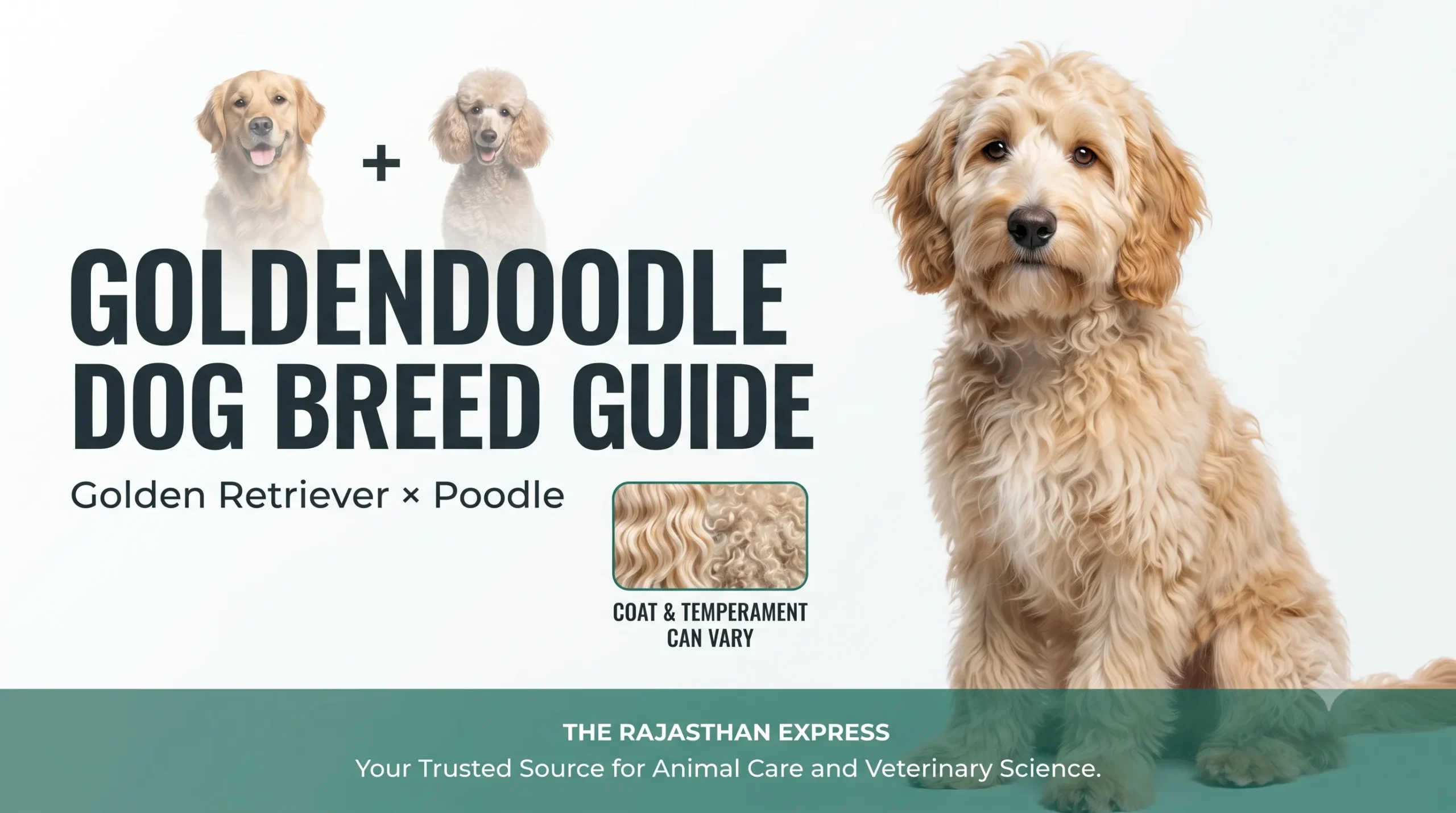
The Goldendoodle is a dog that people lovingly also call Golden Doodle or just Doodle. In Australia, it is also known by the name Groodle. In reality, it is not an old, pure, or naturally developed breed. It is a designer or hybrid dog, prepared by crossbreeding the Golden Retriever and Poodle. That is, humans have deliberately combined two different breeds to create a new dog in which the best qualities of both can come together.
What is a goldendoodle – the simplest answer is that it is a hybrid companion dog that combines the best traits of the Golden Retriever and Poodle.
Goldendoodle vs Labradoodle
It should be understood as different from the Labradoodle. The Labradoodle is a mix of the Labrador Retriever and Poodle, while the Goldendoodle is a mix of the Golden Retriever and Poodle. Both can look quite similar in appearance and temperament, but their roots are in different breeds.
Goldendoodle as a Companion Dog
The Goldendoodle has been developed mainly as a companion dog. If it has good breeding and proper socialisation, it can also be suitable for family life, obedience training, therapy, and some service or assistance work. In the GANA breed standard, special importance is given to its stable temperament, friendliness, confidence, and attachment to people. That is, this dog should be one that mingles with people, does not get scared, and remains happy with the family.
Do Goldendoodles Shed Hair?
The truth is that the coat depends on genetics. Some dogs may shed less, some more. Veterinary sources also clearly state that no dog is 100% hypoallergenic or completely allergy‑free. Allergies are mainly caused by proteins present in the dog’s saliva, skin flakes, and urine. Therefore, if someone is allergic to dogs, they should consult a veterinarian or allergy specialist before getting a Goldendoodle and get complete information about the puppy’s parents and its coat.

Why Is the Goldendoodle So Popular?
The Goldendoodle has today become very popular all over the world, especially among families who want a dog that is loving with children, quick to learn, adapts to the home environment, and also looks attractive. But before adopting it, it is very important to understand that it is a hybrid dog. It has no single fixed breed standard, and every puppy brings a different mix of its parents’ qualities. Therefore, the decision should be made not just by the breed name, but by looking at the parents’ health, breeding quality, socialisation, and the puppy’s behaviour.
Goldendoodle Origin and History
When and Where Did the Goldendoodle Originate?
Look, whenever there is talk about the origin of the Goldendoodle, the first thing that must be understood is that its history is not as clearly recorded as other old pure breeds. Just as we know the clear date and place of the origin of the German Shepherd or Labrador Retriever, it is not the same with the Goldendoodle. Therefore, if someone says that the Goldendoodle was first created in exactly this year and this country, that would not be entirely correct. Its exact first birthplace and time are still considered disputed or poorly documented.
Early Goldendoodle Crossbreeding in 1969
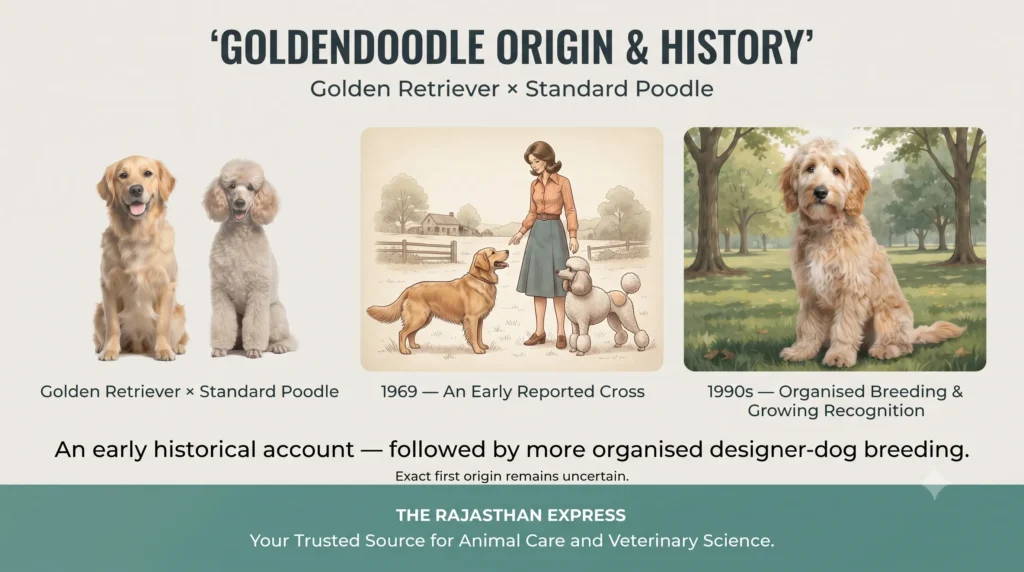
Now let’s come to the oldest known experiment. A very famous and often‑quoted account is from 1969. At that time, a woman named Monica Dickens crossbred a Golden Retriever and Standard Poodle. Interestingly, Monica Dickens was the great‑granddaughter of the famous author Charles Dickens. This is considered the first such experiment mentioned in history. But this was not a large‑scale breeding programme. It was an early attempt, which was carried forward in later decades in a more organised manner.
Modern Goldendoodle Development in the 1990s
After the 1960s, for some time, stories of such crosses kept appearing here and there, but there was no solid record of them. Then in the 1990s, some breeders in Australia and the United States started deliberately and continuously breeding it. This period is considered the real development era of the modern Goldendoodle. It is said that at that time, some designer dog breeders like Ryan Harvey started breeding it widely and gave it the name “Goldendoodle.” That is, the 1990s was the time when the Goldendoodle gradually began to build an identity and became popular among people.
But here is a very important thing. The Goldendoodle Association of North America (GANA) maintains caution in its history that crosses of the Poodle and Golden Retriever may have happened occasionally before, but their exact first beginning is not definitely known. According to GANA, in the late 1990s, some dedicated breeders started actively promoting this cross. After that, the development and popularity of the modern Goldendoodle increased rapidly. Therefore, the most scientific and correct thing would be that the exact first birthplace and time of the Goldendoodle is not completely clear. The 1960s Monica Dickens experiment is cited as an early example, while the organised and modern Goldendoodle’s development mainly happened in the 1990s in Australia and America.
What Was the Original Purpose of Creating the Goldendoodle?
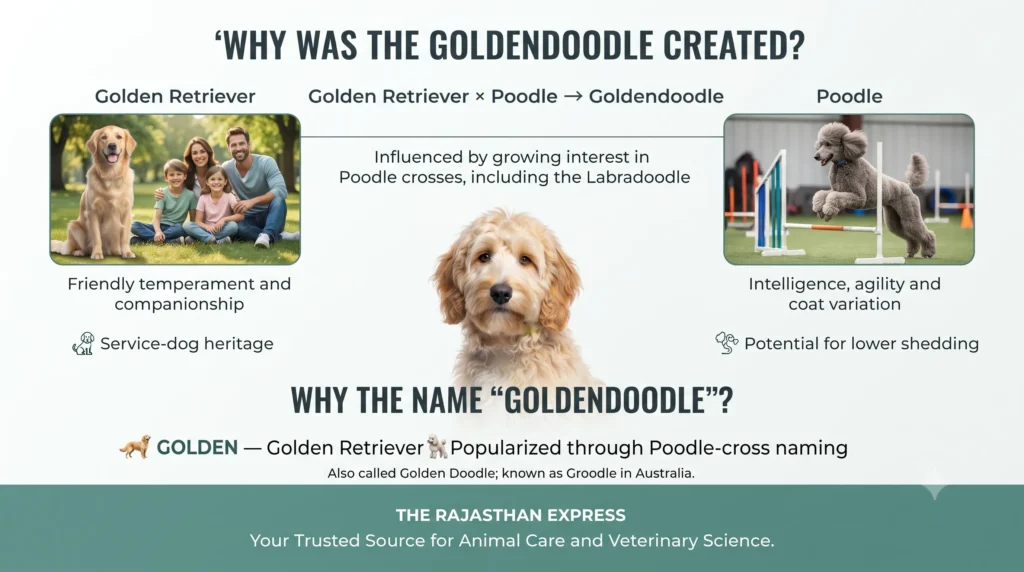
Now the question arises – what was the original purpose of creating the Goldendoodle? The thinking behind it was very clear. The Golden Retriever was already considered a very reliable, family‑oriented, loyal, and service dog. It is known for its friendliness and loving habits. On the other hand, the Poodle is extremely intelligent, agile, and quick to learn. Also, the Poodle’s coat is generally considered lower‑shedding compared to the Golden Retriever. So breeders thought – why not create a dog that combines the Golden Retriever’s temperament, the Poodle’s intelligence, and the Poodle’s coat’s low‑shedding quality – all three together. This thinking became the real foundation of the Goldendoodle’s development.
One more thing played a very big role in this. That was the popularity of the Labradoodle. When the Labradoodle swept across people, the demand for Poodle‑crossed dogs began to increase. People wanted dogs that were intelligent, behaved well with the family, and shed less hair. This demand also pushed the Goldendoodle forward. Gradually, it stopped being just an experiment or service dog and became a very popular family companion dog.
Why Is It Called a Goldendoodle?
- Talking about the name, the word “Goldendoodle” is made from two things. The word “Golden” came from the Golden Retriever, and the word “Doodle” was taken from the Labradoodle. That is, the story of both breeds is hidden in the name itself. In some places, it is also called “Golden Doodle” or just “Doodle.” In Australia, it is also known by the name “Groodle.”
History of the Goldendoodle’s Parent Breeds
To understand the Goldendoodle correctly, it is first necessary to know which two breeds it is made from. The Goldendoodle is not an old pure breed. It is a designer or hybrid dog prepared by crossbreeding the Golden Retriever and Poodle.
1. History of the Golden Retriever
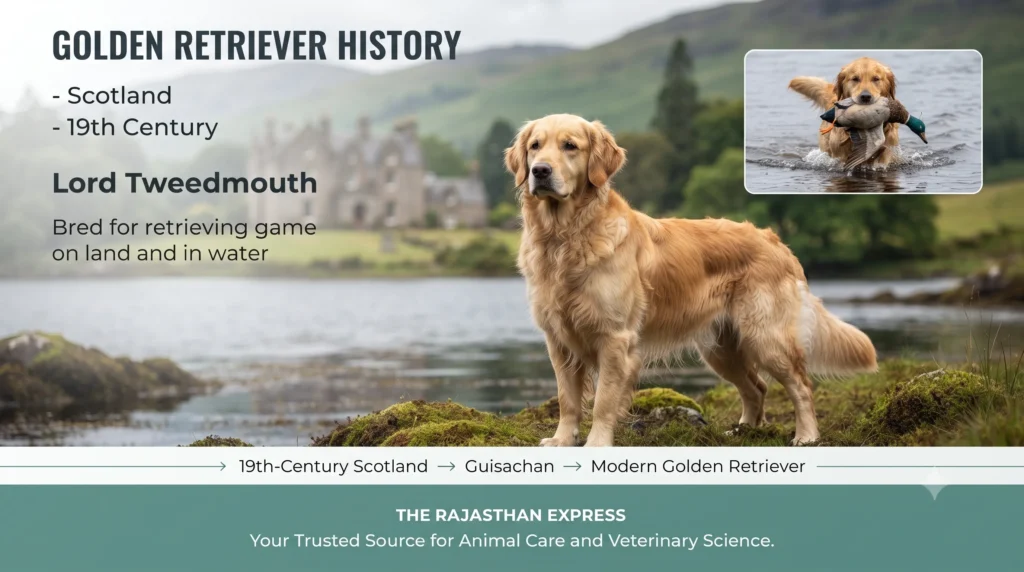
- The Golden Retriever was developed in Scotland. Its modern history is linked to the 19th century breeding programme of Lord Tweedmouth (Dudley Marjoribanks). He worked on developing a retriever at his estate Guisachan in the Scottish Highlands that was expert at retrieving shot birds on both land and water.
- An important dog in the history of the Golden Retriever was Nous. Lord Tweedmouth found him as a yellow‑coloured retriever. Later, he was crossed with a Tweed Water Spaniel named Belle. The Tweed Water Spaniel is now extinct. The puppies born in the 1868 litter are considered the early foundation of the modern Golden Retriever.
- The Golden Retriever was not developed just to be a beautiful family dog. Its main historical purpose was hunting and retrieving work. It was created to retrieve fallen birds from water, work long hours in the field, and work alongside humans. Because of this working background, today’s Golden Retriever shows qualities like learning ability, retrieving instinct, passion for work, and attachment to people.
2. History of the Poodle
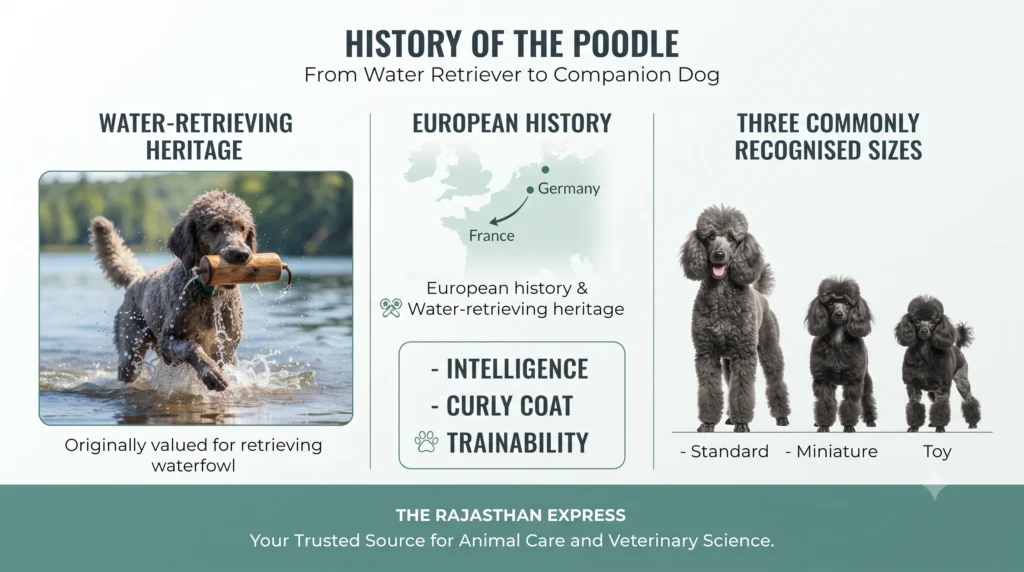
- People generally think of the Poodle as just a stylish or show dog, but its real history is very different. The Poodle’s origin is considered to be in Germany around the 1400s, where it was reared for waterfowl hunting and retrieving things fallen in water, and later it was taken to France. The word Poodle comes from the German word “Pudel,” which means “to splash in water or play with water.” The Poodle was originally used as a waterfowl hunter and truffle hunter. Truffle is a type of valuable underground mushroom, and the Poodle’s sharp nose and intelligence were useful for finding it. The Poodle is known worldwide for its exceptional intelligence, learning ability, and curly coat.
- Another special thing about the Poodle is that it comes in three recognised sizes – Standard, Miniature, and Toy. This size variation is very significant in creating designer dogs, because the size of the Poodle parent can affect the final size of the crossbred puppy.
Other Designer Dogs Created from Poodle Crossbreeding
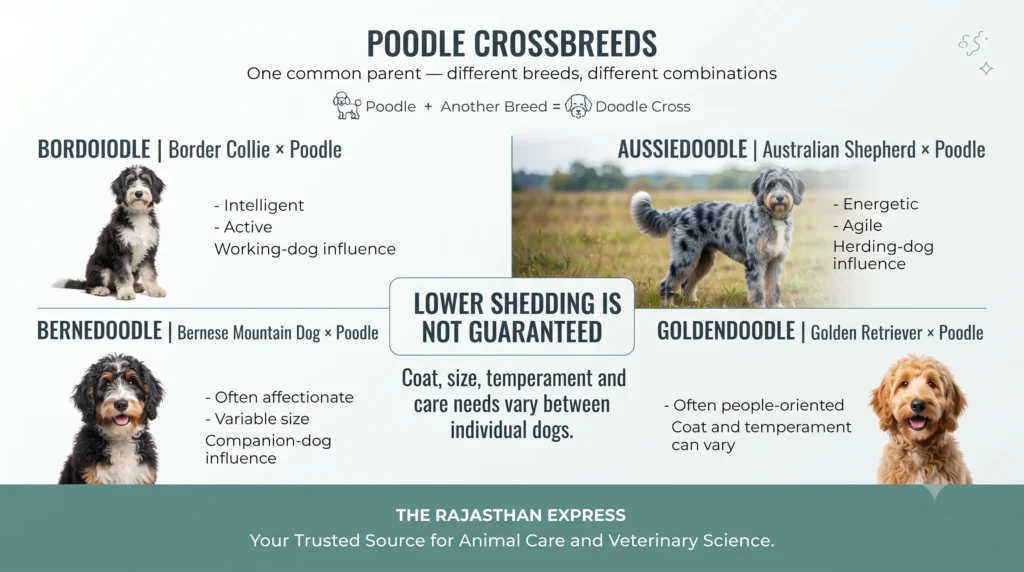
Due to the Poodle’s intelligence, agile body, special curly low‑shedding coat, and three different sizes, breeders over time crossed it with many other breeds. From this trend, several “Doodle” designer dogs emerged. It is very important to understand that crossing another breed with the Poodle does not automatically make it an official pure breed. Such dogs are generally called crossbreed, hybrid, or designer dog, and their qualities keep changing. Like Bordoodle, Bernedoodle, Goldendoodle, Aussiedoodle – all fall under the hybrid or designer dog category.
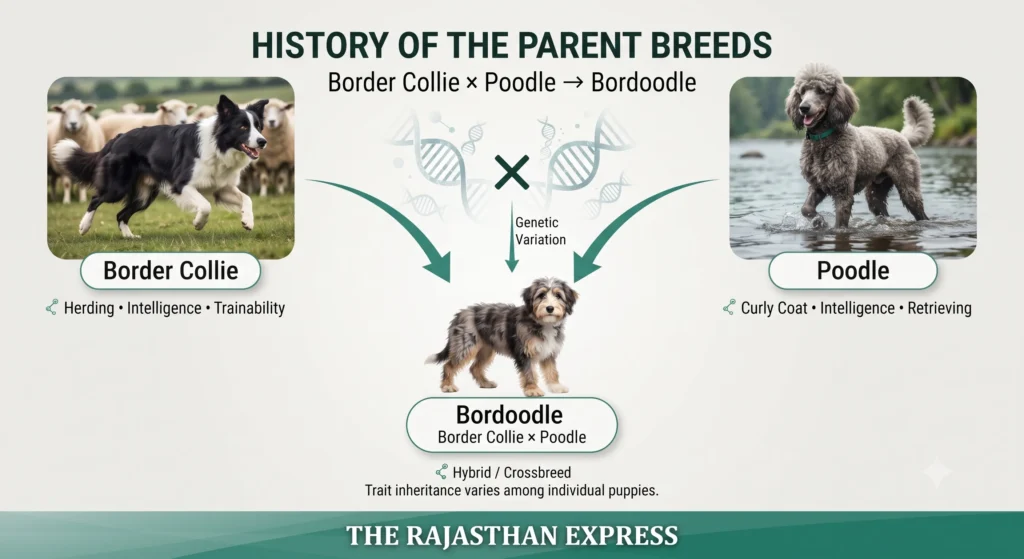
- Bordoodle (Border Collie × Poodle)
In the Bordoodle, an attempt is made to combine the Border Collie’s sharp intelligence, working ability, and herding instinct with the Poodle’s intelligence and coat qualities. It can generally be an active, intelligent, and easily trainable hybrid. Its coat can be straight, wavy, or curly, and shedding can vary according to each dog’s genetics. There is no solid record of the exact first origin of the Bordoodle. During modern designer dog development, its popularity increased in regions like North America and Australia.
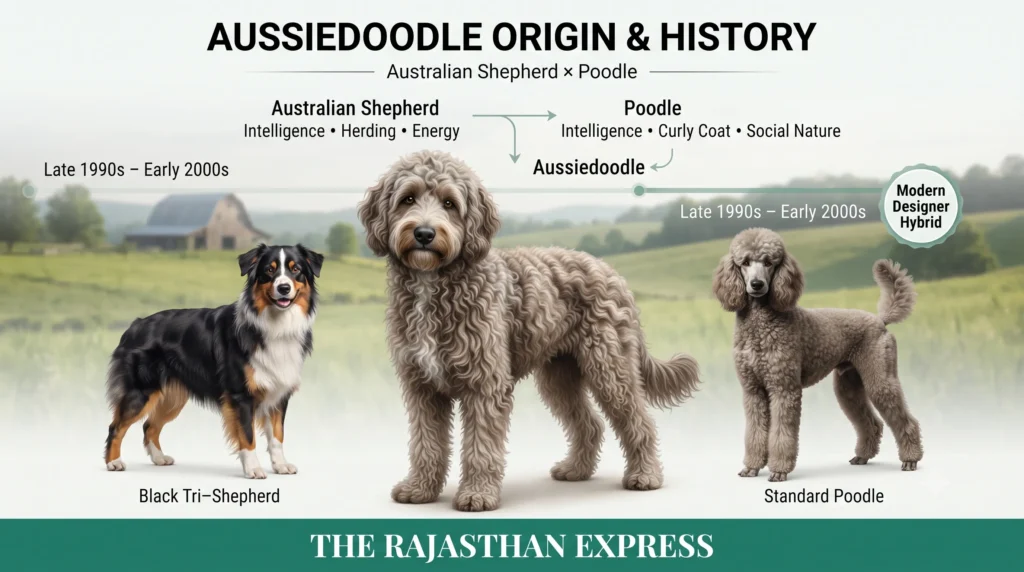
- Aussiedoodle (Australian Shepherd × Poodle)
In the Aussiedoodle, an attempt is made to combine the Australian Shepherd’s intelligence, energy, and herding‑related qualities with the Poodle’s intelligence, trainability, and coat qualities. It can generally be an energetic and intelligent companion and needs sufficient physical exercise and mental stimulation. Its coat can have wavy or curly texture, while colour and pattern can vary greatly. Due to Australian Shepherd genetics, some dogs may also show merle patterns. The Aussiedoodle is also not an old pure breed. It falls under the modern designer dog category, and its exact original breeder and a universally accepted establishment date are not fully determined.
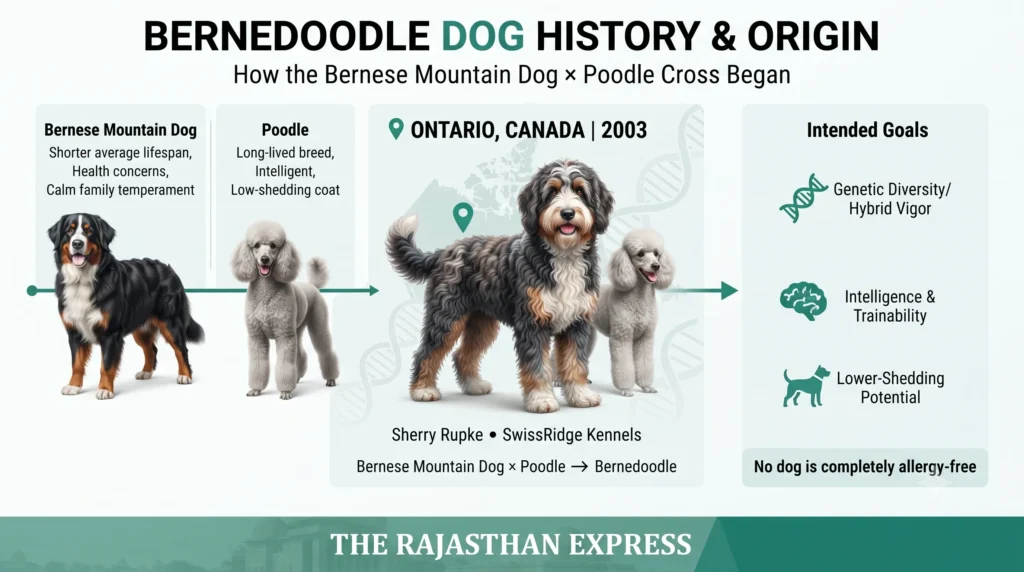
Bernedoodle (Bernese Mountain Dog × Poodle)
In the Bernedoodle, the Bernese Mountain Dog and Poodle are crossed. Its purpose is to combine the Bernese Mountain Dog’s generally friendly, affectionate, and heavy‑bodied qualities with the Poodle’s intelligence and coat qualities. The Bernedoodle’s size can vary greatly, because the Poodle parent can be Standard, Miniature, etc. Therefore, some Bernedoodles are large and heavy, while Mini or smaller varieties can be quite compact. Its coat can have wavy and curly types, and colours can vary greatly. The Bernedoodle is also a hybrid or designer dog, not a traditional pure breed. Due to its F1, F1B, F2, and multigenerational breeding combinations, differences in coat and temperament can occur.
Poodle Crossbreeding
The basic idea of crossing the Poodle with different breeds can be understood like this:
- Poodle + Golden Retriever → Goldendoodle
- Poodle + Border Collie → Bordoodle
- Poodle + Australian Shepherd → Aussiedoodle
- Poodle + Bernese Mountain Dog → Bernedoodle
In all these dogs, the Poodle is a common parent, but because the other parent is different, their physical structure, energy level, temperament, and care needs become different. A common attraction of this crossbreeding is the Poodle’s curly or wavy, generally low‑shedding coat, but it is important to remember that every Poodle cross is not low‑shedding or allergy‑free. Coat genetics is complex, and every puppy can vary greatly.
Similarly, assuming that every Doodle dog will have the same temperament just by seeing the “Doodle” name is not correct. For example, Bordoodles with Border Collie can be more intense and dedicated to work, Aussiedoodles with Australian Shepherd can be more energetic and herding‑oriented, while Bernedoodles with Bernese Mountain Dog can show relatively calmer qualities. Still, these are only breed tendencies; every dog’s actual behaviour depends on its genetics, breeding quality, early socialisation, and training.
So overall, the history of the Goldendoodle is a story that started with a small experiment in the 1960s, took organised form in Australia and America in the 1990s, and today has become a popular designer dog all over the world. Its exact first birthplace and time are still not completely clear, but its modern development and popularity are mainly considered a contribution of the 1990s. Its purpose was to bring together the Golden Retriever’s loving temperament, the Poodle’s sharp intelligence, and a low‑shedding coat. And this is why today the Goldendoodle is considered an intelligent, loving, family‑oriented, and attractive companion dog.
Goldendoodle Distribution and Geographical Area
Where Are Goldendoodles Found?
Now let’s talk about where the Goldendoodle is found in the world. First of all, understand that the Goldendoodle has no “native place” or ancestral region. It is not a wild or naturally developed breed, but a hybrid dog created by humans by crossbreeding the Golden Retriever and Poodle. Therefore, its distribution is not determined by any river, mountain, or country border. It is found more in places where people like designer dogs, where breeders are active, and where the pet market is large.
Goldendoodle Distribution in the United States and Canada
- Today, the Goldendoodle is found in many parts of the world, but its greatest popularity is seen in North America, Australia, and Europe. In America and Canada, it has become very common. According to 2026 data, the Goldendoodle is the fourth most popular dog breed in America. It has become the most preferred breed in about 14 states of America. Some specific areas like Florida, Alabama, and the Canadian province of Quebec are at the forefront. Families there love it very much because it is good with children, quick to learn, and also looks very attractive.
Goldendoodle Distribution in Australia
- In Australia, the Goldendoodle is especially known by the name “Groodle.” Australian veterinary and pet‑related sources describe it as a very well‑known and popular companion dog there. Talking about the United Kingdom, the Goldendoodle has also gained considerable popularity there.
Goldendoodle Distribution in Europe
- In other European countries too, the Goldendoodle is found as a companion and designer dog. In Germany, France, the Netherlands, Belgium, and Scandinavian countries, its demand is gradually increasing. However, its number can be different in each country, because it depends entirely on the availability of breeders and people’s preferences. Talking about India, here too the awareness and availability of the Goldendoodle has increased.
Goldendoodle Distribution in India and Asia
- If a geographical map of the Goldendoodle were made, it would not look like the shape of any one country. It would mainly extend across North America, Europe, Australia, and some major cities of Asia. This map can be called a “map of demand,” because wherever there are lovers of designer dogs, both breeders and keepers of the Goldendoodle are found.
- Based on breeders and pet databases, its distribution map can be made, which is mainly centred in America, Canada, Australia, and European countries. It can also live in rural areas, provided it gets sufficient exercise, open space, and mental stimulation. But its greatest presence is seen in urban and suburban areas, because people there prefer small families, apartment life, and low‑shedding dogs.
Factors Affecting Goldendoodle Distribution
- One more thing to keep in mind is that the Goldendoodle’s distribution also depends on where its parents – the Golden Retriever and Poodle – are found. The Golden Retriever is reared all over the world, especially in livestock and hunting areas. The Poodle is also found in almost every major country.
- Therefore, the Goldendoodle can also be easily created and reared in places where breeders of these two breeds exist. But since it is not a pure breed, major organizations like the American Kennel Club do not recognize it. This means that it has no official “country of origin” or “national distribution” fixed. Organizations like the American Canine Hybrid Club, Designer Breed Registry, and International Designer Canine Registry register it as a hybrid.
Overall, the Goldendoodle today is mainly found in America, Canada, Europe, Australia, and New Zealand. In Asia and India, it is still an emerging breed, mainly limited to big cities, pet enthusiasts, and professional breeders. Its geographical spread is not determined by any river, mountain, or country border, but by people’s preferences, the availability of breeders, and designer dog culture. So if someone asks where Goldendoodles are found, the direct answer is that they are found in places where people want to keep an intelligent, active, family‑oriented, and low‑shedding hybrid dog and where breeding facilities for it are available.
THE RAJASTHAN EXPRESS
Goldendoodle Category and Other Names
What Is the Goldendoodle Category? Hybrid or Crossbreed?
Now let’s talk about which category the Goldendoodle actually belongs to and by what names it is known. It is very important to understand this because people often mistake it for a pure breed, while in reality it is a hybrid or crossbreed dog.
The Goldendoodle is mainly called a hybrid dog or crossbreed. This means it has been prepared by crossbreeding two different breeds – the Golden Retriever and Poodle. It is not recognized as a separate pure breed by any major kennel club like the American Kennel Club or United Kennel Club. That is, if you want to register the Goldendoodle as a pure breed in the AKC register, it is not possible. The AKC clearly states that crossbreed dogs are not eligible for its pure breed registration. Yes, the AKC has a separate programme for mixed breeds called the Canine Partners Program, but that is not the pure breed category.
From a practical and scientific perspective, the Goldendoodle is a domestic dog hybrid or crossbreed. It is placed in the category of designer dog, hybrid dog, or Poodle cross. Its parents are the Golden Retriever and Poodle. Its main purpose is to create a companion dog. Besides this, according to the ability of different dogs, it can also be used for therapy, assistance or service type work, obedience, agility, family activities, and emotional support. The Goldendoodle Association of North America (GANA) describes Goldendoodles as potentially versatile for companion as well as therapy and service roles. But this depends on each dog’s individual ability, training, and temperament.
So understand one thing clearly. In everyday language, people call it “Goldendoodle breed,” but from the perspective of registration and biological classification, it is not a traditional pure breed. It is a cross of the Golden Retriever and Poodle.
Goldendoodle Alternative Names: What Is a Goldendoodle Also Called?
The Goldendoodle is known by many names among different countries, breeders, and keepers. It is important to understand that having different names does not mean it is a different breed. All these names generally refer to the same cross of the Golden Retriever and Poodle.
- Goldendoodle: This is the most common and international name. It is used the most.
- Golden Doodle: This is a different spelling of the same name, written and spoken in many places.
- Groodle: In Australia, this name is most prevalent. Australian sources consider the Goldendoodle and Groodle as the same thing – a cross of the Golden Retriever and Poodle.
- Curly Golden: Some people also call it by this name, because its coat is often curly.
- Curly Retriever: This is also an informal name, pointing towards its Retriever temperament and curly hair.
- Goldenpoo: In some informal naming systems, this name is used, but it is not as standardised as Goldendoodle or Groodle.
- Goldenoodle: This is also sometimes used, but it is not very common.
- Doodle: Generally, all Poodle mix dogs are called “Doodle.” That is, the Goldendoodle is also a type of Doodle.
- Golden Retriever Poodle Mix: This is a descriptive name, which tells which two breeds it is made from. This is not an official breed name.
Among all these names, the most used names are Goldendoodle and Groodle. The other names are less common.
Goldendoodle Characteristics (Identification of Goldendoodle)
Goldendoodle Characteristics: What Does a Goldendoodle Look Like?
The first rule of identifying a Goldendoodle is do not bind it into one single structure like a pure breed. It is a hybrid or designer dog created by crossbreeding the Golden Retriever and Poodle. Therefore, it can have qualities of both parents, but it is not necessary that every puppy gets those qualities in equal amounts. Puppies born in the same litter can have different coat, colour, size, face, and temperament. Because of this, the Goldendoodle’s identification should be made not just by its “teddy bear” face, but by looking at its body, coat, eyes, ears, tail, and behaviour together.
Goldendoodle Size
- The Goldendoodle is usually a medium to large‑sized, strong, agile, and athletic dog. Its body is neither very heavy nor very thin. Ideally, its build should be like a dog that can run comfortably for long periods, play, and work without getting tired. Its chest is deep, back is almost flat, hips are strong, and legs are straight. The body length can be slightly more than the shoulder height. It shows the influence of both the Golden Retriever’s strong build and the Poodle’s agile body.
- Goldendoodle Size: Petite, Mini, Medium, and Standard
- The Goldendoodle has no single fixed size. It depends on whether the Poodle parent was Standard, Miniature, or Toy. The GANA (Goldendoodle Association of North America) mainly divides it into Petite, Miniature, Medium, and Standard categories. Some breeders also use the term “Toy Goldendoodle,” but it is not a separate recognized breed.
| Goldendoodle Size Chart: Petite, Mini, Medium, and Standard | ||
| Type | Shoulder Height | General Weight |
|---|---|---|
| Petite / Petite Mini Goldendoodle Size | Under 14 inches | About 25 pounds or less |
| Mini Goldendoodle Size / Miniature Goldendoodle Size | 14–17 inches | About 26–35 pounds |
| Medium Goldendoodle Size | 17–21 inches | About 36–50 pounds |
| Standard Goldendoodle Size | Over 21 inches | About 51 pounds or more |
| Note: These are only estimated ranges. The actual size depends on genetics, sex, nutrition, and activity. | ||
| The Rajasthan Express : Goldendoodle Size Chart: Petite, Mini, Medium, and Standard | ||
These are only estimated ranges. The actual size depends on genetics, sex, nutrition, and activity. If you are searching for Miniature Goldendoodle full grown weight or how big does a Mini Goldendoodle get, this table gives you a clear idea. The Mini Goldendoodle full grown size is usually 14–17 inches and 26–35 pounds.
Goldendoodle Lifespan
- The average Goldendoodle lifespan is generally considered to be between 10 and 15 years. If you are asking how long does a Goldendoodle live, the answer is about 10–15 years.
Goldendoodle Coat: The Biggest Identification
The biggest identification of the Goldendoodle is its coat. It can mainly be of three types – curly, wavy, and straight.
Curly Coat Goldendoodle
- The curly coat leans more towards the Poodle. In this, the hair is tightly curled and long hair on the face (furnishings) is clearly visible. Such a coat needs to be brushed daily or several times a week, otherwise the hair can tangle and form mats.
Wavy Coat Goldendoodle
- The wavy coat is the most common, and this is what most people call the “teddy bear look.” It has soft waves and care is slightly easier than the curly coat.
Straight Coat Goldendoodle
- The straight coat leans more towards the Golden Retriever. In this, the hair is straight or slightly wavy, and dense Poodle‑like furnishings on the face may be less visible. If you are looking for a straight coat Goldendoodle puppy, note that this coat type is possible.
Do Goldendoodles Shed?
- Here, understand one very important thing. The Goldendoodle is called a “low-shedding” dog, but this does not mean it will not shed at all or that it will be allergy-free. No dog is 100% hypoallergenic. Low shedding can be an advantage, but it is not a guarantee that allergies will be completely eliminated. Many people ask do Goldendoodles shed or do Goldendoodles shed hair—the answer is yes, they can shed, but usually less than many other breeds. The hypoallergenic status of Goldendoodles is often exaggerated; they are not completely hypoallergenic
Goldendoodle Coat Colors and Patterns
Goldendoodle Coat Colour
- Goldendoodle colours include red, golden, apricot, cream, blonde, black, chocolate, brown, silver, and grey. A black Goldendoodle is also possible.
Colour Pattern
- Patterns can include abstract, parti, phantom, sable, and merle. In abstract, the main body colour is solid, but there are white markings on the chest, paws, or face.
- In parti, at least half the body is white, with patches of another color on the rest of the body. Parti Goldendoodle colors and patterns are popular.
- In phantom, there are lighter markings above the eyes, muzzle, chest, and legs on a black or brown base. Phantom Goldendoodle markings are distinctive.
- In merle, a marble-like pattern of black and gray is formed.
Double Merle Warning
- There is a very important warning about merle. Two merle dogs should not be mated together. Doing so can produce double merle puppies, which have a higher risk of deafness and vision defects. Responsible breeders avoid this breeding and get genetic testing done.
Goldendoodle Eyes, Ears, and Face
Goldendoodle Eyes
- The Goldendoodle’s eyes are usually almond‑shaped, medium‑sized, and not protruding. Most dogs have dark brown eyes, but in light‑coloured dogs, amber or hazel colour can also be seen. Blue eyes or one blue and one brown eye can be linked to the merle gene, but do not consider this a definite basis for identifying a Goldendoodle. Because the merle gene is also found in Blue Merle Aussie or Blue Merle Australian Shepherd & Aussie Doodle (Australian Shepherd) . In Blue Merle Aussie, the merle gene is responsible for blue colour and silver‑like grey spots on a black background.
Goldendoodle Ears
- The ears are hanging and soft. The ears are medium‑sized and hang at the sides of the face. Due to hanging ears and inner hair, there is a risk of ear infection, so they should be regularly cleaned and kept dry.
Goldendoodle Head & Nose
- The head is moderately rounded. The muzzle (front part of the mouth) is of medium length. The nose can usually be black, brown, or liver coloured.
Goldendoodle Neck, Back, Chest, Legs, and Tail
Goldendoodle Neck
- The Goldendoodle’s neck is of medium length, muscular, and slightly arched. The back is almost flat and the chest is deep and oval.
Goldendoodle Leg
- The front legs are straight and strong, while the hind legs are muscular and agile. The paws are small, round, and strong. The tail can be long, feathery, and slightly curved.
Goldendoodle Tail
- Generally, the tail hangs down at rest and rises up when excited, but does not go above the back. Docking the Goldendoodle’s tail is not a common or necessary practice.
Goldendoodle vs Bordoodle vs Aussiedoodle vs Bernedoodle: Key Differences
Instead of understanding the Goldendoodle alone, if we compare it with other Poodle‑cross designer dogs, its identification becomes even clearer. Let’s see what these four dogs are:
- Goldendoodle = Golden Retriever × Poodle
- Bordoodle = Border Collie × Poodle
- Aussiedoodle = Australian Shepherd × Poodle
- Bernedoodle = Bernese Mountain Dog × Poodle
One thing is common in all four – the Poodle is one parent. Therefore, all four have the potential for intelligence, training ability, and to some extent, low‑shedding coat. But because the other parent is different, their body, working tendency, energy level, and temperament become different. Therefore, it is not correct to understand these four as the same.
Main Differences Among the Four
Now let’s see who the other parent is and what difference it makes.
1. Goldendoodle (Golden Retriever × Poodle)
- Temperament: In simple language, the Goldendoodle can be called “the home’s loving, friendly, and everyone’s friend.” Its temperament is usually very affectionate, cheerful, and mingles with the family. It is often called a “social butterfly,” because it likes to be among people, play with children, and behave well with guests. The standard Goldendoodle temperament is generally excellent for families.
- Energy: Its energy is medium to high. It needs daily walks, play, and some mental activity, but not as much intensity as a Border Collie. That is, if you play and run with it for 30 to 60 minutes daily, it can remain happy.
- Working Tendency: In working tendency, it gets the Golden Retriever’s retrieving habit (bringing things back) and family companionship. Therefore, it is considered good for therapy, assistance, and family activities.
- Coat: Its coat is usually long, wavy, or curly, giving it a teddy bear look.
- Size: In size, it comes in Petite, Miniature, Medium, and Standard. That is, from small apartments to big houses, it can adapt, provided it gets exercise and attention.
2. Bordoodle (Border Collie × Poodle)
- Temperament: To understand the Bordoodle, call it a “brainy working dog.” It is very intelligent, active, and dedicated to work. It has the Border Collie’s herding instinct, so it can be more “work‑oriented.”
- Energy: Its energy is very high. Just walking it is not enough. It needs running, jumping, learning new commands, solving puzzles, and long mental work. If left bored, it can bark, chew, or create mischief in the house.
- Coat: The coat can be straight, wavy, or curly. Shedding depends on each dog’s genetics, so do not consider it completely non‑shedding.
- Size: In size, it is medium to large, but can be slightly lighter and more agile than the Goldendoodle. It is good for people who are active themselves and can give the dog sufficient time and mental challenge. For first‑time dog owners, it can be a little difficult.
3. Aussiedoodle (Australian Shepherd × Poodle)
- Temperament: The Aussiedoodle can be called a “powerhouse of energy.” Its temperament is energetic, intelligent, alert, and herding‑oriented. Due to the Australian Shepherd, its herding instinct can be strong.
- Energy: Its energy is very high. It loves running, playing, and mental challenges. It can perform well in agility, flyball, herding, and active games.
- Coat: Its coat is wavy or curly. Due to Australian Shepherd genes, some dogs may also show merle patterns. Like Blue Merle Aussie. But caution is necessary regarding merle – two merle dogs should not be mated together, otherwise double merle puppies can have deafness and vision defects.
- Size: In size, it is medium to large, and there are also Miniature Aussiedoodles. It is for people who are very active, spend time outdoors, and can give the dog both physical and mental exercise. If you live a calm, relaxed life, the Aussiedoodle can prove tiring for you.
4. Bernedoodle (Bernese Mountain Dog × Poodle)
- Temperament: The Bernedoodle can be called a “big, calm, and loving companion.” Its temperament is calm, loyal, affectionate, sometimes stubborn, and independent. Due to the Bernese Mountain Dog, it can be comparatively more relaxed.
- Energy: Its energy is medium. It needs daily exercise, but not as much intensity as a Border Collie or Australian Shepherd. It is less used as a heavy working dog.
- Coat: Its coat is thick, curly, or wavy, and often appears in tri‑colour – black, brown, and white.
- Size: In size, it is large and heavy. There are also Mini Bernedoodles, but the Standard Bernedoodle is quite large. It is good for families who want a big, calm, loving, and loyal dog, but can take care of its space, exercise, and grooming.
- Goldendoodle is balanced, family‑oriented, and friendly. It can be a good option for first‑time dog‑owning families.
- Bordoodle is more brainy and work‑oriented. It needs experienced keepers and an environment that provides mental challenge.
- Aussiedoodle is very energetic and herding‑oriented. It needs an active family and a playful environment.
- Bernedoodle is comparatively calm, big, and family‑oriented. It needs space, exercise, and regular grooming.
Goldendoodle Generations: F1, F1B, F2, and Multigenerational
While buying a Goldendoodle or reading about it, you must have heard terms like F1, F1B, F2. These words indicate its generation. Simply put, these labels tell who the dog’s parents and grandparents were and how far it has progressed in the mix of Golden Retriever and Poodle. But understand one very important thing here – these labels are only an estimate. They do not confirm what the dog’s coat will be like, how much it will shed, or what its temperament will be. The real things depend on genetics.
1. F1 Goldendoodle
F1 means first generation. That is, when a Golden Retriever and Poodle are directly crossed, the puppies born are called F1 Goldendoodles.
- Genetic Mix: It has approximately 50% Golden Retriever and 50% Poodle genes.
- Coat and Shedding: Puppies born in the same litter can have different coats. Some will have straight hair, some wavy, some curly. The amount of shedding can also be different in each puppy.
- Special Point: F1 is generally considered the most balanced, because it has approximately half‑half qualities of both parents. But it is not guaranteed that every F1 will look the same.
2. F1B Goldendoodle (F1B Goldendoodle Lifespan & Do F1B Goldendoodles Shed?)
F1B is also called backcross. This means the F1 Goldendoodle is crossed back with one of its original parents.
- Usually, in most cases, the F1 Goldendoodle is crossed with the Poodle. In doing so, the puppy has approximately 75% Poodle and 25% Golden Retriever genes.
- But keep in mind: Technically, F1B does not only mean 75% Poodle. According to the GANA definition, backcross can be with the Poodle as well as the Golden Retriever. That is, if F1 is crossed with the Golden Retriever, it will also be called F1B, but then it will have more Golden Retriever genes.
- Advantage: Backcrossing with the Poodle can increase the possibility of a curly, low‑shedding coat. Therefore, people prefer F1B more. But this is not a guaranteed thing. An F1B puppy can also have straight hair and shed more.
- F1B Goldendoodle Lifespan: The lifespan is generally the same as other Goldendoodles, about 10–15 years.
- Do F1B Goldendoodles Shed? They may shed less, but they are not completely non-shedding. If you are asking do F1B Goldendoodles shed, the answer is yes, but typically less than many breeds.
3. F2 Goldendoodle
F2 means second generation. When two F1 Goldendoodles are crossed with each other, the puppies born are called F2 Goldendoodles.
- Genetic Mix: In this, the gene mixture becomes even more complex. Some puppies may have more Golden Retriever qualities, some more Poodle.
- Coat and Temperament: In F2, a lot of variation can be seen in coat, colour, size, and temperament. Even in the same litter, some puppies can look completely different.
- Special Point: Many people remain confused about F2. It is not considered as predictable as F1 or F1B.
Multigenerational Goldendoodle (Multigen Goldendoodle Size Chart)
When the Goldendoodle is bred for many generations, it is called a Multigenerational Goldendoodle. That is, F3, F4, F5, and beyond. In this, for many generations, only Goldendoodles are crossed with each other.
- GANA’s Statement: According to GANA, in later generations, it is not correct to make an accurate estimate of coat and shedding by just looking at the F‑number. It is more reliable to look at the actual physical qualities and genetic tests.
- Advantage: In the Multigenerational Goldendoodle, some qualities can become stable, but this too is not the same in every dog.
- Multigen Goldendoodle Size Chart: The size can vary, but generally follows the same categories as other Goldendoodles—Petite, Miniature, Medium, and Standard. A multigen Goldendoodle size chart is often used by breeders to estimate adult size.
Is F1B Goldendoodle Always the Most Hypoallergenic?
This is a very common thing that people say – “F1B Goldendoodle is non‑shedding and hypoallergenic.” But this is not completely true.
- Truth: Backcrossing with the Poodle can increase the possibility of a curly, low‑shedding coat, but this is not a guarantee. Every dog’s coat can be different.
- GANA’s Advice: GANA clearly states that for coat and shedding, selection of genetic traits is more reliable than generation labels.
- Therefore: Do not make a decision by just looking at the F1, F1B, or F2 label. Look at the parents’ coat, their shedding tendency, furnishings (face hair), and actual breeding records. This is the most correct method.
So overall, the names of Goldendoodle generations only tell what its family tree is like. F1 is the first generation, F1B is backcross, F2 is the second generation, and Multigenerational is many generations. But these labels do not determine what the dog will look like or what its temperament will be. The real difference comes from genetics, parents, and upbringing.
How Much Exercise Does a Goldendoodle Need?
Look, the Goldendoodle is a very active and intelligent dog. It does not like just eating and sleeping. Both its body and mind need daily work. According to veterinarians, large Standard Goldendoodle and Miniature Goldendoodle generally need about 30 to 60 minutes of physical exercise daily. But this is not a fixed rule. Some dogs want more than this, while some remain happy with a little less. This depends entirely on what the dog’s temperament is like, how energetic it is, and what its age is.
- Now the question is – what should this exercise be like?
- So just taking it for a walk is not enough. You can take it for a stroll, teach it fetch (throwing a ball and bringing it back) , run with it, take it swimming, go hiking in the mountains, give it obedience training, and do activities like agility. From all this, its body remains strong and its mind remains calm. If you keep it locked inside the house only, it will get bored and may start barking, chewing, or creating mischief.
Now understand one thing. The Standard Goldendoodle has a larger body, so it may need more space and more physical activity compared to a Mini Goldendoodle / Miniature Goldendoodle. But one should not decide how much exercise it needs just by looking at size. The dog’s age, health, temperament, and physical fitness matter equally. Like, if there is an old dog, it needs less and light exercise. If there is a sick dog, it should do activity only according to the doctor’s advice. And if there is a very energetic dog, it may demand more than 60 minutes.
One more very important thing, especially for puppies. Puppies should not be forced to run long distances or do too much jumping‑around exercise. Especially in large‑sized dogs, because their joints and bones are still growing. They need protection. If you make the puppy run too much or jump high repeatedly, it can have a bad effect on its joints. Therefore, do light exercise with the puppy, like walking for a short time, light play, and increase activity only according to its age.
So overall, give the Goldendoodle 30 to 60 minutes of exercise daily, but this can be less or more according to its individual need. A Standard Goldendoodle needs more space and activity than a Mini Goldendoodle, but do not decide based only on size. And avoid making puppies run or jump too much, because their growing joints need rest and protection. If you pay attention to this, your Goldendoodle will remain healthy, happy, and energetic.
What Type of Exercise Does a Goldendoodle Need?
A Goldendoodle is not a couch potato. It needs a mix of physical and mental exercise. Good options include:
- Daily walks
- Fetch and retrieve games
- Running or jogging
- Swimming
- Hiking
- Obedience training
- Agility activities
- Puzzle toys and scent games
These activities help the Goldendoodle stay fit and mentally satisfied. Without enough exercise, a Goldendoodle can become bored, destructive, and noisy. This is especially important for Mini Goldendoodle and Standard Goldendoodle owners who live in apartments or small homes.
Goldendoodle Temperament: Standard Goldendoodle Temperament and Mini Goldendoodle Temperament Traits
Look, to understand the Goldendoodle’s temperament, the first thing that must be known is that it is made from the Crossbreeding of the Golden Retriever and Poodle. Therefore, it gets the qualities of both. From the Golden Retriever, it gets friendliness, love, loyalty, reliability, and enthusiasm. From the Poodle, it gets sharp intelligence, sociability, and learning ability. Because of this, the Goldendoodle is usually a very energetic, loyal, and playful dog. It behaves very well with children and is considered a good family dog.
But because of this same friendliness and loyalty, there is also a problem. The Goldendoodle attaches very quickly to its family and does not like being alone. It can have separation anxiety – the anxiety of being separated – especially when it is a puppy. If you leave it alone for long periods, it can become troubled, bark, chew things, or create mischief in the house.
Separation Anxiety in Goldendoodles: Why They Hate Being Alone
- The Goldendoodle also gets the Golden Retriever’s retrieving instinct. This means its mouth remains active and it takes great interest in picking up, chewing, and bringing back things. Therefore, it is very important to give it toys, teach it fetch, and give it things to chew. Otherwise, it can make your shoes, slippers, or furniture its prey.
2019 Behavioral Study on Goldendoodle Temperament: Dog Rivalry, Fear, and Aggression
- Now let’s talk about a 2019 behavioural study. In that study, the Goldendoodle was compared to its parents – the Golden Retriever and Poodle. It was found that the Goldendoodle usually has less dog‑rivalry (fighting with other dogs) compared to the Miniature Poodle.
- But compared to the Golden Retriever, Miniature Poodle, or Standard Poodle, the Goldendoodle showed more aggression towards other dogs, more fear of other dogs, and more fear of strangers. That is, on average, the Goldendoodle can be a little more alert or fearful regarding other dogs and strangers. But this is not true for every dog. This is an average finding, and every dog’s temperament is different.
GANA Goldendoodle Temperament Standard: Friendly, Reliable, and Socially Stable
- According to the Goldendoodle Association of North America (GANA) standard, the Goldendoodle’s temperament should be friendly, reliable, trustworthy, confident, and socially stable. Special attention has been given to stable behaviour around children, the elderly, and disabled people. That is, it should be such that it behaves gently with everyone and does not get scared.
- It is usually a people‑oriented dog. This means it likes to be with people. Many Goldendoodles want to stay constantly with their family members and like to be included in the household’s daily activities. If you go into the kitchen, it will follow you. If you sit, it will want to sit near you. This is its speciality.
- Its biggest strength is its intelligence. Both the Golden Retriever and Poodle are very sharp‑minded dogs. Therefore, the Goldendoodle can learn commands quickly. But only physical exercise is not enough. Its mind also needs work. Puzzle toys, obedience practice, fetch games, scent‑finding games, and other mental activities are very beneficial for it. If it is taken only for a walk and not given mental exercise, it can get bored and create trouble.
- But understand one very important thing here. It would be wrong to say that every Goldendoodle will automatically become a perfect family dog. That does not happen. Its temperament depends on many things. Genetics – qualities received from parents, the puppy’s early socialisation, the breeder’s choice, training, and that dog’s own individual personality – all these together determine what it will become. If the puppy is introduced to different people, animals, sounds, and places from a young age, it will become more confident and balanced. If it is kept locked alone, it can become fearful or aggressive.
So overall, the Goldendoodle is a loving, friendly, intelligent, energetic, and loyal dog. It likes to live with the family, plays well with children, and is quick to learn. But it does not like loneliness, it needs mental exercise, and it is necessary to socialise it properly with other dogs and strangers. If you give it time, love, training, and the right environment, it can become the best companion of your family. But if you leave it alone for long periods and do not give it mental work, it can become troubled. Therefore, before adopting any dog, it is most important to understand its needs.
Goldendoodle Temperament: Standard Goldendoodle Temperament and Mini Goldendoodle Temperament Traits