 By
ByAngora Goat: Origin, Mohair Production, Characteristics, and Global Distribution
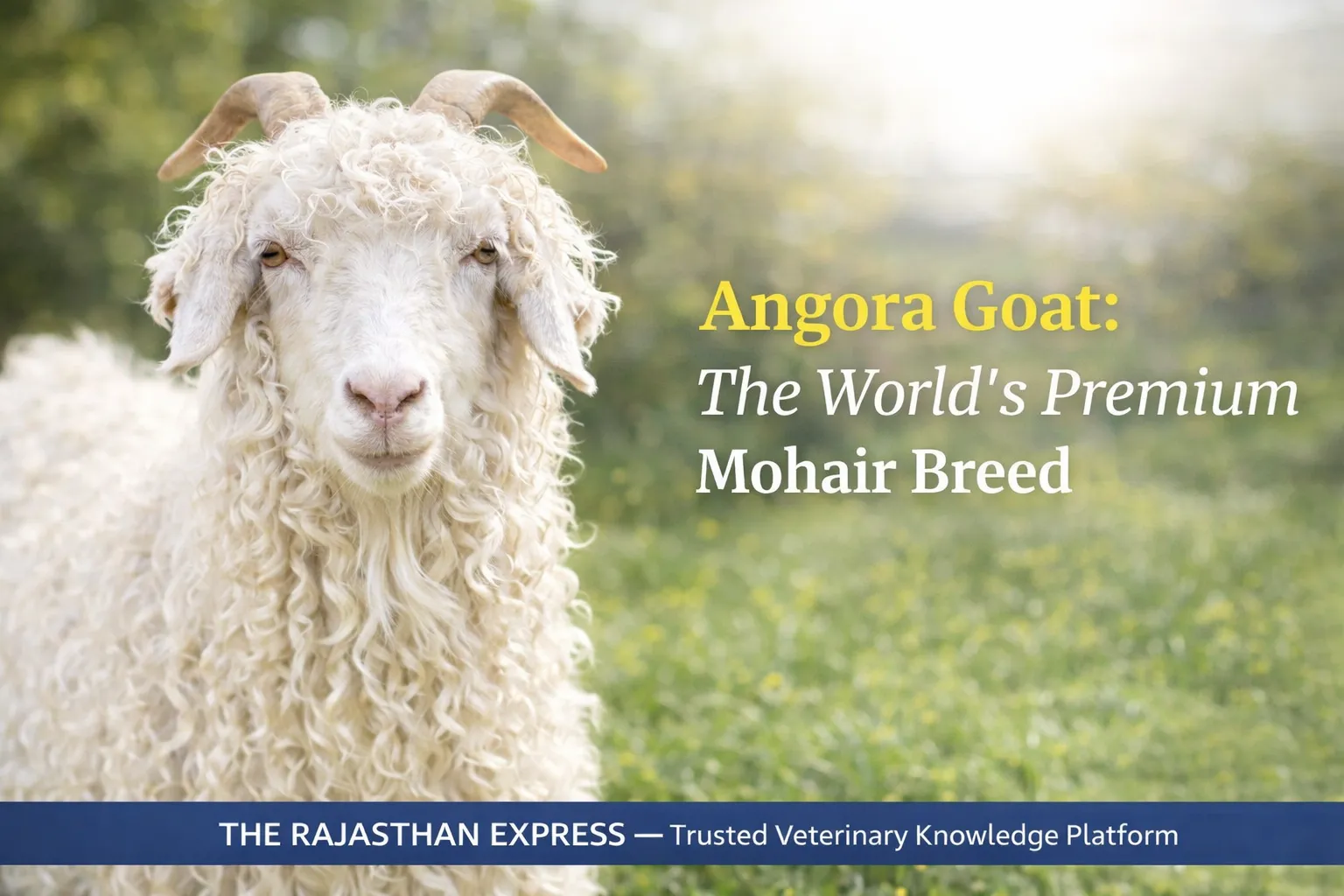
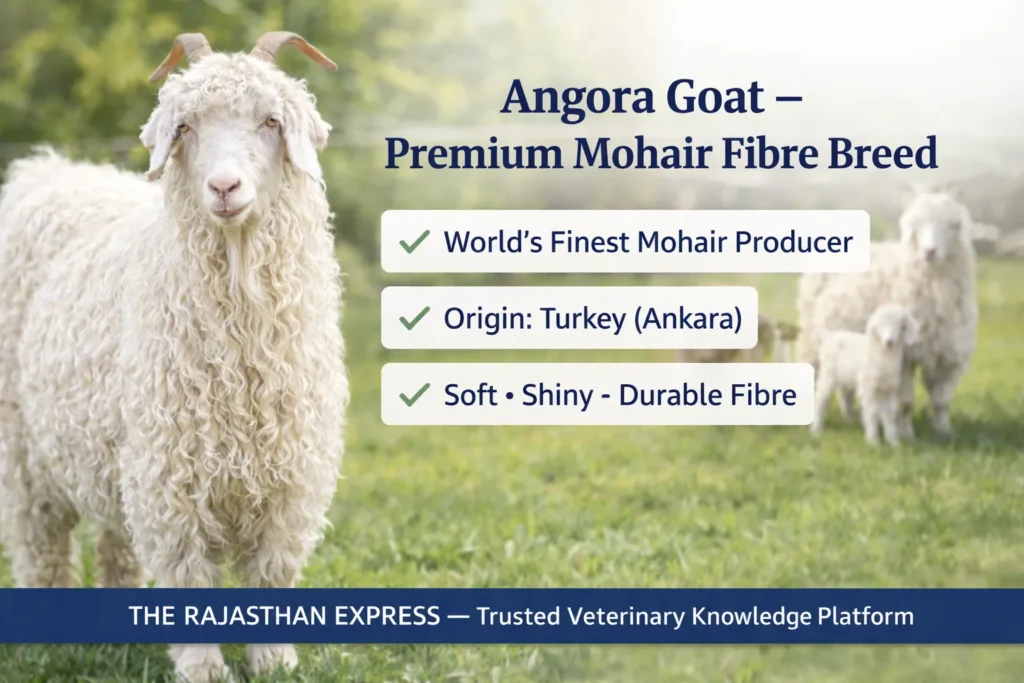
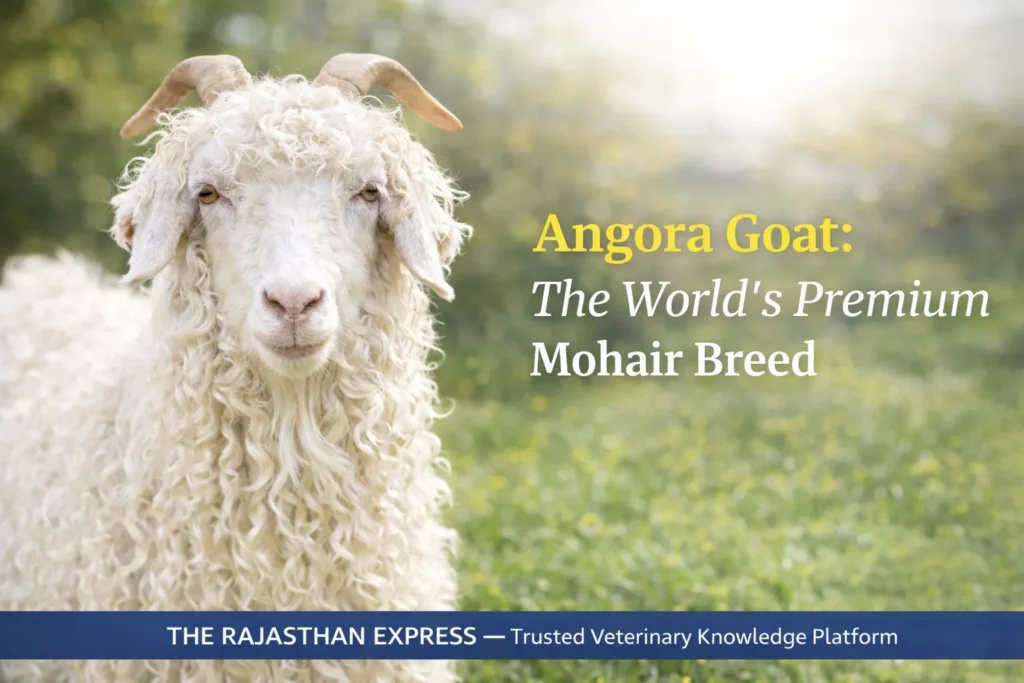
Mohair is one of the most valuable natural fibers in the world. It is obtained from the Angora goat, which is also called the Ankara goat. The scientific name of the Angora goat is Capra hircus aegagrus angorensis. Its origin is in the Ankara province of Turkey (which was called Angora before 1930), and for centuries Turkey maintained restrictions on their export. Even today this breed is known worldwide, but approximately 23% of the world’s Angora goats are found in South Africa.
The white, long, and lustrous hair of the Angora goat is called mohair. The history of mohair is very ancient—according to USDA, it was used even during the time of Moses (1571–1451 BCE). By the nineteenth century, mohair had become a very valuable commodity in trade.
Angora Goat Purpose: Mohair, Meat, Milk, and Leather
- The Angora goat is a multipurpose breed used for mohair, meat, milk, and skin, but today it is mainly raised for high-value mohair production.
Angora Goat Mohair Production One Year
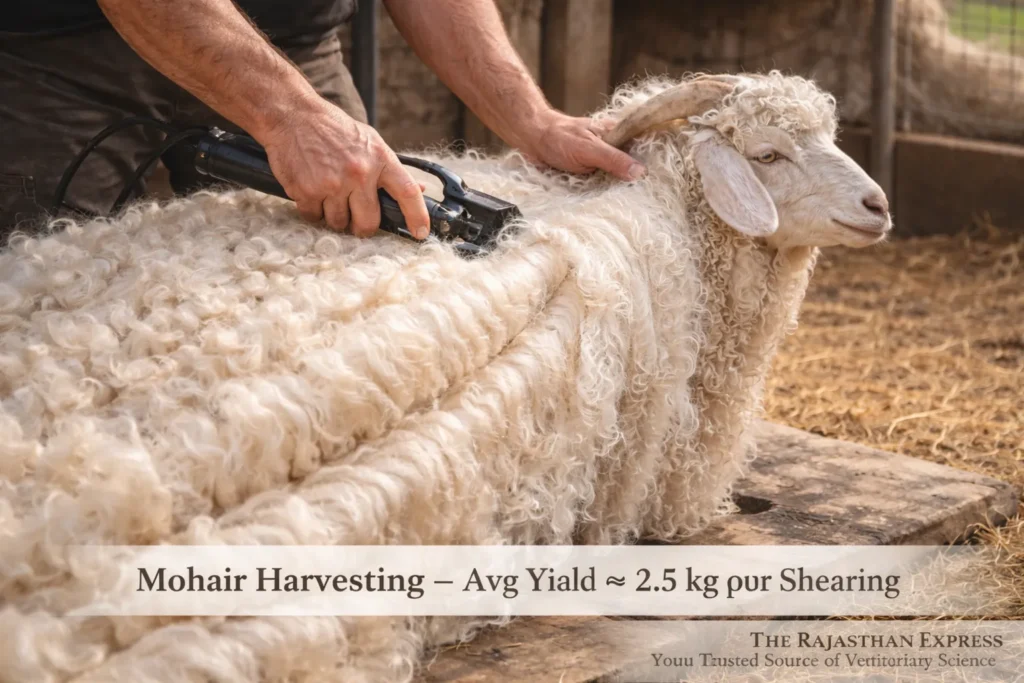
- In America, an average Angora goat produces approximately 2.5 kilograms of mohair in one shearing, and shearing is done twice a year. One Angora goat produces approximately 5 kilograms of mohair per year. This breed is relatively small in size and easily adapts even to difficult environmental conditions.
Angora Goat Characteristics and Physical Appearance
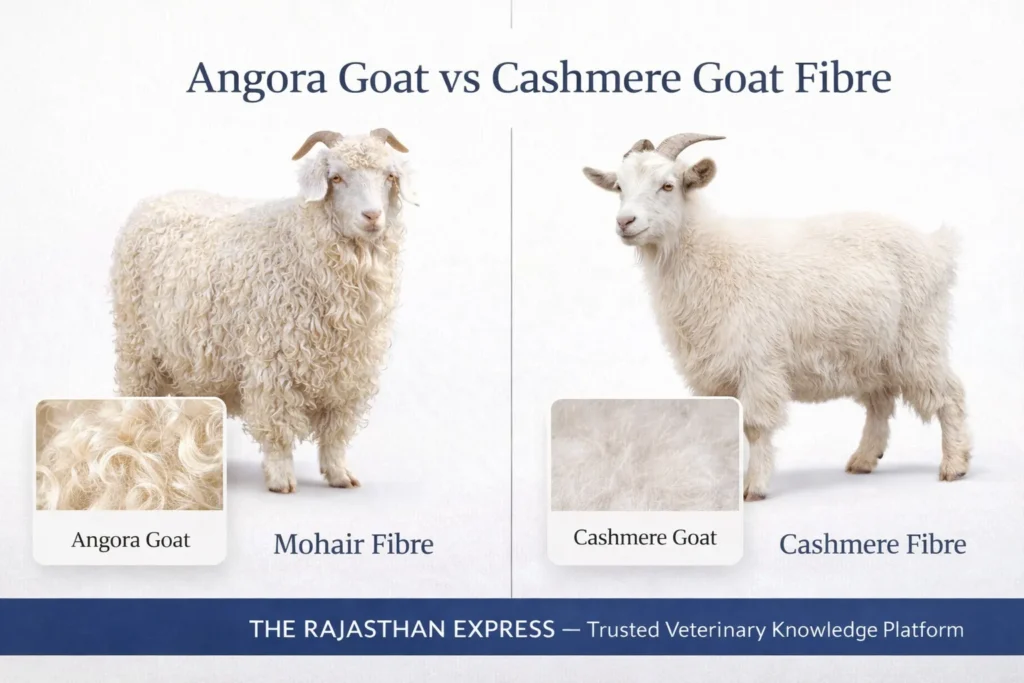
- Mohair is a long, lustrous, and slightly wavy fiber from which very fine fabrics are made. It is important to note that mohair comes from the Angora goat, whereas Angora wool is obtained only from the Angora rabbit. The two are often considered the same, but they are completely different sources.
- If the Angora goat is crossbred with the Kashmiri goat (also called Changthangi or Pashmina goat), a blended fiber called “Cashgora” is obtained. Its quality and utility are limited; it is neither as lustrous as mohair nor as soft as Kashmiri Hair.
Temperament Differences
There is also a major difference in the temperament of the two goats—
- Angora goats are calm, gentle, and easy to handle by nature.
- Whereas Kashmiri (Changthangi/Pashmina) goats and Spanish meat goats are generally more active, fast, and excitable in temperament.
Angora Goat is Found In: Global Population and Distribution
According to FAO, a total of 1,031,722 Angora goats are found across approximately 27 countries worldwide.
- In order to increase mohair demand in the European market, Angora goats were crossbred with local goats in Turkey to increase hair quantity. However, attention was not given to preserving the pure breed, due to which changes in size and health in the Angora region occurred because of crossbred animals.
Spread of the Angora Breed Worldwid
The Angora breed was sent to many countries around the world.
- Around 1554, Angora goats were first brought to Europe by Emperor Charles V.
- In 1765, the breed was taken to Spain and about twenty years later to France, but mohair production there was not successful.
- On the other hand, Angora goats brought to South Africa in 1838 were extremely successful, and the mohair industry developed rapidly there.
Global Mohair Production Report 2021
According to the Global Mohair Production 2021 Report:
- First — South Africa
- Second — Lesotho
- Third — Turkey
In South Africa, Angora goats are mainly raised in the Eastern Cape province and the Karoo region. Here this breed plays an important role in the country’s economy. South Africa produces more than 60% of the world’s mohair and sends approximately 4 million kilograms of mohair to the market every year. More than 72% of the total Angora goats in the country are found in the eastern region, so the highest mohair production also takes place there.
However, between 2003 and 2015, a decline was recorded in the number of Angora goats and mohair production in South Africa. The main reasons were—
- Increasing cost of feed
- Lack of local markets
- Lack of government financial support
- Weak market-related infrastructure
But in the past few years, global demand for mohair has increased, resulting in approximately 25% growth in the number of goats and mohair production in South Africa.
🐐 Angora Goat (Ankara Goat) – Complete Breed Profile
| Breed Name | Angora Goat (Also called Ankara Goat, Mohair Goat) |
|---|---|
| Scientific Name | Capra hircus aegagrus angorensis |
| Origin | Ankara Province, Central Anatolia, Turkey (historically called “Angora” before 1930) One of the oldest fiber-producing goat breeds in the world, believed to exist since around 2400 BCE. |
| Primary Purpose | ✔ Premium Mohair Production (Main Purpose) ✔ Meat (Secondary) ✔ Limited Milk Production ✔ Skin/Leather |
| Global Status | Found in ~27 countries worldwide. Estimated Global Population: ~1,031,722 (FAO / DAD-IS data). Largest Mohair Producer: South Africa (50–60% of world production) |
| Other Names | • Ankara Keçisi (Turkish) • Tiftik Keçisi (“Mohair Goat” in Turkish) • Mohair Goat |
| Breed Type | Hair Goat (Not wool sheep) – Produces Mohair |
| Important Clarification | Mohair comes from the Angora Goat. Angora Wool comes from the Angora Rabbit. These are completely different animals. |
| Historical Importance | • Mentioned by European traveler Pierre Belon (1555). • Exported to Europe in 1554 (Emperor Charles V). • Brought to South Africa in 1838 (Highly successful). • Introduced to USA in 1849 (Texas became major center). • Historically used for military clothing and trade fiber. |
| Physical Appearance |
Color: Predominantly white (rare: cream, yellow, grey, brown, black). Body Type: Small, thin, well-shaped; sheep-like appearance. Height at Withers: • Male: ~66 cm • Female: ~51 cm Weight: • Adult Male (Buck): 45–50 kg • Adult Female (Doe): 32–35 kg Horns: • Both sexes horned. • Males: Long, spiral, screw-shaped. • Females: Shorter, thinner, slightly curved backward. Ears: Medium-large, slightly drooping. Body Covering: Entire body (except face and legs) covered with long, lustrous, curly mohair. |
| Mohair Fiber Characteristics |
Fiber Type: Hair (Mohair) Average Fiber Diameter: ~35 microns Fleece Weight: 0.8 – 6 kg (Average ~2.0 kg per shearing) Shearing Frequency: Twice per year Annual Mohair Production per Goat: ~5 kg Staple Length: 12–15 cm Special Qualities: ✔ High natural luster (shiny appearance) ✔ Strong and durable fiber ✔ Excellent dye absorption ✔ Flame resistant ✔ Static resistant ✔ Moisture absorbent ✔ Hypoallergenic compared to wool ✔ Does not felt easily like sheep wool |
| Types of Mohair Based on Lock Structure | C-Type (Ringlets): Tight spiral ringlets, highest market value. B-Type (Flat Locks): Wavy flat locks, slightly lower value. |
| Reproductive Characteristics |
Kidding Rate: 60–70% under large herd conditions Improved Management: 100–110 kids per 100 does possible Litter Size: Usually single kid (twins 5–24%) Birth Weight: ~2.5–2.7 kg Age at First Kidding: 21–25 months Parturition Interval: 300–400 days Productive Life: ~6 years Strong maternal instinct – often nurses other kids. |
| Milk Production |
Not a dairy breed. Daily Milk Yield: ~0.5 kg/day Lactation Length: ~162–199 days Total Lactation Yield: 80–90 kg (average 88 kg) Average Lactations: 4 |
| Meat Production | Secondary purpose only. Carcass Weight: ~9 kg Dressing Percentage: ~40% |
| Nutritional Requirements |
Dry Matter Intake: 3–4% of body weight Crude Protein Requirement: 14–16% (18% increases mohair growth by ~33%) Essential Minerals: Calcium, Phosphorus, Copper, Sulfur, Molybdenum Low protein → coarse, weak mohair. |
| Adaptability |
✔ Thrives in dry, cold, windy climates ✔ Excellent in semi-arid & rocky grazing lands ✘ Performs poorly in humid, rainy climates ✘ Sensitive to cold after shearing |
| Kidding Management Systems |
1. Open-Range System: Used in large herds; minimal intervention. 2. Intensive System: Small pens, heat lamps, higher survival rate. Post-birth care includes iodine treatment of navel and warming weak kids. |
| Major Mohair Producing Countries |
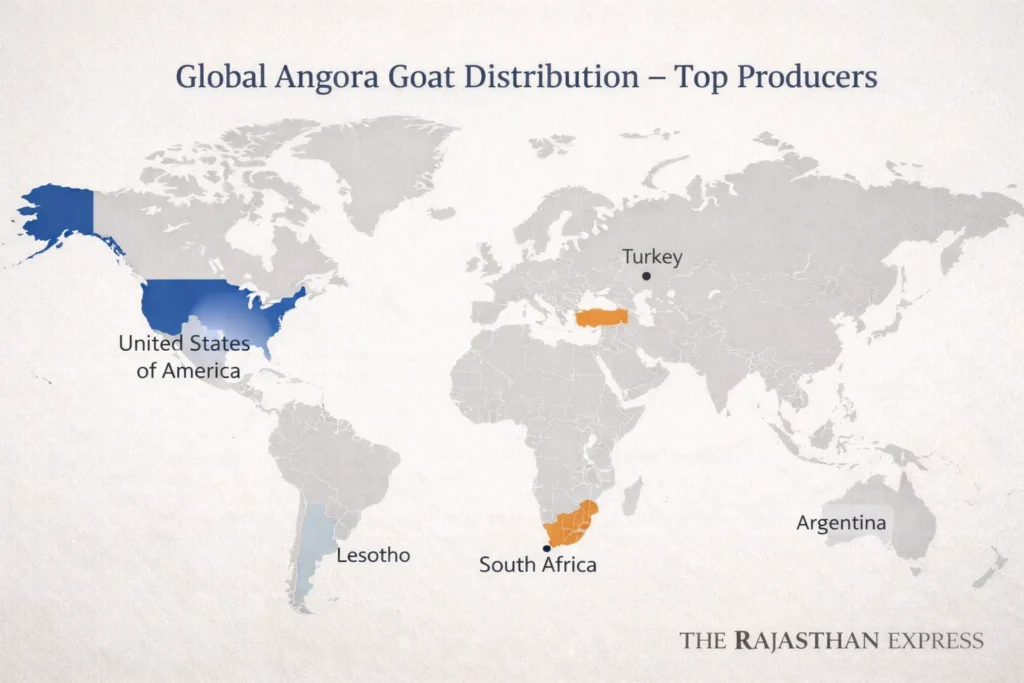
1️⃣ South Africa – 50–60% global share 2️⃣ Lesotho 3️⃣ Turkey 4️⃣ United States (Texas major center) 5️⃣ Argentina 6️⃣ Australia & New Zealand (smaller share) |
| United States Data (2024) |
Total Goats: ~102,000 Mohair Production: 500,000 lbs (~226,800 kg) Average Price: $6.48 per pound (~$14.28/kg) Texas: 63,000 goats $8.90 per pound average price |
| South Africa Mohair Industry |
• Produces 2–4 million kg annually. • ~60% of global mohair. • ~800 farmers involved. • ~30,000 people depend on industry. • Major region: Eastern Cape & Karoo. |
| Population Trend in Turkey |
1960: ~6 million 1975: ~3.5 million 1993: ~900,000 2023: ~183,000–203,000 (increasing trend) Decline Causes: • Grazing restrictions • Mohair price fluctuation • Market instability |
| Major Advantages |
✔ Produces luxury natural fiber ✔ High market value fiber ✔ Long, lustrous, strong mohair ✔ Adapted to harsh dry climates |
| Major Disadvantages |
✘ Low fertility compared to other goats ✘ Kids highly sensitive to cold ✘ Vulnerable to parasites ✘ Cannot tolerate rain after shearing |
| Conservation Status |
• Not globally endangered. • At Risk in some European countries. • Stable or increasing in South Africa and Turkey. • Slight decline reported in USA (2024–2025). |
| Commercial Importance |
Mohair is classified as a luxury natural fiber used in:
• High-end fashion garments • Sweaters, shawls, scarves • Blankets and upholstery • Plush fabrics and carpets • Industrial textiles |
| Key Identity | World’s premier mohair-producing goat breed. Cultural symbol of Ankara (Turkey). Backbone of global mohair textile industry. |
Angora Goat Origin and Distribution
The origin of the Angora goat is believed to be in ancient times in the Angora region of Asia Minor. Today this area is known as Ankara, the capital of Turkey, and the Central Anatolia region. Anatolia, also called Asia Minor, is a large peninsula in Western Asia that covers a major part of Turkey.
- The Angora goat has been famous since ancient times for its very fine, lustrous, and soft fiber—Mohair. European travelers began mentioning it from the 1500s. For example, traveler Pierre Belon described white, fine, and lustrous fiber Angora goats in 1555.
The name of this breed is also derived from the old city “Angora,” which is now called Ankara. Its history is so ancient that it is believed its fiber was used even in biblical times, during the era of Moses (1571–1451 BCE).
The Angora goat is a native and very old breed of Turkey. It is included among the oldest Hair-producing goats in the world. Historical evidence indicates that this breed has existed since around 2400 BCE, that is, for about 4,400 years. This shows that people have been raising these goats for valuable mohair Hair since very early times.
This breed was fully developed in Turkey itself. It was not brought and settled from outside, but evolved over time according to the local climate and natural conditions. The official herdbook (genealogical register) of this breed was prepared in 1995 to systematically record breed conservation, improvement, and selective breeding processes.
Main Regions Where Angora Goat Is Found in Turkey
Angora goats are found more in the following regions of Turkey:
- Ankara province (former name: Angora) — this is its main and most important center
- Central Anatolia region
- Some parts of Southeastern Anatolia
- Certain areas of Eastern Anatolia
The climate of these areas—such as dry, cold, and windy weather—is considered completely suitable for Angora goats. In this environment, this breed has been flourishing for thousands of years.
The Angora goat is an important cultural and symbolic identity of Ankara province in Turkey. From time to time, competitions for the most beautiful kid (Angora goat baby), most beautiful female, and most beautiful male goat are organized among goat farmers. These competitions take the form of festivals for local people and keep the tradition of goat rearing alive.
The historical importance of the Angora goat is also very deep. In ancient times during wars, this breed was used to provide food for soldiers and mohair Hair for their clothing. Because of this breed, the old name of Turkey’s capital Ankara (Ankara) became famous as Angora. This clearly reflects the long history and cultural importance of this breed.
For many centuries, the Turkish Empire maintained a monopoly on Angora goats and their fiber and prevented their export abroad. Gradually the restriction was reduced and this breed reached other parts of the world. Around 1554, a pair of Angora goats was brought to the court of Emperor Charles V in Europe. After the removal of restrictions from Turkey, in 1838 they were first taken to South Africa, where the climate proved very suitable for them. Over time, South Africa became the world’s largest mohair-producing country.
In the United States, this breed began in 1849 when the Sultan of Turkey gifted seven female and two male goats to Dr. James B. Davis. Later, Texas became the main center of this breed and even today most of America’s mohair production comes from there. Similarly, they were taken to Australia in 1853 and later reached Argentina and New Zealand, where local mohair industries developed. They were also brought to Spain and France, but many attempts there were not successful.
In the 18th and 19th centuries, when their export from Turkey increased, local populations developed in countries such as South Africa, the United States, Argentina, Australia, and New Zealand. Due to different climates and local selection, distinct characteristics emerged in each region. In the Texas region of America, Angora rearing spread rapidly during the 19th and 20th centuries and remains an important industry there. Similarly, in South Africa this breed was established on a large scale and now leads in global production.
Mohair, obtained from the long and lustrous hair of the Angora goat, is considered a luxury natural fiber in the high-quality textile industry because of its shine, strength, and ability to hold color well. “Kid mohair,” obtained from young goats (Angora goat baby), is even finer and more valuable, and this commercial importance of the fiber has made Angora goat farming so popular.
Today, Angora goats are found in approximately 27 countries, but based on number and production, South Africa ranks first. It is followed by Lesotho, Argentina, Turkey, and the United States. Turkey, from where this breed originally emerged, also started a special conservation program for it in 2003.
Angora Goat Breeding Tracts, Characteristics, and Mohair Production
Angora goat farming is mainly done for the production of high-quality Hair called Mohair. Its main breeding tracts are those where the climate and grazing conditions are most suitable for it.
1. Angora Goat Origin: Turkey — The Native Home 🇹🇷
Turkey is considered the original home of the Angora goat. The Central Anatolia region, especially Ankara, has been the main center of this breed for centuries.
- The breed’s name is also derived from the old name of Ankara, “Angora.” The cold and dry climate of this region and the tradition of local craftsmanship kept it as the primary breeding tract for a long time.
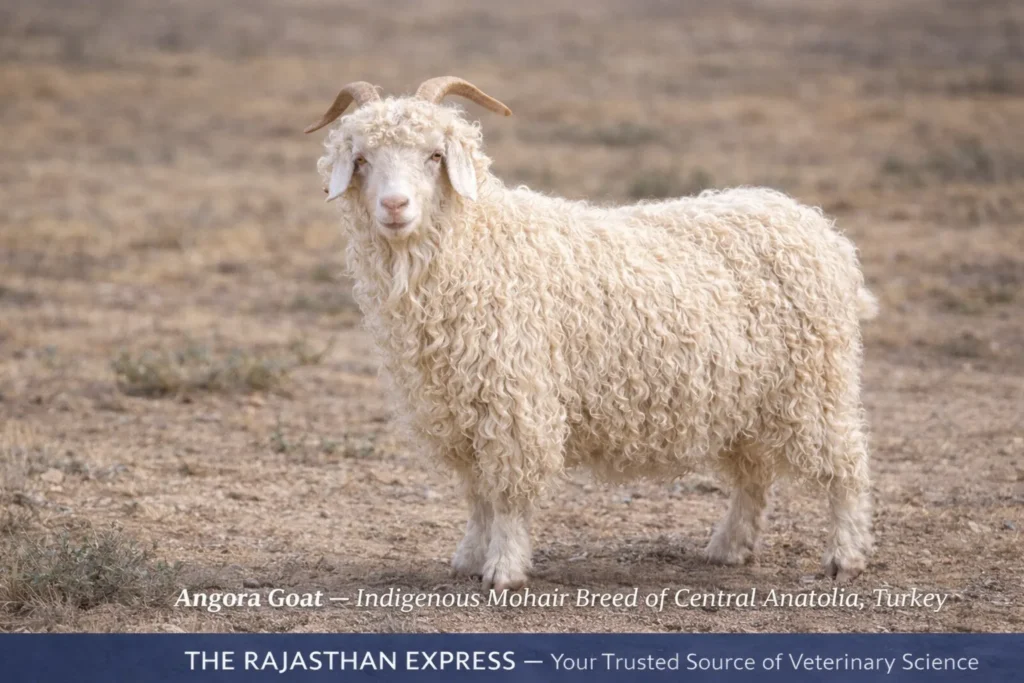
Although its population declined after the 20th century, Turkey is still regarded as the historical and cultural center of the Angora goat origin.
2. South Africa: Largest Global Mohair Producer 🇿🇦
- South Africa ranks first as the largest center of mohair production in the world. The Karoo region, including the Eastern and Western Cape, is highly suitable for Angora goat farming.
- The hot and dry summers and cold winters of the Karoo are considered excellent for this breed. In South Africa, farmers and industries have collectively developed mohair production in a highly organized manner, due to which it leads globally today.
Mohair production in South Africa is very important for the rural economy, especially in the Eastern Cape province, which is considered the largest center of the mohair industry in the world. Around 800 farmers—small-scale, communal, or large commercial—are involved in mohair production. Including these farmers and associated workers, approximately 30,000 people directly or indirectly earn their livelihood from mohair production, its processing, and export.
Several initiatives are being implemented to increase rural farmers’ income and connect them with this industry. One major initiative is the Mohair Empowerment Trust (MET). This trust works together with government institutions to assist new and emerging farmers. With the help of the trust, farmers receive support to improve farm infrastructure, purchase Angora goats, and acquire shearing equipment. This increases productivity and makes market access easier. In this way, previously disadvantaged communities are now entering commercial farming and establishing stable income sources.
- Similarly, in 2023, the Eastern Cape Development Corporation (ECDC) provided more than 1 million rand in financial assistance to support emerging mohair farmers. This assistance helped farmers take better care of their animals, adopt new techniques, and produce high-quality mohair. As a result, both the price and demand for their mohair increased.
3. United States (U.S.): Contribution of Texas 🇺🇸
The United States also holds an important position in Angora goat farming, especially the state of Texas, which is its main center.
The Edwards Plateau, Hill Country, and southwestern regions of Texas are considered suitable for Angora goats due to their dry, rocky land and extensive grazing areas.
These goats easily thrive even in the harsh conditions of this region, which is why a large portion of America’s commercial mohair production comes from Texas.
The U.S. government operates a direct payment scheme to support mohair producers so that the industry continues and farmers remain economically strong.
This payment is provided through the USDA’s Agricultural Stabilization and Conservation Service (ASCS). The amount of payment is determined by the difference between two factors—
- National average market price
- Government-determined “Support Price”
In a recent year, farmers received approximately $2.475 in additional payment for every $1 worth of mohair sold. This means the government provided substantial assistance to keep the mohair industry active.
4. Argentina: Marginal Pastures 🇦🇷
- Argentina also contributes to global mohair supply. The northern part of Patagonia is considered suitable for Angora goats. The marginal pastures and local climate of this region have proven supportive for raising these goats.
5. Lesotho: Traditional and Notable Contribution 🇱🇸
Similarly, the small African country of Lesotho is known for Angora goat farming. The mountainous regions and traditional rearing methods help this breed thrive, and Lesotho’s contribution to global mohair production is significant.
According to the Global Mohair Production 2021 report, South Africa ranked first and Lesotho ranked second in mohair production.
Other Regions Where Angora Goat Is Found
- In addition, Angora goats are also raised in countries such as Australia and New Zealand. Modern breeding programs operate in these countries, but their share in the global market is smaller compared to South Africa, the United States, or Turkey.
- Angora goats are also found in some Central Asian countries, but their contribution to international trade is very limited.
Other Names of Angora Goat
- The scientific name of the Angora goat is Capra hircus aegagrus angorensis. Its place of origin is considered to be the Ankara region of Turkey, which was called Angora before 1930. For this reason, in Turkey the Angora goat is also called the Ankara goat.
- The Angora goat is famous worldwide for its magnificent, soft, and lustrous Angora goat Hair (mohair). In different languages and regions, it is known by several names.
In Turkish Language:
Ankara Keçisi
- This is the original and traditional name of the breed. It is associated with the capital of Turkey, Ankara (former name—Angora), where this breed is believed to have originated.
Tiftik Keçisi
- Here the word “Tiftik” means mohair Hair. Therefore, this name is based on the goat’s Hair production.
In English Language:
Mohair Goat
- This name is directly based on the valuable fiber mohair, for which this goat is famous.
Angora Goat
- This name is derived from its original region Angora (present-day Ankara, Turkey).
Angora Goat Characteristics and Physical Appearance
Head Shape
- The side view of the female’s head appears slightly concave or straight.
- The male’s head appears convex.
Colour
- The most common color of the Angora goat is white. Its skin color is also white.
- However, sometimes cream, yellow, slate-gray, brown, or black Angora goats may also be seen.
Horns
Both male and female Angora goats have two horns.
- The male goat’s horns are long, strong, and screw-shaped (spiral). They appear slightly curved backward.
- The female goat’s horns are shorter, thinner, and grow slightly backward.
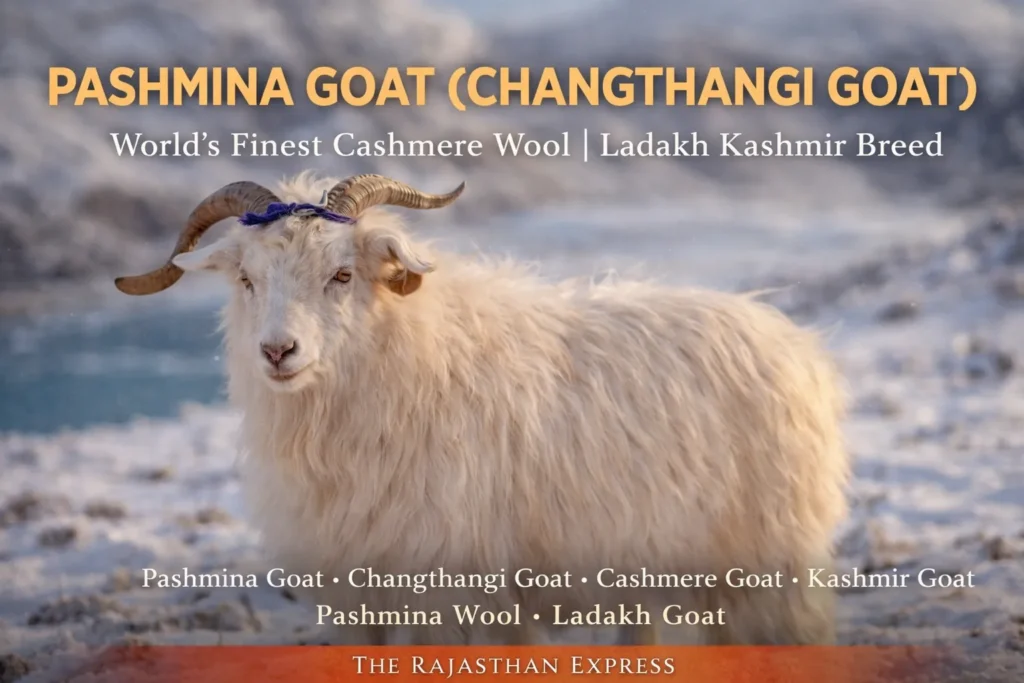
Screw-shaped spiral horns are also found in the Changthangi goat (also called Kashmiri or Pashmina goat).
The Changthangi goat is found in Ladakh and is famous worldwide for its very fine and expensive Pashmina Hair. Shawls and sweaters made from Pashmina sell for lakhs of rupees.
Read More About : Cashmere Goat Characteristics
Ears
- The ears of the Angora goat are relatively large and slightly drooping.
Body Size and Angora Goat Physical Characteristics
- The body of the Angora goat is small, thin, and well-shaped.
- There is considerable variation in size, but adult male goats usually weigh between 45 to 50 kilograms and reach their maximum weight only after five years of age.
- Adult female goats weigh in the range of 32 to 35 kilograms.
- The Angora goat is also known as the sheep-like goat.
- The body shape of these goats resembles that of sheep, although their meat characteristics are less developed compared to sheep.
Hindquarters
- The hind part of the Angora goat is slightly higher than the shoulders.
Legs
- The hind legs are slightly longer than the front legs.
Mohair (Hair)
- Except for the face and legs, the entire body of the Angora breed is covered with white, fine, soft, lustrous, and curly mohair.
- Angora goat mohair production per year averages around 5 kilograms per goat.
Unique Resistance Capacity
- The Angora goat can easily tolerate sudden changes in feed.
- This breed is highly adaptable to dry climates and harsh environmental conditions.
- Its adaptability decreases in highly humid and rainy regions.
Reproductive Characteristics
- The average kidding rate is found to be approximately 85%.
- The rate of twin births has been recorded between 5% and 24%.
- This breed grows relatively slowly.
- Many times, goats have been observed caring for the kids of other goats during kidding. They have a very strong maternal instinct.
Angora Goat Physical Characteristics, Milk Yield, and Mohair Production
Angora Goat Physical Characteristics (Morphology)
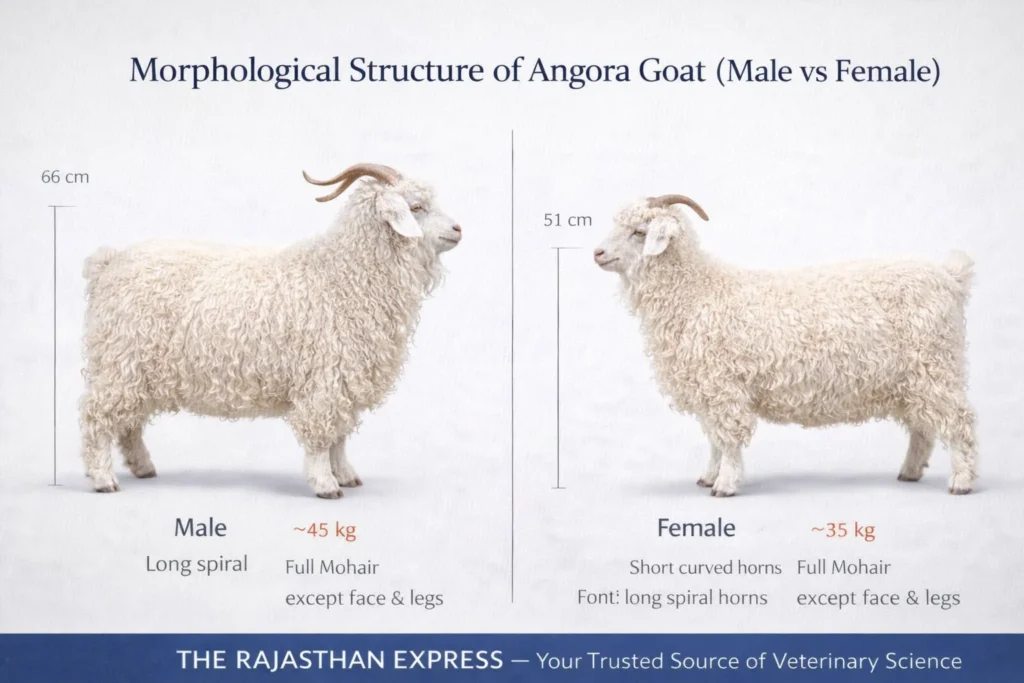
Body Measurements of Male and Female
Height at Withers
- Male: Approximately 66 cm
- Female: Approximately 51 cm
Weight
- Adult Male: Approximately 45 kg
- Adult Female: Approximately 35 kg
These measurements define the standard Angora goat physical appearance and overall body structure of the breed.
Angora Goat Performance Records
| Angora Goat Performance Records | ||||||
| Performance Parameter | Males (Bucks) | Females (Does) | ||||
|---|---|---|---|---|---|---|
| MIN | AVG | MAX | MIN | AVG | MAX | |
| Parturition interval (day) | – | – | – | 300 | 365 | 400 |
| Age at first parturition (month) | – | – | – | 21 | 23 | 25 |
| Age of breeding animals (avg, month) | – | 36 | – | – | 48 | – |
| Birth weight (kg) | – | 2.7 | – | – | 2.5 | – |
| Age of maturity (avg, month) | – | 18 | – | – | 20 | – |
| Daily gain (avg, g) | 110 | – | – | – | – | – |
| Length of productive life (years) | 6 | – | – | – | – | – |
| Carcass weight (kg) | 9 | – | – | – | – | – |
| Dressing percentage (%) | 40 | – | – | – | – | – |
| The Rajasthan Express : Angora Goat Performance Data | ||||||
These data reflect the productive efficiency and Angora goat meat potential, although the breed is primarily reared for mohair.
Angora Goat Milk Production
The Angora goat is not considered a dairy breed, as it is mainly reared for mohair production. However, it does produce a small quantity of milk.
- One Angora goat gives approximately 0.5 kg (half a kilogram) of milk per day.
- During the entire lactation period, it can produce approximately 80 to 90 kg of milk.
- One lactation period in Angora goats lasts about 180 days (approximately 6 months).
Milk Production and Prolificacy Data
| Milk Production and Prolificacy Data | |||
| Parameter | MIN | AVG | MAX |
|---|---|---|---|
| A. Milk Information | |||
| Milk per year (kg) | – | – | – |
| Lactation length (day) | 162 | 179 | 199 |
| Milk yield per lactation (kg) | 51 | 88 | 135 |
| Milk fat (%) | – | – | – |
| Milk protein (%) | – | – | – |
| Milk per day (kg) | – | 0.49 | – |
| Number of lactations | – | 4 | – |
| B. Prolificacy | |||
| Litter (kids) | 1 | 1.13 | 1.24 |
| The Rajasthan Express : Milk Production & Prolificacy Data | |||
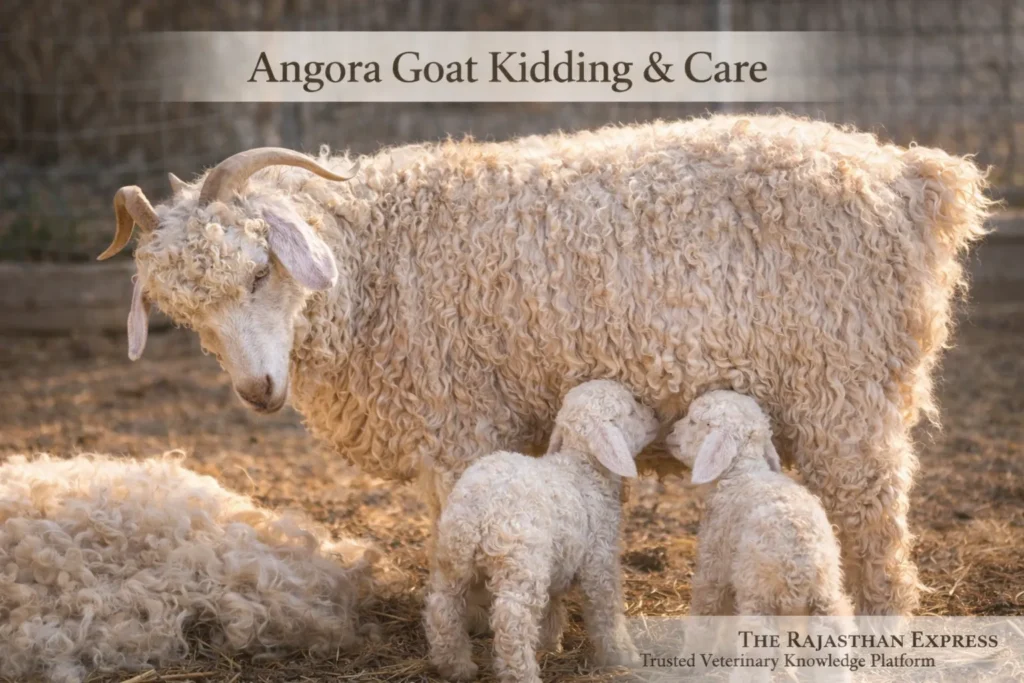
In simple words:
- Most goats give birth to a single kid (Angora goat baby).
- Some goats give twins.
- That is why the average comes slightly above 1 (1.13–1.24).
Angora Goat Mohair Production One Year
The greatest specialty of the Angora goat is its mohair hair. Mohair is an extremely important raw material in the textile industry due to its strength, flexibility, fine structure, moisture absorption capacity, and ability to hold dye well. It is used to make sweaters, blankets, and other woolen products, as well as in pelts.
In America, an average Angora goat produces approximately 2.5 kilograms of mohair in one shearing, and shearing is done twice a year. In this way, one goat produces approximately 5 kilograms of mohair per year. The fiber length obtained ranges from 12–15 centimeters. Compared to wool, the price of mohair fluctuates more in the market, but under normal conditions, it receives good prices.
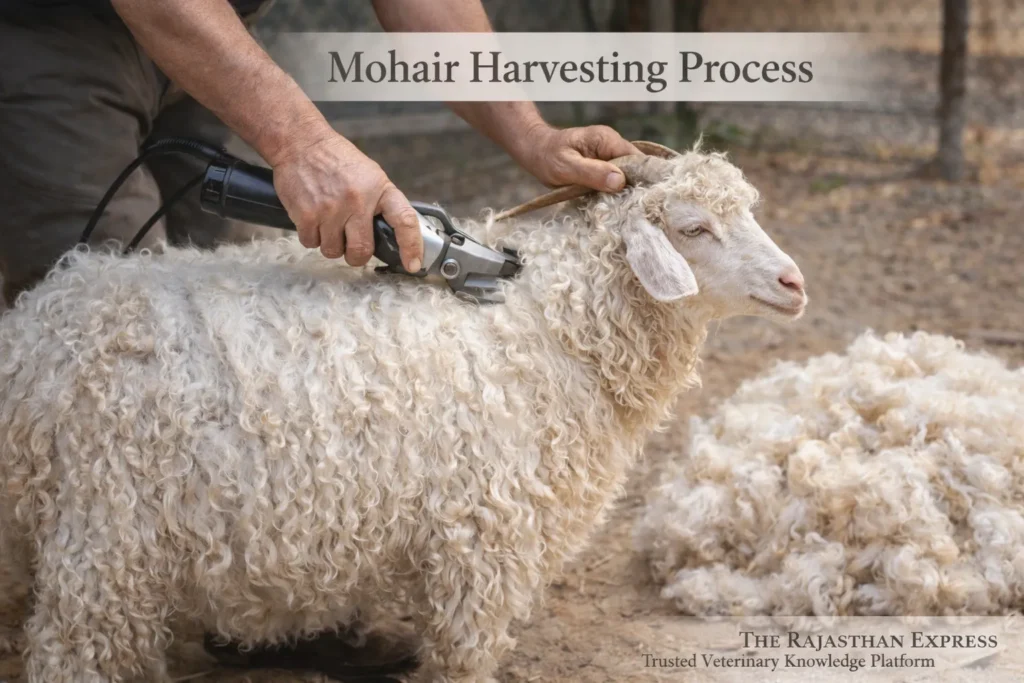
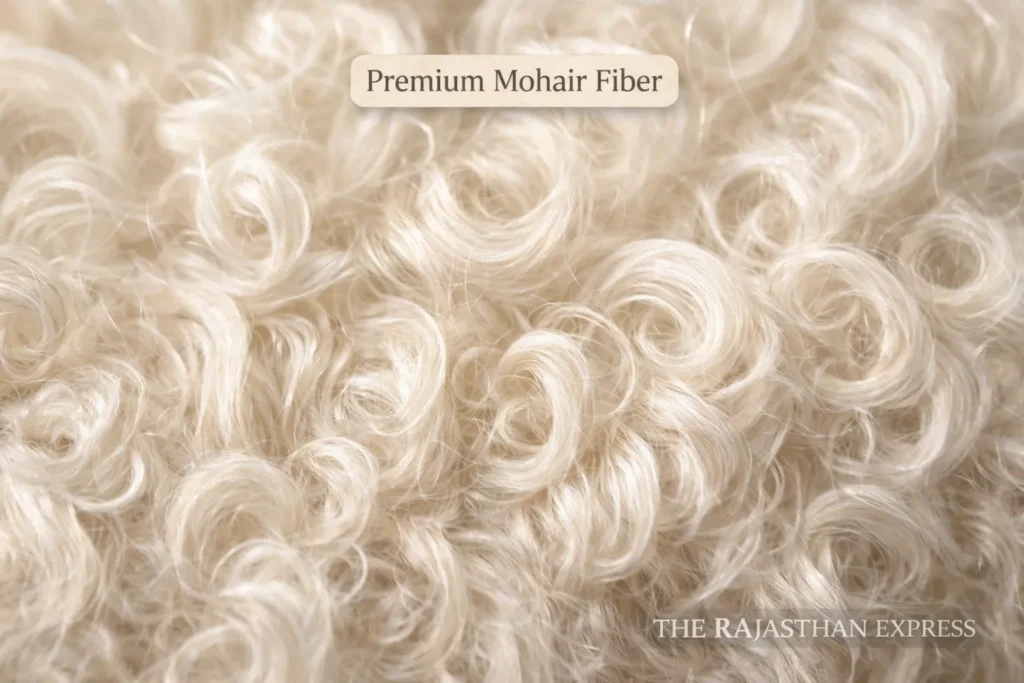
The quality of mohair largely depends on the age of the goat. As the goat grows older, its hair becomes thicker and less shiny, so the quality of mohair decreases. Goats aged one to two years produce less quantity but higher-quality mohair. Goats aged three to five years produce more mohair, but its quality becomes slightly lower. Male goats produce more mohair compared to females.
The quantity and quality of mohair depend on breed, care, and especially feeding management. To obtain high-quality Angora goat wool, balanced nutrition and proper management are essential.
Nutritional Requirements for Quality Mohair
The nutritional needs of Angora goats vary according to age and body condition. For good growth and superior mohair production, the feed should contain about 14–16% crude protein. If protein is low in the diet, mohair becomes coarse and easily breakable. Similarly, low energy intake restricts growth and reduces fiber quality.
Minerals such as calcium and phosphorus are very essential. In addition, copper, sulfur, molybdenum, and clean water intake directly affect mohair quality. Sheep and goat wool contains approximately 4% sulfur, mainly present in the amino acid cysteine. Deficiency of these nutrients leads to bone problems and reproductive issues in goats. Therefore, balanced feeding is necessary for both goat health and mohair quality.
Nutrition has the greatest impact. Angora goats require approximately 3–4% of their body weight as dry matter (DM) feed. For comparison:
- Meat goats require 3–5% DM.
- Dairy goats require 4–6% DM.
In one study, when Angora goats were given a diet containing 18% crude protein, their mohair growth was approximately 33% higher compared to goats fed 12–15% crude protein, even though both groups consumed nearly equal feed.
Types of Modern Angora Goats Based on Hair Growth
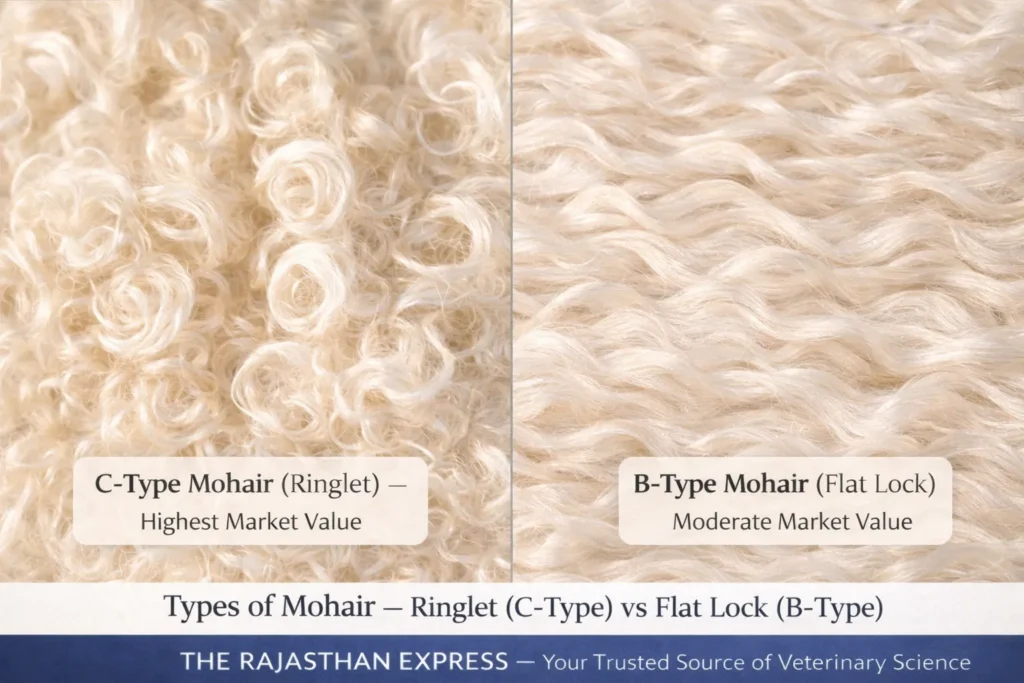
Modern Angora goats are divided into two types based on hair growth pattern:
- Ringlets
- Flat Locks
C-Type Goat (Ringlet Type)
- In these goats, the mohair remains tightly formed in ringlets throughout its full length. It is considered extremely high-quality mohair and commands a higher value.
B-Type Goat (Flat Lock Type)
- In these goats, the hair appears in flat locks. This mohair usually looks wavy and heavier. Its value is slightly lower compared to C-Type.
Angora Goat Fibre Information
| Angora Goat Fibre Information | ||||
| Parameter | MIN | AVG | MAX | Unit |
|---|---|---|---|---|
| Fleece weight | 0.8 | 2.01 | 6 | kg |
| Fibre Diameter | – | 35 | – | μm |
| Wool or Hair Type | – | Hair | – | – |
| Wool Type / Breed | – | Mohair / Angora | – | – |
| The Rajasthan Express : Angora Goat Fibre Data | ||||
Characteristics of Angora Goat Hair (Mohair)
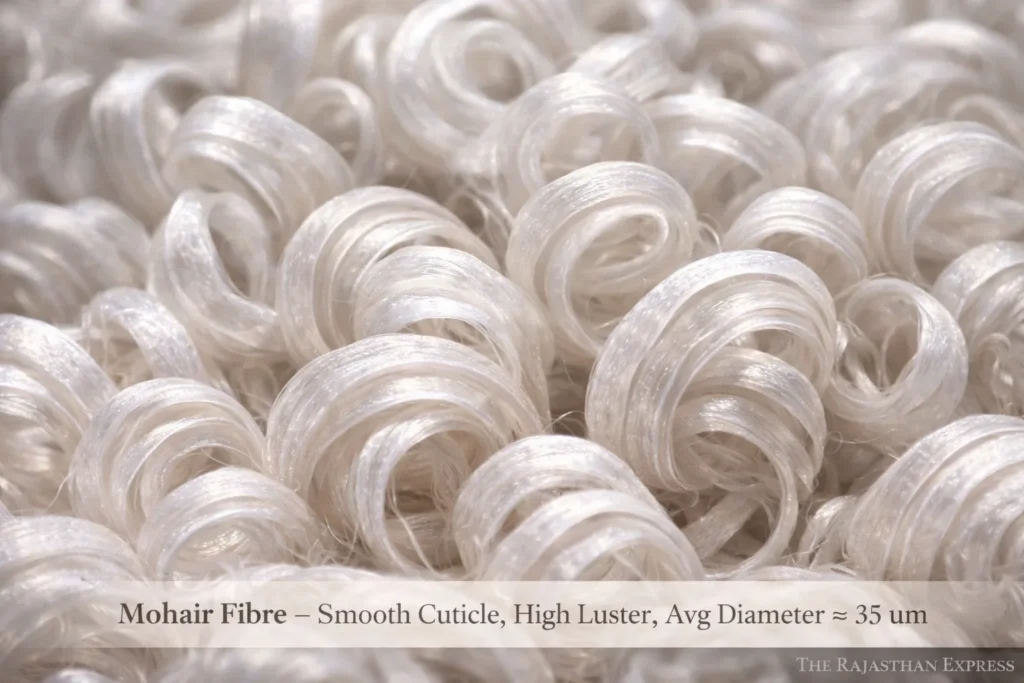
Mohair appears similar to wool, but in many respects, it is considered superior to wool. Its surface is very smooth, soft, and silky. Mohair is a shiny, white, extremely soft, and breathable natural fiber.
It has moisture-absorbing capacity and is strong, flexible, durable, and wrinkle-resistant. This fiber is flame-resistant, static-resistant, and does not allow bacteria to grow. For this reason, it is considered a better option for people with allergies compared to wool or cotton.
Mohair does not tangle easily like wool, and its thickness is approximately equal to coarse wool. Its shine is natural, and it absorbs dye very easily.
Because of all these qualities, mohair is widely used in the textile industry to manufacture clothing, sweaters, socks, curtains, scarves, mattresses, plush fabrics, and other strong and durable products.
Angora Goat Kidding Methods, Mohair Production, and U.S. Price Report (2024)
Angora goat farming is mainly carried out for Angora goat wool (mohair) production, but proper kidding management is equally important for herd growth and sustainability.
Two Main Kidding Methods in Angora Goats
In Angora goats, two types of management systems are adopted for kidding. The method used depends on herd size, labor availability, and management facilities.
1. Open-Range Kidding
This method is adopted for large herds where labor and handling facilities are limited.
Main Features:
- Goats are kept in small paddocks to reduce the chances of losing kids (Angora goat baby).
- Water, feeding areas, and dry bedding arrangements are made in the center of the pasture.
- After birth, the mother and newborn should not be disturbed for several weeks.
- If the mother is disturbed, she may abandon her kid.
- This means the mothering instinct may weaken, putting the kid’s life at risk.
2. Intensive Kidding System
This method is better for small herds or farmers who want safe and organized kidding management.
An intensive housing system is also adopted in poultry, for example: deep litter housing system and cage system, because these housing systems prevent egg loss problems.
This system includes:
- Special buildings
- Small separate pens
- Heat lamps
- Adequate feeding space
This method is expensive, but:
✔ Kid survival rate is higher
✔ Management remains easier
Before kidding, if goats are kept outside except during cold or wet weather and at night, bedding remains clean and dry, and goats also receive adequate exercise.
Post-Kidding Care in Angora Goats
Immediately after birth:
- Move the mother and kid to a separate pen.
- Clean the kid’s navel with 7% Tincture of Iodine or Povidone-Iodine / Chlorhexidine.
- Administer C & D Antitoxin injection to the kid.
- If the kid is cold, it will not be able to drink milk, so warm it under a heat lamp.
- Angora kids catch cold very quickly, and excessive cold can even cause death.
Grouping of Kids
After identifying the mother and kid with paint or ear tags, and ensuring that the mother is properly feeding the kid, they can be moved to a larger group pen.
Do not keep them with kids born as singles.
Reason: Single-born kids are generally stronger and may steal milk from weaker or smaller twin kids.
Kids should be grouped according to age so that management becomes easier and proper growth is ensured.
Most Productive Countries in Mohair Production
South Africa is the largest producer of mohair in the world and alone accounts for approximately 60% of global production. The Karoo region, due to its dry and suitable climate, is considered highly appropriate for Angora goats. Because of this, South Africa has established a distinct identity in producing high-quality mohair. This industry provides employment to thousands of farmers and workers and strengthens the rural economy.
However, there is a major issue—insufficient nutrition. If Angora goats do not receive adequate protein, energy, vitamins, and minerals, both the quantity and quality of mohair decrease. Therefore, a balanced and nutritious diet is extremely important.
To sustain its mohair industry long-term, South Africa is emphasizing sustainable farming practices. Several measures are being taken, such as:
- Improving pasture resilience
- Researching drought-tolerant fodder crops
- Providing training and support to small farmers
- Exploring new uses for mohair beyond traditional markets
Mohair Price in the United States (USDA 2024 Report)
According to a 2024 USDA report, the average price of mohair in the United States (obtained from Angora goat hair) was recorded at $6.48 per pound.
To convert this into kilograms, it should be noted that 1 kilogram equals approximately 2.20462 pounds. Therefore:
- 6.48 × 2.20462 ≈ $14.28 per kilogram
This means that although the price appears lower per pound, when converted to kilograms it becomes more than double because one kilogram represents more weight.
The report also stated that in 2024, approximately 92,000 Angora goats in the United States produced a total of 500 thousand pounds of mohair, generating a total income of about $3,241 thousand.
Texas Data
Texas data differs from the national average.
- 56,000 Angora goats produced 325 thousand pounds of mohair.
- The average price was $8.90 per pound.
- Total sales were approximately $2,893 thousand.
Mohair Production, Price, and Value – United States (2023 & 2024)
| Mohair Production, Price, and Value – United States (2023 & 2024) | ||||||||||
| State | 2024 Goats Clipped | 2023 Goats Clipped | 2024 Avg Clip per Goat (lbs) | 2023 Avg Clip per Goat (lbs) | 2024 Production (1,000 lbs) | 2023 Production (1,000 lbs) | 2024 Price per Pound ($) | 2023 Price per Pound ($) | 2024 Value (1,000 $) | 2023 Value (1,000 $) |
|---|---|---|---|---|---|---|---|---|---|---|
| Arizona | 12,000 | 13,000 | 4.4 | 4 | 53 | 52 | 1 | 1.1 | $53 | $57 |
| New Mexico | 5,000 | 6,000 | 4.2 | 3.3 | 21 | 20 | 1.5 | 1.9 | $32 | $38 |
| Texas | 56,000 | 58,000 | 5.8 | 5.7 | 325 | 329 | 8.9 | 8.6 | $2,893 | $2,829 |
| Other States | 19,000 | 23,000 | 5.3 | 4.5 | 101 | 104 | 2.6 | 2.7 | $263 | $281 |
| United States | 92,000 | 100,000 | 5.4 | 5.1 | 500 | 505 | 6.48 | 6.35 | $3,241 | $3,205 |
| The Rajasthan Express : Source: USDA Report 2024 | ||||||||||
Source By : https://esmis.nal.usda.gov/sites/default/release-files/000000018/zk51xc07n/9593wq66x/shep0125.pdf?
Disadvantages of Angora Goat, Global Population & Mohair Production Data
Angora goat farming is mainly known for Angora goat wool (mohair) production, but along with its advantages, there are also certain limitations related to reproduction, health, and management.
Disadvantages of Angora Goat
Along with its qualities, the Angora goat also has some drawbacks. The biggest drawback is that it produces fewer kids compared to other goat breeds. The birth of twins is also very rare in this breed.
In large herds, it has been observed that out of 100 goats, only 60–70 goats give birth, meaning its reproduction rate is approximately 60–70%.
However, if small herds of pure Angora goats are well cared for and properly managed, this reproduction rate can improve. In such cases, from 100 goats, slightly more than 100 kids (such as 105 or 110) can be obtained in one year. This exceeds 100% because some goats give birth to twins.
The Angora goat is considered one of the most delicate goat breeds. Compared to sheep, it gets infected more quickly by internal and external parasites.
At birth, Angora goat babies are very delicate, and during the first few days in cold or damp weather, they require special care.
An adult goat remains fine when it has a full fleece, but after shearing, it cannot tolerate cold or wet rain. If a severe storm occurs during kidding or shearing time, heavy losses can occur in Angora goat herds.
These points directly relate to important Angora goat characteristics, including its sensitivity, lower fertility rate, and management requirements.
Angora Goat Population Worldwide
According to FAO, the Angora goat is found in approximately 27 countries around the world.
According to a breed-population survey conducted in 12 countries, a total of approximately 1,031,722 Angora goats were recorded.
This answers the common query: “Angora goat is found in which countries?” — It is distributed across multiple regions globally, though population density varies significantly by country.
Angora Goat Population in the United States (USDA/NASS 2024–2025)
According to official USDA/NASS (2024–2025) government data, approximately 102,000 Angora goats are present in the United States.
In 2024, a total of 500,000 pounds (approximately 226,800 kilograms) of mohair were produced in the U.S., reflecting the annual Angora goat mohair production one year statistics.
In Texas alone, during 2024–2025, approximately 63,000 Angora goats were counted.
All these figures are based on official USDA/NASS sources.
Global Mohair Production – Leading Countries
The highest mohair production in the world occurs in South Africa.
This country alone contributes approximately 50–56% of global mohair production (the percentage may vary slightly by year).
According to reports, approximately 23% of the global Angora goat population is found in South Africa.
Each year, South Africa produces between 2 to 4 million kilograms of mohair, depending on the reporting year.
After South Africa, Lesotho has a major contribution to mohair production. According to 2022 global statistics, Lesotho’s share was recorded at approximately 16%, although this percentage also fluctuates annually.
The primary Angora goat purpose worldwide remains mohair production, though secondary uses such as limited Angora goat milk and Angora goat meat exist in some regions.
Angora Goat Origin – Turkey
The Angora goat originated in Turkey. Historically, this breed has been a major natural resource for Turkey, but its population declined significantly during the 20th century.
The FAO DAD-IS database provides year-wise details regarding the status, conservation, and population of this breed in Turkey.
In Turkey:
- In 1960, the population was approximately 6 million.
- By 1975, it declined to 3.5 million.
- In 1981, it increased to 3.8 million.
- Within the next two years, it again decreased to approximately 3.1 million.
| Population Data of Angora Goat in Turkey | ||||||||||
| Year | Last Update | Population (Min / Max) | Trend | Based On | Males / Females | Females in Herdbooks | Females Bred Pure | AI Used | In Situ Conservation | Reliability |
|---|---|---|---|---|---|---|---|---|---|---|
| 1960 | 28/02/2006 | 6,000,000 / – | Unknown | – | – / – | – | – | – | Yes | Unknown |
| 1975 | 28/02/2006 | 3,500,000 / – | Unknown | – | – / – | – | – | – | Yes | Unknown |
| 1983 | 28/02/2006 | 3,100,000 / – | Unknown | – | – / – | – | – | – | Yes | Unknown |
| 1993 | 28/02/2006 | 900,000 / 900,000 | Decreasing | – | – / – | – | – | – | Yes | Unknown |
| 1998 | 01/03/2006 | – / – | – | – | 0 / 0 | 0 | 0 | No | – | – |
| 2003 | 28/02/2006 | 352,560 / 352,560 | Unknown | – | – / – | – | – | – | Yes | Unknown |
| 2010 | 27/04/2012 | 120,000 / 152,000 | Decreasing | – | 4,500 / 115,000 | 3,500 | 85 | No | Yes | Reliable |
| 2013 | 30/04/2014 | 126,000 / 166,000 | Stable | – | 8,278 / 77,362 | 24,000 | 1 | No | Yes | Reliable |
| 2023 | 11/01/2024 | 183,545 / 203,721 | Increasing | Census at species level | 43,778 / 159,943 | 143,199 | 143,199 | – | Yes | Reliable |
| The Rajasthan Express : Angora Goat Population Data (Turkey) | ||||||||||
Reasons for Decline and Instability of Angora Goat Population in Turkey
The main reasons for the decline and instability of Angora goat numbers in Turkey have been:
- Restrictions on grazing in shrub and bushland areas
- Decline and extreme fluctuation in mohair prices
Due to these reasons, the Angora goat population in Turkey has been continuously affected.
| Global Population & Risk Status of Angora Goat Breed | ||||||||
| Breed Name | Country | National Risk Status | Risk Trend | Population Min | Population Max | Breeding Female | Breeding Male | Female Bred Pure |
|---|---|---|---|---|---|---|---|---|
| Angora | Argentina | Not at Risk | Stable Trend | 450000 | 500000 | – | – | – |
| Angora | Brazil | Unknown | – | – | – | – | – | – |
| Angora | Botswana | Unknown | – | – | – | – | – | – |
| Angora | France | Unknown | – | – | – | 0 | 0 | 0 |
| Angora | United Kingdom | At Risk | Stable (No major increase or decrease) | 470 | 470 | 470 | – | – |
| Angora | Indonesia | Unknown | – | – | – | – | – | – |
| Angora | India | Unknown | – | – | – | – | – | – |
| Angora | Ireland | Unknown | – | – | – | – | – | – |
| Angora | Republic of Korea | Unknown | – | – | – | – | – | – |
| Angora | Madagascar | Unknown | – | – | – | – | – | – |
| Angora | Mali | Unknown | – | – | – | – | – | – |
| Angora | Solomon Islands | Unknown | – | – | – | – | – | – |
| Angora | Zimbabwe | Unknown | – | – | – | – | – | – |
| Angora Goat | Australia | Not at Risk | Population is Decreasing | 15000 | 18000 | 11730 | 680 | – |
| Angora Goat | Canada | At Risk | Population is Stable | 50 | 50 | – | – | – |
| Angora Goat | Kenya | Unknown | – | – | – | – | – | – |
| Angora Goat | Lesotho | Not at Risk | Population Increasing | 209100 | 209130 | – | – | – |
| Angora Goat | USA | Not at Risk | Population is Decreasing | 59000 | 59000 | – | – | – |
| Angora Goat | South Africa | Not at Risk | Population Increasing | 70000 | 85000 | 37688 | 32229 | 37688 |
| Angora Nanny | Tajikistan | Unknown | – | – | – | – | – | – |
| Angora goat | Azerbaijan | Unknown | – | – | – | – | – | – |
| Angorageit | Netherlands | At Risk | Stable Trend | 93 | 120 | 70 | 23 | – |
| Angoraziege | Germany | At Risk | Stable | 89 | 89 | 76 | 13 | – |
| Ankara | Türkiye | Not at Risk | Population Increasing | 183545 | 203721 | 159943 | 43778 | 143199 |
| Mohair | Denmark | At Risk | Population Stable | 199 | 199 | – | – | – |
| Moherova | Czechia | At Risk | Stable Trend | 40 | 80 | 7 | 8 | 100 |
| osy | Madagascar | Unknown | – | – | – | – | – | – |
| Total Population of Angora Goat: 1,031,722 Number of countries reporting population data – 12 |
||||||||
| Source: Domestic Animal Diversity Information System (DAD-IS) by FAO | FAO (2010) and Personal Observations | ||||||||
| National Angora Goat Population Trends: USDA Report Highlights 3% Decline to 102,000 Head | ||||
| Class | 2024 (head) | 2025 (head) | Decline (head) | Decline Percentage |
|---|---|---|---|---|
| Angora goats and kids | 105,000 | 102,000 | 3,000 | 2.86% |
| Angora, breeding goats | 90,000 | 87,000 | 3,000 | 3.33% |
| Replacement Kids – under one year | 14,000 | 13,000 | 1,000 | 7.14% |
| Does – one year old and older | 72,000 | 70,000 | 2,000 | 2.78% |
| Bucks – one year old and older | 4,000 | 4,000 | 0 | 0% |
| Angora, market goats and kids | 15,000 | 15,000 | 0 | 0% |
| Kid crop¹ | 60,000 | 58,000 | 2,000 | 3.33% |
| Angora Goats and Kids Inventory – States and United States | ||||
| State / Class | 2024 (head) | 2025 (head) | Change (head) | % Change (Decline / Increase) |
|---|---|---|---|---|
| Arizona | 14,000 | 13,000 | -1,000 | -7.14% (Decline) |
| New Mexico | 7,000 | 6,000 | -1,000 | -14.29% (Decline) |
| Texas | 60,000 | 63,000 | +3,000 | +5.00% (Increase) |
| Other States | 24,000 | 20,000 | -4,000 | -16.67% (Decline) |
| United States | 105,000 | 102,000 | -3,000 | -2.86% (Decline) |
| Source: USDA Report | ||||
Source By :
- https://esmis.nal.usda.gov/sites/default/release-files/000000018/zk51xc07n/9593wq66x/shep0125.pdf?
- https://www.mohair.co.za/mohair-blog/press-release-south-african-mohair-industry-update-april-2023?
- https://www.fao.org/4/ah224e/AH224E04.htm
Complete guide to Angora goat breed—world’s premium mohair producer from Turkey. Characteristics, origin in Ankara, physical traits (male 45 kg, female 35 kg), mohair yield (2.5 kg/shearing), fiber quality (35μ), and global distribution.
THE RAJASTHAN EXPRESS