 By
Cockapoo Types: F1 Cockapoo, F1B Cockapoo, F2 Cockapoo & F2B – The Rajasthan Express
The Cockapoo is a crossbreed (hybrid) dog. It is created by crossbreeding the Cocker Spaniel and Poodle. Since it is not a pure breed, different generations are seen in its breeding. Understanding these generations is important because it reveals who the puppy’s parents are, what the estimated share of Cocker Spaniel and Poodle is in it, and what can be expected regarding its coat, shedding, temperament, and health.
The percentages given in generation names, such as 50%‑50% or 75%‑25% , are only paper‑based ancestry, i.e., pedigree‑based expected ancestry. These are not an exact measure of every gene, every physical trait, or temperament of a puppy. Puppies born in the same litter can also receive different genes. Therefore, it is wrong to assume that an F1B puppy will 100% shed less or that an F1 puppy will always have a wavy coat. No generation guarantees any trait completely.
What Are Cockapoo Generations?
- F means Filial, i.e., offspring or generation.
- F1 means the first offspring of parents of two different pure breeds.
- F1B means crossing the F1 Cockapoo back with one of its original breeds – Cocker Spaniel or Poodle. This is called Backcross.
- F2 means crossing two F1 Cockapoos with each other.
- F3 or Multi‑generational means continuing to cross Cockapoos with Cockapoos for many generations.
1. F1 Cockapoo – What Is an F1 Cockapoo?
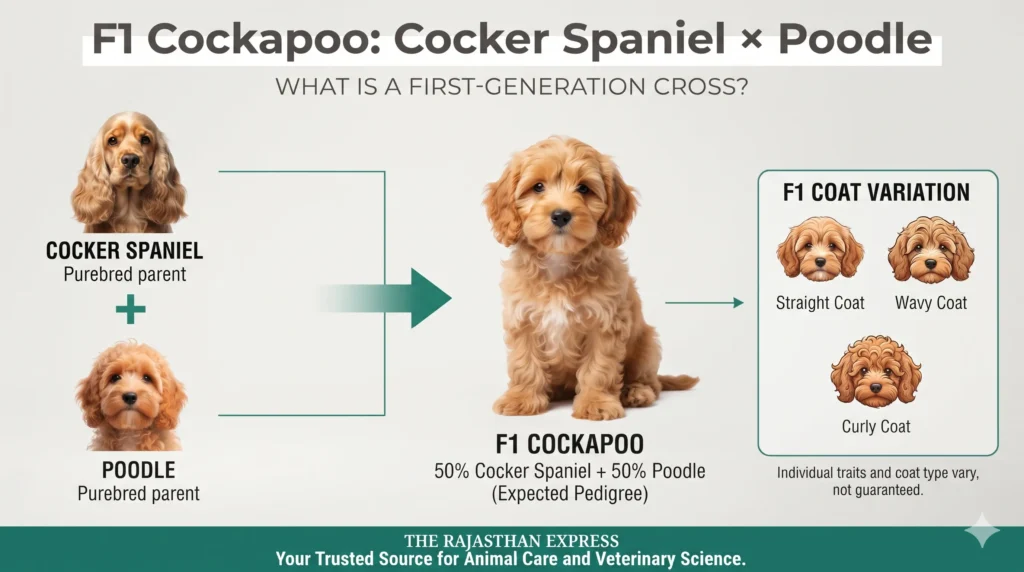
What is an F1 Cockapoo?
- An F1 Cockapoo is created when a pure Cocker Spaniel and a pure Poodle are directly crossbred. Its estimated ancestry is approximately 50% Cocker Spaniel and 50% Poodle.
- This is considered the most common and oldest cross. It shows a mixture of qualities from both parents. The coat can be straight, wavy, or slightly curly. Puppies with different coats can be found in the same litter. Shedding can generally be medium to low, but may be lower if a Poodle‑like curly coat is inherited. The temperament is affectionate, playful, and friendly. Some may show Cocker Spaniel‑like sensitivity and others Poodle‑like sharp intelligence.
- Advantage of F1:
- It can show a balanced mixture of both breeds and is generally considered to have good health potential.
- Drawback:
- It is difficult to predict the coat and shedding. Puppies in the same litter can look very different. It is not always the best option for people with allergies.
2. F1B Cockapoo – What Is an F1B Cockapoo?
What is an F1B Cockapoo?
- An F1B Cockapoo is created when an F1 Cockapoo is crossed back with one of its original breeds. This is called Backcross. There are two main types.
F1B Poodle Backcross
- In this, the F1 Cockapoo is crossed with the Poodle. The estimated ancestry is approximately 25% Cocker Spaniel and 75% Poodle.
- Advantage: The possibility of a more curly and low‑shedding coat increases. It is often considered a better option for people with allergies. It can receive more Poodle‑like sharp intelligence and training ability.
- Drawback: There is a higher risk of matting (tangles) in the curly coat. Regular brushing and professional grooming become very necessary. Some puppies may also have a more sensitive or irritable Poodle‑like temperament.
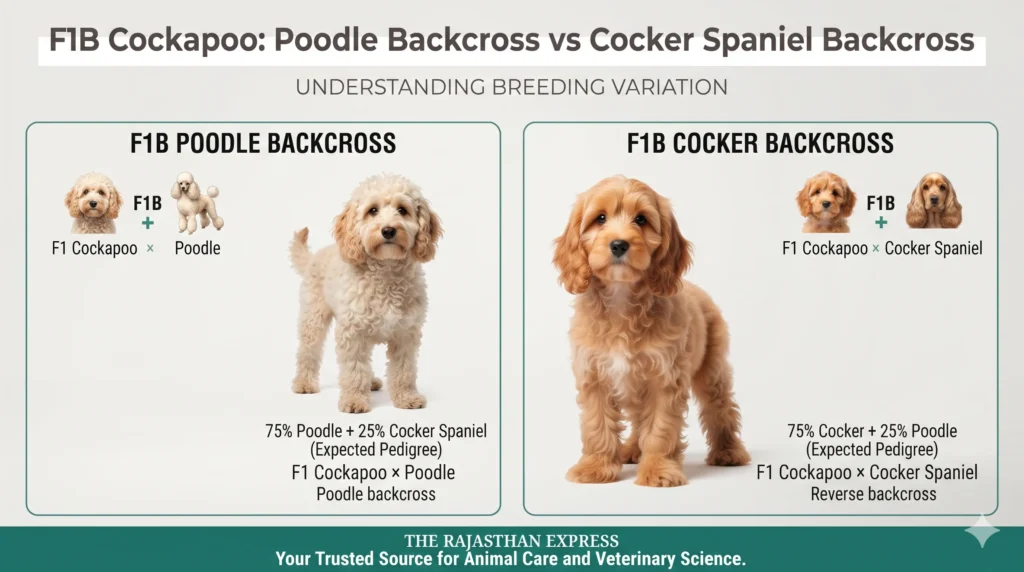
F1B Cocker Spaniel Backcross
- In this, the F1 Cockapoo is crossbred with the Cocker Spaniel. The estimated ancestry is approximately 75% Cocker Spaniel and 25% Poodle. It is sometimes also called F1 Reverse B or Reverse Backcross.
- Advantage: It can have a more affectionate, calm, and family‑oriented Cocker Spaniel‑like temperament. The coat can be more silky and wavy. The ears and face can show beautiful Cocker‑like features.
- Drawback: Shedding can be higher than the Poodle backcross. The risk of Cocker Spaniel‑related ear problems and skin allergies can increase. It is not always ideal for people with allergies.
What is the difference between F1 and F1B Cockapoo?
The main difference between F1 and F1B Cockapoo is their parents and the genes received from them. F1 is the first generation, while F1B is prepared by crossing the F1 Cockapoo back with the Poodle.
1. F1 Cockapoo (First Generation)
- The F1 Cockapoo is produced by crossing a pure Cocker Spaniel and a pure Poodle.
- It has approximately 50‑50% genes of both parents.
- Its hair can be straight, wavy, or curly. Differences can be seen even in the hair of puppies from the same mother.
- It is difficult to predict how much it will shed. Some shed less, some more.
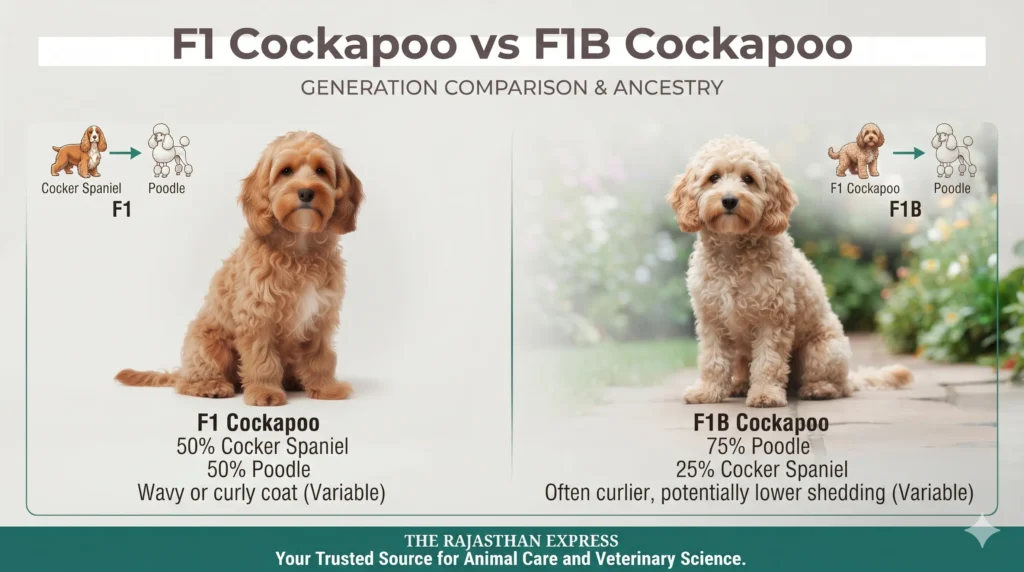
2. F1B Cockapoo (Second Cross with Poodle)
- To prepare an F1B Cockapoo, the F1 Cockapoo is crossed again with a pure Poodle. This is called Backcross.
- It has approximately 75% Poodle and 25% Cocker Spaniel genes.
- Its hair is often more curly and shedding may be less.
| F1 vs F1B Cockapoo: What Is the Difference? | ||
| Feature | F1 Cockapoo | F1B Cockapoo |
|---|---|---|
| Cross | Cocker Spaniel × Poodle | F1 Cockapoo × Poodle |
| Poodle Genes | Approximately 50% | Approximately 75% |
| Cocker Spaniel Genes | Approximately 50% | Approximately 25% |
| Hair Texture | Straight, wavy, or curly | Often more curly |
| Shedding | Can be low or high | Generally can be lower |
| Grooming | Regular need | Regular and possibly more care needed |
| The Rajasthan Express : F1 vs F1B Cockapoo: What Is the Difference? | ||
3. F1BB Cockapoo
- An F1BB Cockapoo is created when an F1B Cockapoo (which is a Poodle backcross) is crossbred again with the Poodle. The estimated ancestry is approximately 12.5% Cocker Spaniel and 87.5% Poodle.
- This is considered the most Poodle‑like Cockapoo. The coat can be very curly and low‑shedding. It can be a strong option for people with allergies, but it is not 100% allergy‑free. Grooming is needed a lot. Curly hair tangles quickly, so daily brushing and professional grooming every 6‑8 weeks may be necessary. The temperament may show Poodle‑like sharp intelligence, activeness, and sometimes sensitivity.
- F1BB is good for people who want a low‑shedding dog and who can give the time and expense for regular grooming.
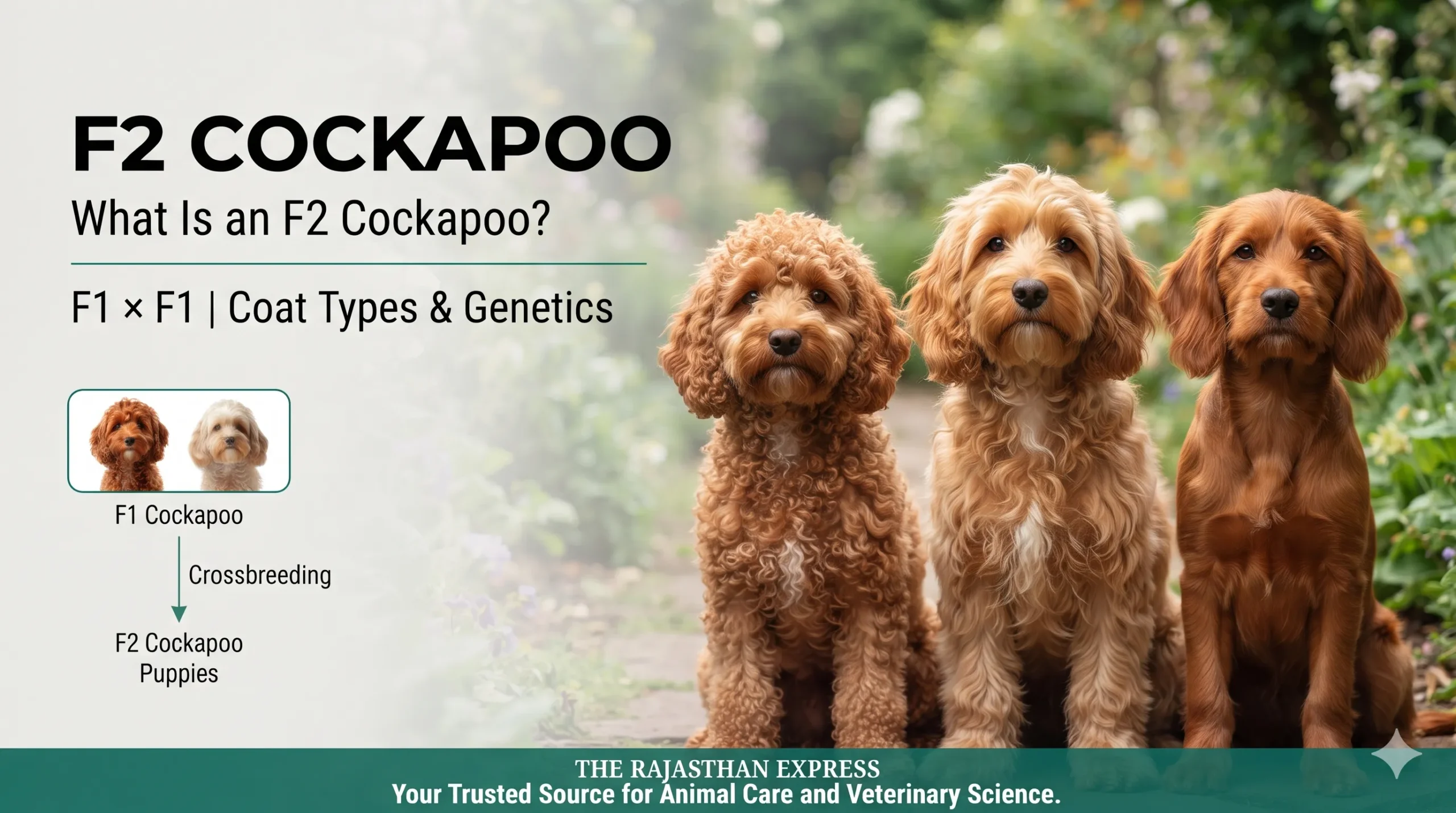
4. F2 Cockapoo – What Is an F2 Cockapoo?
What is an F2 Cockapoo?
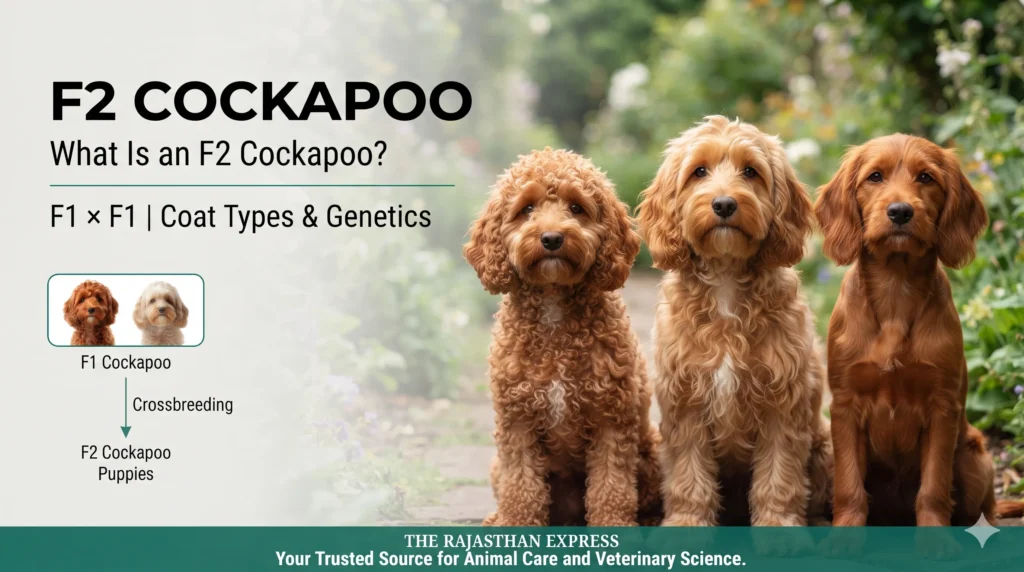
- An F2 Cockapoo is created when two F1 Cockapoos are crossbred with each other. The estimated ancestry is approximately 50% Cocker Spaniel and 50% Poodle.
- In appearance, it may look like F1, but internally it can be much more diverse. The genes of both F1 parents mix in different ways, so in the same litter, some puppies can be very curly, some with straight hair, some more Cocker‑like, and some more Poodle‑like. Coat, shedding, size, and temperament are the hardest to predict. Some puppies may have stronger Poodle or Cocker Spaniel qualities.
- The biggest drawback of F2 is that it can be risky for allergy‑prone families, because shedding and coat cannot be predicted.
5. F2B Cockapoo – What Is an F2B Cockapoo?
What is an F2B Cockapoo?
- An F2B Cockapoo is created when an F2 Cockapoo is crossed again with the Poodle or Cocker Spaniel. This is the same principle as F1B, but because of F2’s instability, the results can be even more uncertain. In the Poodle backcross, the possibility of low shedding increases. In the Cocker backcross, a more affectionate and Cocker‑like appearance can be obtained.
What is the difference between F1 and F2 Cockapoo?
The biggest difference between F1 and F2 Cockapoo is their parents. F1 is the first generation, in which a direct cross of Cocker Spaniel and Poodle is made. Whereas in F2, two F1 Cockapoos are crossed with each other.
1. F1 Cockapoo (First Generation)
- The F1 Cockapoo is produced by crossing a pure Cocker Spaniel and a pure Poodle.
- It has approximately 50‑50% genes of both parents.
- Its hair can be straight, wavy, or curly.
- Its temperament and hair texture can show qualities of both parents, but these qualities are not the same in every puppy.
2. F2 Cockapoo (Second Generation)
- An F2 Cockapoo is produced when two F1 Cockapoos are crossed with each other.
- It also has an average genetic share of approximately 50% Cocker Spaniel and 50% Poodle.
- But predicting the hair texture, colour, size, and temperament of its puppies can be a little difficult.
- For example, one puppy from the same mother may have more curly hair, while another may have wavy or relatively straight hair. Similarly, there can be differences in the amount of shedding.
Why is this difference seen in F2?
- The reason is that the genes received from both parents mix in different ways. In the F2 generation, new combinations of genes are formed. Therefore, some puppies may show more Cocker Spaniel qualities, while others may show more Poodle qualities.
6. F3 and Multi‑generational Cockapoo
What is a Multigenerational Cockapoo?
- F3 is created when two F2 Cockapoos are crossed, or F2 is crossed with F1B. Multi‑generational means continuing to cross Cockapoos with Cockapoos for many generations.
- Over time, some qualities can become stable, such as coat type or size. But this is not a complete guarantee. Do not assume just by hearing the name “Multi‑generational” that the dog will automatically be healthier or better; parents’ health testing and the breeder’s credibility are more important.
Which Cockapoo generation sheds the least hair?
- F1B Cockapoo (which is crossed back with the Poodle) generally has the highest likelihood of low shedding.
- Why?
- F1B Cockapoo has approximately 75% Poodle and 25% Cocker Spaniel genes. Because of more Poodle genes, its hair is often more curly and may shed less.
- F1BB Cockapoo: In this, the share of Poodle genes can increase further. Therefore, it may also have a higher likelihood of low shedding.
- Important point:
- Being F1B or F1BB does not mean the dog’s hair will not shed at all. Every dog sheds some hair and dead skin cells (dander). Therefore, no Cockapoo is completely hair‑free or allergy‑free.
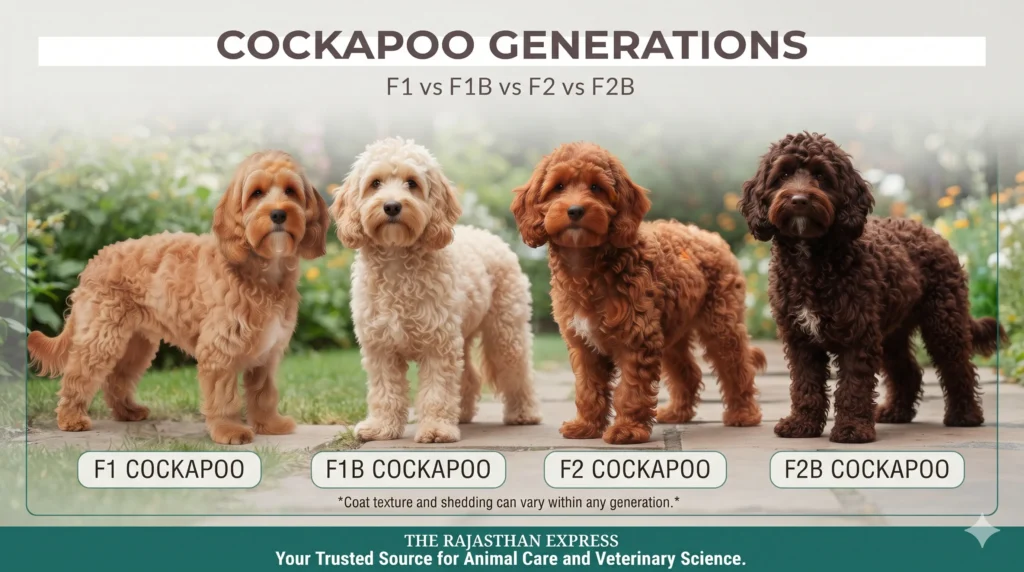
Cockapoo Generations : F1 Cockapoo Vs F1B Cockapoo Vs F2 Cockapoo Vs F2B Cockapoo
| Cockapoo Generations Comparison Table | ||||
| Generation | Breeding Combination | Estimated Ancestry | Key Point | Suitable For |
|---|---|---|---|---|
| F1 Cockapoo | Cocker Spaniel × Miniature Poodle | 50% + 50% | Balanced mix, more diversity | General families, first-time owners |
| F1B Cockapoo (Poodle) | F1 Cockapoo × Poodle | 25% + 75% | More curly, less shedding | Allergy sufferers, those wanting less shedding |
| F1B Cockapoo (Cocker) | F1 Cockapoo × Cocker Spaniel | 75% + 25% | More Cocker-like, affectionate | Those wanting a calm, family companion |
| F1BB Cockapoo | F1B × Poodle | 12.5% + 87.5% | Very curly, very low shedding | Experienced owners with time for grooming |
| F2 Cockapoo | F1 × F1 | 50% + 50% (estimated) | Much more diversity | Only experienced owners who can handle uncertainty |
| F2B Cockapoo | F2 × Poodle/Cocker | According to backcross | Mixed, uncertain | On the advice of a specialist breeder |
| F3 Cockapoo / Multi-generation Cockapoo | Cockapoo × Cockapoo, many generations | Around 50/50 | Some qualities may become stable | Advanced owners wanting a predictable puppy |
| The Rajasthan Express : Cockapoo Generations Comparison Table | ||||
Which Cockapoo generation is the best?
Which Cockapoo generation is best depends on your needs. If you want a dog that shows good qualities of both the Cocker Spaniel and Poodle, then the F1 Cockapoo can be a good option. On the other hand, if you want the dog’s hair to shed less, then the F1B Cockapoo may be better for you.
1. F1 Cockapoo (Mix of Both Parents)
- The F1 Cockapoo is produced when a pure Cocker Spaniel and a pure Poodle are crossed with each other. It has approximately 50‑50% of both parents.
- It can show the Cocker Spaniel’s friendly and loving temperament.
- At the same time, like the Poodle, it can also be intelligent and quick to learn.
2. F1B Cockapoo (Higher Chance of Low Shedding)
- If you want your dog’s hair to shed less, then the F1B Cockapoo can be a good option. To create it, the F1 Cockapoo is crossed again with the Poodle.
- It has approximately 75% Poodle and 25% Cocker Spaniel genes.
- Because of more Poodle genes, its hair can be more curly and low‑shedding.
- It can be a good option for people who want to reduce the trouble of dog hair shedding in the house.
Explore Cockapoo generations, including F1, F1B, F1BB, F2 and F2B Cockapoo types. Learn their differences, ancestry, coat types and shedding.
Cockapoo Generations: F1 Cockapoo, F1B Cockapoo, F2 & F2B Cockapoo – The Rajasthan Express