 By
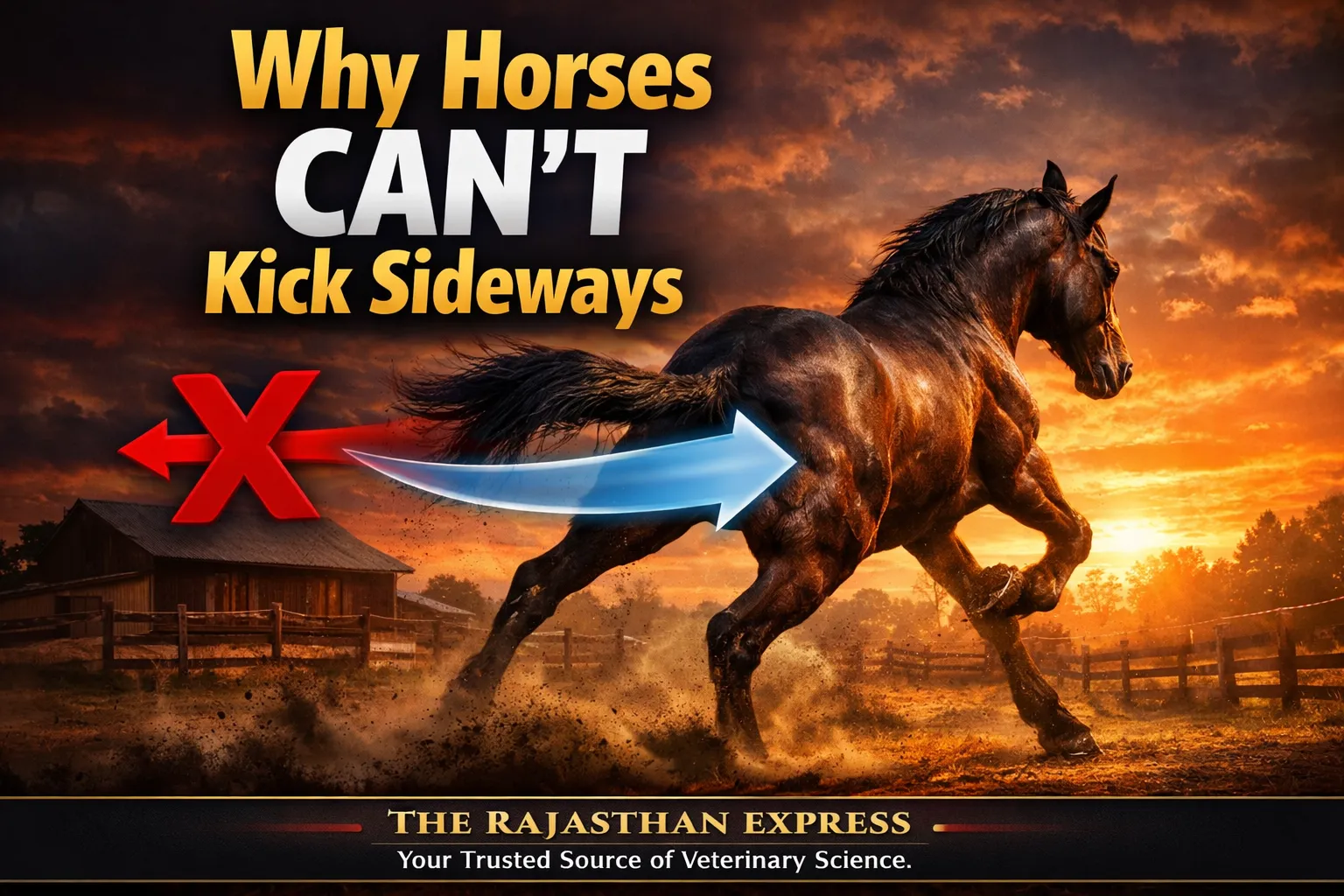
ByWhy Horses Cannot Kick Sideways: Understanding the Horse Hip Joint Anatomy
Do you know that a horse cannot kick directly sideways, but a cow can?
Yes, generally a horse cannot kick directly to the side (laterally) with its hind leg, whereas cows and buffaloes can easily kick sideways. The main reason for this lies in the different anatomical structures of the hind legs and hip joints of these animals.
Horse Hip Joint & Sideways Kick Limitation
| Main Topic | Horse Hip Joint Anatomy |
|---|---|
| Key Question | Why can’t horses kick sideways? |
| Main Reason | The presence of a strong Accessory Ligament (Check Ligament) and Round Ligament in the horse hip joint restricts lateral movement of the hind leg. |
| Joint Type | Ball and Socket Joint |
| Ball Component | Head of the Femur (upper part of the hind leg bone) |
| Socket Component | Acetabulum cavity in the pelvis |
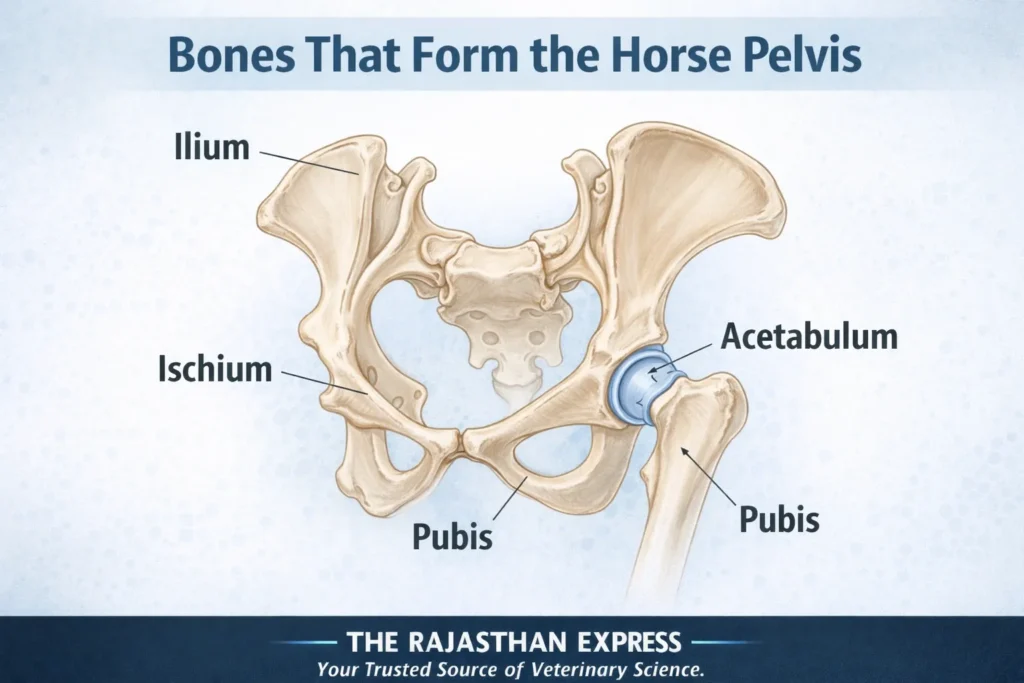
| Bones Forming the Pelvis |
|
| Important Ligaments |
|
| Accessory Ligament Function | Provides additional stability to the hip joint and prevents excessive movement of the femoral head. |
| Round Ligament Function | Keeps the femoral head firmly attached inside the acetabulum. |
| Effect on Leg Movement |
|
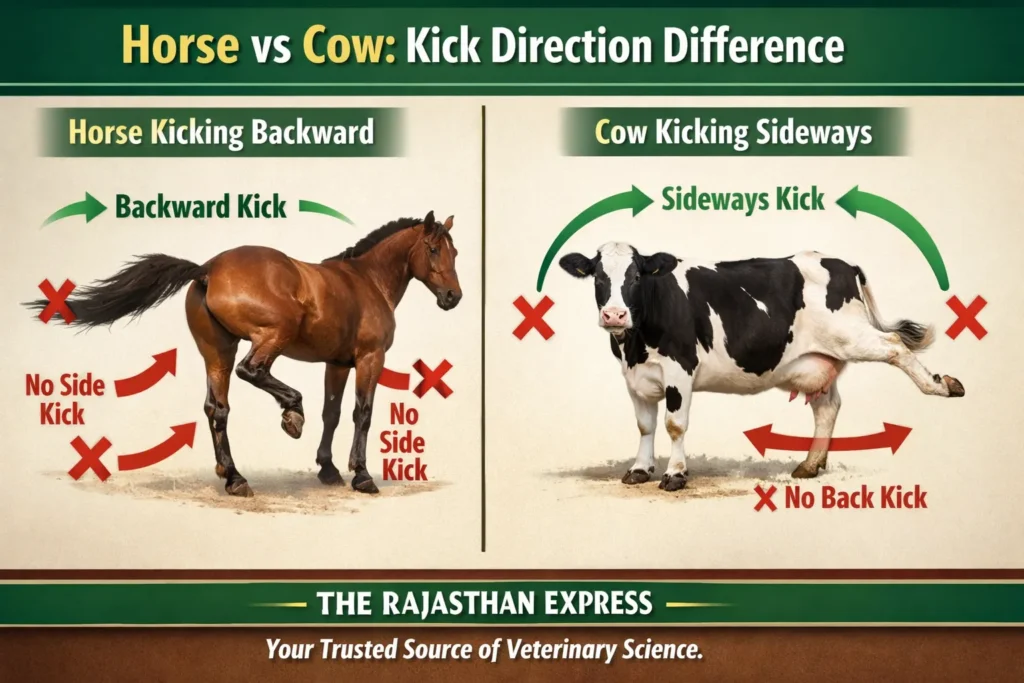
| Kick Direction in Horses | Horses can deliver powerful backward kicks with their hind legs. |
| Movement Limitation | Horses cannot perform strong sideways kicks because the hip joint is extremely stable. |
| Comparison with Cows |
|
| Advantages of Horse Hip Stability |
|
| Trade-Off | Greater stability leads to reduced lateral movement of the hind legs. |
| Key Takeaway | The strong accessory ligament in the horse hip joint stabilizes the femur, allowing powerful forward and backward movement but preventing effective sideways kicking. |
| Sources: The Rajasthan Express : By RAKESH KUMAR LIVESTOCK INSPECTOR IN RAJASTHAN GOVERNMENT ANIMAL HUSBANDRY DEPARTMENT | |
Read More About : Why Can’t Horses Breathe Through Their Mouth?
Anatomy of the Horse Hip Joint
The hip joint of a horse is very strong and stable. To understand this, we can take a simple example. Just like the hinge attached to a door allows it to open only forward and backward, but not sideways, the horse’s hip joint works in a somewhat similar way—only much stronger.
Structure of the Hip Joint
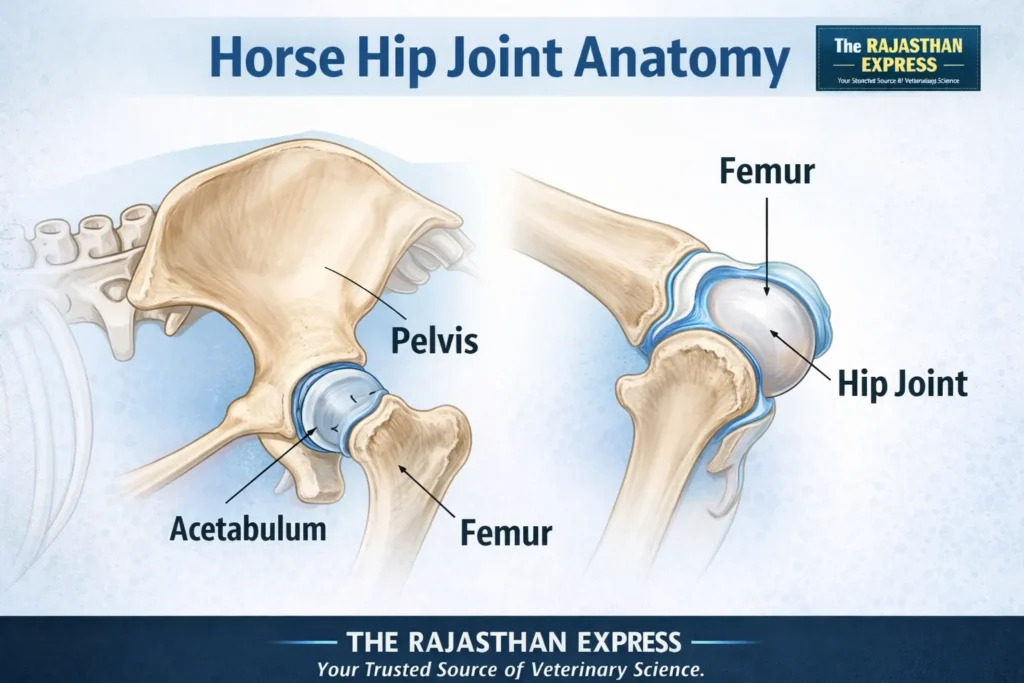
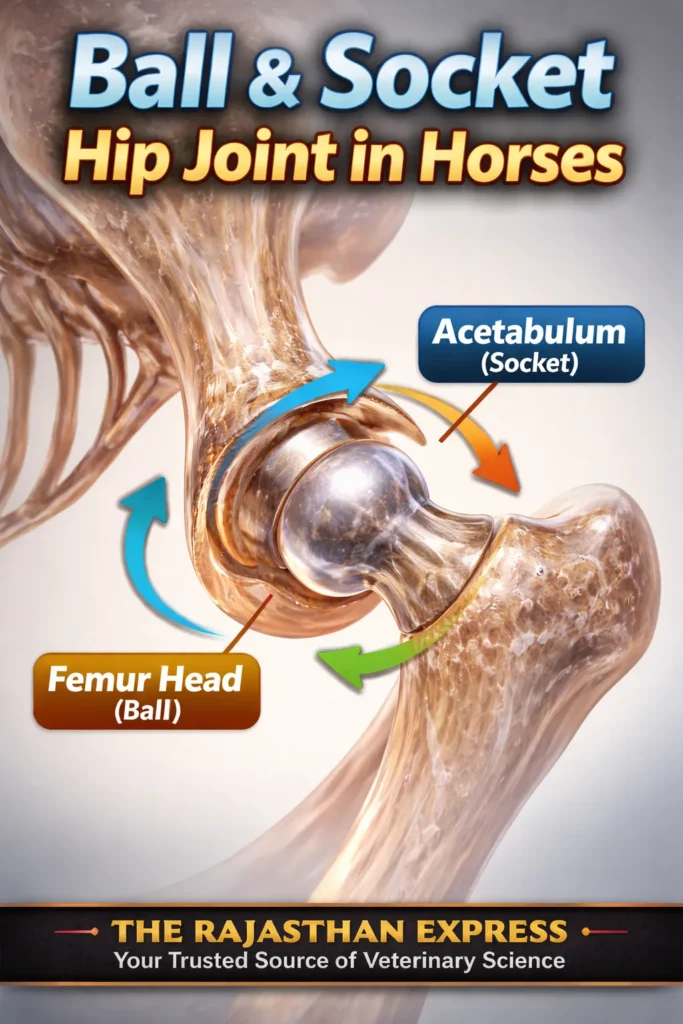
The horse’s hip joint, like that of humans and cows, is a Ball and Socket type joint. This means that it consists of a rounded head and a deep cavity, and the joint is formed when these two connect.
Ball (Head of Femur)
- The upper end of the hind leg bone, called the Femur, is round. This part functions like the ball.
Socket (Acetabulum Cavity)
- In the hip bone, called the Pelvis, there is a deep cavity known as the Acetabulum Cavity. The round head of the femur fits into this cavity, forming the hip joint.
Structure of the Hip Bone
In animals, the Hip Bone is formed by the fusion of three different bones. These bones are:
- Ilium
- Ischium
- Pubis
These three bones join together to form the Pelvis, and at their meeting point the Acetabulum is formed, where the ball of the femur fits to create the hip joint.
Two Important Ligaments in the Horse Hip Joint
The most special structures here are two ligaments. These ligaments play an important role in making the horse’s hip joint strong and stable. They hold the joint in place and prevent the bones from slipping.
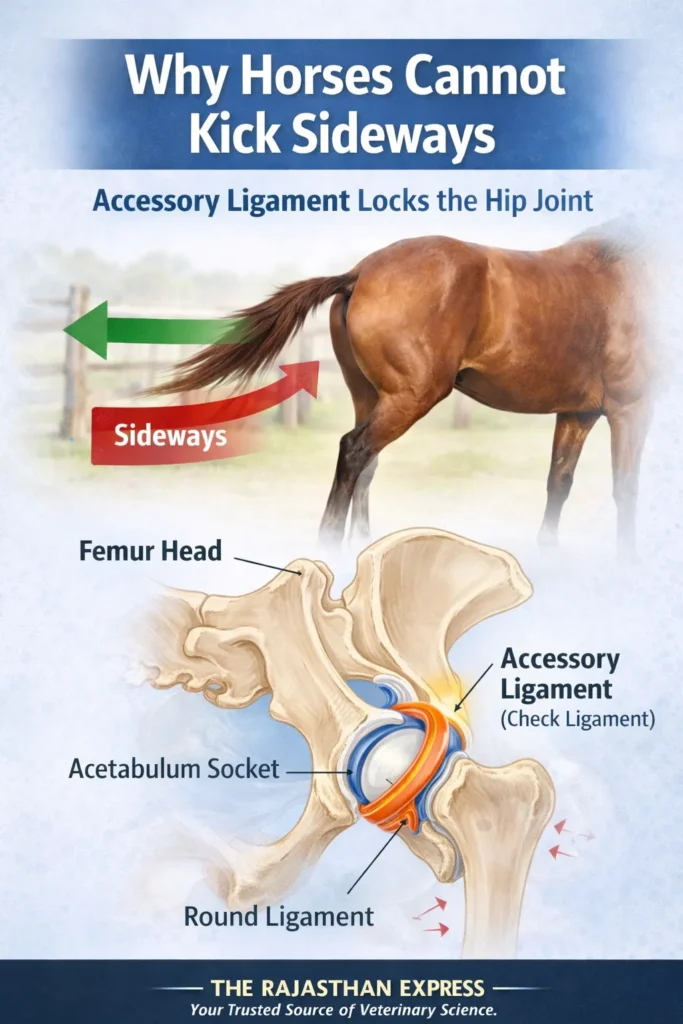
1. Accessory Ligament (Check Ligament Horse)
The Accessory Ligament, also known as the Check Ligament in horses, is like a very strong rope or strap.
- This ligament starts near the head of the femur.
- It connects to the acetabulum located inside the pelvis.
Function:
- Its main function is to hold the head of the femur firmly inside the socket. It prevents the bone from moving forward and provides additional stability to the joint.
- This is the key structure that explains which ligament prevents side kick in horse anatomy.
2. Round Ligament
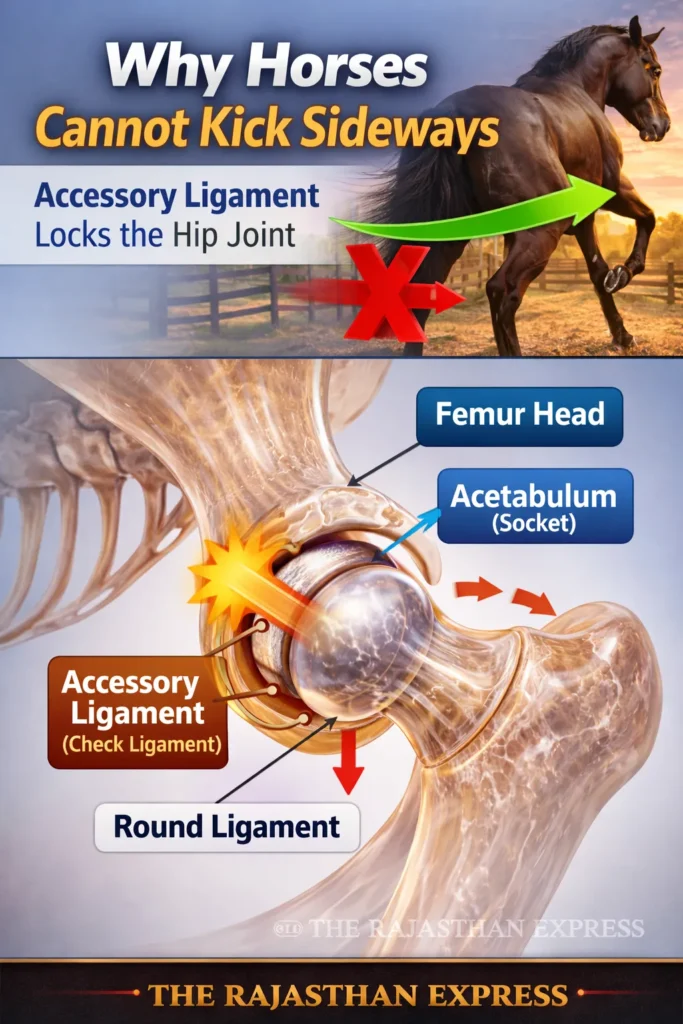
The Round Ligament is a thick and strong cord that directly connects the head of the femur deep inside the acetabulum.
Function:
- Its main role is to keep the femoral head stable inside the socket and strengthen the joint. Because of this ligament, the bone does not easily slip out of place.
Read More About : What are Mustang horses used for
What Do These Two Ligaments Do Together? (Strength vs Movement)
In horses, both the Accessory ligament and the Round ligament are present in the hip joint. Together, they make the hip joint extremely strong and stable. This stability provides several advantages for the horse, but it also creates certain limitations.
Advantage of a Strong Hip Joint
Because the hip joint is very strong, the horse can easily support its heavy body weight.
- Horses can stand for long periods of time.
- They can even rest while standing.
- They do not need to constantly use muscle strength to keep the joint stable.
A strong hip joint also allows horses to:
- Run very fast
- Jump high
- Carry heavy loads
In addition, the hip joint rarely dislocates.
The Trade-Off (Disadvantage)
- Because the joint is extremely strong, the ball of the femur cannot rotate much inside the socket. It remains almost locked in position.
- As a result, certain movements of the leg become limited.
How This Limits Leg Movement
- The movement of lifting the leg sideways is called Abduction. In horses, this movement is very limited.
- This explains why horses are unable to kick sideways in the same way that some other animals can.
What a Horse Can Do
A horse can:
- Kick straight backward with its hind legs
- Move its legs forward and backward
Many people also ask: Can horses kick with their front legs?
Yes, horses can strike forward with their front legs, but their powerful defensive kick comes mainly from the hind legs.
What a Horse Cannot Do
- A horse cannot lift its hind leg sideways and deliver a powerful lateral kick, the way cows or buffaloes can.
- This limitation is directly related to the Accessory Ligament (Check Ligament Horse) that stabilizes the hip joint.
Difference Between Horse and Cow Hip Movement
Horse
- The horse’s hip joint works like a strong hinge. Just like a door hinge allows movement only forward and backward, the horse’s hind leg mainly moves in the forward–backward direction.
- This anatomical structure explains horse hip joint side kick limitations.
Cow (and Most Other Animals)
In cows and many other animals, the Accessory Ligament is absent. Because of this, their hip joints are more flexible.
As a result:
- They can rotate their hind legs sideways
- They can deliver strong lateral kicks
This is why cows and buffaloes can easily kick to the side, while horses cannot.
Conclusion
- The reason horses cannot kick sideways lies in the special anatomical design of their hip joint. The presence of the Accessory Ligament (Check Ligament Horse) and the Round Ligament makes the hip joint extremely strong and stable.
- This stability helps horses run fast, jump high, and carry heavy loads, but it also restricts lateral movement. As a result, horses can kick backward powerfully but cannot deliver strong sideways kicks like cows or buffaloes.
Learn why horses cannot kick sideways. Discover the role of the check ligament, horse hip joint anatomy, and how horses differ from cows and other animals.
THE RAJASTHAN EXPRESS : Your Trusted Source for Animal Care and Veterinary Science.