 By
BySirohi Goat Milk Per Day: Yield, Price, Weight & Characteristics
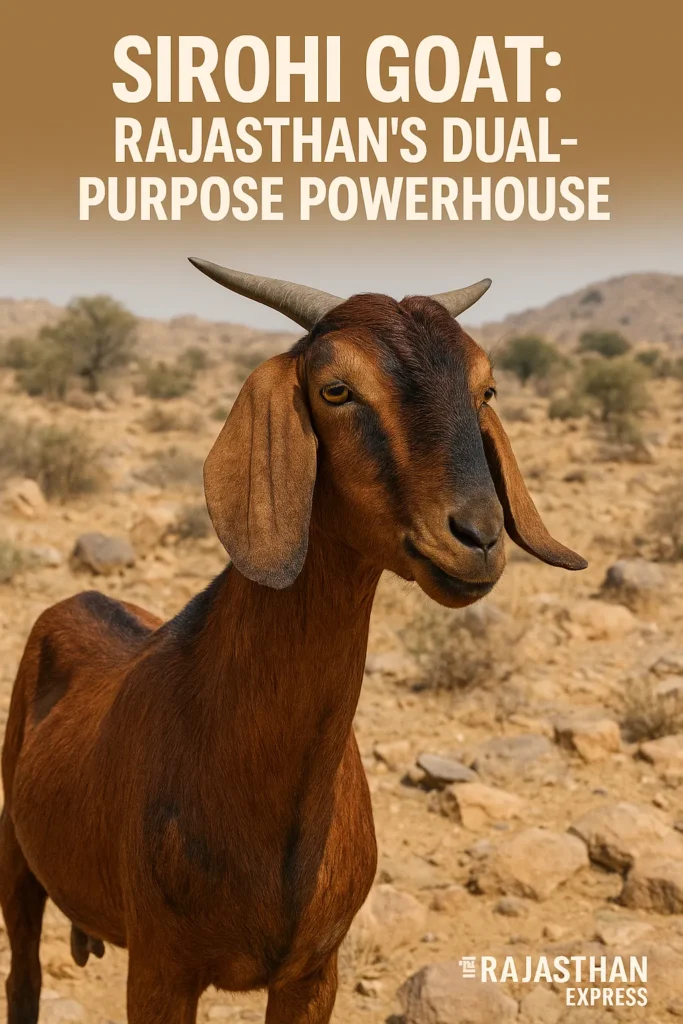
The Sirohi goat is a prominent indigenous breed of India, originating from the Sirohi district of Rajasthan. The breed is named after this district. This breed is registered as a native breed by the Indian National Bureau of Animal Genetic Resources (NBAGR). The responsibility for registering the native breeds of livestock and poultry in the country lies with this institute, which is headquartered in Karnal (Haryana).
Under the Indian Council of Agricultural Research (ICAR), the Breed Registration Committee (BRC), chaired by the Deputy Director General (DDG) of the Department of Animal Science, is the supreme authorized body for the registration of new animal species and breeds in the country.
In the 12th meeting of this committee held on January 6, 2025, at the NASC complex in New Delhi, chaired by Dr. Raghavendra Bhatt (DDG, Animal Science), the registration of 10 new animal and poultry breeds from various states was approved. Following this decision, the total number of registered native livestock and poultry breeds in India has reached 230.
🐐 Sirohi Goat (Capra aegagrus hircus)
Native Dual-purpose Breed of India (Milk & Meat)
| Taxonomic Classification | |||||||||||||||||||||||||||||||
|---|---|---|---|---|---|---|---|---|---|---|---|---|---|---|---|---|---|---|---|---|---|---|---|---|---|---|---|---|---|---|---|
| Domain | Eukaryota | ||||||||||||||||||||||||||||||
| Kingdom | Animalia | ||||||||||||||||||||||||||||||
| Phylum | Chordata | ||||||||||||||||||||||||||||||
| Class | Mammalia | ||||||||||||||||||||||||||||||
| Order | Artiodactyla | ||||||||||||||||||||||||||||||
| Family | Bovidae | ||||||||||||||||||||||||||||||
| Subfamily | Caprinae | ||||||||||||||||||||||||||||||
| Tribe | Caprini | ||||||||||||||||||||||||||||||
| Genus | Capra | ||||||||||||||||||||||||||||||
| Species | C. hircus | ||||||||||||||||||||||||||||||
| 🔶 General Information | |||||||||||||||||||||||||||||||
| Common Name | Sirohi Goat | ||||||||||||||||||||||||||||||
| Scientific Name | Capra aegagrus hircus | ||||||||||||||||||||||||||||||
| Alternative Names / Synonyms | Majithi, Parbatsari, Devgarhi | ||||||||||||||||||||||||||||||
| Breed Registration Authority | National Bureau of Animal Genetic Resources (NBAGR), ICAR | ||||||||||||||||||||||||||||||
| Registration Year | Recognized native breed; registered under ICAR Breed Registration Committee | ||||||||||||||||||||||||||||||
| Origin of Breed Name | Derived from Sirohi District, Rajasthan | ||||||||||||||||||||||||||||||
| Primary Utility | Dual-purpose: Milk and Meat | ||||||||||||||||||||||||||||||
| Breed Status | Indigenous, registered Indian goat breed | ||||||||||||||||||||||||||||||
| Adaptability | Hardy and drought-tolerant; adapted to arid and semi-arid zones | ||||||||||||||||||||||||||||||
| Mobility Pattern | Mostly stationary; some herds seasonally migratory | ||||||||||||||||||||||||||||||
| Management System | Extensive to Semi-intensive grazing-based rearing | ||||||||||||||||||||||||||||||
| Temperament | Docile, alert, hardy | ||||||||||||||||||||||||||||||
| 🗺️ Breeding Tract & Geographic Distribution | |||||||||||||||||||||||||||||||
| Primary Breeding Tract | Rajasthan (Sirohi, Ajmer, Bhilwara, Rajsamand, Chittorgarh, Udaipur) | ||||||||||||||||||||||||||||||
| Extended Distribution | Northern Gujarat (Palanpur region) | ||||||||||||||||||||||||||||||
| Geographical Coordinates | Latitude: 23°50′ – 25°00′ N; Longitude: 71°50′ – 74°00′ E | ||||||||||||||||||||||||||||||
| Topography | Arid and semi-arid plains with rocky terrain along Aravalli hills | ||||||||||||||||||||||||||||||
| Climate | Semi-arid; Temperature 2.3°C–42.3°C; Average rainfall ~660 mm annually | ||||||||||||||||||||||||||||||
| 🧬 Breed Characteristics | |||||||||||||||||||||||||||||||
| Size | Medium to large | ||||||||||||||||||||||||||||||
| Body Type | Compact, strong, well-built; robust frame | ||||||||||||||||||||||||||||||
| Coat Colour | Predominantly brown with dark/light brown or tan patches; some black animals with white spots observed | ||||||||||||||||||||||||||||||
| Face Profile | Straight to slightly convex (Roman nose) | ||||||||||||||||||||||||||||||
| Ears | Leaf-shaped, flat, medium to long, drooping downward | ||||||||||||||||||||||||||||||
| Horns | Both sexes horned; small to medium; slightly twisted, curved upward and backward; some polled goats also exist | ||||||||||||||||||||||||||||||
| Tail | Medium length, turned upward (~16.7 ± 0.14 cm) | ||||||||||||||||||||||||||||||
| Wattles | Present in some individuals | ||||||||||||||||||||||||||||||
| Hair Type | Short, coarse, glossy | ||||||||||||||||||||||||||||||
| Udder (Female) | Well-developed, round, long teats – suitable for milking | ||||||||||||||||||||||||||||||
| Distinctive Features | Hardy constitution, high survivability (94% kid survival rate), resistant to arid stress | ||||||||||||||||||||||||||||||
| ⚖️ Body Measurements (ICAR–NBAGR / FAO) | |||||||||||||||||||||||||||||||
| Parameter |
Adult Male (Buck): 42.83–50.37 kg, 77.94–80 cm length, 78.89–85.6 cm height, 77.5–80.3 cm girth Adult Female (Doe): 22.54–35.27 kg, 61.3–74.19 cm length, 68.4–74.57 cm height, 62.4–74.1 cm girth Newborn Kid: ♂ 2.29 kg, ♀ 2.22 kg | ||||||||||||||||||||||||||||||
| 🍼 Milk Production Traits | |||||||||||||||||||||||||||||||
| Milk Yield per Lactation | ~81.5 kg (average) | ||||||||||||||||||||||||||||||
| Lactation Duration | 90–150 days | ||||||||||||||||||||||||||||||
| Average Daily Yield | 0.9–1.1 liters/day (depending on feed & parity) | ||||||||||||||||||||||||||||||
| Fat Content | ~4.5–5.0% | ||||||||||||||||||||||||||||||
| Udder Type | Round, capacious, well-developed teats | ||||||||||||||||||||||||||||||
| 🐣 Reproductive Performance | |||||||||||||||||||||||||||||||
| Age at First Kidding | ~26 months (651 days) | ||||||||||||||||||||||||||||||
| Parturition Interval | ~10 months (310 days) | ||||||||||||||||||||||||||||||
| Litter Size | Mostly single; twins 10–25% | ||||||||||||||||||||||||||||||
| Kidding Season | Twice a year (varies by region) | ||||||||||||||||||||||||||||||
| Kid Survival Rate (up to 12 months) | ~94% | ||||||||||||||||||||||||||||||
| 🌿 Management & Feeding | |||||||||||||||||||||||||||||||
| Feeding System | Grazing on natural pastures; supplemented with dry fodder, tree leaves, and crop residues | ||||||||||||||||||||||||||||||
| Farm Feed Example | Sorghum straw, tree leaves, pulse husk, gram husk, guar churi | ||||||||||||||||||||||||||||||
| Field Feed Example | Khejri loong, moong, guar, natural grass, shrubs | ||||||||||||||||||||||||||||||
| Housing System | Open paddocks or thatched sheds in groups | ||||||||||||||||||||||||||||||
| Vaccinations | PPR (Peste des Petits Ruminants), Enterotoxaemia (Fadkiya Rog) | ||||||||||||||||||||||||||||||
| Health | Generally disease-resistant under arid conditions | ||||||||||||||||||||||||||||||
| 📊 Growth Performance (RAJUVAS – 5 Year Study, 2013–2017) | |||||||||||||||||||||||||||||||
Insight: Heavier mothers produce heavier kids; regression coefficient (b) = 0.26 at 3 months (P < 0.01). | |||||||||||||||||||||||||||||||
| 🧠 Research & Institutional Involvement | |||||||||||||||||||||||||||||||
| Institution | Rajasthan University of Veterinary & Animal Sciences (RAJUVAS), Bikaner; Livestock Research Station (LRS), Vallabhnagar | ||||||||||||||||||||||||||||||
| Project | All India Coordinated Research Project (AICRP) on Goat Improvement – Sirohi Unit | ||||||||||||||||||||||||||||||
| Key Researchers | Dr. Hina Ashraf Waiz, Dr. Lokesh Gautam, Dr. R.K. Nagda, Dr. M.C. Sharma | ||||||||||||||||||||||||||||||
| Duration of Major Study | 2013–2017 | ||||||||||||||||||||||||||||||
| Funding/Support | ICAR–AICRP, RAJUVAS, Dept. of Animal Husbandry, Rajasthan | ||||||||||||||||||||||||||||||
| 🧊 Genetic Conservation | |||||||||||||||||||||||||||||||
| Institution | National Livestock Gene Bank, NBAGR (ICAR), Karnal, Haryana | ||||||||||||||||||||||||||||||
| Cryopreserved Material | Semen from elite Sirohi bucks stored in liquid nitrogen | ||||||||||||||||||||||||||||||
| Purpose | Genetic resource conservation and AI breeding programs | ||||||||||||||||||||||||||||||
| Other Goat Breeds Preserved | Barbari, Beetal, Jamunapari, Osmanabadi, Black Bengal, Sangamneri, etc. | ||||||||||||||||||||||||||||||
| 📈 Population & Demographics | |||||||||||||||||||||||||||||||
| 1972 | 2.95 lakh – FAO report (Sirohi & Palanpur region) | ||||||||||||||||||||||||||||||
| 2003 | 10 lakh – estimated from tract population | ||||||||||||||||||||||||||||||
| 2013 | 18.2–30.8 lakh – based on DADF breed survey | ||||||||||||||||||||||||||||||
| 2024 | ~3.53 lakh (district estimate only, Dainik Bhaskar report) | ||||||||||||||||||||||||||||||
| Rajasthan Goat Population (2019) | 20.84 million; Sirohi share ≈60% (~12.5 million goats) | ||||||||||||||||||||||||||||||
| 🍖 Production and Economic Importance | |||||||||||||||||||||||||||||||
| Primary Uses | Milk, meat, manure | ||||||||||||||||||||||||||||||
| Dressing Percentage | ~58% | ||||||||||||||||||||||||||||||
| Market Demand | High demand in Rajasthan, Gujarat, and nearby states for meat and breeding stock | ||||||||||||||||||||||||||||||
| Economic Importance | Key livelihood source for small/marginal farmers; known as “Poor Man’s Cow” or “Walking Bank” | ||||||||||||||||||||||||||||||
| Farming Type | Extensive and semi-intensive commercial rearing | ||||||||||||||||||||||||||||||
| 💬 Special Qualities | |||||||||||||||||||||||||||||||
| |||||||||||||||||||||||||||||||
| Sources: ICAR–NBAGR (National Bureau of Animal Genetic Resources), Karnal; FAO DAD-IS Database (FAO.org); Rajasthan University of Veterinary and Animal Sciences (RAJUVAS); AICRP on Goat Improvement – Sirohi Unit; 20th Livestock Census (2019), DADF, GoI; Dainik Bhaskar (2024) – Local Sirohi district population report; Rakesh Kumar (2025),The Rajasthan Express” | |||||||||||||||||||||||||||||||
Sirohi Goat Origin and Alternative Name
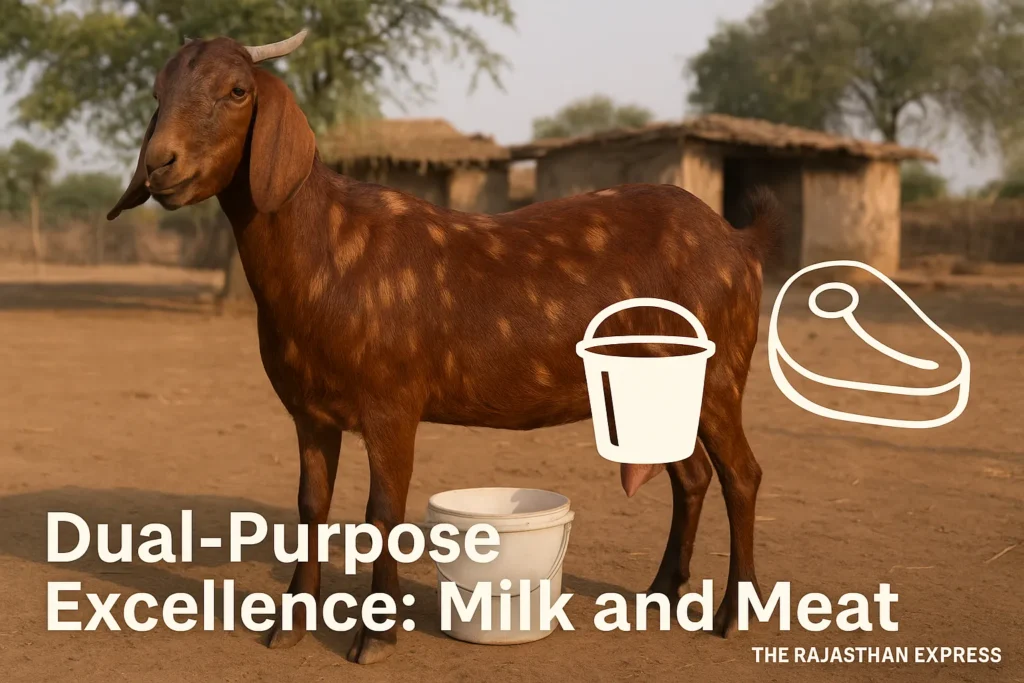
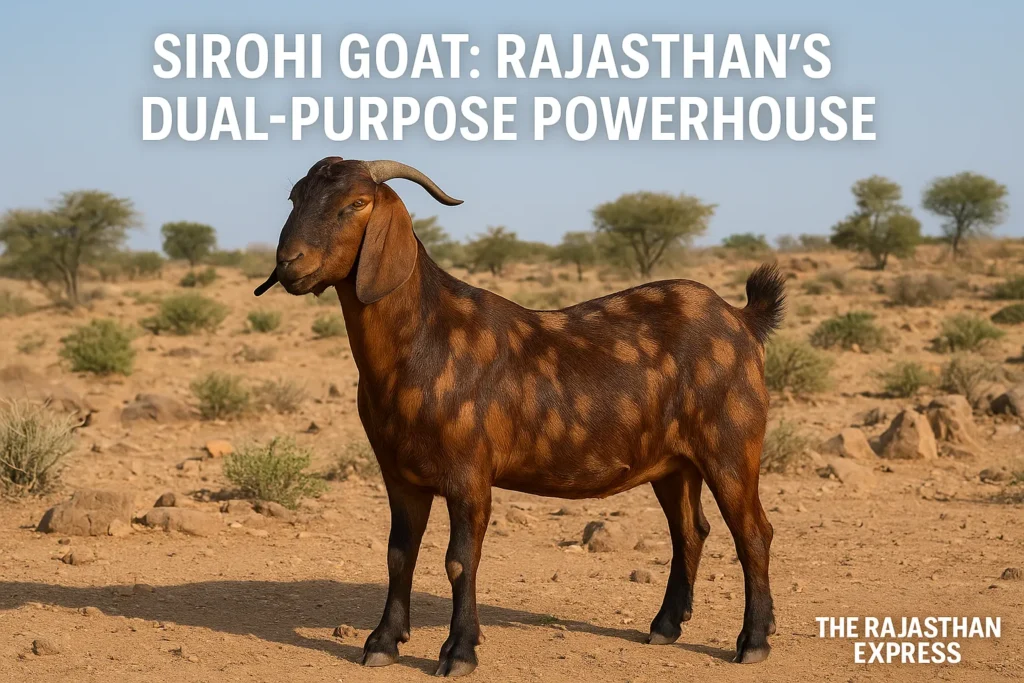
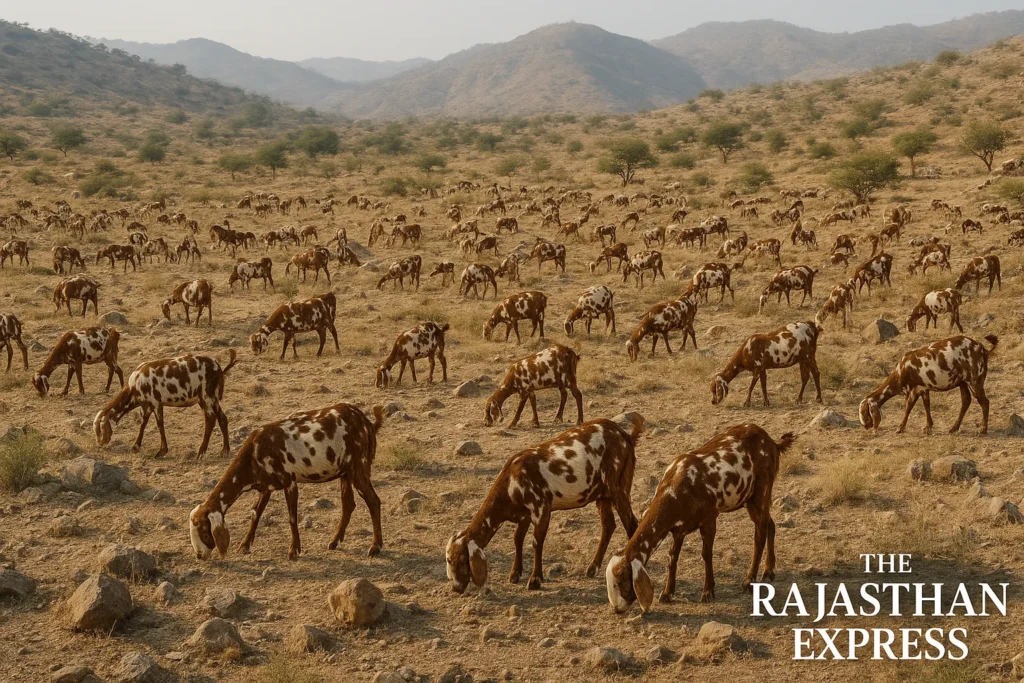
The Sirohi goat is a famous breed of Rajasthan known for both milk and meat production. It is considered one of the highest milk-yielding goats in the state. The spread of the Sirohi breed is observed in districts like Ajmer, Bhilwara, Tonk, and Jaipur in Rajasthan, as well as in the Palanpur region of Northern Gujarat. The state breeding farm for this breed is located in Ramsar (Ajmer), where work on selective breeding and breed improvement of the Sirohi goat is carried out. This center provides excellent breedable bucks to local animal husbanders, which promotes modern goat farming techniques.
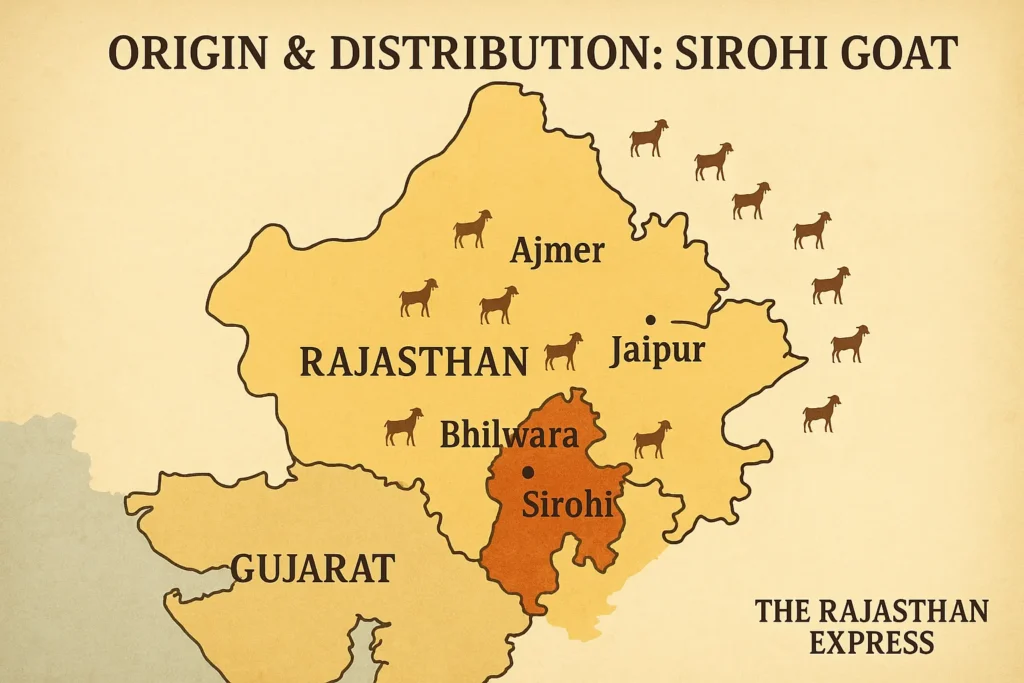
Typically, Sirohi goats are reared in herds of 10 to 200 on open pastures. Most herds are permanent, although large herds are seasonally relocated according to the availability of fodder and water.
The Sirohi breed is also locally known by names such as Majithi, Parbatsari, and Devgadi. It is primarily found in the semi-arid and arid regions of Rajasthan, especially in the Aravalli mountain range and the central and southern districts. Its geographical range extends approximately from 23°50′ to 25°00′ North latitude and 71°50′ to 74°00′ East longitude.
The primary use of this breed is for both milk and meat production.
Sirohi Goat Characteristics and Physical Identification
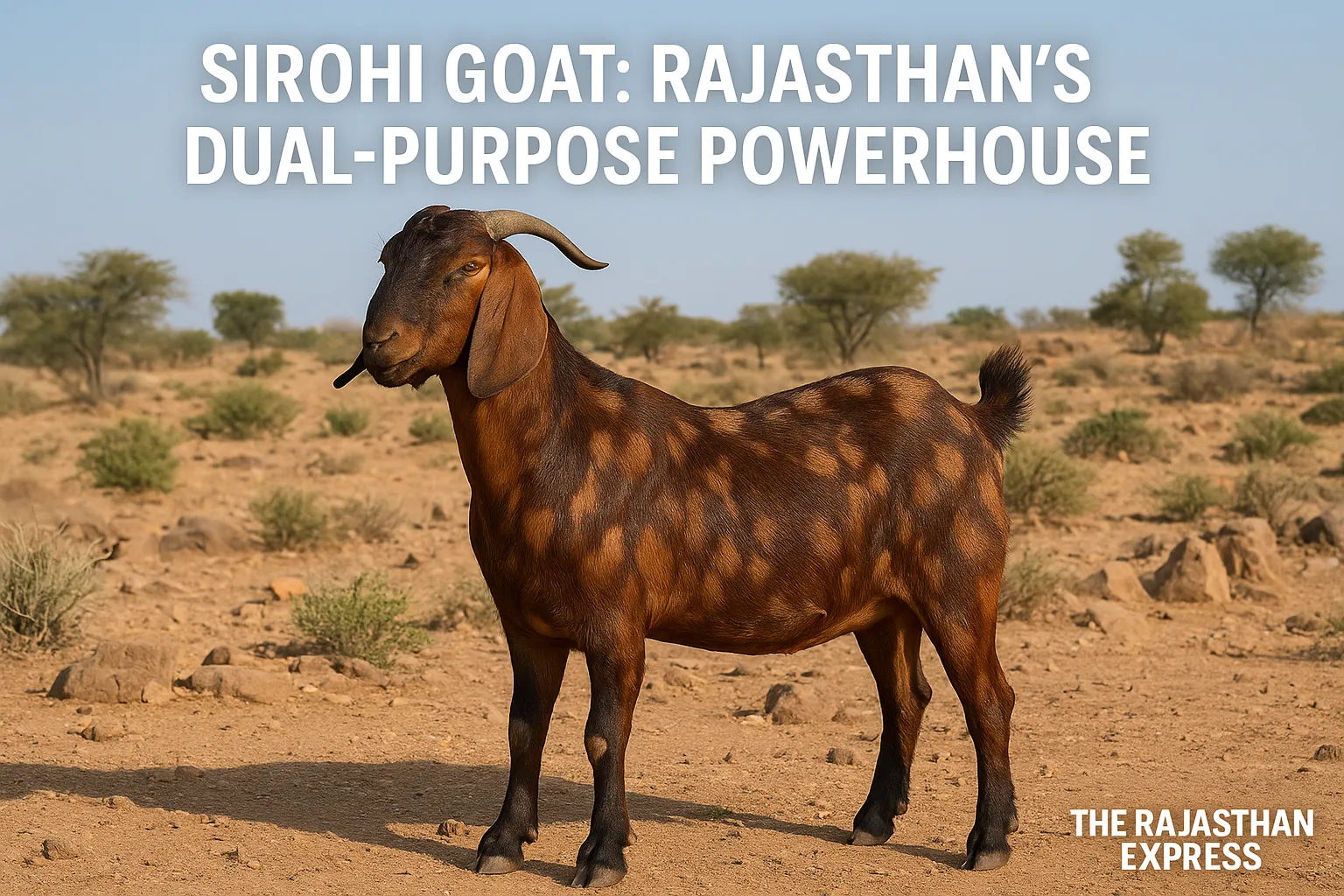
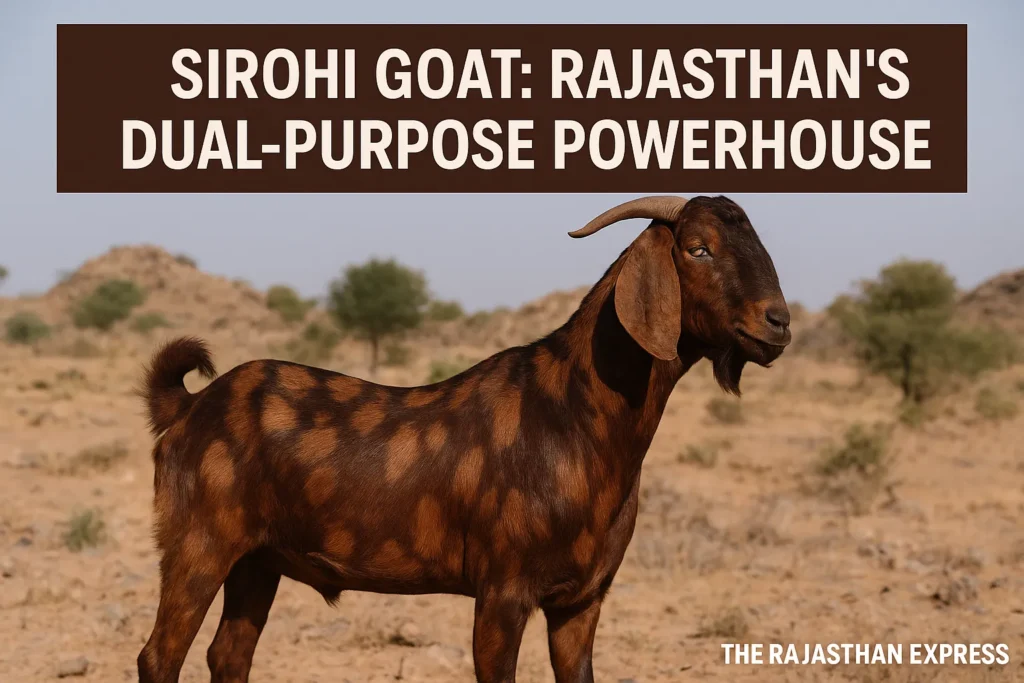
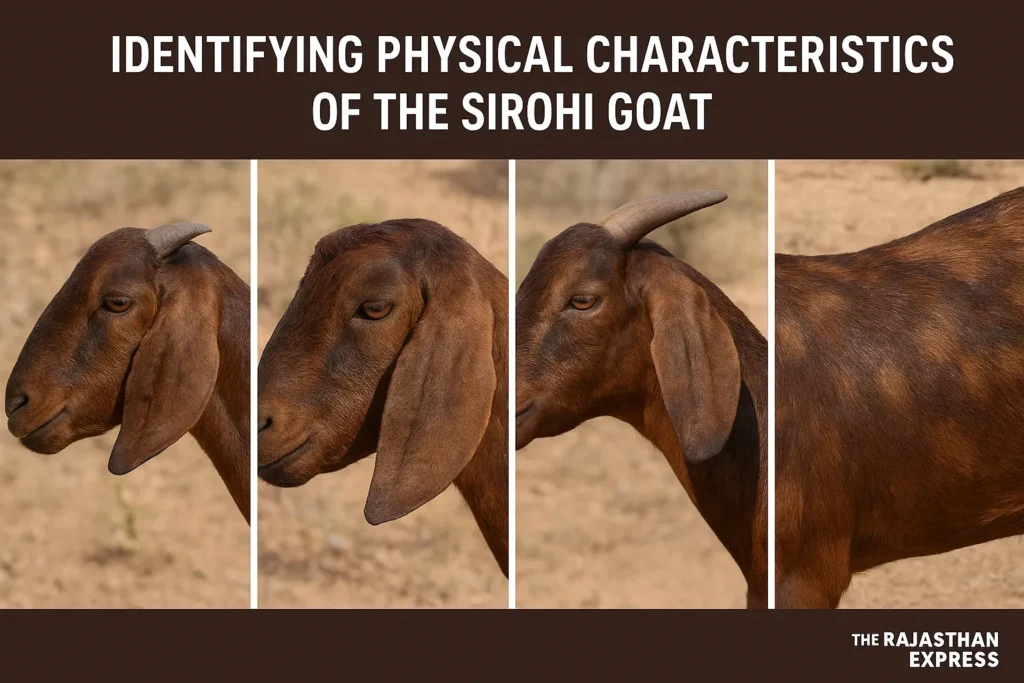
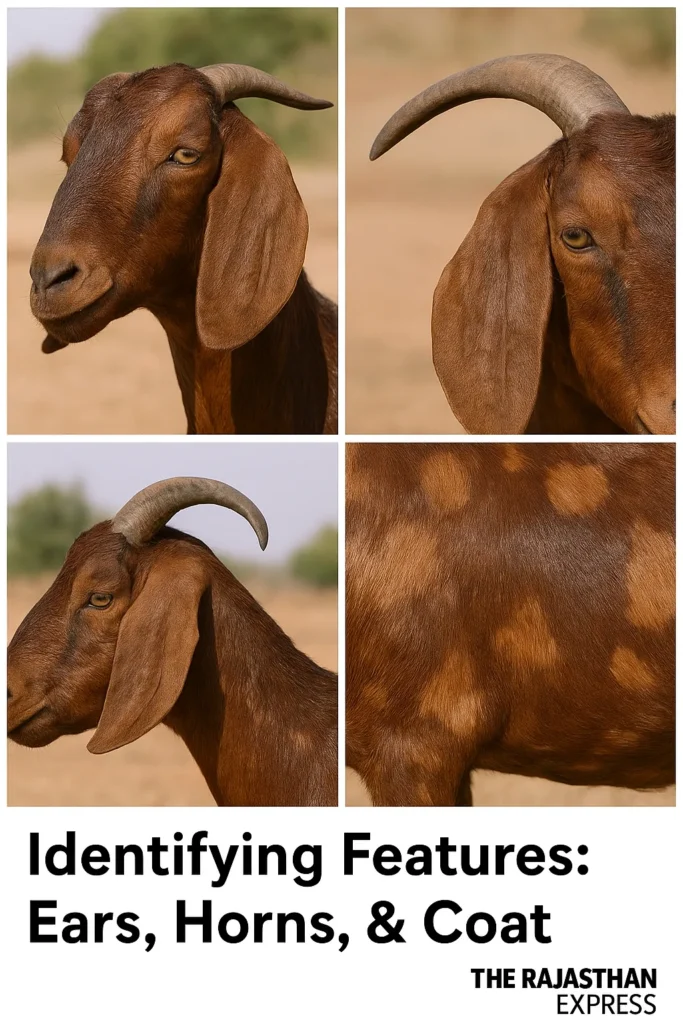
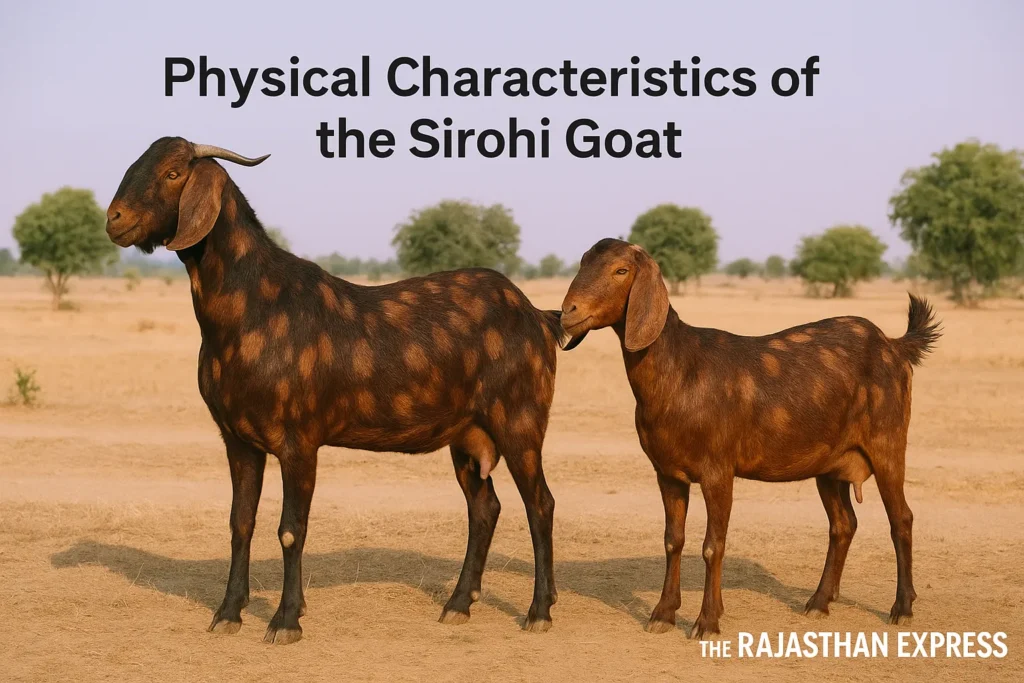
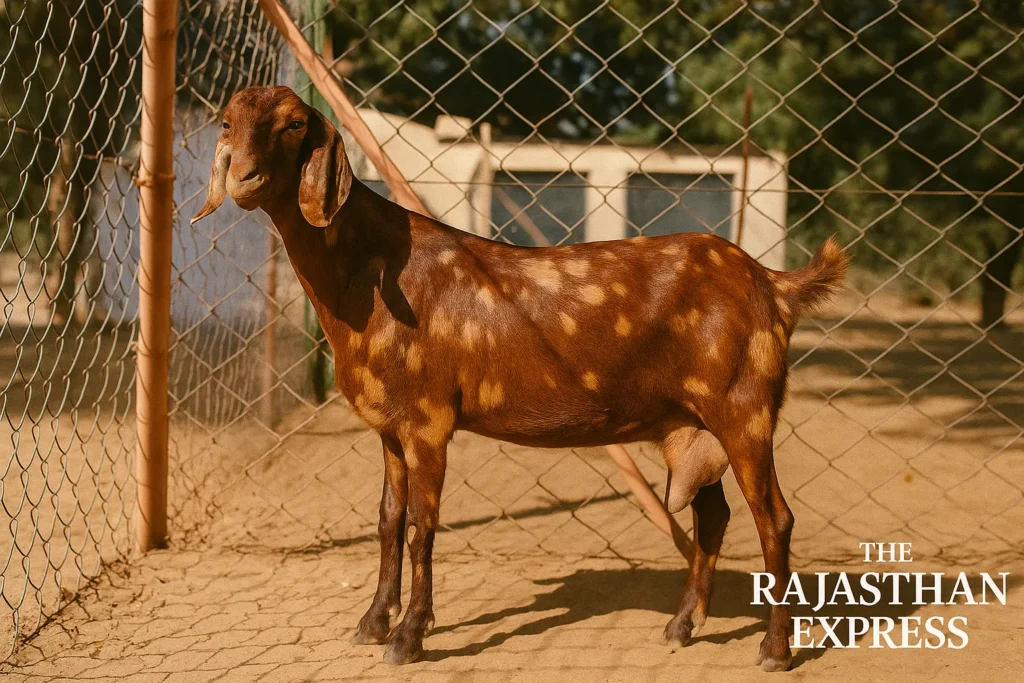
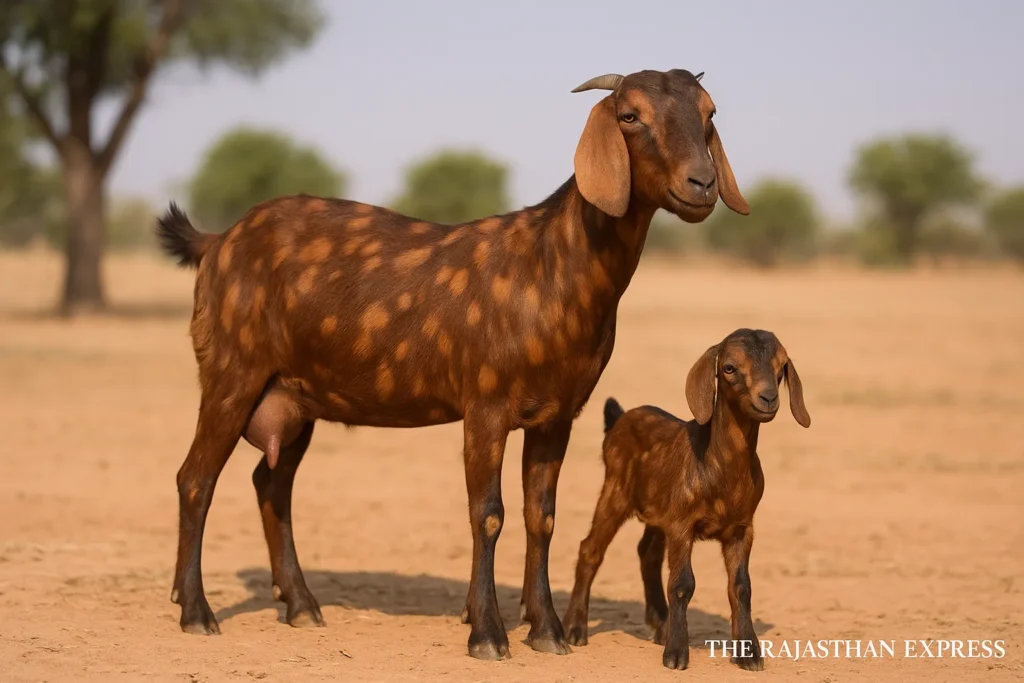
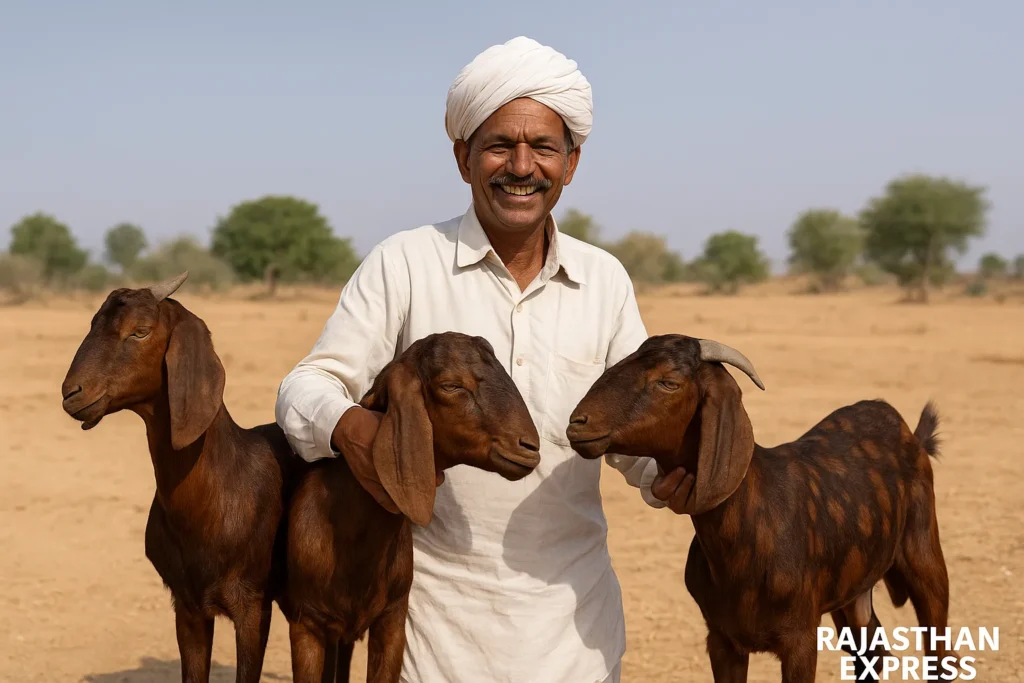
The Sirohi goat is medium to large in size. Its body is strong, well-built, and its legs are powerful. The body colour is generally brown, with dark brown or tan-coloured spots found on it. Approximately 5–10% of the goats are black in colour, with white spots on them. Their ears are of medium length, leaf-like, and droop downwards. Both males and females have horns, which are curved upwards and backwards. Wattles are also seen in some goats.
The Sirohi goat is an excellent milch breed. Its udder is developed, round, and long, which makes it suitable for milk production.
Body Colour and External Appearance
- Main Colour: According to the National Bureau of Animal Genetic Resources (Degrees and decimal minutes (DMM): 41 24.2028, 2 10.4418Degrees and decimal minutes (DMM): 41 24.2028, 2 10.4418NBAGR) and the Indian Council of Agricultural Research (ICAR), the body of the Sirohi breed goat is primarily brown in colour.
- Pattern of Spots: Light and dark brown spots are found on the body of the Sirohi goat. In some animals, a mix of white colour can also be seen with these spots. Sometimes, completely black-coloured animals are also found.
- Build: The body of the Sirohi goat is strong, sturdy, and compact, which proves it to be a robust and durable breed.
Ear Structure
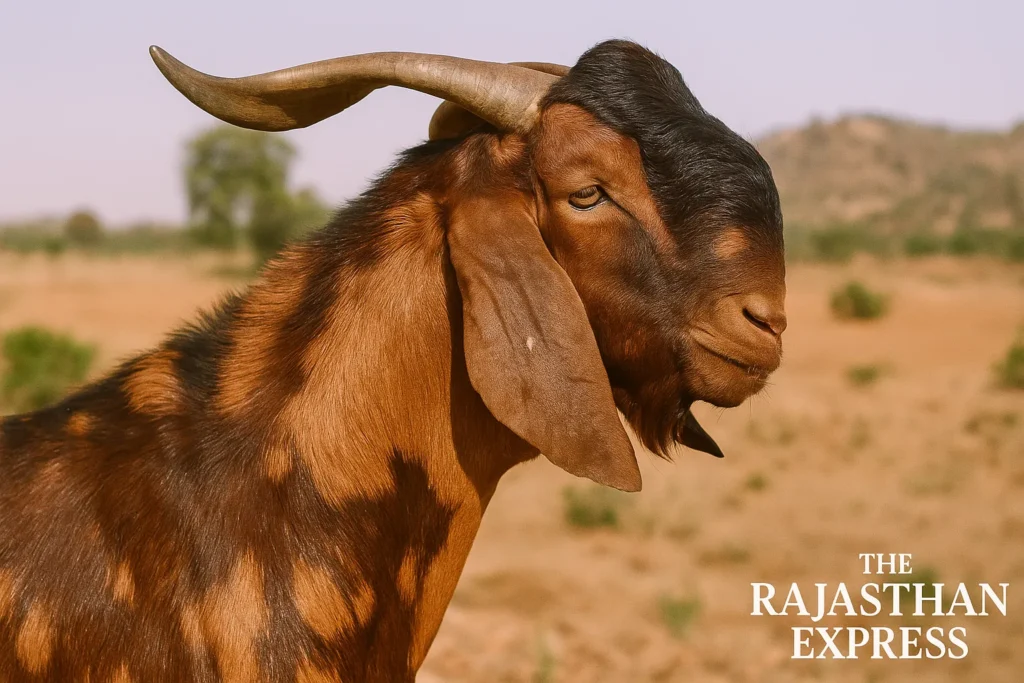
- Size and Shape: According to the ‘Atlas of Indian Livestock Breeds’ published by NBAGR, the ears of the Sirohi goat are medium to long, flat, and leaf-shaped.
- Position: These ears usually remain drooping/downward and hang on both sides of the head.
Horn Characteristics
- Presence: Horns are found in both male and female Sirohi goats. However, some animals can also be born without horns (Polled).
- Size and Direction: The horns are small to medium in size and their direction is upwardly raised and then curved backward (backward and upward curved). This is a key identity of this breed.
Other Key Physical Traits
- Face: The face of the Sirohi goat is usually straight or slightly convex (Roman nose).
- Wattles: Some Sirohi goats also have small hanging pieces of flesh (wattles) on their throat, although this is not present in all.
- Udder: The female goat’s udder is developed and round in shape, indicating its good milk production. The udder’s size is good and well-formed.
- Tail: Medium length and turned upward; tail length: 16.7 ± 0.14 cm.
- Herd Structure: The average herd size is 60 (range: 10 to 200), comprising 1 adult male, 42 adult females, and 17 young (kids).
Sirohi Goat Weight, Height, and Body Measurements
The following data is based on statistics from the Food and Agriculture Organization of the United Nations (FAO).
| Sirohi Goat Weight, Height, and Body Measurements | ||
| Measurement | Adult Male (Buck) | Adult Female (Doe) |
|---|---|---|
| Body Weight | 50.37 ± 2.52 kg (16)* | 22.54 ± 0.17 kg (343) |
| Body Length | 80.0 ± 1.02 cm (16) | 61.3 ± 0.2 cm (343) |
| Height at Withers | 85.6 ± 1.4 cm (16) | 68.4 ± 0.2 cm (343) |
| Heart Girth | 80.3 ± 1.0 cm (16) | 62.4 ± 0.2 cm (343) |
| Source: Food and Agriculture Organization of the United Nations (FAO) | ||
*The number in parentheses () indicates the number of animals. Source: https://www.fao.org/4/x6532e/x6532e03.htm
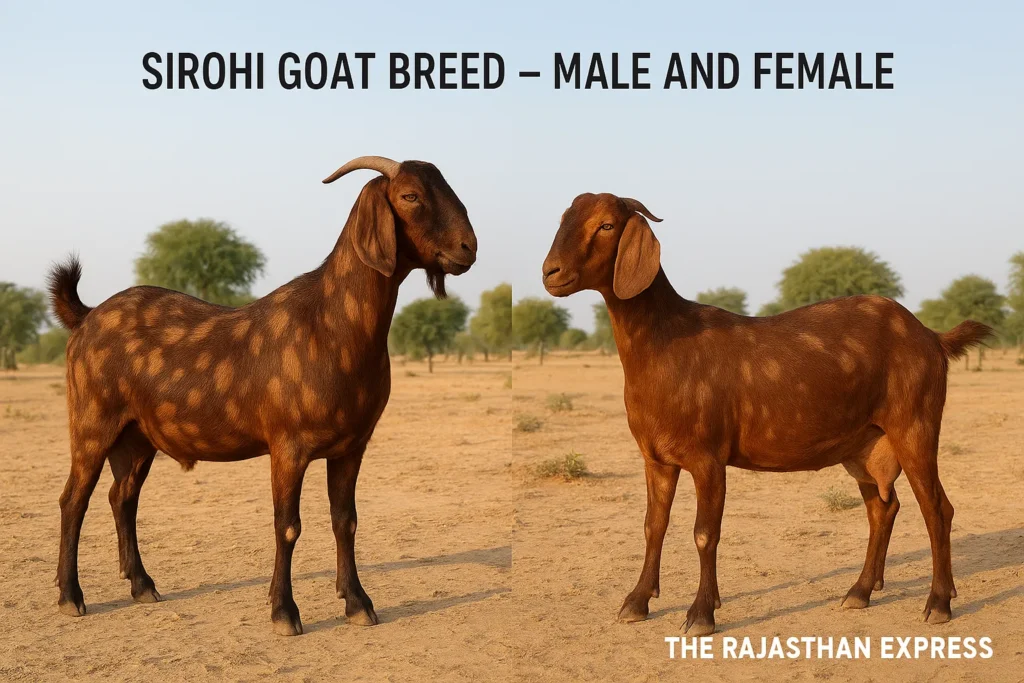
The identification of the Sirohi goat is primarily based on its brown-coloured body, leaf-like drooping ears, upwardly and backwardly curved horns, and strong body structure. These characteristics make it a reliable and productive breed adapted to the difficult conditions of Rajasthan.
Body Size of Sirohi Goat (According to ICAR-NBAGR)
Adult Male Buck Physical Constitution
- Body Length: 77.94 cm
- Height at Withers: 78.89 cm
- Heart Girth: 77.50 cm
- Weight: 42.83 kg
Adult Female Doe Physical Constitution
- Body Length: 74.19 cm
- Height at Withers: 74.57 cm
- Heart Girth: 74.10 cm
- Weight: 35.27 kg
Newborn Kid Size
- Male Kid Birth Weight: 2.29 kg
- Female Kid Birth Weight: 2.22 kg
Sirohi Goat Production Capacity and Performance
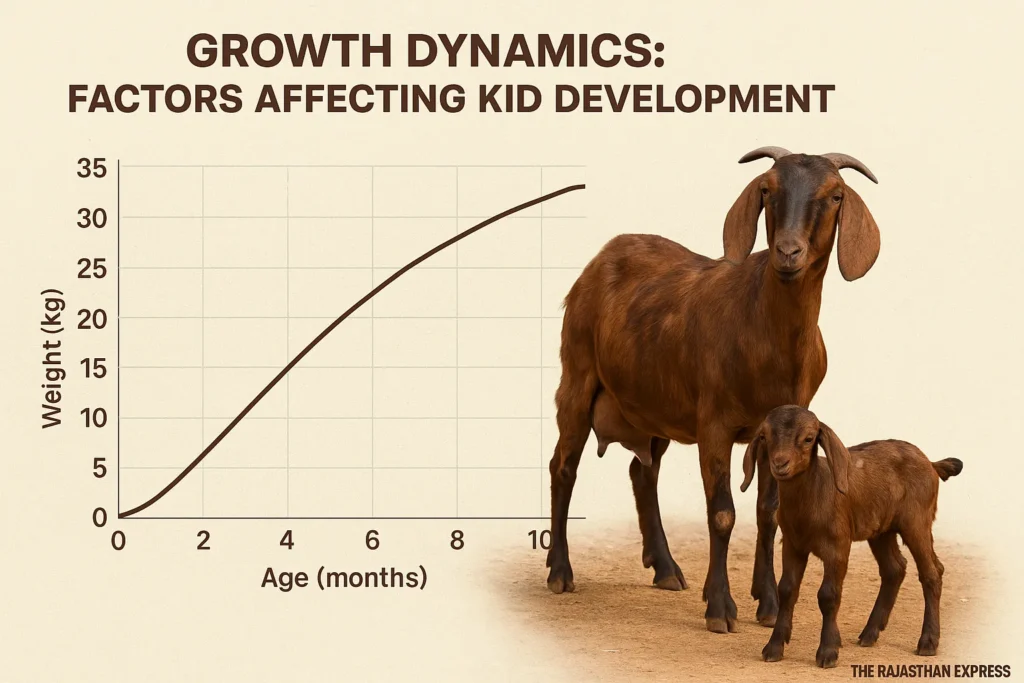
From a production capacity perspective, an average adult breeding male weighs 40-50 kg and a female 25-35 kg. Various studies indicate that the birth weight of their kids is approximately 2-3 kg for males and 1.5-2 kg for females, which increases to 24 kg and 22.5 kg respectively by 12 months of age.
In terms of Sirohi goat milk per day yield, first-time kidding goats yield about 48 kg of milk in 90 days, and produce an average of 81.5 kg of milk in a complete lactation period.
In terms of reproduction, the Sirohi goat kids for the first time at around 651 days (21-22 months) of age, and the interval between two births is approximately 310 days (10 months). The rate of twin births in them ranges between 10-25%, meaning that most of the time a single kid is born. The kid survival rate in this breed up to 12 months is 94%, which proves it to be a durable and healthy breed.
| 🐐 Sirohi Goat – Performance Parameters | ||||
| Parameter | Average | Minimum | Maximum | Unit / Note |
|---|---|---|---|---|
| Age at first parturition | 26.14 | — | — | Months |
| Parturition interval | 10.06 | — | — | Months |
| Milk yield per lactation | 81.50 | — | — | Kilograms (kg) |
| Milk fat | — | — | — | % (Data not available) |
| Litter size at birth | 1.00 | — | — | Kid(s) per birth |
| The Rajasthan Express : Performance Parameters of Sirohi Goat | ||||
Sirohi Goat Price in India (2025) – Rajasthan Rates & Farming Profit
| 💰 Sirohi Goat Price Ranges | |||
| Category | Price Range (per kg) | Price Range (per animal) | Key Details & Regions |
|---|---|---|---|
| General Market Price | ₹220 – ₹600/kg | ₹4,000 – ₹25,000/animal | Wide range based on weight, age, and location. Ajmer, Rajasthan is a major supply hub. |
| Rajasthan (Ajmer/Kishangarh) | ₹220 – ₹280/kg | ₹5,000 – ₹12,000/animal | Often the most competitive rates. Key for bulk purchases. |
| Other States (e.g., Karnataka, Tamil Nadu) | ₹250 – ₹500/kg | ₹12,000 – ₹20,000/animal | Higher prices in southern states (e.g., Tamil Nadu, Kerala) due to transport costs. |
| Premium/High-Weight Animals | ₹400 – ₹1,000/kg | ₹25,000 – ₹40,000/animal | High prices for top-quality breeding stock or very heavy animals (e.g., 45–50 kg). |
| The Rajasthan Express : Market Prices of Sirohi Goats Across India | |||
The National Livestock Gene Bank: A Center for Conserving Indigenous Livestock Genetic Resources
The objective behind establishing the National Livestock Gene Bank is the conservation and promotion of India’s indigenous livestock breeds. This gene bank operates under the National Bureau of Animal Genetic Resources (NBAGR), Karnal, Haryana, which functions under the Indian Council of Agricultural Research (ICAR).
In this gene bank, semen collected from superior breeding male animals of the country’s major indigenous breeds—such as bulls, sheep, goats, camels, horses, and yaks—is preserved through long-term cryopreservation at extremely low temperatures in liquid nitrogen gas. The aim is to preserve these invaluable genetic resources for future generations.
Semen from the Sirohi breed buck has also been preserved in the National Livestock Gene Bank, so that high-quality male goats can be obtained through Artificial Insemination. In addition to the Sirohi goat, semen samples of other native goat breeds and various animal species are also safely stored here.
Currently, a total of 3,06,948 deep frozen semen doses are preserved in the National Livestock Gene Bank, which have been collected from 590 breeding male animals. These samples belong to 63 registered breeds of the country, representing 7 major animal species—cattle, buffalo, sheep, goat, camel, horse, and yak.
Breeds with Cryopreserved Semen in the National Livestock Gene Bank
| Breeds with Cryopreserved Semen in the National Livestock Gene Bank | ||
| S.No. | Species | Conserved Breeds |
|---|---|---|
| 1 | Cattle | Amritmahal, Dangi, Gangatiri, Gir, Hallikar, Hariana, Kangayam, Kankrej, Kherigarh, Khilar, Krishna Valley, Ongole, Ponwar, Punganur, Rathi, Red Kandhari, Red Sindhi, Sahiwal, Tharparkar, Vechur, Frieswal, Gaolao, Bargur, Nagori, Badri, Nimari, Deoni, Binjharpuri, Ghumsuri, Khariar, Malnad Gidda |
| 2 | Buffalo | Assam Swamp, Banni, Bhadawari, Jaffrabadi, Murrah, Nili-Ravi, Pandharpuri, Surati, Tarai, Mehsana, Toda, Nagpuri |
| 3 | Goat | Black Bengal, Chegu, Osmanabadi, Assam Hill, Gaddi, Ganjam, Jamunapari, Berari, Beetle, Sirohi, Sangamneri, Barbari |
| 4 | Sheep | Garole |
| 5 | Camel | Jaisalmeri |
| 6 | Equine | Marwari, Zanskari, Poito, Manipuri, Halari |
| 7 | Yak | Arunachali |
| The Rajasthan Express : National Livestock Gene Bank | ||
Sirohi Goat Population in India
The Sirohi goat is a major dual-purpose (milk and meat) indigenous breed of India, whose primary area is the Sirohi district of Rajasthan. The available data regarding its population is as follows:
1. Total Goat Population in India
According to the 20th Livestock Census (2019):
- The total number of goats in India was 148.88 million (approximately 14.89 crore).
- This figure shows a notable increase of 10.1% compared to the previous 2012 census (135.17 million).
- With this increase, goats have become the second largest livestock category in the country after poultry.
- The state with the highest goat population in India is Rajasthan.
2. Historical and Current Population of Sirohi Goat
An accurate nationwide figure for the specific population of the Sirohi breed is not available, as census reports often do not separately publish breed-wise details. However, estimates obtained from various sources are as follows:
| Sirohi Goat Population | ||
| Year | Reported Population | Source and Remarks |
|---|---|---|
| 1972 | 295,000 (approx. 2.95 lakh) | Breed census in primary distribution area (Sirohi district, Rajasthan and Palanpur district, Gujarat). Included 7,000 adult males and 2,04,000 adult females. (Source: FAO) |
| 2013 | 1.82 – 3.08 Million (approx. 18.2 to 30.8 lakh) | Reported to the UN’s FAO Domestic Animal Diversity Information System (DAD-IS). |
| 2019 | No precise national data available | 20th Livestock Census. |
| 2024 | Approx. 353,000 (3.53 lakh) | According to Dainik Bhaskar, this is an estimated figure for Sirohi district only, not the breed’s total population across India. (Source: Dainik Bhaskar) |
| The Rajasthan Express : Sirohi Goat Population Overview | ||
3. State-Level Analysis: The Status in Rajasthan
- The state of Rajasthan has the highest number of goats in India, at 20.84 million (approx. 2.08 crore).
- According to some sources, the Sirohi breed constitutes about 60% of Rajasthan’s total goat population. If this estimate is correct, then the number of Sirohi goats in Rajasthan alone could be around 12.5 million (1.25 crore). However, this is an estimate and requires official confirmation.
The population of the Sirohi goat has seen a remarkable increase over the last few decades. While its population was about 3 lakh in 1972, it increased to 30 lakh by 2013. Currently, it is the most prominent breed for goat farming in Rajasthan and has also expanded to other parts of the country. However, in the absence of breed-wise data in the 2019 census, estimating its exact number at the national level remains a challenge.
Sirohi Goat Farming: Key Insights from a 5-Year Research Report
This five-year study (2013–2017) presents a real picture of the growth performance of Sirohi goats in Southern Rajasthan. The study revealed that sex, type of birth, rearing location (farm or field), and mother’s weight are the key factors affecting the growth of goats. Goats reared in fields or natural (native) conditions showed better growth compared to goats reared on an industrial farm. A difference of about 10 kg in weight was found between the two at 12 months of age. According to the study, the age of 6 months is the most suitable selection point for predicting future performance.
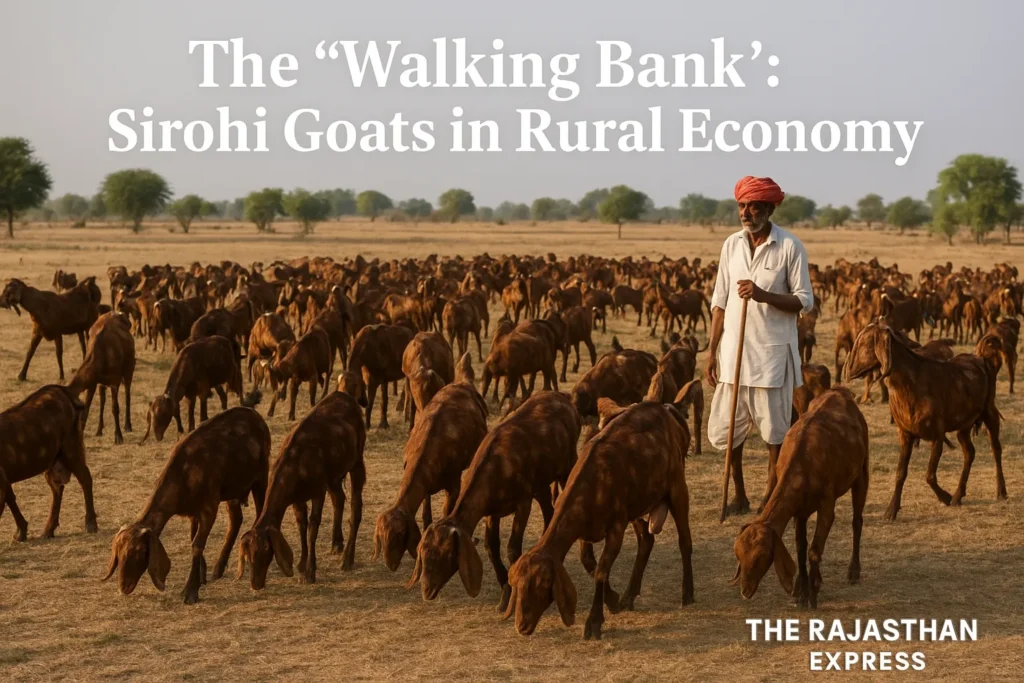
The goat is a significant pillar of the Indian agricultural economy, especially for farmers with limited land and smallholdings. This is why it is often called the “Poor Man’s Cow.” A popular saying in rural areas goes:
“Sheep and goats are wealth at midnight — they can be useful anywhere, anytime.”
The meaning of this saying is that the wealth obtained from sheep and goat rearing is always useful. A farmer can sell a goat or sheep at any time and get immediate cash. From this perspective, goat farming is a safe, flexible, and quick source of income for the rural economy. Rural people often call it a “Walking Bank” — which can fulfill their economic need at any time.
In short, it can be said — “Sheep and goats are the wealth of the rural farmer, which is always useful.”
In Rajasthan, the Sirohi goat constitutes about 60 percent of the state’s total goat population. This breed is primarily reared for meat and milk production and, according to government statistics, is the highest milk-yielding goat in Rajasthan. This study was conducted with the objective of understanding the growth patterns of Sirohi goats in different residential conditions and environmental factors and identifying the elements affecting their growth.
Study Area and Period
- Location: Livestock Research Station (LRS), Vallabhnagar, Udaipur, Rajasthan
- Period: 5 Years (2013–2017)
- Climate: Semi-arid region, where the average annual rainfall is about 660 mm and the temperature ranges between 2.3°C to 42.3°C.
Data Collection and Management
- Sample Size: Data from a total of 2,683 Sirohi goat kids was collected from birth up to 12 months of age.
- Parameters Measured:
- Body Weight – in kilograms (kg)
- Body Measurements – in centimeters (cm)
- Heart Girth (HG)
- Height at Withers (HAW)
- Body Length (BL)
- Measurement Ages: Birth, 3, 6, 9, and 12 months.
Study Groups and Management
- Cluster Classification:
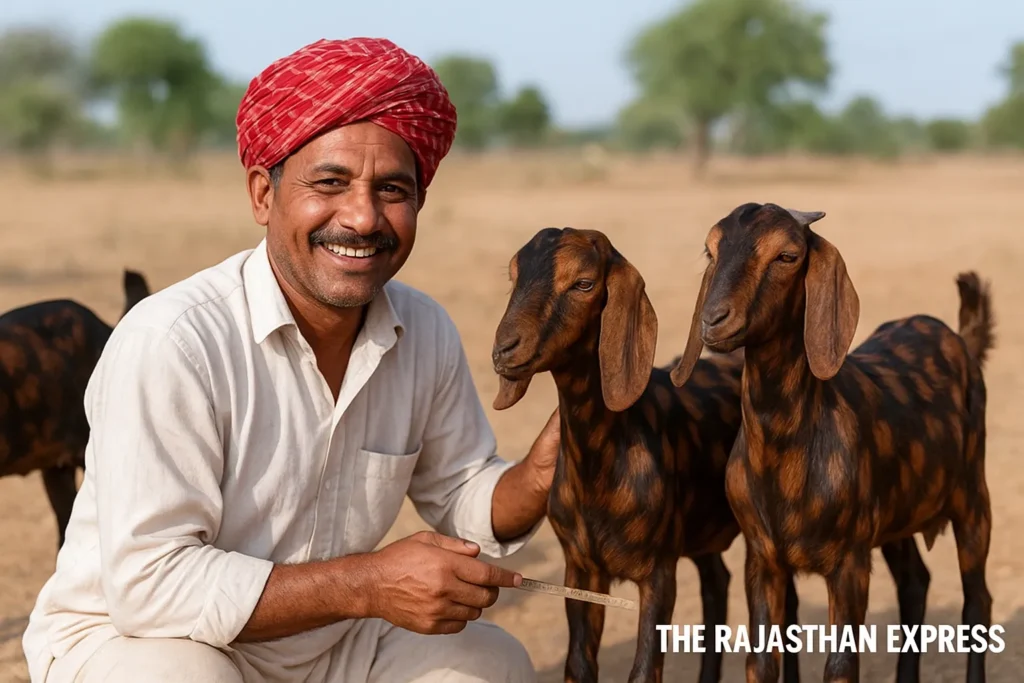
- Farm Group: Goats reared under controlled conditions at LRS, Vallabhnagar under the AICRP project.
- Field Group: Goats reared in natural (native) conditions on selected local farmers’ fields.
- Feeding Management:
- On Farm: Sorghum straw, tree leaves, pulse straw, and dry hay were provided.
- On Fields: Green and dry fodder was provided as per availability by the farmers—such as Khejri loong, Moong, Guar, gram husk, and natural green grass growing in pastures.
- Health Management:
- All goats were regularly vaccinated against:
- Enterotoxaemia (Fadkiya Rog)
- Peste des Petits Ruminants (PPR) disease.
- All goats were regularly vaccinated against:
Research Results and Analysis
1. Overall Growth Patterns
Growth of Body Weight and Measurements in Sirohi Goats with Age
| Growth of Body Weight and Measurements in Sirohi Goats with Age | ||||
| Age | Weight (kg) | Heart Girth (cm) | Height at Withers (cm) | Body Length (cm) |
|---|---|---|---|---|
| Birth | 2.50 ± 0.39 | 30.12 ± 0.33 | 30.65 ± 0.31 | 28.88 ± 0.48 |
| 3 Months | 11.21 ± 0.36 | 49.40 ± 0.56 | 49.27 ± 0.47 | 44.11 ± 0.47 |
| 6 Months | 15.29 ± 0.41 | 55.07 ± 0.63 | 54.21 ± 0.86 | 48.70 ± 0.85 |
| 9 Months | 18.00 ± 0.57 | 58.86 ± 0.88 | 57.89 ± 1.01 | 53.00 ± 1.07 |
| 12 Months | 21.86 ± 0.77 | 63.95 ± 0.99 | 63.47 ± 1.10 | 57.71 ± 1.21 |
| The Rajasthan Express : Growth Patterns of Sirohi Goats | ||||
2. Effect of Various Factors
Effect of Various Factors on Body Weight (in kg)
| Effect of Various Factors on Body Weight (in kg) | |||||
| Factor | Birth | 3 Months | 6 Months | 9 Months | 12 Months |
|---|---|---|---|---|---|
| Sex (Male) | 2.67 | 11.83 | 16.28 | 19.13 | 23.46 |
| Sex (Female) | 2.33 | 10.58 | 14.30 | 16.87 | 20.26 |
| Birth Type (Single) | 2.95 | 11.89 | 16.11 | 18.94 | 22.74 |
| Birth Type (Multiple) | 2.06 | 10.52 | 14.46 | 17.06 | 20.98 |
| Cluster (Field) | 2.38 | 13.03 | 18.19 | 22.53 | 26.81 |
| Cluster (Farm) | 2.62 | 9.39 | 12.39 | 13.47 | 16.90 |
| The Rajasthan Express : Factors Affecting Body Weight in Sirohi Goats | |||||
3. Regression Effect of Mother’s Weight
Regression Coefficient (b) of Body Weight on Mother’s Weight (kg/kg)
| Regression Coefficient (b) of Body Weight on Mother’s Weight (kg/kg) | |||
| Age | Regression Coefficient (b) | Standard Error | Statistical Significance |
|---|---|---|---|
| Birth | 0.04 | 0.002 | P < 0.01 |
| 3 Months | 0.26 | 0.01 | P < 0.01 |
| 6 Months | 0.18 | 0.02 | P < 0.01 |
| 9 Months | 0.14 | 0.03 | P < 0.01 |
| 12 Months | 0.13 | 0.04 | P < 0.01 |
| The Rajasthan Express : Regression Effect of Mother’s Weight on Kid Growth in Sirohi Goats | |||
The most important message of this table is that the relationship between “Mother’s Weight” and “Kid’s Weight” is completely scientific and reliable. This is not a guess or an estimate. This is why the research report recommends selecting heavier females for breeding to get heavier and healthier kids, which will increase farmers’ income.
Meaning of Table Terms in Simple Language
| Meaning of Table Terms in Simple Language | |
| Term | Meaning in Simple Language |
|---|---|
| Age | The time (Birth, 3 months, 6 months, 9 months, 12 months) when the kid’s weight was measured. This was used to observe how the effect of the mother’s weight changes with increasing age. |
| Regression Coefficient (b) | This is the most important statistic. It indicates that if the mother’s weight increases by 1 kilogram, the kid’s weight will increase on average by how many kilograms.
e.g., If b = 0.26 at 3 months of age, it means that if the mother’s weight increases by 1 kg, the kid’s weight will increase by an average of 0.26 kg (260 grams). |
| Standard Error | This indicates how much variation or estimation error there is in the calculation. The lower the value, the more reliable and stable the result is considered.
e.g., A standard error of 0.01 means the measurements are very precise. |
| P-value | This is a statistical “measure of significance.” It tells whether the observed result occurred just by chance.
P < 0.01 means the probability of this result being wrong is less than 1%, meaning this is a very reliable and significant result. In simple terms: the smaller the P-value, the more certain and reliable the result. |
| The Rajasthan Express : Simplified Explanation of Statistical Terms | |
Research Contributors and Institutional Support
Principal Investigator
- Dr. Hina Ashraf Waiz
- Institution: Rajasthan University of Veterinary and Animal Sciences (RAJUVAS), Udaipur
- Position: Assistant Professor, Department of Animal Husbandry
- Email: drhinavet@gmail.com
Co-Authors
- Dr. Lokesh Gautam
- Senior Scientific Officer
- Livestock Research Station (LRS), Vallabhnagar, Udaipur
- Dr. Rajendra Kumar Nagda
- Senior Animal Husbandry Officer
- All India Coordinated Research Project (AICRP) – Sirohi Goat Improvement, Udaipur
- Dr. Mukesh Chand Sharma
- Scientific Officer
- Department of Livestock Development, Rajasthan
Institutional Support
- Rajasthan University of Veterinary and Animal Sciences (RAJUVAS), Bikaner
- Livestock Research Station (LRS), Vallabhnagar, Udaipur
- All India Coordinated Research Project (AICRP) – Goat Improvement