 By
ByRetention of Placenta in Cow (ROP): Causes, Types, and Placenta Structure in Cattle & Buffalo
Retention of Placenta (ROP) in Cattle
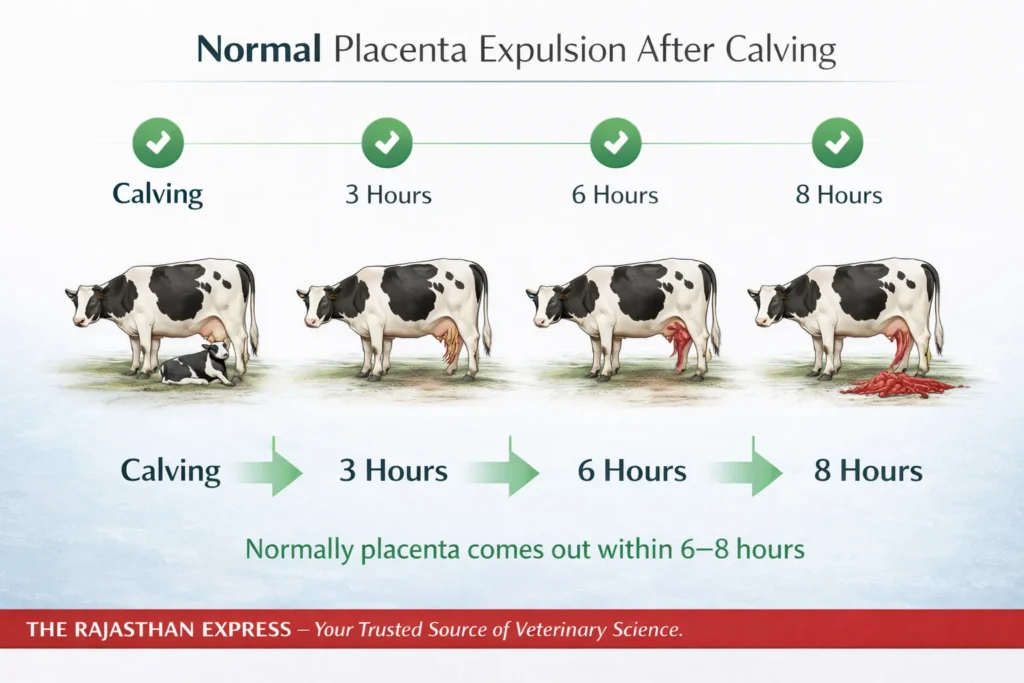
When the placenta does not separate from the uterus and come out even 12 hours after calving, this condition is called Retention of Placenta (ROP).
Under normal conditions in cow and buffalo, the placenta usually comes out on its own within 6 to 8 hours after delivery.
Placenta (अपरा / जेर) – Structure and Function
The placenta is a temporary organ that forms during pregnancy. Its main function is to facilitate the exchange of nutrients, oxygen, and other substances between the mother and the fetus (calf).
In other words, the placenta is the organ located between the blood circulation of the mother and the fetus, and it enables the transfer of nutrients, oxygen, and other essential substances.
This organ is formed by the combination of fetal membranes and the maternal uterine tissues.
In cow and buffalo, it is commonly known as jer, khedi, or placenta in local language. After the animal gives birth, the placenta normally separates from the uterus and comes out automatically after some time.
Retention of Placenta in Cow (ROP) – Causes, Types, Placenta Structure & Treatment in Cattle
| Condition Name |
Retention of Placenta in Cow (ROP) Retained Placenta in Cattle Afterbirth Retention in Cow & Buffalo |
|---|---|
| Common Veterinary Keywords | retention of placenta in cow • causes of retention of placenta in cow • treatment of retention of placenta in cow • how to remove retained placenta in cows • antibiotic for retained placenta in cows • home remedies for retained placenta in cows • retention of placenta in cattle PDF • retention of placenta in cow PPT • treatment protocol for retained placenta in cattle • placenta manual removal after birth in cattle India |
| Definition |
Retention of Placenta (ROP) is a reproductive disorder in cattle where the fetal membranes (placenta) fail to separate from the uterus and are not expelled within 12 hours after calving. Under normal physiological conditions, the placenta of cow and buffalo usually comes out naturally within 6–8 hours after delivery. |
| Local Names |
Placenta (Afterbirth) is locally called: • Jer • Khedi • Apra (अपरा) • Placenta membrane |
| Importance in Dairy Animals |
Retention of placenta in cow is a major postpartum reproductive problem that can lead to: • Metritis and uterine infection • Endometritis • Pyometra • Reduced milk production • Delayed heat cycle • Repeat breeding • Increased calving interval • Economic loss to farmers |
| Normal Placenta Expulsion Time | Cow: 6–8 hours after calving Buffalo: 8–10 hours after calving If placenta remains beyond 12 hours, it is clinically diagnosed as Retention of Placenta (ROP). |
| Placenta – Structure & Function | The placenta is a temporary organ formed during pregnancy that connects the fetus (calf) with the mother. Main Functions: • Transfer of oxygen from mother to fetus • Supply of nutrients and minerals • Removal of fetal waste products • Hormonal support for pregnancy • Protection and immune interaction between mother and fetus |
| Formation of Placenta |
The placenta in cattle forms through the combination of: • Fetal membranes (chorion & allantois) • Maternal uterine tissues (caruncles) Together they create the functional placenta responsible for fetal development. |
| Type of Placenta in Cattle & Buffalo | Cattle and buffalo have a Non-Deciduate Placenta. Meaning: • Placenta separates easily after birth • Very little maternal tissue is lost • Minimal bleeding occurs during calving |
| Human vs Cattle Placenta | Cattle & Buffalo: Non-deciduate placenta Placenta separates easily with minimal bleeding. Humans: Deciduate placenta Placenta is strongly attached and maternal tissues detach during delivery, causing bleeding. |
| Placental Structure in Cattle | The placenta of cow and buffalo can be understood in three structural levels. |
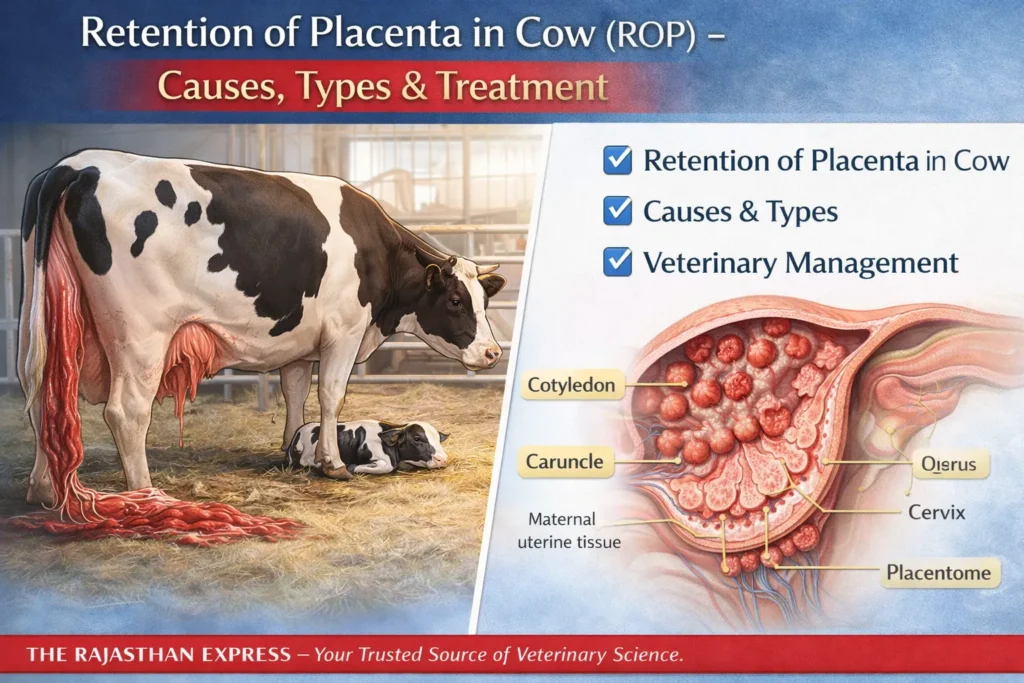
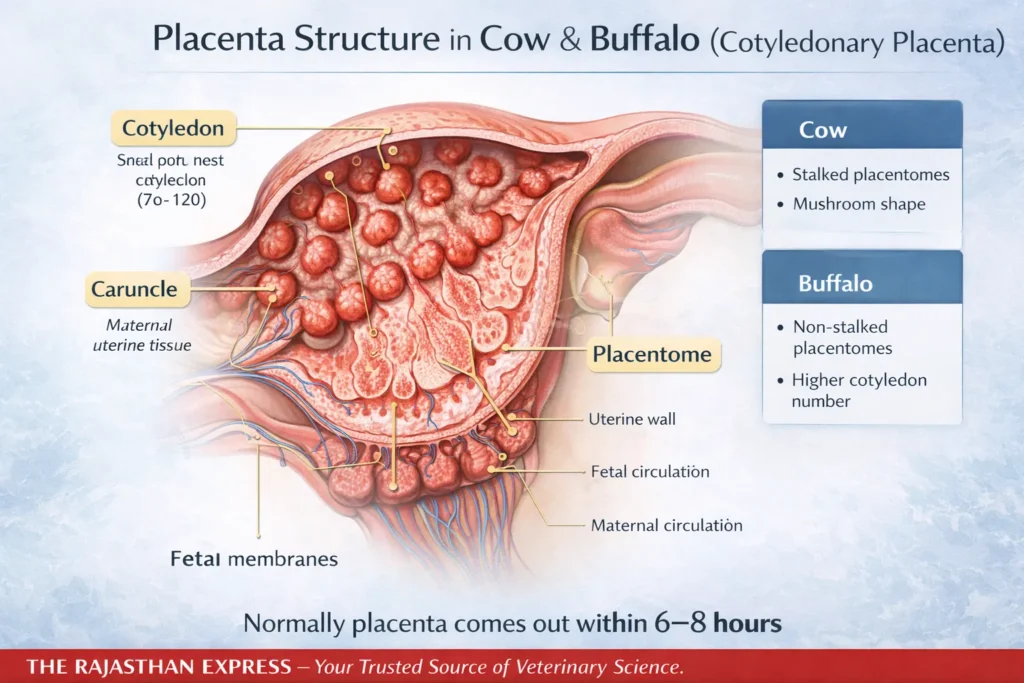
| 1. Gross Structure – Cotyledonary Placenta | In cattle, the placenta is not uniformly spread across the uterus. Instead, it is present in 70–120 round attachment points known as cotyledons.These structures attach to maternal uterine caruncles. |
| 2. Histological Structure – Synepitheliochorial Placenta | This structure allows controlled nutrient exchange between the mother and fetus. • Chorionic villi of fetus attach to uterine epithelium • Nutrient and oxygen exchange occurs at this interface |
| 3. Contact Units – Placentomes | Cotyledon (fetal part) + Caruncle (maternal part) = Placentome Placentomes are the actual functional units where nutrient exchange occurs between mother and fetus. |
| Difference Between Cow and Buffalo Placenta | Cow • Placentomes are stalked • Mushroom shaped structures Buffalo • Placentomes are non-stalked • Number of cotyledons generally higher |
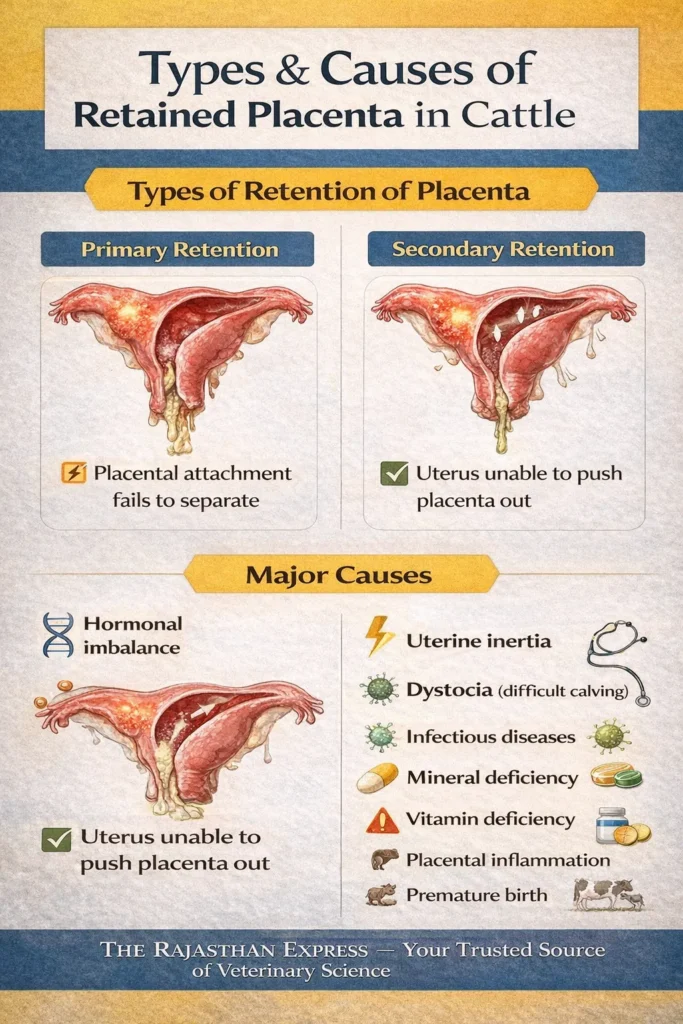
| Types of Retention of Placenta in Cattle | 1. Primary Retention The fetal membranes remain strongly attached to the maternal caruncles and fail to separate naturally. 2. Secondary Retention The uterus fails to contract properly and cannot expel the placenta. |
| Causes of Retention of Placenta in Cow (Etiology) | Major causes include: • Incomplete placental development • Premature birth • Abortion diseases (Brucellosis, Trichomoniasis, Vibriosis) • Placental inflammation (Placentitis) • Uterine inertia • Difficult calving (Dystocia) • Hormonal imbalance • Weak uterine contractions • Cervical closure • Uterine atony |
| Nutritional Causes | Deficiency of minerals and vitamins significantly increases the risk of retained placenta. Important nutrients: • Calcium • Phosphorus • Magnesium • Copper • Cobalt • Selenium • Vitamin A • Vitamin E |
| Clinical Signs of Retention of Placenta in Cow | Symptoms may vary depending on infection severity. |
| Mild / Non-Infectious Signs | • Placenta hanging outside vulva • No foul smell • Normal appetite • Normal body temperature • Milk production normal |
| Severe / Infectious Signs | • Foul smell from placenta • Reduced appetite • High fever • Drop in milk yield • Repeated straining • Dry pale placenta |
| Treatment of Retention of Placenta in Cow | Treatment depends on the condition of the animal and severity of infection. |
| Hormonal Treatment | Oxytocin Injection Dose: 30–50 IU Stimulates uterine contractions. Prostaglandin (PGF2α) Helps increase uterine contractions and placenta expulsion. |
| Calcium Therapy | Injection Calcium Borogluconate Dose: ~450 ml IV slowly Benefits: • Strengthens uterine muscles • Improves contractions • Helps expel placenta • Prevents Milk Fever |
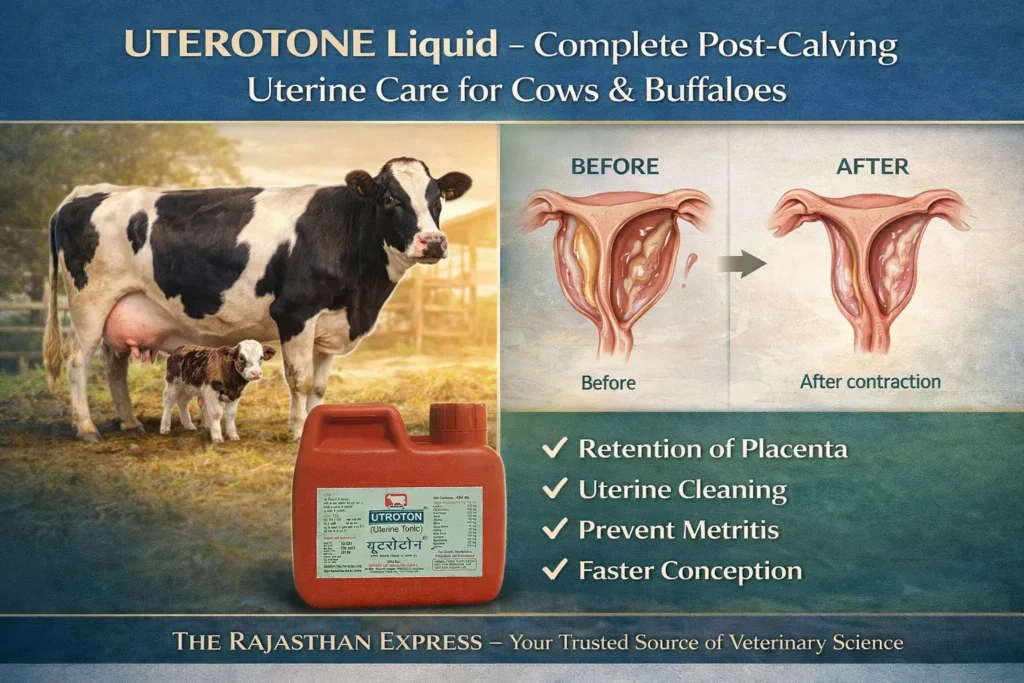
| Herbal Uterine Tonics | These medicines support uterine contraction and uterine cleaning. Common uterine tonics for cow: • Uterotone • Himrop • Utrasafe • Garbho Fit • Exapar • Utrivive |
| Manual Removal of Placenta | Manual removal is done only when medical treatment fails. Usually performed after 14–18 hours after calving under strict hygienic conditions. |
| Procedure | 1. Clean vulva with antiseptic solution 2. Insert lubricated hand into uterus 3. Separate cotyledon from caruncle 4. Slowly pull placenta outward |
| Risks of Manual Removal | • Uterine damage • Severe infection • Bleeding • Infertility risk • Zoonotic infection (Brucellosis) |
| Antibiotic Treatment | Broad spectrum antibiotics are used for 3–5 days. Common antibiotics for retained placenta in cows: • Oxytetracycline • Enrofloxacin • Ceftriaxone |
| Intra-Uterine Medicines | Medicines inserted inside uterus include: • Cleanex IU • Ranflox IU • Furex • Pessurea |
| Supportive Therapy | • NSAIDs (Meloxicam, Analgin) • Antihistamines (Pheniramine) • Vitamin B-Complex • Liver extract supplements |
| Management & Prevention | Proper management includes: • Balanced nutrition • Mineral mixture supplementation • Vitamin A, D, E supplementation • Hygienic calving environment • Early veterinary treatment |
| Conclusion | Retention of placenta in cow is a common postpartum reproductive disorder in dairy animals. Early diagnosis, proper medical treatment, balanced nutrition, and good management practices are essential to prevent infection, restore fertility, and maintain milk production in cows and buffaloes. |
| Sources: The Rajasthan Express; Dr. Pramod Kumar (Bikaner, Rajasthan) | |
Type of Placenta in Cattle & Buffalo
The structure and composition of the placenta in cow and buffalo have some unique characteristics. It can mainly be understood in three parts.
From the human perspective, cows and buffaloes have a Non-Deciduate type of placenta. This means that when a cow or buffalo gives birth, the placenta separates easily from the uterus and comes out, and very little maternal tissue is expelled along with it. Therefore, very little bleeding occurs during delivery.
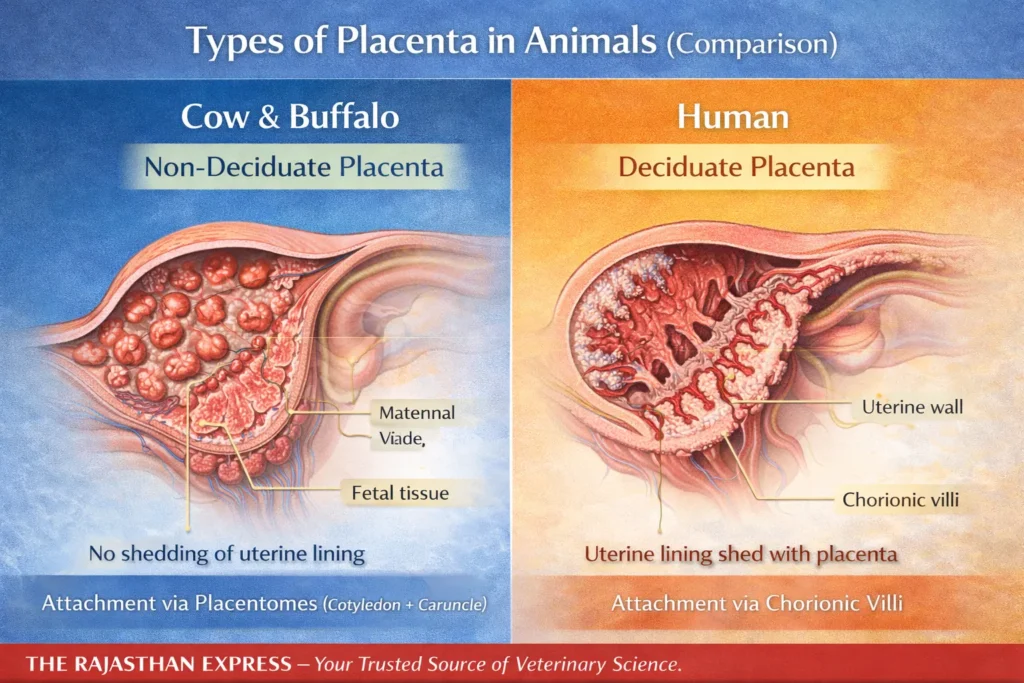
In contrast, humans have a Deciduate type of placenta. In this type, the placenta is strongly attached to the uterine wall. Therefore, when the baby is born and the placenta separates, some maternal tissues also detach, which leads to bleeding.
1. Gross Structure – Cotyledonary Placenta
- In cow and buffalo, the placenta is not spread throughout the uterus.
- Instead, it is present at 70 to 120 small round areas in the uterus known as cotyledons.
2. Histological Structure – Synepitheliochorial Placenta
- In this type of structure, the chorionic villi of the fetus are attached to the maternal uterine epithelium.
- This is the location where nutrients and oxygen are exchanged between the mother and the fetus.
3. Contact Points – Placentomes
- In cow and buffalo, the fetal cotyledons and the maternal caruncles combine to form placentomes.
- The placentome is the actual site where direct contact between the mother and the fetus occurs.
Differences Between Cow and Buffalo Placenta
Cow
- In cows, placentomes are stalked.
- Their structure appears mushroom-shaped.
Buffalo
- In buffaloes, placentomes are non-stalked.
- The number of cotyledons is generally higher in buffalo than in cows.
Retention of Placenta in Cow and Buffalo – Types and Causes
When the placenta does not come out at the proper time after calving and remains stuck inside the uterus, this condition is called Retention of Placenta.
Types of Retention of Placenta in Cattle
1. Primary Type
In this type, the fetal membranes and the maternal uterine caruncles remain excessively attached to each other.
Under normal conditions, this attachment loosens and separates naturally after the birth of the calf. However, when this separation does not occur, the placenta cannot detach from the uterus and remains stuck inside.
In simple terms:
The adhesion between the placenta and the uterus does not break, so the placenta cannot come out.
2. Secondary Type
In this type, the placenta does not come out because the uterus fails to contract properly or there is some obstruction inside the uterus.
The main reasons include:
- Reduced uterine contractions
- Weakening of uterine muscles
When the uterus does not contract properly, it cannot push the placenta out, and the placenta remains inside.
Causes of Retention of Placenta in Cow (Etiology)
There can be several causes of retention of placenta in cattle, some of the main ones are listed below.
1. Incomplete Development of Placenta
- Sometimes the placenta does not develop fully, so it cannot separate easily from the uterus during delivery.
2. Premature Birth
- If the calf is born prematurely, the placenta may not have completed its development and therefore does not detach from the uterus.
3. Abortion-Causing Diseases
Certain infectious diseases cause abortion and may also lead to retained placenta, such as:
- Brucellosis
- Trichomoniasis
- Vibriosis
These diseases affect the uterus and placenta.
4. Placental Disorders
- If there is any disease or abnormality in the placenta, it may fail to separate from the uterus at the proper time.
5. Uterine Inertia
- When uterine contractions become very weak or completely stop, the uterus cannot generate enough force to expel the placenta.
6. Difficult Calving (Dystocia)
- If the delivery is very difficult or prolonged, the uterus becomes exhausted and cannot expel the placenta.
7. Hormonal Imbalance
- If the level of progesterone hormone becomes too high, it reduces uterine contractions.
- As a result, the placenta does not come out.
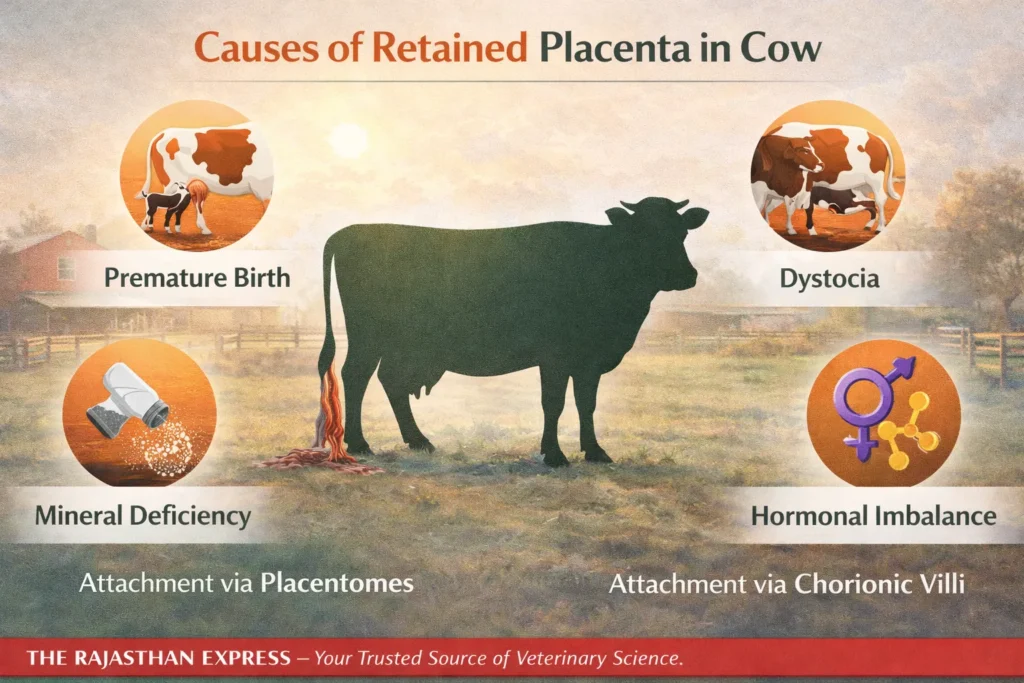
8. Mineral Deficiency
If the animal does not receive a proper mineral mixture, the risk of retained placenta increases.
Important minerals include:
Deficiency of these minerals can weaken the uterus.
9. Vitamin Deficiency
- If the animal lacks Vitamin A, Vitamin E, and Selenium, the placenta may fail to detach on time.
10. Closure of the Cervix
- Sometimes the cervix (uterine opening) does not open completely, which makes it difficult for the placenta to come out.
11. Uterine Atony
- If the uterine muscles become very relaxed, the uterus cannot push the placenta out.
12. Inflammation of the Placenta
- If placentitis (inflammation of the placenta) occurs, the placenta may remain attached to the uterus.
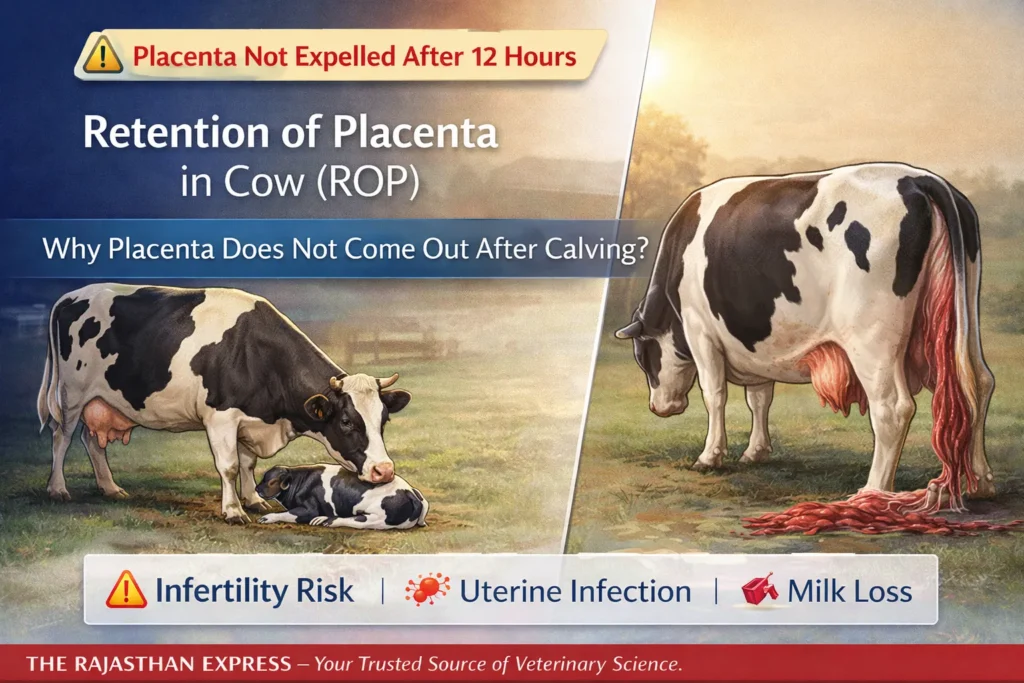
Retention of Placenta in Cow (ROP): Clinical Signs, Symptoms, and Treatment
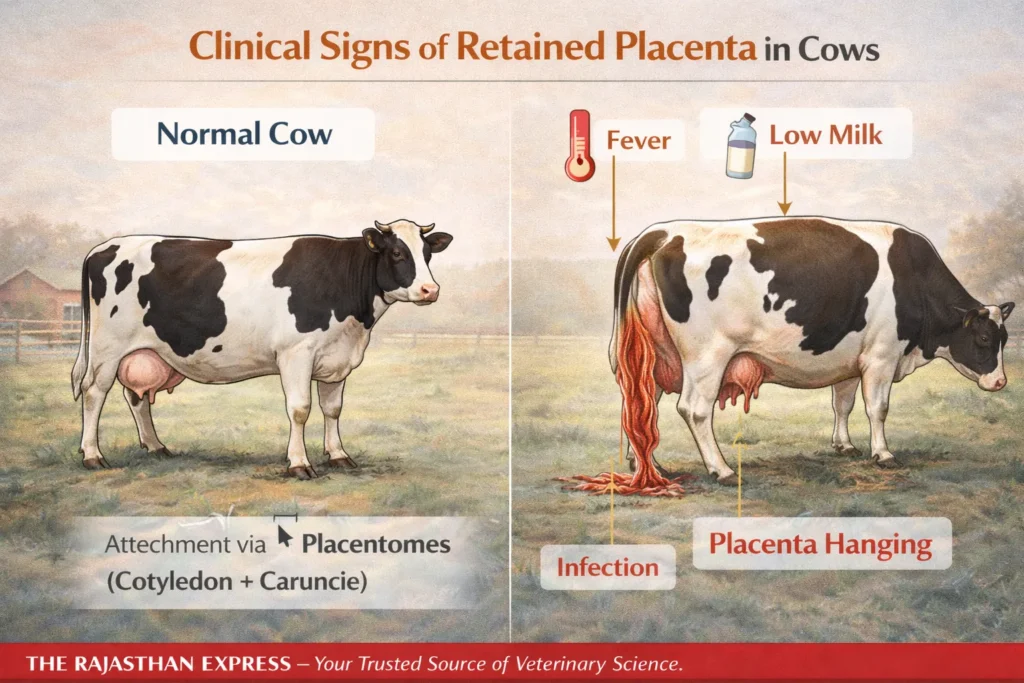
Clinical Signs & Symptoms of Retention of Placenta in Cow
- In cases of retention of placenta in cow, the symptoms can appear in two different forms. This depends on whether the infection is mild or severe.
(A) Non-Infectious Symptoms (Mild or No Infection)
In this condition, the animal generally remains normal, and serious symptoms are usually not observed.
The main signs are as follows:
- The placenta (afterbirth) can be seen hanging outside the vulva.
- There is no strong foul smell coming from the placenta.
- The animal’s appetite remains normal.
- Body temperature remains normal.
- There is no significant decrease in milk production.
- The color, moisture, and shine of the placenta appear normal.
(B) Infectious Symptoms (Severe Infection or Prolonged Retention)
If the placenta remains stuck inside the uterus for a long time, it may start to decompose and become infected. In such cases, serious symptoms begin to appear in the animal.
The main symptoms are:
- The animal’s appetite decreases, or the animal may stop eating and drinking completely.
- High fever may occur.
- Milk production drops significantly.
- The animal strains repeatedly, as if trying to push something out.
- A strong foul smell starts coming from the placenta.
- The placenta becomes pale in color and appears dry.
Note: If abortion in a cow occurs due to Brucellosis, the placenta appears hard and leathery.
THE RAJASTHAN EXPRESS
Treatment of Retention of Placenta in Cow (ROP)
The treatment of retained placenta in cows depends on the condition of the animal and the severity of infection. The most important point is that the placenta should not be pulled out manually in the beginning. Doing so can damage the uterus and increase the risk of infection. Therefore, medical treatment should be started first.
1. Hormonal Treatment for Retained Placenta in Cattle
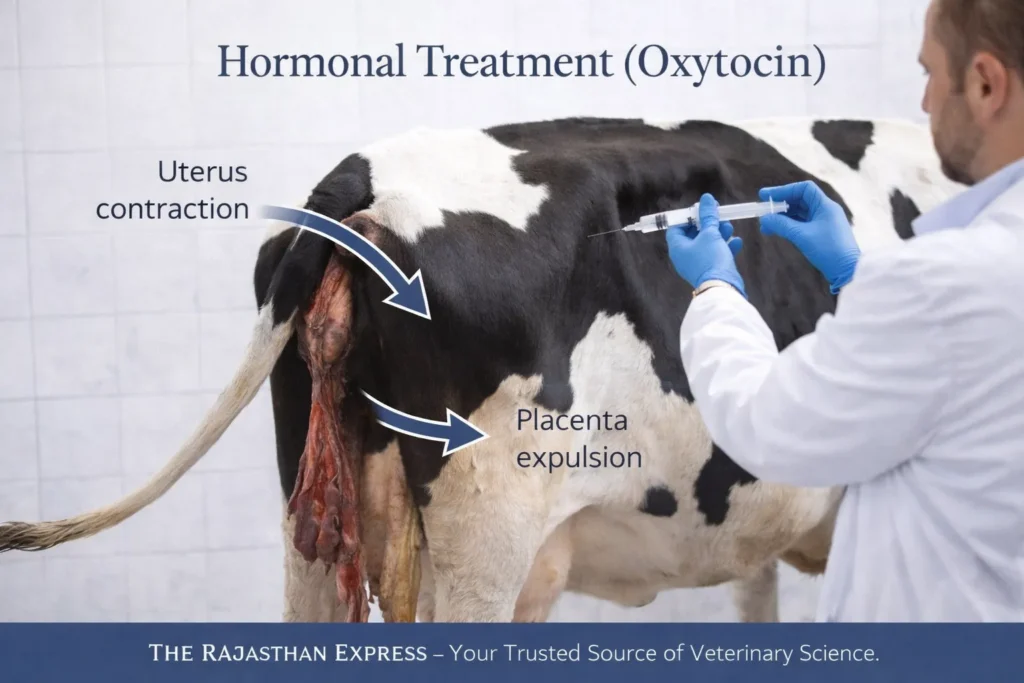
Oxytocin Injection (Inj. Oxytocin)
Dose: 30–50 IU
- This medicine increases uterine contractions.
- It helps the uterus expel the placenta.
⚠️ Important Note:
The effect of oxytocin is more effective within 24 hours after calving. After this period, the uterus becomes less sensitive to the drug, and its effect may decrease.
Oxytocin increases uterine contractions and is considered an Ecbolic Medicine.
Prostaglandin (PGF2α)
- This medicine can be used during or after delivery.
- It is sometimes given along with oxytocin.
- It also increases uterine contractions, which helps in the expulsion of the placenta.
2. Treatment to Increase Uterine Contractions
Calcium Therapy
After calving, animals often experience a deficiency of calcium in the body. Due to this deficiency, the uterine muscles become weak and relaxed, and the placenta cannot come out.
Therefore, calcium is administered to strengthen the muscles and increase contractions.
Benefits of Calcium Therapy
- Provides strength to uterine muscles
- Improves uterine contractions
- Helps in expulsion of the placenta
Medication Used
Dose: Approximately 450 ml
- It is given slowly through intravenous (I/V) route.
Advantages
- Strengthens uterine muscles
- Helps in removal of retained placenta
- Prevents diseases such as Milk Fever (Hypocalcemia) and Downer Cow Syndrome
- Helps the uterus return to its normal size faster after calving (Uterine Involution)
Herbal Ecbolics – Uterine Tonic for Cow
Some Ayurvedic or herbal medicines are also available that help increase uterine contractions. These medicines are used as supportive treatment in cases of retention of placenta in cows.
These medicines are generally known as Uterine Tonics, because they help strengthen the uterus.
Main Benefits
- Help increase uterine contractions
- Strengthen the uterus
- Assist in internal uterine cleaning
- Help the uterus return to normal size after calving
- Assist in expelling the retained placenta
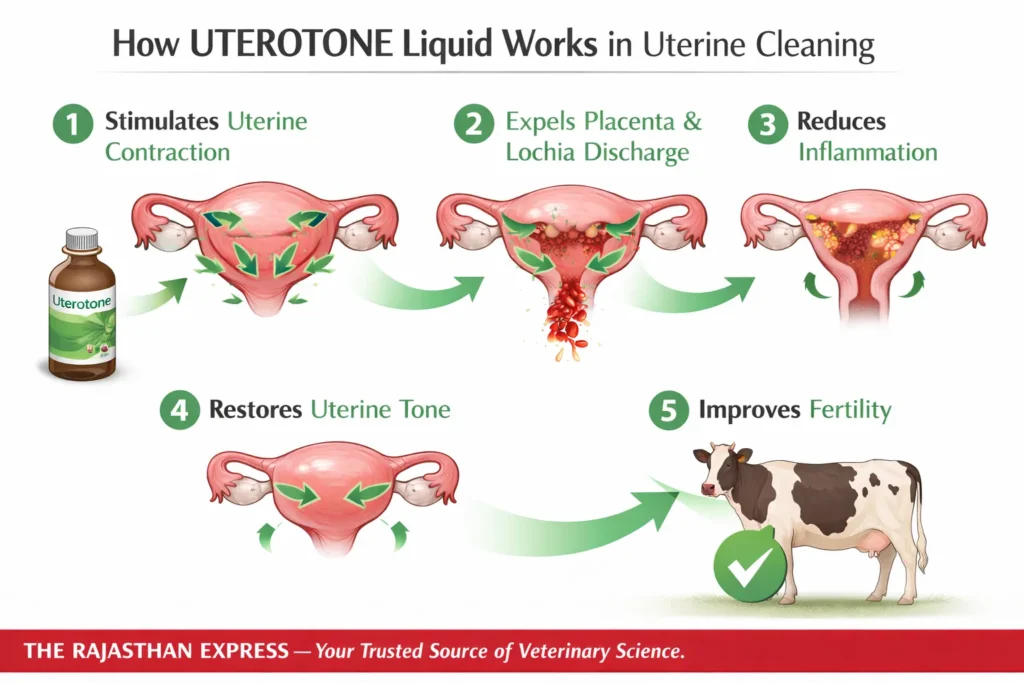
Common Uterine Tonic For Cow Used
Some commonly used herbal uterine tonics for cows include:
- Himrop
- Utrasafe
- Uterotone
- Utrivive
- Garbho Fit
- Exapar
These medicines increase uterine contractions and help in the removal of retained placenta.
Manual Removal of Placenta in Cattle: Procedure, Risks, and Treatment Protocol
Manual Removal of Placenta in Cow and Buffalo
The manual removal of placenta must be performed with great care and complete hygiene. Before attempting to remove the placenta by hand, medical treatment (hormonal therapy and calcium therapy) should always be administered.
Important Points
- The manual removal of placenta in cattle should be used only as a last option after medical treatment.
- If the placenta does not fall out even after approximately 14 to 18 hours after calving, then it may be removed manually.
- This procedure must be performed under strict aseptic conditions.
Why Precaution is Necessary During Manual Removal
During manual removal of placenta, there can be health risks for both the animal and the veterinarian.
Sometimes the placenta fails to come out because the animal suffers from abortion-related diseases, such as Brucellosis.
Brucellosis is a zoonotic disease, which means it can spread from animals to humans. Contact with infected material can infect veterinarians or livestock handlers and may cause serious long-term health problems.
Brucellosis Risk in Rajasthan
- In Rajasthan, veterinarians and livestock farmers have frequent contact with animals, which increases the risk of brucellosis infection.
- Some studies have found cases of infection among veterinary personnel in the Govindgarh and Kishangarh areas of Jaipur district, which is a matter of concern.
Main Sources of Infection
- Handling infected animals such as cows, camels, and sheep
- Contact with aborted fetuses or retained placenta
- Consumption of raw milk or products made from raw milk
Symptoms of Brucellosis in Humans
If a person becomes infected with brucellosis, the following symptoms may commonly appear:
- Persistent fever for a long time
- Joint pain
- Swelling of the testicles and temporary or permanent infertility
- Weakness and fatigue
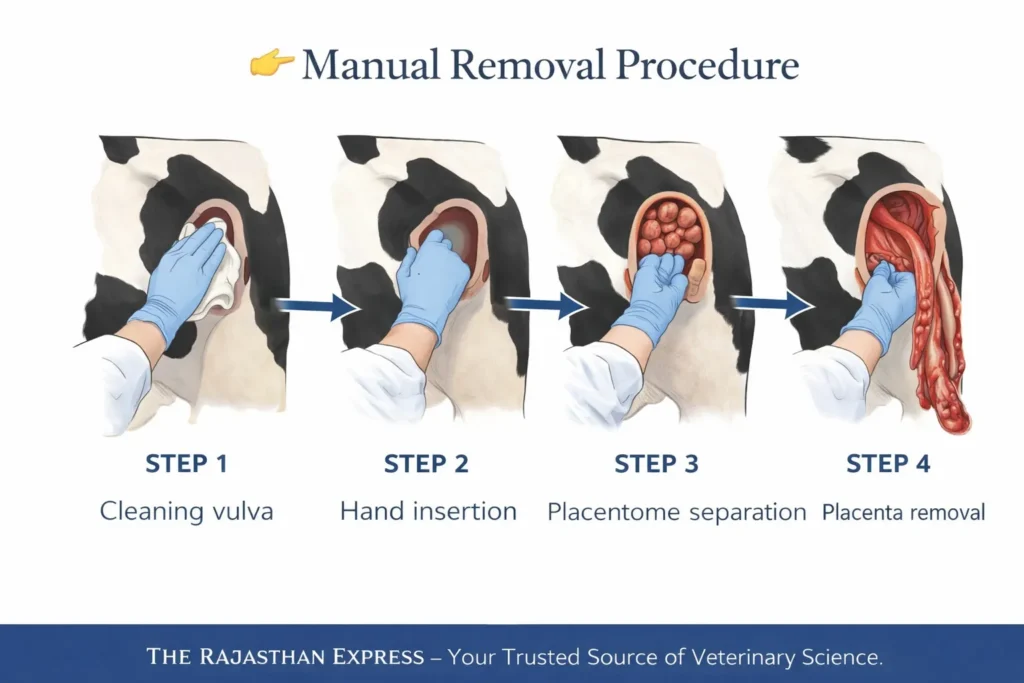
Procedure for Manual Removal of Placenta in Cattle
1. Cleaning
- First, clean the vulva and surrounding area of the animal while wearing a sleeve. Use a mild antiseptic solution such as 1:1000 Potassium Permanganate (KMnO₄).
2. Understanding the Attachment
- Inside the uterus, the maternal caruncle and fetal cotyledon combine to form a button-like structure called a placentome.
- This is the point where the placenta is attached.
3. Method of Separation
- Apply antiseptic cream on the hand and gently insert the hand into the uterus.
- Hold the placentome with the thumb and fingers, rotate it slightly like a screw, or insert the finger between the caruncle and cotyledon to separate them.
- At the same time, use the other hand to slowly pull the hanging placenta outward.
In this way, the placenta gradually separates from the uterus and comes out.
Post-Treatment After Manual Removal
Even after removing the placenta, medical treatment should be continued.
1. Antibiotics for Retained Placenta in Cows
- Give broad-spectrum antibiotics for 3–5 days to prevent any secondary bacterial infection.
2. Intra-Uterine Bolus
These medicines are inserted directly into the uterus, such as:
- Cleanex
- Ranflox-IU
- Furex
- Furea
- Pessurea
These drugs help control infection and support uterine recovery.
3. Antihistaminic + NSAID (Non-Steroidal Anti-Inflammatory Drugs)
These medicines are used to reduce inflammation, pain, and allergic reactions. After placenta removal, swelling and pain may occur in the uterus, so these drugs help provide relief to the animal.
Examples include:
- Meloxicam
- Paracetamol
- Nimesulide
- Analgin
- CPM
- Pheniramine
4. Herbal Uterine Cleanser
These medicines support uterine cleaning and recovery.
Example:
5. Vitamin B-Complex + Liver Extract
These supplements help increase the animal’s strength and improve appetite.
Examples include:
- Tribivet
- Nurokind
- B-Complex
Management of Retention of Placenta in Cattle
Proper management of retained placenta in cattle involves:
- Early medical treatment (hormones and calcium)
- Avoiding forceful manual removal in the early stage
- Maintaining strict hygiene during manual removal
- Providing antibiotics and supportive therapy after removal
- Ensuring proper nutrition, minerals, and vitamins
Effective management helps prevent infection, improve recovery, and restore reproductive health in cows and buffaloes.
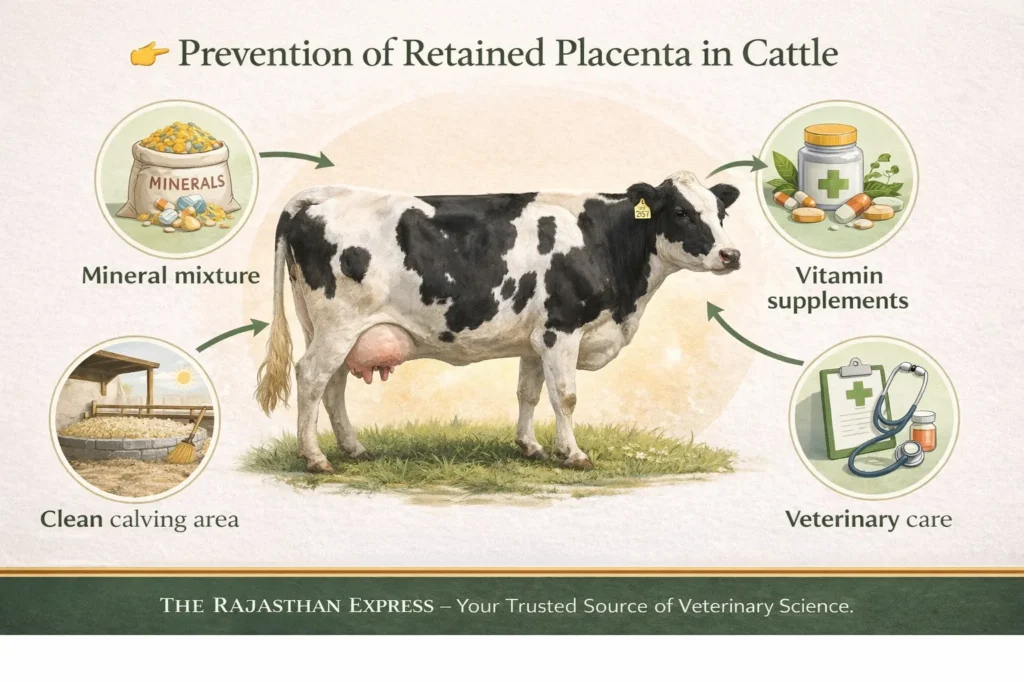
Complete guide on retention of placenta in cow including causes, symptoms, treatment protocol, antibiotics, manual removal procedure, and management in cattle.
THE RAJASTHAN EXPRESS