 By
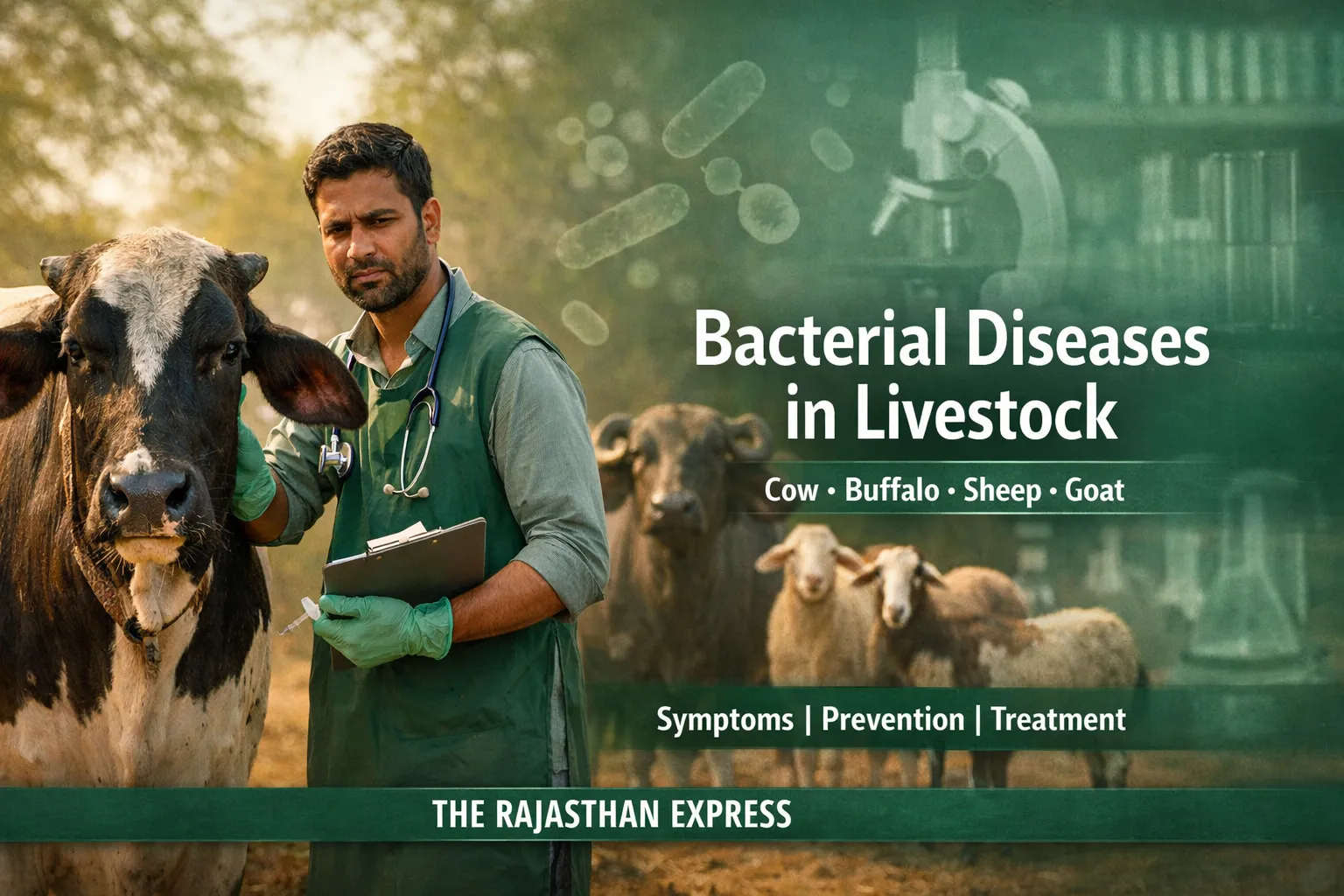
ByBacterial Diseases in Cattle, Buffalo, Sheep & Goat: A Complete Guide
Introduction to Bacterial Diseases in Cattle
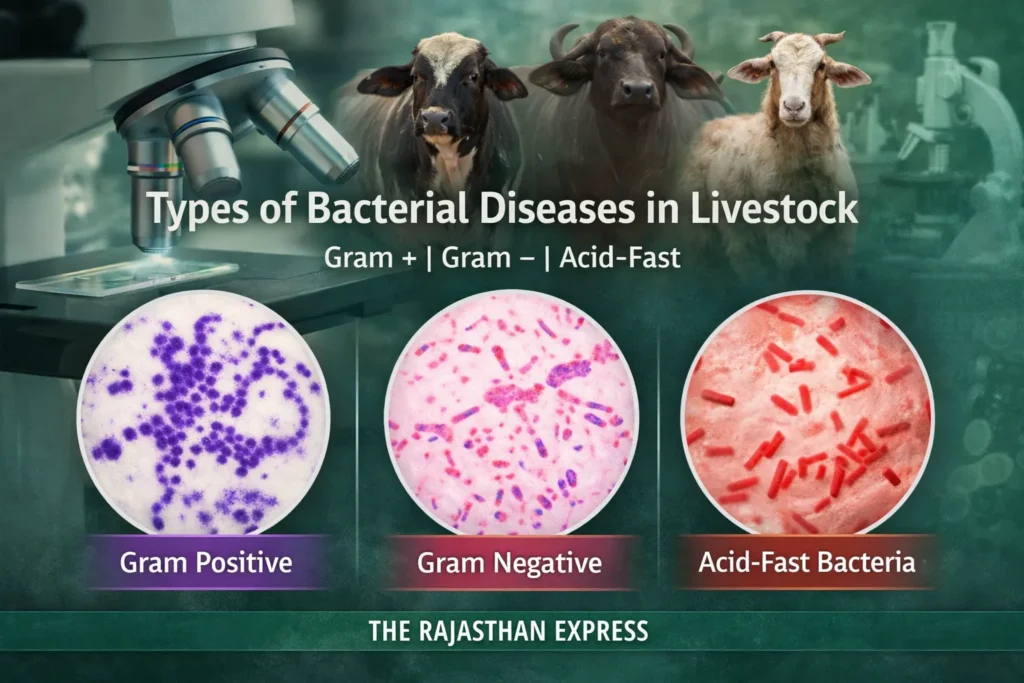
Bacterial diseases are caused by microscopic bacteria. For a clear understanding of cattle diseases, these infections are classified into three main categories based on their cell wall structure and staining properties:
- Gram-Positive (Gram +) Bacterial Diseases
- Gram-Negative (Gram -) Bacterial Diseases
- Acid-Fast Bacterial Diseases
Bacterial Diseases of Cattle, Buffalo, Sheep & Goat
| Field | Veterinary Science / Animal Husbandry | ||||||||
|---|---|---|---|---|---|---|---|---|---|
| Topic | Bacterial Diseases in Livestock | ||||||||
| Definition | Bacterial diseases are infections caused by pathogenic bacteria that affect livestock health, productivity, and reproduction. | ||||||||
| Affected Animals | Cattle (Cow), Buffalo, Sheep, Goat | ||||||||
| Classification |
| ||||||||
| Major Gram-Positive Diseases |
| ||||||||
| Major Gram-Negative Diseases |
| ||||||||
| Acid-Fast Diseases |
| ||||||||
| Mode of Transmission |
| ||||||||
| Common Clinical Signs |
| ||||||||
| Zoonotic Diseases | Anthrax, Brucellosis, Tuberculosis, Leptospirosis (transmissible to humans) | ||||||||
| Prevention & Control |
| ||||||||
| Economic Importance | Causes major losses due to decreased milk yield, mortality, reproductive failure, and treatment costs. | ||||||||
| The Rajasthan Express : bacterial diseases in cattle, livestock diseases, diseases of cattle, cow diseases list, cattle diseases and treatment, bacterial infections in animals, veterinary diseases, animal husbandry diseases | |||||||||
Gram-Positive Bacterial Diseases in Cattle
Identification: These bacteria have a thick peptidoglycan layer in their cell wall. Due to this structure, they retain the crystal violet stain and appear Purple under a microscope during Gram staining.
Below is a comprehensive list of common cow disease names caused by Gram-positive bacteria, their nicknames, and causative agents, essential for any diseases of cattle pdf or study material.
| Gram-Positive Bacterial Diseases in Cattle | |||
| S.No. | Disease | Nickname | Causative Agent |
|---|---|---|---|
| 1 | Anthrax | Splenic fever, Wool sorter’s disease, Hide porter’s disease | Bacillus anthracis |
| 2 | Black Quarter (BQ) | लंगड़ा बुखार (Limping fever), Black leg, Quarter ill | Clostridium chauvoei |
| 3 | Tetanus | Locked Jaw | Clostridium tetani |
| 4 | Listeriosis | Circling disease, Silage disease, Meningo-encephalitis | Listeria monocytogenes |
| 5 | Actinomycosis | Lumpy jaw | Actinomyces bovis |
| 6 | Enterotoxaemia | फड़किया रोग (Fadkiya disease) | Clostridium perfringens |
| 7 | Botulism | Loin disease, Limber neck | Clostridium botulinum |
| 8 | Bacillary hemoglobinuria | Red water disease | Clostridium hemolyticum |
| 9 | Mastitis | Mammitis | Streptococcus, Staphylococcus (Main G+ causes) |
| The Rajasthan Express : Cattle Diseases (Gram-Positive Bacteria) | |||
Gram-Negative Bacterial Diseases in Cattle
Identification:
- These bacteria possess an outer membrane in addition to a thin peptidoglycan layer. They do not retain the crystal violet stain and appear Pink under a microscope.
Understanding these pathogens is crucial for effective bacterial diseases in cattle treatment protocols.
| Gram-Negative Bacterial Diseases in Cattle | |||
| S.No. | Disease | Nickname | Causative Agent |
|---|---|---|---|
| 10 | Hemorrhagic Septicemia (H.S.) | गलघोटू (Galghotu), नाकरोधी (Nakarodhi) | Pasteurella multocida |
| 11 | Brucellosis | Bang’s disease, Undulant fever, Malta fever | Brucella abortus |
| 12 | Leptospirosis | Weil’s disease, Stuttgart disease, Canine typhus | Leptospira spp. |
| 13 | Colibacillosis | Calf scour, White diarrhoea, Calf septicaemia | E. coli |
| 14 | Salmonellosis | Paratyphoid | Salmonella typhimurium |
| 15 | Actinobacillosis | Wooden tongue | Actinobacillus lignieresii |
| 16 | Campylobacteriosis | Vibriosis, Epizootic abortion | Campylobacter foetus |
| 17 | Foot rot | Infectious pododermatitis | Sphaerophorus necrophorus |
| The Rajasthan Express : Cattle Diseases (Gram-Negative Bacteria) | |||
Acid-Fast Bacterial Diseases
Identification:
- These bacteria (Mycobacteria) have a waxy layer (Mycolic acid) in their cell wall, which prevents them from taking up standard Gram stains. Special Acid-Fast stains are required for their identification, a key topic in advanced diseases of cattle studies.
| Acid-Fast Bacterial Diseases in Cattle | |||
| S.No. | Disease | Nickname | Causative Agent |
|---|---|---|---|
| 18 | Tuberculosis | Pearl’s disease (मोती रोग) | Mycobacterium bovis |
| 19 | Para-tuberculosis | Johne’s disease, Chronic bacillary dysentery (CBD) | Mycobacterium paratuberculosis |
| The Rajasthan Express : Cattle Diseases (Acid-Fast Bacteria) | |||
Important Diseases Explained: Symptoms, Causes & Treatment
For farmers and veterinarians looking for detailed information, whether in a diseases of cattle pdf or for practical application, the following section breaks down the most critical bacterial diseases in cattle.
1. Anthrax in Cattle: The Silent Killer
What is Anthrax?
- It is a serious bacterial disease primarily affecting livestock (cattle, buffalo, sheep, goats, horses). It is a Zoonotic Disease, meaning it can spread from animals to humans.
Disease Nicknames:
- English: Anthrax, Splenic fever (due to enlarged spleen), Wool sorter’s disease (common in wool handlers), Hide porter’s disease (common in hide handlers).
- Hindi: एन्थ्रेक्स
Causative Agent:
- Bacteria: Bacillus anthracis
- Shape: Rod-shaped bacteria.
- Gram Nature: Gram-Positive.
The Most Crucial Feature: Spore Formation
- What is a Spore? A spore is a dormant (inactive) form of the bacteria. When conditions become unfavorable (lack of oxygen, extreme heat, or drought), the bacteria forms a spore—a protective “shield” against the external environment.
- Characteristics of Spores:
- Highly Resistant: These spores can survive extreme heat, cold, drought, and even chemical disinfectants.
- Longevity: They can remain alive in the soil for decades (many years). Reports suggest they can persist in the soil for 50-60 years or even longer.
- Germination: When these spores enter the body of an animal or human, they find a favorable environment (warmth, moisture, nutrients) and revert to their active (vegetative) form, causing disease.
- Critical Warning: If an animal dies suddenly with blood oozing from the mouth or anus, suspect Anthrax. Do NOT perform a post-mortem on such an animal, as opening the carcass will expose the spores to the air, contaminating the entire environment.
Read More About : Anthrax Vaccination In Cattle
2. Black Quarter (BQ) in Cattle: Why is it Called “Langda Bukhar”?
What is Black Quarter (BQ)?
- This is a serious bacterial disease primarily affecting cattle and buffalo. It is known for rapidly spreading inflammation in the muscles, leading to gas production and tissue death (necrosis). It is an acute and fatal disease in cattle.
Disease Nicknames:
- English: Black Quarter (BQ), Blackleg, Quarter ill, Symptomatic Anthrax.
- Hindi: लंगड़ा बुखार (Langda Bukhar), काला पैर (Kala Pair).
Causative Agent:
- Bacteria: Clostridium chauvoei
- Gram Nature: Gram-Positive.
- Specialty: This bacteria also forms spores that survive in the soil for many years.
Read More About : Black Quarter Disease In Cattle
Why is it called “Langda Bukhar” (Limping Fever)?
- The first and most prominent symptom is that the affected animal begins to limp (Lameness).
- In the early stages, the bacteria infect the large muscles (usually of the hind leg).
- This infection causes severe pain and swelling in the muscle, preventing the animal from putting weight on that leg, causing it to limp. Hence the Hindi name, “Langda Bukhar.”
Why are Young Animals (6-24 months) More Affected?
- Vaccination Status: Vaccination is often not done on time in this age group, or booster doses are missed, leading to low immunity.
- Weaning Stress: Weaning is a stressful period that lowers immunity, increasing infection risk.
- Teething: The process of losing milk teeth and gaining permanent teeth can temporarily weaken the immune system.
- Activity and Injury: Young animals are more active and prone to muscle injuries during play or fights. If spores are present in the soil, an injury site becomes a perfect entry point for infection.
- Immunity in Other Age Groups: Animals over 2-3 years develop natural immunity. Calves under 6 months receive passive immunity (antibodies) from the mother’s colostrum (first milk).
Read More About : Black Quarter Vaccination In Cattle
3. Hemorrhagic Septicemia (HS): The “Galghotu” Disease
- This disease is called “Nakarodhi” (nasal blockage) or “Galghotu” (choker of the throat) because swelling in the throat causes severe difficulty in breathing. It is a major concern in cattle diseases and spreads most rapidly during the rainy and winter seasons.
Read More About : Hs Vaccination In Cattle
4. Brucellosis in Cattle: The Cause of Abortion
- This is a Zoonotic disease (transmissible to humans) and a leading cause of abortion in livestock. In humans, it is known as “Undulant fever.” Understanding bacterial diseases in cattle treatment for zoonotic diseases like this is critical for public health.
Read More About : Brucellosis Disease in Cattle
5. Tuberculosis in Animals: “Pearl’s Disease”
- It is called “Pearl’s Disease” (Moti Rog) because small, pearl-like granules (nodules) form on infected organs such as the lungs. This is another severe zoonotic disease.
6. Mastitis in Dairy Animals: Causes, Symptoms, and Treatment
What is Mastitis?
- Mastitis is the inflammation or infection of the udder in dairy animals like cows, buffaloes, and goats. It is the single most economically damaging disease of cattle in the dairy industry.
Disease Names:
- Hindi: थनैला (Thanaela), थन का रोग
- English: Mastitis, Mammitis
Causes of Mastitis (Etiology)
This disease is primarily caused by four types of agents, making it a complex disease in cattle to manage.
A. Bacterial Causes (Most Common)
Bacteria are the most common and primary cause of mastitis. They are categorized into three types:
(i) Environmental Mastitis
- Cause: Caused by bacteria found in the animal’s surroundings (dung, dirt, mud).
- Main Bacteria: Klebsiella spp., Escherichia coli (E. coli), Streptococcus uberis.
(ii) Contagious Mastitis
- Cause: Caused by bacteria that spread from an infected animal to a healthy one, mainly during the milking process.
- Main Bacteria:
- Staphylococcus aureus (The most important cause in cows)
- Streptococcus agalactiae (The second biggest cause in cows)
(iii) Seasonal Mastitis
- Summer Mastitis: Occurs in summer. Caused by Corynebacterium pyogenes and Mycobacterium bovis.
- Cold Mastitis: Occurs in winter. Caused by Leptospira Pomona.
(iv) Other Bacteria
- Pasteurella multocida, Streptococcus zooepidemicus, Streptococcus pyogenes, Brucella abortus.
B. Fungal Causes
- Cause: Infection by various types of fungi.
- Main Fungi: Aspergillus fumigatus, A. midulus, Candida spp., Trichosporon spp.
C. Viral Causes
- Some viruses can also cause mastitis, though this is less common than bacterial causes.
D. Parasitic Causes
- Certain parasites can also infect the udder.

Stages of Mastitis
- Mastitis is primarily found in four stages, which is crucial information for any bacterial diseases in cattle ppt or treatment guide.
Read More About : Mastitis in Cattle
| Stages of Mastitis | ||
| S.No. | Stage | Description |
|---|---|---|
| 1 | Percute (Peracute) | Very rapid progression. Symptoms are extremely severe and sudden. |
| 2 | Acute | Symptoms are clearly visible but not as severe as peracute. |
| 3 | Subacute | Symptoms are mild and may be difficult to recognize. |
| 4 | Chronic | The disease persists for a long time, potentially causing permanent damage to the udder. |
| The Rajasthan Express : Stages of Mastitis in Cattle | ||

Symptoms of Mastitis
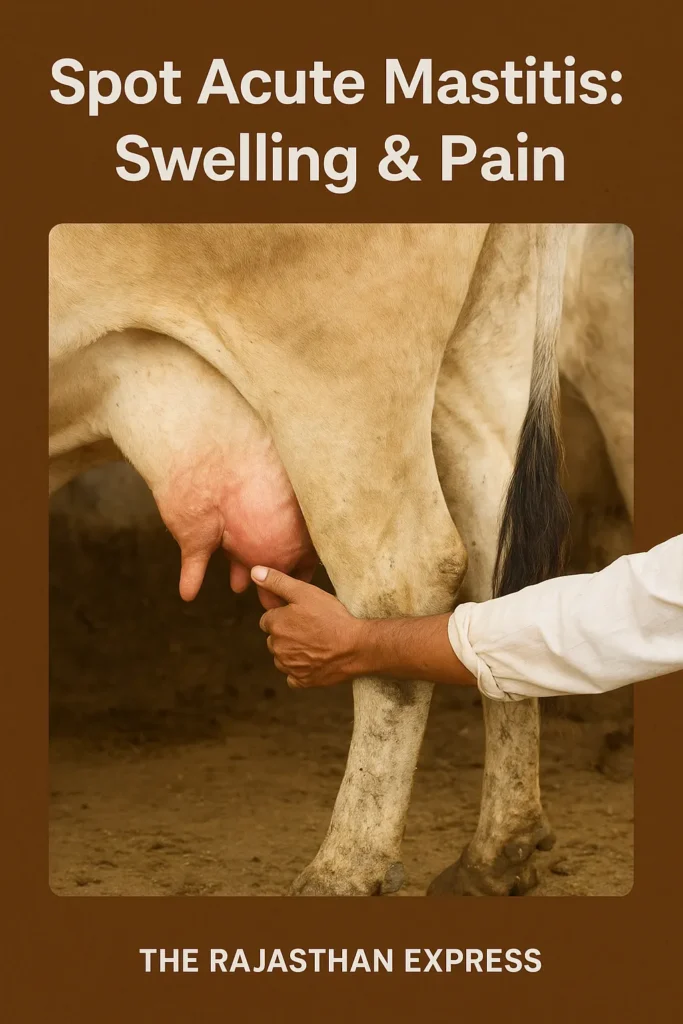
- Swelling in the Udder: The affected udder or quarter becomes swollen, hot, and painful to the touch.
- Changes in Milk: Milk production decreases. The color of the milk changes (yellowish, brownish, or mixed with blood). Clots or curd-like pieces appear in the milk. The milk may become thin and watery and develop a foul odor.
- Animal Behavior: The animal becomes restless, kicks during milking, or refuses to stand still. Other signs include loss of appetite and fever.
- Nodules: Lumps or nodules may be felt inside the udder upon palpation.
Special Facts: Mastitis in Cow vs. Buffalo
(a) Teat Canal Anatomy
- Cow: A cow’s teat canal is wider. Therefore, the likelihood of mastitis is higher in cows than in buffaloes.
- Buffalo: A buffalo’s teat canal is relatively narrower, which reduces the risk of infection.
(b) Mastitis Susceptibility by Lactation Stage
| (b) Mastitis Susceptibility by Lactation Stage | ||
| Animal Type | Highest Risk Lactation | Reason |
|---|---|---|
| Desi Cow (Indigenous) | 3rd Lactation | Milk production peaks during this time, putting more pressure on the udder. |
| Buffalo | 4th Lactation | Milk production is at its highest during this lactation. |
| Exotic Cow (e.g., Holstein) | 5th Lactation | These high-yielding breeds have larger udders, increasing infection susceptibility. |
| The Rajasthan Express : Mastitis Susceptibility by Lactation Stage | ||

(c) Most Affected Breed
Among exotic cows, the Holstein-Friesian breed has the highest incidence of mastitis.
7. Enterotoxaemia (Fadkiya Rog)
- This is called “Fadkiya” because it causes twitching (fasciculation) in the animal’s muscles. This disease often occurs due to overeating (sudden intake of too much grain concentrate).
Read More About : Enterotoxemia Vaccination For Goats
8. Tetanus (Lockjaw)
- It is called “Locked Jaw” because the animal’s jaw becomes locked or stiff, making it unable to eat. It typically occurs following a deep injury, such as a puncture wound from a nail or thorn.
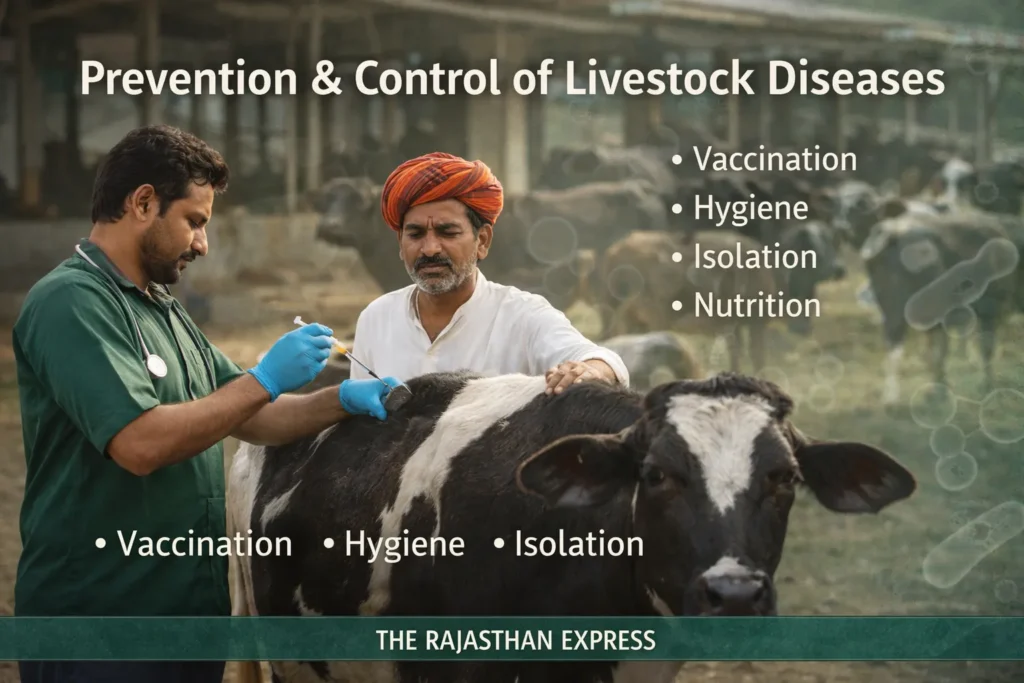
Discover the most common cattle diseases and diseases in cattle including causes, symptoms, and prevention. Get a complete cow disease name list and expert guide on disease of cattle for farmers and veterinary students.
THE RAJASTHAN EXPRESS