 By
ByEstrous Cycle in Animals (Mad Chakra): Complete Guide to the Cow Heat Cycle, Phases, and Types
Estrous Cycle
The body of a female animal operates through a natural cycle that prepares her for pregnancy. This regular process is known as the Estrous Cycle.
- To understand this, let’s take a simple example. Just as women experience a menstrual cycle every month, female animals like cows, buffaloes, and mares also undergo a reproductive cycle in their bodies at specific intervals.
Definition of the Estrous Cycle
Definition: “The periodic activity exhibited by a non-pregnant female animal at regular intervals, during which she becomes receptive to reproduction.”
In simple terms: When a female animal (like a cow) is not pregnant, her body undergoes changes at regular intervals, like clockwork. The purpose of these changes is to prepare her for mating with a male. When she is fully ready, she is said to be in “Heat.”
- Estrous Cycle: This is the entire process, starting from one “heat” stage and ending at the next “heat” stage. It is a continuous cycle that repeats until the animal becomes pregnant.
- Estrus or Heat: This is the most important day (or few hours) of the entire cycle. It is the time when the female is eager to accept the male and stands ready for mating. In common language, we say, “The cow is in heat” or “The buffalo is in estrus.“
Estrous Cycle in Animals (Cow Heat Cycle Guide)
| Scientific Term | Estrous Cycle (Oestrus Cycle / Mad Chakra) |
|---|---|
| Definition | The regular reproductive cycle in non-pregnant female animals during which the body prepares for mating and pregnancy. |
| Main Purpose | To prepare the female reproductive system for fertilization, pregnancy, and reproduction. |
| Heat (Estrus) | The short period in the cycle when the female animal accepts the male for mating. |
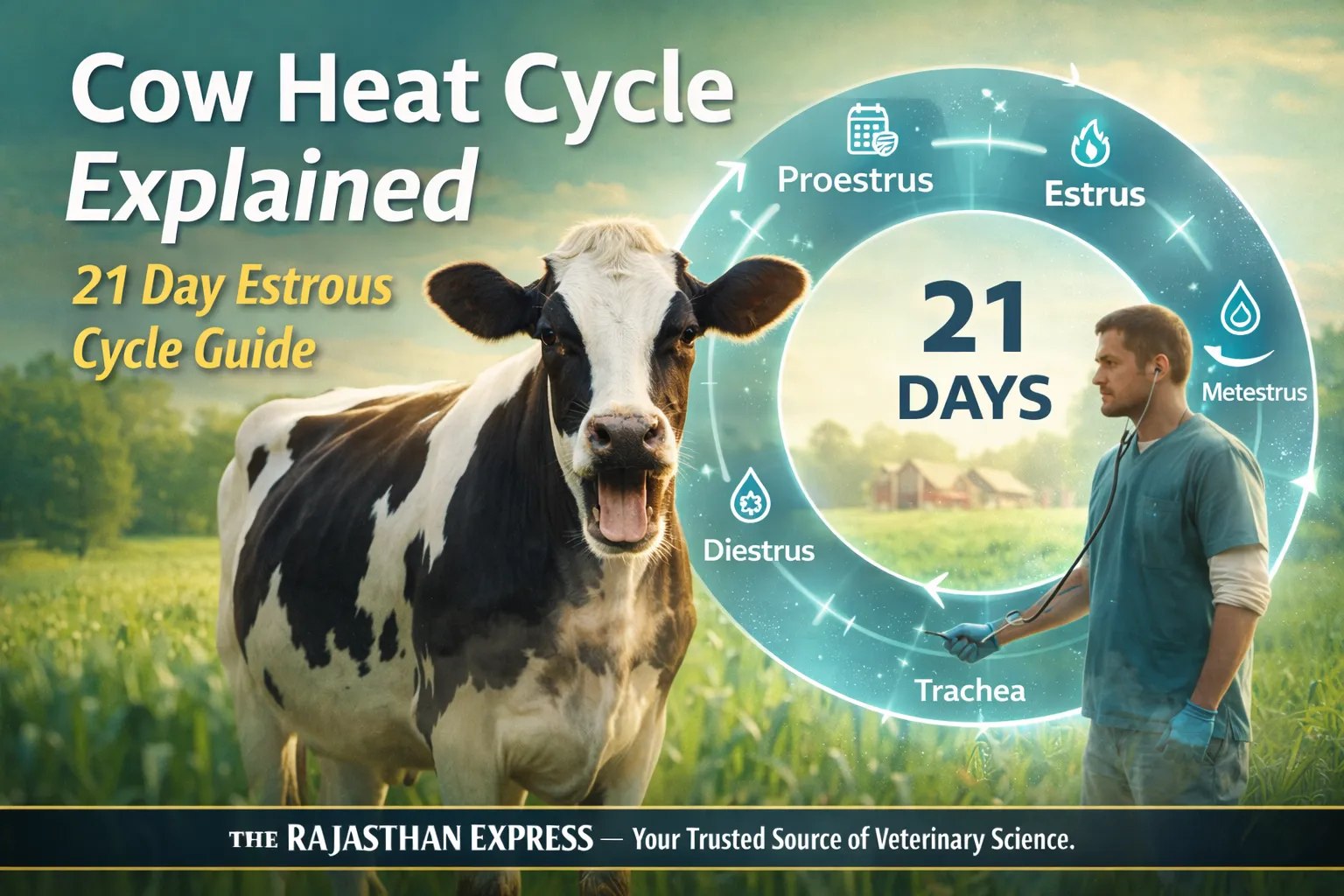
| Length of Estrous Cycle in Cattle | 21 Days (average cow heat cycle length) |
| Heat Duration in Cow | 12–24 Hours |
| How Often Do Cows Come in Heat? | If not pregnant, cows come into heat every 21 days. |
| Main Hormones Involved |
|
| Two Main Phases |
|
| 4 Stages of Estrous Cycle in Cattle |
|
| Ovulation in Cow | Occurs 12–14 hours after the end of heat (during Metestrus stage). |
| Shortest Stage | Estrus (Heat) |
| Longest Stage | Diestrus |
| Common Heat Signs in Cow |
|
| Types of Estrous Cycle in Animals |
|
| Seasonal Breeders |
|
| Cycle Duration in Different Animals |
|
| Important Fact | The best time for breeding or artificial insemination in cows is during the heat period (estrus stage). |
Types of Estrous Cycle in Different Animals
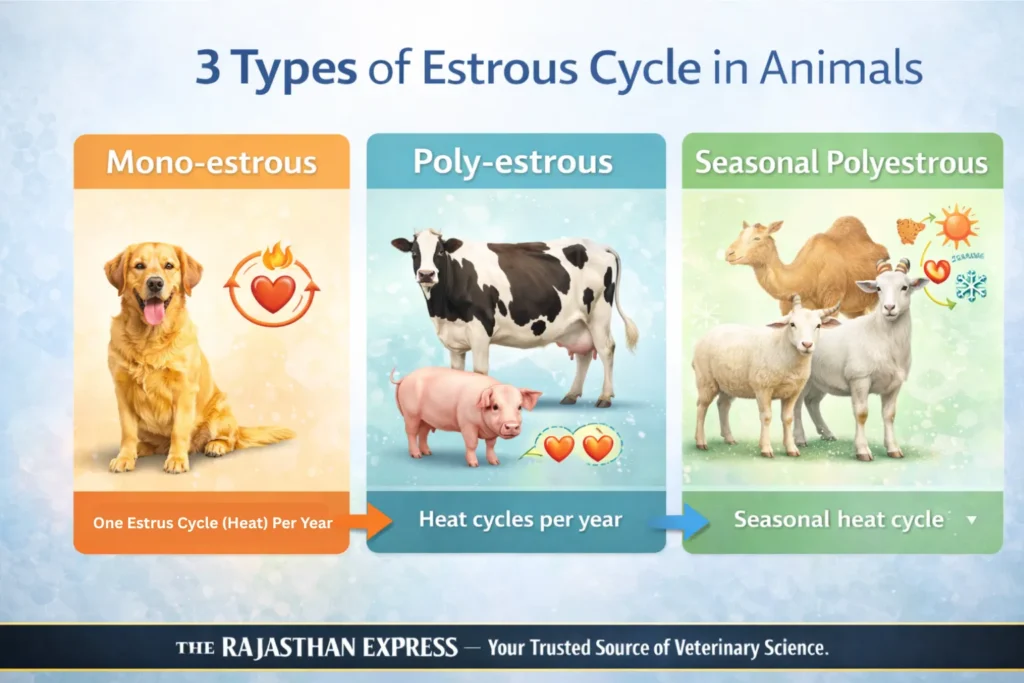
The estrous cycle is not the same in all animals. In some, it occurs once a year, in others multiple times, and in some, it occurs only in a specific season. Animals are categorized based on this pattern.
1. Mono-estrous Animals
In these female animals, the estrous cycle occurs only once a year. If pregnancy does not occur at that time, they must wait a full year for the next opportunity.
- Example:
- Bitch (Dog): Most dogs come into heat twice a year, but some breeds and wild animals like wolves have it only once a year.
- Some Wild Animals (e.g., Wolf, Fox): This ensures their offspring are born in a specific and favorable season (like spring).
2. Poly-estrous Animals
These animals experience repeated estrous cycles throughout the year (all 12 months). As soon as one heat period ends, another begins after a few days or weeks. This continues until they become pregnant.
- Examples:
- Cow: The length of estrous cycle in cattle, specifically in cows, is approximately 21 days. If she doesn’t become pregnant, she will come into heat again after 21 days.
- Sow (Pig): Pigs also cycle throughout the year, approximately every 21 days.
3. Seasonally Polyestrous Animals
In these animals, the estrous cycle occurs only during a specific season of the year. During that season, they come into heat repeatedly, and for the rest of the year, their reproductive system remains dormant. This season is chosen so that the birth of the offspring coincides with the most favorable conditions.
This type is further divided into two categories.
(a) Long-day Breeder Animal
(Cycle occurs during the summer season when days are long)
- When: When the days are long and nights are short (summer season).
- Examples:
- Mare (Horse): Mares typically come into heat during the long days of spring and summer. Their reproductive cycle slows down or stops during winter. This ensures the foal is born the following spring/summer when grass and weather are good.
- Cat: Domestic cats also often come into heat more actively during longer days.
(b) Short-day Breeder
(Cycle occurs during the winter or short-day season)
When: When the days are short and nights are long (autumn or early winter).
Examples:
- Ewe (Sheep) and Doe (Goat): These animals come into heat during the cold season (October-November). This ensures their lambs/kids are born in the spring when the weather is warming up and good forage is available.
- Buffalo: While the estrous cycle in buffalo can occur year-round, their fertility (intensity of heat and conception rate) is best during the cold season (October to February).
- Camel: The main breeding season for camels is also winter.
| Types of Estrous Cycle in Different Animals | |||
| No. | Animal Type | Timing of Estrous Cycle | Examples |
|---|---|---|---|
| 1 | Mono-estrous | Only once a year | Bitch (some), Wild animals |
| 2 | Poly-estrous | Throughout the year (every 20-21 days) | Cow, Sow (Pig) |
| 3 | Seasonal-Polyestrous | In one specific season of the year | Mare, Cat, Sheep, Buffalo, Goat, Camel |
| (a) | Long-day Breeder | In summer (long days) | Mare, Cat |
| (b) | Short-day Breeder | In winter/autumn (short days) | Sheep, Goat, Buffalo, Camel |
| The Rajasthan Express : Types of Estrous Cycle in Animals | |||
The estrous cycle is a natural process in the bodies of female animals that prepares them for pregnancy. This cycle occurs at different times and in different ways in various animals. Accurate knowledge of this cycle is very important in animal husbandry and veterinary science, as it makes timely breeding possible.
THE RAJASTHAN EXPRESS
Rutting Period In Camel Male – The Special Breeding Stage in Male Animals
What is the Rutting Period?
The Rutting Period is a special reproductive stage in male animals. During this time, the process of sperm production (Spermatogenesis) is active in their bodies, and they are ready for breeding.
- In some animals like camels, deer, and elephants, this stage is typically observed during the winter season (November to March). During the rest of the year, sperm production is very low or almost stopped.
Names for this Stage in Camels
This stage in male camels is known by different names.
- Rut: The common English term.
- Musth: This term is more famous for elephants but is also used for camels.
- Thoot (थूट): A term prevalent in rural areas of Rajasthan and North India. In villages, it is often said, “The camel is in Thoot” or “The camel is heated.”
Hormonal Changes During the Rutting Period
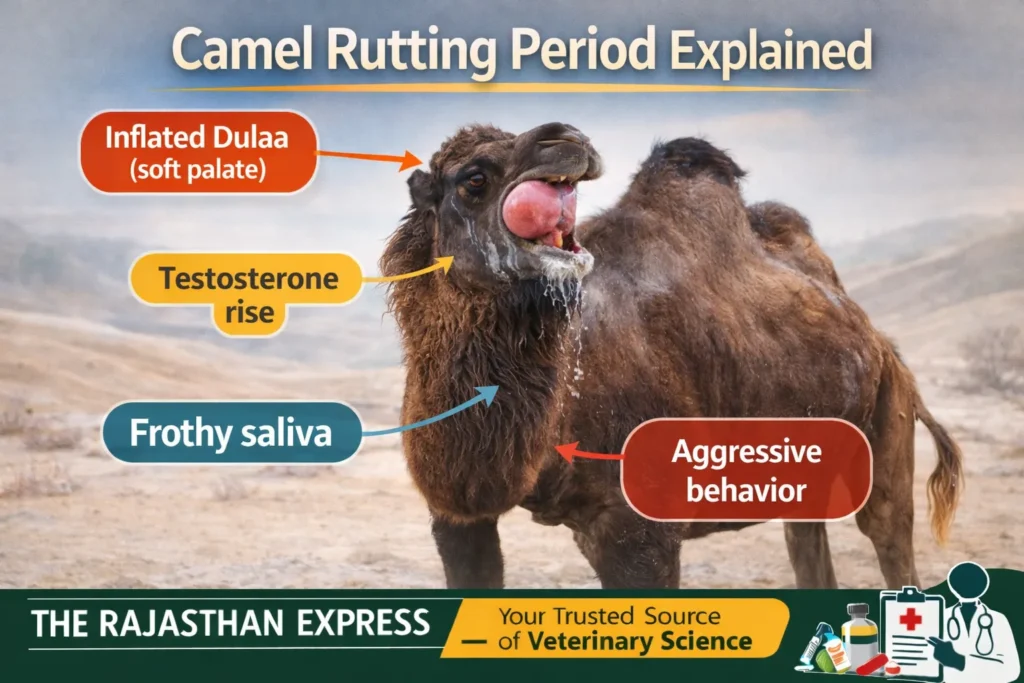
- Increase in Testosterone: During this stage, the male camel’s body secretes a very high amount of the hormone Testosterone.
- Effect: This hormone is responsible for maleness, strength, and aggression. Its increase changes the camel’s behavior.
Camel Behavior During the Rutting Period
- Aggressive Behavior: During this time, the camel becomes more aggressive, irritable, and violent compared to other times.
- Behavioral Changes:
- He attacks other male camels.
- He inflates his soft palate (Dulaa) and extrudes it from his mouth.
- He makes loud sounds (gurgling noises).
- Frothy saliva drips from his mouth.
- He does not allow anyone to come near him.
Mandible Fracture: Cause of Jaw Fracture
- Problem: The highest number of cases of jawbone (Mandible) fractures in camels are observed during the rutting period.
- Reason:
- During this time, two male camels fight each other.
- The camel’s fighting style involves bending its long, strong neck and delivering powerful blows with its head and neck to the other camel.
- If a blow or counter-blow strikes the jawbone directly, it can fracture.
- Biting with teeth can also cause a jaw fracture.
Rural Belief
In rural areas, it is believed that camels should be given less food during the rutting period. People believe that feeding less food ends this stage quickly and the camel returns to normal sooner. Although this is not entirely scientifically proven, nutrition can influence hormonal activity.
Duration of the Rutting Period In Camel
In camels, the rutting period typically lasts from November to March, i.e., about 4–5 months. Its duration depends on several factors:
- Health of the camel
- Food and nutrition
- Breed
A healthy camel with good nutrition may have a longer duration, while a weak camel may have a shorter one.
Phases and Stages of the Estrous Cycle in Cattle
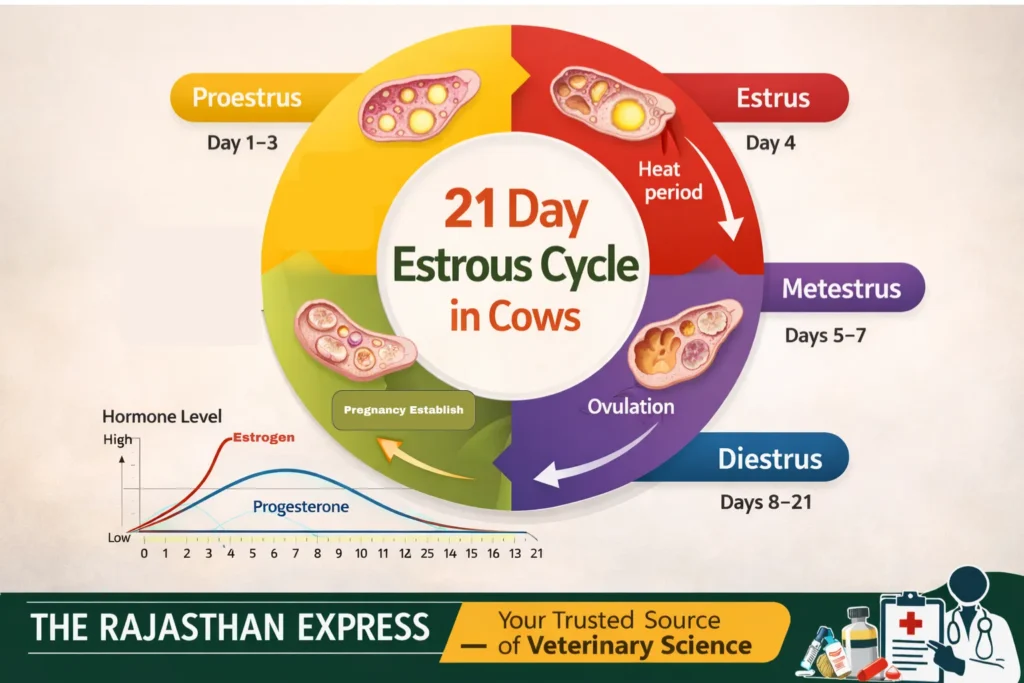
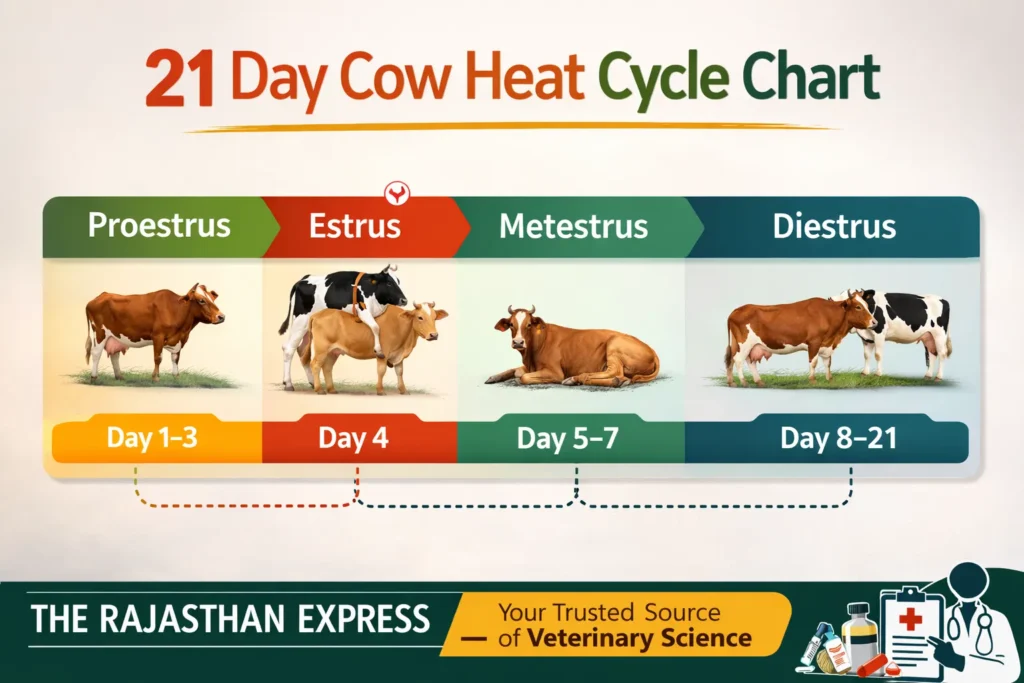
The estrous cycle is divided into two main phases and four distinct stages. Understanding these 4 stages of estrous cycle in cattle is crucial for successful breeding.
Two Main Phases of the Estrous Cycle
1. Follicular Phase
- In this phase, the egg (ovum) is prepared in the ovary. During this time, the female animal slowly begins to show attraction toward the male. The main hormone in this phase is Estrogen.
2. Luteal Phase
- In this phase, the egg has been released, and the body begins to prepare for pregnancy. The main hormone in this phase is Progesterone.
The 4 Stages of Estrous Cycle in Cattle Explained
Within these two phases, there are four specific stages. This detailed breakdown of the 4 stages of estrous cycle in cattle is essential for identifying the cow heat period.
Stage 1: Proestrus
- Duration: In cows, the Proestrus stage lasts approximately 2–3 days.
- What is this stage called?
- Building up Period: Preparation for the upcoming heat occurs in this stage. It’s like laying the foundation.
- What happens? (Internal Changes)
- Role of Hormones: In this stage, the process of follicle formation and growth in the ovary, called Folliculogenesis, begins. The FSH hormone (Follicle Stimulating Hormone) plays a key role in initiating this process. FSH is secreted by the Pituitary Gland.
- Under the influence of FSH, many small follicles begin to form in the ovary. Among these follicles, one grows rapidly and is called the Dominant Follicle. This follicle will eventually develop the egg.
- Production of Estrogen: At this time, the follicle also begins to produce the Estrogen hormone. The growing follicles (especially the dominant one) start producing Estrogen. Estrogen is the hormone that will later cause the signs of heat.
- Symptoms in the Animal (Cow Heat Cycle Symptoms):
- Very few external signs: The cow does not show many external behavioral changes at this stage. Most activity is internal.
- Sniffing: The cow may sniff other cows, especially their genitals.
- Refuses to be mounted: This is the most important sign. In this stage, the cow may mount other cows, but if another cow or bull tries to mount her, she will not stand for it. There is no standing heat.
- Vaginal Mucus: Towards the end of this stage, a little thin, watery mucus may come from the vagina, but it is not as sticky and clear as in the estrus stage.
- Restlessness: Slight restlessness may be observed, but it is not pronounced.
Stage 2: Estrus (Heat)
- Duration: In cows, the Estrus stage lasts approximately 12 to 24 hours. This is the shortest but most critical stage of the estrous cycle. This is when the cow is said to be “in heat” or “in season.” Knowing how long does a cow stay in heat is vital for timing insemination.
- What happens?
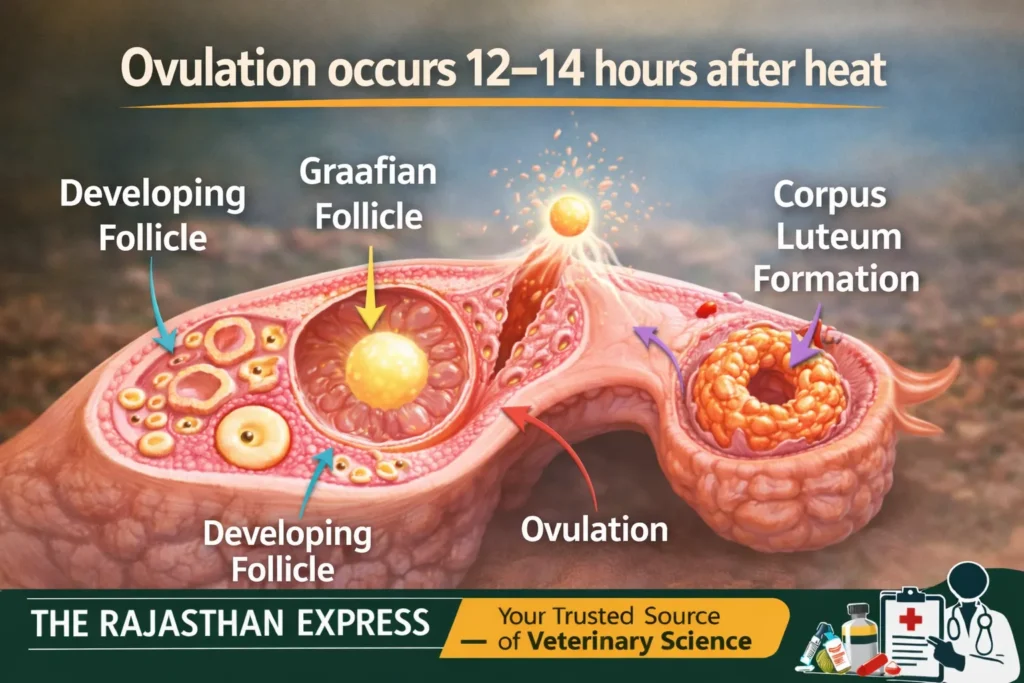
- The follicle that started developing in the Proestrus stage progresses and becomes a Graafian Follicle. This follicle is now fully mature.
- The Graafian Follicle secretes a large amount of Estrogen. FSH stimulates the Graafian Follicle to secrete Estrogen. Estrogen is responsible for producing the signs of heat in the female.
- In this stage, the female experiences increased sexual desire and receptivity.
- Normally, in most animals, ovulation occurs during this stage. However, in cows, ovulation occurs approximately 12–14 hours after the end of estrus, i.e., in the Metestrus stage.
- During this stage, the Cervix remains open. The cervix is normally closed but opens during heat and calving.
- Key Symptoms (Heat Cycle in Cattle Symptoms):
- The animal is restless.
- Frequently vocalizes (moos).
- Mounts other cows.
- Allows other cows or the bull to mount her (Standing Heat) – This is the primary sign.
- Clear, stretchy mucus discharges from the vagina – This is a primary sign.
- Milk production may decrease slightly.
- This is the time when the female accepts the male and is the most suitable time for mating or artificial insemination. This answers the common question: how often do cows come in heat? (Every 21 days) and how often does a cow come in heat? (Every 21 days if not pregnant).
Stage 3: Metestrus
- Duration: In cows, the Metestrus stage lasts approximately 3 days.
- What is this stage called?
- Transition Period: This is the time of changing from the Follicular Phase to the Luteal Phase.
- What happens?
- Ovulation: Ovulation occurs in this stage. Ovulation means the mature Graafian follicle ruptures and releases the secondary oocyte (egg). In cows, ovulation typically occurs about 12-14 hours after heat ends.
- Role of Hormones: The Luteinizing Hormone (LH) is primarily responsible for the ovulation process. The surge of LH in the estrus stage induces ovulation.
- Formation of Corpus Luteum: After the egg is released, the ruptured follicle does not remain empty. It slowly begins to transform and forms a new structure called the Corpus Luteum (CL) .
- Main Function of Corpus Luteum: It starts producing the hormone Progesterone. Progesterone plays a vital role in maintaining pregnancy and preparing the uterus for gestation.
- Special Note: Metestrus Bleeding
- In some cows, slight bleeding may be visible during this stage. This is called “Metestrus Bleeding.”
- This bleeding is considered normal and occurs from the inner lining of the uterus (endometrium) due to a sudden drop in estrogen levels at the time of ovulation.
- This bleeding is usually light and can be seen around the cow’s tail or vulva.
- External Symptoms in the Animal (Cow):
- Heat signs end: By the time this stage arrives, all clear signs of heat have ended.
- Normal Behavior: The cow becomes calm and shows no interest in other cows or the bull. She prevents the male from approaching her.
- Bleeding: If it occurs, light blood or blood-tinged mucus may be seen from the vagina.
Stage 4: Diestrus
- Duration: In cows, the Diestrus stage lasts approximately 15 days. This is the longest stage of the estrous cycle.
- What is this stage called?
- Period of CL: In this stage, the Corpus Luteum (CL) is fully developed and active.
- Luteal Phase: This is the main part of the luteal phase of the estrous cycle.
- What happens? (Internal Changes)
- Full Development of Corpus Luteum (CL): The CL that began forming in the Metestrus stage is now fully developed. It is clearly visible as a gland on the ovary.
- High Level of Progesterone: The fully developed CL produces and secretes large amounts of the hormone Progesterone. The concentration of Progesterone in the blood is at its peak level during this stage.
- Function of Progesterone: It keeps the uterus ready for pregnancy. It thickens the inner lining of the uterus and makes it glandular, providing a suitable environment for a fertilized egg (embryo) to grow if it arrives.
- Two Possible Outcomes of Heat (Fertilization or No Fertilization)
- (i) If Fertilization Occurs (Conception):
- CL Persists: If the ovum and sperm fertilize, the CL does not regress. It remains active throughout the entire pregnancy.
- Continuous Progesterone Secretion: This active CL continues to secrete the Progesterone hormone.
- Importance of Progesterone: This high level of Progesterone maintains a favorable environment for the fetus in the uterus and prevents any new estrous cycle (heat) from occurring during pregnancy.
- Result: In this situation, the estrous cycle stops completely until calving.
- Process of Regression:
- If the egg is not fertilized, the uterus secretes a hormone called Prostaglandin (PGF2α) .
- This hormone affects the CL located on the ovary.
- Around the 16th to 18th day of the estrous cycle, the CL begins to regress (shrink). This process is called Luteolysis.
- The regressing CL gradually stops its function (producing Progesterone).
- Formation of Corpus Albicans:
- The fully regressed and non-functional CL now turns into a white, fibrous tissue.
- This inactive structure is called the Corpus Albicans. It remains on the ovary like a scar.
- Start of a New Cycle:
- As the CL regresses, Progesterone levels drop rapidly.
- As Progesterone decreases, the Pituitary Gland begins to increase the secretion of FSH hormone.
- After about 21 days (in a cow), a new estrous cycle (new Proestrus stage) begins again.
- External Symptoms in the Animal (Cow):
- Sexual Quiescence: Throughout this entire stage (15 days), the cow remains completely calm. She shows no interest in any male and does not allow any male to approach her.
- Normal Behavior: The cow’s behavior is entirely normal. She continues to eat, drink, and produce milk regularly.
- No External Signs: No external signs related to heat (like restlessness, mucus, mounting) are visible in this stage. This period is crucial for understanding the cow heat cycle after calving as the body rests and prepares for the next cycle. This knowledge applies to various breeds, from a jersey cow heat cycle to a beef cow heat cycle.
Estrous Cycle Duration in Different Animals: How often does a cow come in heat?
Understanding the length of estrous cycle in cattle and other animals is fundamental for successful breeding management. The duration of the entire cycle and the heat period varies significantly across species.
| Estrous Cycle Duration in Different Animals | |||
| Sr. No. | Animal | Length of Estrous Cycle | Length of Heat (Estrus) Period |
|---|---|---|---|
| 1 | Cow | 21 days | 12–24 hours |
| 2 | Sow (Pig) | 21 days | 2–2.5 days |
| 3 | Mare (Horse) | 21 days | Approximately 6 days |
| 4 | Camel | 23 days | 3–5 days |
| 5 | Sheep | 16–17 days | Approximately 36 hours |
| 6 | Goat | 19–20 days | Approximately 48 hours |
| 7 | Bitch (Dog) | 6–7 months | Approximately 9 days |
| The Rajasthan Express : Estrous Cycle Duration in Animals | |||
Important Facts About the Estrous Cycle
Here are some critical facts that every livestock owner and veterinary professional should know about the cow heat cycle and the cycles of other animals.
1. Longest and Shortest Stages in Cow
- Shortest Stage: Estrus – This is the heat period, lasting only 12 to 24 hours. This is the only time the cow will stand to be mounted by a male. Knowing how long does a cow stay in heat is crucial for timely insemination.
- Longest Stage: Diestrus – This stage lasts approximately 15 days. During this period, the Corpus Luteum (CL) is fully developed and produces progesterone.
Read More About : Artificial Insemination in Cattle
2. Stages of the Estrous Cycle in the Bitch (Dog)
- The estrous cycle in the bitch has four stages, but their names and duration differ from the cow estrus cycle.
| Stages of the Estrous Cycle in the Bitch (Dog) | ||
| Stage | Duration | Description |
|---|---|---|
| (a) Proestrus | Approximately 9 days | Bleeding occurs in this stage. The female attracts the male but will not stand for mating. |
| (b) Estrus | Approximately 9 days | This is the heat period. The female stands for mating with the male. Ovulation occurs during this stage. |
| (c) Diestrus | Approximately 2 months | This stage resembles pregnancy or pseudopregnancy. The CL remains active and produces progesterone. |
| (d) Anestrus | Approximately 4–5 months | This is a period of inactivity between cycles. No sexual activity occurs during this time. |
| The Rajasthan Express : Estrous Cycle in Bitch (Dog) | ||
3. Which Stage is Absent in the Bitch?
The Metestrus stage is absent in the estrous cycle of the bitch.
- The Metestrus stage seen in cows (lasting about 3 days) does not occur in dogs. In the bitch, Diestrus begins immediately after Estrus.
4. Which Animal Has the Longest Heat Period?
Among domestic animals, the Bitch (dog) has the longest heat period (estrus stage), lasting approximately 9 days.
- The second longest heat period is found in the Mare (horse) , which can last approximately 5-7 days (average 6 days).
5. Bleeding During the Estrous Cycle: When and in Which Animals?
- General Rule: In most female animals (like buffalo, goat, sheep), bleeding is not observed during the estrous cycle.
- Exceptions: Bleeding during the estrous cycle can be observed only in bitches and cows.
6. Correct Timing of Bleeding
- Bitch (Dog): Bleeding occurs in the Proestrus stage. This is a main identifier of the estrous cycle in dogs.
- Cow: Bleeding typically occurs in the Metestrus stage. This is called “Metestrus Bleeding” and happens after ovulation.
| Correct Timing of Bleeding | ||
| Animal | Stage of Bleeding | Timing |
|---|---|---|
| Bitch (Dog) | Proestrus | Before heat starts |
| Cow | Metestrus | After heat ends |
| The Rajasthan Express : Timing of Bleeding in Animals | ||
7. Timing of Ovulation: General Rule vs. the Cow
- General Rule: In most animals (like buffalo, goat, sheep, pig), ovulation occurs during the Estrus stage (heat period).
- Exception in Cow: In cows, ovulation occurs approximately 12-14 hours after the end of the Estrus stage. This means that in cows, ovulation occurs in the Metestrus stage or Luteal Phase. This explains why understanding the bovine heat cycle is critical: the best time for breeding is during heat, even though the egg is released later.
8. Unique Feature of Ovulation in the Mare (Horse)
- Most Animals: In most animals (cow, buffalo, goat, pig), ovulation can occur anywhere on the surface of the ovary.
- Specialty in Mare: In mares, ovulation occurs only from a specific location called the Ovulation Fossa. Most of the mare’s ovary is covered with dense tissue; the egg can only be released from this fossa.
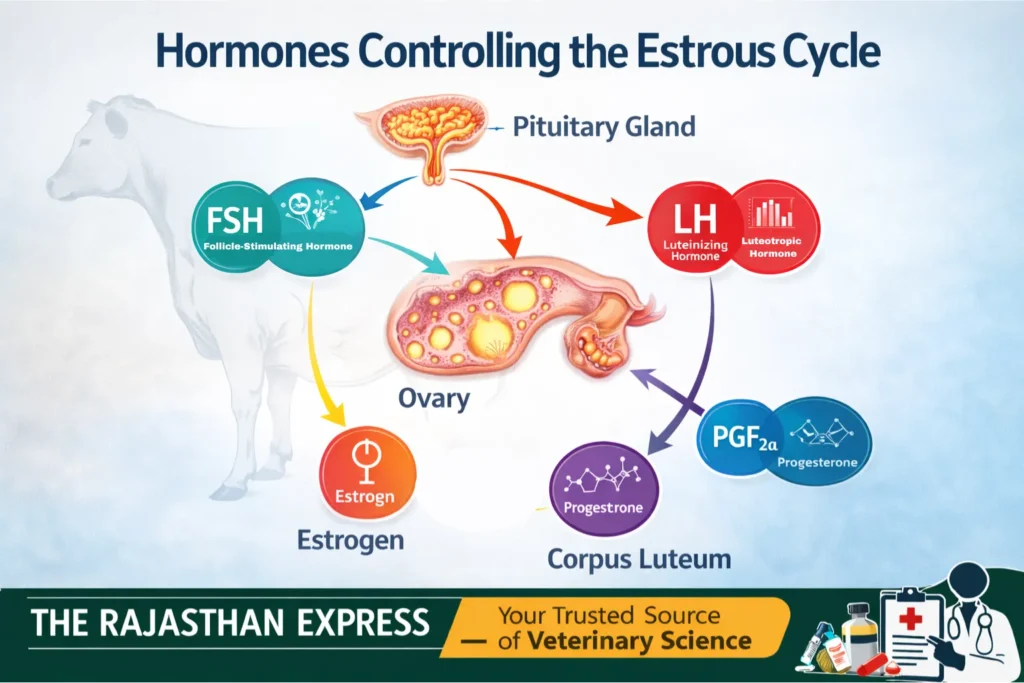
9. Important Hormonal Functions
- (i) Luteotropic Function of LH:
- A main function of the LH hormone is to maintain the Corpus Luteum (CL) . This is called its Luteotropic Function. LH supports the CL and stimulates it to produce progesterone.
- (ii) Function of FSH:
- The FSH hormone stimulates the Graafian Follicle to secrete the Estrogen hormone. FSH grows the follicle and causes it to produce estrogen.
- (iii) Luteolytic Function of PGF2α:
- The PGF2α (Prostaglandin F2 Alpha) hormone functions to destroy the Corpus Luteum (CL) . This is called its Luteolytic Function.
- If conception does not occur, PGF2α is secreted from the uterus and causes the CL to regress, allowing a new estrous cycle to begin.
10. The Ovary and Ovarian Bursa in the Bitch
- What is it? The ovary of the bitch is surrounded on all sides by a special pouch. This pouch is called the Ovarian Bursa. It is made from a membrane called the peritoneum.
- Function: This pouch provides protection to the ovary. After ovulation, the released egg falls directly into this bursa and then enters the oviduct.
11. Stage of Ovulation (Oocyte Stage)
- General Rule: In most animals (cow, buffalo, goat, sheep, pig), ovulation occurs at the Secondary Oocyte stage. At this stage, the egg has a haploid number of chromosomes (N).
- Exceptions: Two animals ovulate at the Primary Oocyte stage. At this stage, the egg has a diploid number of chromosomes (2N).
- Mare (Horse)
- Bitch (Dog)
| Stage of Ovulation (Oocyte Stage) | ||
| Animal | Stage of Ovulation | Chromosome Number |
|---|---|---|
| Most Animals (Cow, Buffalo, Goat, Sheep, Pig) | Secondary Oocyte | N (Haploid) |
| Mare (Horse) | Primary Oocyte | 2N (Diploid) |
| Bitch (Dog) | Primary Oocyte | 2N (Diploid) |
| The Rajasthan Express : Stage of Ovulation in Animals | ||
12. Development of Male Reproductive Organs
- Source of Development: Male reproductive organs develop from the Wolffian Duct. It is also called the Mesonephric Duct.
- Organs formed in males: Epididymis, Vas Deferens, sperm ducts.
13. Development of Female Reproductive Organs
- Source of Development: Female reproductive organs develop from the Mullerian Duct. It is also called the Paramesonephric Duct.
- Organs formed in females: Oviduct (Fallopian Tube), Uterus, Cervix, and the upper part of the Vagina.
14. Canal of Gartner
- What is it? This is a remnant of the Wolffian Duct found in female animals.
- During the embryonic stage, both males and females have two types of ducts: the Wolffian Duct and the Mullerian Duct.
- During development:
- In males: The Wolffian Duct develops into male reproductive organs, and the Mullerian Duct regresses.
- In females: The Mullerian Duct develops into female reproductive organs, and the Wolffian Duct regresses.
- The small part of the Wolffian Duct that remains in the female is called the Canal of Gartner.
- Location: It is typically found in the wall of the cervix or vagina.
Classification of Animals Based on Ovulation
1. Induced / Reflexive Ovulator
- Definition: Animals in which ovulation does not occur automatically but requires external stimulation.
- Main Point: In these animals, ovulation occurs only after mating (copulation) . The physical stimulation during mating causes the release of hormones (LH), which triggers the egg’s release.
- Examples: An easy way to remember this is CCR:
- C – Camel
- C – Cat
- R – Rabbit
2. Spontaneous Ovulator
- Definition: Animals in which mating is not required for ovulation.
- Main Point: In these animals, ovulation occurs spontaneously (on its own) when the egg matures. This is part of a regular, recurring estrous cycle. This group includes most of the common domestic animals whose cycles are studied in resources like an estrous cycle in cattle ppt or an estrus cycle in cow pdf.
- Examples:
- Cow
- Buffalo
- Goat
- Sheep
- Sow (Pig)
- Mare (Horse)
- Bitch (Dog)
Heat Signs in Different Animals: A Complete Guide to Estrus Detection
Detecting heat cycle in cattle symptoms accurately is the cornerstone of successful breeding management. However, heat signs vary significantly across different species. Understanding these species-specific behaviors ensures timely breeding and optimal reproductive efficiency. This guide covers the key signs of estrus in cows, sows, sheep, and goats.
1. Heat Signs in Cow (Heat Cycle in Cattle Symptoms)
Detecting the cow heat cycle requires careful observation. The signs can be subtle, but knowing what to look for is key to answering questions like how often do cows come in heat and how long does a cow stay in heat.
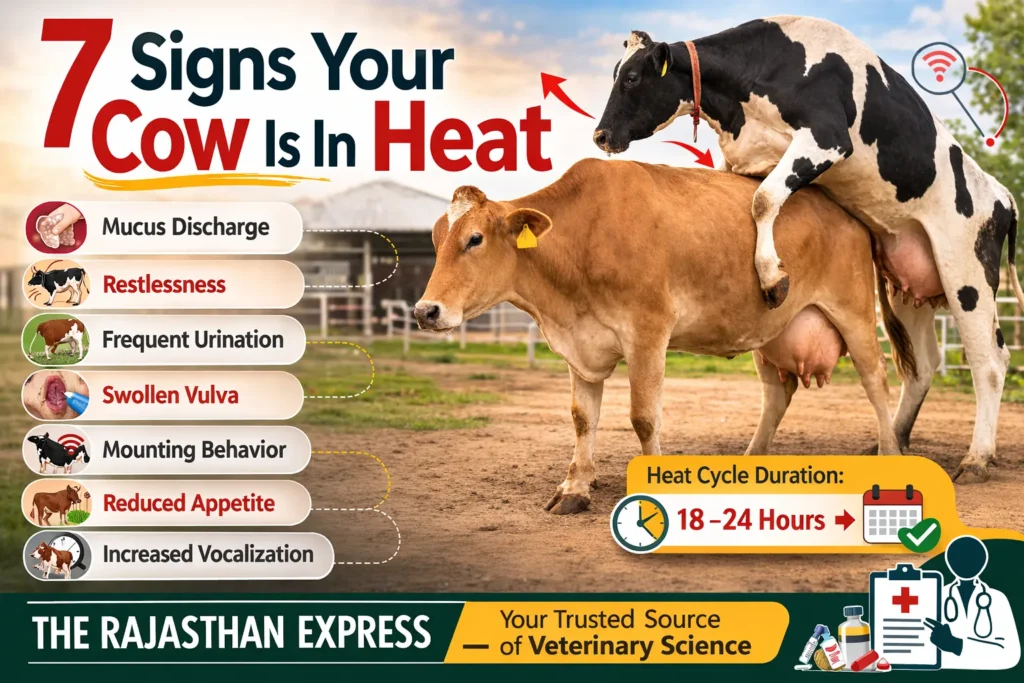
1. Homosexual Behavior – The Most Prominent Sign
The most reliable and prominent sign for identifying heat in a cow is her homosexual behavior. This means the cow in heat behaves towards other cows as if she were a bull (male).
- (a) Mounting on Other Cows:
- A cow in heat frequently attempts to mount other cows (that are not in heat). She places her front legs on the back of another cow and performs the mounting action. This is caused by hormonal stimulation.
- (b) Standing Heat – The Most Confirmed Sign:
- This is the most important and definitive sign. A cow in heat will stand firmly and remain stationary while another cow or a bull mounts her.
- She neither runs away nor resists. This stage is called “Standing Heat.”
- Importance: This is the exact time when the cow is fully ready for mating or Artificial Insemination (AI). Understanding this is crucial for anyone studying the bovine heat cycle or referring to a cattle heat cycle chart.
2. Other Important Signs (Cow Heat Cycle Symptoms)
- (a) Restlessness:
- A cow in heat is more restless than usual. She does not sit or stand quietly in one place.
- She frequently wanders around, tries to separate from the herd, and goes near the fence looking for other animals or a bull.
- (b) Frequent Bellowing/Mooing:
- A cow in heat vocalizes more often and more loudly than normal. Her voice carries a distinct tone of excitement and calling, as if she is summoning someone. This can happen at any time of day or night.
- (c) Vulvar Discharge / Mucus (Heat Cycle in Cattle Symptoms):
- During heat, a clear, transparent, and sticky (slimy) mucus discharges from the cow’s vulva.
- This mucus resembles raw egg white. It can often be seen stuck to the tail or hanging from the hindquarters. This is caused by high levels of estrogen hormone.
- (d) Decreased Milk Production:
- There is a temporary decrease in the cow’s milk production during the days she is in heat.
- (e) Swelling & Redness of Vulva:
- During heat, the cow’s external genitalia (vulva) may appear slightly swollen and red or pink. This is due to the effect of estrogen.
- (f) Frequent Urination:
- A cow in heat urinates frequently in small amounts. The pheromones in the urine attract the bull.
- (g) Decreased Appetite:
- A cow’s appetite may decrease during heat. She eats less fodder than normal.
- (h) Arching of Back:
- When another cow or bull tries to mount her, she arches her back slightly and stands firm. This is a classic sign on any cow heat cycle chart.
2. Heat Signs in Sow (Female Pig)
Detecting heat in a sow can be slightly difficult, so specific tests based on the sow’s behavior are performed. These tests are essential for managing the cattle breeding cycle by analogy, though swine have their own unique indicators.
(a) Riding Test
- When is it performed?
- This test is usually performed on the second day of the sow’s heat. Signs on the first day may be less clear; the sow is most receptive on the second day.
- What is the method?
- The person performing the test places a hand on the sow’s back and applies gentle pressure. Sometimes, an attempt is made to sit or mount her back.
- Symptoms (What is observed?): If the sow is in heat, she will display the following signs:
- Standing Rigid: She does not try to move or run away. She becomes completely stationary.
- Lordosis: She arches her back slightly downwards (inward). This is called the lordosis reflex and is a sign of accepting the male for mating.
- Cocking of Ears: This is a very specific sign. The sow curls her ears forward or upward in a particular way (cocked), as if she is listening intently or has become transfixed.
- Mating Posture: She stands completely calm and firm, as if to say, “I am ready.”
(b) Lordosis – The Back Arching Response
- What is it?
- Lordosis is not just a test; it is the natural posture adopted by a sow when she is in heat. The Riding Test or Back Pressure Test triggers this lordosis reflex.
- Symptom:
- As soon as pressure is applied to the back, the sow arches her back and becomes rigid. This is a clear signal to the male (boar) that the female is ready for mating.
(c) Back Pressure Test
- What is it?
- This is similar to the Riding Test. Often, they are considered the same thing.
- Method:
- Firm pressure is applied downwards by placing a hand on the sow’s back.
- Symptoms: If the sow is in heat, she will show all the above signs:
- She stands completely immobile and firm, as if rooted to the ground.
- Back Arching: She assumes the lordosis position.
- Cocking of Ears: The ears adopt a specific posture.
3. Heat Signs in Ewe (Sheep) and Doe (Goat)
Ewes and does are short-day breeders, meaning their breeding season begins when days become shorter (around October to February). Recognizing heat signs in these animals is different from recognizing heat cycle in cattle symptoms.
Main Signs of Heat in Sheep and Goat
- (a) Tail Wagging / Flagging:
- The most common and recognizable sign: When a ewe or doe is in heat, she wags her tail rapidly and continuously (flagging).
- This movement looks as if she is signaling or calling out to someone.
- Purpose: This tail wagging is a way to attract the male (ram/buck) and indicate, “I am ready for mating.” This is the most distinctive sign for sheep and goats compared to cows or buffaloes.
- (b) Vulvar Swelling:
- Change in external genitalia: During heat, the external genitalia (vulva) appears slightly swollen, red, and pinkish compared to normal. This is caused by the effect of estrogen.
- This swelling is less pronounced in sheep and goats than in cows or buffaloes but can be noticed with careful observation.
- (c) Bleating (Vocalization):
- Abnormal and increased vocalization: A ewe or doe in heat vocalizes more often and more loudly than usual (bleating).
- She repeatedly makes “maa-maa” or “bleat-bleat” sounds, as if calling the male. This sound is different from her normal state and is heard more frequently.
- (d) Restlessness:
- Frequent walking and searching for the male: The animal in heat remains restless. It does not sit or stand quietly in one place. It frequently walks around, goes near the fence, and searches for the male (ram/buck). If a male is nearby, it will stay close to him.
- (e) Mucus Discharge:
- Vaginal secretion: During heat, thin, clear, or slightly cloudy mucus may discharge from the vagina.
- This mucus is not as abundant or sticky as in cows, but it may sometimes be seen dried on the tail or hindquarters.
- (f) Pawing the Ground:
- Behavioral sign: The animal in heat often paws the ground with its front feet.
- (g) Frequent Urination:
- Animals in heat urinate frequently in small amounts. The pheromones in the urine attract the male. The male can detect if the female is in heat by sniffing this urine.
- (h) Standing to be Mounted:
Read More About : Top 10 Best Sheep Breeds
| Comparison: Ewe/Doe vs. Cow vs. Bitch | |||
| Feature | Ewe/Doe (Sheep/Goat) | Cow | Bitch (Dog) |
|---|---|---|---|
| Type | Short-day breeder (Winter) | Poly-estrous (Year-round) | Mono-estrous (Twice a year) |
| Estrous Cycle Length | 17–21 days | 21 days | 4–5 months (incl. Anestrus) |
| Heat Duration | 24–36 hours | 12–24 hours | 9 days |
| Most Common Sign | Tail wagging (Flagging) | Mounting and Standing | Bleeding |
| Bleeding | Does not occur | May occur in Metestrus | Occurs in Proestrus |
| The Rajasthan Express : Estrous Cycle Comparison | |||
Timing of the Estrous Cycle in Ewe and Doe
- 1. Type of Estrous Cycle:
- Short-day breeder: Both sheep (Ewe) and goats (Doe) are short-day breeders.
- What does this mean? It means they primarily come into heat during the winter season (Short Days/Long Nights). Their breeding season starts when days become shorter and nights become longer (around October to February).
- Why? This happens so that their offspring (lambs/kids) are born in the spring season when the weather is pleasant and green fodder is abundant.
- 2. Duration of Estrous Cycle:
- Length of estrous cycle: In sheep and goats, the length of the estrous cycle (the time between one heat and the next) is approximately 17 to 21 days (average 17-18 days).
- Duration of heat (Estrus): This is very short, approximately 24 to 36 hours (about 1-1.5 days).
Read More About : Sheep Breeds
4. Heat Signs in Buffalo
The estrous cycle in buffalo and its heat signs are quite different and much less pronounced compared to cows. This makes heat detection in buffaloes the biggest challenge for livestock owners.
Main Point: Why are heat signs less pronounced?
Compared to cows, buffaloes have a calmer and more docile temperament. They do not exhibit their heat as vigorously as cows. Therefore, heat signs in buffalo are dull or subdued.
(a) Silent Heat – The Biggest Challenge
- What is it?
- Silent Heat means “heat without sound” or “heat that comes silently.” It is also called “Mook Mad” (Silent Estrus).
- What happens? (Physiologically)
- Everything is happening normally in the buffalo’s ovary:
- Follicles (the egg’s home) are forming.
- The egg is maturing.
- Ovulation is occurring at the right time.
- Hormones (Estrogen) are being produced.
- However, externally, the signs of heat are very few or completely invisible:
- The buffalo does not appear restless.
- She does not mount other buffaloes.
- Nor does she allow others to mount her.
- There is no bellowing.
- Very little or no mucus discharges from the vagina.
- Everything is happening normally in the buffalo’s ovary:
- What is the result?
- The livestock owner never finds out that the buffalo was in heat.
- They cannot perform timely insemination (AI or natural).
- This leads to problems like the buffalo remaining anestrus or not conceiving for a long period.
- Why does Silent Heat occur?
- Hormonal Reasons: The level of Estrogen hormone may not rise enough to produce clear external signs.
- Species Characteristic: This is a natural trait of the buffalo species.
- Seasonal Effect: The chances of silent heat increase significantly during the summer season.
- Nutritional Deficiency: Poor diet and deficiency of mineral salts can also be a cause.
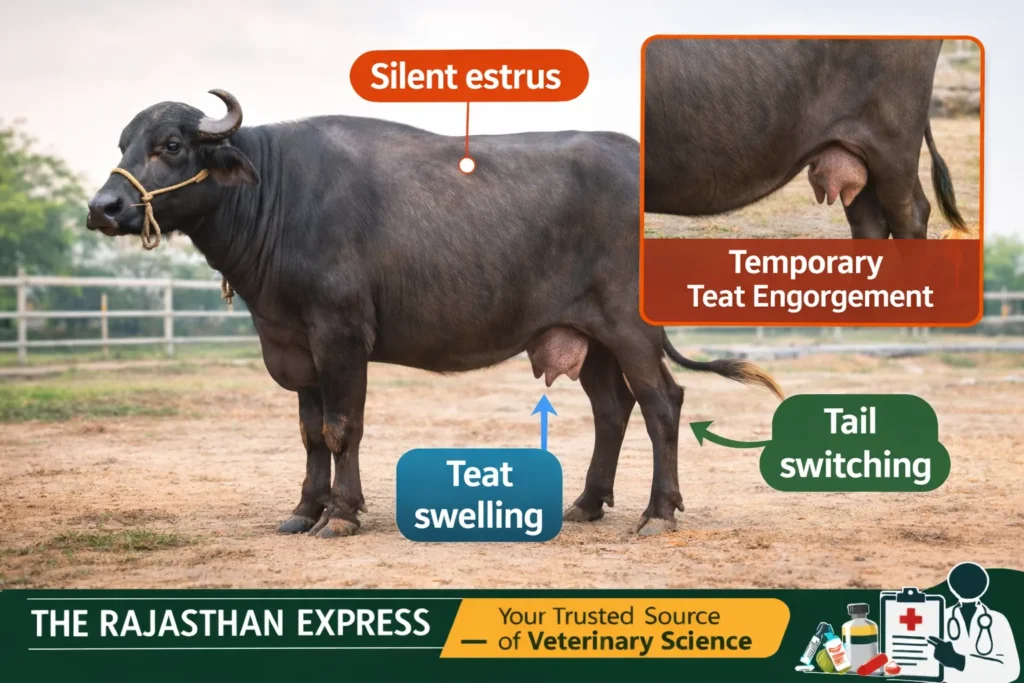
(b) Temporary Teat Engorgement (TTE) – Doka Fill Up
This is a very specific and reliable sign of heat in buffaloes, which is not found in cows. In rural areas, it is called “Doka Bharna” or “Doklya.”
- What is it?
- TTE stands for Temporary Teat Engorgement.
- It means temporary swelling in the teats.
- When does it occur?
- This sign is observed in the Proestrus stage of the estrous cycle.
- That is, this sign starts appearing 2-3 days before heat (estrus) begins.
- What happens?
- There is mild, temporary swelling in all four teats of the buffalo.
- This swelling lasts for about three days.
- The teats feel slightly warm and engorged to the touch.
- This swelling is temporary, meaning it resolves on its own after heat arrives or within a few days.
- This is not mastitis (udder infection), so the milk does not spoil, and there is no pain (though slight warmth may be felt).
- What is the cause?
- Hormonal Change: The increase in Estrogen levels during the Proestrus stage causes increased blood flow to the teats, resulting in this temporary swelling.
- Why is this sign important?
- It is considered the most reliable identifier of heat in buffaloes.
- Rural livestock owners recognize by this sign that the buffalo is “Doke par,” meaning she will come into heat in the next 2-3 days.
- It is a pre-heat indicator. As soon as this swelling is seen, one should understand that monitoring of the buffalo must be intensified.
(c) Other Signs of Heat in Buffalo
- Switching of Tail:
- When in heat, a buffalo lifts its tail and holds it to one side. In a normal state, the tail hangs straight down or swishes. During heat, she tilts it from the base to one side, as if making way. This is called “tail switching.”
- Mucus Discharge:
- Compared to cows, very little mucus discharges from a buffalo. This mucus is thick and sticky, but one must observe carefully to see it. It may be found dried and stuck around the tail or vulva.
- Sniffing Other Buffaloes:
- The buffalo may frequently sniff the genitals of other buffaloes. However, this sign is not as pronounced as in cows.
- Frequent Urination:
- The buffalo may assume a urinating posture frequently, but this sign is also less distinct.
- Decreased Milk Production:
- The amount of milk given may decrease slightly during heat.
| What Signs are NOT Seen in Buffalo (Compared to Cow)? | ||
| Sign | In Cow | In Buffalo |
|---|---|---|
| Homosexual Behavior | Clearly mounts other cows. | Very little or not observed. |
| Bellowing | Bellows loudly in heat. | Does not bellow or makes very soft sounds. |
| Restlessness | Very restless. | Less restless. |
| Drop in Milk | Clearly decreases. | Slight decrease may occur, but goes unnoticed. |
| The Rajasthan Express : Heat Signs Comparison (Cow vs Buffalo) | ||
(e) Breeding Season in Buffalo
- Main Season: Buffaloes primarily come into heat during the winter season.
- Time Period: This season is typically between September and February.
- Effect of Summer: During the summer season (March-August), heat signs in buffaloes become even less frequent, and the chance of silent heat increases. This is also called Summer Anestrus.
5. Heat Signs in Mare
The estrous cycle in the mare is quite different from the cow. It has some specific stages and signs observed only in mares.
(a) Foal Heat – The First Heat After Foaling
- Definition:
- Foal heat is a special stage in mares where she comes into heat again immediately after giving birth (foaling).
- Timing:
- When does it occur? Within approximately 7 to 14 days of foaling.
- Average Time: In most mares, it is observed around the 9th day.
- Why is it special?
- This is a normal physiological process.
- It means the mare has just given birth, but her body is ready to reproduce again so quickly.
- It reflects the high fertility of the mare.
- Important Note:
- Breeding during foal heat is possible, but at this time, the mare’s uterus has not fully returned to its normal state (it takes time to recover after foaling).
- Therefore, the conception rate during foal heat may be slightly lower. Nevertheless, it is a natural and normal stage. This is somewhat analogous to the cow heat cycle after calving, though the timing is much shorter in mares.
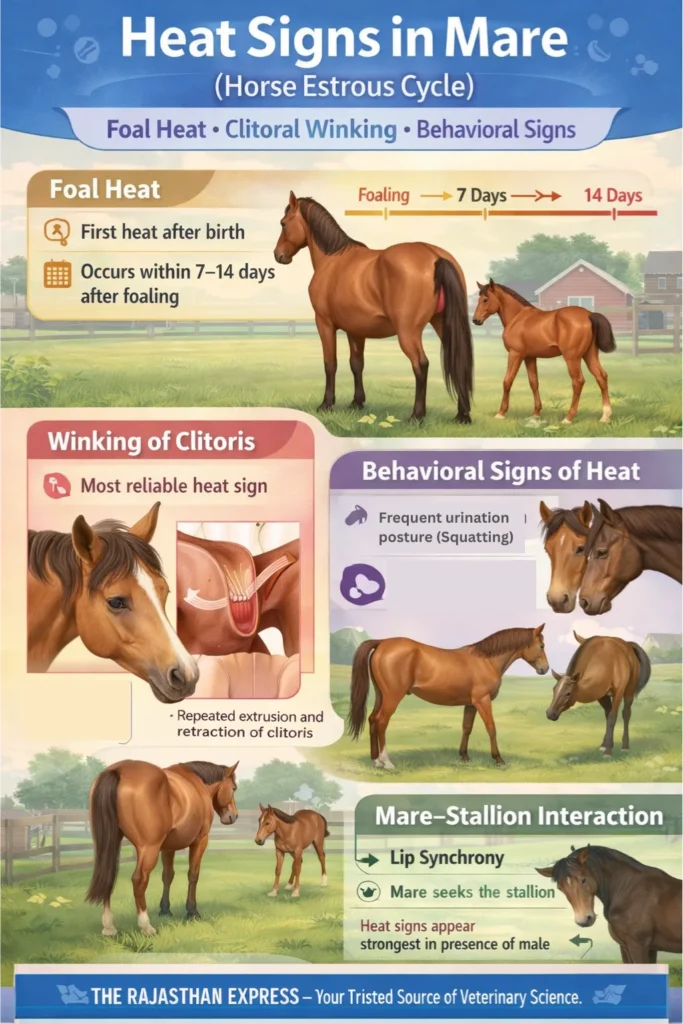
(b) Winking of Clitoris – A Key Heat Identifier
- Most Recognizable Sign:
- This is the most reliable and easily identifiable sign of heat in a mare.
- What is the Clitoris? (A Little Anatomy):
- The clitoris is a small part of the female animal’s genitalia, located in the lower part of the vulva.
- It is considered a remnant organ of the male’s penis. It is the part left over during development that forms the penis in males.
- What happens? (Meaning of Winking):
- When a mare is in heat, she repeatedly extrudes and retracts her clitoris.
- This action looks exactly like someone “winking an eye.”
- Hence, it is called “Winking of the Clitoris.”
- Purpose:
- By doing this, the mare signals to the male (stallion) that “I am in heat and ready for mating.” It is a type of sexual signal.
(c) Other Signs of Heat in Mare
- Frequent Urination Posture (Squatting):
- The mare frequently assumes a urination posture, whether or not she has urine.
- She stands with her hind legs slightly apart, tail raised, and back slightly arched. This action is called “Squatting.”
- In simple words: The mare offers her hindquarters to the stallion, as if saying “Come.”
- Urination:
- She urinates frequently in small amounts. The urine may also have a strong odor, which attracts the male.
- Standing Receptive:
- This is the most important sign. When a male horse (teaser/breeding stallion) approaches, the mare stands calmly and does not try to run away.
- She allows the male to sniff and examine her hindquarters.
- Mucus Discharge:
- When in heat, a clear, sticky, thin mucus discharges from the mare’s vagina. It is not as abundant as in cows, but it does occur.
- Lip Synchrony:
- This is a very interesting sign.
- The mare shows interest in touching lips with the teaser stallion (used for testing).
- She goes near his mouth and sniffs or touches his lips, as if “kissing.” This is a sign of mutual bonding and acceptance.
(d) An Important Fact: In Whose Presence do Mare’s Signs Appear?
All signs of heat in a mare (winking, squatting, urination, lip synchrony) are primarily observed clearly in the presence of a male horse (stallion).
- Why? Because the mare needs to attract the male. She performs these actions in front of the male so he can understand she is ready for mating. When alone or among other females, these signs are not as pronounced as they are in the presence of a male.
6. Heat Signs in Bitch
To identify heat in a bitch, the first and easiest sign is pro-estrus bleeding. But remember, during bleeding, she is not ready for mating. The actual heat (when she stands) comes after the bleeding stops. And if it ever seems like her heat stopped in the middle and then started again, understand that this could be a condition called split heat, which occurs due to hormonal imbalance. In such cases, vaginal cytology or a progesterone test can accurately determine the right time.
(a) Pro-estrus Bleeding – The First Sign of Heat
- What is it?
- Pro-estrus bleeding is the most prominent, first, and easiest-to-recognize sign of the estrous cycle in a bitch.
- Timing:
- This bleeding occurs in the Proestrus stage.
- This stage (including bleeding) typically lasts about 7 to 9 days (in some bitches, it can be from 3 to 17 days).
- What happens during this time?
- Bleeding: Blood starts coming from the bitch’s vagina. It can range from light pink to dark red. This is a normal process.
- Swelling of Vulva: During this time, the bitch’s external genitalia (vulva) become swollen and soft.
- Frequent Urination: The bitch urinates frequently, spreading her scent (pheromones) and attracting male dogs.
- Attracting Males: In this stage, the bitch attracts male dogs, but she will not allow them to mount her. She may bark, growl, or try to bite the male. She will not stand for mating (No Standing Heat).
- How to identify the true heat (Estrus)? (Vaginal Cytology)
- After pro-estrus bleeding, the bitch enters true heat (estrus).
- However, it is difficult to tell exactly when true heat has started just by looking at the bleeding. A scientific method called Vaginal Cytology is used for this.
- What is Vaginal Cytology? (In Simple Terms)
- A small sample (swab) is taken from the bitch’s vagina, placed on a slide, and examined under a microscope.
- The shape and type of vaginal cells change in different stages.
- In Proestrus: Mostly small, round cells (Parabasal and Intermediate cells) are seen.
- In Estrus (True Heat): Mostly large, cornified, anucleated cells (Superficial Cornified Cells) are seen. When these cells exceed 90%, it indicates the bitch is in true heat and it is the right time for breeding.
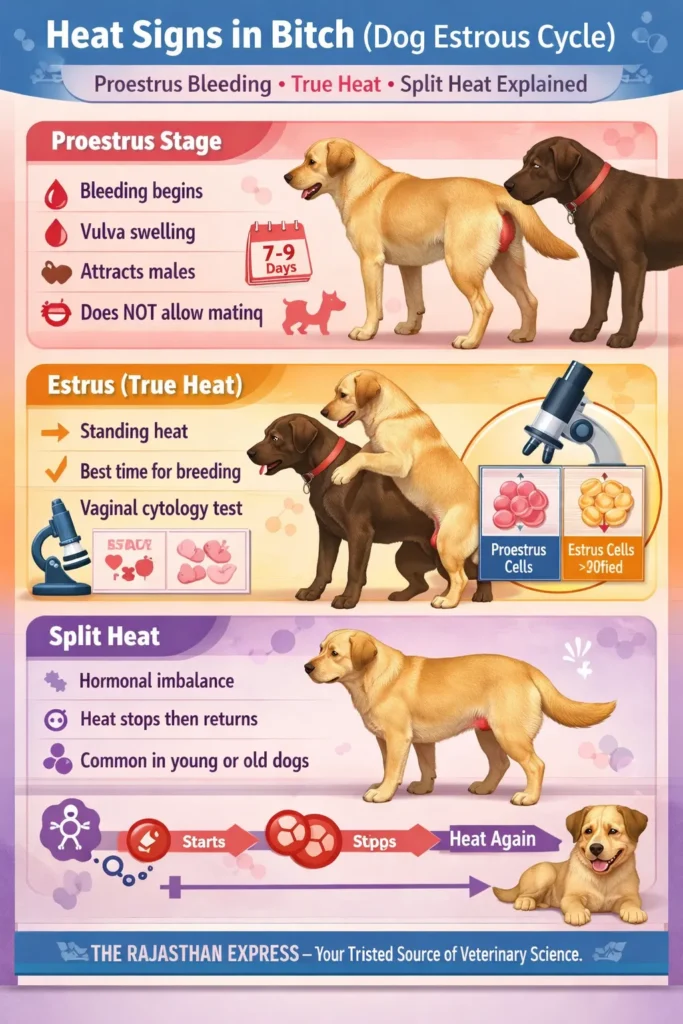
(b) Split Heat – An Abnormal Condition
- What is it?
- Split heat is an abnormal or undesirable condition observed in bitches. It can be called “divided heat.”
- What happens?
- In this condition:
- Beginning: The bitch starts showing normal signs of heat. She has pro-estrus bleeding, the vulva swells, and she attracts males.
- Suddenly Stops: But after a few days (usually 3-5 days), all these signs suddenly stop. The bleeding stops, swelling reduces, and she loses interest in the male.
- Starts Again: After a few days (usually a few days to 2-3 weeks), all these signs start again. This time, she comes into full heat and stands for mating.
- It seems as if the bitch’s heat is split into two parts – the first part incomplete, the second part complete.
- In this condition:
- What are the causes?
- Hormonal Imbalance: This is mainly due to hormonal imbalance, especially a disruption in the coordination between Follicle Stimulating Hormone (FSH) and Luteinizing Hormone (LH).
- Improper Follicle Development: Sometimes, the follicles in the ovary do not develop properly in the first attempt, and estrogen levels do not rise enough for full heat. So, the body stops the signs and tries again after a few days.
- Young or Old Bitches: This condition is often seen in very young bitches (experiencing their first or second cycle) or very old bitches, when their hormonal system is not fully stable.
- Stress or Illness: Sometimes, stress or illness can also cause this.
7. Heat Signs in She-Camel
The estrous cycle in the she-camel is also different from other animals. It is primarily active during the winter season.
(a) Lip Synchrony
- What is it?
- Lip synchrony is the most important and reliable identifier of heat in a she-camel.
- What happens?
- When a she-camel is in heat, she goes to the teaser male camel and tries to touch lips with him.
- She extends and moves her lips to touch the male’s lips, as if she wants to “kiss” him.
- This is a type of sexual signal, through which she tells the male, “I am in heat and ready for mating.”
- Why is this sign special?
- This sign is primarily observed prominently only in the she-camel and the mare.
- Like the mare, the she-camel displays this sign only in the presence of a male, to attract him.
(b) Seeking the Male
- What is it?
- During heat, the she-camel’s behavior changes. She actively seeks out the male camel and tries to go near him.
- What happens?
- If the she-camel sees a male camel, she will go to him on her own.
- She circles around him, sniffs him, and makes her presence known.
- Going near the male, she stands quietly so the male can mount her.
- This is called “seeking the male.” That is, she presents herself to the male.
(c) Breeding Season in She-Camel
- Main Season:
- The she-camel primarily comes into heat during the winter season.
- Time Period:
- This season is usually between November and March.
- During this time, days are short and nights are long (Short Day Breeder).
- Why in Winter?
- Nature has designed this so that the calf is born in the favorable season of the next year (like spring or early summer) when fodder and water are easily available.
(d) Rutting Period in Male Camel
- What is it?
- Just as the she-camel comes into heat in winter, the male camel also experiences the Rutting Period during the winter season.
- The rutting period is the stage in a male camel when he is fully ready for breeding, and his testosterone levels rise significantly.
- Signs of Rutting in Male Camel:
- Aggressive Behavior: The male camel becomes very aggressive and irritable.
- Dula Out: He inflates his soft palate (Dulaa) and extrudes it from his mouth.
- Vocalizations: He makes gurgling sounds and loud roars.
- Drooling: Frothy saliva drips from his mouth.
- Synchronization:
- Nature has created this wonderful synchronization so that the she-camel’s heat period and the male camel’s rutting period both occur in the same season (winter).
- This ensures both are ready for reproduction at the same time, leading to successful breeding.
Quick Answers: Common Questions About the Cow Estrous Cycle
Here are quick, authoritative answers to the most frequently asked questions about the cow heat cycle, based on veterinary science and practical animal husbandry.
1. How often do cows come in heat?
Answer: Cows are poly-estrous animals, meaning they come into heat repeatedly throughout the year.
- A cow typically comes into heat every 21 days (the average length of estrous cycle in cattle).
- The normal range can vary from 18 to 24 days.
- This cycle continues year-round until the cow becomes pregnant.
2. How long does a cow stay in heat?
Answer: A cow stays in heat (the estrus stage) for approximately 12 to 24 hours.
- This is the shortest but most critical stage of the cow estrus cycle.
- The duration can vary slightly based on age, health, and environmental factors.
- This is the only time the cow will stand to be mounted by a bull or be receptive to artificial insemination.
3. What are the 4 Stages of the Estrous Cycle in Cattle?
Answer: The 4 stages of estrous cycle in cattle are:
- Proestrus (2-3 days): The “building up” period. Follicles develop in the ovary, and estrogen production begins. The cow may show interest in other cows but will not stand to be mounted.
- Estrus (12-24 hours): The “heat” period. The cow is sexually receptive, shows standing heat, and has clear mucus discharge. This is the time for breeding.
- Metestrus (approx. 3 days): The “transition” period. Ovulation occurs (12-14 hours after heat ends). The ruptured follicle begins to form the Corpus Luteum (CL).
- Diestrus (approx. 15 days): The longest stage. The CL is fully active and produces progesterone to prepare the uterus for pregnancy. If the cow is not pregnant, the cycle will begin again.
4. What are the Main Heat Cycle in Cattle Symptoms?
Answer: The main heat cycle in cattle symptoms to watch for are:
- Standing Heat (The most reliable sign): The cow stands firm and allows other cows or a bull to mount her.
- Mounting other cows: She displays homosexual behavior by trying to mount herdmates.
- Clear Mucus Discharge: A stringy, clear discharge resembling raw egg white hangs from the vulva.
- Restlessness: She is agitated, walks frequently, and separates from the herd.
- Frequent Bellowing: She moos more often and loudly.
- Swollen Vulva: The external genitalia may appear slightly red and swollen.
- Decreased Appetite and Milk Drop: She may eat less and produce slightly less milk temporarily.
5. When Does the Cow Heat Cycle After Calving Start?
Answer: The cow heat cycle after calving typically resumes within 45 to 50 days postpartum.
- This first heat after calving is an important milestone for re-breeding.
- However, it is common for this first heat to be a “silent heat” (especially in high-producing dairy cows), where ovulation occurs without clear external symptoms.
- Close observation is crucial during this period to ensure timely re-conception.
6. Do Heifers Have Different Cycles than Cows?
Answer: Generally, the heifer heat cycle is very similar to that of a mature cow, but with a few key differences:
- Cycle Length: Heifers typically have a very consistent 21-day cycle, sometimes even more regular than older cows.
- Heat Duration: The heat period of a heifer can sometimes be slightly shorter than that of a mature cow.
- Heat Intensity: Heifers may show slightly different or less pronounced heat cycle in cattle symptoms. They can be “shyer” in their displays, especially in a herd with dominant cows.
- Breeding: Heifers are often bred on their second or third heat to ensure they are mature enough for a successful pregnancy.
7. How long is a cow in standing heat?
Answer: The period of standing heat (when the cow will stand immobile while being mounted) lasts for the duration of the estrus stage, which is approximately 12 to 24 hours.
- This is the most fertile period for the cow.
- The actual “standing to be mounted” behavior is most intense during the middle portion of this 12-24 hour window.
8. When do cows start cycling after calving?
Answer: Cows typically start cycling again, or resume their normal cow period cycle, within 45 to 50 days after calving.
- The uterus needs time to involute (return to its normal size) and repair itself after birth.
- Nutritional status and body condition score heavily influence how quickly a cow resumes cycling. Well-fed, healthy cows will cycle sooner.