 By
ByDid You Know That a Horse Can Rest While Standing? (Stay Apparatus in Horse Anatomy)
Does Horse Sleep While Standing?
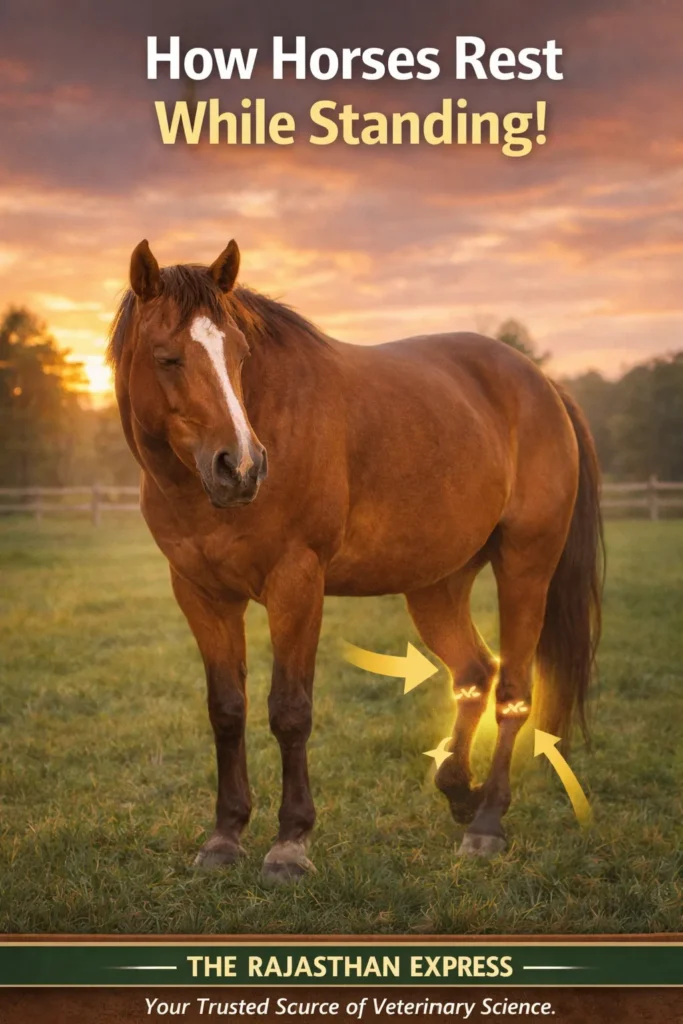
Have you ever wondered how a horse can stand for many hours without falling and without getting tired? A horse is an animal that can remain standing in the same position for a long time compared to other animals. It can rest while standing and can even take a light nap. The reason for this is a special mechanism present in its hind legs called the Stay Apparatus.
To understand it in simple language, the legs of a horse have a kind of auto-lock system. Just like a cupboard door automatically closes and stays fixed with the help of a magnet, in the same way when a horse stands, some of the joints in its legs automatically become stable. Because of this, it does not have to exert much pressure on its muscles to remain standing.
Stay Apparatus in Horses
| Main Concept | Stay Apparatus – a special anatomical mechanism that allows a horse to stand for long periods with minimal muscular effort. |
|---|---|
| Function | Helps horses rest and take light sleep while standing without getting tired. |
| Type of System | Automatic joint-locking mechanism involving muscles, tendons, and ligaments. |
| Body Parts Involved |
|
| Main Purpose |
|
| Forelimb Stay Apparatus | Stabilized mainly by strong tendons and ligaments rather than muscles. |
| Important Forelimb Structures |
|
| Forelimb Function | Prevents excessive bending of the shoulder, carpal, and lower limb joints, keeping the forelegs straight like pillars. |
| Hind Limb Stay Apparatus | More complex mechanism involving coordinated muscle action that stabilizes the stifle and hock joints. |
| Main Hind Limb Muscles |
|
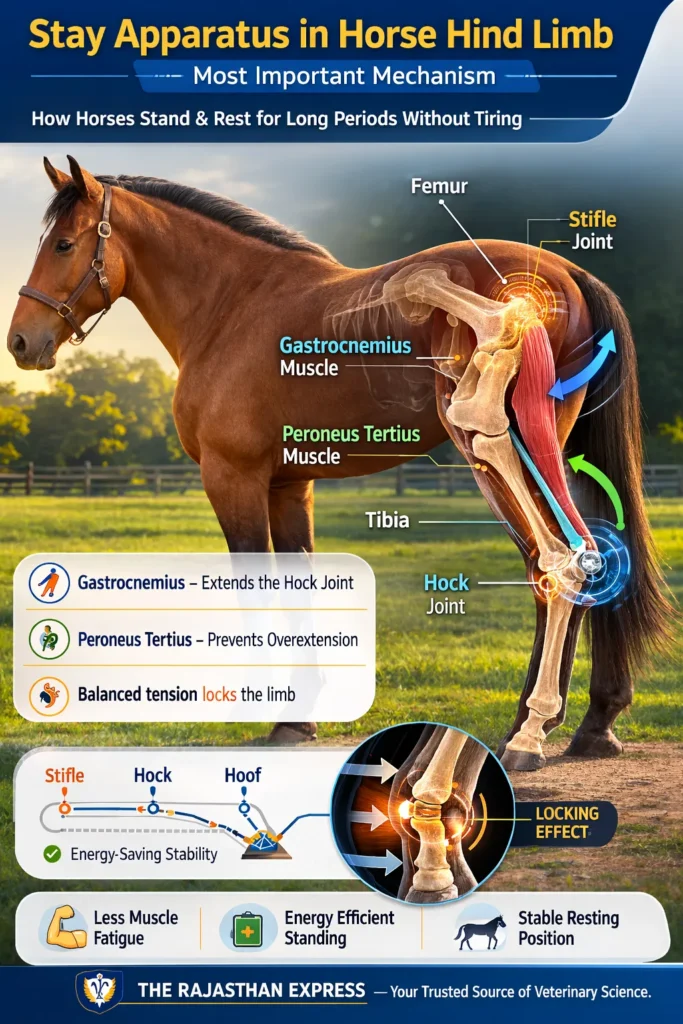
| Gastrocnemius Function | Extends the hock joint and helps position the leg for standing. |
| Peroneus Tertius Function | Prevents excessive extension of the hock joint and maintains balance in the limb. |
| Joint Stabilization | Opposing tension between these muscles stabilizes the stifle joint and hock joint, creating a locked standing position. |
| Sleep Behavior in Horses |
|
| Key Advantage | Allows horses to rest quickly and remain ready to escape predators in the wild. |
| Simple Explanation | The stay apparatus acts like an automatic locking system in the horse’s legs that keeps joints stable without continuous muscle effort. |
| Sources: The Rajasthan Express; By Rakesh Kumar (Govt. Livestock Inspector) | |
Stay Apparatus in Horse Anatomy
What is the Stay Apparatus? (Stay Apparatus in Horse Function)
The Stay Apparatus is a system of muscles, tendons, and ligaments in a horse’s legs that helps it remain standing for long periods without much muscular effort. When the horse stands, this system makes its legs almost straight and strong.
Because of this mechanism, a horse can stand for a long time without getting tired and can even take light sleep.
Stay Apparatus in Horse Forelimb
Mechanism of the Forelimb Stay Apparatus
The method of stabilizing the forelegs is slightly different. Here, strong tendons and ligaments work more than muscles. Together they keep the legs stable.
Shoulder Joint Mechanism
- Near the shoulder there is a special muscle called the Biceps brachii. On top of this muscle there is a loop-like structure.
- When the horse stands, this loop prevents the Shoulder Joint from moving forward. This stabilizes the shoulder joint and the leg comes into a locked position.
Carpal Joint and Lower Joints
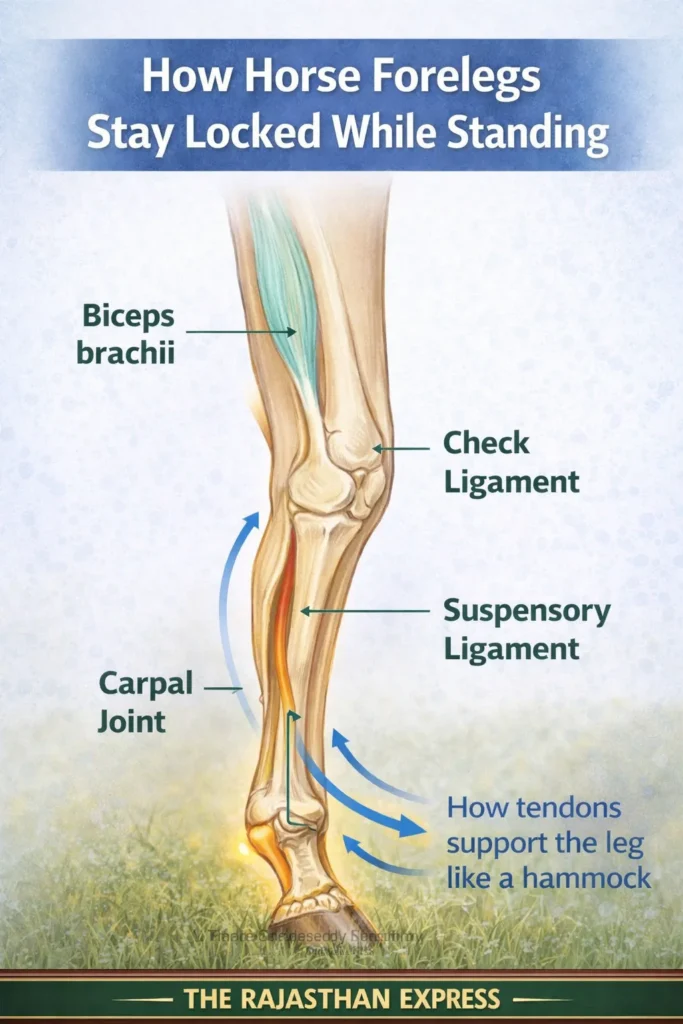
In the wrist (carpal region) and the lower part of the leg, there are several strong ligaments and tendons such as:
- Check ligament
- Suspensory ligament
All of these together work somewhat like a hammock. The function of this hammock-like arrangement is to prevent the wrist and the joints below it from bending excessively. Because of this, the forelimb of the horse remains straight and strong like a pillar.
Read More About : Why Horses Cannot Kick Sideways
Stay Apparatus Horse Hind limb (Most Imp.)
Muscles Involved in the Stay Apparatus
The stay apparatus in the hind legs of a horse is slightly more complex. Two special muscles play the main role here. When the proper balance forms between these two muscles, the hind legs of the horse become stable and it can comfortably stand for a long time.
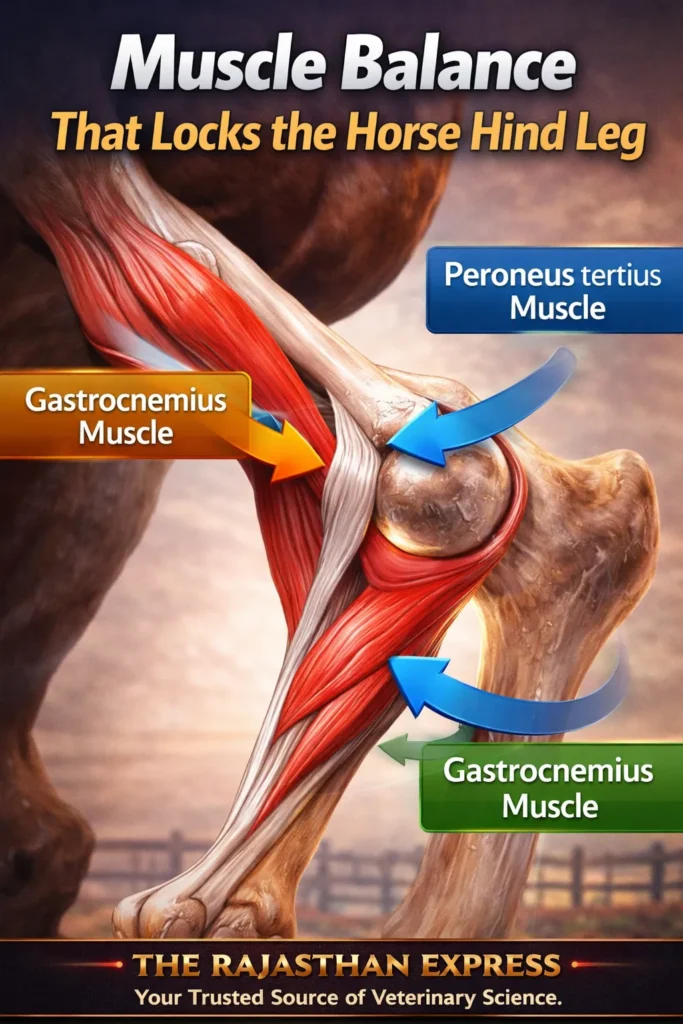
1. Gastrocnemius Muscle in Horse Anatomy
Where is it located?
- This is the main calf muscle. It extends along the back side of the hind limb from the Stifle Joint to the Hock Joint near the heel.
What is its function? (Gastrocnemius Muscle Movement)
- Its main function is to extend the Hock Joint. When this muscle contracts, the hock joint stretches and becomes straight, bringing the horse’s leg into a standing position.
- This can be understood like pulling a door from behind to close it.
- However, if this muscle works alone, the hock joint may extend too much and the leg may bend backward. This can make the horse unstable.
2. Peroneus Tertius Muscle Horse
Where is it located?
- This is a special muscle mainly found in horses. It starts from the front part of the Stifle Joint, runs downward along the front side of the leg, and attaches to the front part of the Hock Joint.
- This structure is a combination of muscle and tendon.
What is its function?
- Its main function is to prevent the Hock Joint from becoming excessively straight.
- It can be understood like a safety chain attached to a door. Just as that chain prevents the door from opening too much, this muscle prevents the hock joint from extending too far.
Read More About : Why Can’t Horses Breathe Through Their Mouth?
How the Stay Apparatus Works in Horses
When the Horse Stands
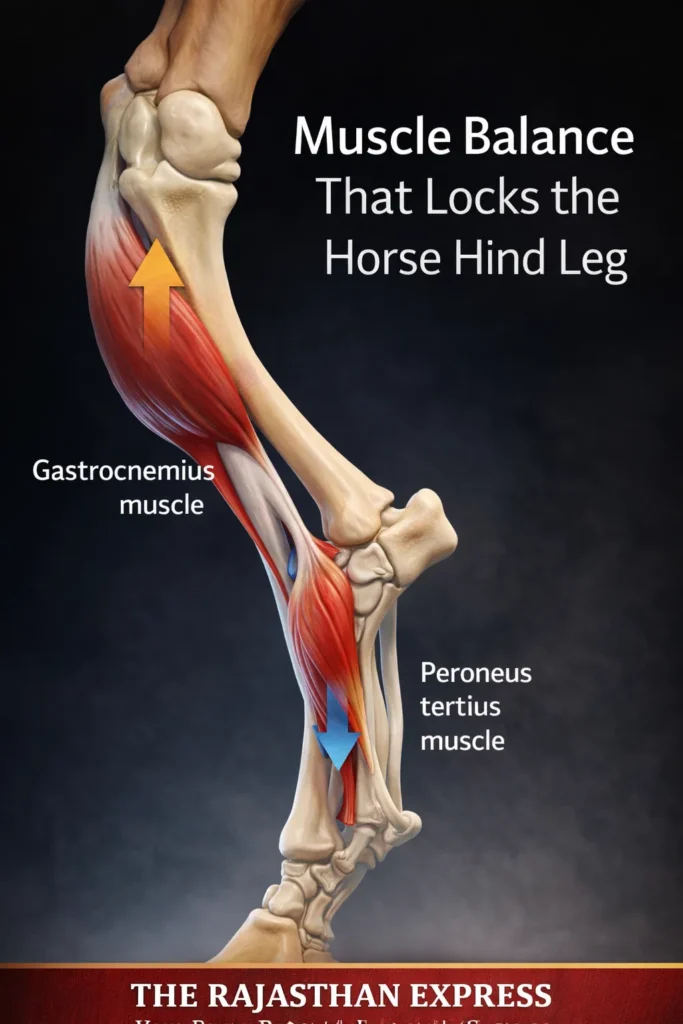
- When the horse stands, the Gastrocnemius muscle becomes active and begins to pull the Hock Joint backward, making it straight.
- If only this muscle worked, the hock joint could extend excessively and the horse could become unstable.
Activation of the Second Muscle
- To balance this condition, the Peroneus Tertius muscle works. It cancels the effect of the contraction of the gastrocnemius and allows the joint to extend only within a certain limit.
- As soon as the Hock Joint begins to straighten, the Peroneus Tertius muscle automatically stretches.
Balance Between the Two Muscles
- Because of this balance, the muscles reach a stable condition and they do not need to continuously expend energy.
The Leg Gets Locked
- In this way, both muscles create opposing tension to each other. As a result, the Hock Joint and the Stifle Joint become stable.
- This can be understood like when a bicycle stand is applied and the bicycle stands on its own.
Do Horses Sleep Lying Down or Standing Up?
How Long Do Horses Sleep Standing Up?
This entire system is called the Stay Apparatus. Because of it, horses receive several advantages.
Because of this system:
- A horse can stand for many hours without much muscular effort.
- Since the muscles do not have to work continuously, the body saves energy.
- Due to this locking system, a horse can also take light sleep or a short nap while standing.
However, to take deep sleep, the horse needs to lie down on the ground.
This mechanism exists not only in the hind limbs but also in the forelimbs, where it helps stabilize the Shoulder Joint and Elbow Joint.
Conclusion: The Automatic Lock System in Horse Legs
The Stay Apparatus in horse anatomy is a natural automatic lock system present in its legs that stabilizes its joints.
- In the forelimbs, it works with the help of strong tendons and ligaments.
- In the hind limbs, the balance between the Gastrocnemius muscle and the Peroneus Tertius muscle locks the leg.
Because of this unique system, a horse can remain standing for a long time without getting tired and without falling.
Did you know horses can rest while standing? Explore the stay apparatus in horse anatomy, forelimb and hindlimb mechanism, and key muscles involved.
The Rajasthan Express: Your Trusted Source for Animal Care and Veterinary Science.


