 By
ByWhy Does a Horse Always Breathe Through the Nose? | Understanding the Horse Respiratory System
Why Does a Horse Always Breathe Through the Nose?
A horse is an animal that, under normal conditions, breathes only through its nose. It cannot breathe through its mouth. In rural areas, a saying is also common that a horse will die but will not breathe through its mouth. This saying is completely scientifically correct, but there is an important reason behind it.
The main reason for this is the special structure of the respiratory system of a horse. The structure of the pathways of the horse’s mouth and nose is such that air normally reaches the lungs only through the nasal route.
Even today, if many large horse breeders are asked about this subject, many of them do not know the correct information. Often they believe that a horse can breathe through both the mouth and the nose like other animals, but in reality this is not the case. Because of the horse’s physical structure, it normally breathes only through the nose.
This special structure of the horse respiratory system works like a kind of protective shield. When the horse eats fodder or drinks water, this arrangement ensures that food or water particles do not enter the windpipe. This reduces the risk of choking or suffocation in the horse.
Horse Nasal Breathing (Obligate Nasal Breather)
| Scientific Topic | Horse Respiratory System |
|---|---|
| Main Concept | Horses are obligate nasal breathers, meaning they normally breathe only through their nose and not through their mouth. |
| Common Question | Why does a horse always breathe through the nose? |
| Primary Reason | The long soft palate and the position of the epiglottis block the airway from the mouth to the trachea. |
| Key Structures Involved |
|
| Breathing Pathway | Nostrils → Nasal Cavity → Pharynx → Trachea → Lungs |
| Why Mouth Breathing is Impossible | The soft palate forms a tight seal with the epiglottis, preventing air entering from the mouth from reaching the lungs. |
| Special Term | Obligate Nasal Breather – An animal that must breathe only through its nose. |
| Advantages of Nasal Breathing |
|
| Air Processing in Nose | The nasal passages filter, warm, and moisten air before it reaches the lungs. |
| Important Health Indicator | If a horse breathes with its mouth open, it usually indicates serious respiratory distress or disease. |
| Common Respiratory Disorder | Dorsal Displacement of the Soft Palate (DDSP) – a condition where the soft palate moves above the epiglottis and partially blocks the airway during intense exercise. |
| Symptoms of DDSP |
|
| Importance in Horse Physiology | This respiratory design supports the horse’s high stamina, fast running ability, and continuous grazing behavior. |
| Key Takeaway | A healthy horse always breathes through its nose because its anatomy naturally blocks the airway from the mouth. |
| Sources: The Rajasthan Express By Rakesh Kumar (Govt. Livestock Inspector) | |
Structure of the Respiratory System of a Horse
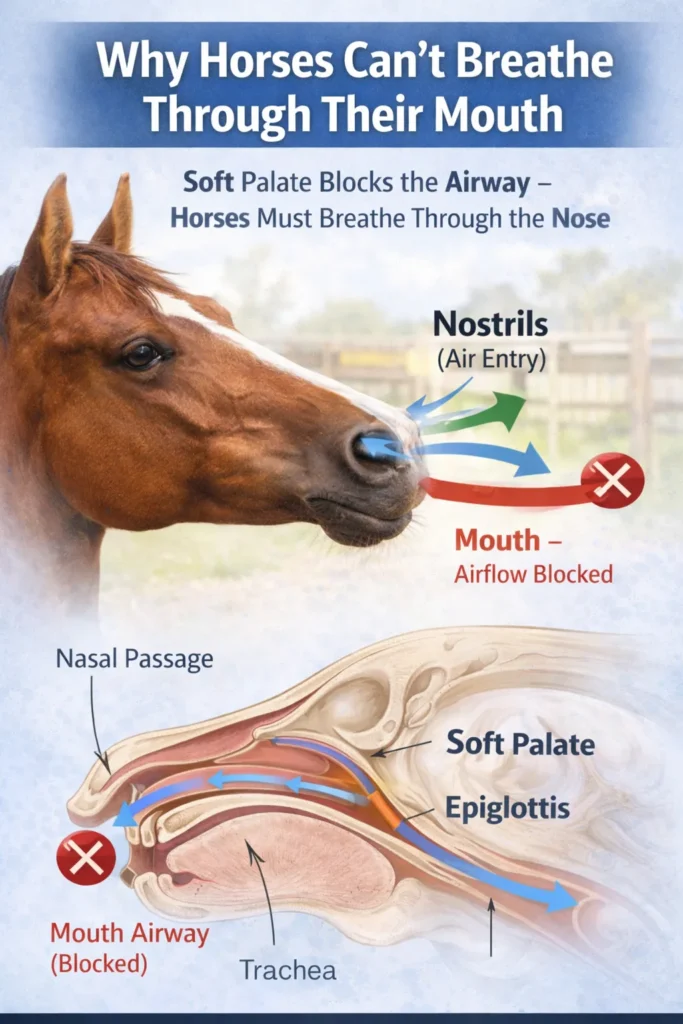
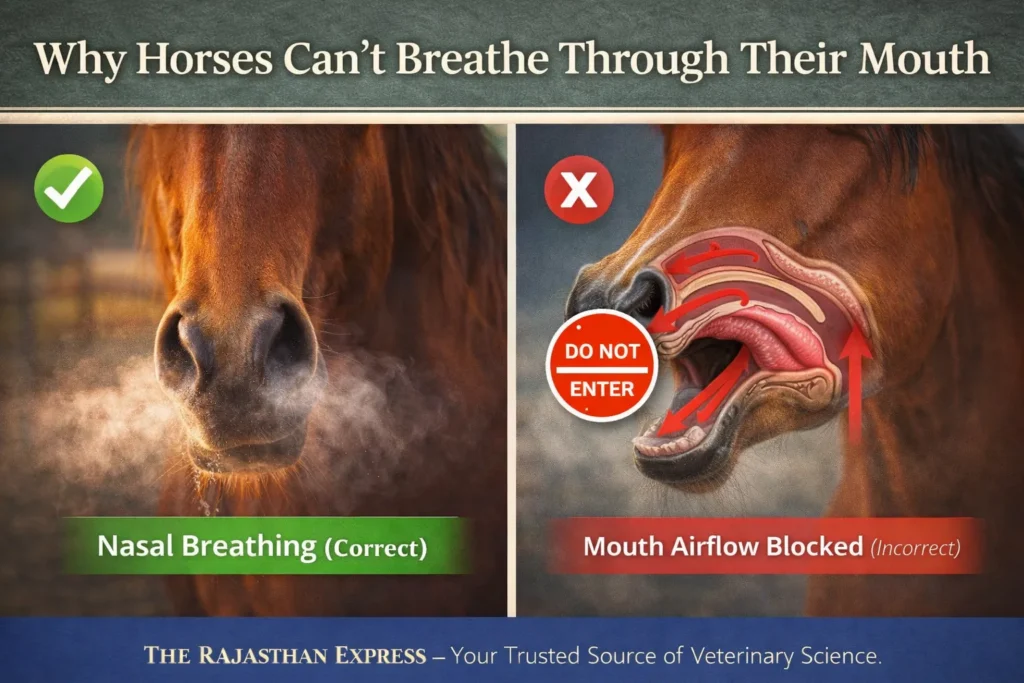
Between the horse’s mouth and nose there is a long structure called the soft palate. It acts like a curtain that separates the oral cavity from the nasal cavity.
In horses, this soft palate is very long and extends to the back of the throat. Because of this, it almost closes the passage from the mouth and keeps the main air route through the nose.
In humans and many other animals, the soft palate is not so long. Therefore, air can enter through both the mouth and the nose. But in horses, due to its length, the pathway for air from the mouth remains almost closed. For this reason, the horse is called an obligate nasal breather.
Above the soft palate there is a structure called the epiglottis. The epiglottis is a triangular structure made of cartilage and is an important part of the larynx.

In horses, the epiglottis lies above the free edge of the soft palate and normally rests on it. This forms a strong airtight seal. Because of this seal, air coming from the mouth cannot reach the trachea, and the airflow travels only through the nose to the horse lungs.
As a result, the pathways of the mouth and nose remain separated from each other.
How Do Horses Breathe? | Understanding Horse Breathing
Horses use only their nose to breathe. They cannot breathe through their mouth. Let’s understand how this happens and why it happens.
The Journey of Air Inside the Horse’s Body
Entry Point (Nostrils)
- Air first enters through the horse’s nostrils. These openings are quite large and flexible so that the horse can take in as much air as possible while running.
Nasal Passage
- After entering through the nose, the air passes through the wide nasal passages. These passages clean, moisten, and warm or cool the air so that it becomes ready to reach the lungs.
The Crossroad (Pharynx)
- After that, the air reaches a place called the pharynx. This acts like a crossroads where the food pathway (esophagus) and the breathing pathway (trachea) both originate. This is where the most interesting process happens.
The Special Mechanism: Epiglottis and Soft Palate
- Behind the roof of the horse’s mouth there is a soft structure called the soft palate.
- Just below it there is a small lid-like structure called the epiglottis.
- Normally, these two parts (the soft palate and the epiglottis) remain connected to each other. In a way, this acts like a curtain hanging from above that permanently blocks the pathway connecting the mouth to the trachea.
Why Can’t Horses Breathe Through Their Mouth?
Now if a horse tries to breathe by opening its mouth, what will happen?
- Air will enter the mouth but it will not find a way forward.
- The “curtain” described above (soft palate and epiglottis) will block the path.
- The air will get stuck there and will not be able to reach the trachea that leads to the lungs.
In simple terms, the pathway between the horse’s mouth and its lungs remains permanently closed.

Why Does a Horse Always Breathe Through the Nose?
Therefore, the only pathway left for breathing is the nose. Air enters through the nose, passes through the pharynx, bypasses the blocked oral route, enters the trachea, and then reaches the lungs.
This explains why a horse always breathes through the nose.
Advantages of Nose Breathing in Horses
Nature has designed horses this way for several benefits.
1. Better Performance During Fast Running
- When a horse runs fast, its breathing becomes very rapid. This nasal breathing system helps synchronize inhalation and exhalation with the rhythm of running.
- In a way, it improves the horse’s running efficiency and athletic ability.

2. Eating While Breathing
- Horses spend most of their day grazing and eating grass.
- Since the breathing path and food path are separate (nose for breathing and mouth for eating), they can breathe comfortably while chewing grass. There is very little risk of food entering the airway.
Important Sign That Separates Healthy Horses from Sick Horses
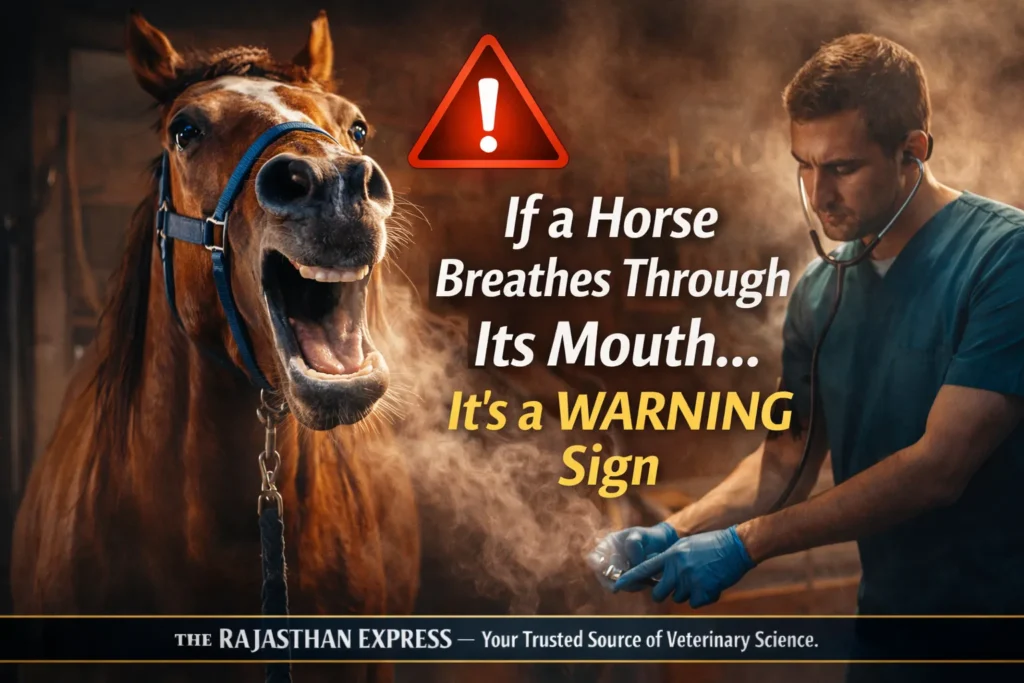
If you ever see a horse breathing with its mouth open, it should be understood that the horse is sick or having serious breathing difficulty. A healthy horse will always breathe through its nose.
Special Condition in Horses: DDSP
Sometimes, during very intense running or heavy exertion, the soft palate can move from its normal position. This condition is called Dorsal Displacement of the Soft Palate (DDSP).
In this situation, the soft palate shifts upward and moves above the epiglottis. This can partially block the airway.
Because of this:
- The horse may have difficulty breathing
- A strange noise may occur during running
- Its performance capacity may decrease
In severe cases, the horse may even try to breathe with its mouth open.
This problem can occur due to abnormal muscle contractions, nerve damage, or congenital problems of the epiglottis. Sometimes it can also arise due to damage to a branch of the vagus nerve.
Benefits of Horses Being Obligate Nasal Breathers
1. Helps Avoid Predators
- Horses are naturally prey animals. In forests or open fields, they are always at risk from predators.
- Even while grazing, horses continuously breathe through their nose. Because of nasal breathing, their sense of smell remains constantly active.
- If there is a predator nearby, the horse can detect its smell quickly and become alert immediately, increasing its chances of survival.
2. Separation of Breathing and Eating Pathways
- Due to the special structure of the horse respiratory system, the pathways of the mouth and nose remain separate.
- The biggest advantage of this is that food particles rarely enter the trachea by mistake. This significantly reduces the risk of choking.
- At the same time, the horse can breathe continuously while eating.
3. High Running and Work Capacity
- Horses are extremely fast and powerful runners. Their respiratory system is designed in such a way that they can deliver a large amount of air to the horse lungs during running.
- When a horse runs fast, its breathing synchronizes with its stride. Often it takes one breath with each stride.
- Because of this system, airflow to the lungs increases greatly during exercise, providing more oxygen. This improves stamina and performance.
- However, there is also a disadvantage. If any obstruction occurs in the nasal passages, the horse may face serious difficulty and in extreme cases it can even lead to death.
4. Protection from Dust and Allergies
- When horses graze close to the ground, dust, pollen, and other small particles are present in the air.
- The structures inside the nose act like filters and prevent these particles from directly entering the lungs.
- Because of this, the risk of respiratory infections and allergies in horses is somewhat reduced.
Simple Explanation
A horse is an Obligate Nasal Breather.
- Obligate = Mandatory / Compulsory
- Nasal = Through the nose
- Breather = One who breathes
Therefore, a horse is an Obligate Nasal Breather, which means it is an animal that must breathe only through its nose.
Why can’t horses breathe through their mouth? Learn how the horse respiratory system and lungs work and why horses always breathe through their nose.
THE RAJASTHAN EXPRESS